online | memorias.ioc.fiocruz.br Women infected with human immunodeficiency
vi-rus type 1 (HIV) receive antiretrovirals (ARVs) during pregnancy for prophylaxis (PR) [prevention of mother-to-child transmission (MTCT) of HIV] or for the treat-ment (TR) of their own HIV infection. Concerns have been raised regarding the discontinuation of ARVs after delivery (among women who received ARVs for PR) in light of the results of the studies of structured TR in-terruption among HIV-infected individuals receiving ARVs for TR (Ananworanich et al. 2006, El-Sadr et al. 2006, Ruiz et al. 2007). For example, in the SMART trial, HIV-infected subjects with CD4+ counts above 350 cells/mm3 were randomly assigned to the continuous or episodic receipt of ARV therapy. The latter group only used ARVs when the CD4+ count decreased to below
Financial support: NICHD (HHSN267200800001C/N01-DK-8-0001) + Corresponding author: [email protected]
Presented in part at the 48th Annual ICAAC/46th Annual IDSA Meet-ing (Title: Postpartum Changes in Plasma Viremia and CD4 Percent in HIV-Infected Women from Latin American and Caribbean Countries the NISDI Perinatal Study, Washington DC, October 25-28 2008). Received 28 June 2010
Accepted 15 October 2010
250 cells/mm3 and had a significantly higher rate of op-portunistic infections and all-cause mortality (El-Sadr et al. 2006). The results of studies evaluating changes in the plasma HIV RNA concentration [viral load (VL)], the CD4+ lymphocyte percentage (CD4%) or absolute CD4+ lymphocyte count, or the HIV clinical disease stage in the postpartum (PP) period among HIV-infected women continuing or discontinuing ARVs after pregnancy have shown conflicting results (Cao et al. 1997, Melvin et al. 1997, Watts et al. 2003, Martin et al. 2006, Tungsiripat et al. 2007, Cavallo et al. 2010). To avoid the effect of a higher volume of distribution on absolute CD4+ lym-phocyte counts, the CD4% should be used for monitor-ing T lymphocytes durmonitor-ing pregnancy and PP (Miotti et al. 1992, Ekouevi et al. 2007). We analyzed data from the Eunice Kennedy Shriver National Institute of Child Health and Human Development (NICHD) International Site Development Initiative (NISDI) Perinatal Study to determine factors associated with a VL increase or a CD4% decrease among HIV-infected women who re-ceived ARVs during pregnancy, according to whether or not ARVs were discontinued after delivery.
PATIENTS, MATERIALS AND METHODS
NISDI Perinatal Study - The NISDI Perinatal Study was a prospective cohort study of HIV-infected women and their children conducted at multiple sites in Latin
Postpartum changes in plasma viral load and CD4 percentage
among HIV-infected women from Latin American and
Caribbean countries: the NISDI Perinatal Study
Victor H Melo1/+, Jorge A Pinto1, Laura Freimanis-Hance2, Cesar Gutierrez3, Mário Peixoto4,
Breno Santos5, Daisy M Machado6, Esaú C Joao7, Kathleen Robergeau2, Jennifer S Read8
1Faculdade de Medicina, Universidade Federal de Minas Gerais, Av. Alfredo Balena 190 4º andar, 30130-100 Belo Horizonte, MG, Brasil 2Westat, Rockville, USA 3Universidad Nacional Mayor de San Marcos, Lima, Peru 4Hospital Femina, Porto Alegre, RS, Brasil
5Hospital Conceição, Porto Alegre, RS, Brasil 6Universidade Federal de São Paulo, São Paulo, SP, Brasil
7Hospital dos Servidores do Estado, Rio de Janeiro, RJ, Brasil 8Pediatric, Adolescent and Maternal AIDS Branch, National Institute of Child
Health and Department of Health and Human Services, Human Development, National Institute of Health, Bethesda, USA
The goal of this study was to evaluate changes in plasmahuman immunodeficiency virus (HIV) RNA concentra-tion [viral load (VL)] and CD4+ percentage (CD4%) during 6-12 weeks postpartum (PP) among HIV-infected women and to assess differences according to the reason for receipt of antiretrovirals (ARVs) during pregnancy [prophy-laxis (PR) vs. treatment (TR)]. Data from a prospective cohort of HIV-infected pregnant women (National Institute of Child Health and Human Development International Site Development Initiative Perinatal Study) were analyzed. Women experiencing their first pregnancy who received ARVs for PR (started during pregnancy, stopped PP) or for TR (initiated prior to pregnancy and/or continued PP) were included and were followed PP. Increases in plasma VL (≥ 0.5 log10) and decreases in CD4% (≥ 20% relative decrease in CD4%) between hospital discharge (HD) and PP were assessed. Of the 1,229 women enrolled, 1,119 met the inclusion criteria (PR: 601; TR: 518). At enrollment, 87% were asymptomatic. The median CD4% values were: HD [34% (PR); 25% (TR)] and PP [29% (PR); 24% (TR)]. The VL increases were 60% (PR) and 19% (TR) (p < 0.0001). The CD4% decreases were 36% (PR) and 18% (TR) (p < 0.0001). Women receiving PR were more likely to exhibit an increase in VL [adjusted odds ratio (AOR) 7.7 (95% CI: 5.5-10.9) and a CD4% decrease (AOR 2.3; 95% CI: 1.6-3.2). Women receiving PR are more likely to have VL increases and CD4% decreases compared to those receiving TR. The clinical implications of these VL and CD4% changes remain to be explored.
America and in the Caribbean (Read et al. 2007). ARVs for HIV-infected women and children had to be available at each participating site, along with alternatives to breast-feeding. The primary objectives of this observational study included assessing the use of ARVs for the preven-tion of MTCT and for the woman’s own health. Enroll-ment began in 2002 and was completed in 2007. Women were eligible for enrollment if their pregnancy was con-firmed, their HIV infection documented, they intended to deliver at a participating clinical site and to be followed up (along with their children) after delivery or birth and they were willing and able to provide informed consent. Enrollment had to occur before delivery. Signed informed consent was obtained for all subjects before enrollment into the study. The protocol was approved by the ethical review board at each clinical site, as well as by institution-al review boards at the sponsoring institution (NICHD) and at the data management center (Westat).
Maternal study visits were conducted during preg-nancy, at delivery, at hospital discharge (HD) after de-livery and at 6-12 weeks and six months PP. During each of these visits, a medical history was obtained, a physical examination was performed and laboratory samples were obtained (except at the delivery and the 6-month PP visits). The virological, immunological and clinical characteristics of the women were assessed during pregnancy, at the time of HD after delivery and at the 6-12 week PP visit. Maternal clinical disease staging was performed at each visit using the US Cen-ters for Disease Control and Prevention classification system (CDC 1992).
Study population and definitions for this analysis - The study population for this analysis was restricted to women enrolled in the NISDI Perinatal Study as of Oc-tober 2007, with their first pregnancy during the study, who were followed until at least the 6-12 week PP visit, who received ARVs during pregnancy and for whom the reason for receipt ARVs was known. The receipt of ARVs during pregnancy was categorized as either PR or TR. Women were classified as having received PR if they were not receiving ARVs when they became nant, but they initiated one or more ARVs during preg-nancy and discontinued these drugs at or before the 6-12 week PP visit. Otherwise, women were classified as hav-ing received TR if they were receivhav-ing ARVs when they became pregnant or continued ARVs after the 6-12 week PP visit. The outcome variables of interest were changes between the HD visit and the 6-12 week PP visit defined
as: an increase in plasma VL (≥ 0.5 log10 increase) and
a decline in CD4% (≥ 20% relative decrease). Other co -variates were defined as follows: homemakers, unem-ployed individuals and students were classified as not gainfully employed outside of the home and all others were classified as gainfully employed outside of the home. A maternal history of substance use during the index pregnancy was ascertained through maternal in-terview at enrollment.
Data collected from a small part of the current cohort (4% of the study population) has been published else-where (Cavallo et al. 2010).
Statistical analysis - The associations of categori-cal variables with VL increase and CD4% decline at the 6-12 week visit were evaluated using the Fisher-Free-man-Halton exact test. Variables at least marginally
as-sociated with VL increase and CD4% decline (p ≤ 0.20)
were considered candidates for multivariable logistic regression modelling. Both stepwise selection and back-ward elimination strategies were applied to determine whether both selection procedures arrived at the same parsimonious model (using a 5% significance level).
Ethics - The ethical protocol was approved by the ethical review board at each clinical site, as well as by institutional review boards at the sponsoring institution (NICHD) and at the data management center (Westat).
RESULTS
Size and characteristics of the study population - As of October 2007, there were 1,229 women enrolled in the NISDI Perinatal Study. Of these, there were 1,174 first pregnancies in the study. Of the 1,174 pregnant women, three were lost to follow-up between enrollment and the 6-12 week visit. Of the remaining 1,171 women, 1,163 received one or more ARVs during pregnancy. The rea-son for the receipt of ARVs during pregnancy could not be determined for 44 women. Thus, the study population comprised 1,119 women (601 received ARVs as PR and 518 received ARVs as TR).
The characteristics of the study population of 1,119 women, overall and according to the receipt of ARVs for PR or TR, are shown in Table I. Several characteristics varied significantly (p < 0.05) according to the receipt of PR vs. TR, including country of residence, age, educa-tion and tobacco use during pregnancy.
At enrollment and at HD, a greater proportion of women in the PR group were asymptomatic or only mildly symptomatic (clinical stage A) than women in the TR group. Women in the PR group were more likely to have received 1-2 nucleoside reverse transcriptase in-hibitors (NRTIs) as their most complex ARV regimen of
≥ 28 days during pregnancy or to have received ARVs
for < 28 days during pregnancy, than women in the TR group. Finally, at 6-12 weeks PP, women in the PR group were more likely to be at clinical stage A than women in the TR group (Table I).
A greater proportion of women in the PR group had a
CD4% ≥ 29% at enrollment (63.6%) and at HD (74.2%).
At 6-12 weeks PP, they were more likely to have a CD4%
≥ 29% (52.7%) than women in the TR group. The per -centage of women with VL < 1,000 copies/mL at en-rollment and at HD was not different between the two groups. However, women in the TR group were more likely to have a VL < 1,000 copies/mL at 6-12 weeks PP (67.4%; p < 0.0001) (Table II).
TABLE I
Characteristics of the study population, overall and according to reason for receipt of antiretrovirals (ARV) during pregnancy
Prophylaxis (n = 601)
n (%)
Treatment (n = 518)
n (%)
Total (n = 1,119)
n (%) p value
At enrollment Country of residence
Argentina 145 (24.1) 192 (37.1) 337 (30.1) < 0.0001
Bahamas 27 (4.5) 14 (2.7) 41 (3.7)
-Brazil 379 (63.1) 261 (50.4) 640 (57.2)
-Jamaica 26 (4.3) 7 (1.4) 33 (3)
-Mexico 13 (2.2) 29 (5.6) 42 (3.8)
-Peru 11 (1.8) 15 (2.9) 26 (2.3)
-Age (years)
< 20 49 (8.2) 15 (2.9) 64 (5.7) < 0.0001
20-29 373 (62.1) 245 (47.3) 618 (55.2)
-≥ 29 179 (29.8) 258 (49.8) 437 (39)
-Education (years)
≥ 13 20 (3.3) 35 (6.8) 55 (4.9) 0.0008
7-12 363 (60.4) 340 (65.6) 703 (62.8)
-0-6 218 (36.3) 143 (27.6) 361 (32.3) -
Crowding (number of persons living in the household)
1-3 260 (43.3) 245 (47.3) 505 (45.1) 0.18
≥ 4 341 (56.7) 273 (52.7) 614 (54.9)
-Gainfully employed outside the home
Yes 134 (22.3) 126 (24.3) 260 (23.2) 0.42
No 467 (77.7) 392 (75.7) 859 (76.8)
-Tobacco use during pregnancy
Yes 159 (26.5) 108 (20.8) 267 (23.9) 0.03
No 442 (73.5) 410 (79.2) 852 (76.1)
-Alcohol use during pregnancy
Yes 57 (9.5) 47 (9.1) 104 (9.3) 0.81
No 544 (90.5) 471 (90.9) 1,015 (90.7)
-Cocaine use during pregnancy
Yes 18 (3) 12 (2.3) 30 (2.7) 0.48
No 583 (97) 506 (97.7) 1,089 (97.3)
-Marijuana use during pregnancy
Yes 12 (2) 13 (2.5) 25 (2.2) 0.56
No 589 (98) 505 (97.5) 1,094 (97.8)
-Clinical disease stage
A 578 (96.2) 395 (76.2) 973 (87) < 0.0001
B 13 (2.2) 46 (8.9) 59 (5.3)
-C 10 (1.7) 77 (14.9) 87 (7.8)
-At hospital discharge following delivery Clinical disease stage
A 576 (95.8) 392 (75.7) 968 (86.5) < 0.0001
B 14 (2.3) 48 (9.3) 62 (5.5)
-C 11 (1.8) 78 (15.1) 89 (8)
-Most complex ARV regimen of ≥ 28 days during pregnancy
2 NRTIs + 1 PI 324 (53.9) 259 (50) 583 (52.1) < 0.0001
2 NRTIs + 1 NRTI 138 (23) 215 (41.5) 353 (31.5)
-1-2 NRTIs 98 (16.3) 16 (3.1) 114 (10.2)
-ARVs < 28 days 36 (6) 16 (3.1) 52 (4.6)
-Other 5 (0.8) 12 (2.3) 17 (1.5)
-At 6-12 weeks postpartum Clinical disease stage
A 575 (95.7) 389 (75.1) 964 (86.2) < 0.0001
B 15 (2.5) 50 (9.6) 65 (5.8)
-C 11 (1.8) 79 (15.2) 90 (8)
VL increase and CD4% decline - Univariate analyses assessing associations with an increase in VL between HD and the 6-12 week PP visit were performed. Several
factors were marginally associated (p ≤ 0.20) with a VL
increase and were included in logistic regression analy-ses, including the receipt of ARVs for PR (p < 0.0001), the country of residence (p < 0.0001), age (years) (p = 0.004), education (years) (p = 0.03) and alcohol (p = 0.12) and cocaine use (p = 0.08) during pregnancy. Other vari-ables associated with a VL increase were CD4% (p < 0.0001), VL (copies/mL) (p < 0.0001) and HIV clinical disease stage (p < 0.0001) before the 6-12 week PP visit. Specifically, those with lower CD4% (at enrollment and
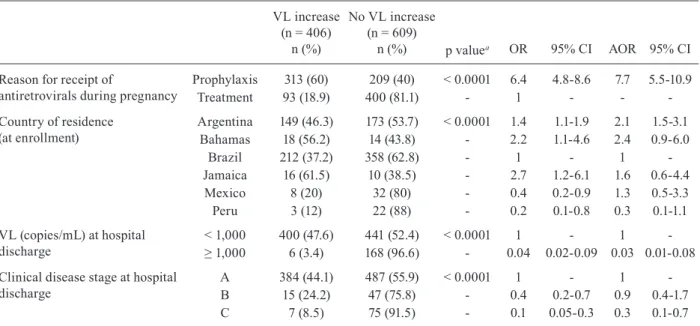
at HD) were less likely to have a VL increase. Those with higher VL values (at enrollment and at HD) were less likely to have a VL increase. Finally, those with a more advanced HIV clinical disease stage (at enroll-ment and at HD) were less likely to have a VL increase. Multivariable modelling incorporating all of the above variables resulted in a final model including four vari-ables (Table III): reason for the receipt of ARVs during pregnancy, the country of residence, VL at HD and clini-cal disease stage at HD. The country of residence was retained in the model to control for site variability. Those who received ARV PR during pregnancy had an almost eight-fold increase in risk of a VL increase at 6-12 weeks TABLE II
Results of CD4% and viral load (VL) according to reason for receipt of antiretrovirals during pregnancy
Prophylaxis (n = 601)
n (%)
Treatment (n = 518)
n (%)
Total
(n = 1,119) p value
At enrollment CD4%
< 14 14 (2.5) 78 (16.5) 92 (9) < 0.0001
14-28 187 (33.8) 255 (53.8) 442 (43)
-≥ 29 352 (63.6) 141 (29.8) 493 (48)
-Unknown 48 44 -
-VL (copies/mL)
< 1,000 357 (60.7) 292 (56.8) 649 (58.9) 0.35
1,000 ≤ 10,000 120 (20.4) 109 (21.2) 229 (20.8)
-≥ 10,000 111 (18.9) 113 (22) 224 (20.3)
-Unknown 13 4 -
-At hospital discharge following delivery CD4%
< 14 7 (1.4) 57 (12.3) 64 (6.7) < 0.0001
14-28 122 (24.4) 231 (50) 353 (36.7)
-≥ 29 370 (74.2) 174 (37.7) 544 (56.6)
-Unknown 102 56 -
-VL (copies/mL)
< 1,000 450 (84.9) 400 (80.6) 850 (82.8) 0.10
1,000 ≤ 10,000 44 (8.3) 61 (12.3) 105 (10.2)
-≥ 10,000 36 (6.8) 35 (7.1) 71 (6.9)
-Unknown 71 22 -
-At 6-12 weeks postpartum CD4%
< 14 19 (3.3) 55 (11.3) 74 (7) < 0.0001
14-28 253 (44) 260 (53.4) 513 (48.3)
-≥ 29 303 (52.7) 172 (35.3) 475 (44.7)
-Unknown 26 31
-VL (copies/mL)
< 1,000 142 (24) 347 (67.4) 489 (44.2) < 0.0001
1,000 ≤ 10,000 181 (30.6) 74 (14.4) 255 (23.1)
-≥ 10,000 268 (45.4) 94 (18.2) 362 (32.7)
-Unknown 10 3 -
PP compared to those who received ARVs for TR [ad-justed odds ratio (AOR) = 7.7; 95% CI 5.5-10.9]. Women
with VLs ≥ 1,000 copies/mL at HD were significantly
less likely to experience a VL increase at 6-12 weeks compared to those with VL < 1,000 copies/mL. Finally, women with more advanced clinical HIV disease at HD were significantly less likely to have a VL increase that those who were asymptomatic (Table III).
Univariate analyses assessing associations with CD4% decline between HD and the 6-12 week PP visit also were performed. Variables marginally associated (p
≤ 0.20) with a CD4% decline that were incorporated into
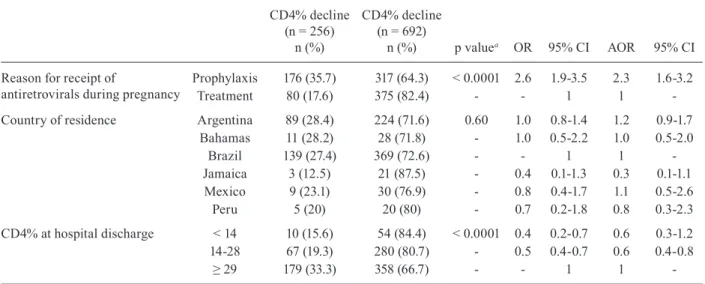
logistic regression analyses included crowding (number of persons living in the household) (p = 0.11), alcohol (p = 0.12) and marijuana (p = 0.12) use during pregnancy and the receipt of ARVs during pregnancy for PR (p < 0.0001). Those with CD4% < 14% at enrollment (p = 0.04) and at HD (p < 0.0001) were less likely to have a CD4% decline. Similarly, those with more advanced HIV clinical disease at enrollment (p = 0.0046) and at HD (p = 0.0049) were less likely to have a CD4% de-cline. Multivariable modelling incorporating all of the above variables resulted in a final model including rea-son for the receipt of ARVs during pregnancy, country of residence and CD4% at HD (Table IV). As before, country of residence was retained in the model to control for site variability. Those who received ARV PR during pregnancy had a higher risk of a CD4% decline at 6-12 weeks PP compared to those who received ARVs for TR (AOR = 2.3; 95% CI 1.6-3.2). Those with a CD4% of 14-28% at HD were less likely to have a CD4% decline at
6-12 weeks PP compared to those with a CD4% ≥ 29%
[AOR = 0.60 (95% CI 0.4-0.8)] (Table IV).
DISCUSSION
In this study of a relatively healthy population of HIV-infected women [at enrollment, approximately half had a
CD4% ≥ 29%, almost 60% had a VL below 1,000 copies/
mL and approximately 87% were asymptomatic (clinical stage A)], there was little clinical progression over time (by 6-12 weeks PP, 86% of women remained at clinical stage A). Although there were changes in CD4% and VL values over time (60% of women who received ARVs dur-ing pregnancy for PR had a VL increase and 40% had a CD4% decline during the first few weeks PP vs. 19% and 18%, respectively, of women who received ARVs during pregnancy for TR), most women who received ARVs for
PR maintained a CD4% ≥ 29% (74% at HD and 53% at
6-12 weeks PP). Eighty-five percent of women who re-ceived ARVs for PR during pregnancy had a VL < 1,000 copies/mL at HD. However, only 24% of these women had a VL < 1,000 copies/mL at 6-12 weeks PP.
The interruption of ARV PR after delivery is not completely analogous to structured ARV interruption (Ananworanich et al. 2006, Danel et al. 2006, El-Sadr et al. 2006, Pai et al. 2006, Ruiz et al. 2007). With the use of ARVs for the prevention of the MTCT of HIV, as-suming the woman does not meet criteria for ARV TR, maternal ARVs are discontinued after the delivery of the infant. With the interruption of ARV TR, structured ac-cording to VL and CD4+ count results, patients whose immunological status suggests a low risk of disease pro-gression either continued therapy or interrupted it until the CD4+ count reached a certain threshold. Studies gen-erally have demonstrated worse outcomes for those with structured TR interruptions.
TABLE III
Risk of viral load (VL) increase [unadjusted (OR) and adjusted odds ratios (AOR)]
VL increase (n = 406)
n (%)
No VL increase (n = 609)
n (%) p valuea OR 95% CI AOR 95% CI
Reason for receipt of
antiretrovirals during pregnancy
Prophylaxis 313 (60) 209 (40) < 0.0001 6.4 4.8-8.6 7.7 5.5-10.9 Treatment 93 (18.9) 400 (81.1) - 1 - -
-Country of residence (at enrollment)
Argentina 149 (46.3) 173 (53.7) < 0.0001 1.4 1.1-1.9 2.1 1.5-3.1 Bahamas 18 (56.2) 14 (43.8) - 2.2 1.1-4.6 2.4 0.9-6.0
Brazil 212 (37.2) 358 (62.8) - 1 - 1
-Jamaica 16 (61.5) 10 (38.5) - 2.7 1.2-6.1 1.6 0.6-4.4 Mexico 8 (20) 32 (80) - 0.4 0.2-0.9 1.3 0.5-3.3 Peru 3 (12) 22 (88) - 0.2 0.1-0.8 0.3 0.1-1.1
VL (copies/mL) at hospital discharge
< 1,000 400 (47.6) 441 (52.4) < 0.0001 1 - 1
-≥ 1,000 6 (3.4) 168 (96.6) - 0.04 0.02-0.09 0.03 0.01-0.08
Clinical disease stage at hospital discharge
A 384 (44.1) 487 (55.9) < 0.0001 1 - 1 -B 15 (24.2) 47 (75.8) - 0.4 0.2-0.7 0.9 0.4-1.7 C 7 (8.5) 75 (91.5) - 0.1 0.05-0.3 0.3 0.1-0.7
TABLE IV
Risk of CD4+ lymphocyte percentage (CD4%) decline [unadjusted (OR) and adjusted odds ratios (AOR)]
CD4% decline (n = 256)
n (%)
CD4% decline (n = 692)
n (%) p valuea OR 95% CI AOR 95% CI
Reason for receipt of
antiretrovirals during pregnancy
Prophylaxis 176 (35.7) 317 (64.3) < 0.0001 2.6 1.9-3.5 2.3 1.6-3.2
Treatment 80 (17.6) 375 (82.4) - - 1 1
-Country of residence Argentina 89 (28.4) 224 (71.6) 0.60 1.0 0.8-1.4 1.2 0.9-1.7 Bahamas 11 (28.2) 28 (71.8) - 1.0 0.5-2.2 1.0 0.5-2.0
Brazil 139 (27.4) 369 (72.6) - - 1 1
-Jamaica 3 (12.5) 21 (87.5) - 0.4 0.1-1.3 0.3 0.1-1.1 Mexico 9 (23.1) 30 (76.9) - 0.8 0.4-1.7 1.1 0.5-2.6 Peru 5 (20) 20 (80) - 0.7 0.2-1.8 0.8 0.3-2.3
CD4% at hospital discharge < 14 10 (15.6) 54 (84.4) < 0.0001 0.4 0.2-0.7 0.6 0.3-1.2 14-28 67 (19.3) 280 (80.7) - 0.5 0.4-0.7 0.6 0.4-0.8
≥ 29 179 (33.3) 358 (66.7) - - 1 1
-a: p value for unadjusted OR using Fisher-Freeman-Halton exact test for assessment of association of each characteristic with the outcome; CI: confidence interval.
Previous studies have evaluated changes in the abso-lute CD4+ count (Read et al. 2007) or percentage (Watts et al. 2003) among HIV-infected women who did or did not discontinue ARVs after delivery. As noted previous-ly, the CD4% should be used to monitor T lymphocytes during pregnancy and PP (Miotti et al. 1992, Ekouevi et al. 2007). In a secondary analysis of the PACTG 185 clinical trial database (Watts et al. 2003), women who continued ARV therapy after delivery were compared to those who discontinued therapy. All enrolled wom-en had CD4+ lymphocyte counts below 500 cells/mm3 at enrollment. Most (86%) received zidovudine (ZDV) alone, while 14% received two NRTIs during pregnan-cy. Changes in CD4+ percentages between delivery and 18 months PP did not differ significantly according to whether ZDV monotherapy was continued or discontin-ued following delivery.
Similarly, other studies have assessed VL changes among HIV-infected women according to the continua-tion or discontinuacontinua-tion of ARVs after delivery (Cao et al. 1997, Melvin et al. 1997, Watts et al. 2003, Martin et al. 2006, Tungsiripat et al. 2007). Some studies have sug-gested no change in VL PP, although others indicated VL increases. First, in a retrospective study of HIV-infected women who discontinued ARVs at delivery (Tungsiripat et al. 2007), median VLs at 12-96 weeks PP were similar to values obtained during pregnancy. In another study of 44 HIV-infected pregnant women, 23 women initi-ated ZDV therapy during pregnancy, 17 women did not use ARVs and four women used ZDV before and during pregnancy (Melvin et al. 1997). Overall, VLs remained stable until six weeks PP, but there was a trend toward an increase in VL values PP among those women who re-ceived ZDV therapy only during pregnancy. However, in the Ariel Project (Cao et al. 1997), in which most women
(85%) used ZDV during pregnancy for the prevention of MTCT and only a minority of women received it before pregnancy and continued after delivery (TR), a signifi-cant VL increase was noted at two and six months PP. Among women enrolled in the PACTG 185 clinical trial (Watts et al. 2003), increases in VLs from delivery to 12 weeks PP were observed, but VL changes were similar among women continuing or discontinuing therapy af-ter delivery. In a study of HIV-infected pregnant women who received ZDV alone, combination ARV therapy and combination ARV PR (Martin et al. 2006), follow-up continued for an average of 33 months after delivery. At the end of follow-up, the median VL was higher in the ARV PR group (3.5 log copies/mL) compared to the TR group (1.7 log copies/mL). However, at the last follow-up, the proportion of women on combination ARV ther-apy with VLs < 50 copies/mL did not differ significantly according to whether ARV TR or PR was used during pregnancy (78% and 79%, respectively).
Finally, in a recent study comprising 112 HIV-infect-ed pregnant women treatHIV-infect-ed with potent ARVs (60 taking ARV for PR and 52 for TR), VL rebound affected women much more often in the PR than in the TR group (84.7% vs. 15.3%; p < 0.001) six months after delivery and was associated with ARV discontinuation. In addition, there was a higher decline in CD4 cell percentage among wom-en in the PR group at this time (Cavallo et al. 2010).
PP increases in VLs have been attributed to physi-ological changes occurring during pregnancy, such as blood volume expansion and elevated levels of estrogen and progesterone, that do not persist after delivery. How-ever, in our study, we did observe a difference in VLs PP according to whether ARVs were continued or discon-tinued following delivery (60% of women who received ARVs during pregnancy for PR had a VL increase).
The clinical implications of a VL increase in the PP period could be an increased risk of the development of viral resistance, possibly related to decreased adherence to ARVs in the PP period (Bardeguez et al. 2008). A re-cent analysis of data from the NISDI Perinatal Study in-cluded a predominantly asymptomatic population of HIV-infected pregnant women who were diagnosed with HIV infection during pregnancy and, therefore, only initiated ARVs during the index pregnancy (Duran et al. 2007). In this analysis, 14% of women had ARV resistance muta-tions at 6-12 weeks PP. The occurrence of resistance mu-tations was not associated with clinical, immunological or virological disease stage at the time points of comparison (enrollment and 6-12 weeks PP), nor with the most com-plex ARV regimens received during pregnancy. No sig-nificant association was found between VL and resistance mutations in this population of pregnant women.
A major strength of this study is the large size of the cohort, with enrollment at multiple sites. Also, enroll-ment occurred at clinical sites in six Latin American and Caribbean countries and the “country of residence” vari-able was retained in the multivarivari-able model to account for heterogeneity attributable to differences in the study populations and practices. The period of PP follow-up was relatively short, which prevented the analysis of HIV dis-ease progression after 6-12 weeks PP. Adherence to ARVs was not assessed as part of the protocol. However, the pro-tocol has been modified to incorporate a longer follow-up PP (up to 5 years) and assessments of adherence.
The clinical implications of the observed VL and CD4% changes remain to be explored. However, it is important to emphasize that clinical disease stage re-mained quite stable throughout the duration of follow-up. Similarly, most women in the PR group maintained
a CD4% ≥ 29% throughout the duration of follow-up.
Whether the observed early increase in VL among those who used ARVs for the prevention of MTCT affects the risk of developing ARV-resistant viral mutations is an important question to assess, particularly in terms of the response to future ARV TR regimens.
APPENDIx
NICHD International Site Development Initiative: Peri-natal/LILAC and Pediatric/Places Protocols - Principal in-vestigators, co-principal inin-vestigators, study coordinators, coordinating center representatives, and NICHD staff include: Argentina: Buenos Aires: Marcelo H. Losso, Irene Foradori, Claudia Checa, Silvina Ivalo (Hospital General de Agudos José María Ramos Mejía); Brazil: Belo Horizonte: Jorge Pinto,
Victor Melo, Fabiana Kakehasi (Universidade Federal de Mi-nas Gerais); Caxias do Sul: Ricardo da Silva de Souza, Nicole Golin, Sílvia Mariani Costamilan (Universidade de Caxias do Sul/ Serviço Municipal de Infectologia); Nova Iguaçu: Jose
Pi-lotto, Beatriz Grinsztejn, Valdilea Veloso, Gisely Falco (Hos-pital Geral Nova de Iguacu - HIV Family Care Clinic); Porto Alegre: Ricardo da Silva de Souza, Breno Riegel Santos, Rita de Cassia Alves Lira (Universidade de Caxias do Sul/Hospital Conceição); Ricardo da Silva de Souza, Mario Ferreira Peix-oto, Elizabete Teles (Universidade de Caxias do Sul/Hospital Fêmina); Regis Kreitchmann, Luis Carlos Ribeiro, Fabrizio
Motta, Debora Fernandes Coelho (Irmandade da Santa Casa de Misericordia de Porto Alegre); Ribeirão Preto: Marisa M. Mussi-Pinhata, Geraldo Duarte, Adriana A. Tiraboschi Bár -baro, Conrado Milani Coutinho, Anderson Sanches de Melo (Hospital das Clínicas da Faculdade de Medicina de Ribeirão Preto da Universidade de São Paulo); Rio de Janeiro: Ricardo Hugo S. Oliveira, Elizabeth S. Machado, Maria C. Chermont Sapia (Instituto de Puericultura e Pediatria Martagão Gestei-ra); Esau Custodio Joao, Leon Claude Sidi, Ezequias Martins, Plinio Tostes Berardo (Hospital dos Servidores do Estado); São
Paulo: Regina Celia de Menezes Succi, Prescilla Chow (Uni-versidade Federal de São Paulo); Peru: Lima: Jorge Alarcón Villaverde (Instituto de Medicina Tropical “Daniel Alcides Carrión”- Sección de Epidemiología, UNMSM), Carlos Ve-lásquez Vásquez (Instituto Nacional Materno Perinatal), César Gutiérrez Villafuerte (Instituto de Medicina Tropical “Daniel Alcides Carrión”- Sección de Epidemiología, UNMSM); Data Management and Statistical Center: Yolanda Bertucci, Lau-ra Freimanis Hance, René Gonin, D. Robert Harris, Roslyn Hennessey, James Korelitz, Margot Krauss, Sharon Sothern de Sanchez, Sonia K. Stoszek (Westat, Rockville, MD, USA); NICHD: Rohan Hazra, Lynne Mofenson, Jennifer S. Read, Heather Watts, Carol Worrell (Eunice Kennedy Shriver Na-tional Institute of Child Health and Human Development, Bethesda, Maryland, USA).
REFERENCES
Ananworanich J, Gayet-Ageron A, Le Braz M, Prasithsirikul W, Chetchotisakd P, Kiertiburanakul S, Munsakul W, Raksakulkarn P, Tansuphasawasdikul S, Sirivichayakul S, Cavassini M, Kar-rer U, Genné D, Nüesch R, Vernazza P, Bernasconi E, Leduc D, Satchell C, Yerly S, Perrin L, Hill A, Perneger T, Phanuphak P, Furrer H, Cooper D, Ruxrungtham K, Hirschel B, The Staccato Study Group, the Swiss HIV Cohort Study 2006. CD4-guided scheduled treatment interruptions compared with continuous therapy for patients infected with HIV-1: results of the Staccato randomised trial. Lancet 368: 459-465.
Bardeguez AD, Lindsey JC, Shannon M, Tuomala RE, Cohn SE, Smith E, Stek A, Buschur S, Cotter A, Bettica L, Read JS, PACTG 1025 Protocol Team 2008. Adherence to antiretrovirals among US women during and after pregnancy. J Acquir Immune
Defic Syndr48: 408-417.
Cao Y, Krogstad P, Korber BT, Koup RA, Muldoon M, Macken C, Song JL, Jin Z, Zhao JQ, Clapp S, Chen IS, Ho DD, Ammann AJ 1997. Maternal HIV-1 viral load and vertical transmission of in-fection: the Ariel Project for the prevention of HIV transmission from mother to infant. Nat Med3: 549-552.
Cavallo IK, Kakehasi FM, Andrade BA, Lobato AC, Aguiar RA, Pinto JA, Melo VH 2010. Predictors of postpartum viral load re-bound in a cohort of HIV-infected Brazilian women. Int J Gynae-col Obstet108: 111-114.
CDC - Centers for Disease Control and Prevention 1992. 1993 revised classification system for HIV infection and expanded surveil-lance case definition for AIDS among adolescents and adults.
MMWR Recomm Rep 41: 1-19.
Nzu-netu G, Gabillard D, Rouet F, Sorho S, Chaix ML, Eholié S, Menan H, Sauvageot D, Bissagnene E, Salamon R, Anglaret X, Trivacan ANRS 1269 trial group 2006. CD4-guided structured antiretroviral treatment interruption strategy in HIV-infected adults in west Africa (Trivacan ANRS 1269 trial): a randomised trial. Lancet367: 1981-1989.
Duran AS, Losso MH, Salomón H, Harris DR, Pampuro S, Soto-Ramirez LE, Duarte G, de Souza RS, Read JS, NISDI Perinatal Study Group 2007. Drug resistance among HIV-infected pregnant women re-ceiving antiretrovirals for prophylaxis. AIDS21: 199-205.
Ekouevi DK, Inwoley A, Tonwe-Gold B, Danel C, Becquet R, Viho I, Rouet F, Dabis F, Anglaret X, Leroy V 2007. Variation of CD4 count and percentage during pregnancy and after delivery: impli-cations for HAART initiation in resource-limited settings. AIDS Res Hum Retroviruses 23: 1469-1474.
El-Sadr WM, Lundgren JD, Neaton JD, Gordin F, Abrams D, Ar-duino RC, Babiker A, Burman W, Clumeck N, Cohen CJ, Cohn D, Cooper D, Darbyshire J, Emery S, Fätkenheuer G, Gazzard B, Grund B, Hoy J, Klingman K, Losso M, Markowitz N, Neuhaus J, Phillips A, Rappoport C, SMART Study Group 2006. CD4+
count-guided interruption of antiretroviral treatment. N Engl J Med 355: 2283-2296.
Martin F, Navaratne L, Khan W, Sarner L, Mercey D, Anderson J, Noble H, Fakoya A, Hawkins DA, De Ruiter A, Taylor GP 2006. Pregnant women with HIV infection can expect healthy survival: three-year follow-up. J Acquir Immune Defic Syndr 43: 186-192.
Melvin AJ, Burchett SK, Watts DH, Hitti J, Hughes JP, McLellan CL, King PD, Johnson EJ, Williams BL, Frenkel LM, Coombs RW
1997. Effect of pregnancy and zidovudine therapy on viral load in HIV-1-infected women. J Acquir Immune Defic Syndr Hum
Retrovirol 14: 232-236.
Miotti PG, Liomba G, Dallabetta GA, Hoover DR, Chiphangwi JD, Saah AJ 1992. T lymphocyte subsets during and after pregnancy: analysis in human immunodeficiency virus type 1-infected and -uninfected Malawian mothers. J Infect Dis 165: 1116-1119.
Pai NP, Lawrence J, Reingold AL, Tulsky JP 2006. Structured treat-ment interruptions (STI) in chronic unsuppressed HIV infection in adults. Cochrane Database Syst Rev 3: CD006148.
Read JS, Cahn P, Losso M, Pinto J, Joao E, Duarte G, Cardoso E, Freimanis-Hance L, Stoszek SK, NISDI Perinatal Study Group 2007. Management of human immunodeficiency virus-infected pregnant women at Latin American and Caribbean sites. Obstet
Gynecol 109: 1358-1367.
Ruiz L, Paredes R, Gómez G, Romeu J, Domingo P, Pérez-Alvarez N, Tambussi G, Llibre JM, Martínez-Picado J, Vidal F, Fumaz CR, Clotet B, TIBET Study Group 2007. Antiretroviral therapy inter-ruption guided by CD4 cell counts and plasma HIV-1 RNA levels in chronically HIV-1-infected patients. AIDS 21: 169-178.
Tungsiripat M, Drechsler H, Aberg JA 2007. Discontinuation of antiretroviral therapy postpartum: no evidence for altered viral set point. J Acquir Immune Defic Syndr 44: 116-117.