Submitted14 November 2014 Accepted 5 January 2015 Published10 February 2015
Corresponding authors Luciane A. Chimetto Tonon, [email protected] Fabiano L. Thompson,
Academic editor Tom Coenye
Additional Information and Declarations can be found on page 15
DOI10.7717/peerj.741
Copyright
2015 Chimetto Tonon et al.
Distributed under
Creative Commons CC-BY 4.0
OPEN ACCESS
Diversity and ecological structure of
vibrios in benthic and pelagic habitats
along a latitudinal gradient in the
Southwest Atlantic Ocean
Luciane A. Chimetto Tonon1,2, Bruno Sergio de O. Silva1, Ana Paula B. Moreira1, Cecilia Valle1, Nelson Alves Jr1, Giselle Cavalcanti1, Gizele Garcia1, Rubens M. Lopes3, Ronaldo B. Francini-Filho4, Rodrigo L. de Moura1, Cristiane C. Thompson1and Fabiano L. Thompson1
1Laboratory of Microbiology, Institute of Biology, Federal University of Rio de Janeiro (UFRJ),
Rio de Janeiro, Brazil
2Brazilian Biosciences National Laboratory (LNBio), National Research Center Energy and
Materials (CNPEM), Campinas, Brazil
3Institute of Oceanography, University of S˜ao Paulo (IO-USP), S˜ao Paulo, Brazil
4Department of Environment and Engineering, Federal University of Para´ıba (UFPB), Rio Tinto,
PB, Brazil
ABSTRACT
We analyzed the diversity and population structure of the 775Vibrioisolates from different locations of the southwestern Atlantic Ocean (SAO), including St. Peter and St. Paul Archipelago (SPSPA), Abrolhos Bank (AB) and the St. Sebastian region (SS), between 2005 and 2010. In this study, 195 novel isolates, obtained from seawater and major benthic organisms (rhodoliths and corals), were compared with a collection of 580 isolates previously characterized (available atwww.taxvibrio.lncc.br). The isolates were distributed in 8 major habitat spectra according to AdaptML analysis on the basis ofpyrHphylogenetic reconstruction and ecological information, such as isolation source (i.e., corals:Madracis decactis,Mussismilia braziliensis,M. hispida,
Phyllogorgia dilatata,Scolymia wellsi; zoanthids:Palythoa caribaeorum,P. variabilis
andZoanthus solanderi; fireworm:Hermodice carunculata; rhodolith; water and sediment) and sampling site regions (SPSPA, AB and SS). Ecologically distinct groups were discerned through AdaptML, which finds phylogenetic groups that are significantly different in their spectra of habitat preferences. Some habitat spectra suggested ecological specialization, with habitat spectra 2, 3, and 4 corresponding to specialization on SPSPA, AB, and SS, respectively. This match between habitat and location may reflect a minor exchange of Vibrio populations between geographically isolated benthic systems. Moreover, we found several widespread
in both seawater and several benthic hosts in the SAO. The benthopelagic coupling observed here stands out the importance of vibrios in the global ocean health.
Subjects Biodiversity, Ecology, Marine Biology, Microbiology
Keywords Habitats,Vibrio, Corals, AdaptML, Rhodoliths, Benthos, Plankton
INTRODUCTION
The distribution of microorganisms in space does not occur evenly, but generally, it is efficient because local environmental conditions selects specific populations to become relatively more abundant. In situations where this may be a good approximation of the primary mechanisms creating population structure, one can invoke a niche theory to understand how organisms interact with other species and their environment (Tilman, 1982). Under this model, competition with co-existing organisms is an important determinant of which species are present in specific environment (Hibbing et al., 2010). Over evolutionary time scales, competition can cause species to adapt alternative lifestyles, e.g., to attach to different hosts or different substrates in the same hosts. Such trade-offs are a necessary result of constraints on cellular machinery, such as cell-surface proteins and enzymatic capacity or genome size, resulting in specialized populations with limited niche overlap (Preheim, 2010).
Microbes associated with benthic holobionts, such as corals, play key roles in the health of their hosts (Rosenberg et al., 2007). Vibrios represent a significant component of the culturable microbiomes of marine hosts and plankton. Their proliferation and population abundance can be induced by multiple factors including increased water temperature related to global climate change, which can cause impacts in ecosystem structure, including
Vibrio-associated diseases (Baker-Austin et al., 2013;Vezzulli et al., 2012). However, when the proliferation of vibrios is not favored, they are able to find refuge in suitable reservoirs to survive, making use of their extensive adaptive capabilities. For instance, vibrios can change from free-swimming cells to “swarmer cells” that prosper in more viscous environments such as biofilms (McCarter, 1999), or switch from an active stage to a dormant and viable but not culturable (VBNC) stage, but yet may still be very potent opportunists if favorable conditions recur (McDougald & Kjelleberg, 2006).
Moreover, increases of organic material used byVibriofor energy may be an additional factor in determiningVibriodynamics. Phosphorous, for example, seems to influence the abundance of planktonic vibrios according to a metagenomic study of bacterioplankton diversity in a tropical bay. According to this study, nutrient limitation effects can be observed at community (metagenomic) and population levels (total prokaryote and vibrio counts) (Gregoracci et al., 2012). Vibrios display a broad metabolic range that enables them to use a wide variety of carbon sources (Thompson & Polz, 2006). Nevertheless, it is not clear whether vibrioplanktonic cells are genetically and ecologically coupled to vibrio cells that live in association with holobionts.
We previously reported massive mortality of the major coral reef builder,Mussismilia braziliensis, and we isolated potential causative agents (Francini-Filho et al., 2008;Alves et al., 2010). According to these former studies, the diseases affecting corals were tissue necrosis inPhyllogorgia dillatata, bleaching inM. hispidaand white plague and bleaching inM. braziliensis. Most of the isolated vibrios fell into the Harveyi clade (Sawabe, Kita-Tsukamoto & Thompson, 2007;Sawabe et al., 2013) andV. coralliilyticus. The vibrio isolates of these studies encompassed strains originating from both apparently healthy and diseased corals and had high pathogenic potential for different animals.V. alginolyticus
40B,V. communis1DA3 andV. coralliilyticus2DA3 caused 25–88% mortality in the model organismDrosophila melanogaster(Alves et al., 2010). However, the possible ecologic structure and genetic connectivity among vibrios from the coastal-oceanic and benthic-pelagic systems of the SAO remains unclear.
Studies performed in subtropical areas indicate that coastal vibrioplanktonic commu-nities are finely structured in discrete phylogenetic clusters, revealing the co-occurrence of several hundreds of closely related populations (Thompson et al., 2005a;Thompson et al., 2005b). Sympatric differentiation may be due to niche partitioning and specialization, with the association of different groups of bacterioplanktonic species with different habitats (zooplankton, particles and water) in the same geographic location.Hunt et al. (2008)
showed that some vibrio species appeared to occur only in association with plankton, whereas other species appeared to be exclusively free-living.
largest macrophyte-dominated benthic communities (Foster, 2001). AB is a particularly nutrient-rich reef system, with higher nutrients concentration levels than reef systems less influenced by river estuaries (Bruce et al., 2012). SPSPA and AB are under the influence of water masses formed by the warm and salty Tropical Water (TW), with temperature values ranging from 22 to 27◦C, and salinity values ranging from 36.5 to 37 (Castro &
Miranda, 1998;Rossi-Wongtschowski et al., 2006). The benthic communities occurring in the different islands may also be locally a source of nutrients in the SAO. SS is a sea passage 25 km long, 2–7 km wide and 40 m maximum depth located between the island of S˜ao Sebasti˜ao (municipality of Ilhabela) and the mainland (S˜ao Sebasti˜ao), on the coast upstate S˜ao Paulo, southeastern Brazil. The currents in the channel are directed by the wind and the water temperature range is 15–28◦C. The region is influenced by both the warm waters of the Brazil Current (22–28◦C) that goes down to the south and the cold (<13◦C), and saltier (∼36 psu) South Atlantic Central Waters (ACAS,Oliveira & Marques, 2007).
Based on the analysis of the diversity and population structure of vibrios, by using a collection of new isolates originated from seawater, sediment, rhodoliths, coral (Scolymia welsii), and previously characterized strains (Chimetto et al., 2009;Alves et al., 2010;
Moreira et al., 2013) from different environments located in the SAO, we investigated (i) the habitat spectra ofVibriopopulations in the SAO; (ii) whether these vibrio populations were generalist- and/or specialist-adapted; and (iii) if there was connectivity among the benthic-pelagic systems in AB, the largest South Atlantic reef complex. We performed the taxonomic characterization of the isolates using the reliable taxonomic marker gene
pyrH(which has higher discriminatory power than 16S rRNA sequences, allowing the distinction of closely relatedVibriospecies) (Thompson et al., 2005a;Thompson et al., 2005b;Thompson et al., 2007) and inferred ecological associations by using a mathematical model (AdaptML) (David, 2010;Hunt et al., 2008).
MATERIAL AND METHODS
Sources of isolation
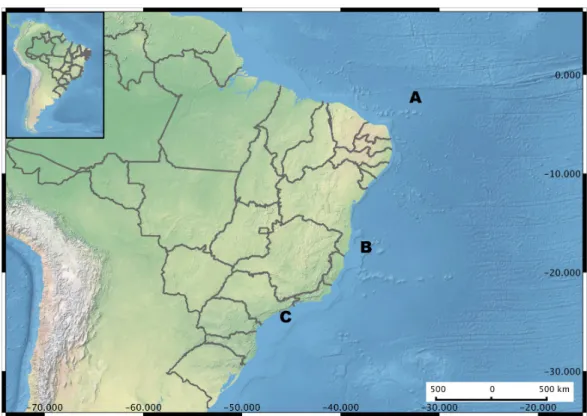
In total, 775 vibrio strains, isolated between 2005 and 2010, and identified by means ofpyrHsequences, were analyzed. Information on locations and sources are detailed inTable S1(strain list). The geographic span represents over 3,000 km, including the oceanic SPSPA, AB, and the southeastern Brazilian Saint Sebastian channel (SS) (Fig. 1, map). For the 195 novel isolates, the sources were: sediments from the Buracas (N =25)
(for a full description of the so-called Buracas reef system seeCavalcanti et al., 2013a); rhodoliths (N=76) (for a full description of the rhodoliths holobiont seeCavalcanti et al.,
2013b) from 27 and 43 m depth; seawater from AB, from 10 and 150 m depth (N=76),
including two locations (station 61: closer to shore, and station 65: oceanic), andS. welsii
mucus (N =18), from SPSPA. The remainder 580 strains were obtained previously
Figure 1 Brazil Map showing the sampling regions.Microenvironments are highlighted in each sam-pling site. (A) Saint Peter and Saint Paul Archipelago. Hosts investigatedHermodice carunculata, Scolymia wellsiand Madracis decactis. (B) Abrolhos Bank. Sediment, rhodolith, water,Mussismilia brasiliensis,
M. hispidaandPhylogorgia dilatata. (C) Saint Sebastian region.M. hispida, Zoanthus solanderi, Palythoa caribaeorumandP. variabilis.
of habitat categories under comparison as well as their geographic extent, allowing a more comprehensive evaluation of potential ecological and genetic relationships among locations. Sampling permit Sisbio n. 24732-1 was issued by the Ministry of Environment Institute Chico Mendes (ICMBio).
Isolation and preservation of vibrios
Vibrios originating from the water column were obtained from inoculation, performed on board the RV Prof. W. Besnard, in July 2007, in AB. Samples were collected with a rosette system in three depths (10, 75 and 150 m) in station 65 (17◦0′36′′S; 36◦59′56.4′′ W-oceanic), and at 10 m in station 61 (17◦0′3.6′′S; 39◦0′0′′W-on the shelf). Samples from sequential filtration (200 mL) in 3µm and 0.22µm filters and aliquots of unfiltered
at 28◦C. Isolates were purified at Federal University of Rio de Janeiro (UFRJ). The pure cultures were maintained in vials with Tryptic Soy Broth (Oxoid) with 3% NaCl or Marine Broth media, both supplied with 20% (v/v) glycerol, and preserved at−80◦C.
Taxonomic characterization
Characterization of all vibrio isolates was obtained bypyrH sequencing (80F and 530R primers) as described previously (Thompson et al., 2005a;Thompson et al., 2005b). DNA extraction was performed based onPitcher, Saunders & Owen (1989). PCR sequencing reactions, consensus sequences determination and alignment were performed as in
Moreira et al. (2013). Phylogenetic trees were built in MEGA 5 (Tamura et al., 2011). The topology of the tree was based on neighbor-joining method. Distance estimations were obtained according to the Kimura-2-parameter model and the Maximum Composite Likelihood model. Bootstrap percentages were used after 1,000 replications. To analyze the ecological grouping, the multi-FASTA file was converted in MEGA 5 to PHYLIP 3.0 format. The .phy file was used as input to PhyML 2.44 (Guindon & Gascuel, 2003;Guindon et al., 2010) where the suitable tree was generated and again used as input file for the AdaptML software (David, 2010;Hunt et al., 2008). Tree figures were generated using the interactive Tree of Life web application (itol.embl.de) (Letunick & Bork, 2007).
Ecologic grouping of vibrios
Clusters of vibrios’ sequences were obtained with the software AdaptML as described previously (David, 2010;Hunt et al., 2008). In brief, the software combines genetic information embedded in sequence-based phylogenies and information about the ecology, herein the source and place of isolation, in order to identify genetically- and ecologically-distinct bacterial populations. This quantitative model (AdaptML) uses a Hidden Markov Model to predict the phylogenetic bounds of ecologically distinctpopulations, and theirhabitat composition(distribution among environmental categories). AdaptML algorithm can account for environmental parameter discretization schemes and is based on the model concept of a habitat (a place and related features that determines microbial distribution). Habitats are characterized by discrete probability distributions describing the likelihood that a strain adapted to a habitat will be sampled from a given ecological state (e.g., at a particular location in the water column or in a specific host). Habitats are not defineda prioribut rather learned directly from the sequence phylogeny and ecological data using an Expectation Maximization routine. Once habitats are defined, a maximum likelihood model is used for the evolution of habitat association on the tree (David, 2010;
Hunt et al., 2008). The habitat-learning and clustering steps of AdaptML were performed using the default settings. Confident assignments are shown for ecological populations predicted by the model. The model threshold value was set at 0.05 andPhotobacterium
80% of bootstraps were shown. The visualization of the distribution ofVibriogroups in all habitats (Fig. S2) was generated by the online tool Many Eyes (IBM Many Eyes Project;
Vi´egas et al., 2007).
All gene sequences obtained in this study are available through the website TAXVIB-RIO (http://www.taxvibrio.lncc.br/). The GenBank accession numbers for thepyrH
sequences reported in this study areKC871632–KC871720; KJ154031–KJ154048;
EU251514–EU251689; EU716656–EU717075; GU186166–GU186371;
KC871598–KC871720.
RESULTS
Taxonomic assignment of the vibrio isolates
The taxonomic characterization of the isolates was mainly based on the phylogenetic position ofpyrHgene sequences and its similarities in relation to the closest type strain of
Vibriospecies. ThepyrHgene has shown to be a reliable taxonomic marker for theVibrio
group, even able to discriminate closely related species (Thompson et al., 2005a;Thompson et al., 2005b;Thompson et al., 2007). However, in some cases we also performed a Multi-locus sequence Analysis (MLSA) of housekeeping genes and whole genome sequencing (Chimetto et al., 2009;Moreira et al., 2014). Most of the vibrio isolates wereV. communis
(21.9%),V. mediterranei/V. shiloi(19.7%),V. harveyi(12.4%),V. alginolyticus(9.5%),
V. campbellii(7.7%). Other prevailing groups wereV. maritimus(4.5%),V. tubiashii
(3.5%),V. coralliilyticus(3.1%),V. pelagius(2.5%),V. diabolicus(2.2%) andV. chagasii
(1.8%). In addition, 22 strains (2.8%) were identified as candidate newVibriospecies based on 16S rRNA (data not shown) andpyrHgene sequence similarities. Ecological popula-tions predicted by the AdaptML model totalized 19Vibriogroups clustered accordingly
Fig. 2. Most species found in the water column (i.e.,V. communis, V. campbellii, V. harveyi, V. maritimus, V. pelagiusandV. diabolicus) were also isolated from different invertebrate hosts (Table 1andFig. S1). However, some species asV. hepatariusand a unique strain of
V. alfacsensiswere found only in water samples, whilstV. rotiferianusonly in the benthos, coral and zoanthid samples (M. hispida,M. braziliensis, P. dilatataandP. caribaeorum). Some species were retrieved from a single given host.V. sinaloensiswas found only in the coralMussismilia (hispidaandM. braziliensis), as well asV. madracius(=V. shiloi-like,
Fig. 2) was associated only withM. decactis. V. shiloiwas found mainly in association with the firewormH. carunculataand also withM. hispidain SS.V. furnissiiwas only associated withH. carunculata. We observed low counts (colony forming units—CFU) in the water column (typically<102per mL) compared with the abundance of vibrios in reef waters (up to 104CFU mL−1) (Bruce et al., 2012) and in the coral mucus (106CFU mL−1) (Alves et al., 2010;Moreira et al., 2013).
Partitioning of vibrio isolates according to their genetic and ecological similarity
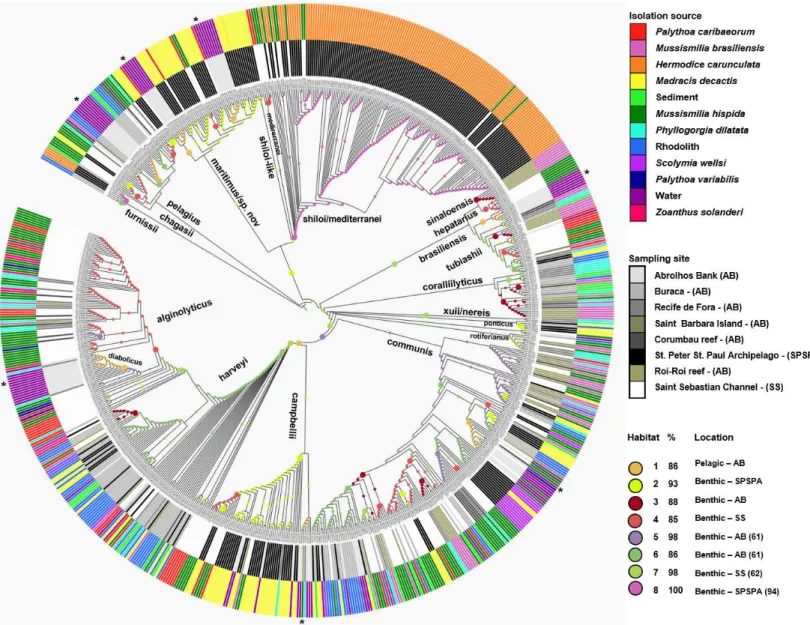
TheVibrioisolates were distributed in 8 habitat spectra. These habitat are a spectrum of environment types over which a given population may be isolated from (Table S2;Fig. 2
Figure 2 Inferred habitat associations for all ancestors of sequencedVibriostrains.The rings surrounding the tree represent the isolation source (outer) and the sampling site (inner) from which strains were isolated. The maximum likelihood assignment of nodes to habitats is shown for all nodes, regardless of the confidence of each prediction. Colored circles on each branch indicate the habitat spectrum assignment (H1-H8) for the node immediately below that branch (see above legend for color scheme). Branch lengths are adjusted to aid visualization and do not represent evolutionary distances. * Highlights the isolation source, water.
Table 1 List of vibrios species found in seawater and at the same time in other hosts investigated in this study.
M. hispida P. dilatada M. decactis M. brasiliensis P. caribaeorum S. wellsi Rhodolith P. variabilis Sediment
V. communis X X X X X X X X ND
V. harveyi X X X X X X X ND X
V. campbellii X X X X X ND ND ND ND
V. chagasii X X X X ND ND ND ND X
V. pelagius X X X ND ND ND ND ND ND
V. diabolicus X X ND ND ND ND ND ND ND
Notes.
ND, Not detected.
Figure 3 Distribution of the environmental categories that compose each of the 8 habitats predicted by AdaptML.Distributions are normalized by the total number of isolates in each environmental category to reduce the effect of uneven sampling.
(72%), H-4 fromM. hispida(69%), H-5 fromMussismilia(hispidaandbrasiliensis) (72%), H-6 from rhodolith (44%), H-7 fromP. caribaeorum(50%) and H-8 fromH. carunculata
(94%) (Fig. 3).
Although the observation of these different microenvironments in the SAO was based on a single sampling, the correlation found among the inferred habitat spectra, sampling sites, isolation sources and the associations with all ancestors of the vibrios studied indicated structured populations (Fig. 2). The predominant environmental category in the composition of each predicted habitat spectrum can be clearly visualized inFig. 3.
(N=42), candidateVibriosp. nov (N=19) andV. maritimus(N=15) were the most
frequently found species (Fig. S3andTable S2). Two clusters ofV. maritimus, one from AB seawater and the other from SPSPAM. decactis, were clearly distinguished (Fig. S3). H-6 had mainly (57%) vibrios from Buracas—AB (44%: rhodolith, 13%: sediment) and from seawater (6%) (Fig. S3). Species highlighted wereV. harveyi, V. communis, V. coralliilyticus, V. tubiashiiand candidateVibriosp. nov. (Fig. S2). H-7 was mainly represented by the same
Vibriospecies found in H-6, except for potencial newVibriospecies and the presence ofV. rotiferianus. The hosts observed in this habitat wereP. caribaeorum(50%) and
M. hispida(12%) both from SS;P. dilatata(23%: Recife de Fora),M. braziliensis(10%: Saint Barbara Island), rhodoliths (3%: Buracas), and water (2%: AB) (Fig. 3andTable S2).
H-3 encompassed mostly isolates associated with Mussismilia (78%), mainly
M. braziliensis(68%) (Roi-Roi reef—AB). The species adapted to this habitat spectrum wereV. coralliilyticus,V. harveyi,V. communis, V. sinaloensisandV. tubiashii(Fig. S3). H-4 was mostly represented by benthic animals from SS channel (85%). The main host (72.5%) wasM. hispida(69%: SS, 2%: AB).M. braziliensiswas also represented (1.5%: AB).Vibriospecies observed in H-4 wereV. alginolyticus, V. communis, V. campbellii, V. tubiashii, V. chagasiiandV. sinaloensis(Fig. S2). H-5 was composed of environmental categories from AB (61%) and SS (37%) (Fig. 3andTable S2). The dominant category was the hostMussismilia(72%), including both species:M. hispida(46%: AB and SS) and
M. braziliensis(26%: AB).V. communisandV. alginolyticuswere the dominant species (Fig. S2). H-8 comprised mostlyV. shiloiassociated withH. carunculatain SPSPA (94%). A fewV. shiloistrains were associated withM. hispidain SS (6%) (Fig. 3).
Connectivity among the benthic-pelagic systems in Abrolhos bank The presence of identicalpyrHsequences of vibrios from planktonic and coral reinforce the hypothesis of connectivity (Fig. S3). For instanceV. communis(PEL4D from 150 m depth and R-680 fromM. hispida,G35, G52 from rhodoliths), (PEL103A from 10 m depth and R-239, R-264 fromM. hispida);V. harveyi(PEL36B from 10 m depth and 1DA5 fromP. dilatata);V. campbellii(PEL44A from 10 m depth and 42A fromM. hispida, PEL45A from 10 m deep and A-391 fromM. decactis);V. diabolicus(PEL41D from 150 m depth and 4D2 fromP. dilatata);V. pelagius(PEL22B from 10 m depth and 28A2 from
M. hispida) andV. chagasii(PEL47A from 75 m depth and PA10 fromM. braziliensisand 1DA1 fromP. dilatata) (Fig. S3). Samples from water clustered with samples from benthos are highlighted (*) inFig. 2.
On the other hand, some clusters of planktonic strains seemed to have uniquepyrH gene sequences (i.e.,V. maritimusgroup, PEL21 (A, B, C, E and F—station 61, 10 m); PEL102 (A e B), PEL106A, PEL111A, PEL121C, PEL122A, PEL124A and PEL125 (A and B); and
V. pelagiusgroup PEL115 (A, B, C, D, E, F, G, H and J—station 65, 150 m) (Fig. S3). The distribution pattern of the mainVibriospecies from benthic and pelagic sources in AB based on the evolutionary history inferred by the Neighbor-Joining method withpyrH
A more targeted AdaptML analysis was performed by dividing the isolation sources in generic two hosts, benthic and pelagic, to explore the extent and significance of the coupling events. It resulted in a very similar cluster distribution of the populations of vibrios. Again, isolates from Abrolhos Bank, both from open water and benthos, were present in the same branches. However, the number of habitat spectra stablished were reduced to six (H1-H6) (Fig. S5).
DISCUSSION
Vibrio population distribution in the Southeastern Atlantic
The predicted habitats spectrum were dispersed along a spatial gradient ca. 3,000 km, from the coastal southeastern SS to the most distant from coast Brazilian archipelago, located above the Equator (SPSPA). Ecologically coherent groups were associated with seawater (H-1), corals [M. decactis(H-2),M. braziliensis(H-3),M. hispidafrom SS (H-4), bothMussismiliaspecies (M. braziliensisandM. hispida) (H-5)], rodoliths and sediment (H-6), zoanthids—P. dilatataandP. caribaeorum(H-7), and the polichaeteH. carunculata(H-8).
The behavior of vibrios showed a wide spectrum, from approaching a true generalist to a strict specialist. The dominant group, the Communis cluster, was present in all habitats spectrum, except for H-8 (mainly composed by the host fireworm), and in 10 out of the 12 samples analyzed. This suggests that these hosts may serve as a reservoir forV. communis’ populations when their abundance in seawater decreases. The exceptions were the zoanthid (Z. solanderi) and the fireworm (H. carunculata). Nevertheless it’s worth to note that only
V. alginolyticusinhabitedZ. solanderi, according to this study, thus raising the possibility that antagonists among its populations (or the animal itself) could be effective against vibrios. Apart from the exceptions,V. communispopulations showed a true generalist behavior.V. communisstrains were isolated from multiple independent samples and thus do not represent clonal expansion, suggesting that this may reflect a true habitat switch. Moreover,V. communisappeared to have ecologically diversified, possibly by invading new niches or partitioning resources at increasingly fine scales in a similar way to that ofV. splendidusin the northwestern Atlantic coast (Preheim et al., 2011;Hunt et al., 2008). Despite being recognized as a generalist,V. splendiduswas not represented in this study, which might reflect its low tolerance to high temperatures (>21◦C) (Materna et
al., 2012). The other host that seemed unavailable toV. communiswas the fireworm in SPSPA. In contrast to the high diversity that corals harbored, this host was dominated by
V. shiloi(n=143) and someV. furnissiistrains (n=4).V. shiloiwas also present in corals
(M. hispida) in SS. SPSPA and SS are the extremes of the latitudinal gradient uncovered. Corals and the fireworm appear to define the habitat spectrum forV. shiloi. Both host associations were previously observed in the Eastern Mediterranean (Sussman et al., 2003), suggesting they are stable and that population-habitat linkage is highly predictable for
Populations of vibrios in the SAO and those in the northwestern Atlantic showed narrow intersection. In addition toV. splendidus, other vibrios found in the American northern coast wereV. rumoiensis,V. alginolyticus,V. fischeri/logei,V. penaeicida,V. super-stes,V. aestuarianus,V. ordalii, V. breoganii, V. crassostreae, V. kanaloae, V. tasmaniensis, V. gigantis,andV. cyclitrophicus(Preheim et al., 2011;Hunt et al., 2008). The only common group isV. alginolyticus.It was associated with zooplankton and also displayed free-living style in the coastal northern hemisphere (Hunt et al., 2008). In this study
V. alginolyticuswas also found in coastal areas of AB and SS, but associated with almost all cnidarians surveyed, and not in the seawater. Variation in host association and lifestyle may reflect genome heterogeneity, possibly due to a large set of flexible genes. In members of theVibrionaceae, small-scale differences in environmental conditions based on microenvironment and season have been shown to drive lineage adaptation (Hunt et al., 2008) and presumably genome content. A representative study targetingV. alginolyticus
genomes (n=192) from the Chinese coast revealed a high prevalence of mobile genetic
elements, including integrating conjugative elements (ICEs), superintegron-like cassettes (SICs), insertion sequences (ISs), and two types of transposase genes (valT1 and valT2). Moreover, BLAST searches and phylogenetic analysis of the ICE, SIC, IS elements and transposase genes showed that the corresponding homologues were bacterial derived from extensive sources, indicating intensive exchange with environmental bacteria (Luo et al., 2012). Indeed, the horizontal gene transfer (HGT) mechanism has played an important role in bacterial evolution, facilitating the origins of bacterial diversity and adaptation to new ecological niches (Wiedenbeck & Cohan, 2011). An important feature shared by the habitats whereV. alginolyticuswas common is the vicinity to coast, and thus to human activities and nutrient enrichment (SS, AB and Plum Island Estuary, NE Massachusetts).
When we look to the evolutionary history of the generalist and specialist vibrio populations found in this study, two distinct clades defined by MLSA of 8 housekeeping genes can be highlighted: Harveyi and Mediterranei respectively (Sawabe, Kita-Tsukamoto & Thompson, 2007;Sawabe et al., 2013). Harveyi clade is composed by 9 species mainly associate with seawater, salt marsh mud, marine animal and coral mucus. In some cases, distinguishing species and strains within this clade is a hard task for taxonomy, because the presence of recombination among closely related species. Meditteranei clade is composed by 4 species mainly found in habitats as warm seawater and coral mucus (Sawabe, Kita-Tsukamoto & Thompson, 2007;Sawabe et al., 2013;Moreira et al., 2014—V. madracius
sp novel). Although, the clades are not phylogenetic very closely related, both possess typically pathogenic species in aquatic environments (Reshef, Ron & Rosenberg, 2008;
Ruwandeepika et al., 2010;Ruwandeepika et al., 2011).
The influence of temporal dimension in habitat distribution is visualized inFig. S6. Although not all regions were sampled all years, there was prevalence of 2010 strains in H-2, H-6 and H-8; and of 2007 in H-1 and H-3. On the other hand, strains from 2005, 2006, 2007 and 2010 were present in H-4, H-5 and H-7.
Habitat delineation and taxonomy are congruent
We observed a good congruence between the ecologic grouping generated by the AdaptML and the currently recognizedVibriospecies. However, the AdaptML provided further refinement of the species into subspecific groups that may reflect niche partitioning. For instance, we found groups ofV. maritimusassociated with the seawater and with the coralM. decactisin SPSPA. We defined ecologic groups of vibrios that live in the water column and in association with the benthic organisms. Some species (such asV. harveyi,
V. aliynolyticusandV. communis) occupied different habitat spectra, whereas other species (such asV. hepatarius, V. rotiferianusandV. brasiliensis) appeared to be restricted to one habitat (Fig. S2). Some habitat spectra (e.g., H-1) can be defined by multiple species (e.g.,V. communis,V. campbellii,V. diabolicus,V. pelagius,V. hepatarius,V. maritimus
andV. chagasii). These species are widespread in the water column (up to 150 m depth), representing 86% of the isolates in this habitat spectrum.
The ecological grouping observed in this study suggests dispersal and connectivity among the benthic-pelagic systems in AB. The distribution pattern of theVibriospecies from benthic and pelagic sources in AB based on evolutionary history inferred by using the Neighbor-Joining method of thepyrHgene sequence (Fig. S4) corroborates with this hypothesis. Genetic coherence among the strains from SS, SPSPA and AB also contributes with the coupling idea. Conspecific identical isolates (e.g., PEL4D and R-680, G35, G52; PEL 103A and R-239, R-264; PEL36B and 1DA5; and others), based onpyrHsequences, originated from the pelagic and benthic systems reinforced the idea of connectivity. Even if AdaptML has mistakenly pooled open water specialists and benthic specialists into one population, these identities (ofpyrHsequences from benthic and pelagic isolates) are strong evidence of benthopelagic coupling. It is noteworthy identicalpyrHsequences from both compartments and among distantly located isolates, since this gene is one of the most divergent among the pool of housekeeping genes employed for vibrios’ MLSA (Thompson et al., 2005a;Thompson et al., 2005b;Thompson et al., 2007). Isolates from both open water and benthic sites were also detected when the AdaptML analysis was based on generic hosts (benthic and pelagic). Moreover, similar cluster distribution of vibrios populations were observed in both parameters analyzed (Fig. 2andFig. S5).
group. Furthermore, several vibrios observed in the plankton of the AB may have a pathogenic potential to corals. However, we did not recover some known coral pathogens (e.g.,V. coralliilyticusandV. shiloi) in our pelagic survey, suggesting that some vibrio species may have evolved into associated habitats, as the coral holobiont, for example, as observed in the H-8. It was demonstrated thatV. shiloiandV. coralliilyticususe chemotaxis to find their coral hosts, by sensing aβ-D-galactopyranoside-containing receptor and the metabolite dimethylsulfoniopropionate (DMSP), respectively, both present in the coral mucus (Toren et al., 1998;Garren et al., 2013).V. coralliilyticusemploys also chemokinesis and its swimming ability is noteworthy (Winn, Bourne & Mitchell, 2013;Garren et al., 2013). These vibrios may thus have a higher host association frequency. Interestingly,
V. madraciusretrieved only from the coralM. decactis, which might indicate a new ecological role of this bacterium in this host. This recently described species (Moreira et al., 2014) is closely related toV. mediterranei/shiloi,which is known for pathogenicity.
Influence of benthopelagic coupling in the coral reef health
We observed that several vibrios associated with the seawater and with benthic organisms (corals) formed a cohesive ecologic unity, indicating the connectivity between the benthic-pelagic compartments. Benthic communities obtain their energy through primary production from the benthic compartment and, to a lesser extent, from the overlying water column. Thereupon, the distribution and abundance of planktonic microbes may be dependent on benthic processes, which affect the transfer of organic material between benthic and pelagic systems (Fowler & Knauer, 1986). Bacteria and phytoplankton production are also stimulated by resuspension of nutrients from the seabed into the photic zone, which in turn stimulates zooplankton production, and so on up the food chain (Wainright , 1987). In the present study, we reinforce the power of ecologic theory already developed for the study of vibrioplankton from temperate areas (Materna et al., 2012;Szabo et al., 2013). The genetic connectivity observed among the vibrios originated from the seawater and coral hosts in the SAO illustrates the potential influence of the pelagic system in the coral reef systems health. In a scenario of increasing abundance of vibrios, mediated by higher global oceanic temperatures, the pathogenic potential of someVibriogroups may lead to increased incidence of diseases in the marine realm. For instance,V. vulnificusimplicated in outbreaks were linked to climate change in Israel (Paz et al., 2007), as well asV. parahaemolyticusoutbreaks documented in Alaska and linked to the consumption of raw seafood followed by episodes of increased seawater temperature, pinpointing a link between climate change and disease (McLaughlin et al., 2005;Materna et al., 2005;Martinez-Urtaza et al., 2008).
CONCLUSIONS
whilstV. shiloi was confirmed as specialist, associated toH. carunculataand corals. AdaptML analysis generated a good congruence between ecologic grouping and the currently recognizedVibriospecies, with further refinement of the species reflecting niche partitioning. Vibrios might occupy the pelagic and the holobiont habitats, indicating coupling between these microbes and their benthic hosts. The benthic pelagic coupling observed in AB, which is the largest South Atlantic reef complex, may suggest the importance of vibrios in the global ocean health.
ACKNOWLEDGEMENTS
The authors thank Pedro Meirelles comments and technical support of Oswaldo Maia and Milene M.A. Mesquita.
ADDITIONAL INFORMATION AND DECLARATIONS
Funding
Funding was provided by Conselho Nacional de Desenvolvimento Cient´ıfico e Tecnol ´ogico (CNPq), Fundac¸˜ao de Amparo `a Pesquisa do Estado do Rio de Janeiro (FAPERJ), and Coordenac¸˜ao de Aperfeic¸oamento de Pessoal de Nivel Superior (CAPES). The funders had no role in study design, data collection and analysis, decision to publish, or preparation of the manuscript.
Grant Disclosures
The following grant information was disclosed by the authors:
Conselho Nacional de Desenvolvimento Cient´ıfico e Tecnol ´ogico (CNPq). Fundac¸˜ao de Amparo `a Pesquisa do Estado do Rio de Janeiro (FAPERJ). Coordenac¸˜ao de Aperfeic¸oamento de Pessoal de Nivel Superior (CAPES).
Competing Interests
Fabiano Thompson is an Academic Editor for PeerJ.
Author Contributions
• Luciane A. Chimetto Tonon conceived and designed the experiments, performed
the experiments, analyzed the data, wrote the paper, prepared figures and/or tables, reviewed drafts of the paper.
• Bruno Sergio de O. Silva and Ana Paula B. Moreira performed the experiments, analyzed
the data, wrote the paper, reviewed drafts of the paper.
• Cecilia Valle, Nelson Alves Jr, Giselle Cavalcanti and Gizele Garcia performed the
experiments.
• Rubens M. Lopes analyzed the data, reviewed drafts of the paper.
• Ronaldo B. Francini-Filho and Rodrigo L. de Moura contributed
reagents/materials/analysis tools.
• Cristiane C. Thompson analyzed the data, contributed reagents/materials/analysis tools,
• Fabiano L. Thompson conceived and designed the experiments, analyzed the data,
contributed reagents/materials/analysis tools, reviewed drafts of the paper.
Field Study Permissions
The following information was supplied relating to field study approvals (i.e., approving body and any reference numbers):
Sampling permit SISBIO n.24732-1 issue by the Ministry of Environment Institute Chico Mendes (ICMBio).
DNA Deposition
The following information was supplied regarding the deposition of DNA sequences: All gene sequences obtained in this study are available through the website TAXVIBRIO (http://www.taxvibrio.lncc.br/). The GenBank accession numbers for the sequences reported in this study are pyrH (KC871632–KC871720;KJ154031–KJ154048;EU251514–
EU251689;EU716656–EU717075;GU186166–GU186371;KC871598–KC871720).
Supplemental Information
Supplemental information for this article can be found online athttp://dx.doi.org/ 10.7717/peerj.741#supplemental-information.
REFERENCES
Alves Jr N, Neto OSM, Silva BSO, de Moura RL, Francini-Filho RB, Barreira e Castro C, Paranhos R, Bitner-Math ˜A BC, Kruger RH, Vicente ACP, Thompson CC, Thompson FL. 2010.Diversity and pathogenic potential of vibrios isolated from Abrolhos Bank corals. Environmental Microbiology Reports2:90–95DOI 10.1111/j.1758-2229.2009.00101.x.
Amado-Filho GM, Moura RL, Bastos AC, Salgado LT, Sumida PY, Guth AZ, Francini-Filho RB, Pereira-Filho GH, Abrantes DP, Brasileiro PS, Bahia RG, Leal RN, Kaufman L, Kleypas JA, Farina M, Thompson FL. 2012.Rhodolith beds are major CaCO3 bio-factories in the tropical South West Atlantic.PLoS ONE7(4):e35171DOI 10.1371/journal.pone.0035171.
Baker-Austin C, Trinanes JA, Taylor NGH, Hartnell R, Siitonen A, Martinez-Urtaza J. 2013. EmergingVibriorisk at high latitudes in response to ocean warming.Nature Climate Change 3:73–77DOI 10.1038/nclimate1628.
Bruce T, Meirelles PM, Garcia G, Paranhos R, Rezende CE, de Moura RL, Filho RF, Coni EO, Vasconcelos AT, Amado Filho G, Hatay M, Schmieder R, Edwards R, Dinsdale E,
Thompson FL. 2012.Abrolhos bank reef health evaluated by means of water quality, microbial diversity, benthic cover, and fish biomass data. PLoS ONE 7(6):e36687
DOI 10.1371/journal.pone.0036687.
Castro BM, Miranda LB. 1998.Physical oceanography of the western Atlantic continental shelf located between 4◦N and 34◦S. In: Robinson AR, Brink KH, eds.The sea, vol. 11. New York: John Wiley and Sons, 209–252.
Cavalcanti GS, Gregoracci GB, Moura RL, Amado-Filho GM, Bastos AC, Francini-Filho R, Paranhos R, Ferreira CM, Ghisolfi RD, Kruger R, Guth AZ, Sumida PYG, Bruce T, Maia-Neto O, Santos EO, Iida T, Thompson FL. 2013a. Sinkhole-like structures as bioproductivity hotspots in the Abrolhos Bank.Continental Shelf Research70:126–134
DOI 10.1016/j.csr.2013.05.011.
Chimetto LA, Brocchi M, Gondo ML, Thompson CC, Gomez-Gil B, Thompson FL. 2009. Genomic diversity of vibrios associated with the Brazilian coral Mussismilia hispida and its sympatric zoanthids (Palythoa caribaeorum, P. variabilis, andZoanthus solanderi).Journal of Applied Microbiology106:1818–1826DOI 10.1111/j.1365-2672.2009.04149.x.
David LA. 2010.Novel phylogenetic approaches to problems in microbial genomics. Thesis, MIT, USA.
Foster MS. 2001.Rhodoliths: between rocks and soft places.Journal of Phycology37:659–667
DOI 10.1046/j.1529-8817.2001.00195.x.
Fowler SW, Knauer GA. 1986.Role of large sinking particles in the transport of elements and organic compounds through the water. Progress in Oceanography16:147–194
DOI 10.1016/0079-6611(86)90032-7.
Francini-Filho RB, Moura RL, Thompson FL, Reis RM, Kaufman L, Kikuchi RK, Le˜ao ZM. 2008.Diseases leading to accelerated decline of reef corals in the largest South Atlantic reef complex (Abrolhos Bank, eastern Brazil).Marine Pollution Bulletin56(5):1008–1014
DOI 10.1016/j.marpolbul.2008.02.013.
Fukui Y, Saitoh S, Sawabe T. 2010.Environmental determinants correlated to Vibrio harveyi-mediated death of marine gastropods.Environmental Microbiology12(1):124–133
DOI 10.1111/j.1462-2920.2009.02052.x.
Garren M, Azam F. 2012. Corals shed bacteria as a potential mechanism of resilience to organic matter enrichment.The ISME Journal: Multidisciplinary Journal of Microbial Ecology 6(6):1159–1165DOI 10.1038/ismej.2011.180.
Garren M, Son K, Raina JB, Rusconi R, Menolascina F, Shapiro OH, Tout J, Bourne DG, Seymour JR, Stocker R. 2013.A bacterial pathogen uses dimethylsulfoniopropionate as a cue to target heat-stressed corals.The ISME Journal: Multidisciplinary Journal of Microbial Ecology Epub ahead of printDOI 10.1038/ismej.2013.210.
Gregoracci GB, Nascimento JR, Cabral AS, Paranhos R, Valentin JL, Thompson CC,
Thompson FL. 2012.Structuring of bacterioplankton diversity in a large tropical bay.PLoS ONE7(2):e31408DOI 10.1371/journal.pone.0031408.
Guindon S, Dufayard JF, Lefort V, Anisimova M, Hordijk W, Gascuel O. 2010.New algorithms and methods to estimate Maximum-Likelihood phylogenies: assessing the performance of PhyML 3.0.Systematic Biology59:307–321DOI 10.1093/sysbio/syq010.
Guindon S, Gascuel O. 2003.A simple, fast, and accurate algorithm to estimate large phylogenies by maximum likelihood.Systematic Biology52:696–704DOI 10.1080/10635150390235520. Hibbing ME, Fuqua C, Parsek MR, Peterson SB. 2010.Bacterial competition: surviving
and thriving in the microbial jungle. Nature Reviews Microbiology 8(1):15–25
DOI 10.1038/nrmicro2259.
Hunt DE, David LA, Gevers D, Preheim SP, Alm E, J, Polz MF. 2008.Resource partitioning and sympatric differentiation among closely related bacterioplankton.Science320(5879):1081–1085
DOI 10.1126/science.1157890.
Luo P, Jiang H, Wang Y, Su T, Hu C, Ren C, Jiang X. 2012.Prevalence of mobile genetic elements and transposase genes inVibrio alginolyticusfrom the southern coastal region of China and their role in horizontal gene transfer.International Microbiology15(4):201–210
DOI 10.2436/20.1501.01.173.
Martinez-Urtaza J, Huapaya B, Gavilan RG, Blanco-Abad V, Ansede-Bermejo J, Cadarso-Suarez C, Figueiras A, Trinanes J. 2008.Emergence of asiatic Vibrio diseases in South America in phase with El Ni˜no.Epidemiology19:829–837DOI 10.1097/EDE.0b013e3181883d43. Materna AC, Friedman J, Bauer C, David C, Chen S, Huang IB, Gillens A, ClarkeMcLaughlin JB,
DePaola A, Bopp CA, Martinek KA, Napolilli NP, Allison CG, Murray SL, Thompson EC, Bird MM, Middaugh JP. 2005. Outbreak of Vibrio parahaemolyticus gastroenteritis associated with Alaskan oysters. New England Journal of Medicine353:1463–1470
DOI 10.1056/NEJMoa051594.
Materna AC, Friedman J, Bauer C, David C, Chen S, Huang IB, Gillens A, Clarke SA, Polz MF, Alm EJ. 2012. Shape and evolution of the fundamental niche in marine Vibrio.The ISME Journal: Multidisciplinary Journal of Microbial Ecology6(12):2168–2177
DOI 10.1038/ismej.2012.65.
McCarter L. 1999.The multiple identities ofVibrio parahaemolyticus.Journal of Molecular Microbiology and Biotechnology1:51–57.
McDougald D, Kjelleberg S. 2006.Adaptive responses ofVibrios. In: Thompson FL, Austin B, Swings J, eds.The biology of Vibrios. Washington D.C: American Society for Microbiology, 133–155.
McLaughlin JB, DePaola A, Bopp CA, Martinek KA, Napolilli NP, Allison CG, Murray SL, Thompson EC, Bird MM, Middaugh JP. 2005. Outbreak ofVibrio parahaemolyticus gastroenteritis associated with Alaskan oysters. New England Journal of Medicine 353(14):1463–1470DOI 10.1056/NEJMoa051594.
Moreira APB, Chimetto Tonon LA, Valle P, Pereira C, Alves N, Amado-Filho GM,
Francini-Filho RB, Paranhos R, Thompson FL. 2013.Culturable heterotrophic bacteria associated with healthy and bleached scleractinianMadracis decactisand the fireworm Hermodice carunculatafrom the remote St. Peter and St. Paul Archipelago, Brazil.Current Microbiology68(1):38–46DOI 10.1007/s00284-013-0435-1.
Moreira AP, Duytschaever G, Tonon LAC, Dias GM, Mesquita M, Cnockaert M,
Francini-Filho RB, DeVos P, Thompson CC, Thompson FL. 2014.Vibrio madraciussp. nov. isolated fromMadracis decactis(Scleractinia) in St Peter & St Paul Archipelago, Mid-Atlantic Ridge, Brazil.Current Microbiology69(4):405–411DOI 10.1007/s00284-014-0600-1.
Oliveira OMP, Marques AC. 2007.Dinˆamica sazonal das massas de ´agua no canal de S˜ao Sebasti˜ao (SE Brasil) de marc¸o de 2005 a maio de 2006. In:XII Congresso Latino-Americano de Ciˆencias do Mar - XII COLACMAR.
Paz S, Bisharat N, Paz E, Kidar O, Cohen D. 2007. Climate change and the emer-gence of Vibrio vulnificus disease in Israel. Environmental Research 103:390–396
DOI 10.1016/j.envres.2006.07.002.
Pitcher DG, Saunders NA, Owen RJ. 1989.Rapid extraction of bacterial genomic DNA with guanidium thiocyanate.Letters in Applied Microbiology8:151–156DOI 10.1111/j.1472-765X.1989.tb00262.x.
Preheim SP, Boucher Y, Wildschutte H, David LA, Veneziano D, Alm EJ, Polz MF. 2011. Metapopulation structure of Vibrionaceae among coastal marine invertebrates.Environmental Microbiology13(1):265–275DOI 10.1111/j.1462-2920.2010.02328.x.
Reshef L, Ron E, Rosenberg E. 2008.Genome analysis of the coral bleaching pathogenVibrio shiloi.Archives of Microbiology190(2):185–194DOI 10.1007/s00203-008-0388-0.
Rosenberg E, Koren O, Reshef L, Efrony R, Zilber-Rosenberg I. 2007. The role of
microorganisms in coral health, disease e evolution.Nature Reviews Microbiology5:355–362
DOI 10.1038/nrmicro1635.
Rossi-Wongtschowski CLDB, Valentin JL, Jablonski S, Amaral ACZ, Hazin FHV, EL-Robrini M. 2006.O Ambiente Marinho. In:Minist´erio do Meio Ambiente (MMA). Secretaria de Qualidade Ambiental, eds. Programa REVIZEE: avaliac¸˜ao do potencial sustent´avel de recursos vivos na zona econˆomica exclusiva: relat´orio executivo. Bras´ılia: Minist´erio do Meio Ambiente, 22–77. Ruwandeepika HA, Defoirdt T, Bhowmick PP, Karunasagar I, Karunasagar I, Bossier P. 2011.
In vitroandin vivoexpression of virulence genes inVibrioisolates belonging to the Harveyi clade in relation to their virulence towards gnotobiotic brine shrimp (Artemia franciscana). Environmental Microbiology13(2):506–517DOI 10.1111/j.1462-2920.2010.02354.x.
Ruwandeepika HA, Defoirdt T, Bhowmick PP, Shekar M, Bossier P, Karunasagar I. 2010. Presence of typical and atypical virulence genes invibrioisolates belonging to the Harveyi clade.Journal of Applied Microbiology109(3):888–899DOI 10.1111/j.1365-2672.2010.04715.x. Sawabe T, Kita-Tsukamoto K, Thompson FL. 2007.Inferring the evolutionary history of
vibrios by means of multilocus sequence analysis.Journal of Bacteriology189:7932–7936
DOI 10.1128/JB.00693-07.
Sawabe T, Ogura Y, Matsumura Y, Feng G, Amin AR, Mino S, Nakagawa S, Sawabe T, Kumar R, Fukui Y, Satomi M, Matsushima R, Thompson FL, Gomez-Gil B, Christen R, Maruyama F, Kurokawa K, Hayashi T. 2013.Updating theVibrioclades defined by multilocus sequence phylogeny: proposal of eight new clades, and the description ofVibrio tritoniussp. nov.Frontiers in Microbiology4:414DOI 10.3389/fmicb.2013.00414.
Sussman M, Loya Y, Fine M, Rosenberg E. 2003.The marine firewormHermodice carunculatais a winter reservoir and spring-summer vector for the coral-bleaching pathogenVibrio shiloi. Environmental Microbiology5(4):250–255DOI 10.1046/j.1462-2920.2003.00424.x.
Szabo G, Preheim SP, Kauffman KM, David LA, Shapiro J, Alm EJ, Polz MF. 2013. Reproducibil-ity ofVibrionaceaepopulation structure in coastal bacterioplankton.The ISME Journal: Multidisciplinary Journal of Microbial Ecology7(3):509–519DOI 10.1038/ismej.2012.134. Tamura K, Peterson D, Peterson N, Stecher G, Nei M, Kumar S. 2011.MEGA5: molecular
evolutionary genetics analysis using maximum likelihood, evolutionary distance and maximum parsimony methods.Molecular Biology and Evolution 28(10):2731–2739
DOI 10.1093/molbev/msr121.
Thompson FL, Gevers D, Thompson CC, Dawyndt P, Naser S, Hoste B, Munn CB, Swings J. 2005a. Phylogeny and molecular identification of vibrios on the basis of multilocus sequence analysis.Applied and Environmental Microbiology 71(9):5107–5115
DOI 10.1128/AEM.71.9.5107-5115.2005.
Thompson JR, Pacocha S, Pharino C, Klepac-Ceraj V, Hunt DE, Benoit J, Sarma-Rupavtarm R, Distel DL, Polz MF. 2005b.Genotypic diversity within a natural coastal bacterioplankton population.Science307(5713):1311–1313DOI 10.1126/science.1106028.
Thompson JR, Polz MF. 2006.Dynamics ofVibriopopulations and their role in environmental nutrient cycling. In: Thompson FL, Austin B, Swings J, eds.The biology of Vibrios. Washington DC: American Society for Microbiology, 190–203.
Tilman D. 1982.Resource competition and community structure. Princetown: Princetown University Press.
Toren A, Landau L, Kushmaro A, Loya Y, Rosenberg E. 1998.Effect of temperature on adhesion ofVibriostrain AK-1 toOculina patagonicaand on coral bleaching.Applied and Environmental Microbiology64:1379–1384.
Vezzulli L, Brettar I, Pezzati E, Reid PC, Colwell RR, H¨ofle MG, Pruzzo C. 2012.Long-term effects of ocean warming on the prokaryotic community: evidence from the vibrios.The ISME Journal: Multidisciplinary Journal of Microbial Ecology6(1):21–30DOI 10.1038/ismej.2011.89. Vezzulli L, Previati M, Pruzzo C, Marchese A, Bourne DG, Cerrano C, VibrioSea Consortium.
2010.Vibrioinfections triggering mass mortality events in a warming Mediterranean Sea. Environmental Microbiology12:2007–2019DOI 10.1111/j.1462-2920.2010.02209.x.
Vi´egas FB, Wattenberg M, Ham FV, Kriss J, McKeon M. 2007.Many eyes: a site for visualization at internet scale.IEEE Transactions on Visualization and Computer Graphics13(6):1121–1128
DOI 10.1109/TVCG.2007.70577.
Wainright S. 1987.Stimulation of heterotrophic microplankton production by resuspended marine sediments.Science238:1710–1712DOI 10.1126/science.238.4834.1710.
Wiedenbeck J, Cohan FM. 2011.Origins of bacterial diversity through horizontal genetic transfer and adaptation to new ecological niches.FEMS Microbiology Reviews35(5):957–976
DOI 10.1111/j.1574-6976.2011.00292.x.