Breeding Increases the Efficacy of
Chondrostereum purpureum
in the Sprout
Control of Birch
Leena Hamberg*, Henna Vartiamäki, Jarkko Hantula
Finnish Forest Research Institute, Vantaa Research Unit, Vantaa, Finland
Abstract
We tested whether the pairing of selected isolates could be used to increase the efficiency of a decay fungusChondrostereum purpureum(Pers. Ex Fr.) Pouzar to control hardwood
sprouting in Finland. We pairedC. purpureumstrains efficient in sprout control or highly
ac-tive in laccase production, and tested the efficacy of their progeny in spout control experi-ments. This procedure resulted in a strain with an efficacy superior to that of the parental strains. The mortality of birch (Betula pendulaRoth. andB. pubescensEhrh.) 1 cm in stump
diameter was 78%, 56% and 9% for the best progeny, the best parental strain and the con-trol, respectively. Mortality was only slightly higher forB. pendulathan forB. pubescensbut
no significant differences were found between the number or maximum height of stump sprouts. Our results showed that cross breeding of this decay fungus is a good alternative in attempts to produce efficient biocontrol agents against hardwood sprouting.
Introduction
In Finland, sprouting of broad-leaved trees is a hindrance in spruce (Picea abies[L.] H. Karst.) and pine (Pinus sylvestrisL.) regeneration areas, alongside roads and railways, under electric power lines and above gas pipe lines. In regeneration areas, broad-leaved species such as silver and downy birch (Betula pendulaRoth. andB.pubescensEhrh.), decrease the growth of more commercially valuable conifers, and therefore non-crop species are typically cleaned, preferably at an early stage when trees are about 1 m in height [1,2,3]. Next to roads and railways, broad-leaved trees form a threat to the safety of traffic as they restrict visibility, cover traffic signs and tempt moose, and are therefore regularly removed. Electric power lines are kept open to ensure continuous electric transmission and gas pipe lines marked with visible signs are frequently cleared in order to avoid unintended excavations. Sprout control of broad-leaved trees costs more than 60 million euros annually in Finnish forest regeneration areas, along roads and rail-ways, and at electric power and gas pipe lines (information gathered from UPM Forest Ltd., The Finnish Transport Agency, Fingrid Ltd. and Gasum Ltd.).
Herbicides were previously successfully used in sprout control [4,5], but the use of chemicals is no longer recommended in Finnish groundwater areas due to their harmful effects [6,7]. a11111
OPEN ACCESS
Citation:Hamberg L, Vartiamäki H, Hantula J (2015) Breeding Increases the Efficacy ofChondrostereum purpureumin the Sprout Control of Birch. PLoS ONE 10(2): e0117381. doi:10.1371/journal.pone.0117381
Academic Editor:Petr Karlovsky, Georg-August-University Göttingen, GERMANY
Received:October 3, 2014
Accepted:December 23, 2014
Published:February 12, 2015
Copyright:© 2015 Hamberg et al. This is an open access article distributed under the terms of the Creative Commons Attribution License, which permits unrestricted use, distribution, and reproduction in any medium, provided the original author and source are credited.
Data Availability Statement:All data sets and figures are available from the Dryad Digital Repository:http://dx.doi.org/10.5061/dryad.f5s6r.
Also, public opinion is strongly against their usage. On the other hand, mechanical cutting alone is not effective due to the vigorous sprouting of broad-leaved trees [8,9]. Therefore, new methods for sprout control are needed.
One promising option is to utilize a natural pathogen of broad-leaved trees, the silver leaf fungus,Chondrostereum purpureum(Pers. ex Fr.) Pouzar [10,11], which has been shown to re-strict the sprouting of several tree species [8,12,13,14]. Therefore it can be considered a‘nature friendly’alternative to chemicals.
C.purpureumis a basidiomycete commonly found on wounded broad-leaved wood in boreal and temperate vegetation zones in Europe [15,16,17]. The fungus is widespread in nature due to its efficient basidiospore production resulting in frequent new infections [15,18]. In nature, mono-karyotic spores landing on wood first germinate, after which the hyphae from different spores hy-bridize and form dikaryotic mycelia which then colonize the host [18]. However, in man-made sprout control, dikaryotic fungal hyphae are directly spread onto freshly cut stumps [9,12,13].
The use ofC.purpureumin sprout control is based on its ability to grow inside a stump and finally decay it. During the invasion,C.purpureumpenetrates through starch granules and cell walls enzymatically, and induces the occlusion of tree vessels [15,19,20,21]. The resulting dehy-dration combined with fungal toxins may finally cause mortality of the host. White rot fungi, such asC.purpureum, are efficient in breaking down lignin [22,23]. In woody cell walls, lignin surrounds the cellulose which is the actual carbon and energy source for the fungus, and possi-bly the ultimate reason for lignin degradation [23,24]. Laccases are the main oxidative enzymes in this decay process in addition to lignin and manganese peroxidases [13,23].
The efficacy ofC.purpureumin sprout control depends on the host tree species
[5,8,9,13,14]. Also, an increase in the diameter of an inoculated stump has been shown to affect stump mortality [9,14]. Furthermore, considerable variation exists in the ability of different
C.purpureumstrains to prevent sprouting [4,5,13], but the possibility of increasing control effi-ciency by breeding has not been tested before.
Breeding among sexually propagating fungi has previously been used in industrial applica-tions such as the chemical industry (e.g. enzymes for bioethanol), and in wine production in order to increase the yield of cultivated organisms and economic benefit [25,26]. Moreover, the biocontrol ability of a saprophytic fungusPhlebiopsis gigantea(Fr.) Jül. against a root rot fun-gusHeterobasidion parviporumNiemelä & Korhonen was improved by traditional breeding [27]. Therefore, breeding based on the natural variation ofC.purpureumcan be expected to provide an efficient way to increase the ability of this fungus to control sprouting.
The main aim of this study was to test whether breeding can be used to increase the efficacy of the decay fungusC.purpureumin preventing sprouting of small birch stumps (Betula pen-dulaandB.pubescens). We hypothesized that pairing of strains efficient in (i) sprout control and (ii) laccase production could result in a superior combination of genes producing at least one progeny strain better than the parental strains. In addition, we tested whether the ability of
C.purpureumto control sprouting differs between the birch species. Here we show that breed-ing can successfully be used to improve the biocontrol ability ofC.purpureumbut no signifi-cant differences between the two birch species investigated were found.
Materials and Methods
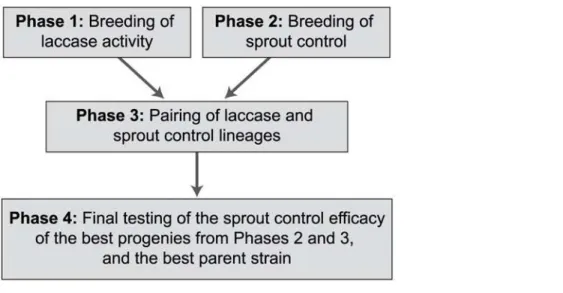
The study was composed of four phases (Fig. 1): 1) pairing of the best strains in terms of laccase activity and progeny testing in the laboratory, 2) pairing of the most efficient parental strains available [13] and progeny testing in the field, 3) pairing of the best progenies from Phases 1 and 2 and progeny testing in the field, and 4) final testing of the efficacy of the best progenies the Finnish Cultural Foundation (http://www.skr.fi/en,
project number 00081430) and the Finnish Forest Research Institute (http://www.metla.fi/index-en.html). LH received salary from the Finnish Forest Research Institute which obtained funding from the
abovementioned sources. The funders had no role in the study design, data collection and analysis, decision to publish, or preparation of the manuscript.
from Phases 2 and 3. All data sets and figures are available from the Dryad Digital Repository: http://dx.doi.org/10.5061/dryad.f5s6r
Ethics Statement
Permission for the field experiments of Phases 2–4 was granted by land owners, Fingrid Ltd., UPM-Kymmene Ltd. and the Finnish Forest Research Institute. Endangered or protected spe-cies were not used in this study. Fungal strains ofC.purpureumhave been deposited in the cul-ture collection of the Finnish Forest Research Institute.
Laccase activity tests
Laccase activity of the isolates was studied as it has been shown that laccase activity of
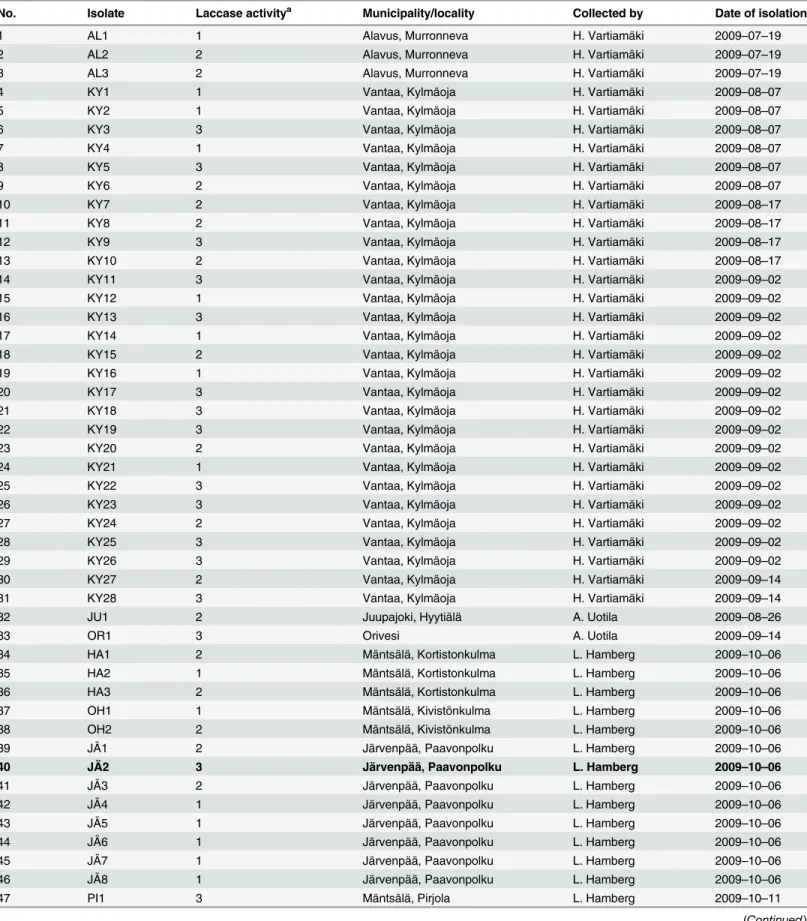
C.purpureumisolates correlates with the efficacy of their sprout control [13]. In order to find efficient laccase producers, altogether 69 heterocaryoticC.purpureumisolates were collected from birch (Betula pendulaandB.pubescens) stumps in July-October 2009. These isolates were collected from different parts of Finland, in Alavus (3 isolates), Vantaa (40), Hyytiälä (1), Juu-pajoki (2), Mäntsälä (16) and Järvenpää (8) (Table 1).
We used ABTS (2,2’-azino-bis[3-ethylbenzothiazoline-6-sulphonic acid]) plates whose color reaction reveals the laccase activity ofC.purpureum(0 = no color reaction, i.e., low laccase activ-ity to 3 = strong dark-green color reaction, i.e., high laccase activactiv-ity, see [13]). The ABTS plates (modified from [28]) were prepared by mixing 1.0 g glucose (Acros Organics), 2.0 g KH2PO4 (Merck), 0.5 g MgS04× 7H2O (Fluka), 0.13 g CaCl2× 2H2O (Merck), 0.5 g (NH4)2-tartrate (Alfa Aesar), 1.78 g dimethylsuccinic acid (Merck), 0.2 g yeast extract (Becton, Dickinson and Compa-ny) and 25 g agar (Becton, Dickinson and CompaCompa-ny) with 1000 ml deionized water. All elements except agar were suspended in water and pH adjusted to 5.0 with 1.0 M NaOH. Agar was added and the substrate was autoclaved at 121°C for 15 min. Altogether 250 mg ABTS (Applichem) di-luted with 99% ethanol was added to the medium when the temperature was 48–50°C.
AllC.purpureumisolates were grown on potato dextrose agar Petri plates (PDA: 24 g potato dextrose broth and 15 g agar with 1000 ml deionized water; Becton, Dickinson and Company), and a 6-mm diameter agar plug at the periphery of the grown mycelium was transferred to the middle of an ABTS plate using a sterilized Pasteur pipette and a scalpel. Two replicate plates
Fig 1. The Breeding Process of the Study.
Table 1.Chondrostereum purpureumIsolates Collected for Phase 1.
No. Isolate Laccase activitya Municipality/locality Collected by Date of isolation
1 AL1 1 Alavus, Murronneva H. Vartiamäki 2009–07–19
2 AL2 2 Alavus, Murronneva H. Vartiamäki 2009–07–19
3 AL3 2 Alavus, Murronneva H. Vartiamäki 2009–07–19
4 KY1 1 Vantaa, Kylmäoja H. Vartiamäki 2009–08–07
5 KY2 1 Vantaa, Kylmäoja H. Vartiamäki 2009–08–07
6 KY3 3 Vantaa, Kylmäoja H. Vartiamäki 2009–08–07
7 KY4 1 Vantaa, Kylmäoja H. Vartiamäki 2009–08–07
8 KY5 3 Vantaa, Kylmäoja H. Vartiamäki 2009–08–07
9 KY6 2 Vantaa, Kylmäoja H. Vartiamäki 2009–08–07
10 KY7 2 Vantaa, Kylmäoja H. Vartiamäki 2009–08–17
11 KY8 2 Vantaa, Kylmäoja H. Vartiamäki 2009–08–17
12 KY9 3 Vantaa, Kylmäoja H. Vartiamäki 2009–08–17
13 KY10 2 Vantaa, Kylmäoja H. Vartiamäki 2009–08–17
14 KY11 3 Vantaa, Kylmäoja H. Vartiamäki 2009–09–02
15 KY12 1 Vantaa, Kylmäoja H. Vartiamäki 2009–09–02
16 KY13 3 Vantaa, Kylmäoja H. Vartiamäki 2009–09–02
17 KY14 1 Vantaa, Kylmäoja H. Vartiamäki 2009–09–02
18 KY15 2 Vantaa, Kylmäoja H. Vartiamäki 2009–09–02
19 KY16 1 Vantaa, Kylmäoja H. Vartiamäki 2009–09–02
20 KY17 3 Vantaa, Kylmäoja H. Vartiamäki 2009–09–02
21 KY18 3 Vantaa, Kylmäoja H. Vartiamäki 2009–09–02
22 KY19 3 Vantaa, Kylmäoja H. Vartiamäki 2009–09–02
23 KY20 2 Vantaa, Kylmäoja H. Vartiamäki 2009–09–02
24 KY21 1 Vantaa, Kylmäoja H. Vartiamäki 2009–09–02
25 KY22 3 Vantaa, Kylmäoja H. Vartiamäki 2009–09–02
26 KY23 3 Vantaa, Kylmäoja H. Vartiamäki 2009–09–02
27 KY24 2 Vantaa, Kylmäoja H. Vartiamäki 2009–09–02
28 KY25 3 Vantaa, Kylmäoja H. Vartiamäki 2009–09–02
29 KY26 3 Vantaa, Kylmäoja H. Vartiamäki 2009–09–02
30 KY27 2 Vantaa, Kylmäoja H. Vartiamäki 2009–09–14
31 KY28 3 Vantaa, Kylmäoja H. Vartiamäki 2009–09–14
32 JU1 2 Juupajoki, Hyytiälä A. Uotila 2009–08–26
33 OR1 3 Orivesi A. Uotila 2009–09–14
34 HA1 2 Mäntsälä, Kortistonkulma L. Hamberg 2009–10–06
35 HA2 1 Mäntsälä, Kortistonkulma L. Hamberg 2009–10–06
36 HA3 2 Mäntsälä, Kortistonkulma L. Hamberg 2009–10–06
37 OH1 1 Mäntsälä, Kivistönkulma L. Hamberg 2009–10–06
38 OH2 2 Mäntsälä, Kivistönkulma L. Hamberg 2009–10–06
39 JÄ1 2 Järvenpää, Paavonpolku L. Hamberg 2009–10–06
40 JÄ2 3 Järvenpää, Paavonpolku L. Hamberg 2009–10–06
41 JÄ3 2 Järvenpää, Paavonpolku L. Hamberg 2009–10–06
42 JÄ4 1 Järvenpää, Paavonpolku L. Hamberg 2009–10–06
43 JÄ5 1 Järvenpää, Paavonpolku L. Hamberg 2009–10–06
44 JÄ6 1 Järvenpää, Paavonpolku L. Hamberg 2009–10–06
45 JÄ7 1 Järvenpää, Paavonpolku L. Hamberg 2009–10–06
46 JÄ8 1 Järvenpää, Paavonpolku L. Hamberg 2009–10–06
47 PI1 3 Mäntsälä, Pirjola L. Hamberg 2009–10–11
per isolate were incubated at 25°C for 4 d. Enzymatic activity was visually estimated as the strength of the color reaction on a plate. The two isolates with the highest laccase activity were selected and paired (see below) with each other (see Tables1and2, Phase 1). Laccase activities of the 24 progeny isolates were also investigated after 4 d on the ABTS plates as described above, and the best producer was named E+1.
Pairings
First, the best twoC.purpureumstrains in terms of laccase activity (seeTable 1) were paired (Table 2, Phase 1). The isolates to be paired were cultured on PDA Petri plates, one isolate per plate, for ca. 3–4 weeks until they formed fruiting bodies. A fruiting body was cut from a plate with a sterilized scalpel and transferred onto a new PDA plate lid. One drop of sterilized water was pipetted just next to the fruiting body to activate spore release. One day later, when spores had started to germinate on a PDA Petri plate, 24 spores per isolate JÄ2 and 20 spores per iso-late PI7 were successfully isoiso-lated from the piso-lates with a modified and sterilized Pasteur pipette and transferred to new PDA plates, one spore per plate. After the occurrence of hyphae their morphology was investigated with a microscope to verify that single spore isolations were suc-cessful and that the hypha was homokaryotic (no visible clump connections). A single hyphal tip was further isolated from each plate to verify a homokaryotic state. These isolates were
Table 1. (Continued)
No. Isolate Laccase activitya Municipality/locality Collected by Date of isolation
48 PI2 2 Mäntsälä, Pirjola L. Hamberg 2009–10–11
49 PI3 1 Mäntsälä, Pirjola L. Hamberg 2009–10–11
50 PI4 3 Mäntsälä, Pirjola L. Hamberg 2009–10–11
51 PI5 1 Mäntsälä, Pirjola L. Hamberg 2009–10–11
52 PI6 1 Mäntsälä, Pirjola L. Hamberg 2009–10–11
53 PI7 3 Mäntsälä, Pirjola L. Hamberg 2009–10–11
54 PI8 2 Mäntsälä, Pirjola L. Hamberg 2009–10–11
55 PI9 2 Mäntsälä, Pirjola L. Hamberg 2009–10–11
56 PI10 1 Mäntsälä, Pirjola L. Hamberg 2009–10–11
57 PI11 3 Mäntsälä, Pirjola L. Hamberg 2009–10–11
58 RU1 3 Vantaa, Ruskeasanta L. Hamberg 2009–10–19
59 RU2 3 Vantaa, Ruskeasanta L. Hamberg 2009–10–19
60 RU3 2 Vantaa, Ruskeasanta L. Hamberg 2009–10–19
61 RU4 3 Vantaa, Ruskeasanta L. Hamberg 2009–10–19
62 RU5 1 Vantaa, Ruskeasanta L. Hamberg 2009–10–19
63 RU6 2 Vantaa, Ruskeasanta L. Hamberg 2009–10–19
64 RU7 1 Vantaa, Ruskeasanta L. Hamberg 2009–10–19
65 RU8 2 Vantaa, Ruskeasanta L. Hamberg 2009–10–19
66 RU9 1 Vantaa, Ruskeasanta L. Hamberg 2009–10–19
67 RU10 2 Vantaa, Ruskeasanta L. Hamberg 2009–10–19
68 RU11 2 Vantaa, Ruskeasanta L. Hamberg 2009–10–19
69 RU12 1 Vantaa, Ruskeasanta L. Hamberg 2009–10–19
AllC.purpureumstrains were isolated from fruiting bodies on birch stumps (Betula pendulaandB.pubescens) in Finland and were heterokaryotic. The two best strains in the laccase activity test are in bold.
a0: No color reaction, i.e., low laccase activity; 1: slight color reaction; 2: intermediate color reaction; 3: strong color reaction, i.e., high laccase activity on Petri plates.
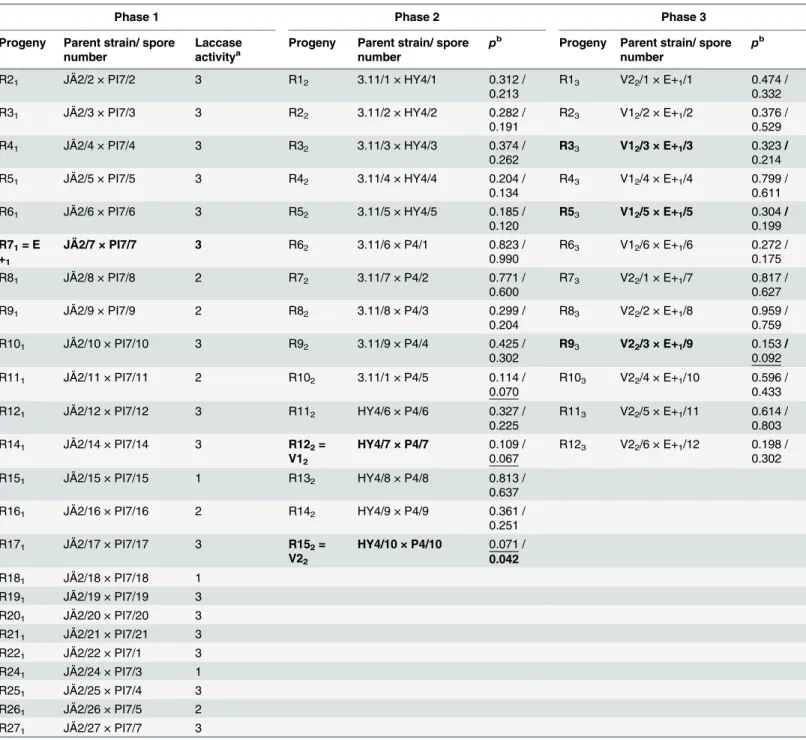
Table 2. Breeding Process of the Study.
Phase 1 Phase 2 Phase 3
Progeny Parent strain/ spore
number Laccaseactivitya Progeny Parent strain/ sporenumber p
b Progeny Parent strain/ spore
number
pb
R21 JÄ2/2 × PI7/2 3 R12 3.11/1 × HY4/1 0.312 /
0.213 R13 V22/1 × E+1/1 0.474 /0.332
R31 JÄ2/3 × PI7/3 3 R22 3.11/2 × HY4/2 0.282 /
0.191 R23 V12/2 × E+1/2 0.376 /0.529
R41 JÄ2/4 × PI7/4 3 R32 3.11/3 × HY4/3 0.374 /
0.262 R33 V12/3 × E+1/3 0.3230.214/
R51 JÄ2/5 × PI7/5 3 R42 3.11/4 × HY4/4 0.204 /
0.134 R43 V12/4 × E+1/4 0.799 /0.611
R61 JÄ2/6 × PI7/6 3 R52 3.11/5 × HY4/5 0.185 /
0.120 R53 V12/5 × E+1/5 0.3040.199/
R71= E
+1
JÄ2/7 × PI7/7 3 R62 3.11/6 × P4/1 0.823 /
0.990 R63 V12/6 × E+1/6 0.272 /0.175
R81 JÄ2/8 × PI7/8 2 R72 3.11/7 × P4/2 0.771 /
0.600 R73 V22/1 × E+1/7 0.817 /0.627
R91 JÄ2/9 × PI7/9 2 R82 3.11/8 × P4/3 0.299 /
0.204 R83 V22/2 × E+1/8 0.959 /0.759
R101 JÄ2/10 × PI7/10 3 R92 3.11/9 × P4/4 0.425 /
0.302
R93 V22/3 × E+1/9 0.153/ 0.092
R111 JÄ2/11 × PI7/11 2 R102 3.11/1 × P4/5 0.114 /
0.070
R103 V22/4 × E+1/10 0.596 / 0.433
R121 JÄ2/12 × PI7/12 3 R112 HY4/6 × P4/6 0.327 /
0.225 R113 V22/5 × E+1/11 0.614 /0.803
R141 JÄ2/14 × PI7/14 3 R122=
V12
HY4/7 × P4/7 0.109 /
0.067 R123 V22/6 × E+1/12 0.198 /0.302
R151 JÄ2/15 × PI7/15 1 R132 HY4/8 × P4/8 0.813 /
0.637
R161 JÄ2/16 × PI7/16 2 R142 HY4/9 × P4/9 0.361 /
0.251
R171 JÄ2/17 × PI7/17 3 R152=
V22
HY4/10 × P4/10 0.071 /
0.042
R181 JÄ2/18 × PI7/18 1
R191 JÄ2/19 × PI7/19 3
R201 JÄ2/20 × PI7/20 3
R211 JÄ2/21 × PI7/21 3
R221 JÄ2/22 × PI7/1 3
R241 JÄ2/24 × PI7/3 1
R251 JÄ2/25 × PI7/4 3
R261 JÄ2/26 × PI7/5 2
R271 JÄ2/27 × PI7/7 3
Breeding phase,C.purpureumstrain and its spore number in each breeding phase are presented. The best progenies in terms of laccase activity (the strongest color reaction, Phase 1) or in terms of efficacy in sprout control in thefield (Phases 2 and 3) three months afterC.purpureumapplication are in bold (seeFig. 2). During Phase 2 the best parent strains based onfield experiments were bred and in Phase 3 the best progenies from Phases 1 and 2 were bred. Note: the subscript of a progeny indicates the breeding phase.
a0: No color reaction, i.e., low laccase activity; 1: slight color reaction; 2: intermediate color reaction; 3: strong color reaction, i.e., high laccase activity on a Petri plate.
bStatistical difference in the number of stump sprouts between the control (cutting only) and theC.purpureumtreatment, and the liquid control (inoculum medium spread withoutC.purpureum) and theC.purpureumtreatment, respectively.P-values indicating statistically significant differences are based on generalized linear mixed models.P-values<0.05 are in bold and those between 0.05 and 0.10 have been underlined.
paired according toTable 2(Phase 1), i.e., two spores from different isolates were placed on a single PDA Petri plate to allow them to form heterokaryotic mycelium. After one week, an in-teraction zone between the isolates developed between the inocula, from which hyphae were transferred to a new PDA Petri plate. Successful pairing was verified microscopically by con-firming clump connections. A single heterokaryotic hyphal tip was further transferred to a new PDA plate for further use.
The three most efficient natural strains tested by Vartiamäki et al. [13], isolates HY4, P4 and 3.11, were originally collected from birches (Betula pendulaandB.pubescens) in Juupajoki in 2003, Vantaa in 2004 and Helsinki in 2001, respectively, and used for the second set of pairings. Altogether 10 spores per isolate HY4 and P4, and 9 spores per isolate 3.11 were successfully iso-lated from the plates and paired as described above (seeTable 2, Phase 2).
Third, the best progenies from Phases 1 and 2 were paired according toTable 2(Phase 3), as described above.
Inoculum for field experiments
The inoculum medium for the field experiments was prepared as follows: 24 g potato dextrose broth (Becton, Dickinson and Company) and 20 g Sipernat 22S (Evonik Degussa) per 1000 ml deionized water was autoclaved in an Agarmatik machine at 121°C for 15 min. Erlenmayer flasks, 250 ml in volume were also autoclaved at 121°C for 15 min. Altogether, 150 ml cooled autoclaved inoculum medium was added to the flasks andC.purpureumhyphae from one PDA cellophane plate (per isolate, Phase 2) was transferred to the flask with a sterilized scalpel. This inoculated medium was incubated in the dark at 18°C for 7–10 d on a rotator shaker (100 rpm). The inoculum was homogenized by Ultra Turrax apparatus for 1.5 min and diluted 1:10 with tap water before treatments in the field.
For Phases 3 and 4, the fungal inoculum was prepared as in Phase 2 except that the weight of hyphae added to the Erlenmayer bottles was equal (0.120 ± 0.024 g and 0.167 ± 0.018 g, mean ± SD, respectively) in each treatment (i.e., for each fungal isolate used in the experiment). All strains were cultivated for 10 d in a shaker at 20°C.
Experiments in the field
The efficacy of all progenies of Phases 2, 3 and 4 was investigated in field experiments. The first experiment (seeTable 2, Phase 2) was established on 9 and 10 June 2009 under electric power lines in Porvoo, Hinthaara, southern Finland. Both days were cloudy with a temperature of ca. 15°C. However, 9 June was partly drizzly. The site included plenty of naturally growing birches (Betula pendulaandB.pubescens) with a basal diameter (at ca. 15 cm above soil surface) of 2.2 ± 1.4 cm (mean ± SD). The efficacy of 15 different progenies and their parental strains HY4, 3.11 and P4 were tested in this field experiment (seeTable 2). Furthermore, sample plots for controls (cutting only) and liquid controls (procedural controls: inoculum medium without
C.purpureum) were also established. Altogether, 80 circular sample plots, four per isolate or control treatment, were established randomly on the site. Each sample plot included ca. 20 birch stumps. Thus, altogether 1583 birch stumps were investigated in this experiment (Betula bendula49%,B.pubescens49% and unrecognized birches 2%—the proportion of tree species was investigated three months after the treatments and therefore some were already dead). In theC.purpureumsample plots, fungal inoculum was spread on stumps immediately after cut-ting. Treatments in the liquid control sample plots were similar, but only inoculum medium without any mycelium was sprayed on the stumps. Viability of the fungal inoculum was con-firmed before and after field applications by squirting inoculum to PDA Petri plates. All of the
Three and a half months later, after one growing season, in September 2009, the number of living sprouts per birch stump and basal diameters of stumps (mm) were measured. Based on the number of sprouts, the two bestC.purpureumprogenies were chosen for further investiga-tion. The two best ones had the lowest number of stump sprouts per stump and the statistical difference was the highest (although usually not significant) when compared to the control stumps. These progenies were named V12and V22(seeTable 2).
In the second field experiment, the efficacy of the progenies and their parental strains in Phase 3 (Table 2) were tested in the field. The efficacy of differentC.purpureumstrains was tested in three different regeneration areas of spruce in Turenki, southern Finland, including lots of naturally grown birches (Betula pendulaandB.pubescens) 1.0 ± 0.4 cm (mean ± SD) in basal diameter (at ca. 15 cm above soil surface). At each site, the efficacy of 12 progenies and the parental strains from different phases, i.e., HY4, P4, 3.11 and V12, V22, E+1, was tested. Furthermore, sample plots for controls (cutting only) and liquid controls (inoculum medium spread withoutC.purpureum) were established. One sample plot per treatment was randomly placed within each site. Each sample plot included ca. 30 birch stumps. Thus, 60 sample plots including 1796 birch stumps were included in the study (Betula pendula46%,B.pubescens
53%, and unrecognized birches 1%). Sample plots were treated on 15 and 16 June 2010. 15 June was partly cloudy, sunny and rainy with 15°C whereas 16 June was sunny but windy with 17°C. AllC.purpureumstrains were viable before and after the experiment.
Three months later, in September 2010, the number of stump sprouts per birch stump and basal diameters of stumps (mm) were measured, and the three bestC.purpureumprogenies were chosen for further investigation. The three best strains had the lowest numbers of stump sprouts and statistical differences were the highest (although usually not significant) when compared to the control stumps.
In the third field experiment we tested the efficacy of the bestC.purpureumstrains from Phases 2 and 3 for three growing seasons. The best strains from Phase 3, R33(progeny strain from the pairing between V12and E+1), R53(V12× E+1) and R93(V22× E+1), together with strains V12and V22from Phase 2 were included in the experiment. Furthermore, HY4, the best parental strain originally collected from the field (based on the study by Vartiamäki et al. [13]), and a liquid control (inoculum medium withoutC.purpureum) were included. Eight re-generation areas of spruce with a high frequency of birches (Betula pendulaandB.pubescens) were chosen for the study (Table 3). Four of the sites were located in Lapinjärvi, and four in Turenki, both in southern Finland. At each site, circular sample plots including ten birch sap-lings per treatment were established. The order of the sample plots was randomized within each site. Altogether 560 birch saplings, 80 saplings per treatment, were included in the study (Betula pendula12%,B.pubescens75% and unrecognized birches 13%). The mean basal diam-eter of birches was 1.1 ± 0.4 cm (mean ± SD, ca. 15 cm above soil surface). The experiment was established on 10 to 13 May 2011. The weather was sunny with a temperature of 14–21°C.
Statistical analyses
Generalized linear mixed models (GLMMs) were used to investigate differences between the treatments. In Phases 2 and 3 the effects of different treatments (control, liquid control and dif-ferentC.purpureumstrains) on the number of stump sprouts were investigated using a Poisson model with log link function in package lme4 in the statistical program R [30,31]. Thus, the number of stump sprouts per stump three months after the treatments was the response vari-able and treatments (as a factor) and the basal diameter of a stump were explanatory varivari-ables in the models. In Phase 2, the sample plot was used as a random factor to take into account pseudoreplication, i.e., the fact that 20 stumps within each sample plot may be—due to environ-mental conditions—more similar than randomly chosen saplings. In Phase 3, site (logging unit) and sample plot were treated as nested random factors to take into account the fact that several stumps within the same site and sample plot were investigated. Both in Phase 2 and 3, the con-trol treatment (cutting only) and the liquid concon-trol (inoculum medium without a fungus) were compared to the other treatments. The best fungal strains were chosen for further investigation based on the biggest differences in the number of stump sprouts per stump between the control treatments and the fungal treatments (lower in the fungal treatment) and the lowestp-values.
The GLMMs were also used to analyze data relating to the final field experiment, which lasted for three growing seasons from 2011 to 2013 (Phase 4). We estimated the models sepa-rately for each year. The package lme4 in R was used to investigate the effects of controls (inoc-ulum withoutC.purpureumspread on cut stumps) and differentC.purpureumstrains on the investigated stumps. Effects on the mortality of investigated stumps and the probability of oc-currence of fruiting bodies on stumps were analyzed using a binomial model with logit link function [30,31]. Effects on the number of stump sprouts per stump were investigated using a Poisson model with log link function. The effect of different treatments on the maximum height of stump sprouts per stump was investigated using function lme in the nlme package in R [31,32] assuming a normal distribution. All stumps were included in the mortality models whereas only living stumps were included when differences between the number and maxi-mum height of stump sprouts were investigated. Explanatory variables in the models were 1) treatment (as a factor with seven levels; however, the liquid control was excluded from the fruiting body model), 2) the basal diameter of a stump (mm), 3) the number of other stumps
Table 3. Description of the Study Sites Included in the Field Experiment in Phase 4.
Site Site
typea Topography Soil Clear-cutting(year) Soilcultivation Spruce saplings planted(year) Lapinjärvi 67 MT Partly
sloping Sand moraine 2003 Mounding 2004
Lapinjärvi 58 MT Even Gravel moraine/stony 1998 No 1999
Lapinjärvi
245 OMT Even Clay/gravel moraine 1999 Disc trenching 2000
Lapinjärvi
349 OMT Even Clay/gravel moraine/peat-covered 2006
b Disc trenching 2007
Turenki 93 OMT Even Gravel moraine 2002 Mounding 2003
Turenki 116 OMT Even Gravel moraine 2004 No 2004
Turenki 220 OMT Even Gravel moraine 2003 Mounding 2004/2007
Turenki 241.2 OMT Even Peat 2003 Mounding 2004–2005
aMT =Myrtillustype forest, OMT =Oxalis
—Myrtillustype forest. bWindfall spruces on this site.
and saplings around an investigated stump, and 4) the total volume of retention trees around an investigated sapling (m3ha-1). For the stump sprout height model 5) browsing (as a factor: 0 = no browsing, 1 = browsing) was also taken into account as it affects the maximum height of stump sprouts. First, differences between the liquid control and theC.purpureumtreatments were investigated. Second, differences between the best fungus treatment (the greatest differ-ence from the control) and otherC.purpureumtreatments were investigated. Correlations be-tween the continuous explanatory variables were low (the strongest Pearson correlation was between the basal diameter of a stump and the total volume of retention trees,r= 0.14), and therefore all of the explanatory variables were included in the models. Forest site and sample plot were used as nested random factors in the models.
Differences in mortality, sprout number and maximum height between birch species (Betula pendulaandB.pubescens) were investigated as above. However, tree species (as a factor with two levels:B.pendulaandB.pubescens) was included as an explanatory variable to the models instead of treatment. The data collected in 2013 including sample plots treated withC. purpur-eumstrains were used in these investigations. Unrecognized dead stumps were removed from the mortality model.
Results
Phase 1: Laccase activity tests and pairings
Altogether 69C.purpureumstrains were collected from birch stumps, and investigated on ABTS Petri plates revealing laccase activity. Based on the color reaction on these plates, ca. 32% of the investigated strains belonged to class 3 (strong color reaction, i.e., high laccase activity, Table 1, see [13]). The bestC.purpureumstrains in this enzymatic test were JÄ2 and PI7 (the strongest color reaction on plates), which were further paired with each other (Table 2, Phase 1). The laccase activity of the progenies of JÄ2 × PI7 was further tested on the ABTS plates. Al-together 67% of the strains belonged to class 3 (strong color reaction, i.e., high laccase activity, Table 2). The best of the progenies in this enzymatic test (showing the strongest color reaction on plates) was R71, which was renamed as E+1.
Phase 2: Pairing of the most efficient parental strains available and first
generation progeny testing in the field
The most efficientC.purpureumparental strains were paired in Phase 2 (Table 2). Based on the subsequent field experiment, progenies R122and R152(later on designated as V12and V22, re-spectively) had the lowest number of stump sprouts andp-values compared to controls. These strains were chosen for further pairings and investigation (seeTable 2,Fig. 2a) although the final effect on sprout control can be expected only after several growing seasons [33]. Differ-ences in the number of stump sprouts between the parental strains HY4, P4 and 3.11, and the control treatments were smaller (0.127p0.892). Furthermore, the models revealed that the number of stump sprouts increased with an increase in basal diameter of a stump (p<0.001).
Phase 3: Pairing of the best progenies from Phases 1 and 2 and second
generation progeny testing in the field
and 3.11 and the controls were smaller (p0.590), but parental strain P4 was quite efficient in this experiment (p0.110). Furthermore, the number of stump sprouts increased with an in-crease in basal diameter of a stump (p<0.001).
Phase 4: Long-lasting field experiment
—
final testing of the efficacy of
the best progenies from Phases 2 and 3
Mortality
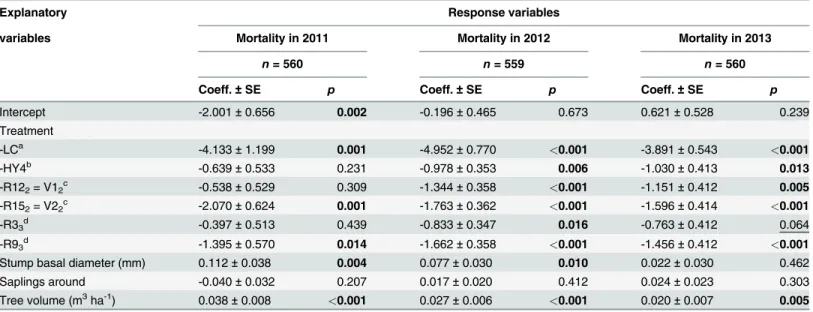
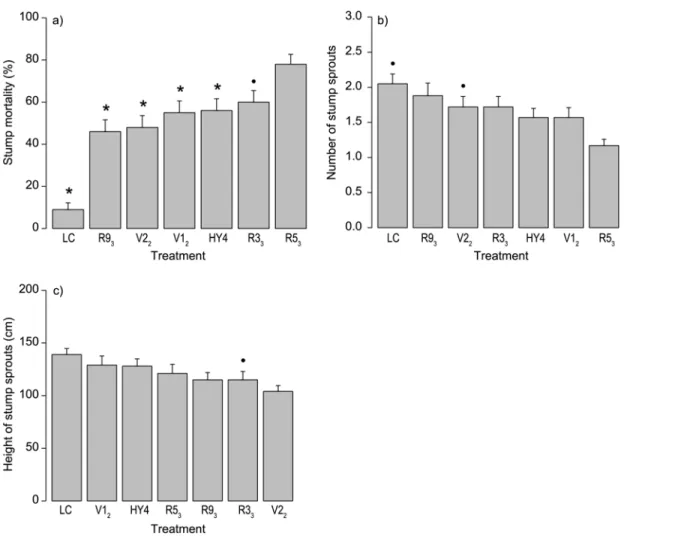
In the final field experiment (Phase 4), lasting three growing seasons (2011–2013), we found that one of the testedC.purpureumprogenies, R53, was considerably more efficient than other strains in the sprout control of birch. Mortality was clearly higher in stumps treated with R53 especially two and three growing seasons after the treatments in 2012 and 2013 (Table 4). This was the only strain that differed statistically significantly from the parental strain HY4 three growing seasons (in 2013) after the treatments. After three growing seasons, the mortality in R53treated stumps was 78% whereas that for the best parental strain, HY4, was 56% and for the control 9% (cutting with inoculum medium withoutC.purpureum, seeTable 4, Figs.3a and4a). The efficacy in sprout control was 28% lower for the parental strain HY4 than for R53. Our results also revealed that another progeny isolate (R33) was highly efficient in sprout con-trol as 60% of the treated birch stumps were dead after three growing seasons. However, the ef-ficacy for R33was 23% lower than for R53. Furthermore, the mortality of stumps was higher in all theC.purpureumtreatments than in the liquid control (0.001p0.099).
Sprout numbers
Our results showed that the number of stump sprouts (in the living birches) was lower for treatment R53than for treatments V12, V22, and the liquid control in 2011 (seeTable 5). After three growing seasons (in 2013), the number of sprouts in living stumps was still the lowest in stumps treated with R53but the differences were not significant any more (seeTable 5, Fig. 3b). The number of stump sprouts in living stumps was lower in all theC.purpureum
treatments compared to the liquid control (0.001p0.085).
Fig 2. The Effects of Different Treatments on Birch Spouting during Phases 2 and 3.The number of stump sprouts of birch (Betula pendulaandB. pubescens) per investigated stump one growing season after the treatments a) in Phase 2 (Porvoo in 2009) and b) Phase 3 (Turenki in 2010). C = control, i. e., cutting only; LC = liquid control, i.e., cut stumps were spread with the inoculum medium withoutC.purpureum; HY4, P4 and 3.11 = the best parental strains ofC.purpureum; E+1, R12-R112, R132-R142, V12-V22, and R13-R123= progenies ofC.purpureumstrains, seeTable 2. Means with standard errors are presented.
Sprout height
Treatment R53was not better than the otherC.purpureumtreatments in terms of the maxi-mum height of stump sprouts (seeTable 6,Fig. 3c). In fact, after the third growing season (in 2013), sprout height was indicatively lower in stumps treated with the progeny R33than with R53. However, the maximum height of stump sprouts in living stumps was lower in allC.
pur-pureumtreatments than in the liquid control (0.005p0.096).
Fruiting schedule
In 2011, stumps treated with treatment R53had higher occurrence of fruiting bodies (56%) than stumps treated with HY4 (38%), V11(39%), V21(41%), R33(46%) and R93(48%). How-ever, only some statistically indicative differences between the strains were found (seeTable 7). In 2012, positive coefficients for the otherC.purpureumtreatments indicated that the occur-rence of fruiting bodies was lower in the R53treatment. In 2013, no differences in the occur-rence of fruiting bodies were found. The occuroccur-rence of fruiting bodies on stumps treated with
C.purpureumdecreased with time, ca. 45% of stumps had fruiting bodies in 2011, whereas later on in 2012 and 2013, 39% and 4% of stumps had fruiting bodies, respectively. Only two stumps in the control treatment had fruiting bodies in 2012 (seeFig. 4d).
Table 4. Differences in Mortality of Birch Stumps between theC.purpureumStrain R53and Other Treatments.
Explanatory Response variables
variables Mortality in 2011 Mortality in 2012 Mortality in 2013
n= 560 n= 559 n= 560
Coeff.±SE p Coeff.±SE p Coeff.±SE p
Intercept -2.001±0.656 0.002 -0.196±0.465 0.673 0.621±0.528 0.239
Treatment
-LCa -4.133±1.199 0.001 -4.952±0.770 <0.001 -3.891±0.543 <0.001
-HY4b -0.639±0.533 0.231 -0.978±0.353 0.006 -1.030±0.413 0.013
-R122= V12c -0.538±0.529 0.309 -1.344±0.358 <0.001 -1.151±0.412 0.005
-R152= V22c -2.070±0.624 0.001 -1.763±0.362 <0.001 -1.596±0.414 <0.001
-R33d -0.397±0.513 0.439 -0.833±0.347 0.016 -0.763±0.412 0.064
-R93d -1.395±0.570 0.014 -1.662±0.358 <0.001 -1.456±0.412 <0.001
Stump basal diameter (mm) 0.112±0.038 0.004 0.077±0.030 0.010 0.022±0.030 0.462
Saplings around -0.040±0.032 0.207 0.017±0.020 0.412 0.024±0.023 0.303
Tree volume (m3ha-1) 0.038±0.008 <0.001 0.027±0.006 <0.001 0.020±0.007 0.005
The effect of different treatments (C.purpureumstrain or liquid control (LC)), the basal area of investigated stumps, the number of saplings and the volume of trees around an investigated sapling on the mortality of birch (Betula pendulaandB.pubescens) stumps in eight regeneration areas of spruce (Picea abies) three months (in 2011), one year (in 2012) and two years (in 2013) after the treatments (generalized linear mixed model results). All stumps have been included in the models. Statistically significantp-values (p<0.05) for the model coefficients are in bold and indicative results have been
underlined (0.05p0.10). The sign of a coefficient indicates whether an explanatory variable has an increasing (+) or decreasing (-) effect on the mortality of stumps. See Figs.3aand4a. Note: the subscript of aC.purpureumprogeny relates to the breeding phase (seeTable 2).
aLiquid control i.e., cut stumps were spread with inoculum medium withoutC.purpureum. bThe best parent stain based on an earlier study [13].
cThe best progenies from Phase 2. dThe best progenies from Phase 3.
Effects of stump sizes and environmental factors
One and two growing seasons after the treatments, an increase in stump basal diameter in-creased stump mortality (seeTable 4). Furthermore, an increase in the volume of retention trees increased mortality during the study. Three growing seasons after the treatments, an in-crease in the basal diameter of stumps inin-creased the number and maximum height of stump sprouts in living stumps, whereas an increase in the number of surrounding saplings and the volume of retention trees decreased the maximum height (see Tables5and6). Browsing de-creased the maximum height in 2011. The probability of occurrence of fruiting bodies in-creased with an increase in stump diameter (seeTable 7).
Differences between
Betula pendula
and
B
.
pubescens
Our results revealed that only slight differences were found between the two birch species. Mortality ofB.pendula(58% of investigated stumps) was indicatively higher than forB. pubes-cens(48%,p= 0.097). However, no differences were found when the number and maximum height of stump sprouts were compared (p= 0.574 andp= 0.707, respectively).
Fig 3. The Effects of Different Treatments on Birch Sprouting during Phase 4.The effects on a) the mortality of stump sprouts (n= 560), b) the number of stump sprouts in living stumps (n= 279), and c) the maximum height of stump sprouts in living stumps (n= 279) of birch (Betula pendulaandB.
pubescens) three growing seasons (autumn 2013) after the treatments. Means with standard errors are presented. Statistically significant differences between theC.purpureumstrain R53and other treatments are indicated with an asterisk (p<0.05) or a dot (0.05p0.10). See Tables4–6.
Discussion
Our results showed that breeding can be used to increase the efficacy ofC.purpureumas a bio-control agent. After the whole breeding process,C.purpureumstrain R53was statistically sig-nificantly better than the best original parental strain HY4 and subsequent parental strain V12 created during the process. After three growing seasons, the mortality of birch stumps ca. 1 cm in diameter treated with R53was 78% whereas those with parental strains HY4 and V12were only 56% and 55%, respectively. Thus, it seems that our breeding process was successful, sup-porting our initial hypothesis.
The efficacy of HY4 has been investigated in an earlier study with birch stumps ca. 3–4 cm in di-ameter resulting in more than 90% mortality after two growing seasons [13]. The lower mortalities observed in the present study was expected as it is known that mortality is usually lower for smaller stumps [9]. Therefore, the mortality caused by the best strain from our breeding program (78%) in small stumps with a diameter of about 1 cm can be considered a promising result because in regen-eration areas of spruce (Picea abies) and pine (Pinus sylvestris), non-crop species of this size are usually removed. Thus, high biocontrol efficacy withC.purpureumcan provide one option to lower costs for sprout control via decreasing the number of repeated cuttings (see [34]). Sprout
Fig 4. Comparison between the Best Progeny and Parent Strain ofC.purpureum.The effects ofC.purpureumstrains R53(a progeny), HY4 (a parental strain), and the liquid control (cutting with inoculum medium withoutC.purpureum) on a) stump mortality (%), b) the number of stump sprouts (in living stumps), c) stump sprout height (in living stumps, cm), and d) the occurrence of fruiting bodies (%) on birch (Betula pendulaandB.pubescens) stumps one, two and three growing seasons after the treatments (Phase 4). Means with standard errors are presented. Statistically significant differences (p<0.05)
between fungal strains R53and HY4 are indicated with an asterisk and indicative differences (0.05p0.10) with a dot. See Tables4–7.
control also allows better growth conditions for more valuable conifers because competition with broad-leaved trees can reduce their growth and even induce mortality [3,34,35].
It seems thatC.purpureumis especially efficient in the sprout control of birch, as for yellow birch (Betula alleghaniensisBritt.) at least 96% of inoculated stumps died within one year [8], similarly as with silver and downy birch after three growing seasons [33], whereas in the study of Roy et al. [14], the mortality of paper birch (Betula papyriferaMarsh.) was ca. 75% after four growing seasons. Also, fruiting bodies have been especially abundant on inoculated yellow (87% of the treated stumps) and paper birch stumps (100%) [8,36].
In our study, after the first growing season in 2011, the occurrence of fruiting bodies was highest (56%) with strain R53indicating that this fungus was able to penetrate wood faster than the parental strain HY4 and the otherC.purpureumstrains. Investigations with red alder (Alnus rubraBong.) have revealed a close relationship between the time of mortality and the occurrence of fruiting bodies: peaks in fruiting body formation occur one year before, the same year or one year after mortality, and those trees that died slowly supported fruiting bodies for a longer time [36].
Although significant differences were not found in the number of stump sprouts per living stump between the progeny strain R53and the parental strain HY4, the treatment with R53 re-sulted in a lower number of sprouts in living stumps (see Figs.3band4b). Furthermore, results relating to the progeny strain R53indicate that the number of sprouts per stump was lower than
Table 5. Differences in the Number of Stump Sprouts of Living Birches between theC.purpureumStrain R53and Other Treatments.
Explanatory Response variables
variables Number of stump sprouts in
2011 Number of stump sprouts in2012 Number of stump sprouts in2013
n= 454 n= 317 n= 279
Coeff.±SE p Coeff.±SE p Coeff.±SE p
Intercept 1.044±0.121 0.001 0.756±0.232 0.001 0.170±0.286 0.552
Treatment
-LCa 0.343±0.099 0.001 0.276±0.160 0.085 0.448±0.238 0.060
-HY4b 0.155±0.105 0.139 0.105±0.178 0.554 0.209±0.258 0.418
-R122= V12c 0.272±0.105 0.010 -0.002±0.177 0.991 0.240±0.257 0.350
-R152= V22c 0.271±0.102 0.008 0.212±0.172 0.218 0.415±0.249 0.095
-R33d 0.091±0.107 0.391 -0.126±0.183 0.494 0.251±0.261 0.336
-R93d 0.130±0.104 0.210 0.030±0.171 0.859 0.334±0.251 0.184
Stump basal diameter (mm) 0.044±0.007 <0.001 0.029±0.011 0.009 0.024±0.014 0.076
Saplings around -0.008±0.005 0.141 -0.021±0.009 0.020 -0.015±0.010 0.147
Tree volume (m3ha-1) -0.006±0.002 <0.001 -0.005±0.004 0.143 -0.005±0.003 0.125
The effect of different treatments (C.purpureumstrain or liquid control (LC)), the basal area of investigated stumps, the number of saplings and the volume of trees around an investigated sapling on the number of stump sprouts of birch (Betula pendulaandB.pubescens) in eight regeneration areas of spruce (Picea abies) three months (in 2011), one year (in 2012) and two years (in 2013) after the treatments (generalized linear mixed model results). Living stumps have been included in the models. Statistically significantp-values (p<0.05) for the model coefficients are in bold and indicative results
have been underlined (0.05p0.10). The sign of a coefficient indicates whether an explanatory variable has an increasing (+) or decreasing (-) effect on the number of stump sprouts. See Figs.3band4b. Note: the subscript of aC.purpureumprogeny relates to the breeding phase (seeTable 2). aLiquid control i.e., cut stumps were spread with inoculum medium withoutC.purpureum.
bThe best parent stain based on an earlier study [13]. cThe best progenies from Phase 2.
in the control in every investigated year. However, in terms of the maximum height of sprouts (in living stumps), hardly any differences between the treatments were found (see also [13]).
Our results revealed that an increasing volume of trees around an investigated stump in-creased stump mortality. This is in accordance with earlier findings as shading of neighboring trees has been shown to have a profound effect on shoot growth due to a greater proportion of shoot buds dying under heavy shading [37,38]. Furthermore, our results showed that an in-crease in the number of surrounding saplings dein-creased the number and maximum height of stump sprouts (see also [39]). On the other hand, high mortality withC.purpureuminoculated stumps (especially with R53) may provide more growing space for those stumps that are still living. This may be the reason why significant differences between the treatments were not ob-served in stump numbers and height.
AllC.purpureumstrains investigated were originally collected from birch stumps in south-ern and middle Finland (seeMethodssection andTable 1). However, investigations from Fin-land, Canada and New Zealand showed thatC.purpureumstrains are genetically diverse, and are not associated with a specific host species or ecological region [11,17,18]. Thus, it is possible that the most efficient strain, R53, is efficient also against the sprouting of other tree species and in other geographical areas.
Table 6. Differences in the Height of Stump Sprouts of Living Birches between theC.purpureumStrain R53and Other Treatments.
Explanatory Response variables
variables Stump sprout height in 2011 Stump sprout height in 2012 Stump sprout height in 2013
n= 454 n= 317 n= 279
Coeff.±SE p Coeff.±SE P Coeff.±SE p
Intercept 46.065±4.588 <0.001 75.190±10.645 <0.001 112.429±16.939 <0.001
Treatment
-LCa 4.330±3.557 0.230 3.155±7.444 0.674 5.965±11.204 0.598
-HY4b -1.704±3.620 0.640 2.906±7.900 0.715 -5.446±11.974 0.652
-R122= V12c 0.717±3.668 0.846 -0.057±7.785 0.994 1.679±11.857 0.888
-R152= V22c 0.766±3.580 0.832 -9.614±7.727 0.221 -9.347±11.767 0.432
-R33d -2.646±3.692 0.478 -8.554±8.040 0.294 -21.540±12.295 0.088
-R93d 2.173±3.644 0.554 -7.848±7.736 0.317 -15.882±11.896 0.190
Stump basal diameter (mm) 1.466±0.205 <0.001 2.403±0.454 <0.001 3.598±0.725 <0.001
Saplings around -0.180±0.180 0.316 -0.718±0.396 0.071 -1.692±0.611 0.006
Tree volume (m3ha-1) -0.163±0.071 0.027 -0.153±0.156 0.335 -0.553±0.229 0.021
Browsing -6.459±1.649 <0.001 1.263±3.413 0.712 3.365±6.634 0.613
The effect of different treatments (C.purpureumstrain or liquid control (LC)), the basal area of investigated stumps, the number of saplings and the volume of trees around an investigated sapling, and browsing on the maximum height of stump sprouts of birch (Betula pendulaandB.pubescens) in eight regeneration areas of spruce (Picea abies) three months (in 2011), one year (in 2012) and two years (in 2013) after the treatments (linear mixed model results). Living stumps have been included in the models. Statistically significantp-values (p<0.05) for the model coefficients are in bold and
indicative results have been underlined (0.05p0.10). The sign of a coefficient indicates whether an explanatory variable has an increasing (+) or decreasing (-) effect on the maximum height of stump sprouts. See Figs.3cand4c. Note: the subscript of aC.purpureumprogeny relates to the breeding phase (seeTable 2).
aLiquid control i.e., cut stumps were spread with inoculum medium withoutC.purpureum. bThe best parent stain based on an earlier study [13].
cThe best progenies from Phase 2. dThe best progenies from Phase 3.
Furthermore, earlier studies have indicated that a single genotype can be used as inoculum without the risk of introducing genes that differ significantly from local populations [11,17]. The best strain R53was developed by traditional breeding (via consequent pairings of selected myce-lia), i.e., similarly like any otherC.purpureumstrain in the nature. In that sense this strain does not differ from its natural counterparts. Moreover, as the fungus has no asexual stage, the genetic combination of a single exceptionally efficient biocontrol fungus breaks up in meiosis before the spores are released. Thus, the sameC.purpureumgenotype applied on cut stumps cannot spread further in forest ecosystems, and thus there is no risk for explosion of the biocontrol strain.
Classical breeding experiments with biocontrolling fungi are scarce. However, in addition to ours, Wall et al. [10] compared the efficacy ofC.purpureummonokaryons and their dikaryon progenies in causing wood tissue mortality, but could not find any differences. However, their experiment was not tested under field conditions. Another biocontrol fungus,Phlebiopsis gigantea, was bred to improve the efficacy againstHeterobasidionroot rot in forests [27]. Re-sults of that study indicated that progeny strains had better properties againstH.parviporum
than the parental strains. Furthermore, classical pairings were successfully used to improve temperature tolerance of fermenting yeasts using a backcross approach [25]. Thus, these stud-ies (including the present one) show that improving by breeding may help in developing more efficient fungal strains for different purposes.
Table 7. Differences in the Occurrence of Fruiting Bodies in Birch Stumps between theC.purpureumStrain R53and Other Treatments.
Explanatory Response variables
variables Occurrence of fruiting bodies
in 2011 Occurrence of fruiting bodiesin 2012 Occurrence of fruitingbodies in 2013
n= 480 n= 479 n= 480
Coeff.±SE p Coeff.±SE p Coeff.±SE p
Intercept -2.339±0.752 0.002 -2.382±0.570 <0.001 -
-Treatment
-HY4a -0.970±0.496 0.051 0.248±0.350 0.480 -
--R122= V12b -0.959±0.511 0.061 0.022±0.350 0.950 -
--R152= V22b -0.698±0.490 0.154 0.759±0.346 0.028 -
--R33c -0.678±0.489 0.166 0.031±0.355 0.931 -
--R93c -0.584±0.481 0.225 0.209±0.349 0.549 -
-Stump basal diameter (mm) 0.258±0.040 <0.001 0.145±0.032 <0.001 -
-Saplings around -0.014±0.031 0.640 0.007±0.023 0.752 -
-Tree volume (m3ha-1) 0.012±0.010 0.249 0.001±0.007 0.910 -
-The effect of different treatments (C.purpureumstrain), the basal area of investigated stumps, the number of saplings and the volume of trees around an investigated sapling on the probability of occurrence of fruiting bodies on birch (Betula pendulaandB.pubescens) stumps in eight regeneration areas of spruce (Picea abies) three months (in 2011) and one year (in 2012) after the treatments (generalized linear mixed model results). The model for year 2013 was not estimated because the occurrence of fruiting bodies was too low (4%). All stumps except those in the liquid control have been included in the models. Statistically significantp-values (p<0.05) for the model coefficients are in bold and indicative results have been underlined (0.05p0.10). The sign of a coefficient indicates whether an explanatory variable has an increasing (+) or decreasing (-) effect on the occurrence of fruiting bodies. See Fig. 4d. Note: the subscript of aC.purpureumprogeny relates to the breeding phase (seeTable 2).
aThe best parent stain based on an earlier study [13]. bThe best progenies from Phase 2.
cThe best progenies from Phase 3.
However, breeding studies with field experiments may be time consuming as seen in our study. Time for follow-up is usually limited, which forces us to choose the best strains for sub-sequent steps after a short time period. For example, in our study, we had to choose progeny isolates for the next pairings after the first growing season (both in 2009 and 2010) based only on the number of stump sprouts in differentC.purpureumtreatments (a low mortality did not allow for mortality analyses). Moreover, as seen also in the present study, the efficacy ofC. pur-pureumis not tightly associated with the parents, because each parent can produce relatively virulent as well as avirulent strains [10]. This is not surprising as Wall et al. [10] have stated that the inheritance of efficacy is probably multifactorial and complex and may be subject to different modifying factors under field and laboratory conditions. Thus, final efficacy should always be investigated in field experiments. This view was supported by our results as the best strain in terms of laccase activity in the laboratory, E+1, was not efficient in sprout control (see Fig. 2b) although some of its progenies (R53and R33) in the end showed the best ability to pre-vent sprouting of broad-leaved trees in the field.
Conclusions
We showed that traditional breeding can increase the efficacy ofC.purpureumin the sprout control of birch. Mortality of the treated birch stumps was highest when the progeny strain R53 was used to control sprouting. This resulted in 78% mortality in birch stumps 1 cm in diameter. The efficacy of strain R53was significantly higher than that of the investigated parental strain HY4 (56%). The effect of sprout control was especially pronounced when the volume of trees and the number of surrounding saplings was high. However, breeding experiments that aim at increasing the efficacy of sprout control are time consuming because efficacy has to be investi-gated in long-lasting field experiments.
Acknowledgments
We thank Fingrid Ltd., UPM-Kymmene Ltd. and the Finnish Forest Research Institute for pro-viding forest sites, and Antti Uotila for propro-vidingC.purpureumstrains for the study. Markku Rantala, Erkki Piiroinen, Kaarina Pynnönen, Asko Harju, Marja-Leena Santanen, Ritva Vanha-nen, Pekka Hämäläinen and Juha Honkaniemi helped in the field. Sonja Sarsila and Minna Sinkkonen are acknowledged for preparing plates for the study. We also thank Marina Brandt-berg for valuable comments on the manuscript. Anne Siika modified the figures, and Johan Kotze checked the language.
Author Contributions
Conceived and designed the experiments: LH HV JH. Performed the experiments: LH HV JH. Analyzed the data: LH. Contributed reagents/materials/analysis tools: LH HV JH. Wrote the paper: LH HV JH.
References
1. Finnish Forest Research Institute (1995) National forest inventory data. Vantaa, Finland.
2. Valkonen S, Ruuska J (2003) Effect ofBetula pendulaadmixture on tree growth and branch diameter in youngPinus sylvestrisstands in southern Finland. Scand J For Res 18: 416–426.
3. Uotila K, Saksa T (2014) Effects of early cleaning on youngPicea abiesstands. Scand J For Res 29: 111–119.
5. Pitt DG, Dumas MT, Wall RE, Thompson DG, Lanteigne L, et al. (1999).Chondrostereum purpureum as a biological control agent in forest vegetation management. I Efficacy on speckled alder, red maple and aspen in eastern Canada. Can J For Res 29: 841–851.
6. FSC Standard for Finland (2010) Finnish FSC association. 46 p. Available: http://ic.fsc.org/force-download.php?file=136. Accessed 2014 Jun 25.
7. Äijälä O, Koistinen A, Sved J, Vanhatalo K, Väisänen P, editors (2014) Metsänhoidon suositukset [Rec-ommendations for forestry]. Metsätalouden kehittämiskeskus Tapion julkaisuja. ISBN 978–952–6612–
32–4 Available:http://www.tapio.fi/files/tapio/metsanhoitosuositukset/Metsanhoidon_suositukset_ ver2_netti.pdf. (In Finnish) Accessed 2014 Jun 25.
8. Wall RE (1990) The fungusChondrostereum purpureumas a silvicide to control stump sprouting in hardwoods. North J Appl For 7: 17–19.
9. Hamberg L, Malmivaara-Lämsä M, Löfström I, Hantula J (2014) Effects of a biocontrol agent Chondros-tereum purpureumon sprouting ofSorbus aucupariaandPopulus tremulaafter four growing seasons. BioControl 59: 125–137.
10. Wall RE, Macey DE, Sela E (1996) Virulence and interfertility ofChondrostereum purpureumisolates. Biol Control 7: 205–211.
11. Gosselin L, Jobidon R, Bernier L (1995) Assessment of genetic variation withinChondrostereum pur-pureumfrom Québec by random amplified polymorphic DNA analysis. Mycol Res 100: 151–158.
12. Vandenbroucke JE, Gaucher C, Major N (2005) Biological vegetation management: an alternative to chemical pesticides. J Arboric 31: 251–256.
13. Vartiamäki H, Maijala P, Uotila A, Hantula J (2008a) Characterization of growth and enzyme production ofChondrostereum purpureumisolates and correlation of these characteristics with their capability to prevent sprouting of birch in field. Biol Control 47: 46–54.
14. Roy V, Dubeau D, Auger I (2010). Biological control of intolerant hardwood competition: Silvicultural ef-ficacy ofChondrostereum purpureumand worker productivity in conifer plantations. For Ecol Manage 256: 1571–1579.
15. Butler EJ, Jones SG (1949) Silver leaf disease of plum,Stereum purpureum(Fr.) Fr. In: Plant Patholo-gy. London: MacMillian & Co., pp. 763–767.
16. Scheepens PC, Hoogerbrugge A (1989) Control ofPrunus serotinain forests with the endemic fungus Chondrostereum purpurem. In: Delfosse ES, editor. Proceedings of the VII International Symposium on Biological Control of Weeds, Rome: Ist Patol Veg (MAF). pp. 545–551.
17. Vartiamäki H, Uotila A, Vasaitis R, Hantula J (2008b) Genetic diversity in Nordic and Baltic populations ofChondrostereum purpureum: a potential herbicide biocontrol agent. For Pathol 38: 381–393.
18. Spiers AG, Brewster DT, Slade A, Gardiner SE (2000) Characterization of New Zealand isolates of Chondrostereum purpureumwith regard to morphology, growth, pathogenicity and RAPD banding pat-terns. Mycol Res 104: 395–402.
19. Spiers AG, Edwards WRN, Hopcroft DH (1987) Effects of silverleaf infection on ultrastructure of foliage ofPrunus,Rosa, andPopulus. NZ J Bot 25: 411–423.
20. Spiers AG, Brewster DT, Bus VG, Hopcroft DH (1998) Seasonal variation in susceptibility of xylem tis-sue ofMalus,Pyrus, andSalixspecies toChondrostereum purpureumin New Zealand. Mycol Res 102: 881–890.
21. Strunz GM, Bethell R, Dumas MT, Boyonoski N (1997) On a new synthesis of sterpurene and the bioac-tivity of some relatedChondrostereum purpureumsesquiterpene metabolites. Can J Chem 75: 742–753.
22. Kirk TK, Farrell RL (1987) Enzymatic“combustion”: the microbial degradation of lignin. Annu Rev
Micro-biol 41: 465–505. PMID:3318677
23. ten Have R, Teunissen PJM (2001) Oxidative mechanisms involved in lignin degradation by white-rot fungi. Chem Rev 101: 3397–3413. PMID:11749405
24. Leatham GF (1986) The ligninolytic activities ofLentinus edodesandPhanerochaete chrysosporium. Appl Microbiol Biotechnol 24: 51–58.
25. Marullo P, Mansour C, Dufour M, Albertin W, Sicard D, et al. (2009) Genetic improvement of thermo-tol-erance in wineSaccharomyces cerevisiaestrains by a backcross approach. FEMS Yeast Res 9: 1148–1160. doi:10.1111/j.1567-1364.2009.00550.xPMID:19758333
27. Sun H, Korhonen K, Hantula J, Asiegbu FO, Kasanen R (2009) Use of breeding approach for improving biocontrol efficacy ofPhlebiopsis giganteastrains againstHeterobasidioninfection of Norway spruce stumps. FEMS Microbiol Ecol 69: 266–273. doi:10.1111/j.1574-6941.2009.00711.xPMID:19496817
28. Steffen KT, Hofrichter M, Hatakka A (2000) Mineralization of14C-labelled synthetic lignin and ligninoly-tic enzyme activities of litter-decomposing basidiomycetous fungi. Appl Microbiol Biotechnol 54: 819–825. PMID:11152075
29. Hyvämäki T (2002) Tapion taskukirja [The handbook of Tapio]. Helsinki: Kustannusosakeyhtiö Metsä-lehti. 555 p. (in Finnish)
30. Bates D, Maechler M, Bolker B (2012) lme4: Linear mixed-effects models using S4 classes. R package version 0.999999–0. Available:http://CRAN.R-project.org/package = lme4
31. R Core Team (2012) R: A language and environment for statistical computing. R Foundation for Statis-tical Computing, Vienna, Austria. ISBN 3–900051–07–0, URL Available:http://www.R-project.org/. doi:10.1002/jcc.22917PMID:22278855
32. Pinheiro J, Bates D, DebRoy S, Sarkar D (2012) nlme: Linear and Nonlinear Mixed Effects Models. R package version 3.1–104. Available:http://CRAN.R-project.org/package = nlme
33. Vartiamäki H, Hantula J, Uotila A (2009) Effect of application time on the efficacy ofChondrostereum purpuremtreatment against the sprouting of birch in Finland. Can J For Res 39: 731–739.
34. Kaila S, Kiljunen N, Miettinen A, Valkonen S (2006) Effect of timing of precommercial thinning on the consumption of working time inPicea abiesstands in Finland. Scand J For Res 21:496–504.
35. Jobidon R (2000) Density-dependent effects of northern hardwood competition on selected environ-mental resources and young White spruce (Picea glauca) plantation growth, mineral nutrition, and stand structural development—a 5-year study. For Ecol Manage 130: 77–97.
36. Wall (1997) Fructification ofChondrostereum purpuremon hardwoods inoculated for biological control. Can J Plant Pathol 19: 181–184.
37. Jones M, Harper JL (1987) The influence of neighbours on the growth of trees I. The demography of buds inBetula pendula. Proc R Soc Lond B Biol Sci 232: 1–18.
38. Atkinson MD (1992)Betula pendulaRoth. (B.verrucosaEhrh.) andB.pubescensEhrh. Biological Flora of the British Isles. J Ecol 80: 837–870.