[Short communication]
Small mammals of the Mongolian mountain steppe region near Erdensant:
insights from live-trapping and bird pellet remains.
Joanne L. Isaac
2*, Jargal Jamsranjav
1, Lucy Simpson
1and Sarah R. B. King
11Steppe Forward Programme, Biology Faculty, National University of Mongolia, PO Box 46/377, Ulaanbaatar 210646, Mongolia
2Tropical Biology, James Cook University, Queensland, Australia. *Corresponding Author:
5/17 Love Lane, Mundingburra, QLD, 4810, Australia Ph: +61 7 47814133
Abstract
Relatively little is known of the distribution, abundance and ecology of small mammals in Mongolia
and as a result there is scant knowledge of the effects of environmental and anthropogenic factors on small mammal populations. The aim of this study was to assess the occurrence of small mammals in mountain steppe habitat from live-trapping and analysis of mammal remains from raptor pellets and below nests. During live-trapping, root voles (Microtus oeconemus) were the most commonly caught
species accounting for 47.5 % of captures, striped hamsters (Cricetulus barabensis) and pika (Ochotona hyperborea) accounted for 30 % and 22.5 % of captures respectively. Temperature inluenced trapping
success, with small mammals appearing to avoid being active at temperatures over 20˚C. The three
species caught on the trapping grid appeared to avoid competition for resources through both temporal
and spatial differences in the use of available habitat. Mammals identiied from raptor pellets and other
remains included the grey hamster (Cricatulus migratorius), Siberian marmot (Marmota sibirica), red
fox (Vulpes vulpes), long-tailed souslik (Citellus undulatus) and the Daurian mole (Myospalax aspalax).
Results are discussed in terms of their relevance to the conservation of mammals in Mongolia and their co-existence with livestock and humans.
Key words: grazing, livestock, live-trapping, mammal, Mongolia, niche overlap.
Introduction
Relatively little is known of the distribution,
abundance and ecology of small mammals in
Mon-golia (Clarke et al. 2006) and as a result there is
scant knowledge of the effects of environmental and anthropogenic factors on small mammal
popula-tions. More than 25 % of Mongolia is classiied as mountain-steppe (Mallon, 1985) and a variety of
small mammals occur in this habitat type. How-ever mountain steppe regions are also increasingly occupied by humans, resulting in wildlife being threatened by competition with livestock for pasture and water and illegal hunting.
Globally, many studies have found a decrease in the abundance and diversity of small mammals
with an increase in grazing intensity (e.g. Schmidt
et al., 2005). In Mongolia, livestock stocking rates
are increasing at a rapid level in the mountain steppe regions and this can result in grass on the steppes
being shorter and sparser, with reduced soil mois-ture content, which is predicted to alter small mam-mal diversity and species composition (Wang et al., 2003). Outbreaks of Brandt’s vole (Microtus brandti), in conjunction with grazing pressure, can
drastically defoliate grasslands. However, poisoning to control Brandt’s vole can also negatively impact on other native mammals and birds (Natsagdorj &
Batbayar, 2002). A number of small mammals in the
steppe regions are hunted for food and fur, such as
the Siberian marmot (Marmota sibirica) and some
species of ground squirrel (Citellus spp.).
to co-exist.
Materials and Methods
Study Area
The study area (around N 47˚ 07’, E 104˚ 20’)
was located in a valley adjacent to the Batchan
Protected Area, Töv aimag, approximately 8 hours
drive south-west of Ulaanbaatar. Vegetation
includ-ed mixinclud-ed birch (Betula platyphylla) forest patches
on north facing slopes, with rocky outcrops and
steppe vegetation on other slopes, e.g. Siberian
needlegrass (Stipa siberica), foot-like sedge (Carex pediformis) and bluegrass (Poa attenuate). Salix
spp. scrub occurred in drainages and valley bottoms. The study took place between the dates of 15th June
– 4th July 2005. Livestock present in the valley and
nearby included horses, cattle and sheep.
Live-trapping
The trapping study ran from 28th June – 1st July.
A trapping grid was set up with a total of 50 traps
in rows of 10, spaced at 5 m intervals. The trap-ping grid was set in various plant communities in the valley bottom, including shrubs, grasses and sedges. Traps were standard small mammal traps made by Elliott© and Sherman© and were baited
with peanut butter and millet, rolled into small balls, with bedding material provided. Traps were
checked approximately every 2 hours during the
day from 0600h – 2200h, and were also left set
overnight. On capture, all animals were identiied and sexed, then released at their place of capture.
Other details recorded were time of capture and
temperature. Trapping effort was deined as the
number of trap nights x traps (i.e. 50 x 3).
In order to investigate temporal differences in
habitat use between small mammals at the study site, time checks were pooled into four time blocks
for analysis – 1 (0600-1400); 2 (1400-1800); 3 (1800-2200); 4 (2200-0600). The vegetation in a 1 metre square around each trap site was assessed; microhabitat descriptors taken included % total veg
-etation cover, average veg-etation height (cm), % grass cover, average grass height (cm), % shrub cover, average shrub height (cm) and % total bare
ground.
Mammal remains from raptor pellets
Raptor pellets were collected ad hoc during the study. Where raptor nests (most commonly of the black kite, Milvus migrans) were identiied, the area
below the nest was extensively searched for pellets
and other remains, which were taken back to camp
for identiication. Pellets were soaked in water over
night to aid in the removal of small bones.
Mam-mal remains were identiied using the key from Dulamtseren (1970).
Results
Live-trapping
We caught three species of small mammal dur-ing the trappdur-ing study. Trappdur-ing effort totalled 150 trap nights, with a total of 40 captures and a
capture success of 27 %. Species captured were
Cricetulus barabensis (striped hamster), Microtus oeconemus (root vole) and Ochotona hyperborea
(northern pika). Root voles were the most com
-monly caught species, accounting for 47.5 % of
0 1 2 3 4 5
3 8 13 18 23 28
Temperature (C)
N
umber of capt
ures
all captures, while hamsters and pika accounted for
30 % and 22.5 % of captures respectively. There
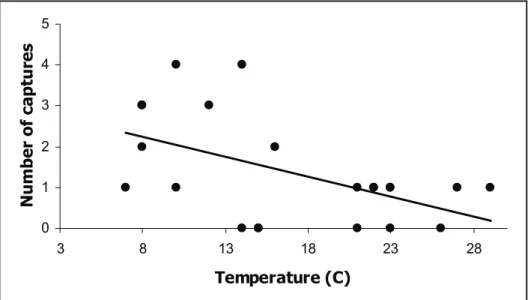
was a negative relationship between the number of animals caught and the temperature at the time of
trap check (Figure 1; R2 = 0.27; n = 22; p = 0.01).
The majority of animals (>70 %) were caught at temperatures between 7-14˚C.
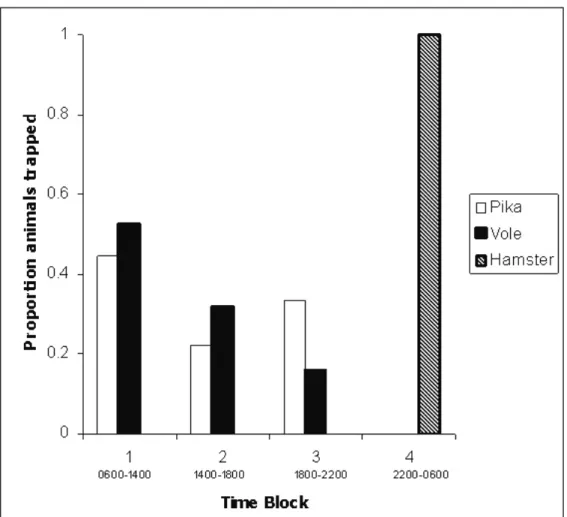
We found some evidence of a difference in the temporal use of the habitat by the three species
caught (Figure 2). Pika and voles were most active
in the mornings and were active at similar times
during the day; neither species appeared to be active
at night. No hamsters were captured during the day: they appeared to be strictly nocturnal, with activity restricted to the hours of 2200-0600.
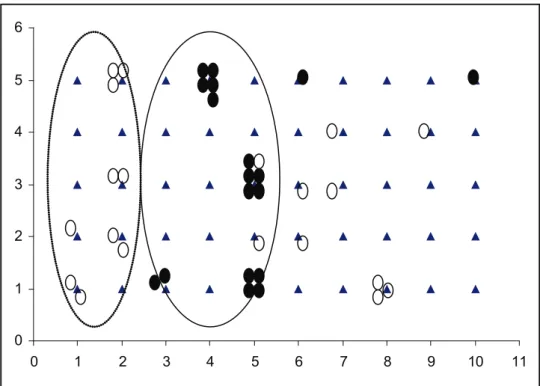
There was evidence of spatial differences in mi-crohabitat use between pika and voles on the trap-ping grid. There was no overlap in the microhabitats
where pika and voles were trapped (Fig. 3), sug -gesting they avoid overlap by using different areas. Due to the small sample sizes of animals caught,
there were no signiicant relationships with any of
the microhabitat variables measured. However, preliminary regressions indicate that more voles were caught where there is less overall vegetation
cover (R2 = 0.61, n = 6, p = 0.06), while pikas were
caught in areas with more grass cover (R2 = 0.71,
n = 4, p = 0.15).
Figure 2. Bar chart showing the proportion of each small mammal species caught during each time
block. Pikas are denoted by open bars, voles by illed bars and hamsters by hatched bars. Mammals identiied in raptor pellets and
remains
Six species of mammal were identiied from
raptor pellets or remains found below raptor nests, these are summarised in Table 1. The most
com-monly occurring remains came from the Siberian
marmot, with smaller rodents, most commonly grey
hamster and root vole, being the next most frequent
prey remains found.
Two additional skulls found at the study site, not obviously associated with raptor nests, were
Discussion
This study identiied three species of small mam -mal occurring at the study site during trapping stud-ies and a further four small mammals from remains
around raptor nests, along with red fox (Vulpes vul-pes) remains. The occurrence of these species in this area is in agreement with distribution maps given
in Mallon (1985) and Tinnin et al., (2002), except
for C. migratorius. As well as being identiied from
remains found in raptor pellets, C. migratorius was
caught in traps set at the camp (kitchen) and was
seen foraging during the day around the study area.
C. migratorius is generally considered a desert and steppe species (Krasnov et al., 2005), so it is not
unlikely that the species was identiied here. It is
however possible, but highly unlikely given the
large number of remains identiied in raptor pellets, that the species was misidentiied.
Although the data were insuficient for formal
analyses to be carried out, there was some evidence of niche partitioning in the three rodent species caught on the trapping grid. While data are clearly preliminary in this study, some interesting patterns were highlighted which suggest ways in which these species may avoid direct competition over resources. Hamsters were found to use areas of the trapping grid utilised by both of the other spe-cies, but appeared to avoid competition by temporal separation: being strictly nocturnal while the other two species were strictly diurnal. Voles and pika, although active at similar times of the day, were found to use different areas of the trapping grid,
Table 1. Species identiied, and percent of their total remains identiied, from raptor pellets
Species Identiied % of Total Identiied Remains
Marmota sibirica (Siberian marmot) 4
Cricatulus migratorius (grey hamster) 15
Unidentiied rodent incisors 1
Unidentiied avian bones 1
Unidentiied Microtus jaws 11
Microtus oeconemus (root vole) 8
Vulpes vulpes (red fox) 4
Citellus undulates (long-tailed souslik) 2 0
1 2 3 4 5 6
0 1 2 3 4 5 6 7 8 9 10 11
Figure 3. Grid representing the 10 m x 5 m trapping grid showing the distribution of trapping
records for each of the three mammal species caught. Pikas are denoted by open circles, voles
by illed black circles and hamsters by hatched circles. The dashed circle shows the clustering
avoiding the potential for spatial overlap with each
other. All three of the species caught on the grid are
burrowing rodents with overlapping diets to some degree. However, their diet preferences do differ – root voles are specialist herbivores, tending to prefer sedges and grasses, predominantly Carex
spp. (Steen et al., 2005), pikas are more general -ist herbivores, eating grasses and other vegetation
(Dearing, 1997), while striped hamsters are largely
granivorous (Wang et al., 2003). Thus these rodents
may also, to some degree, use food partitioning as
another mechanism of coexistence. The preliminary
data on microhabitat preferences on the trapping grid indicates that hamsters showed no preference for particular microhabitat features, pikas showed a trend to select areas with more grass cover and voles tended to be caught in areas with less overall vegetation cover. The grey hamster was not caught on the trapping grid, suggesting it prefers different habitats and does not directly compete for resources with the other three rodent species.
Other studies have found that grazing can
in-luence community dynamics and niche overlap in small mammals. Steen et al. (2005) found that
sheep grazing had a negative effect on ield vole (M. agrestis) density, but no effect on bank vole density
(Clethrionomys glareolus). The authors suggest this
is because sheep and ield voles are primarily grass
eaters, while bank voles eat more bilberry ( Vaccin-ium myrtillus). Thus the prevalence of grazing on
the grasslands of the Mongolian steppe may have consequences for small mammal diversity and in-teractions. Given the trend for pikas to prefer areas with more grass cover, and their dependence upon a grass diet, grazing may have a more negative
effect on pikas than the other species identiied in
our study.
The high presence of marmots as a prey item for raptors suggests that this area recently held high densities of marmots. However, no marmots were seen, and marmots were heard calling only
once in the three weeks of the study. Local herd
-ers conirmed that hunt-ers commonly shoot large
numbers of marmots in the valley, and it is likely marmots are declining elsewhere due to hunting pressure. There was evidence from scats that both pika and long-tailed souslik (Citellus undulatus)
had taken over the abandoned burrows of marmots. Thus the reduction in marmot density is likely to have repercussions for small mammal community dynamics and interactions. Finally, the negative
relationship identiied in this study between tem
-perature and trapping success suggests that small mammals avoid being active at higher temperatures.
A reduction in vegetation cover, due to grazing,
may mean that rodents are forced to become inac-tive earlier in the day and reduce foraging, or else be active at higher temperatures, increasing their
risk of dehydration and exposure. Any reduction
in vegetation cover due to grazing may also affect soil moisture content, which has been shown to
negatively inluence small mammal communities
(Wang et al., 2003).
Acknowledgements
Joanne Isaac would like to thank the Steppe
Forward Program for an invitation to visit
Mon-golia and conduct this study. The Steppe Forward Programme is funded by the Darwin Initiative (UK DEFRA) and administered by the Zoological So
-ciety of London. M. Amartuvshin, M. Bakhatgul
and P. Erdenechimeg, students from the National University of Mongolia, contributed to this study by conducting small mammal trapping and helping
with identiication of remains from raptor pellets.
References
Clarke, E.L., Ocock, J.F., King, S.R.B. & Baillie, J.E.M. Proceedings of the Mongolian Biodiversity Databank Workshop: Assessing the Conservation Status of Mongolian Mammals and Fishes: II – Mammals: Assessment Results
and Threats. Mong. J. Biol. Sci. 3(2). In press.
Dearing, M.D. 1997. The function of hypiles of pikas (Ochotona princepts). J. Mamm. 78: 1156-116.
Dulamtseren, S. 1970. A key identification to Mongolia's mammals. Ulaanbaatar, Mongolia
(in Mongolian).
Krasnov, B.R., Shenbrot, G.I., Mouillot, D., Khokhlova, I.S. & Poulin, R. 2005. Spatial
variation in species diversity and composition
of lea assemblages in small mammalian hosts:
geographical distance or faunal similarity? J. Biogeography 2: 6-644.
Mallon, D. P. 1985. The mammals of the Mongolian
People’s Republic. Mamm. Rev. 15: 71-102. Natsagdorj & Batbayar. 2002. The impact of
ro-denticide used to control rodents on Demoiselle
Crane (Anthropoides virgo) and other animals
in Mongolia. Unpublished Report.
on small mammal population ecology in wet meadows. Basic and Applied Ecology 6: 57-66.
Steen, H., Mysterud, A. & Austrheim, G. 2005. Sheep grazing and rodent populations: evidence
of negative interactions from a landscape scale
experiment. Oecologia 14: 57-64.
Tinnin, D.S., Dunnum, J.L., Salazar-Bravo, J., Bat
-sakhan, N., Burt, M.S., Gardner, S.L. & Yates,
T.L. 2002. Contributions to the mammalogy of
Mongolia, with a checklist of species for the country. Special Publication: the Museum of Southwestern Biology 6: 1-8.
Wang, G., Zhong, W., Zhou, Q. & Wang, Z. 200.
Soil water condition and small mammal spatial distribution in Inner Mongolian steppes, China.