Pages: 11-15 DOI: 10.13057/biodiv/d170102
Floristic changes at Khersan Glacier Territory, Alamkuh Mountain,
Central Alborz, North of Iran
KOUROSH KAVOUSI1, TAHER NEJADSATARI1,♥, YUNES ASRI2, HAMID EJTEHADI3,
RAMEZAN ALI KHAVARI-NEJAD1
1Department of Biology, Science and Research Branch, Islamic Azad University, Hesarak-1477893855, Tehran. Iran,
email: [email protected] 2Research Institute of Forest and Rangelands, National Botanical Garden of Iran, P.O. Box 13185-116, Tehran, Iran
3Department of Biology, Faculty of Science, Ferdowsi University of Mashhad, Azadi Square, Mashhad 9177948974, Iran
Manuscript received: 12 October 2015. Revision accepted: 14 November 2015.
Abstract. Kavousi K, Nejadsattari T, Asri Y, Ejtehadi H, Khavari-Nejad RA. 2016. Floristic changes at Khersan Glacier Territory, Alamkuh Mountain, Central Alborz, North of Iran. Biodiversitas 17: 11-15. Extensive investigation in subnival-nival area around Khersan glacier moraine introduced 71 vascular plant species. From this list 43 species have been listed in Noroozi et al. (2011) in “ subnival-nival vascular plant species of Iran :a unique high mountain flora and its threat from climate warming” and the others are new for subnival-nival area of Iran. Among this plant list 31 species had introduced with Kotschy (1861a,b), Bornmuller (1906), Melchior (1937), Klein (1982), European researchers and the other is named for the first time from Khersan glacier territory. Many species such as Astragalus macrosemius, Pseudocamelina kleinii, Crepis multicaulis subsp. congesta, Didymophysa fedtschenkoana and Draba melanopus due to glacier condition have very sensitive habitat, vulnerable and only gathered from restrict area with conservation value. Vegetation change happened in many nival and subnival areas with upward movement in the same habitat and movement from lower altitude at alpine towards summit in subnival and nival. Carex oreophila, Campanula stevenii, Bromus brachystachyus, Oxytropis immersa,Erigeron uniflorus, Trachydium pauciradiatum, Scorzonera radicosa and some other species are surprisingly movement to subnival area and many nival and subnival species such as Didymophysa aucheri, Didymophysa fedtschenkoana, Dracocephalum aucheri andArabis caucasica have come significantly upward in nival. The movement is different in all side of Khersan glacier moraine in north, south and the east (beside moraine tongue) slops and limited with presence of soil natural generation and other ecological remarks. Limitation for soil generation starts at different altitude in northern, southern and eastern slopes of Khersan glacier valley. This study examined changes of flora in Khersan glacier territory during recent decades according to extensive data gathering, full list of Khersan glacier territory introducedBarbarea stricta, Draba melanopus, Pseudocamelina kleinii, Crepis multicaulis subsp.congesta as new report for flora of Iran and flora Iranica area.
Keywords: Alamkuh, alpine, glacier territory, Khersan, moraine, subnival-nival
INTRODUCTION
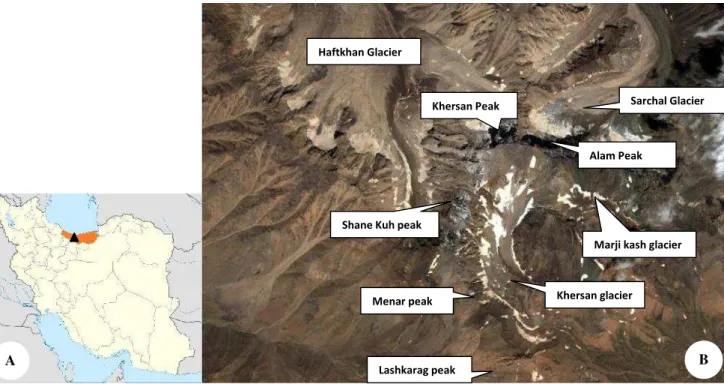
Alamkuh in Mazandaran province is the second high after Damavand peak in Iran which is protected as natural national monument with Iranian Department of Environment (Figure 1.A). There are 13 active glacier such as Haft-khan with 7 western glacial valley, Marji-kash with an eastern active moraine and parallel with Khersan valley, 4 Nordic moraines towards Sarchal valley, and Khersan glacier with an active longest and widest glacier in these series. Hasarchal is a plain at the base of Khersan glacier valley which surrounded by mountain series in north such as Alamkuh and Marji-kash, Khersan, Shane-kuh, Menar and Lashkarag in the south side of glacier moraine valley.
Khersan peak with 4620 m lead to Shane-kuh, Menar, Lashkarag in the east, Khersan glacier in the southeast and Alam peak and Marji-kash glacier in the western location. Biodiversity and abundance of native species is given high values to this location as a centre of biodiversity for plant species. In this paper Khersan glacier has been studied and presented with more detailed information with new plant record from Iran and Khersan glacier territories. Important location and study area of Khersan glacier shows in the
Figure 1.B.
Botanical studies in this area was conducted in 1843 by Theodor Kotschy and after Kotschy (1861a,b), Bornmuller (1906), did gathering extensive in the area, the information that is given in the Flora Iranica. Melchior (1937) after in depth studies in Hasarchal has provided a great deal of taxonomic information. Klein (1982) completed Bornmuller (1906) information with an extensive data gathering in Alborz Mountains and has provided botanical and phytosociological data from Hasarchal and Khersan glacier territories.
changes such as movement, elimination and plant species up warding.
MATERIALS AND METHODS
Landsat ETM + has been used in this study to identify normal range of Khersan glacier and it changes and study
area, GPS and fixed prefabricated quadrate (2m х 2m) has
been used to record the location information for studies and comparing between present and past. European researcher collected information such as Kotschy (1861a,b) and Bornmuller (1906), including the location and their species nomenclature is used to replicate the recent studies and extensive field visit during 2013 to 2015 conducted this work studies.
Studies begin from the lower pilot in altitude 3800 m asl. towards the mountains in three access road around Khersan moraine with 38 quadrate in north, south and east slopes during 2013 to 2015. Quadrate size is determined based on standard curve for square size and number of species and fixed for each altitude. Plant species gathered from 38 square (12 in north and 15 in west, 11 in south and east) has been named with literatures from Komarov (1939), Assadi et al. (1988-2010), Rechinger (1963-2010), Breckle (2007), and Noroozi et al. (2008, 2010a,b, 2011, 2013), and has been updated according to extensive data gathering. Comparative study has done according to recent field visit and data which had been gathered with Kotschy (1861a,b), Klein (1982), Bornmuller (1906), Melchior (1937) and Rechinger (1963-2010) since 1843 for determine present or absent of plant species, biological characteristics changes, upward movement and etc.
RESULTS AND DISCUSSION
Results
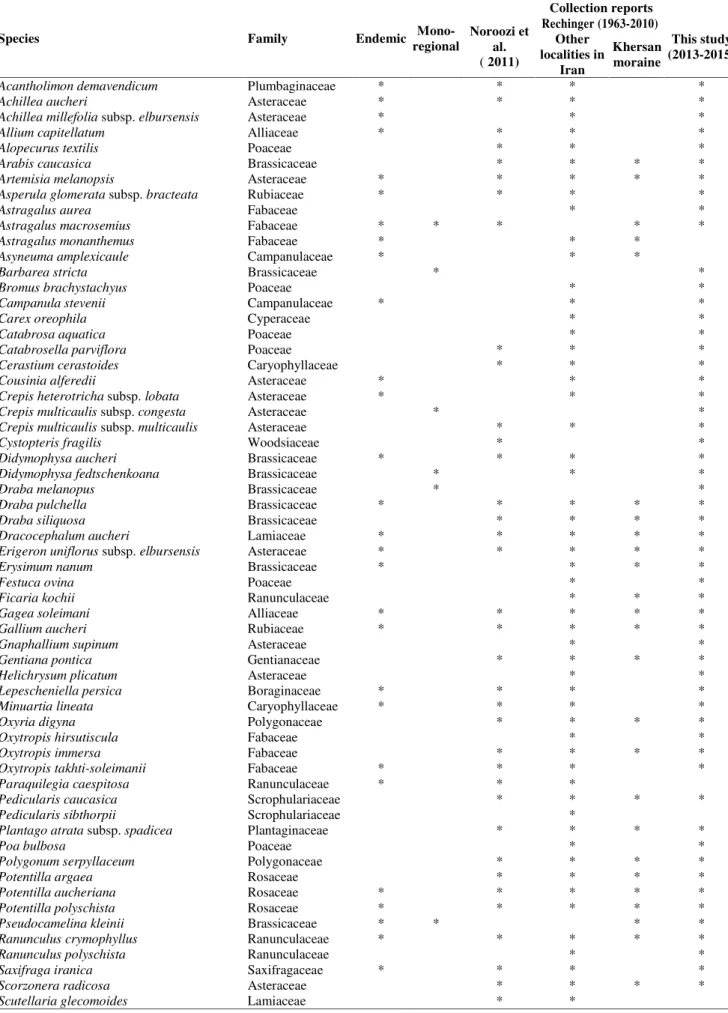
The Table 1 is set for discussion present the species gathered from study area during 2013-2015. It lists the plant species collected since 1843 in Khersan glacier territory and has been compared with the last documents such as Noroozi et al. (2010a, 2011, 2013) about subnival-nival vascular plant of Iran, Flora Iranica and recent studies which is demonstrated in Khersan moraine column. Each row in the table shows the history of plant species since 1843 to the last gathered in summer 2015.
The list shows there are 71 vascular plant species in margin of Khersan moraine glacier from 4435 m asl. in the northern slope to lower elevation in borderline of subnival in 3900 m asl. around Khersan territory. About 50% of this plant list is endemic in Iran and 6 of those are mono-regional and have only known from one locality in Iran. This number is much more than of previous reports since 1982 with 31 species and this studies added 40 plant species to Khersan glacier territories. A group of these added species come upward from lower elevation and much of it dependent to appropriate collection during the past three years with authors.
According the plant species list Barbarea stricta,Crepis multicaulis subsp.congesta,Didymophysa fedtschenkoana,
Draba melanopus recorded for the first time from Iran. These species have very specific habit due to Khersan glacier territory and with very restricted distribution. Many species of list as above new records and some other species with low habit and endangered location affected by human activities classified in Critically Endangered (CR) class according to IUCN Red List Categories and Criteria (IUCN 2001) and need to conservation and protection program.
Figure 1.A. Alamkuh, Mazandaran province, Iran (▲ ), B. Highland condition with main peaks in Khersan glacier territory
Haftkhan Glacier
Sarchal Glacier
Marji kash glacier Shane Kuh peak
Lashkarag peak
Menar peak Khersan glacier Alam Peak Khersan Peak
Table 1. Alphabetical list for plant species in study area and it's history
Collection reports Rechinger (1963-2010) Species Family Endemic
Mono-regional
Noroozi et al.
( 2011)
Other localities in
Iran
Khersan moraine
This study (2013-2015)
Acantholimon demavendicum Plumbaginaceae * * * *
Achillea aucheri Asteraceae * * * *
Achillea millefoliasubsp.elbursensis Asteraceae * * *
Allium capitellatum Alliaceae * * * *
Alopecurus textilis Poaceae * * *
Arabis caucasica Brassicaceae * * * *
Artemisia melanopsis Asteraceae * * * * *
Asperula glomeratasubsp.bracteata Rubiaceae * * * *
Astragalus aurea Fabaceae * *
Astragalus macrosemius Fabaceae * * * * *
Astragalus monanthemus Fabaceae * * *
Asyneuma amplexicaule Campanulaceae * * *
Barbarea stricta Brassicaceae * *
Bromus brachystachyus Poaceae * *
Campanula stevenii Campanulaceae * * *
Carex oreophila Cyperaceae * *
Catabrosa aquatica Poaceae * *
Catabrosella parviflora Poaceae * * *
Cerastium cerastoides Caryophyllaceae * * *
Cousinia alferedii Asteraceae * * *
Crepis heterotrichasubsp.lobata Asteraceae * * *
Crepis multicaulissubsp.congesta Asteraceae * *
Crepis multicaulissubsp.multicaulis Asteraceae * * *
Cystopteris fragilis Woodsiaceae * *
Didymophysa aucheri Brassicaceae * * * *
Didymophysa fedtschenkoana Brassicaceae * * *
Draba melanopus Brassicaceae * *
Draba pulchella Brassicaceae * * * * *
Draba siliquosa Brassicaceae * * * *
Dracocephalum aucheri Lamiaceae * * * * *
Erigeron uniflorussubsp.elbursensis Asteraceae * * * * *
Erysimum nanum Brassicaceae * * * *
Festuca ovina Poaceae * *
Ficaria kochii Ranunculaceae * * *
Gagea soleimani Alliaceae * * * * *
Gallium aucheri Rubiaceae * * * * *
Gnaphallium supinum Asteraceae * *
Gentiana pontica Gentianaceae * * * *
Helichrysum plicatum Asteraceae * *
Lepescheniella persica Boraginaceae * * * *
Minuartia lineata Caryophyllaceae * * * *
Oxyria digyna Polygonaceae * * * *
Oxytropis hirsutiscula Fabaceae * *
Oxytropis immersa Fabaceae * * * *
Oxytropis takhti-soleimanii Fabaceae * * * *
Paraquilegia caespitosa Ranunculaceae * * *
Pedicularis caucasica Scrophulariaceae * * * *
Pedicularis sibthorpii Scrophulariaceae *
Plantago atratasubsp.spadicea Plantaginaceae * * * *
Poa bulbosa Poaceae * *
Polygonum serpyllaceum Polygonaceae * * * *
Potentilla argaea Rosaceae * * * *
Potentilla aucheriana Rosaceae * * * * *
Potentilla polyschista Rosaceae * * * * *
Pseudocamelina kleinii Brassicaceae * * * *
Ranunculus crymophyllus Ranunculaceae * * * * *
Ranunculus polyschista Ranunculaceae * *
Saxifraga iranica Saxifragaceae * * * *
Scorzonera radicosa Asteraceae * * * *
Scutellaria pinnatifida Lamiaceae * *
Senecio vulcanicus Asteraceae * * * * *
Tarxacum crepidiforme Asteraceae * * * *
Thymus caucasica Lamiaceae * *
Trachydium depressumsubsp.depressum Apiaceae * * * *
Trachydium pauciradiatum Apiaceae * * * *
Tragopogon kotschyi Asteraceae * * *
Veronica aucheri Scrophulariaceae * * * *
Veronica gaubae Scrophulariaceae * * *
Veronica kurdica Scrophulariaceae * * * *
Veronica paederotae Scrophulariaceae * * * * *
Note: * = present
Entering livestock around Khersan glacier margin above 3800 m asl. in the recent year, camping at Hasarchal more than of capacity, medicinal plant collection, consecutive changes of climbing rout toward peaks that makes mechanical erosion, and some other human activities and due to these activities affect extremely on Critically Endangered (CR) plant species habitat and should be controlled and preventing.
Discussion
In the glacial valley to the accommodation camp at 3800 m asl., 71 plant species were collected, 35 species equivalent 50% are native to Iran. Two species
Pseudocamelina kleinii, Astragalus macrosemius grow
only in this area throughout the world and those are located on an very small area in the southern part of Khersan moraine. In addition to the above plantDraba melanopus,
Crepis multicaulis subsp. congesta has only known from eastern area of Khersan moraine and Barbarea congesta
has only distributed around major spring east of Khersan moraine with very restricted and vulnerable habitat.
The extensive survey since 2013 in Khersan territory has not collected again Astragalus monanthemus,
Asyneuma amplexicaule, Paraquilegia caespitosa and
Tragopogon kotschyi from this area and it seems these species had disappeared. Plant species Astragalus aurea, Achillea aucheri, Achillea millefolia subsp. elbursensis,
Asperula glomerata subsp. bracteata, Acantholimon
demavendicum, Alopecurus textilis, Allium capitellatum, Cerastium cerastoides, Carex oreophila, Catabrosa
aquatica, Crepis heterotricha subsp. lobata, Crepis
multicaulis subsp. multicaulis, Crepis multicaulis subsp.
congesta, Campanula stevenii, Cystopteris fragilis,
Catabrosella parviflora, Didymophysa aucheri, Scutellaria glecomoides, Scutellaria pinnatifida, Draba melanopsis, Bromus brachystachyus, Festuca ovina, Gnaphallium supinum, Helichrysum plicatum, Lepescheniella persica,
Minuartia lineata, Poa bulbosa, Didymophysa
fedtschenkoana, Barbarea stricta, Oxytropis hirsutiscula,
Oxytropis takhti-soleimanii, Ranunculus polyschista,
Saxifraga iranica, Thymus caucasica, Veronica gaubae, Veronica aucheriana and Veronica kurdica gathered for the first time from Khersan glacier territory. Many plant species such as Astragalus aurea, Astragalus
monanthemus, Achillea millefolia subsp. elbursensis,
Catabrosa aquatica, Campanula stevenii, Draba
melanopsis, Bromus brachystachyus, Erysimum nanum,
Festuca ovina, Gnaphallium supinum, Helichrysum
plicatum, Pedicularis sibthorpii, Poa bulbosa,
Pseudocamelina kleinii, Ranunculus polyschista,
Scutellaria pinnatifida, Trachydium pauciradiatum,
Thymus caucasica, Veronica gaubae and Ficaria kochii
has not included by Noroozi et al. (2010a, 2011, 2013) in the previous list of subnival and nival area of Iran while these species are growing in the highlands around Khersan glacier valley and probability these species growing in the other place around Alamkuh too. Pseudocamelina kleinii
has gathered from Khersan moraine margin by Klein (1971) after Iranian flora of Brassicaceae has published. It has mono regional location in the world with low amount of population less than 20 and grows at altitude between 4119 and 4127 m asl.
Collecting ofCarex oreophila, Poa bulbosa, Catabrosa aquatica, Campanula stevenii, Bromus brachystachyus, Oxytropis immersa, Erigeron uniflorus subsp.elbursensis,
Trachydium pauciradiatum, Scorzonera radicosa and many
species of veronica in subnival-nival area which are naturally belong to alpine area proof entering Alpine species at the nival and subnival, phenomena which illustrate the occupation and disturbing of summit with invasive plants. During 2013-2015Draba melanopus from the Khesan glacier tongue, Crepis multicaulis subsp.
congesta on calcareous conglomerate at the southern area of moraine and Didymophysa fedtschenkoana in volcanic margin of Khersan between Alamkuh and Marji-kash peak has been collected for the first time. These thrice species added to actual Iranian subnival and nival plant species no mentioned with Noroozi et al. (2011).
In subnival-nival area place to live are limited and some late comer such as Cousinia alferedii, Festuca ovina, Poa bulbosa and Alopecurus textilis that have higher survival chance for living, reduce grow of the threatened species.
Pseudocamelina kleinii has a low population is at risk of global threat. In addition the current growth point of this plant in Iran have also been collected from Azad-kuh in 1974 at altitude 3880 m asl. Central Alborz. Now the situation was not known and in the recent studies species has not been collected again. This species observed in Khersan glacier valley for the first time in 2013 and its habit and ecological condition has monitored in 2014 and 2015.
Plant species such as Pseudocamelina kleinii, Arabis caucasica, Dracocephalum aucheri, Didymophysa aucheri
alpine invasive species but the displacement height with existing of soil in summit restricted. Many species didn't moved upward and log in alpine and sub alpine invasive plants species changed their habitat and will be destroy gradually.
The area is highly impacted by human activities and local livestock. Livestock disturb highlands ecosystem regulation and native people uses rare plant medicinal and edible and made pressure on natural ecosystem. Upward shift of grasses such as Poa, Festuca and Alopecurus
species with wind, human, animal skins and livestock increase population and network nest of snow vole around ofAstragalus aurea roots and some other similar plants, gradually, ice influencing around the root canal which made by mature Voles, plant roots freezing and dead after two or three winter. Livestock have main role in seed displacement and actually it improved by human activities.
Pseudocamelina kleinii, Astragalus macrosemius with one address in the world and very restricted population classified as Critically Endangered (CR) in IUCN (2001) conservation categories and need to effective protection plan and monitoring program.
ACKNOWLEDGEMENTS
We would like thank to thank from Islamic Azad University, Tehran Science and Research Branch, Iran, Dr. Farrokhnia, Dr. Eftekhari who works at Iranian Institute of Water Research for providing the facilities necessary to carry out the work. I wish to express my gratitude to Prof. Mozaffarain, Zehzad, Goshtasb and Prof. Mizuno for their valuable botanical advice and Sharifi ancient gamekeeper environmental guard for his effective environmental comments during all botanical tours. We would like thank to Dr. Yusefi, Qashqaee, Allahgholi and Fahimi environmentalist for their mentioned about behavior and population changes of mountain Vole species in subnival study area and Dr. Abassian for his help in all field visit during recent year and for his valuable data about big
mammals grazing food chain due to Khersan valley and conservation values.
REFERENCES
Assadi M, Maassoumi AA, Khatamsaz M, Mozaffarian V (eds.). 1988-2010. Flora of Iran. Vols 1-66. Research Institute of Forests and Rangelands Publications, Tehran. [Persian]
Bornmuller J. 1906. Beitrage zur Flora der Elburzgebirge Nord-Persiens, Bull Herb Boiss. Geneve. 6: 605-620,765-780.
Breckle SW. 2007. Flora and vegetation of Afghanistan. Basic Appl. Dryland Res. 1 (2): 155-194.
Ghelichnia H. 2014. Flora and vegetation of Mt. Damavand in Iran Phytologia Balcanica 20 (2-3): 257-265.
IUCN. 2001. IUCN Red List Categories and Criteria, Version 3.1. Prepared by the IUCN Species Survival Commission. IUCN, Gland, Switzerland, and Cambridge, United Kingdom.
Klein JK. 1982. Les groupments chinphilesde l' Alborz central (Iran). Comparasion avec lears homologues d' Asia centrale. Phytocoenologia 10: 463-485.
Komarov VL. 1939. Flora of USSR, Botanical Institute of the Academy of Sciences of the U.S.S.R, Izdatel'stvo Akademii Nauk SSSR Moskva-Leningrad. 8: 276-237.
Kotschy T. 1861a. Die Vegetation des westlichen Elbrus in Nordpersien. Osterr Bot Zeitschr 11 (4): 105-117.
Kotschy T. 1861b. Der westliche Elbrus bei Teheran. Mitt. der K. K. Oester Geogr Gesell Wien 5: 65-110.
Melchior H. 1937. Zur pflanzengeographie ddes Elburs-Gebirges in Nord-Iran. Sber Ges Naturf Freunde Berl 1937: 55-71.
Noroozi J, Ajani Y, Nordenstam B. 2010a. A new annual species of
Senecio (Compositae-Senecioneae) from subnival zone of southern Iran with comments on phytogeographical aspects of the area. Comp Newsl 48: 4-23.
Noroozi J, Akhani H, Breckle SW. 2008. Biodiversity and phytogeography of the alpine flora of Iran. Biodiv Conserv 17 (2): 493-521.
Noroozi J, Akhani H, Willner W. 2010b. Phytosociological and ecological study of the high alpine vegetation of Tuchal Mountains (Central Alborz, Iran). Phytocoenologia 40 (4): 293-32.
Noroozi J, Pauli H, Grabhen G, Breckle SW. 2011.The subnival-nival vascular plant species of Iran: a unique high-mountain flora and it threat from climate. Biodiv Conserv 20: 1319-1338.
Noroozi J, Willner W, Pauli H, Grabherr G. 2013. Phytosociology and ecology study of the high-alpine to subnival scree vegetation of N and NW Iran (Alborz and Azerbaijan Mts.). Appl Veg Sci 17 (1): 142-161.