www.adv-radio-sci.net/11/101/2013/ doi:10.5194/ars-11-101-2013
© Author(s) 2013. CC Attribution 3.0 License.
Radio Science
Improving pedestrian detection using MPEG-7 descriptors
H. Lietz1, M. Ritter2, R. Manthey2, and G. Wanielik1
1Chemnitz University of Technology, Professorship on Communications Engineering, Reichenhainer Straße 70, 09126 Chemnitz, Germany
2Chemnitz University of Technology, Chair Media Informatics, Straße der Nationen 62, 09111 Chemnitz, Germany
Correspondence to:H. Lietz ([email protected])
Abstract.During the last decade, modern Pedestrian Detec-tion Systems made massive use of the steadily growing num-bers of high-performance image acquisition sensors. Within our naturalistic driving environment, a lot of different and heterogeneous scenes occur that are caused by varying illu-mination and weather conditions. Unfortunately, current sys-tems do not work properly under these hardened conditions. The aim of this article is to investigate and evaluate observed video scenes from an open source dataset by using various image features in order to create a basis for robust and more accurate object detection.
1 Introduction
Due to the increasing interest of research in the field of Vul-nerable Road User (VRU) protection, a series of Pedestrian Detection Systems (PDS) using in-vehicle sensors has been developed within the past years. A state-of-the-art overview on different PDS as well as an evaluation of those systems is given in (Doll´ar et al., 2011). Most of the current sys-tems use Histograms of Oriented Gradient (HOG) features, since they yield good results in the field of pedestrian detec-tion, but fail completely in some situations. Therefore, many approaches use additional features like Haar Wavelets (Pa-pageorgiou et al., 1998) or Local Binary Patterns (Harwood et al., 1995) in order to improve the detection and to compen-sate the weaknesses of single feature systems. In this con-tribution, we present a novel multi-feature approach which combines HOG and MPEG-7 features.
This paper is structured into five sections. The following Sect. 2 presents a brief background of HOGs and MPEG-7 features. Section 3 introduces the details of the proposed multi-feature approach. Section 4 presents the details and re-sults of our experiments on pedestrian datasets. The paper
ends in Sect. 5 with conclusions and recommendations to fur-ther work.
2 Features
In this section, we present our multi-feature approach that uses HOGs and features of the MPEG-7 Homogeneous Tex-ture Descriptor.
2.1 Histograms of Oriented Gradients
The Histogram of Oriented Gradients was firstly described by Lowe (2004) and employed for pedestrian detection by Dalal and Triggs (2005). Many authors of the approaches mentioned in Doll´ar et al. (2011) used HOGs. According to Dalal’s approach, the HOG feature vector is computed by dividing the image into several sub-regions: the HOG cells and HOG blocks, whereas each HOG block consists of four HOG cells. For each cell, a normalized n-bin-histogram of weighted gradient directions is computed. The main concep-tion of the HOGs is that objects within an image can be de-scribed by the distribution of intensity gradients and edge di-rections. These features correlate much stronger to the con-tour of an object than to its color. The big advantage of the HOG features is its translation and illumination invariance.
2.2 The MPEG-7 Homogeneous Texture Descriptor
102 H. Lietz et al.: Improving pedestrian detection using MPEG-7 descriptors
Fig. 1.Our cascaded classifiers try to reach high detection rates with the HOG-SVM in the first stage, and a second stage which focused on the avoidance of false detections, using MPEG-7 features and a boosted decision tree.
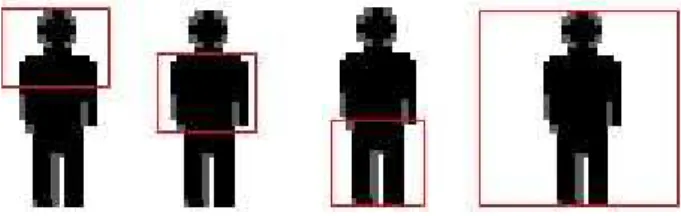
Fig. 2.MPEG-7 features are extracted from four quadratic regions (head & shoulders, torso, legs and whole ROI).
multimedia description, that have been originally composed for application in image retrieval including color, texture, shape, and motion descriptors. MPEG-7 feature descriptors have already been successfully applied in terms of human body posture estimation (Moghaddam and Piccardi, 2010) as well as visual surveillance (Annesley and Orwell, 2006). Within our evaluation, we use the features of the Homoge-neous Texture Descriptor (HTD) (Ro et al., 2001) which is one part of the MPEG-7 texture descriptors for classifica-tion. It provides a homogenous image characterization for similarity retrieval based on local spatial-frequency statistics. The descriptor yields 62 integer values on every sub-window. The first two features are the mean and the standard deviation of the image (cf. Wu et al., 2001). The remaining 60 are the energy and energy deviation of the Gabor filtered responses of the 30 so-called channels in the subdivision layout of the frequency domain. For these features, the Radon transform followed by an 1-D fourier transform is applied.
3 Combined pedestrian detection system
The previously introduced features are employed in the clas-sification algorithms which are presented in the following paragraphs.
3.1 System overview
Our approach operates in two stages: in the first stage, we use the HOG-SVM pedestrian detector of Dalal and Triggs (2005). The aim of our approach is to take benefit of the high
Table 1.Classifier accuracy of different feature combinations with performance at the cross-validation (CV) and at the dedicated test set (col. @TS).
CV @TS
Features # Feat. Ø Acc. Rank Ø Acc. Rank
HOG 2016 80.43 4 73.60 1
MPEG-7 248 89.67 1 67.89 4
MPEG-7/HOG 2264 87.21 2 70.80 2
Haar 370 84.66 3 69.55 3
LBP 1860 65.76 5 62.58 5
detection rates of the HOG-SVM, but to avoid false detec-tions. Thus, we use in the second stage a trained classifier verifying the detected regions using MPEG-7 texture fea-tures. The result of this combination is a classifier cascade that operates as follows: At first, a HOG feature vector is computed from a Region of Interest (ROI) of the input image and classified with the trained SVM. If the SVM output is non-pedestrian (N), then the output of the classifier cascade is non-pedestrian, too. If the SVM output is positive, then a new vector of MPEG-7 features of this ROI is computed and classified with a boosted decision tree. The final classifier cascade output is equal to the output of a boosted decision tree. In summary, this means that an ROI is only classified as pedestrian (P) when the output of the HOG-SVM and the boosted decision tree is pedestrian. The classification scheme is illustrated in Fig. 1.
3.2 Classifiers and training
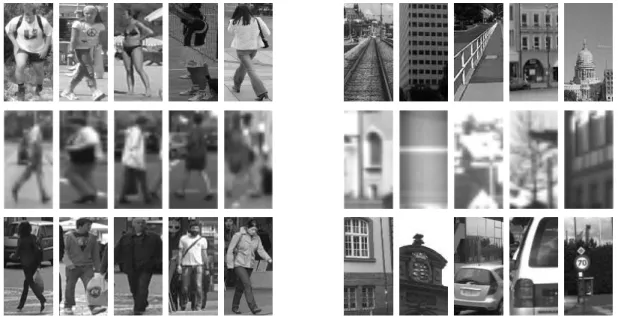
Fig. 3.Five positive (left) and negative (right) samples from each dataset: INRIA (top), DaimlerChrysler (middle) and TUD-Brussels (bot-tom).
62 features per sub-region, we get 248 features from the Ho-mogenous Texture Descriptor in total.
4 Experiments
To test our the MPEG-7 features, we conducted two experi-ments. In the first experiment, we analyzed the classification performance of those features in comparison of other well-known features. In the second experiment, we tested the ben-efit of the combined classifiers of the HOG-SVM and the boosted MPEG-7 decision tree. Due to different optimized versions of the feature extraction methods, runtime compari-son is neglected in the following section.
4.1 Classification performances of different features
In our first experiment, we compared the classification per-formance of MPEG-7 features with HOGs, Haar Wavelets and Local Binary Patterns using the following publicly avail-able pedestrian datasets: INRIA (Dalal and Triggs, 2005), DaimlerChrysler (Munder and Gavrila, 2006), and TUD Brussels (Doll´ar et al., 2011), illustrated in Fig. 3. Each of these datasets has annotations for pedestrian positions in im-ages, but the DaimlerChrysler is the only dataset that has ded-icated negative (non-pedestrian) examples. For the INRIA and TUD Brussels datasets, we generated negative examples by extracting ROIs at random positions in the images without any pedestrians. For each dataset, we extracted HOG, Haar, and MPEG-7 features and trained a boosted decision tree. We measured the classification accuracy firstly using a three-fold
cross-validation (CV) and secondly on the dedicated test set (TS) of the applied datasets.
The mean values of the three cross-validation results and of the three dedicated test set runs (one for each dataset) are used to determine the evaluation results which are presented in Table 1.
4.2 Cascaded classifiers
In our second experiment, we applied the trained cascaded classifiers, described in Sect. 3, to a youtube video. For the evaluation we used a scenario of the driver‘s cab of a tram1. We manually annotated over 2,500 ROIs of pedestrians in this video with dimensions between 15×30 and 147×294 pixels. The aspect ratio was always 1:2. The ground truth annotations only show persons being less than 50 % occluded by other persons or objects. We measured the classification performance by generating receiver operating characteris-tic (ROC) curves. We used the evaluation methodology of Doll´ar et al. (2011) which is based on the scheme laid out in the PASCAL object detection challenges (Ponce et al., 2006): a detected bounding box (BBdt) and a ground truth bounding box (BBgt) form a potential match, if the area of overlap is greater than 50 %.
a0=
area(BBdt∩BBgt) area(BBdt∪BBgt)
>0.5 (1)
104 H. Lietz et al.: Improving pedestrian detection using MPEG-7 descriptors
Fig. 4.ROC curve of false positives per image rates of the pedes-trian detector at minimum size of pedespedes-trian without size con-straints.
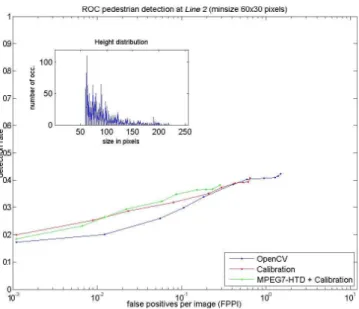
Fig. 5.ROC curve of false positives per image rates of the pedes-trian detector at minimum size of pedespedes-trian having 30 pixel in width and 60 pixel in heigth.
The results of the classification performance are illustrated in Figs. 4–6. The ROC curves were determined for three dif-ferent classifiers:
1. OpenCV classiffiers applied on full-size images. 2. OpenCV classiffiers applied on image regions in that
most of the pedestrians appear.
3. A cascaded classiffier applied on image regions in that most of the pedestrians appear.
Fig. 6.ROC curve of false positives per image rates of the pedes-trian detector at minimum size of pedespedes-trian having 65 pixel in width and 130 pixel in heigth.
In cases 2 and 3, we assumed that pedestrians move on a flat ground plane. Thus, we ignored detections obviously located in the sky. By using an accurate camera calibration, human intelligence can be integrated into the detection sys-tem and the number of false detections can be reduced sig-nificantly. Because of the limitation of detection size of the OpenCV HOG-SVM, our evaluation is performed on uncon-straint sizes (Fig. 4) as well as on sizes 60×30, and 130×65 pixel (Figs. 5 and 6). Due to the size constraints, the num-ber of occurences of pedestrian ROIs in the ground trouth changes in the three different situations. The histogram of the pedestrian heights in pixels is shown in the upper left corner of each figure.
4.3 Analysis of results and conclusion
The results of our first experiment (classification perfor-mance of different features) show that MPEG-7 features ranked first place in the cross-validation test, whereas HOG features achieved the first rank in classification accuracy on the dedicated testset. The combination of HOG and MPEG-7 features reached the second place in both categories. As one can see, the results of the cross-validation tend to be signifi-cantly better than on the dedicated testsets.
The results of the conducted experiments indicate that the combination of MPEG-7 Homogeneous Texture Descrip-tors and HOG features can increase the classification per-formance by reducing the false positive rate of the existing OpenCV classifier.
5 Summary and future work
In this contribution, we presented a novel multi-feature ap-proach by combining HOG features and features extracted from MPEG-7 texture descriptors. We conducted two exper-iments in order to determine the classification performance of the single feature classifier as well as the combined sys-tem.
In addition, we showed the dependency of the size of the ROI to the detection rate and the false positive rate of the classifier. We found out that it can significantly improve clas-sification results of existing HOG-based approaches.
In future work, we will involve the color features of the MPEG-7 standard into our evaluation, as well as further clas-sifiers and evaluation scenarios altogether with runtime com-parison analysis.
Acknowledgements. This work was partially accomplished within the project ValidAX – Validation of the AMOPA and XTRIEVAL framework (Project VIP0044), funded by the Federal Ministry of Education and Research (Bundesministerium f¨ur Wissenschaft und Forschung), Germany.
References
Annesley, J. and Orwell, J.: On the Use of MPEG-7 for Visual Surveillance, in: Proceedings of 6th IEEE International Work-shop on Visual Surveillance, 2006.
Bas¸tan, M., C¸ am, H., G¨ud¨ukbay, U., and Ulusoy, ¨O.: BilVideo-7: An MPEG-7-Compatible Video Indexing and Retrieval System, IEEE MultiMedia, 17, 62–73, 2010.
Dalal, N. and Triggs, B.: Histograms of Oriented Gradients for Hu-man Detection, in: International Conference on Computer Vision and Pattern Recognition, vol. 2, 886–893, 2005.
Doll´ar, P., Wojek, C., Schiele, B., and Perona, P.: Pedestrian Detec-tion: An Evaluation of the State of the Art, in: IEEE Transactions on Pattern Analysis and Machine Intelligence, vol. 34, 743–761, 2011.
Harwood, D., Ojala, T., Pietik¨ainen, M., Kelman, S., and Davis, L.: Texture Classification by Center-symmetric Auto-correlation us-ing Kullback Discrimination of Distributions, Pattern Recogni-tion Letters, 16, 1–10, 1995.
Lowe, D. G.: Distinctive image features from scale-invariant key-points, International Journal of Computer Vision, 60, 91–110, 2004.
Manjunath, B., Salembier, P., and Sikora, T.: Introduction to MPEG-7: Multimedia Content Description Interface, John Wiley & Sons, 2002.
Moghaddam, Z. and Piccardi, M.: Human action recognition with MPEG-7 descriptors and architectures, in: Proceedings of the first ACM international workshop on Analysis and retrieval of tracked events and motion in imagery streams, 63–68, 2010. Munder, S. and Gavrila, D. M.: An experimental study on pedestrian
classification, in: IEEE Transactions on Pattern Analysis and Ma-chine Intelligence, vol. 28, 1863–1868, 2006.
Papageorgiou, C., Oren, M., and Poggio, T.: A general framework for object detection, in: International Conference on Computer Vision, 555–562, 1998.
Ponce, J., Berg, T., Everingham, M., Forsyth, D., Hebert, M., Lazeb-nik, S., Marszalek, M., Schmid, C., Russell, B., Torralba, A., Williams, C., Zhang, J., and Zisserman, A.: Dataset Issues in Object Recognition, in: Toward Category-Level Object Recog-nition, vol. 4170, 29–48, 2006.