1,6-Mannanases That Function in the Incorporation of
Glycoproteins into the Cell Wall
Abhiram Maddi1, Ci Fu2, Stephen J. Free2*
1Department of Periodontics and Endodontics, School of Dental Medicine, State University of New York, University at Buffalo, Buffalo, New York, United States of America,
2Department of Biological Sciences, State University of New York, University at Buffalo, Buffalo, New York, United States of America
Abstract
The covalent cross-linking of cell wall proteins into the cell wall glucan/chitin matrix is an important step in the biogenesis of the fungal cell wall. We demonstrate that theNeurospora crassaDFG5 (NCU03770) and DCW1 (NCU08127) enzymes functionin vivoto cross-link glycoproteins into the cell wall. Mutants lacking DFG5 or DCW1 release slightly elevated levels of cell wall proteins into their growth medium. Mutants lacking both DFG5 and DCW1 have substantially reduced levels of cell wall proteins in their cell walls and release large amounts of known cell wall proteins into the medium. DFG5 and DCW1 are members of the GH76 family of glycosyl hydrolases, which have specificity to recognize and cleavea-1,6-mannans. A model for incorporation of glycoproteins into the cell wall through thea-1,6-mannan core of the N-linked galactomannan is presented. In this model, DFG5 and DCW1 recognize the N-linked galactomannan present on glycoproteins and cross-link it into the cell wall glucan/chitin matrix.
Citation:Maddi A, Fu C, Free SJ (2012) TheNeurospora crassa dfg5 anddcw1Genes Encode a-1,6-Mannanases That Function in the Incorporation of Glycoproteins into the Cell Wall. PLoS ONE 7(6): e38872. doi:10.1371/journal.pone.0038872
Editor:Luis M. Corrochano, Universidad de Sevilla, Spain
ReceivedMarch 5, 2012;AcceptedMay 15, 2012;PublishedJune 11, 2012
Copyright:ß2012 Maddi et al. This is an open-access article distributed under the terms of the Creative Commons Attribution License, which permits unrestricted use, distribution, and reproduction in any medium, provided the original author and source are credited.
Funding:This research was supported by grant R01 GM078589 from the National Institutes of Health and by funds from the UB Foundation. The research was supported in part by the Department of Energy-funded (DE-FG02-09ER-20097) Center for Plant and Microbial Complex Carbohydrates. The funders had no role in study design, data collection and analysis, decision to publish, or preparation of the manuscript.
Competing Interests:The authors have declared that no competing interests exist. * E-mail: [email protected]
Introduction
The cell wall is critical to the survival and growth of fungal cells. It is a dynamic structure that changes in response to environmen-tal conditions and developmenenvironmen-tal processes.
It is created by the cross-linking of glucans, chitin, and cell wall proteins together into a three-dimensional network. The glucans and chitin are initially synthesized as linear polymers and extruded into the cell wall space during their synthesis. Plasma membrane-associated glucan synthase complexes and chitin synthases utilize intracellular UDP-glucose and UDP-N-acetylglucosamine respec-tively as substrates to add sugars to the reducing end of the growing polysaccharides. In addition to chitin (a polymer ofb -1,4-N-acetylglucosamines), a number of different glucan types have been found in fungal cell walls, includingb-1,3-glucose polymers, b-1,6-glucose polymers, polymers having a mixture of b-1,3/b -1,4-glucose linkages, and a-1,3-glucose polymers [1,2,3,4]. Mu-tants of chitin synthases, b-1,3-glucan synthases, b-1,6-glucan synthases, anda-1,3-glucan synthases demonstrate the importance of the polymers for cell wall biogenesis [4,5]. As these polysac-charides are extruded into the cell wall space, they are cross-linked together by a group of enzymes having glucanase, chitinase, and glycosyl transferase activities [6,7,8]. These cross-linking enzymes are encoded by multi-gene families, which provide the fungi with a number of cell wall cross-linking enzymes having overlapping specificities and a ‘‘built-in redundancy’’ that help insure that the cell wall polymers are effectively cross-linked together.
containinga-1,2-linked mannoses andb-linked terminal galacto-furanose residues [14]. We now report on two newly identified GPI-anchored cross-linking enzymes that function to generate cross-linking between N-linked oligosaccharide-associated galacto-mannan and the glucan/chitin matrix of the cell wall, and thereby effectively covalently cross-link glycoproteins into the cell wall matrix. These enzymes belong to the GH-76 class of glycosyl hydrolases and glycosyl transferases, which have specificity fora -1,6-linked mannans.
Materials and Methods
Strains and Culturing Conditions
N. crassa wild type and mutant isolates were maintained on Vogel’s minimal medium with 2% sucrose at room temperature [15]. Thedfg5,dcw1, andoch-1deletion mutants were generated as part of the Neurospora genome project [16], and obtained from the Fungal Genetics Stock Center (Kansas City, MO). These deletion strains were created by replacing the coding regions of the genes with a hygromycin resistance cassette [16]. Cloning, sequencing, transformation, and complementation experiments were done as described by Colot et al. [16] and Maniatis et al. [17]. Double mutant strains were created by mating the single mutant isolates. TheDdfg5, his-3andDdcw1, his-3isolates used for transformation experiments were generated by mating a his-3 isolate with the deletion mutants. The genetic analyses, including co-segregation analysis, were carried out as described by Davis and DeSerres [15].
Isolation and Characterization of GH76 Deletion Mutants As listed in theN. crassa e-compendium (www.bioinf.leeds.ac. uk/˜gen6ar/newgenelist/genes), the N. crassa genome contains 9 genes encoding GH76 family members (GH76-1/NCU02032, GH76-2/NCU04262, GH76-3/NCU08127, GH76-4/NCU6319, GH76-5/NCU09937, GH76-6/NCU02216, GH76-7/ NCU03770, GH76-8/NCU00086, and GH76-9/NCU07005). The Fungal Genetics Stock Center maintains a vast collection of N. crassamutants [18]. Deletion mutants for all nine of these were obtained from the Fungal Genetics Stock Center (Kansas City, MO) (NCU02032/FGSC#21230, NCU04264/FGSC#20538 & 20539, NCU08127/FGSC#19642, NCU06319/FGSC#20003, NCU09937/FGSC#18877 & 18878, NCU02216/ FGSC#16188, NCU03770/FGSC#21268, NCU00086/ FGSC#15969 & 15970, and NCU07005/FGSC#21045 & 21046). The presence of the deletion mutation was verified for each of these mutants by doing two PCR reactions. One reaction utilized a primer set that gave a product from the deletion mutant genome, in which the gene of interest had been replaced by a hygromycin-resistance cassette. The second PCR reaction gave a product from the wild type copy of the gene, but not from the genome of a deletion mutant. These primers are listed in Table S1. Mutants for all nine genes were also subjected to a morphology and cell wall stress analysis. The morphology of these strains was assessed by growing them in Petri dishes on Vogel’s sucrose medium and examining the gross colony morphology and the morphology of the leading hyphae edge. A more careful examination for cellular morphological differences was carried out by growing the isolates between two sheets of cellophane and examining the hyphae with a differential interference contrast (DIC) microscope [19].
Cell Wall Stress Tests
To determine if the deletion mutants were affected in the integrity of the cell wall, cell wall stress tests were carried out as
previously described [13]. The deletion mutants were grown on 3 ml slants of Vogel’s sucrose agar medium or in Vogel’s liquid medium containing the stress reagents. The growth of the mutants in the presence of the stress reagents was observed over a 72 hour period of time and compared with the growth of the wild type. The cell wall stress reagents used included 10% NaCl (salt stress), 0.01% sodium dodecyl sulfate (detergent), and 10mg/ml caspo-fungin (glucan synthesis inhibitor). The caspocaspo-fungin was obtained as a gift from Merck Research Laboratories (Rahway, NJ). The isolates were also grown at 18uC and 37uC to test for temperature-sensitive growth phenotypes.
Coomassie Dye Binding Assay
A Coomassie Brilliant Blue G250 dye binding assay was used to assess the amounts of protein contained in purified cell wall preparations [13]. The assay consists of incubating increasing amounts of cell wall material with a 16concentration of the dye as specified by the manufacturer (BioRad, Hercules, CA) and allowing the dye to bind to the wall during a 30 min. incubation with gentle agitation at room temperature. Following dye absorption, the cell walls were removed with a centrifugation step and the amount of unbound dye was spectrophotometrically determined as OD465. The dye binding assay was performed with duplicate samples.
Carbohydrate Composition and Linkage Analyses Carbohydrate composition and linkage analyses were per-formed at the Complex Carbohydrate Research Center (Univ. of Georgia, Athens, GA). Cell wall samples were permethylated, depolymerized, reduced, and acetylated, and the partially methylated alditol acetates (PMAAs) were analyzed by GC/MS.
Analysis of Secreted Protein by Nano-LC/MS/MS
The preparation and analysis of secreted proteins were performed as previously described [13]. Samples of secreted protein were digested with trypsin and subjected to nano-LC/MS/ MS analysis (Midwest BioServices, Overland Park, KS). The secreted proteins were identified by matching peptide sequences obtained from an MS/MS analysis with the protein sequences from theN. crassagenome available at the Broad Institute (www. broad.mit.edu) using the TurboSEQUEST software. Only those proteins with multiple peptides and/or single peptides with an XC (correlation coefficient) value of.2.5 for 2 ions or.3.0 for 3 ions were accepted as accurate identifications in the analysis.
Protein Secretion Assays
protein were determined with the BioRad protein assay kit. The total amount of secreted protein was divided by the total amount of cytosolic and secreted protein to determine what percentage of the total protein was secreted. Samples from the secreted and the cytosolic protein were used in Western blot experiments.
Western blot experiments were carried out to examine the secretion of two well-knownN. crassacell wall proteins, ACW-1 and GEL-1. ACW-1 and GEL-1 are homologs of theS. cerevisiaeEcm33p and Gas1p, respectively [10]. These Western blot experiments were carried out as previously described [13]. Polyclonal rabbit antibody directed against amino acids#186–208 of ACW-1 was used at a 1:5,000 dilution for the detection of ACW-1. Polyclonal rabbit antibody directed against purified GEL-1 was used at a 1:50,000 dilution for GEL-1 detection. Immunoreactive bands were visual-ized using a goat anti-rabbit alkaline phosphatase-conjugated secondary antibody (Sigma Aldrich, St. Louis, MO) at a 1:15,000 dilution.
Cell Wall Preparations
Cell wall samples were prepared as previously described [13]. The cells were harvested on the Buchner funnel, frozen in liquid N2, and ground to a fine powder with a mortar and pestle. PBS buffer was added and a crude cell wall fraction was obtained by a 4,0006G centrifugation step. The cell wall fraction was washed
three times with ice-cold PBS buffer and resuspended in 10 ml PBS with 1% SDS. The test tube with the sample was placed in a boiling water bath for 10 minutes to release SDS-soluble cell wall proteins. The cell wall samples were then washed three times with PBS and three times with distilled water to remove SDS from the sample.
Cloning, Complementation, and RIP Experiments Cloning experiments were carried out using the pBM61 vector system, which allows for the targeted insertion of cloned genes into the intragenic region downstream of thehis-3locus [20]. Regions from 1,500 bp upstream of the coding regions to 500 bp downstream of the coding regions for dfg5 (NCU03770) and dcw1(NCU08127) were amplified from wild type genomic DNA and cloned into the pBM61. Primers containingSpeIand EcoRI sites to facilitate cloning into the vector were used to amplify the wild typedfg5gene. Primers containingNotIandBamHIsites were used to amplify thedcw1gene. These primer sequences are given in Table S1. The amplified DNAs and the pBM61 vector were digested with restriction enzymes and ligated together to generate plasmids pBMDFG5 and pBMDCW1, which contained wild type copies ofdfg5anddcw1respectively. These vectors were sequenced to make sure that they contained wild type copies of the genes and then used to transformDdfg5, his-3and Ddcw1, his-3mutants in complementation experiments.
Complementation experiments for dfg5 were carried out by transforming a Ddfg5, his-3 isolate with the pBMDFG5 vector using the protocol described by Margolin et al. [20], and demonstrating that the wild type copy of the gene restored a wild type colony phenotype to the transformant. Similarly, comple-mentation experiments for dcw1 were carried out using pBMDCW1 to transform aDdcw1, his-3isolate and showing that the wild type copy ofdcw1restored wild type hyphal morphology. As a second way to verify that theDdcw1phenotype was due to loss ofdcw1, we carried out RIP (repeat induced point mutation) experiments. RIP is a phenomenon in which any DNA sequence that is found in duplicate copies in theN. crassahaploid genome is mutated during mating [21]. Multiple C to T and G to A mutations are generated in both copies of the duplicated DNA during RIP. RIP experiments for DCW1 were done by
transforming aDdfg5, his-3mutant with pBMDCW1 to generate a transformant strain having duplicate copies ofdcw1in aDdfg5 background. The transformant was then mated with ahis-3isolate of the opposite mating type to activate the RIP process. Individual progeny from the mating where screened for the easily assessed Ddfg5, Ddcw1 double mutant morphology and several such progeny were obtained. PCR amplification and DNA sequence analysis for the dcw1 gene from a progeny having the double mutant morphology was carried out to verify that thedcw1gene had been mutated.
Results
Morphological Characterization of theDdfg5andDdcw1 Mutants
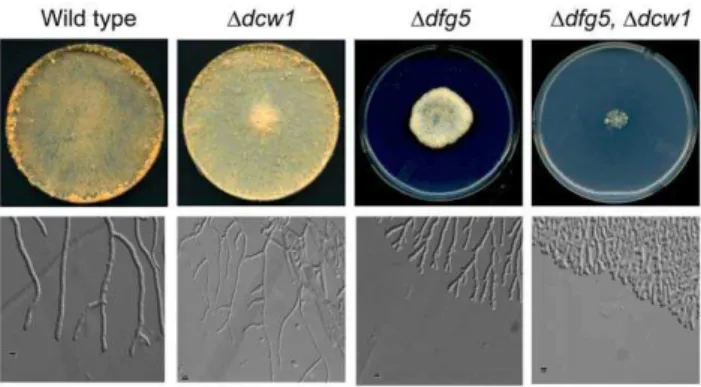
Previous characterization of the N. crassa Doch-1 mutant demonstrated the importance of N-linked galactomannan con-taining ana-1,6-mannose core structure as being necessary for the incorporation of cell wall proteins into the cell wall [13], suggesting thata-1,6-mannanases found in the cell wall space might play a role in cross-linking protein to the glucan/chitin matrix. The N. crassa genome contains nine genes in the gh76 (a -1,6-mannanase) gene family and the library contains deletion mutants for all ninegh76genes. We used the PCR primers shown in Table S1 to determine if the targetedgh76genes had been deleted in these deletion mutants, and verified that in all cases the strains had the targeted deletions. To determine whether any of the a -1,6-mannanase genes might be required for the incorporation of cell wall proteins into the cell wall glucan/chitin matrix, deletion mutants for all nine genes were tested for morphological phenotypes, for cell wall stability phenotypes, and for the release of cell wall proteins into the growth medium. Two of the mutants, Dgh76-7 (NCU03770) and Dgh76-3 (NCU08127) had altered morphology. These genes are homologs of the previously identified S. cerevisiae DFG5 and DCW1 genes, and we have opted to designate NCU03770 asdfg5 and NCU08127 asdcw1 to reflect their relationship to the yeast genes. Ddfg5 (NCU03770) had a spreading colonial phenotype that was easily recognized visually (Figure 1).Ddfg5could also be easily distinguished from the wild type on the basis of its cellular morphology as assessed under the microscope. The mutant hyphae were irregular in diameter and had a dichotomous branching pattern, which was quite different from the subapical branching pattern characteristic of the wild type (Figure 1). Ddcw1 had a more subtle phenotype. It had a normal gross morphology, but microscopic examination of the hyphal morphology showed that the hyphae produced at the edge of a growing colony were thinner in diameter than the wild type hyphae (Figure 1). Co-segregation experiments demonstrated that the dfg5 gross morphology phenotype and the dcw1 hyphal phenotype both co-segregated with the deletion mutations, suggesting that the deletion mutations were responsible for the mutant phenotypes.
A series of double mutants were prepared by matingDdfg5with each of the othergh76deletion mutants. We found that theDdfg5, Ddcw1double mutant had a significantly more severe phenotype than either of its parents (Figure 1), while the other double mutants were indistinguishable from theDdfg5parent. The double mutant grew in a much more restricted colonial manner than theDdfg5 parent, and microscopic examination of the hyphal morphology showed that the double mutant had a more tightly restricted dichotomous branching pattern (Figure 1).
S2). The ability of the mutants to grow at the low and high temperatures for N. crassa growth was also tested. None of the single gene deletion mutants showed susceptibility to the tested cell wall perturbation reagents, but theDdfg5grew very slowly at 18uC and would be classified as having a temperature-sensitive growth phenotype. However, the Ddfg5, Ddcw1 double mutant showed clear evidence of having a weakened cell wall. The double mutant was susceptible to the presence of low concentrations of SDS and caspofungin. It was also unable to grow at 18uC. We concluded that the double mutant has a weakened cell wall and that thedfg5 anddcw1genes encodea-1,6-mannanases that are required for the synthesis of a normal cell wall.
Complementation and RIP Experiments Demonstrate Ddfg5andDdcw1are Responsible for the Mutant Phenotypes
To demonstrate that deletions ofdfg5anddcw1are responsible for creating the mutant phenotypes, we carried out transformation experiments in which wild type copies of the genes were used to complement the deletion mutations. As described in the Materials and Methods, the wild type copies of the genes were targeted for insertion into the intragenic region downstream of thehis-3gene. We found that the insertion of a wild type copy ofdfg5 into the genome of the Ddfg5 mutant complemented the morphological phenotype (Figure 2). We also found that the insertion of a wild type copy of dcw1 into the Ddcw1 genome complemented the hyphal morphology phenotype. We conclude that the phenotypes were caused by the deletions and that DFG5 and DCW1 are required for the formation of a normal cell wall.
In addition to doing the complementation experiment, we also created RIP mutants ofdcw1to demonstrate that mutation ofdcw1 gives rise to thedcw1mutant phenotype we observed. These RIP experiments were done in aDdfg5background because theDdfg5, Ddcw1double mutant has an easily recognized colonial morphol-ogy. RIP is a phenomenon in which multiple mutations can be generated in cloned genes [21]. As shown in Figure 3, aDdfg5, dcw1RIPdouble mutant is indistinguishable from theDdfg5,Ddcw1 double mutant. One of these RIP alleles, dcw1RIP2, was PCR amplified and sequenced. It was found to have 173 mutations, including 11 stop codons, and mutations altering the branch sites in two introns within the gene (Genbank accession#JQ520137). The first stop codon was at amino acid 30, well before the
predicted catalytic region of the 478 amino acid DCW1. These results verify that mutations indcw1are responsible for the mutant phenotypes. The morphological characteristics of theDdfg5,Ddcw1 and the Ddfg5, dcw1RIP double mutants closely resemble those found for theDoch-1mutant (Figure 3), which has been shown to be defective in incorporating cell wall proteins into the cell wall [13].
TheDdfg5,Ddcw1Double Mutant is Defective in Incorporating Cell Wall Proteins into the Wall
To determine if theDdfg5,Ddcw1double mutant was impaired in the incorporation of protein into the cell wall, we used the Coomassie Blue binding assay described in Materials and Methods to examine the protein levels in purified cell walls from the wild type, Ddfg5, Ddcw1, and double mutant isolates (Figure 4). Although the assay isn’t linear with the amount of cell wall used, Figure 4 clearly shows that the Ddfg5, Ddcw1 cell wall absorbs much less dye than the wild type cell wall and thatDdfg5may also have a reduced amount of cell wall protein. The levels of cell wall protein in theDdcw1cell wall appear to be comparable to those in the wild type cell wall. We conclude that theDdfg5,Ddcw1cell wall has less protein in it than the wild type cell wall.
Figure 1. Morphology of Ddcw1, Ddfg5, and Ddfg5, Ddcw1
mutants. Colonies of wild type, Ddcw1, Ddfg5, and Ddfg5, Ddcw1 mutants growing for 48 hours on Vogel’s sucrose medium in Petri dishes are shown in the upper panels. The lower panels show the morphology of hyphae growing at the edge of the colony growing between sheets of cellophane on a Vogel’s sucrose agar medium. The small black bar in the lower panel pictures is 5mm in length. doi:10.1371/journal.pone.0038872.g001
Figure 2. The wild type copy ofdfg5complements theDdfg5
mutation.Colonies of wild type,Ddfg5, and aDdfg5mutant that has been transformed with a wild type copy of thedfg5gene (labeled as transformant) are shown. The colonies were inoculated in the middle of Petri dishes containing Vogel’s sucrose medium and grown for 48 hours at room temperature.
doi:10.1371/journal.pone.0038872.g002
To further demonstrate that theDdfg5,Ddcw1, andDdfg5,Ddcw1 mutants were affected in the ability to incorporate proteins into their cell walls, the release of proteins into the medium was assessed as described in the Materials and Methods. We found the Ddfg5 and Ddcw1 mutants released 1.6 and 1.8 times as much protein into the medium as the wild type. The double mutant released 17.7 times as much protein as the wild type (The wild type cells released 0.1% of their total protein into the medium while the double mutant released 1.77% of its total protein into the medium). We conclude that both mutants are affected in the ability to retain protein and that the double mutant secretes a significantly larger amount of protein than the wild type cell. These results from theDdfg5,Ddcw1double mutant closely mirror the results from theDoch-1mutant [13].
To examine which proteins are being released by the wild type and mutant cells, an SDS PAGE analysis was carried out. Figure 5 shows a silver stained gel containing the secreted protein samples from wild type and mutant cells. Each lane in the gel contains the amount of secreted protein released by cells having 300mg worth of cytosolic protein. As is clear from the gel, the Ddfg5, Ddcw1 double mutant releases large amounts of protein into the medium. An examination of the proteins in the gel suggests that the wild type and single deletion mutants released largely the same array of proteins, while the double mutant may be releasing a few additional proteins into the medium.
A proteomic analysis was carried out to identify some of proteins secreted by the wild type andDdfg5,Ddcw1cells. Samples of secreted proteins were digested with trypsin and the released peptides analyzed by nano-LC/MS/MS (Midwest BioServices, Overland Park, KS). A larger number of proteins were identified in theDdfg5,Ddcw1sample than in the wild type sample, and we often identified a larger number peptides for these proteins in the Ddfg5,Ddcw1sample (Table S3). These findings are consistent with
the release of large amounts of cell wall protein into the growth medium byDdfg5,Ddcw1.
TheDdfg5,Ddcw1Double Mutant Releases known Cell Wall Proteins to the Medium
To look at the release of known cell wall proteins into the medium, antibodies directed against two well-known cell wall proteins, ACW-1 and GEL-1, were used in Western blot experiments. The amounts of these two proteins in the medium were examined as described in Materials and Methods. As is evident in Figure 6, both single gene deletion mutants secrete slightly elevated levels of ACW-1. However, the double mutant clearly released high levels of ACW-1 into the medium. The higher molecular weight band in Figure 6 is the same size as the ACW-1 in transit to the cell wall (Figure S1), and the lower molecular weight band is thought to be generated by proteolysis of the secreted ACW-1. Analysis of the levels of intracellular ACW-1 showed that intracellular levels of ACW-1 were comparable in all four strains (Figure S1). The increased level of secreted ACW-1 in the double mutant cannot be ascribed to an increased rate of ACW-1 synthesis by the mutant, but must come from a difference in the ability of the mutant to covalently incorporate ACW-1 into the cell wall matrix. The fact that the levels of released ACW-1 in the double mutant is much more than the addition of the amounts released by the single mutants suggests that DFG5 and DCW1 are each capable of cross-linking ACW-1 into the wall, and when both enzymes are lost the incorporation of ACW-1 into the cell wall is severely compromised. The data suggests that there is redundancy in the functions of DFG5 and DCW1. Having a group of glucanases with redundant activities cross-linking the glucan/ chitin cell wall matrix is a common theme in fungal cell wall biogenesis [2,3,5]. Figure 6 also shows a similar experiment in which the levels of released GEL-1, another well-knownN. crassa cell wall protein [10] were examined by Western blot analysis. As Figure 4. The Ddfg5, Ddcw1cell wall is deficient in cell wall
protein. Coomassie brilliant blue dye assay of cell wall protein. Increasing amounts of wild type,Ddfg5,Ddcw1, andDdfg5,Ddcw1cell walls were incubated in a solution of Coomassie Blue, and the amounts of dye absorbed by the cell walls were determined.
doi:10.1371/journal.pone.0038872.g004
Figure 5. SDS PAGE analysis of secreted protein shows that
Ddfg5, Ddcw1 secretes large amounts of protein. Samples of secreted protein representing the amount of protein secreted from cells containing 300mg of cytosolic protein were subjected to SDS PAGE and stained with silver stain. Lane 1, proteins secreted by wild type cells. Lane 2, proteins secreted byDdcw1. Lane 3, proteins secreted byDdfg5. Lane 4, proteins secreted byDdfg5,Ddcw1.
was the case for ACW-1,Ddfg5,Ddcw1released large amounts of GEL-1 into the medium. We conclude that the DFG5 and DCW1 encoded mannanases which are required for the efficient cross-linking of cell wall proteins into the cell wall.
Cell Wall Sugar Analysis Further Substantiates thatDdfg5, Ddcw1has a Reduced Level of Glycoprotein
Analyses of theN. crassacell wall carbohydrate has shown that the wall contains large amounts of 1,3-linked and 1,4-linked glucose, with lesser amounts of mannose and galactose residues [13]. The glucose is derived from the glucans within the wall, while the mannose and galactose have been shown to be, in large part, derived from the post-translational modifications found on glycoproteins [13]. In Doch-1, which is unable to incorporate glycoprotein into the cell wall, the levels of galactose and mannose residues are dramatically reduced from those found in the wild type cell wall [13]. We carried out a similar analysis of the sugars and their linkages in theDdfg5,Ddcw1double mutant and found that the levels of mannose and galactose were dramatically reduced from those found in the wild type cell wall (Table 1). The results from the cell wall analysis forDdfg5,Ddcw1are similar to those previously found in theDoch-1cell wall. The reduced levels of cell wall mannose and galactose further substantiate the conclusion that DFG5 and DCW1 function in cross-linking cell wall proteins into the cell wall matrix.
Discussion
The cell wall is a vital and essential structure for filamentous fungi. It protects the cell from environmental stresses and allows the cell to assess environmental changes. Cell wall proteins have been shown to be important determinants of morphology, virulence and adhesion [2,3,4,5]. Cell wall proteins include sensors and receptors for signal transduction pathways, as well as structural proteins, adhesins, and cell wall biosynthetic enzymes. These proteins are produced by ER-associated ribosomes and pass through the canonical secretory pathway. Once secreted into the cell wall space, many cell wall proteins become covalently cross-linked into the cell wall chitin/glucan matrix.
We report on the characterization of two N. crassa cell wall proteins, DFG5 and DCW1. These a-1,6-mannanases are homologs of theS. cerevisiaeDfg5p and Dcw1p cell wall proteins. DFG5 and DCW1 have N-terminal signal peptides as well as anv site for the addition of a GPI-anchor, suggesting that they function in the cell wall space. Our data shows that loss of DFG5 and DCW1 gives rise to a colonial phenotype and sensitivity to cell wall
perturbation reagents, indicating that DFG5 and DCW1 function in cell wall biogenesis. We found that total cell wall protein was reduced in aDdfg5, Ddcw1cell. Cell wall sugar linkage analysis showed that the double mutant cell wall had decreased levels of mannose and galactose. Mannose and galactose are found in the post-translational modifications of cell wall glycoproteins, and the decreased levels of these sugars substantiates that the double mutant was defective in the incorporation of protein into the wall. We also showed that Ddfg5, Ddcw1 released large amounts of protein into the medium, including large amount of ACW-1 and GEL-1, two well-characterized cell wall proteins. All of these findings clearly demonstrate that DFG5 and DCW1 are required for the efficient incorporation of glycoprotein into theN. crassacell wall.
Our data indicates that DFG5 and DCW1 have some redundancy in their functions, such as the ability to cross-link ACW-1, GEL-1, and a number of other proteins into the cell wall (Figure 5 and Figure 6). However, sinceDdfg5 and Ddcw1 have different phenotypes (Figure 1), there may be some proteins that are preferentially incorporated into the cell wall by DFG5 or DCW1. Loss of these proteins could be responsible for the differences between theDdfg5andDdcw1phenotypes.
Previous work has shown that the N. crassaDoch-1 mutant is unable to incorporate cell wall proteins into the cell wall matrix [13]. OCH-1 catalyzes the addition of a mannose residue to N-linked oligosaccharides, and is the first step in the biosynthetic pathway for outer chain mannans inS. cerevisiae and for an N-linked galactomannan in N. crassa [13,22,23,24]. The galacto-mannan is thought to contain ana-1,6-mannan core chain with a-1,2-mannose containing side chain that are terminated by galactofuranose residues [14]. In this report, we show that DFG5 and DCW1, two cell wall a-1,6-mannanases, are also required for the incorporation of cell wall protein into the cell wall glucan/chitin matrix. The data from this report, combined with the data from the OCH-1 study, suggests that DFG5 and DCW1 function by recognizing N-linked galactomannans, cleaving the a-1,6-mannan backbone, and cross-linking the N-linked galacto-mannan into the glucan/chitin matrix. In so doing, they would effectively cross-link the glycoprotein into the cell wall structure. This model for the incorporation of glycoproteins into the cell wall is interesting in that the cross-linking of protein into the wall occurs by essentially the same mechanism used to cross-link the glucan/chitin matrix. Several cell wall glucanases and chitinases have been shown to function in cross-linking the glucan/chitin matrix [2,3,5]. The best characterized of these enzymes are the Gas1p/GEL1 enzymes, which have been shown to be able to cleave and join b-1,3-glucans [8]. Many of these enzymes are encoded by multi-gene families, and multiple members of these families are expressed providing the cell with a built-in biosynthetic redundancy. One appealing feature of the mecha-nism we have uncovered for incorporating glycoproteins into the cell wall though N-linked galactomannans is that it would be relatively easy for fungal cells, expressing a large number of such sugar polymer hydrolase/transferase enzymes, to evolve the ability to cross-link the galactomannan into the cell wall matrix. A small change in substrate specificity for one of the enzymes involved in cross-linking the matrix glucans and chitins would be sufficient for the creation of an enzyme capable of cross-linking protein into the cell wall.
DFG5 and DCW1 encoding genes have been identified in the genomes of a number of fungi, and the encoded proteins are well conserved. Table S4 shows the alignment of DFG5 and DCW1 with the related genes fromS. cerevisiae,C. albicansandA. fumigatus. The genes were first identified inS. cerevisiae, and named DFG5 Figure 6. Western blot analysis of ACW-1 and GEL-1 secretion
in wild type and mutant cells. Western blot analyses using antibodies directed against ACW-1 (top panel) and GEL-1 (bottom panel) were carried out on the secreted protein from cells having 300mg of cytosolic protein. ACW-1 and GEL-1 are two well-character-izedN. crassacell wall proteins. Lane 1, wild type secreted protein. Lane 2, Ddcw1secreted protein. Lane 3, Ddfg5secreted protein. Lane 4, Ddfg5,Ddcw1secreted protein.
(Defective for Filamentous Growth) and DCW1 (Defective Cell Wall) [25,26]. Mutants lacking these genes have been studied in bothS. cerevisiaeandC. albicans[25,26,27,28]. The deletion of both genes is lethal in these organisms [26,28]. InC. albicans, Dfg5p was shown to be localized to the plasma membrane and cell wall [27]. C. albicans mutants lacking Dfg5p and Dcw1p were found to be defective in hyphal formation [28]. Because the expression of a hyphal-specific cell wall protein was affected in DFG5 mutants, Spreghini et al. [28] suggested that Dfg5p might function in transmitting an extracellular signal needed for the expression of hyphal-specific genes. The C. albicans DFG5 mutant has been shown to be sensitive to caspofungin, suggesting that Dfg5p functions in cell wall biogenesis [29]. Kitagaki et al. [26] demonstrated that theS. cerevisiae DFG5 and DCW1 genes were needed for cell wall biogenesis and that Cwp1p, a GPI-anchored cell wall protein, was secreted in the absence of Dfg5p and Dcw1p. Gonzalez et al. [30] also demonstrated that mutants lacking Dfg5p and Dcw1p secreted GPI-anchored proteins. InS. cerevisiae, GPI-anchored proteins have been shown to be cross-linked into the cell wall throughb-1,6-glucan polymers [12], and Kitagaki et al. [26] speculated that Dfg5p and Dcws1p were involved in this cross-linking activity. Our hypothesis differs from that presented by Kitagaki et al., in that we propose that the N. crassaDFG5 and DCW1 function to cross-link the a-1,6-mannan core of the N-linked galactomannan present on glycoproteins into the cell wall matrix.
Studies in other fungi suggest that the incorporation of protein into the cell wall matrix can occur by multiple mechanisms. In S. cerevisiae, Lu et al. [12] found thatb-1,6-glucan can function to cross-link the GPI-anchor found on some cell wall proteins into the
cell wall glucan. N. crassacell walls do not contain b-1,6-glucan [10], and the genome lacks the genes for its synthesis [16]. Our studies on theN. crassaDoch-1mutant demonstrate that it is unable to incorporate cell wall protein into the cell wall [13], but studies in Aspergillus fumigatusindicate that mutation of the och1 gene in that species does not give rise to a mutant phenotype [31]. These findings suggest that the fungi may have evolved multiple ways to cross-link the elements of their cell walls so as to provide for functional redundancy and robustness in cell wall biogenesis. The cell wall is a critical structure for the survival of the fungi, and providing multiple cross-linking mechanisms to insure the formation of a strong cell wall may have been selected for in different fungal lineages. The robustness and redundancy in cell wall biosynthetic functions is highlighted by the presence of 133 encoded glycosyl hydrolases in theN. crassagenome, as noted in the N. crassa e-compendium. Other filamentous fungi also have large numbers of glycosyl hydrolase genes. Most of these genes encode proteins with signal peptides and many also have GPI-anchor signals at their encoded C termini, suggesting that most of these enzymes are found in the cell wall and function in cell wall biogenesis. Our laboratory has carried out a functional analysis of 45 gene deletion mutants forN. crassa glycosyl hydrolases. With the exception ofdfg5, we have found that the deletion of individual glycosyl hydrolases does not give rise to dramatically altered phenotypes (unpublished data).
Our results indicate that DFG5 and DCW1 function in cross-linking proteins into the cell wall, and that they have a redundancy in function. In addition to DFG5 and DCW1, theN. crassagenome has another seven relateda-1,6-mannanase genes. Some of these might function as ‘‘minor’’ cross-linking enzymes during vegetative
Table 1.Linkage analysis of the carbohydrates present in wild type and mutant cell walls.
Glycosyl Residue
Wild type cell wall (% of total sugar in analysis)
Ddfg5,Ddcw1cell wall (% of total sugar in analysis)
Terminally linked mannopyranosyl (t-Man) 3.4% 0.7%
2-linked mannopyranosyl (2-Man) 5.4% 1.1%
6-linked mannopyranosyl (6-Man) 2.0% 0.5%
2,3-linked mannopyranosyl (2,3-Man) 1.7% 0.0%
2,6-linked mannopyranosyl (2,6-Man) 2.3% 0.0%
Total Mannose residues 14.8% 2.3%
Terminally linked galactofuranosyl (t-Galf) 6.8% 1.1%
Terminally linked galactopyranosyl (t-Gal) 1.6% 1.1%
4-linked galactopyranosyl (4-Gal) 2.5% 1.3%
2,3-linked galactopyranosyl (2,3-Gal) 0.0% 0.3%
6-linked galactopyranosyl (6-Gal) 0.8% 0.0%
Total Galactose residues 11.7% 3.8%
Terminally linked glucopyranosyl (t-Glc) 9.1% 6.2%
3-linked glucopyranosyl (3-Glc) 40.1% 41.2%
4-linked glucopyranosyl (4-Glc) 18.9% 42.7%
3,4-linked glucopyranosyl (3,4-Glc) 1.3% 0.5%
2,3 linked glucopyranosyl (2,3-Glc) 1.8% 1.5%
3,6 linked glucopyranosyl (3,6-Glc) 0.9% 0.5%
4,6 linked glucopyranosyl (4,6-Glc) 0.7% 1.3%
Total Glucose residues 72.8% 92.6%
The amounts of the different sugar linkages found in the analysis are given as a percentile of the total carbohydrate. The total percentage of mannose, galactose and glucose in the analysis was determined by the addition of all of the different linked mannose, galactose and glucose residues.
growth, and this could explain why theN. crassadouble mutant is viable while the equivalent double mutants for S. cerevisiae and C. albicansare lethal. Another possibility is that some of these other a-1,6-mannanases function in different cell types during the Neurospora life cycle. One common theme that emerges from the study of fungal cell walls is that by producing a large number of cell wall cross-linking enzymes with overlapping functions, the fungus insures that it will be able to create a strong cell wall under a wide variety of environmental conditions.
Supporting Information
Figure S1 Wild type and mutant cell contain compara-ble levels of ACW-1 in transitto the cell wall. 30 ugr of cytosolic proteins from wild type (lane 1),Ddcw1 (lane 2),Ddfg5 (lane 3), and the Ddfg5, Ddcw1 double mutant (lane 4) were subjected to a Western blot analysis for ACW-1.
(DOC)
Table S1 Primers used for cloning experiments. Sequences for each of the primers used in cloning experiments are shown. (DOC)
Table S2 Sensitivity to Stress Conditions. Conidia from wild type,Ddfg5,Ddcw1, and theDdfg5,Ddcw1double mutant were used to inoculate test tubes containing 3 ml of Vogel’s minimal medium with 2% sucrose. Individual tubes were supplemented with caspofungin, SDS, and NaCl as indicated, or placed in incubators at 18uC and 37uC. The growth of the culture was assessed after 72 hours of incubation.
(DOC)
Table S3 Proteomic analysis ofNeurospora crassaproteins released into Vogel’s sucrose liquid growth medium by wild type and
Ddfdg5,Ddcw1vegetative hyphae. All of the peptides identified in a nano-LC/MS/MS analysis of secreted proteins from vegetative wild type cells and Ddfg5, Ddcw1 cells are listed in the middle column. The proteins from which these peptides were derived were identified using the TurboSEQUEST software to search the proteins encoded by theN. crassagenome at the Broad Institute and NCU#s are shown in the first two columns. The location of the peptide within the identified protein is given in the fourth column. Whether the peptides were found in the secreted proteins from wild type cell (WT) or from the Ddfg5, Ddcw1 (mutant) secreted proteins is denoted in the last two columns. A * by the protein name denotes a putative GPI-anchored protein.
(DOC)
Table S4 Alignments for DFG5 and DCW1. Alignments of DFG5 and DCW1 fromN. crassa,S. cerevisiae,C. albicans, andA. fumigatususing CLUSTAL W (1.83) multiple sequence alignment. (DOC)
Acknowledgments
We thank Dr. Frank Scannapieco for providing access to the lyophilizer used in preparing the cell wall samples. We thank Alan Siegel for his help with the DIC microscope. We express appreciation to James Stamos for his help in preparing illustrations.
Author Contributions
Conceived and designed the experiments: AM CF SJF. Performed the experiments: AM CF SJF. Analyzed the data: AM CF SJF. Contributed reagents/materials/analysis tools: AM CF SJF. Wrote the paper: SJF AM CF.
References
1. Bowman SM, Free SJ (2006) The structure and synthesis of the fungal cell wall. Bioessays 28: 799–808.
2. Klis FM, Sosinska GJ, de Groot PW, Brul S (2009) Covalently linked cell wall proteins of Candida albicans and their role in fitness and virulence. FEMS Yeast Res 9: 1013–1028.
3. Latge JP (2007) The cell wall: a carbohydrate armour for the fungal cell. Mol Microbiol 66: 279–290.
4. Lesage G, Bussey H (2006) Cell wall assembly in Saccharomyces cerevisiae. Microbiol Mol Biol Rev 70: 317–343.
5. de Groot PW, Brandt BW, Horiuchi H, Ram AF, de Koster CG, et al. (2009) Comprehensive genomic analysis of cell wall genes in Aspergillus nidulans. Fungal Genet Biol 46 Suppl 1:: S72–81.
6. Cabib E, Blanco N, Grau C, Rodriguez-Pena JM, Arroyo J (2007) Crh1p and Crh2p are required for the cross-linking of chitin to beta(1-6)glucan in the Saccharomyces cerevisiae cell wall. Mol Microbiol 63: 921–935.
7. Goldman RC, Sullivan PA, Zakula D, Capobianco JO (1995) Kinetics of beta-1,3 glucan interaction at the donor and acceptor sites of the fungal glucosyltransferase encoded by the BGL2 gene. Eur J Biochem 227: 372–378. 8. Mouyna I, Fontaine T, Vai M, Monod M, Fonzi WA, et al. (2000)
Glycosylphosphatidylinositol-anchored glucanosyltransferases play an active role in the biosynthesis of the fungal cell wall. J Biol Chem 275: 14882–14889. 9. Bowman SM, Piwowar A, Al Dabbous M, Vierula J, Free SJ (2006) Mutational
analysis of the glycosylphosphatidylinositol (GPI) anchor pathway demonstrates that GPI-anchored proteins are required for cell wall biogenesis and normal hyphal growth in Neurospora crassa. Eukaryot Cell 5: 587–600.
10. Maddi A, Bowman SM, Free SJ (2009) Trifluoromethanesulfonic acid-based proteomic analysis of cell wall and secreted proteins of the ascomycetous fungi Neurospora crassa and Candida albicans. Fungal Genet Biol 46: 768–781. 11. Fujii T, Shimoi H, Iimura Y (1999) Structure of the glucan-binding sugar chain
of Tip1p, a cell wall protein of Saccharomyces cerevisiae. Biochim Biophys Acta 1427: 133–144.
12. Lu CF, Montijn RC, Brown JL, Klis F, Kurjan J, et al. (1995) Glycosyl phosphatidylinositol-dependent cross-linking of alpha-agglutinin and beta 1,6-glucan in the Saccharomyces cerevisiae cell wall. J Cell Biol 128: 333–340. 13. Maddi A, Free SJ (2010) alpha-1,6-Mannosylation of N-linked oligosaccharide
present on cell wall proteins is required for their incorporation into the cell wall in the filamentous fungus Neurospora crassa. Eukaryot Cell 9: 1766–1775.
14. Nakajima T, Yoshida M, Nakamura M, Hiura N, Matsuda K (1984) Structure of the cell wall proteogalactomannan from Neurospora crassa. II. Structural analysis of the polysaccharide part. J Biochem 96: 1013–1020.
15. Davis RH, De Serres FJ (1970) Genetic and microbiological research techniques forNeurospora crassa. Meth Enzymol 27: 79–143.
16. Colot HV, Park G, Turner GE, Ringelberg C, Crew CM, et al. (2006) A high-throughput gene knockout procedure for Neurospora reveals functions for multiple transcription factors. Proc Natl Acad Sci U S A 103: 10352–10357. 17. Maniatis T, Frisch EF, Sambrook C, editors (1982) Molecular Cloning: A
laboratory manual: Cold Spring Harbor Press, Cold Spring Harbor, NY. 18. McCluskey K, Wiest A, Plamann M (2010) The Fungal Genetics Stock Center: a
repository for 50 years of fungal genetics research. J Biosci 35: 119–126. 19. Aldabbous MS, Roca MG, Stout A, Huang IC, Read ND, et al. (2010) The
ham-5, rcm-1 and rco-1 genes regulate hyphal fusion in Neurospora crassa. Microbiology 156: 2621–2629.
20. Margolin BS, Freitag M, Selker EU (1997) Improved plasmids for gene targeting at thehis-3locus ofNeurospora crassa.Fungal Genet Newsl 44: 34–36. 21. Selker EU (1999) Gene silencing: repeats that count. Cell 97: 157–160. 22. Deshpande N, Wilkins MR, Packer N, Nevalainen H (2008) Protein
glycosylation pathways in filamentous fungi. Glycobiology 18: 626–637. 23. Nakanishi-Shindo Y, Nakayama K, Tanaka A, Toda Y, Jigami Y (1993)
Structure of the N-linked oligosaccharides that show the complete loss of alpha-1,6-polymannose outer chain from och1, och1 mnn1, and och1 mnn1 alg3 mutants of Saccharomyces cerevisiae. J Biol Chem 268: 26338–26345. 24. Nakayama K, Nagasu T, Shimma Y, Kuromitsu J, Jigami Y (1992) OCH1
encodes a novel membrane bound mannosyltransferase: outer chain elongation of asparagine-linked oligosaccharides. EMBO J 11: 2511–2519.
25. Mosch HU, Fink GR (1997) Dissection of filamentous growth by transposon mutagenesis in Saccharomyces cerevisiae. Genetics 145: 671–684.
26. Kitagaki H, Wu H, Shimoi H, Ito K (2002) Two homologous genes, DCW1 (YKL046c) and DFG5, are essential for cell growth and encode glycosylpho-sphatidylinositol (GPI)-anchored membrane proteins required for cell wall biogenesis in Saccharomyces cerevisiae. Mol Microbiol 46: 1011–1022. 27. Kitagaki H, Ito K, Shimoi H (2004) A temperature-sensitive dcw1 mutant of
Saccharomyces cerevisiae is cell cycle arrested with small buds which have aberrant cell walls. Eukaryot Cell 3: 1297–1306.
29. Plaine A, Walker L, Da Costa G, Mora-Montes HM, McKinnon A, et al. (2008) Functional analysis of Candida albicans GPI-anchored proteins: roles in cell wall integrity and caspofungin sensitivity. Fungal Genet Biol 45: 1404–1414. 30. Gonzalez M, Goddard N, Hicks C, Ovalle R, Rauceo JM, et al. (2010) A screen
for deficiencies in GPI-anchorage of wall glycoproteins in yeast. Yeast 27: 583– 596.