CREATIVE ACCOUNTING – PLAYERS AND THEIR GAINS AND LOSES
Balaciu Diana
University of Oradea Faculty of Economics
Vladu Alina Beattrice
Babes Bolyai University, Cluj Napoca
Faculty of Economics and Business Administration
The aim of this paper is to bring into attention an interesting game of accounts manipulation and its playes. Their expectations represent the genesis point of manipulative behaviour and by understanding their actions and gains and losses we may create a link to undestanding the process of creative accounting thinking. The divergent interests of these users (e.g.managers, fiscal authorities and banks) derive from their position and power, and give rise to doubt regarding the objectivity of accountancy information provided by annual financial reports.
Keywords:creative accounting, manipulation accounts, information users
Cod JEL lucrare:M 41
Introduction
When and why exactly this concept first appeared and what influenced its development – these are questions that come up when opening this true Pandora’s Box: creative accounting.
With hindsight a few favourable circumstances to this concept can be identified, circumstances first related to the economical advent of world states but at the same time to the need of economic entities to create for themselves a good reputation in an increasingly competitive and tough economic environment. About this particular moment, that is - the first mention, regarding creative accounting practices, we can’t ignore the fact that the first mention belongs to the founder of accounting - Luca Paciolo. This ambition of making figures more appealing or the opposite, if the case, is as old as 500 years. Thus, Luca Paciolo was shaping in his already renowned De Arithmetica, the first accounting manual, practices of creative accounting.
In the context of brisk Venetian foreign trade, relationships between traders were recorded by double-entry bookkeeping with ink and quill-pen in main and subsidiary books. Where discrepancies arose, the inkwell was occasionally knocked over on these books – not always unintentionally – in order to make the entries illegible. That’s the origin of the term “cover-up”. In the context of the world economic crisis nowadays, creative accounting will be referred to more often as a field from where it is expected either to offer live-saving solutions or be blamed for all the negative evolutions. On this aspect, Salustro and Leburn (quated by Delesalle, 2000) would say: „Crisis periods are actually trials for enterprises; affecting their cash flow and generating risks, that accounting doesn’t deal with in a flawless manner. Therefore, managers are tempted to resort to ingenious, more often questionable procedures, for refining accounts presentation.”
The reality of an enterprise can be mirrored in several aspects, starting from the atmosphere and the environment where the employees perform their daily activity, through the company’s brand and to the yearly financial statements. This reality, though, seen from the perspective of the external environment, capitalized in clients, suppliers, public institutions, banks, investors etc, is strongly influenced by the subjectivity of the one watching.
misunderstood. Yet, reading between the lines and making certain connections, several ways to manipulate the information can be discovered.
Actors and their gains and loses in the accounts manipulation game
In the chess parties there are many times when we consider that one of the parts has an important advantage, even though the number of the pieces on the board is the same. To what does this statement owe, otherwise a correct one? Obviously, it is explained through the pieces activity difference. Seldom, during the moments of maximum confrontation of the pieces on the board, one of the parts has more pieces “out of the game”. How can we avoid such situations? Simple, taking into account the piece improving principle (according to the Russians, first worded out by Makogonov) who shows that: “in balanced position, when none of the parts has immediate threats, it is necessary to rearrange the pieces, in the worst situation, on a suitable field, or if this thing is not possible, let’s try to change them.” Of course, there are multiple the situations when we have more pieces out of the game. It is necessary the successive application of this principle, starting with the strongest pieces. What we have presented above seems something absolutely ordinary, we all learn, from first steps on the land of this magical game, that we have “to arrange the pieces on the centre of the board, to be stronger”. This does not prevent us, that in the moments of relative “calm” on the board, from forgetting about the application of this principle. Otherwise, subsequently, this thing becomes already hard or impossible to achieve.
As within the framework of this “brain” game we can see the ability of the parts to use the pieces available to them (by complying more or less with the principle worded) in order to achieve the result proposed, thus, by extrapolating our analysis to the case of the enterprises, we can identify certain participants who, according to the levers available to them can shape, more or less, the image of the enterprise.
Specialist literature in creative accounting field refers to agency theory, which relates to the conflicts of interests between users of accountancy information.
An agency relationship comes into being when one party, known as the principal, entrusts management of their private assets to another party, known as the agent, who has competence and knowledge inaccessible to the principal. The most common form of agency is that in which a manager operates on behalf of a shareholder. From this point of view in the life of an enterprise, we can identify two categories of actors having a special position (Feleag N., 2006):
• on one side, the shareholders, because their patrimonial rights are not exercised but in the end, after the others, who have rights (creditors, suppliers, employees etc.) have emphasized their debts, the shareholders take the financial risk justifying the appropriation of a part of the year’s profit and from the residual net asset, in the case of the entity closing down;
The conflicts of interest among different interest groups is the real cause of creative accounting. Managing shareholders’ interest is to pay less tax and dividends. Investor-shareholders are interested to get more dividends and capital gains. Country’s tax authorities would like to collect more and more taxes. Employees are interested to get better salary and higher profit share. But creative accounting puts one group or two to advantageous position at the expense of others. One day the present authors had an opportunity to have a discussion with the Chief Accountant of an enterprise in this regard. The Chief Accountant told, in the course of conversation, that he was determined to retain profit for the expansion of his existing unit and establishment of new ones. Quite naturally, his interest was to pay less tax and less dividend and, accordingly, to ‘create’ financial statements. This type of creative accounting has led David Schiff (1993: 94) to warn investors; in general that taking a company’s financial statements at face value can be ``a recipe for disaster``.
The IASC’s framework for the Preparation and presentation of Financial Statements, envisaged by the IASB, presents the following categories of users: current and potential investors, employees, creditors, suppliers, and other commercial creditors, clients, government and governmental institutions and the general public. According to the position of these users relative to the business in question, they may be divided in internal and external users. Internal users are principally management personnel within the company. They have responsibility for information release systems, and therefore have access to supplementary information. External users fall into the other categories mentioned in the Framework; according to their authority, they may be able to dictate the nature of the information to which they are privy, as is very much the case with governmental institutions and banks, while other may be unable to have any say regarding the type of information to which they may obtain access, since they lack the necessary authority. According to Stolowy and Breton (2004) there are a lot of players in accounts manipulation game as we can see in the next scheme:
Figura 1. Players in the field of accounts manipulation
Source: Stolowy and Breton (2004)
Market Firm Society
Investors - Actual - Potential (including shareholders, funders and ”buy side” analysts
Intermediaries - Stockbrokers - Underwriters - ”sell side”
analysts - Auditors
- Managers - Employees
- State - Local
government
The investors can be divided in four subgroups: real and potential shareholders and the real and potential stockholders. Their interests are very varied and the transfers of riches can be operated between these subgroups. Consequently, they react differently to manipulating accounting data. Analysts can be grouped into two categories: “buy- side” and “sell-side”. The studies of Robb (1998) and Kasznik (1999) indicate the role of financial analysts whose issue recommendation and forecasts. According to Breton and Tafler (1995) they normally try to forecast the reported numbers including the effects of manipulation. They make profit if a manipulation raises prices, and furthermore the issues may be easier to sell.
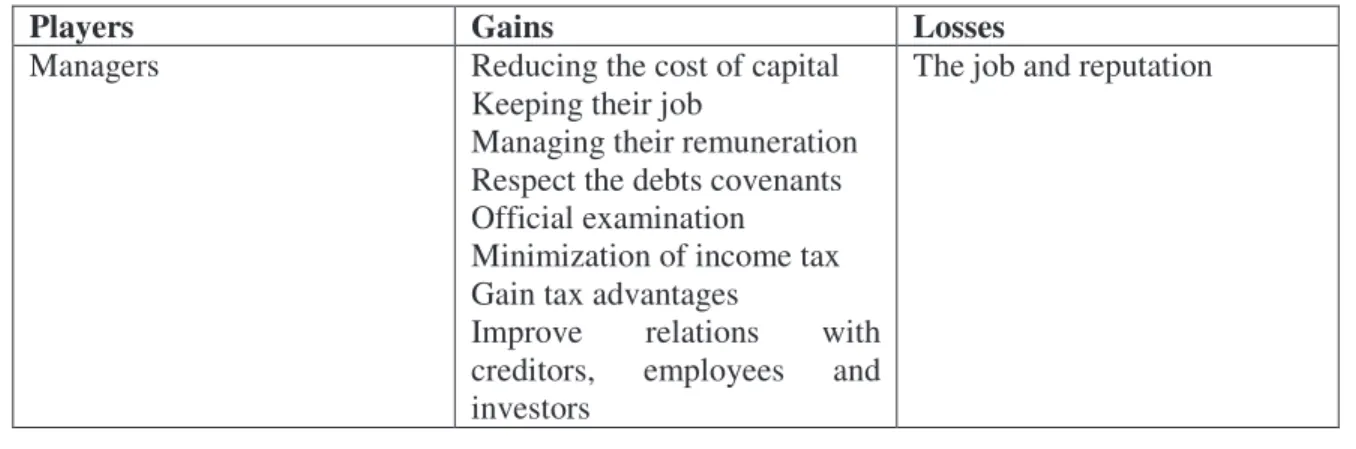
Managers may or may not believe in market efficiency. In case they do not, they can act in order to manipulate the numbers. Their purpose would be to reduce the cost of capital, to satisfy the external demand of existing shareholders, to increase their own remuneration, to decrease the overall risk of the firm, or to avoid violating the debt covenant or incurring political capital costs. Concerning the auditors, two contradictory goals can be seen: on the one hand they want to satisfy the client and, on the other hand they want to avoid excessive risk from third parties. The quality of auditors may also have an effect on the degree of earnings management.
Current investors (shareholders) principally follow the progress of their investments, future profitability and the management’s administration and direction of company resources towards their individual interests.
Potential investors follow the likely estimated risk of their future investments, profitability and stability of profits over time, and the long term capacity of the business to generate liquidity. The public, through the administration of diverse communities, is concerned with the impact of the company’s activities upon local economic development, the creation of new jobs, professional training, contributions to the local budget, and environmental impact.
There are many forces that influence the accounts and, more particularly, the profit figure. From the interests of each group arises the motivation to manage accounting figure. These motivations are studied directly and indirectly by many authors. Several have been identified ranging from the managers’ incentives to manipulate earnings to the reasons of the other stakeholders (Merchant i Rockness, 1994). The most important work in this area is the paper written by Watts i Zimmerman (1986)which proposes a theory for accounting procedure choice containing some essential underlying motivations: the remuneration package, debt covenants and political costs. Finally, Dye (1988) and Schipper (1989), propose some explanations of the manipulating behavior of shareholders based on the positive accounting theory.
Some of these stakeholders groups also have something to lose through accounts manipulation. Although, Revsine (1991) sais that everybody wins, that is not always the case.
Stolowy (2003) identified, on the one side, the potential gains of each group in manipulating accounts and the potential loss for different stakeholder groups because of accounts manipulation, on the other side. We can summarize them as follow:
Table 1. Potential gains and losses in/from manipulating accounts
Players Gains Losses
Managers Reducing the cost of capital Keeping their job
Managing their remuneration Respect the debts covenants Official examination Minimization of income tax Gain tax advantages
Improve relations with creditors, employees and investors
Avoid political costs
Existing shareholders Increasing the market value of their shares
Controlling employees claims Reducing the cost of capital Reducing the volume of transaction
Confidence in the market
Existing bondholders Increase the market value of their bonds
Controlling employees claims
Wealth transfer to the actual shareholders
Employees Keeping their jobs
Increase the remuneration
Their job from an unexpected bankruptcy
Suppliers Keeping their client Some money following an
unexpected bankruptcy
Clients Continuous services
Warranty respected
Services interrupted Warranties not honored
State Tax to collect
Jobs for people
No more tax to collect
Unemployed people to provide for
Bankers Repayment of the loan Some money following an
unexpected bankruptcy
Society Keeping the job
Production of wealth
Jobs lost and resources wasted
Source: adapted from Stolowy and Breton (2004)
Conclusion
Even if creative accounting is not against the law, operating within the letter both of the law and of accounting standards, it is quite clearly against the spirit of both. Creative accounting is a process of using the rules, the flexibility provided by them and the omissions within them, in order to make financial statements look somewhat different from what was intended by the rule. The positive image built with the financial statements help will influence decision making both internal and external (users of accounting information being including here).
We can identify a lot of expected rewards earned by those who play this manipulatative game. Understanding the players in the accounting field demands and expectations is the key to understand the process of creative accounting. If we were to articulate the process of rational reconstruction within the methodological framework that can be used in order to describe the process of charecterize the manner in which their expectations can represent the genesis point of manipulative behaviour, the framework will include the following assumptions:
Source: Elaborated by the authors
Sometimes the desire reward is an upward move in a firm’s share price. For others, the incentive may be a desire to improve debt ratings and reduce interest costs on borrowed amounts, or create
Define the expectations of players in accounting
Define key assumptions regarding their possible actions
Identify possible directions of action
additional slack and reduce restrictions from debt covenants. Regarding high-profile firms, the motivation may be lower political costs, including avoiding more regulation or higher taxes. The question that arise as long as we seek in this field is: Can creative accounting be controlled? Until we’ll be able to respond on this question based on our researches we come with the answer of Sir David Tweedie (quated by McBarnet D, Whelan C, 1999) when was asked whether the new regim will win the battle against creative accounting. His respond was memorable: “ We’re like a cross-eyed javelin thrower competing at the Olympic Games: we may not win but we’ll keep the crowd on the edge of its seats!”
References:
1. Balaciu, D Bogdan, V, Vladu, A.B. (2009), A brief review of creative accounting literature and its consequences in practice, publicat în Annales Universitatis Apulensis Series Oeconomica, 13-14 noiembrie 2009 volume 1, issue 11, p 16, available at: http://econpapers.repec.org/article/alujournl/default1.htm
2. Barnea, A., Ronen, J. and Sadan, S. (1976), Classificatory smoothing of income with extraordinary items, The Accounting Review, pg. 110-122
3. Berle A., Means G., (1932), The modern Corporation and private Property, New, Tranzaction Pub
4. Breton, G., Taffler, R.J., (1995), Creative accounting and investment analyst response, Accounting and Business Research, Vol. 25 No.98, pp.81-92
5. Delesalle, F., Delesalle, E. (2000), La comptabilite et les dix commandements, FID edition 6. Dye, R.A., (1988), Earnings management in an overlapping generations model. Journal of
Accounting Research, vol. 26, pp. 195-235
7. Feleag , N., (2006), Importan a informa iei contabile în func ionarea procesului de guvernan a întreprinderii, în lucrarea Congresul al XVI-lea al profesiei contabile din România- Profesia contabil i Globalizarea,Bucure ti, 15-16 septembrie 2006, Editura CECCAR, Bucure ti
8. Kasznik, R., (1999), On the association between voluntary disclosure and earnings management, Journal of Accounting Research, vol. 37, pp. 57-81
9. Merchant K. A., Rockness J., (1994), The Ethics of Managing Earnings: An Empirical Investigation, Journal of Accounting and Public Policy, vol. 13 , pp. 79-94
10. McBarnet, D., Whelan, C., (1999), Creative accounting and the cross-eyed javelin thrower. John Wiley, pp. 3
11. Revsine, L., (1991), The selective financial misrepresentation hypothesis, Accounting Horizons, December, pp. 16-27
12. Robb, Sean W.G., (1998), The Effect of Analysts' Forecasts on Earnings Management in Financial Institutions. Journal of Financial Research, available at SSRN: http://ssrn.com/abstract=89608
13. Schiff, David (1993), The Dangers of Creative Accounting Worth (March): 92-94.
14. Schipper K., (1989), A commentary on earnings management, Accounting Horizons, vol.3, no.4, pp. 91-102
15. Stolowy H., Breton G., (2003), Accounts Manipulation:A Literature Review and Proposed Conceptual Framework, available at: http://www.emeraldinsight.com
16. Stolowy H., Breton G., (2004), Accounts Manipulation: A Literature Review and Proposed Conceptual Framework, Review of Accounting and Finance, vol. 3, no.1, pp. 5-66
17. Watts, R.L., and Zimmerman, J.L., (1986), Positive Accounting Theory, Prentice-Hall, Englewood cliffs.
* The author wish to thank for the financial support provided from the program co-financed by