l'vIultiple Structural
Change
lVIodels:
A
Sinlluation Analysis*
Pirrrp Prrron t
I3oston CoIlcgp I3uston Ulliwrsit.y
This vcrsion: April セセL@
2()On
Abstract
In a reccnt paper. Bai and Perron (1998) considcrccl theoretical issues relatec\ lo lhe limiting distriblltion of estimators and test. statist.ics in the linear model \\'ith multiplc struct ural changes. \Ve assess. via simulations, the adequacy of the \'arious I1Iethods suggested. These CO\'er the size and power of tests for structural changes. the cO\'erage rates of the confidence Íntervals for the break dates and the relat.Í\'e merits of methods to select the I1umber of breaks. The \'arious data generating processes considered alIo,,' for general conditions OIl the data and the errors including differellces across segmcll(s. Yarious practical recommendations are made.
JEL CIassification Number: C20.
Keywords: changc-poÍnl, segrnenlcd rcgressiolls, lncak date;;. bypothesÍs ICStillg. Illodcl sclect ion .
• Jushall I3ai acknowledges financiai support from the National Sciencc Foundation undcr Gran!
SBR9i09508. Address for correspondence: Pierre Perron, Department of Economics. Bostou Uni\'crsit\·.
4 2iO Bny Stat.e Road. Br)ston. 02215. USA (e-mail: [email protected]). .
tDepartment or Economics, I3oston College, Chcstnut I-lill, !\1A. 02467 ([email protected]).
•
1 11lfrodllc(,ion.BClt I1 t JjC' :-;1 ;11 iSI iC':-; (1))(1 ('('c)JjllIlle(.ric:s lil,cratun' (,ollt.aill ;1 \';1.<;1. éll 1101 1Il1, nf work (lll i:-;:-;IJ('S
J(,/;tt c 'cI t (l :0;1 mel mal challgf', IllOsl o[ i 1. spccificall.\' clC'sigl H'rI fuI' lhe case o[ H si IIg1(' dl;lllgc', lJll\':r'\'!'!". I lI(' prnhlcllI (lf 1l11JIt.iple structllral changcs I!fI.<; 1'('('c'Í\n! r'ollsidcrflhly kss ;tI tr'liliclil. 11('('c'lll h', Bai (Il1d PeITOll (1!)D8, 19UU) prO\'iclecl tl cOluprclwllsi"c エ}BHセ。ャャjャcャャl@ o[ \'élrj()lls iSS111'S ill t IIc rUIlI rxl o[ Illulf ip!(' sI rudural challge Ulodels: ('c)J)sisl.cIlCY
(Ir
estillla(.('S a[ Lhe I ll"f'(l k fiM('s. trsls for slrtH'tmal HGィ。ャャァHセウL@ confidcllcc iU1.Cl'\'élls for t.\1C' iIェBHセ。ォ@ dat,r's, IIIC'I!II)(];; 1(1sdcct t he 1I11IIlhcr o[ breaks allel cIJiciellt algorit hlllS f,o COlllj)ut,(' lhe estilllaLcs. lIo\\,('\'('r. thcir rr'stdl s ;Ire ウッャ」ャセG@ 'l.<;,nnpt,oLic ill ャャ。エLオョセ@ anel Hィイセ@ rlr/e(jlltlc.v ill finit0 salllplcs n'lllrtills I () IH' ill\'f'sl ig;lf f'r1.
III
t his palll'L \\'f' illLclld Lo Jlmtiéllly fill Lhis g;lp.\\'r' !lIr's('1l1 silllulat iCll1 r(,slllt,s pcr(.a.illillg tr) tJ](' hchél\'ior rlf Ilw ('sLilllaL()!'s ;lJId If'sls ill lillitp セ[ャャャャーャHGセL@ \Vc COIlsidrr lhe prnblclIl o[ forlllillg HGッャ、ゥ、イセii」HG@ ゥャャエNHセイカ。ャウ@ for the lm'a/.; d;lks under \';1 riolls ィケーッエィHGウ・セ@ a bout the struct.urc of lhe data anel crrors across scgnH'1I1 s, 111 pnrti('ular. \\·c ャャャHQセG@ al1o\\' lhe data alld crrors t.o héWC difI'CICll( distriuutiollS (1cruss segllll'lIls - or illl POS(' él COIl1IlICtII strtlcll1re. Thc iSS11C o[ tesLÍug for st.rllct.llral changes is also C( JIlsid('red
under ョセャG|G@ geueral couelitiolls on
the
daI a anel Lhe errOl'S ,lllel thc propcrtics o[ tests, boI I1 ilJt he da ta- gCIIcrat.ing processes éUld iu Lhe spccificat.iulI o[ t l]f' エNイセウャウN@ '\V0 also address t.hc iS:"1 \I'
o[ estima! ing
thc
numbcr of brcaks. Tot-hat
cffcct., \\'e disCllSS mcthods bf1Seel ou ill[orlllatinll criteria and a method based on a sequent.ial testing proccdure as suggest.ed in Dai anel Penou (1998).2 The IVlodel and Estillléltors.
ror 11l" pllrp()s(' of the sin11lIatinll ウエオ、セGL@ ".(' ("ol1sidcr ! l!e f()l\owillg 1I1t1ltiplC' lillPé1r H'gn'ssi()1I "'i/Ii UI lllf'Clk;-; (11/
+
1 ITgilJlC's):t = Tj _ 1
+
1 .....r.).
( 1 )for j = 1 ...
m
+
1. This is a special case of the general l!IoJc1 cOllsidcl'ed ill Dai alld Penoll (1 セIYXI@ ('oncspulldillg f o n pure struclural challgc lllodcl. lIcre. UI is UH' O1>SC1'\'('<I depelldr'll!\';uiahlp ;11 tiJllr f; .:, (q x 1) is a \'(x:tors ()[ covariilLf's ;I!J(! HセNW@
U
= 1, ... ,711+
1) is U,(' 」ッイイHLセーッャャ、ゥャャァ@ ョセ」エNッイ@ of cocfficicllts; u( is I,he disturlJílllCC Clt. time f. The íudices (1'1 ..... QセQQIL@ (.Ir t11"
1>1('<1k
jJOilltS. are Hセクーャゥ」ゥエNャケ@ trC'ated DS llukllm\'ll (wC' use UH.' COl1VClll.iOllthaJ
1;)= ()
anel Tm+1 = T). Thc purpose is to cstill1é1t.c lhe Ul1kllO\\'ll regression coeHicicnt.s l,ogetIH'!' \\'it h lhe brcak point.s \\'hcn
T
observations ou(Yi.
z() are available.tィHセ@ ltIelhod of est.iIlJéll iOll cOllsidercd is Um\. !m,scd 011 Lhe ICil.<;t-squarcs prillcípIc. For eac1! 171-partitioll (TI .....
T
m ); lhe associatcd lcast-squares cst.imates ofDj
are obt.aiucd 「セG@milJimizillg l11e SUllI
of
squarccl residllalsm+1 Qセ@
5
1'(T
1 •....T
m )=
L
L
[Yt -Z;Ó;)2.
Let
h
{T
j }) denot.e t.hc resulting estimatcs b:1sccl 011 thc givcn m-part.ition (TI, .... T,,,) clenotrd{T
j }. Substit.uting thcse estimatcs in the objcctive function, the estimated break points(Í"I ... T1/1) are sueh tlwt
(2)
\\'hcre t hc rninimizat.ion is taken over a11 partitiolls (TI, ....
1"m)
suelI t11at1i -
1i-1 ::.::: h ::.::: (1.Thus thc break-point estimators are global minimizers of the objective fUllction. Finall.v, f,he' イ」ァイ」セウゥHIョ@ pararnet.er estillla.tes are obtained using the associatcd kast.-squares csLimat.cs at the estimated m-partition
{T
j }, i.e.b
=b(
{T
j }). All ellicient algoritlun, based on the prill-ciplc of dynamic programming, to obtain global minimizers of the sum of squared residuaIsis presented in Bai and Perron (1999).
,
A ('rlll rill resu!l 、HGイゥョセ、@ ill 13ili allel PelTOII HャduセI@ (,()IlCrrJ!S lhe HGoiQカHGイァHセiャHLHG@ ()[ (!te "n';l!: [racfilil\s -\ =
);/1'
illl!l (Iw raLe o[ (,ollvcrgCllCl'. TII(' rl'sl1lfs (,j)I,lillCd sltu\\" IlO( 1)1\1\· 1.11;11,\, cunwrgcs 1 () iLs 1 rue villue O|セ@ but t.hal, it does so ,l!, cite [i1st r;ll,c
T.
i.('.TP,
-
/\;1)=
(J 1'( I ) [1)1' ,ti I i. TlI is Cf IャivヲGョセcャQHLc@ result, i" o bt.aillcd lllldn il |GイイセG@ gr'l1crlll set o[ HQセsャャiャQ@ pLio] IS;11 I( I\\'i] 112, ;1 widf' \'mi("Y (J[ Il)()dcls. JI., I li )W('V(T, pn'c!lIc!r'" i IIt アセイ[ャ@ Ccd \';lriéll ,I( 'S (\\'i 111 ;111
;1111 ()r('gJf'ssi\'(' lIlli!' mu!) 1>111. ーHセョャャゥQNウ@ lrclldillg イイセァイイGウウイjャGsZ@ ri»)' Hセx[ャiャQーAHG@ wiLh ;1 l],(,lId (I[ IIH'
[onll .(/1 = fi
+
lJ(t/T). Thc assllInpt.inlls cOllcernillg t.!Jc uat,urc o[ Lhe crrors ill rdatiull 1.\,UH' regressr,lrs
{Zt}
are f)f two killds. FirsL, whcl\ IlO !;.lgget! 、HセjャHLャi、Hセiil@ \'ariahk is ;l!l(l\\'(,dill
{:r}.
I i}Hセ@ ('()lIditioIlS O)) ANi}Hセ@ residuaIs ilrc CjlliL(' gCIIN;t! ;l.IId nllow sllbsLalll,i;d (,O!T('Iiltiolland heI ('rr,skcda."t.icity. The second case alIows lélgged df'pCllclcllt. \'ariables as regress()rs IlIl1. t I)('J). (Ir HGHIjャイセゥHB@ !li) sl'l'ial C{))'ndélt ir))) ゥセ[@ ーHセョャャゥャヲ\G、@ ill !.IJ(' (')TUrS
{I/(}.
II1 I)()!,.!l (';IS('S. IIJ('。セセオャャャーャ@ iom; me general cIlough to alI 0\\' c1iffcrent. dist.rihul,iolls for boCh t.llc regre::;sors ()!Hl the rlTors across segment,s.
-3
SU1l1l11ary ar Relevant Asymptatic Results.-3.1
Constructing Confidence Intcrvals.To gct ali 。sセGiャIーエHIエゥ」@ distributioll [01' tl1c urcak dates, t,hr; strntegy ceJIlsiderecl is 1.0 adop! ,111 イエsセGャiャーエ@ ot ir frame\\"ork whcrc the magnitudes of t,he shifts converge 1.0 zero as t,he sall1ple sizl'
increases. The resultil1g limiting distribution is then independen1. of 1.he specific distrilmtioll of the pair
{Zt. UI}'
To describe the releyant distribut.ional result, we need to define some nofations. For i=
1. .... m. andllT?
=
TIO - ョセャG@ lctT?
Qi
lim(llT?t
1L
E(Zt
Z ;).t=T?_1
+1T?
L
eHzイzセWjtャiHIN@In
the case "'l1ere the data are non-trending, we have, under various assumptions1 stat,ed inIThe important ones are as fo11O\\'s: thc magnitude of the shifts dccrenses ai a suitablc rate as th!' s<llllplc
size increases, a functional central limit theorem holds for the partial sums of the \"ariables {Zt 1I( }. also
plim(SZ-P)-1
lZM[NZMQUエセt[GQ@
E(Ztz;) = SQi is assumed to exist \\"ith Qi a fIxcd matrix. The latter prce!lldps.- I
Bfli íllld PCITOIl (1998), the
following limiting distriblltioll of
エィセ@ Lrcak 」Q。エNセウZ@(lnr!
HセセアLセェIR@ -
o
-1'1(ü/O":' ) I , , (1: - T, ) =:;.,
arg max sI'
(s). (1 = 1. .". m).çj -
セZqゥKQ@D.,j
.0.:0,.:},.
'2q/i.!
セZョLセLO@ .0.:QjQ.; .. '2
(.\'2 dNZsRGMGNiセLェqNZcAGA⦅iセ[G@
ifsSO.
ir.'i>
O.(.1 )
AbtJ. 11";'\(8) anel
ャfセGIHXI@
are illdcpcnclcnt sLanelard \Veincr processesdcfinecl
Oll [O,'x).start illg
at
t hc origin whell S =O. These proc.esses are also indepcndent across
i.The
cUlI1ulativc distribution function of argmaxsV(i)(s) is deri"cd in Dai
(HJ97a) and ali-::. that. is needcd to comput.e thc rcle"ant criticaI \'alues
arecstimates of
セゥL@
Q"
and O,. Thesc
are gin'I1
「セG@Ai
-
b'
+1 -b,.
T,
Qi Hセゥゥ@ )-1
L
/-
ZIZ"t=T,_I+l
and an estimate of
D,
can bc constructed using the covariance lllatrix cstimat.or of
All-dre\\'s
(1991)applied to the vector
{z(ud
and USiIlg data
0"01' scgl1lcnt ioIlly. \Ve use Lhe
Quadratic Spectral kernel with an AR(l) approximation for cach element of the vedar
{z(u(}
to construct the optimal bandwidth (henceforth referred to as a
HACestimator).
In
practice, one may want to impose some constraints OIl this general framework rclat.ed lo
the distribution of the errors and regressors across segments. For ease of reference, especially
with the simulation results presented later, we shall adopt the following notation.
'VITedenote
bv
t. cor _ 11 = 1the case "'hcre the crrors are allo\Vcd to
becorrelatcd and bv
... cor _u.
.••• = O t,hecase whcre
110correction for serial correlation is made. Similarly,
het _ z = 1denotesthc case
\\'here the regressors are allowed to have heterogenous distributions across segmcnts and
「セG@hei _:: = O
the case where the distributions are
。ウウセュ・、@to be homogeIlous across segments.
Fillally.
hei _ u = 1permits heterogenous variances of the residuaIs across scgll1ellts
anel-
-. 'i,:'·
• TIl(' ョGァイイセウウ」ャイウ@ :::( are ident.icaIly disLribuLcd acru:'iS scgJllcllLs (CO/'_II = L hrt _,:
= (),
"ri
1/ = 1). Thcll Q;=
(2;+1 = Q \\'hich t:(lll c(JllsisLcllt.I,\' QjHセ@ cstilllalPdhy rJ
,_=T-I IGZセi@
z,z;.
In t,hisCélSC, lhe lillJiliug resuIt ;:;1;1!(':-; !,h;d,
\\"il li
ç,
= 1.• TIJ(' cnors are idcnt.icalJy distribut.ed ncross seglllcllls (('()r_lI = L hct _,:: = 1.!rd _" = ()), tィHセQャ@
n,
=
n,_1-I
=
n
\\'hiclI call cOIlsisLclltIy !J(' cst imal.ed lIsiug afIA C
('slilua!, II()pplie<! lo lhe |G。イゥ←Q「ィセ@
f:::(
li,}
using dat.() ()Ver UH' \\'hol(' ウョャャャーIHセL@• TI]!' PITors and Lhe data are idcnticalI,y dist.ribut.ccl ncross scgmcnts (COI'_lI = j.
"cf
_.:
= O. hct_11 = O). Uere, \\'e havcçj
= 1, anel Ó"l = 0;,2 and Lhe lilllitillgri isl ri I >11 t ion !Td iicヲMセs@ 1,0
\\'hich lias a dcnsity fUllction symll1ctric about. thc origin,
• The errors are serial1y uncorrclated (cor _11
=
oセ@ hei_2=
1, het_u=
1). In t,his case (') - 2Q d 62 - ,2 - 2 .}' I b . 1 ' · ' 2 - (Ar,' ) -I ",,1', . 2Hi - ai - i an 'i,1 - <1>j.2 - (Ti \, l1C 1 cctn e est.Ullat.ec uSlllg (Ti - Ll j L..t=i;_I+llIt.
The confidence int.en'als can then
bc
const.ructeel [ro111the
approxil1laLion(G)
• The crrors are serially uncorrclated anel thc regrcssors are idcntically elistribut.ecl across segments
(cor
_u =O,
het_z =O,
het_u =1).
I-lereq;;.!
=q;;.2
=ar
anelÇi
= 1. The confidence intervaIs can then be constructed from the approximation(6.',Q6.)
7"
.
(')
2 ! (Ti -
T:
0) セ@ arg max{l-l' ,(s)
-
IsI/2}.
(J, ,5
t
(G)
• The errors are seriaIIy uncorrelateel and ielentically distri buteel across segments (cor _ u =
O.
hel_ z
=
1.het
_
u
=O).
The approxima tion is the same as(G)
with ;,-2=
T-
1 iZtセ@ 1it
セ@-
-• The f.'ITOrs me scrialh' ullcorrclatccl <llle! .... IH)th t,hr (/;)(.a allel エィHセ@ . crrors a.re irblticall\" - . dislribllLeu セャcイッss@ srglllcllLs (C07'_l/,
=
O,
lu:t_.:=
n.
hei_li=
O). The
apjJroxim;tliollis t
111'
S;lJllC él."i (G) \\"it hrr
2 instead ofrrr
SillfP I!w Im'ak diltf:S arp illlf'gf'r \·alllrd. wc collsidcr ('()llfidCllCe ill(.('lTals j,]J(lt. are jikr'wis('
ゥャャヲHGセitM|G。ャャャHG、@ li,\" lIsing tlH' higlwsf. sll1allrr iulq;('r ff)r 11)1' !()\\"cr 1)(>1ll1d alld tlH' Slllilll('sl ィゥセAェHGイ@ illl HGセHセイ@ fnr lhe lIpj)cr !JIJlIlld.
3.2 Test
Statistics for l\1ultiple Breaks.3.2.1 A Test. of 110 brcnk versus a fixed numher of lJreaks.
\\"f' HGHiiQセセゥ、HGイ@ II,c sup F fypc tesl, ()[ no structmal brrak
(171
=
O) ョセイsiャs@ t.hc ;1!ir'1'II;din'h,\"lJot ltcsis tlwt t here élre 717 = k iJreaks. Let (TI' .... Tk·) be a partit.ioll suclI that
:r,
=[T\,
1
(i=
l. .... I .. ). LeI R 1)(, thc cOllvcntiollallllatrix sueh Um!. (lló)' =(Ô'I -
6; ... イセセN@ - HG■セZセ⦅ャIG@Ddi!H'
. * . - _ 1
(T
-
(k+
l)q) " , ',' '-1 'Fr()\j .... ,/\k,q) - T kq éJR(fll. (f»R) Ró, (7)
"'here \.
(é) IS au estimate o[ the variancc covariance matrix o[b
that lS robust to serial correlat iOllanel
lIetcroskeclasticity; i.e. a consistcnt. estimate o[(8)
The
st at istic F; is simply t,he convelltional F -1'tatistic [OI' testingó
1 = ... = Ó k+ 1 againstt,
=F hi_1 [OI' S0111ei
giwnthe
partition (TI ...TJ.:).
The
supF
t セGー・@ j,C's!. st.atist.ic is thCll uefined ,15supF;.(k:q) = Sllp
Fj'pl] .
...
,Àk;q),(.Àl.· .. ,.À k )t;;:\,
for some arbitraQ' positive number E. In this general case, allowing [OI' serial correlation in lhe errors, the sllpF;.(k: q) may be rather cUl11iJersollle to compute. I-Iowcvcr, 011e can ubt.ain
, <
TIJP
サGセエ@ ill);\! ('S /\)< 000' Àk ar\' cqlIi\'alentlo\'t.he
<lrgurncllts to!Jat. IlJaXIIllI7,CS Lhe' foIlo\\Oillf,!:F-ウエ。エゥセャゥHッZ@
;1) ,ri
/ -\-, ( ( 'O)=T(Z Z , _ J I o
tlw ('n'(l1 ゥ[QQQHPHセ@ lUalorix u[ (. a.sslllllillg sphcrical crrOl'So This proccdul'(' is H|セケャQャIャエNHャエゥHG[、ャッ|o@
f'fjui\'ahtt sillce the IH'CHk datcs are consistellL ('ven in th\' prcsr:'llCC
o[
serial corrclationoTIl('
。sセGャャャーエ@ oI iro dist rilmtio!l st.ill depeneis Oll the spccificaLioll of t.he sei j\( via t.he ilUjlClsitiol1 Ilf
t 11(' lllillilllal lCllgl II " of a scgment.. Hcnce, I':: =
h/To
\ '<!l'iulIS \OcrsiolL'-; (j[ the t.csts C<lU
ue
obt.aillcd dCpClldillg 011 Lhe aSSUlll pLiolJS Ill;\( 1<, \\Oi til r\'slwc1. t Cl lhe elistrihlltoinI1 of the data anel Lhe errors across scgmcntso Thcsc variaLiolls rda(csto diffe!'en( specificatiolls in the construction of Lhe estimat.e of the limit.ing covariance mat.rix
|ッGHHセI@ gin'll 1)0\' (8)0 Tlwy are the [ollO\vingo
• f\o scri<ll cOIT('\at.ioll, diffe1'elllo distributious for Lhe dat.a and identic:al dist.ribul ion f( II
lhe ClTors across segments (cor _ 11
=
O, hct _ z=
1. hct _11=
O) o In this base C<lse. t he cst imat.e is• -1\0
serial correlation inthe
errors, different variances of the crrors and different dis-tributions of the dat.a aeross segments (cor _u=
O.hct_oz
=
1,hei
7J=
1)0 In this case.\\"hc1'c
F
(ód
is 1,he covarianee matrix of the estimatcb
i using only data fram scgmclIto o " - _ 2 • -1 1" I -1 o -2 • -1 1i A2 o
1: 1.e, \,
(ó;)
=ad(.6Td
2:
1 r.'. 1 ZtZtl wlthai
=(.6T
i )2:
t-r.- 1u
t · These met= 1-1+ - 1-1+
simp\y the
OLS
estimates obtained using data from eaeh segment separatelyo• Serial eorrelation in the errors, different distributions for the data and the errors ac1'OSS segments (cor _ U
=
1,
het _ z=
1:
het _ u=
1).
Here, we make use of the faet. that- - I .
||GャIHL|BヲセN@ f()r i = 1. ... , m
+
1.This (';111
IH:
cOllsisLcnl1y f'st.imat.cd, scglllf'1I111\'
SI'r.',I1If'II1., \\'iLh aTI.I\C'
('slilll;I1I)](Ir
F (/,) using
OJl1:v
clc1ta
from scgmcllt i.• Sr'l'ial corrclation ill the crrOIS, samc distribut.ion for t.hc crrors across scgmcnt.s (c(lr I/. =
1.
"ri
_.:
= 1. hd_IJ = O). In this 」←ャセ・@ thc limi1.ing ('()\',lrÍélllC<' llléltrix is.1\=
This ean be C'onsist.ently est.imated using セゥ@ =
t/T
anel a HAC estimator based OIltIH'
pair{::tú/}
const.ruetcd using the full sal11plc. Note t,hat we lwvc an implicit assumption t-hat the regressors z/ have the same distribut.ion aeross segments since the cOllsistcnt estill1ate of p limZ'0.Z /T
is constructed using the full sal11ple. For reasons, discussed1
-bclO\\' \Ye do not impose that restriction \\'hen evaluating
p
limZ Z /T.
That is, we st..illuse
Z' Z /T
instead of an estil11ate o[Hセ@
2 Q) obtained usingQ
=T-
1"L:=l
z/z;
basedon the fuH sample.
In
the eonstruction of the tests \\'e do not consider imposing the restriction t.hat t,hc.'-
-\\'!Jf'n'
q
=
lilllT_x T-ILLI
E(ZI,':;), Not.e UmL a consistf'llt estimat e (';111 be oht.aillcd 1\Sillg (i = tGilZセェGZエZ[ZL@ (r'l = tMilサセiᅪャヲ@ (I!leIA
COllst,rllctr'd llsillg /\, =t/')'
(i = 1.",,/11),SlljJpr,lsr' t lia! tlJ(' ::'s ;Ire eXflgcllous alld LlIC C!TUl'S I!(}\'(' t lI(' s[エijャ\セ@ \'(lriéllJ('c ;lCrosS Sq,"llH'IJtS,
TII('II. fI 'I ;1 イセゥョGャャ@ p;lrtitirlll (TI, .... T,1I)' the ('xncf. \'ari;Ulf'r' rlf tlw HGウエNゥャャャ。エNHセ、@ codlici('lIt.s
i\
isI\illg tlJf' ;1.<-:\'1I1pflltir' \'('!"SIOll fHHセI@ = ヲtZAサゥ|セM
(jr
l Ill(lY illlpl\ ;IIJ iIJ;l('r'1\rat.(, apprUXilJlatitl]1fll f
11"
"X;\I't r1istril!1lt iO/l, This \\'rlllld O(,Cl\l" HGsiIヲG」ゥ[iiャセG@ ir SIll;t11 segll)(·Ilt.s ;lH' ;J!It)\\"('l1 i'l \\'llicll(';1.'-;(' tl}f' r,:-:;\('t mrJl!H'llt lIlatrix (Ir the AGHセァイ」ウウッイウ@ lIJ;I,V dcvi;tf(' sll!Js[.(\lltially rrOlll itf' rllll Sillllplr'
The ウ。ャャャイセ@ prohleJll nccurs ill thc c(}sr with 110 serial corrdatioll in tlJc crrors alie! dif[crcllt \'ari;lIll'f' fln t lJe lTf'idllals ;HTOSS SC'glllCIILs (cor _11. = O, Irct 71 = 1), lm]>osillg
"cf
,_ ,:
= ()
gin's t!lf' lilllitillg \'(IriallCf'
\\'hich r(lU be consistcntly estimatcd using
Q,
ÀiTi/T
andIr;
=(Q.Tit
1lゥセQB@
I ílf,t- 1-1+
Again. ill fillite sarnples, imposing the constraint thaL
Z;Zi/(6Td
be approximatccl by () over alI segments Illay imply a poor approximation in finite samples. We have [ound, in thcsc two CllSCS, thal irnposillg a common distributioll for the rcgressors across SCglllCllt.S leads to tests with worse properties even when the data indeed have an invariant distribut.ioll, These distortioIls becomes less importallt, ho\\'c\'cr, whcn Lhe samplc sizc is large éllld/or tlw trimming 15: is large.Thc rclevallt asymptotic distribution has been derived in Bai and Perrou (H)9S) anel criticaI values can be found in Bai and Perron (1998) for a trimming E = ,05 and valucs
' . .: r.,' " d . ""
(»),s('n'nt ir)]IS: f()!" ex;unplc, if
T
= 100 and ( = ,OS, OIlC ('llds IIp cst,illtat,illg, for SOI!1e segllH'111 s, qllilllt il ir,c; Iikc Lhe \"ariallcc of lhe residuaIs USiIlg oIlI.\" セャ@ nhscn'atiolls. sゥャャャゥャ。イャセGL@ wit.lJ serial ('{)JTcl:l.t inll (1 IIAC cstimator \,'olllcl nccd to bc npplicd I() \'cr\" shol't smuplcs. TIl(' est.iIll,d ('s(\li' (1)(,I1 Itighl,v imprecisc lllld t,he LcsLs (1('cordillgly SIHl\\' ウゥコHセ@ distort iOlls. \VhcII ;dl(l\',illg
rliff"If'II! \';lri;1I1('('S anoss sC'gmenls OI' serial corrclat.i()1I ;\ higilcr \',JllI(, (l1" ( should 1)(' IIsr·11. I{r'II(P, I lw HG[ャN\Z[Hセ@ (ror 11 =
n,
hd ,-:; = 1. hrt 11 = O) sll()llld he ('llllRidrrccl Lh(' Il;l,<;r' (';I"r'111 \\'hit.'h I l!e I CSI s can bc c:onstr1lct.cd using ,UI ,trlJit.rar\' small trillll1lillg c, For alI 01.111'1
C<l."ir's, ('(\1'(' s!tould bc cxercisccl ill lhe choicc ()[ c alHl l;lI'gf'l' \"allles s!Jollld Iw cOIIsidnt'd,
Cli! ic;l! \'ídw's for trilllIllillg pilnllllct,(·]' c
=
,lO. ,I!), ,lO illld .2:i (',lU 1H' fOllnd ill !3;li ;IlldPf'!I'lllI HャセIセIAIIN@ Nair' that, \':hell (=.lO tlte IlHlxilllUrn J\lIJlllJ('r ofhrcak (,oIlRic!8red is 0 sill('('
;dl,,'.'.'illg fi 1!l'f'"ks illlPI)S(' lhe r;stilllatc's lu 1)(, ('x;\c'(.I,\' '\1
=
,I. /\'2 == ,2111' Ir) \) =c-= NセjL@ I'IH;:;iIllilar rr;l,>.:nIIS. the nwxilllulll QQャャQQjィHセイ@ 01" Lreaks al!o\\'cd is !) whcll C = .IS, :3 \\'helI ( = ,20
alId 2 \\'11I-'1l ( = ,25,
3.2.2 Double maxhnum tests.
OftCll. ali ill\·cstigat.or wishes not to prr'-spccify a part.icular l1l11nbcr af breaks to lllakc illf('r-enre> , T(l allo\\' this I3ai and Perron (1998) have introduced two t.cst.s of Lhe 1lUll hypo! hef'is
of no struct.ural brea-k againstan unknown number of breaks given some upper bound .'1. These are called the
double ma.rim'llTn tcsts.
The first is an cqual wcight.ed versioll dcfilll'db,\'
\ |GHセ@ llSP 11H' HQZ[セGャャャーエッャ@ ゥ」。ャャセG@ cquivalcut. wrsioIl
\\'here Àj - Tj/T
(j
= 1, .. セ@ m) are the estimates of the break points obtained using the global minimization of the SU111 af squared residuaIs.Thc secolld t.est applies weights Lo the individuais tcsts such tlmt the marginal p-\"all\f's are equal across values of TIl. This implies weights tha!; depend 011 q and thc significélllCC'
levei af the t.est, say Q. To be more precise, iHセエ@
c(q,
Q, m) be tlJe <l!'iymptotic criticaI \'ahH'of tlte tcst. sllP(.Àl, ... セイョIea\@ FT(>.,I, .... Àrn; q) for a. significancc leveI Q, The weights are tlH'1J
defined as 01 = 1 and for m
>
1 as Om=
」HアセqNャIO」HアLH|NュIN@ This \'crsion is denot.ed* c( q, a, 1) P* ( \ \ )
11'DmaxFT(M,q) = max ( ' ) SHp -T .AI, .... /\m:q .
1'2",<lII r: (/.(\.1'11. ('\1 .. ' ,.\",1":\.
:\g;lill. \H' use Ibe 8Sylllplot.ically cqtú\'alcnt. "crsiOll
:\o!.e I hal, オャャャゥォHセ@
Lhe
UD
max Fl'( AI, q) tcst, UlP \',li IIC()f
t11f'11-D
llIax FI' ( j\J. ri) e1c'l )<:I]C 1:-;Oll tlJ(' sigllificélllce lcn'l cl!nSCll sincc Lhe ",cights t.l!ClllSC]WS dqH'IJ(] Oll (l. Cril i('él] \';1l1lt,:-; call IH' [rHllld ill Dai aliei P0ITOll
(lmm,
l!HJ9) ror (= .();)
(JiI=
S), ( = .lO (1\1=
:1), .1;)(Ji! = .j), .:20 (:i! =
:3)
anel .2.J (iH = 2).3.2.:3 A
t.est of
r
versus (+
I breaks.B;l i élllrl P('!Tr III (Hl08) propns('d a I<:st. for ( verS1\S (
+
1 hrc:! ks. This ksl is la I )('lIr'dSll p
rI
( /
..L 11 r). Tbc nwt hod a 1II01l11Ls I ()t1w
セャーーャゥHG←ャ@ t iOll (If ( (-+
1) lf'st.s of the 111111 AjセGーH@ 1I h('sis of WJ st rue! mal changc vcrsus Lhe altcrnati\'c hypot.hcsis of a singlc changc. Thc ((':-;( isapplíf'd In cach segmcnt containing Lhe obscrvations
T:-
J tnÍ';
(i = 1 ... (+ 1). Thc cs(.illlatf'sT,
IIccd IIU'1)(' lhe
glolxd lllinilllizcrs of Lhe SI1111 of sqtwrcd residuaIs,all
t,hat. is rcqllil'c(I
is lha! lhe brcak frrwl iOlls /\, = i/T converge tu t,hcir true "alue aI rat.c T. "Te cOllclud<' fOI'a
reject ion in fa\'or of a modeI with ((+
1)
breaks if the overall minimaI "alue oflhe
511111of squared residuaIs (over aIl segments where a11 aelditional break is included) is sufficient.ly ウャャャ。ャャセイ@ than the sum of squared residuaIs fram the { breaks model.
The
break dat.e thlls selected is the one associated with this overall minimum.Asymptotic criticaI values were pro\'ided by Bai and Perron (1998, 1999) for q rangillg fra111 1 to 10. and for trinuning values ê of .05, .10, .15, .20 and .25. Of course. aIl the sal1lC uptiolls are a\'ailabIe as for thc pre\'ious tests concerning the pot.cntial specifica.t.iolls of 1:11(' lIa1.1I1T ()f the dist.ributions for the errors alld the dnta across segmcnts.
3.3 Estimating the number
ofbreaks.
A
common procedure to select the dimension of a model is to consider an informatioll criterion. Yao (1988) suggests the use of the Baycsian IlIfonnat.io11 Criterion (lJIC) dcfincd asBIC(m)
= InÔ'2(m)+
p. In(T)/T,-
-, •. セLGエᄋ@ LセN@ ,A "
SC!J\\'ill/' rTÍt('riOIl tlIal I.akcs lhe funil:
TIJl.',\' ;;ugg('!'t llsing bo
=
0,1 anel Co=
0,290, Perroll HャセjdWI@ pn's(lIl(,(;t! a sil1lulat.ioll sl,udy (Ir 111" 111'11;) \'in! nf t I H' t hl'sc Lv;o illrUrIllat.iun cri teria éllld ()f UH' / \ _ . I C - ill Lhe l'uut.cx t. of cst.illlal il)!' \"lt h" Illllllher uf challges in t,he trcml fUlldion uf a scrics ill 1.he prCSCllCC of serial corrclatioll. TI1(> r f'S11 11 s fir.t.;t sho\\'cd lhe
A 1
C to pcr[orm vHセイセG@ iJadl,v a Ilel, l!ellcc, Lhis crit,erioll \\'ili
!lnl 1)(> ((IIlSid"}{'d ;lIly [urt!WI'. TheJJIC'
allel LIF Z pcrfr)1'll1 )'(';lS0IW,bl,y wdl whclI !lO s('ri;ll cnrrdilt ion ill t ィセ@ errors is prcsPllt. Imt illlply dl00sillg ;t Iltlllll)(lr of breaks llluch higlH'r tlwllt
1)('
1[1)(' vallH' \\"hell serial corrclaLioll is prescnt.. \VhclI 110 sNia.l correl"Lioll is pr('S('llt illt llf' ('lTfl!<'; 1)\]1 a ャョァセNGOセ、@ d(,pClldcllt. \'ariahl!' is pn's('llt.. tIl(' rJ
le
jlf'l'fonlls ijh、ャセG@ \\"11('11 tIl<'HGHI、イゥHGゥイセャiエ@ ('I! lhe' laggf'd 、・ーcャャHャイZセャiエ@ \";lriablc is largc (ilIl<) 11101'(' so as it appnmches エャャャゥHセGIL@
In sueli cases, t-he L
n'
Z per[onns better under the null of no break but. lludcrestilllat.c the 11l1I1l1H'r rlf hrpaks \\"hcll some are presellt..Thc I11ethod suggested by Dai and Perron (1998) is based OIl the sequential application of thc Sl1p
FrU
+
li!) test.. The procedure to estimate the llumber of breaks is the follo\\"iug. ,Start
by estirnating a mode! \\'ith a small number of breaks that are thoughi. to be necessary (or start. \\;(h no break). Then perfonn parameter-constancy tests for each subsamples (thosc obt.aiucd by cutting off at the estimated breaks), adding a break to a subsalllplC' associated,,-ith
a rejection with the test supF
T ( [+
11t').
This process is repeated increa':iing( sequentially until the test snp FT (
€
+
11l')
fails to reject the null hypothesis of no addit.ional structural changes. The limiting distribution of the test is the same \\"hen using global millimizcrs for t 11e estimat.cs of the break dates or seqllcntial onc-at-a-time estimat.cs sinceboI h illl ply break [radions that converge at rat.e T (see I3ai (1 097b) ). The final nUllll)('r
01'
breaks is thus equal to the number of rejections obtained \vith the parameter constancy tests plus thc number of breaks used in the initial round.A
distinct advantage of model selection procedures based on hypothesis testing is that, unlike illformat.ion criteria, they can directly take into accaunt the possi ble prcsence o[ seriétl correlation in the errors and non-homogeneous variances across scgmcllts.4 Simulation Experiments.
In this sectioll, "'e present the results of simulation experiments to 。セ。ャケコ・@ the size anu po,,'cr af 1.he t.ests. 1.he coverage rates of thc confidencc illtervals for t.he break dates alld tIl('
flf
di-lt rl gC'llcratillg proce::i::iCS are ronsiucrcd allO\\'illg cJifI'crcnL vanances for the rcsiduabfIliei イQゥヲiGHセjHGャャャ@ dislrillllliollS [or
Lhe
regrcssors (lcross seglllf'nts as",cll
<1S serialcnrrclílt
i(l]l.:\Il
tI'lllputat.iolls Hャイイセ@ pcr[orIlIcr! inGAUSS
usillg ;1 (:01l1])1I/.('1" prugralllChaL
i::; availald(' rlll lf?qwst fln lloll-profi.t élcadclllic use (sec Dai ,mel PcrrrJll HhIセjセjI@ for;1 Ilwwugh dcscripti()!l(Ir
t!JI' fi'all1rf's of this prrlg/illll).4,1 T1Je G1SC with no break.
\ ri'
セQ@ ;1I 1 \' .. i I b I he Cil.S(, V,' ィHセイ」@ エN「Hセ@ dat.a gPI wnlt.i IIg pro(TSS('S exlii!li t. IIU sfrllrtllra! clJa IIgc i1l1d. hpJl("('. ;111;1I\'Zf' lhe sizc (lf I.Jw LesLs alld !Jf)\\' wdl t.hc lllcL!Juc!s t.() ウ」ャHセ」エN@ (.]1(' 11111111)('1" oI' ]1J"(';J!,puintc: élctWtl!y sclcd ャャHjャャHセN@ Tlu'ollgbout
{c,}
c!e]lfJ(.cs él scqllf'lICC of i.i.d. N(O.l) ralldrllll\·illi;dl!f'S. {lI',} is (l S0.qUl'l)(·f' of i.i.d. N(1.1) r<Uldfllll \'ariabh's ll11corrdaJed witb
{It}.
\\'('
IN' sélJllplc sizps of
T
= 120.andT
=240,
The \'alues o[ the trill1111ing c alldt.h('
lllaxiullllll1111111],('1'
()f
lJr('nks (:\1) cOllsidereel are: f=
.05 anel111
=
5, c=
.10 anel lH=
5, (=
.1G éll1d.H
=
·"l. (=
.20 alld li!=
:3, (=
.25 aliei iH=
2. Til a.1I ('élses, 2,000 rf']>licaLiolls ;ln' \1sed.The data
gcncrélting
processes and t-he corresponding regressors used are:• DGP-I:
.YI = c(anel
z(=
{1}
(q=
1);
• DGP-2:
VI=
lJ't+
Ct and Zt=
{I,
wd
(q =2);
• DGP-3:
UI = 0.5VI-1+
et and z, ={l,
Yt-1} (q =2).
• DGP-4:
Yt=
1'( wit-h 1'(=
0.51·t_1+
e, and z,=
{l}
(q=
1);• DGP-5:
VI = 1'( with 1',=
c(+
0 .. 5et-1 and z,=
{1} (q = 1);• DGP-G:
y, = 1'( with l't = Ct - 0.3Ct_1 and Zt = {1}(q
= 1);The DGP-1
withi.i.d,
data is a base case to assess thc basic properties of the tests aud met hods tu select the number of breaks. It is useful to assess the cfrect of allo\\'ing difI'ercut variances o[ the elTors across セ・ァュ」ョエウ@ and/or serial corrclation whcn these [catures are 1I0(prf'..sent. The
DGP-2
is a variation which includes an exogenous regressor.DGP-:3
is one where serial correlation is taken into account paramctrically.DGPs
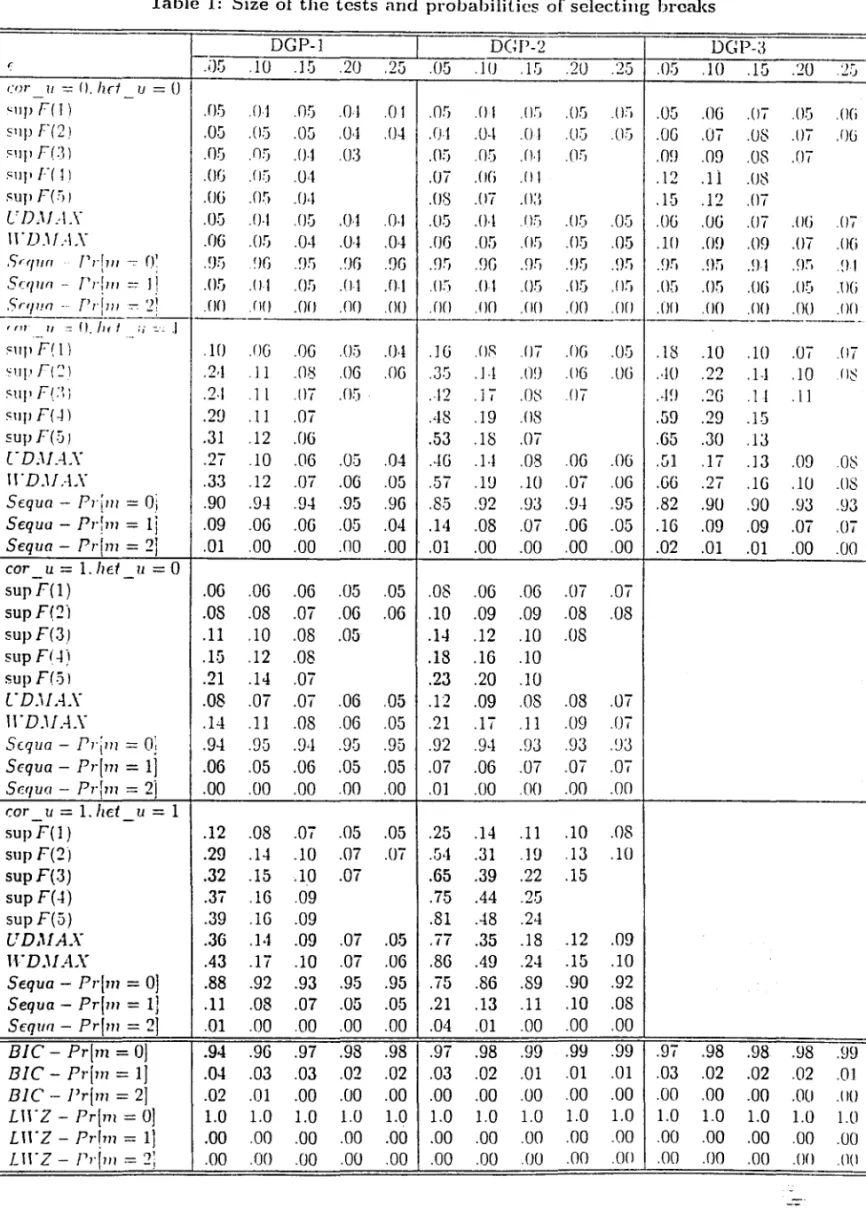
4 to 6 are used to assess the eIfect o[ serial correlation in the errors and how weU lbe corrcctions for its prcscnce leads to t.ests \\'ith adequat.e sizes.11;1\'(' ,1](' rig,ilt Si7,(l for ilny \'allle of IIl(' trimmillg:-, ;\s (';qwcted. Lhe sef(uc'lIt.i;d jl\"(l("l'lltm' r-l]f)f}'-"'S tlC) 11}('ak arulIlId wェセt@ uf t,hc tinJ(', The
n/c
bet \\"('Cll uセャHOセL@ ,lllelas
%
H、・ー」ャj、ゥャjセセ@ Oll :-) ;11l! I f I J('r
lI" Z 100%. of t.he linH', \ Vhell d iffcrent \'<lri;:lIJ('('s"r
lhe l'csid ll<lls are allo\\,('t! éltTns:-; sHGセiiェHGャjヲウL@".p
sce slIIJManli<l1 ウゥコHセ@ dis!ort,jnIlS \\'hr'1l I IH" trillllllillg ( is Slllél11 ,
TlwsC', IH'\\'("'('l.rliS;qljlP;\1 ,',-IWll :- イイセ←Q、}HGウ@ ,IS or ,20, tihセ@ sc.quf'nlial pr!lCcdmc is SOllIC\\'I!;t! biasec! \\']]('11
:- -=()-Í IlIlt t his I,ias disap!WilrS qllickh' <1.<) S(IOII ;1,<; :- rr'rl('Ilf'S .1
n,
Similar Silo!.' disl,!lltiflw; III'!'1Ir \':]IPII ;dl(,\\'illg セ」イゥH、@ cOITelat,ion in lhe crrors (cu/' /I = 1), These are' SOlIl('\\'!JaL 1I1!JI(':;"\'('11'
ir.
ill additinIL diffcrclIt Y;Hi,J!)(,cs are allo\\'cd, \Vhel! hei _11 = O, t.he seqw'llt i:d fll (I('('rlurp :-;l!Il\\,S 110 SiZ0 disl.())'t.ioll (11. (lny \"<1.I11(:S (Ir:, H()v:p\'('r. if hd 1I = 1, t.lw S('(Il1('l1t i;t1イjAGHIHGイセ、ャャョNG@ is adequa! c HIャャャセG@ if ': is at, lca.')1 .1 S,
,\ sillliLtr pi(,t 111'(' ('!Jwrg('s fr)r DCP-2 \\']lCr<' ;1 1;\lIr]olll イャGァL}GHGsセHャイs@ is ilJ(']lIr!('rI, ,Ir {'OI' /1-'
h(
t
__ "
=
U. élll AHGアセ@ h;1\'(' lhe right size, HO\\'e\Tl'. élllu\',illg for I'it Iwr diIh'rf'nl. \'é1riil!lI'('S ;1111] '(Ir S( '1i;d ('(I/Tela I illll ill lhe resid Ilals illd \1('es SII hsta III ial sizc d isLurtiollS lI11lcss ê is la イセNNGLHGL@""1H'1I
Jl(l scrinl corrd('tfioll is allo\\'ed, lhe proccdures ha,w t,he right. sizc i[ E' is <lI le<l,<;t, ,10: __ \\'hell serial correlation is allowpd a larger value is nceded,The results [01' DGP-3, which is ,HI AR(l), sho\\'s tllélt if 011e is t.csting agai11st a large
Illlmhcr of breaks (or using tlle H'
D
lllílX test) there aw SOllle dis(,ort.iollS evrll if co/' li = hct _ li=
O \\"11e11 :- is smalL The sequential proccdure rcmains, howevcr. a.dequat,r for 。ャャセG@,",llnes (lf:, If different. variances are allO\\"cd size distortions oceur un1css E is at, kasl ,20,
Thf' DGPs -1 to
6
are cases ,\"here serial correlation is present in the residuais. As expect.ed. if cor li=
O,
a11 procedllres show substantial size clist.ortions (with posit.i\'c correlaliollthe
エ・セエウ@ are liberal and \\'ith ncgative correlation they me conscn';ltivc), It is t.hereforc import Hllt to correct for serial correlatioll, This, 110we\'er, call be done adequatcly only if a large uill1ming is lIsed, ,15 or ,20 depending on the c a.t; es , An intercsting fcat.ure, ho\\'e\"cl'. is that the sequential procedure \\'orks vcry well for any values of E when the variances areronst raincd to be lhe samc (het _11 = O), In particular, iL pcrforms 1l1uch bet.ter U)(111 UH' information crit.crion EIC (and also LH"Z in the case of positivc AR errors),
In fiummary, if no serial correlation is present and allo\Ved for, alI procedures work \\'dl for any ,"alues of the trimming E when the specification co I' _ u = hef _ u = O is usecL If seria]
correlRt ion is present a larger value of the trimming is needed \\'hen const.ruct.ing lhe tests using t he specification C07" _ v = 1, This is also the ca.'3e i[ different \'<uiances are allo\\'C'd
across segments, Also, the results sho"," the sequential procedill'c t.o perfonn quite weU [01'
HャョセB@ \'alucs of the trilllllling provided one is correct.ing for serial cOlTC'lat.ion ,dlcn nc(xled alld
4.2 The case with one break.
TIl" l"l:-;ic d;\!;) gpnr'ratillg ーイッ」セウウ@ consiclcr('d is (Case 1):
!fI - fil
+ ')
I \JI I+
r I,.1/1 - ヲQGャNKセHRGQOiKciL@
if
t
S;[O,ST],
if t
>
[n,ST]:
\Ylw)(' 'Ifr -- I,/.{/ X(l.l) allel Ci "-' i,i,d lY(O, 1) anel botlt (lJ'C ullcorrclai.ed, Since, 110 s('ri,,!
(IIr)['I,1I ir))l is pn'sellt ill I.llC crrors (lIHIIlO dmllgc ill Lhe disl,rilJ!ltioll
()f
ch(, daI;! or UI<' ('!Tllrsis al!f)\\'I'd, \H' use thc spccifical,ioIl co/"_/J.
=
hr.t _1/= ()
allel E = ,O!i, fo()r tlw (.('s(s, \\'1' \lS(,h,t
:::
= 1 allel to construcl.t,hc
confielellcc int,en'nls Oll Lhe hrenk dat.es, \\'(' use hd .: = fl, \\'(' r'(lIIsidn flnc!' typcs o[ shifLs: (I) a clHl.llge ill ill(,('n'('pl. olJI\'h
l=
,''2
=
1), h) " 」ャャ[ャャャLHセHG@in slupE' olll,\' (//1
=
/1 2 = O), anel c) a simultaneous challgc ill slope anel intcrccpt..\\-(' ilbo (,o!1sidcr a \'ariatioIl \\'ithout the regressor |jAセ@ \\'il.h crrors that. are scri(dly
COlT('-1"lcr!:
• Case 2:
-'I
=
-'2=
O. and Ci replacccl by 1'/=
0,5/'1_1+
el' Herez,
=
{l},
In this sccono case, we use the spccificat.ions COlO _ /1
=
1, het _ li = O and セ@=
,20. Agaill,for the tests. \\'e use hct _ z = 1 and t.o construct thc confidence int.ervals on the break dat.(,s'\ "'c use
hei
_:;
= O. The experiments are performed forT
= 120 andT
= 240 anel again 2.0UU replicat ions are used.The result.s are presented in Table 2. Ro,,' (a) presents a case wiLh a smaIl change in intercept 0111y, Here the power of the test is rather lo\\' cllld the covcrage rate of the break date is imprccise. \Ye shalI use this base case to investigate what increases power. There are, nevertheless. some features of interest. First, the pO\ver of the Sllp
F(k)
test is decreasing as k increascs (more so as k reaches 5; not shoWI1), However, both D mux test.s havc PO\\,('I' as high as the case with k = 1 (which gives the highest power). AIso, of the three methods to selcct the number of breaks, the sequential methods works best. The crit.erioll L H' Z is quite illaccurate since it chooses no break 98% of the times, Row (b) considers t.he SaIllC' specifications but doubling the sample size to 240, The power of the tests increases, t,he sequential method selects 1 break more often and the coverage rate is better but. not 1.0 él11 ()\\. (I l) prcsl'llt s t 1](' CélSe o[ a l1lild challgc i 11 slOjle. Agaill, (111' j)o\\"rr (J[ UH' .'UI/) F (I,. i
dl'ITI ᄋ[ャNBヲGセ@ ;IS k ゥャャョHセ[jウ」ウ@ hut. t.hc D max (.rsts ィ。ョセ@ él,<; high po\\'cr as (hc snp F( 1) lcst. Alsn.
Ilw セゥGャェャャHGャャャゥ[、@ prr)('('dm(' is 1)('.'1(. 1.0 s(dccf (he C()lTf'cl \,;11\11' 111 = J \\'hil(' UH' Ul"7 is \"\'1"\'
illéH'('llrat(', 111)\\' (I') cUllsiucrs l1lcrgiIlg the sllIall .'1hifts ill inlcl'c('pt aliei slope,
We
.'1('(' til;!!til" セゥャAャQAQヲ[ャiャBャャャjs@ (l("Cllrrf1I)('(' (I[ 1\\'0 :-.;hifts ;1/ tlte .'1;1111(' rlaLI's ill(Tr'aS('s HGオョウゥ、ヲGャG。ャIiセG@ UH' lH)\\'('r
n[ tlll' li'sls ;lIJd the prp.cisioll 1)[ 11)(' sp]ccter! 1Il11IIIJC'r of ]lrl'ak.'1. ;1.S \'.'('11 ←ャセ@ t.he C 0\"(')'(1 12.(' r<1tr'
o[ ャャェイセ@ ィョセ。ォ@ dalr' (lllUCh lIlorr' thall :til ゥョイtHセ。sP@ ill :-';(llIlpl!' size), Rows (!') aurl (f) cOllsidf'j" :1
1;IJg,rT 、ェ[ャjIエセHG@ in s)qpc HIャャャセG@ awl ャ。イァャセイ@ SillllllLallcoll.'1 ck\llgcs. H'S])c(' t.i \"cly. 1 [c\"(\ UH' IH 1\\'(')
n[ th" 1 "sts is Ullr, III such (:;1,<:;rs. tllP crJvcragc raLes (IH' ;1(,(,l1rat.r nlld ali IlIcl!Jor!s S('I{'cl 11l!'
c( 1)')"('cl 1l111U!)('l'
()f
brcaks alTuralel,\",no\'.'<.; 111) I II (k) COllsid('l' c[iZセHG@ 2 o[ él c!UlIl,E.'P ill 11If';111 \\-itlI sniall.\' (·(Irrdat.f'd ('rr(l]"s,
"'I'
sei' I II;II t 1](' prcsrllc" of ヲ[セイゥ。j@ corrclati!JIl ヲィG」イイ。ウセウ@ uェHセ@ pnwer o[ tlIe tes\' subst.ant.iall,\', 11('1'(', for éI gi\"('lI s]lÍfl. uouldillg t bc smllple size illduccs a negligible ゥャャ」イ」。セ」@ ill powcr alld iu (11('
a('C'lIra(',\" ()[ t!Jc sclcct ion lI1cl.l!ods OI' C'{)\'crélgr ra1.r's, N('\,crt.l!('10sS, Lhc cO\'rrnp,(' rat.rs <In'
_ quite (\('C'llraf(' \\'hich shows t,hat t,he llon-paralllctric corrcctiOll for the prCSCllce o[ serial
('(Il'ldat iOIl SCCIJ1S I I) iJ('
dfcctjn',
4.3 The case with two breaks.
For c。セHG@ 1. t.hc basic struct llre is sirnilnr cxccp( that. 11m\' t,he da (.a gCllcrating pwccss is:
Yf IJ I
+
セii@ \{*'t
+
ê * I . if 1<
t セ@[T /3],
.Yr /12
+
セBR@ \{ *'t
+
C, • •if
[T/3]
<
t セ@[2TjJ],
!lI IJ3
+
セィ@ '.l'. f+ .
c,.
if
[2T/3]
<
t,
<
T."'1]('1'('
'.li;
"-' i,i.d N(ç1.1). if 1<
t.
セ@[T/3].
\li. f "-' i.i .. d lV(ç2, 1).if
[T/3]
<
t セ@[2T/3].
\li. f "-' i,i.d .l\'(ç3.1). if[2T/3]
<
t
セ@T.
anel
.
i.i.d1V(O,O'i).
ゥヲャ\エセ{tOSl@e
f ...•
' , d N(O 2)if
[T/3]
<
t セ@[2T/3] .
Cf '1.1. '(]'2 ,
e;
"'" i ,i.d N(O,O'5),
if[2T/3]
<
t セ@T.
16
-For Cfl.c;P 2. \\'1' !la\"(' O!l l,r dHl.UgCS i li ITlrélll \\'i t.h scri,l\ 1.\' ('()rrr/a t.cd ('r1'(\rs. That. is
.1// fi,
+
1!, . if 1<
t ::;[TO].
.Ih - P'2
+
7'" if[TO]
<
t
セ@[')j'/'I]
- /,i,U,
/1:\+
1',. if[2T(!J]
<
t
:;T.
\\'h('J'(' /',
=
fl.Sl'(_1+ ("(
with r/ LNNセ@i.i.d. N(0,1).
\\'(' firsl C'rJl]sidcr c。ウHセ@
1
\vhcrclhe
data ;'Illel crror:::; ;'11'(' ゥ、HセiiエNゥ」←ャャャケ@ 、ゥウQNイゥィオャHセ、@ ,l(']'()SSseg,lIlcills. that is
rri
=
イイセ@=
rT5
and ç\=
Ç2=
Ç3. Resull.s are ftrst presen!'.crl ill Tablf' :3 for (';I.<;('S \\'!lerelhe
shift.s illvolvc eithcr only t.he intercepto (ro\\'s (;1) 1.0(11))
or in Lhe : .. ;lojl(\(ITI\\'S
Ci)
tu (o)).111
aJI cases T=
120, TI=
40, T2=
80, E=
.OS. C01'_71=
0, hct_u = O.alld
",f
_.:
= 1 for tlle (,oIlstruct.ion of t.he tests éllld"et
_.:
=
O for t.he COllst,ruc( iOllof
11](' «)J!fide!H'(' iul (,ITals for thc break dat.es.\Ve start \\'it h éI case wherc the dctection of t,he numbcr of brcaks is notoriously clifficult . IIf'J'{', til(' ill! er('cp1 illCl'C'(lSCS by SOllJe valuc aI, TI = 40 anti gues Imck 1.0 it.s origillal \'all\('
- aí.
T'2
= 80. Row ((I) consiclers Lhe case where t.his challge is .S. The po\\'cr is. indeed. \,(T\'lo\\' and ali lllethodfi basically select !lU break. The case where the change is 1 (ro\\' (I»)) is |GcイセG@ instructiyc about the usefulness of the Dmax tests aüd the sllpF((
+
11.0
test to det.ermine the number of breaks. Here the power of the Sllp F(1) test is very low and, hem'e, the sequential procedure selects 2 breaks ouly 31% of the time. However, theU D
max anel n'Dmax tests hayc high power (82% and 88%, respectively). The sup(211) test also has high po",er (73%). Hence. a useful strategy is to fist decide that some break is prescnt based 011 t heD
max test. Then look at the supF(
[+11f)
to see if more than one is present.. In the example of row (b) this would lead to selecting 2 breaks 64% of the time. Another examplc of the usefulness of this strategy is presented in row (k). Here there is a change in slopé from 1 to 2 then back to 1. The sequential procedure chooses 2 breaks only 69% of the time. However, the strategy discliSsed above would lead to select 2 breaks almost 100% of the times since tIreD
max tests have 99% power and thc8upF(21l)
11(1898% powcr.is difllcull 1(, rlistiJlguislt hel\\'eclI 110 bn"l.k aml (l sillgll' hrcak \\'ltilc iL is ('(l:-;,v Lo disl.illgllisll
l)('t\\'cclI 1J(l ijャBHセHャォ@ auel lllore than OH brcak.
Tlw nll\f'r HGHャセHGs@
()f
T;thlc ;3 silo\\' \';uil)l!s cUllfigu1',ILiollS for Chall,l.',I'S ill illl.l'IT('pl. ('r sl()\I('.Tlte r('sults ('nll
1)('
sUlIlllwrizcd <1.') follo\',·s. FirsL i1l((']'(:/'[>1 dlllllgC'S oftlj('
fonu 1'1 = ().iGセ@
=
J. /':\=
2 (illfT('(lsillg sleps) are aIso difficlllt ('(lSf'S ||GiIHGョセ@ 11IosL pw('('dlll'('s faillu s<'lI'('1I\':r) brc<lks (I he S;.1Tl1" is true for slopc cltallgp:,! of I,!t(' S;'1111(' fonll). 111 gellrul!. \\,11<'11 Iltr'
lIIaglli 1 lide I)f lhe challg(' is srnall (01' difIicult t.o ident.if\·) lhe cu\'cragc rat,cs for Lhe 1>1'('(\ k
(hf('s [iョセ@ t(lO slI1311 (e.g. rU\\'5 (a,b,j,l,o)). lf Lhe c1HllIgcs are \Tr.y Iarge (c.g., rn\\, (lt) OI' rem'
(f. s('('(llld brE'(lk)) t.hcy are {no wide. Ho\\,p.ver, in most, (:<1.<;r:" \\'11('1'(' Lhe 1I1l1111H'1'
()f
hn'8ks is",di idl'1I1 ifil'd I 11(, 」ャI|GHセイ←ャァHG@ イ。NエNイセウ@ are ctdcqllat.p.
T"l.!!,·\ lirsf ('(}lJsidns C;I.,,;(' J \\'iUI Silllltll.;lIH'UIIS 」QwャャLエセHGs@ ill illl.(')'(·('pl "l\(I slojl('. Hu\\' (;1)
sll\l\\'s t II(\! \U'}' littlc gélill in po\\'er 01' accl.lracy of tire ('(,vcrag<' ]'(11.('S is gaÍlH'c! \\'1]('11 t \\'"
shif1 s t !tal (Ire ver}" difTicult, t.o identify illdividually occur simultalleously. Ho,,"cvcr, 1'0\\'8 (b) alld (c) shows that, import.allt gains caIl be obtaillecl ill oLher Cé.1.c.;es (ill part.icula.r compar(' - row (b) of Ta ble
-
<1 ",ith row (c) of Table 3).The other parts of Tablc .:l 」ッョウゥ、Hセイ@ Case 2 with int.ercept shifts and scrially correla.(.f'rl errors "'ith the specification cor 7J = 1. Rows (d) to (k) considcr the difficult ca.ses wherc 1 l!e llleall return t.o its old value at the second brealc Eere po,,"cr is low ",hen the change is .S aliei cven 1. Hencc. serial correlation induces a loss in power. The covcrage rates are adequa{C' anel we conclude t.hat. the non-parametric C'orrcction for the presence of serial correlatioll works ,"eII. Also, we see that for given changes in mean, an increase in the sample size has some efreet 011 pm\'er. probabI:y due to the fact t,hat, for givcn trimming E, a largcr numbC'r of obselTat ions allows more precise estimates of nuisance paramet.ers related to correlation in t.IrC' residuaIs. '\T}1C1l the change in lIlean is Iarger, say 2 OI' 4 (see rows (h) to (k)) Lhe pO\\'C'r ofthe supF(1) test is lo\\' but the power ofthe s7J[JF(2) and
sllpF(211)
tests are higll. Hence, a modeI selectioll strategy based OIl these statistic would conclude basically lOOo/c! of the t.imes t,hat. 2 breaks are present.Tables 5.a and 5.b cOllsider cases where the distribution of the errors and the data are het erogcllous across segments. The goal is to see ir applying the required corrections lea.d to tests, Illodel sclections and coveragc rat.es that are better. Table 5.a. considers data gClleraLed
「セG@ the two breaks model with '"h
=
1, ")'2 = 1,5, ')'3=
1.5 (1Jld 11'1 = 0,1)2=
1.5. f..l3 = .5. TablrG.b considers data generated by the two breaks model with 1I
=
L ")'2=
1.5, '1'3=
2 and/'1 = O·Il'2
=
.5, Jl3=
1. In alI cases,ai
=
。セ@ 1, Ç'I = Ç3=
1 and we vary 。セ@ anrlHGHャャiセゥイャit@ :- = ,20 for tlll' ('(l,<;('S in Tablc ,'i,I), \Vc COIl1!H1l'1' Ih<: !>nljll'rt.ies of lhe ーjGHIHGHG、QャャGHGセ@
llsillg t
hc
1\llcurrcctcd \'crsians (hel_z
=1
anu hct. _/1 =O
int.llc
c:ullstruction af t.hc !.ests,hrl _,:
=
hd __ 11 = O ill Lhe cClllst.ruct.ioJl of Lhe cOllfid('lIcC iJl(,('n',t!s) i1nd HiャHセ@ ('()ITI'('I('d \'prsiolls(",t
.:
=
hd li=
1 in lhe canstruc(ian af lhe t.f'sts ,mel ill lhe CUllstrlldioll of til" ('()Ididf'll(,f' ゥャャHセョᄋL、ウIN@ The 1'dC\'(l]]( COllllllllS are tllf' SlIp F(211) tes!.. til(' prul'i\l,iIilif's(I[ S('I('('1 ill,l.'. 2 h1'caks illld I IH' HGHI|G・イLiセAOL@ 1"l(.('S I)f Ih(' brrilk (1;1Ics (Ilo!.(' fhal f()r IllC sC'IrTI il.lIl
1'J'f,I('I'dllll'S ]);I.c.;('d IlII I)w DIC alle! LIFZ. only tlw IlllCnrn,cI,cd ve!'sioll is ーイHGウHGャャエN」セ、@ Slll('('
t ィcGウHセG@ lJlel !JI)ds C(\11110(, IJC Illudificd I () accuu11l for ltcLerogclIci t.:v ac!'oss scgUH'llts).
TIH' rrslIlls S!J0W l,lIat import.allt. gains in lhe power of thc lest.s (',1.11 「Hセ@ oh1.aillcd \\'1\('11 all'l\\'illg for difrcrclIt. distrihutioll of Lhe errors aerass segllH'IlLs. III allllos( ali casps, til(' PO\\'('I'
(Ir
f 111' slIp(2!1 ) ェHセウヲL@ is hig!tpl' \\'!tCIJ (,olT<'c!.cd, For Hセク。ャャャーャHGL@ in Téllll(· S.h \\'!t<:11 !Il(' \'é\riéll\('('()r
(1)1' CIT01S is [om I imcs higher i11 tlte lIlidd18 scgmclIt. (i\ 1Ie1 Lhe llIenll of Lhe regrcSS( Irs ゥセ@ also 4 limes higher) anel T = 120 (row(g)), the po\\'er of t.he ullcorrcct.cel vcrsioll is .53 \\'lJih' it is LWセ@ \\'1](,lI flllo"'Íllg for diff0.r0.lIt. variflllCCS. This also Lrallslat.<:s ill(.o a highcr prohé1hilil\' __ ()f s('lt:'ctillg (\\'O brcaks, 7G(rc im;t.cael af32Yl\
makillg Lhe scqucllt.i(ll proccuurc more adcqllal(' to selcc( lhe 11111l1hcr of breaks thall エNャャHセ@ BIC. Evcn sLrollgcr comparisolls obtaill wi(lJ (1)1'second 」。セ・@ present.ed in Table
.5.
b. For cxample, in row (g) \vc see an increasc in the po\\'cr af the Sllp F(2j 1) t.est and the prabability of choosing 2 breaks rising from 22% t.o 60%. The results (lIso shm\" that corrcct.ing for het.erogelleity in Lhe data imprm'cs the cO\'cragc rales of t Ile cOllfidcllCC intervals of the break dates.5 Summary and Practieal Recommendations.
Tlle silllulaf,j011S ィ。|GHセ@ showl1 thc t.cst.s, 1l10dcl selcctioll proccdurcs alld Lhe const.ructioll of t.lte' confidellce int.ervals for the break dates to bc useful tools to al1alyze mo deis with mult.iplc breaks, IIo\\'pwr: carc must. hc t.akcn ",hcn using part.icular specificatiolls. \\ir Jllélkc t,l)(' following recommendations.
• First. ellsurc that. the specifieations are sueh that the size of the tests are adequat.p under the hypot.hesis of no break. If serial correlation and/or heterogeneity in t.he data 01' errors across segments are not allowed in the estimat.ed regression model (anel not. present Ül the
DGP),
using any "alue af Lhe trimming E \ViII lead t.o t.ests wil.hNGMセ@ .. BNGセGNBLLG@ セ@ GLNセNG@
セLLLL[L@
Il('('r!('(l. Tlles(' could hc rcducccl if Imgcr sa,lIIpk siz('s ,l,re tI.\·a,ila!llc,
• 0\"(')';111. sclccting tlle 1>1'cak point using t-hc
n
I C
\\"nrks ||BHセQi@ \\"hen brca ks are p1'(,scllt Im( iHセウウ@ so llncler the BulI ィセGーッエLィ・ウゥウL@ cspccialJy if serial c()rrclaLioll is prcsent.. tャャHセ@lllpt J I( Ir! J J;lsed (m the L l F Z crit.erioll \\"orks Jwl I.!:r l1IHkr Lhe 1111)] hypollwsis ('\'('J\ \\'i! It
S'Tial ('flrrdéll i01l) J)y ilJlposillg a llighcr pCllalty. 1I0\\'('\·cr. I his higher p!:llaHy t Jallsled ('S
illl (J ;\ \TrV b,l d pcrformance \\"hCll !m2aks ,ll'C' prc.sf'llt .. 1\lso, IllUdcl sclcction pro('cd \ll'('S
!JiI.c;('d (l1I illformal irjll crit.pria CaT!ll()!' エN。ォHセ@ i"t.{l nr'('(llIIlL pol.ellt.ial ャエ、N・イョNーーャャHセゥエNケ@ ;UTnss scglllclIIs 1I1l1ikc lhe scquclltiél.l lllcthod. o|GHセイ。ャャL@ t.h(' S('<jllclltia] ーャGHjHG」、オョセ@ works I)('st
ill S"I('('I illg I l]l' 11111111H'J nf Jm'aks.
• TlJ('11' ;\1(' Ílllpn)'l.alll illst.all('es \\'1)('1'(' t.!t<, pcrfnrlll;IIIc'(' nf I.hc' S('qw'lltial pro('t'r!lIJ't' ('illl
h(' illl prm·('d.
A
useful st.rategy is to firsi look aJ t,hcU D
max 01' ll'D
llla.X tcsts t.o S('e' if ai Icast a break is prescnt. Thell the llumbcr of breaks Célll hc clccicled basecl UpOll au r,xaJllination of tlw Sll)1 F( (+llf)
statistics const J'lld,cd using cstinw.1.rs of th!: brrélk dates obtained frolll a globrtl minimization of t.hc sum of squarcd residuais. This is, in OUI' qpillion. (I!e preferred stratcg,\".• TIIP po",cr of t he
U D
max or lVD
max tests is almosl as high as t.he pO\\'el' of a {,CS( ofllO change versus au alternative hypothesis that. specifies the t.rue number of changes. tiiᅪセ@ proviues added justificat.ions for it.s use in prac:tice.
• The COH?rage rates for the break dates are adequate unless thr break is eiLhcr too small
(s() smélll él.S not 1.0 bc detected by the t.est.s) ar 100 big. This is, froll1 a practicél.1 POilll of view, however, an encouraging result. The confidence intervals are inaclequat.e (in that they Illiss the true break value too oftell) exactly in those cases where it \\"ould
he
quite difficult to conclude that a break is present. (in which case they would not be llsed anyway). \\o'hen the breaks are very large the confidence intervals do contain t.hc t.rue values but a.re quite wide Icadillg 1.0 a conscrvat.ive asscssmenl. of t.he accurac,\' of lhe estimat.cs. It \\'as found that COlTCctillg for het.erogencit,y in t,hc dat.a and/or er1'ors across segment.s yields improvements over a more straightforward uncorrectcd inter\'<11. Correcting for serial correlation also does lead to substantial improvemellt.s .-
-)1<' -'
Referellces
[lI
[L]
[:
{]
[11
[r',]
[rq
[7]
[81
[!J ]
aャi、|HG||GセN@ D.\V.K. (10D1): "I1cLcroskcc!a . ..,ticil.y élllel !\1l10('(llTC\;tt.ioll Cnllsist,('lll
O\\'(\ri-aTl(,f' i\ l(li rix Eslilll;l.t.ir)JJ." Er:nllOlllel7';m riD, 817-Rris.
:\JJdn'\\"s.
D.\V.1\.
H}uセIZIIZ@"Tests for
Pa,HIlJJdcr IlIst;tlJilily;lJJd
Slnwlllral Challg<' \\'itll Ullklll)\\'ll ChéllJg<'POillL"
Eco7l()Jllcfrira UI, XRiMHャIセ|HゥL@Alldrf'\\'s, D.\V.K. anel .1.C. J\IollnhalJ (lDD2): "AlJ 1l1l)1l'()\'pd ャiヲGエHGイッウォHLH|[ャsャゥHGゥャセG@ illld
AlItocorrc!n(jr)1J COl1sist,cnt CovariallcP J\laJrix Est.illJiltO)',·' EcnllOll/rfl'ic{/.
GO. DG;)-D()(j.
Dai . ./. Hャセjセjャ。IZ@ "Esl.illJélt.ir)/) o[<l cィ。ャjァイセ@ P!lilJl illl\lldlijllr' H('gn'ssiolJ fo.lodf'ls," Ilr-fl/'lI'
r
/-
,
I 5'( f' t' -o r. r.l r. C" J0, :-rollon/.lC a7lc L ,(/, ,IS te,'; (;J, ;J,j -.) I,J.
13;'1 .. /, () !J!J7I)): "Eslilltal.iug I\llllt,ipl!' Brcnks UlIe' ai ;1 TillH'," CCO'/l.OII/(·f/'ir· 'I'lICO'I'Y 1 ZセL@
j}セMQsRL@ .
Dai .. /. (ll\(! P. pr..'lTOll HhIセIXIZ@ "EstilllaJillg aliei Tcsl illg LilJ('rlr I\lodds \\'ith J\IlIlt.ipl('
St
r1H'lmal Changes."
Ecollomr.t7'icaGG,
47-78,I3éli .
.T.
<llld P. Pcrron (1990): "Computat.ionanel
Analysis af J\Iuliplc St.ruc-tnral Ch;.mg(' l\[odds," llHlllllscript., I30St.Oll Un i \'f'l'S i t,y ..Li1l . .1" S, \\'11, élnd
.LV.
Ziclck
(1097): "011 s」ァュ」QQエNHセ、@ J\Iulti\'ariat.c Rq,'TcssiollS,"Staflsfica Sinica
7,497-525.PeITOll. P. (1997): "L'estimation
de
ャャャッHゥ\|ィセウ@ él\'CC cJwllgclIlC'nt.s ウエNイオ」エNオイ\セャウ@ lllllllipl('s."4 t l 'l' E' . --3 4r:- r:Or:
• C 1/.Q I C • ConOTnI,qu.e I , v (-;) d,
[10]
YélO.Y-C.
(1988):"Est.imating thc Numbcr of Change-Point.s via
Schwarz'Criterioll."
Stllfislic8 Qlld