ㅔ에
I. INTRODUCTION
Abstract—Main objective of this pilot study was to present a method to convenient monitoring of detailed ambulatory movements in daily life, by use of a portable measurement device employing single tri-axial accelerometer. In particular, we implemented a small-size wearable data storing system in real time that we used Micro SD-Memory card for convenient and long period habitual physical activity monitoring during daily life. Mean & standard deviation of acceleration and correlation features were extracted from acceleration data. Activity recognition on these features was performed using Fuzzy c means classification algorithm recognized standing, sitting, lying, walking and running with 99.5% accuracy.
This study was pilot test for our developed system’s feasibilities. Further application of the present technique may be helpful in the health promotion of both young and elderly, and in the management of obese, diabetic, hyperlipidemic and cardiac patients
Index Terms— Physical Activity, Accelerometer, Micro SD-Memory
Ver the past two decades, a striking increase in the number of people with the metabolic syndrome worldwide has taken place. This increase is associated with the global epidemic of obesity and diabetes. With the elevated risk not only of diabetes but also of cardiovascular disease from the metabolic syndrome, there is urgent need for strategies to prevent the emerging global epidemic [1,2]. Although the metabolic syndrome appears to be more common in people who are genetically susceptible, acquired underlying risk factors-being overweight or obese, physical inactivity, and an atherogenic diet-commonly elicit clinical manifestations [3].
This study was supported by a grant of the Seoul R&BD Program, Republic of Korea (10526) and the Ministry of Knowledge Economy(MKE) and Korea Institute for Advancement in Technology (KIAT) through the Workforce Development Program in Strategic Technology.
M.H.Lee is with the Graduate School of Biomedical Engineering, Univ. of Yonsei. Seoul. Korea. (Phone:82-2-2123-2865; fax:82-2-392-4358; e-mail: [email protected])
J.C. Kim is with the Graduate School of Biomedical Engineering, Univ. of Yonsei. Seoul. Korea. (e-mail: [email protected])
K.S. Kim is with the Brain Korea 21 Project for Medical Science, Univ. of Yonsei. Seoul. Korea. (e-mail: cartia82@ gmail.com)
I.H Lee is with the Graduate School of Biomedical Engineering, Univ. of Yonsei. Seoul. Korea. (e-mail: [email protected] )
S.H. Jee is a professor at the Institute for Health Promotion, Graduate school of Public Health, Univ. of Yonsei, Seoul, Korea (e-mail: [email protected])
*SunKook Yoo is a professor at the Dept. of Medical Engineering, Univ. of Yonsei, Seoul, Korea (e-mail: [email protected])
Current guidelines recommend practical, regular, and moderate regimens of physical activity (eq, 30 min moderate-intensity exercise daily)[4]. Regular and sustained physical activity will improve all risk factors of the metabolic syndrome. Sedentary activities in leisure time should be replaced by more active behavior such as brisk walking, jogging, swimming, biking, golfing, and team sports. Combination of weight loss and exercise to reduce the incidence of type 2 diabetes in patients with glucose intolerance should not be dismissed [5].
A practical and reliable method to investigate individual’s daily physical activity allows better assessment such as of outcomes of medical interventions. Information such as intensity of exercise, types of activities is also necessary to appropriately formulate safe and beneficial exercise program on individual basis [6]. Ambulatory movement is the most accessible type of exercise easy to perform that does not require any special equipment. Therefore, a reliable assessment of ambulatory movements in daily life, such as standing, walking, ascending stairs (Up), descending stairs (Down) and running, is essential for exercise prescription in the clinics as well as in health promotion programs.
A variety of methods exist to quantify levels of habitual physical activity during daily life, including objective measures such as heart rate, one-and three dimensional accelerometer, and pedometer, as well as subjective recall questionnaires like the International Physical Activity Questionnaire and physical activity logbooks [7,8]. Yet all possess some important limitations. Heart rate monitors have been widely used to quantify physiological stress, but their efficacy at low intensities has been questioned due to the potential interference of environmental conditions and emotional stress [9]. A wide range of self-report activity questionnaires exist that are well suited to large surveillance studies but are limited due to their reliance on subjective recall. Pedometers are an inexpensive form of body motion sensor, yet many fail to measure slow walking speeds or upper body movements, and most are unable to log data to determine changes in exercise intensity [10]. The most common accelerometers used in human activity research measure accelerations either in a vertical plane (uni-axial), or in three planes (tri-axial), with excellent data-logging abilities [1, 10].
Main objective of this study was to present a method to convenient monitoring of detailed ambulatory movements in daily life, by use of a portable measurement device employing single tri-axial accelerometer. Specially, we implemented a small-size wearable data store system in real time that we used Micro SD-Memory card (Secure Digital memory card)
Physical Activity Recognition Using a Single Tri-Axis Accelerometer
Mi-hee Lee, Jungchae Kim, Kwangsoo Kim, Inho Lee, Sun Ha Jee, Sun Kook Yoo*
O
Proceedings of the World Congress on Engineering and Computer Science 2009 Vol I WCECS 2009, October 20-22, 2009, San Francisco, USA
for convenient and long period habitual physical activity monitoring during daily life.
In this work, the performance of activity recognition algorithms under conditions akin to those found in real-world settings is assessed. Activity recognition results are based on acceleration data collected from single tri-axial accelerometer placed on subjects’ waist under semi-naturalistic conditions for pilot test.
II. MATERIAL AND METHOD
A.Wearable measurement device
Our long-term aim in developing an accelerometry monitoring system was to develop a practical system that could be used to monitor and assess physical activities in free-living subjects. Therefore, we developed a wearable device consisted of Micro SD-Memory card connector (AUTF-08WP01, AUSTONE Electronics, Inc., USA) with mini USB socket (5P, SMT type, SHIH HAN CO., LTD., Russia). Measured acceleration signal was stored on micro SD-Memory card or transmitted wirelessly using Zigbee-compatible 2.4G bandwidth for wireless communication, and CC2420 (Chipcon Co. Ltd., Norway) with a simple interface circuit around the chip. In addition, a ceramic chip antenna TI-AN048 (SMD type, Texas Instruments Co. USA) was applied for stable wireless transmission.
For this we used ADXL330 (Analog Devices, Inc., USA), an acceleration sensor that is composed of a single chip and can detect tri-axis acceleration information, and measured acceleration information of axis X, Y and Z according to the subject’s posture and activity. Using the implemented system, we measured change in acceleration signal according to the change of activity pattern. Li-Ionic batteries, micro processor units and micro SD memory card, as shown in Figure 1. This equipment was small (60 x 40 x 20 [mm]) and light enough to carry without and restriction. Sampling frequency was 100Hz. Data was downloaded via USB, and processed offline by a PC. The equipment was designed to be attached on the waist (see figure 1).
B.Activity Data Collection
The data for these experiments were gathered in an unsupervised pilot study in which healthy young (age 24-33) subjects performed a variety of activities in the three times on outdoor conditions. Characteristics of the participants are presented in Table 1.
We put the acceleration measuring sensor system on the left waist of the subjects, and measured change in acceleration signal according to change in ambulatory movement and physical activities. In the experiment performed in this research, the change of acceleration was measured while the
subject was repeating postures such as standing, sitting, lying, walking and running. A representatives set of routine data is shown in figure 2.
While the movements and postures contained within the routine are by no means a complete set of all possible activities that a given person might perform, they do form a basic set of simple activities which form an underlying structure to a person’s daily life, and are likely to provide a great deal of information in terms of the person’s balance, gait and activity levels if they can be accurately identified.
Fig. 1 Architecture of the wearable measurement device
Table 1. Participant characteristics.
Case Gender
(M/F)
Age (yr)
Height (cm)
Weight (kg)
BMI
(kgm-2)
A M 26 182 76 22.9
B M 28 179 85 26.5
C M 28 177 69 22.0
D F 24 167 55 19.7
E F 33 160 55 21.5
Proceedings of the World Congress on Engineering and Computer Science 2009 Vol I WCECS 2009, October 20-22, 2009, San Francisco, USA
Fig. 2 Representative data from the daily routine for each of the three axes of the tri-axial device
C.Feature Extraction
Features were computed on 512 sample windows of acceleration data with 256 samples overlapping between consecutive windows. At a sampling frequency of 100Hz, each window represents 5.2seconds. Maximum acceleration, mean and standard deviation of acceleration channels were computed over sliding windows with 50% overlap has demonstrated success in past works. The 512 sample window size enabled fast computation of FFTs used for some of the features. The DC feature for normalization is the mean acceleration value of the signal over the window. Use of mean of maximum acceleration features has been shown to result in accurate recognition of certain postures and activities
III. RESULTS
This section describes the experiments and experimental results of the human posture recognition system. In the pilot test, a subject continuous posture change including standing, sitting, lying, walking and running. In the experiment, each posture was recognized third.
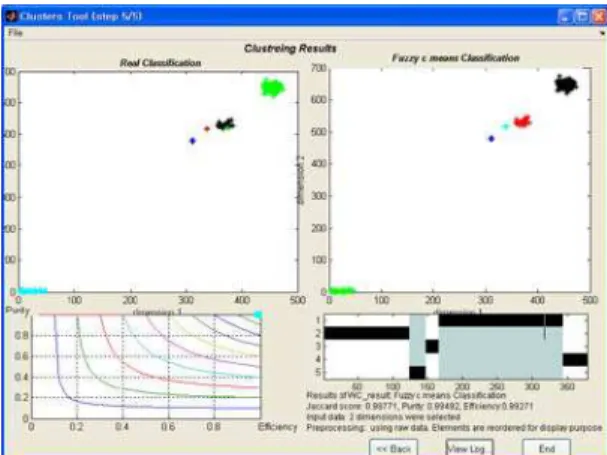
Mean & standard deviation of acceleration and correlation features were extracted from acceleration data. Activity recognition on these features was performed using Fuzzy c means classification algorithm recognized standing, sitting, lying, walking and running with 99.5% accuracy as shown Table 2 and Figure 3
Table 2. Clustering results of different posture in a continuous motion
Parameters &
Real posture Jaccard score Purity Efficiency
Standing 0.99 0.99 1
Sitting 1 1 1
Lying 1 1 1
Walking 0.99 1 0.99
Running 1 1 1
Average 0.98 0.99 0.99
Fig. 3 Activity recognition result using Fuzzy c means classification algorithm
IV. DISCUSSION&CONCLUSION
This paper proposes an ambulatory movement’s recognition system in daily life. A portable acceleration sensor module has been designed and implemented to measure human body motion. A small portable device utilizing single tri-axis accelerometer was developed, which detects features of ambulatory movements including vertical position shifts. The classification method based on Fuzzy c means classification algorithm, recognition accuracy of over 99% on a five activities (standing, sitting, lying, walking and running). These results are competitive with prior activity recognition results that only used laboratory data.
However, several limitations are also observed for the system. Firstly, collected data was from younger (age 24-33) subjects. Secondly, single accelerometer of placed on body waist typically do not measure ascending and descending stairs walking.
Accelerometers are preferable to detect frequency and intensity of vibrational human motion. [11] Many studies have demonstrated the usefulness of accelerometer for the evaluation of physical activity, mostly focusing on the detection of level walking or active/rest discrimination. [12-14]
This study was pilot test for our developed system’s feasibilities. Further application of the present technique may be helpful in the health promotion of both young and elderly, and in the management of obese, diabetic, hyperlipidemic and cardiac patients. Efforts are being directed to make the device smaller and allow data collection for longer time periods. Implementation of real-time processing firmware and encapsulation of the hardware are our future studies.
ACKNOWLEDGMENT
This study was supported by a grant of the Seoul R&BD Program, Republic of Korea (10526) and the Ministry of Knowledge Economy(MKE) and Korea Institute for Advancement in Technology (KIAT) through the Workforce Development Program in Strategic Technology.
Proceedings of the World Congress on Engineering and Computer Science 2009 Vol I WCECS 2009, October 20-22, 2009, San Francisco, USA
REFERENCES
[1] Zimmet P, Alberti KG, Shaw J. Global and societal implications of the diabetes epidemic. Nature 2001; 414: 782-787
[2] Grundy SM, Hansen B, Smith SC Jr, Cleeman JI, Kahn RA. Clinical management of metabolic syndrome: report of the American Heart Association/National Heart, Lung, and Blood Institute/American Diabetes Association conference on scientific issues related to management. Circulation 2004;109: 551-556
[3] R.H. Eckel, S.M. Grundy, P.Z. Zimmet, The metabolic syndrome. Lancet 2005; 365: 1415-28
[4] Thompson PD, Buchner D, Pina IL, et al. Exercise and physical activity in the prevention and treatment of atherosclerotic cardiovascular disease: a statement from the Council on Clinical Cardiology (Subcommittee on Exercise, Rehabilitation, and Prevention) and the Council on Nutrition, Physical Activity, and Metabolism (Subcommittee on Physical Activity). Circulation 2003; 107: 3109-3116
[5] Tuomilehto J, Lindstrom J, Eriksson JG, et al. Prevention of type 2 diabetes mellitus by changes in lifestyle among subjects with impaired glucose tolerance. N Engl J Med 2001; 344: 1343-1350
[6] Y. Ohtaki, M. Susumago, A. Suzuki et al. Automatic classification of ambulatory movements and evaluation of energy consumptions utilizing accelerometers and a barometer. Microsyst Technol 2005; 11: 1034-1040
[7] Bassett DR Jr. Validity and reliability issues in objective monitoring of physical activity. Res Q Exerc Sport 2000;71: S30–S36.
[8] Craig CL, Marshall AL, Sjostrom M, Bauman AE, at al. International physical activity questionnaire: 12-country reliability and validity. Med Sci Sports Exerc 2003; 35: 1381–1395.
[9] Allor KM and Pivarnik JM. Stability and convergent validity of three physical activity assessments. Med Sci Sports Exerc 2001; 33: 671–676.
[10] LaMonte MJ, Ainsworth BE, and Tudor-Locke C. Assessment of physical activity and energy expenditure. In: Obesity: Etiology, Assessment, Treatment and Prevention, edited by Andersen RE. Champaign, IL:Human Kinetics, 2003; p. 111–117.
[11] Bouten CVC, Koekkoek KTM, Verduin M, Kodde R, Janssen JD. A triaxial accelerometer and portable data processing unit for the assessment of daily physical activity. IEEE Transactions on Biomedical Engineering 1997;44(3):136–147
[12] Nakahara AK, Sabelman EE, Jaffe DL, Development of a second generation wearable accelerometric motion analysis system. Proceedings of the first joint EMBS/BMES conference, 1999; 630 [13] Aminian K, Robert P, Buchser EE, Rutschmann B, Hayoz D, Depairon
M, Physical activity monitoring based on accelerometry. Medical and Biological Engineering and Computing 1999; 37:304–308
[14] Mathie MJ, Lovell NH, Coster CF, Celler BG, Determining activity using a triaxial accelerometer. In: Proceedings of the second joint EMBS/BMES conference, 2002; 2481–2482
Proceedings of the World Congress on Engineering and Computer Science 2009 Vol I WCECS 2009, October 20-22, 2009, San Francisco, USA