A
FFIRMATIVE
A
CTION AND
I
NTERRACIAL
F
RIENDSHIPS
B
RAZC
AMARGOR
ALPHS
TINEBRICKNERT
ODDS
TINEBRICKNEROutubro
de 2009
T
T
e
e
x
x
t
t
o
o
s
s
p
p
a
a
r
r
a
a
D
D
i
i
s
s
c
c
u
u
s
s
s
s
ã
ã
o
o
TEXTO PARA DISCUSSÃO 200• OUTUBRO DE 2009• 1
Os artigos dos Textos para Discussão da Escola de Economia de São Paulo da Fundação Getulio
Vargas são de inteira responsabilidade dos autores e não refletem necessariamente a opinião da
FGV-EESP. É permitida a reprodução total ou parcial dos artigos, desde que creditada a fonte.
Escola de Economia de São Paulo da Fundação Getulio Vargas FGV-EESP
Affirmative Action and Interracial Friendships
∗
Braz Camargo
University of Western Ontario
Ralph Stinebrickner
Berea College
Todd Stinebrickner
†University of Western Ontario
Abstract
In two recent cases involving the University of Michigan, the Supreme Court
exam-ined whether race should be allowed to play an explicit role in the admission decisions
of schools. The primary argument in these court cases and others has been that racial
diversity strengthens the quality of education offered to all students. Underlying this
argument is the notion that educational benefits arise if interactions between students
of different races improve preparation for life after college by, among other things,
fos-tering mutual understanding and correcting misperceptions. A comprehensive study of
this issue would ideally examine two conditions: first, whether students actually have
incorrect perceptions about their friendship compatibility with students of other races
at the time of college entrance; second, if misperceptions exist, whether diversity on
campus is effective in changing students’ beliefs about individuals of different races.
In this paper we provide, to the best of our knowledge, the first direct evidence about
both conditions by taking advantage of unique new data that was collected specifically
for this purpose.
∗We would like to thank John Bound, Kerwin Charles, Stacy Dickert–Conlin, Lance Lochner, Eugenia
Toma, and numerous seminar participants for very useful comments and suggestions. This paper would not have been possible without the help of Dianne Stinebrickner and the tireless efforts of Lori Scafidi. We are extremely grateful for generous support from The Mellon Foundation, The University of Kentucky Center for Poverty Research, The Spencer Foundation, The National Science Foundation, The Social Sciences and Humanities Research Council of Canada, and Berea College.
†Corresponding Author. Address: Social Science Centre, Department of Economics, London, ON, N6A
1
Introduction
In two recent cases involving the University of Michigan (Gratz v. Bollinger and Grutter
v. Bollinger), the Supreme Court examined whether race should be allowed to play an
explicit role in the admission decisions of schools. The prominent argument in these court
cases and others has been that racial diversity strengthens the quality of education o¤ered
to all students. For example, when describing the defense put forward by the University
of Michigan in the Gratz v. Bollinger case, a Syllabus of the Supreme Court explains that
“Respondents contended that the College of Literature, Science, and Arts has just such an
interest in the educational bene…ts that result from having a racially and ethnically diverse
student body and that its program is narrowly tailored to serve that purpose" (Gratz v.
Bollinger, Syllabus, 2003).1
Jonathan Alger, who coordinated the University of Michigan’s legal e¤orts in the two
Supreme Court cases, stressed that the primary legal argument in support of a¢rmative
action should center on the notion that educational gains are achieved when students of
all races “discover just how much they have in common" (Alger, 1997). He elaborates:
“...members of every racial group di¤er in their life experiences...The range of similarities
and di¤erences within and among racial groups is precisely what gives diversity in higher
education its educational value. For example, by seeing …rsthand that all black or Hispanic
students in their classes do not act or think alike, white students can overcome learned
prejudices that may have arisen in part from a lack of direct exposure to individuals of other
races." Further, the majority opinion in the Grutter v. Bollinger case supported the validity
of this primary legal argument by noting that the educational bene…ts of diversity include
“cross–racial understanding" and the breaking down of racial stereotypes.2
1There are other motivations for a¢rmative action. However, understanding the attractiveness of the primary legal argument is of fundamental importance for groups on both sides of the a¢rmative action debate given the reality that the other rationales stand on less solid legal footing. For example, courts have made it di¢cult to defend a¢rmative action programs on the grounds of remedying past discrimination by focusing narrowly on an institution’s ability to remedy discrimination that occurred at that institution (Alger, 1999). According to Baez (2003), “Many scholars believe that providing empirical evidence of the compelling need for diversity is the only hope for saving a¢rmative action."
In this paper, we provide evidence about the primary legal argument that a¢rmative
action is bene…cial because it allows students to correct misperceptions about how much
they have in common with students from di¤erent races. The particular belief we study
is whether a student perceives that, on average, his friendship compatibility is higher with
students of his race than it is with students of other races. There may be other beliefs
in which one might also be interested. Nonetheless, beliefs about interracial friendship
compatibility seemingly incorporate a variety of views of relevance for understanding whether
an individual thinks that he has much in common with individuals of other races, and recent
research motivated by a¢rmative action admission policies has examined friendship decisions
in college (Arcidiacono et al., 2007; Marmaros and Sacerdote, 2006; Mayer and Puller, 2008).
A comprehensive study of this issue would ideally examine two conditions: …rst, whether
students actually have incorrect perceptions about their friendship compatibility with
stu-dents of other races at the time of college entrance; second, if misperceptions exist, whether
diversity on campus is e¤ective in changing students’ beliefs about individuals of di¤erent
races. We address both conditions in this paper.
We begin in Section 2 with a description of our data, which comes from the Berea Panel
Study (BPS). We initiated this survey at Berea College, in part, for the purposes of this
paper. As discussed in more detail later, we take advantage of both speci…c institutional
details of the school and the fact that the BPS is unique among higher education data sources
in that it allows us to directly identify each student’s friends.3
We address the issue of misperceptions at the time of entrance in Section 3. A
stan-dard “revealed preference" approach for this question would require that a researcher: 1)
et al., 2003; Daniel et al. 2001; Gurin, 1999; Syverud, 1999). The courts views of these arguments have been somewhat mixed. For example, Alger points out that the courts have often not been sympathetic to the notion that the bene…ts of diversity arise because students from di¤erent races have di¤erent points of view: “The courts frown on this (notion)...This is a group–based, stereotypical assumption, when the reality is the exactly the opposite" (Elgass, 1998). However, the majority opinion in Grutter v. Bollinger did note that “major American businesses have made clear that the skills needed in today’s increasingly global marketplace can only be developed through exposure to widely diverse people, cultures, ideas, and viewpoints." Regardless, the potential to correct misperceptions clearly plays a central role in the legal argument.
characterize the amount of racial sorting in friendships at the time of entrance; 2) identify
beliefs about interracial friendship compatibility at the time of entrance from the observed
friendship decisions; and 3) provide evidence about actual interracial friendship
compati-bility at the time of entrance. We are in a unique position to provide, to the best of our
knowledge, the …rst evidence about whether students have misperceptions at the time of
entrance because, as discussed below, we are able to provide evidence about each of these
three individual issues.
We start in Subsection 3.1 with a description of the basic empirical di¢culty that is
present if one wishes to characterize the amount of racial sorting in friendships—that
friend-ship decisions are not observed directly in higher education data sources. We then discuss
previous approaches for characterizing the amount of sorting which involve the use of indirect
measures of friendship. Finally, we describe the friendship information that we have used to
directly document friendships, discuss how the ‡exibility of our survey e¤orts allowed us to
collect this information at the end of the short orientation period that occurs immediately
before the start of classes, and detail the amount of racial sorting that is present at this time.
In Subsection 3.2, we begin by describing the di¢culty involved in identifying beliefs
about interracial friendship compatibility from observed friendships at a point in time—that
friendship choices are in‡uenced not only by beliefs about interracial friendship compatibility,
but also by the process which governs how students meet potential friends. We then discuss
our approach which takes advantage of the fact that we consider friendship decisions made
at a point in time—immediately before classes began in the students’ freshman year—when
institutional details related to the orientation program and housing assignment procedure
at Berea suggest that the process by which a person meets potential friends is, to a close
approximation, unconditionally random.
In Subsection 3.3 we describe how we provide perhaps the …rst direct evidence about
actual interracial friendship compatibility. We take advantage of an experiment which arises
because students at Berea are randomly (and unconditionally) assigned roommates in their
freshman year. In essence, this experiment forces some students to learn about their
The results and discussion in Section 3 suggest that: 1) substantial racial sorting exists in
friendships at the time of college entrance; 2) the most plausible explanation of this sorting
would seem to be that some students believe that they are more compatible with students of
their own race than with students of di¤erent races; and 3) in reality, students from di¤erent
races are as compatible as students from the same race. Informally, these results taken
together suggest the interpretation that incorrect beliefs about individuals from other races
may exist at the time of entrance. However, to make our investigation more formal and to
provide a framework for considering reasons why our conclusions may not be appropriate,
in Section 4 we specify a simple but ‡exible model of friendship–making under uncertainty
and: 1) interpret the results of Section 3 under the prism of this model; 2) consider changes
to the model that would imply that our conclusions about beliefs would be wrong.
We turn to the question of the e¤ectiveness of diversity in correcting misperceptions in
Section 5. In Subsection 5.1 we provide the …rst evidence about whether the amount of
racial sorting changes across semesters in school. While this information is of fundamental
importance for understanding the e¤ectiveness of a¢rmative action policies, previous work
has not been able to address this issue because the indirect techniques employed to identify
measures of friendship permit the construction of only a single cross–section. In contrast,
our data allow us to observe friendship decisions both at the time of entrance and at an
additional time each year.
In Subsection 5.2 we provide some of the …rst direct evidence about whether policy can
in‡uence the amount of interracial friendship interaction during college. To do this we again
utilize the experiment in which at entrance some students are randomly assigned roommates
of the same race while other students are randomly assigned roommates of a di¤erent race,
but now examine the total amount of interracial interaction that a person has at various
points in school. Our …ndings in this subsection and the previous one indicate that the total
amount of racial sorting remains roughly constant over time in the sample as a whole, but
that, in the long-run, white students who are randomly assigned black roommates have a
signi…cantly larger proportion of black friends than white students who are assigned white
roommates, even when randomly assigned roommates are not included in the calculation
roommates is similar to the overall proportion of black students at the school.
This last …nding is important in and of itself. Indeed, much of the literature on a¢rmative
action has made providing evidence about whether the amount of interracial interaction can
be a¤ected by policy its primary objective, in essence taking as given that interactions are
su¢cient to generate the changes in perceptions that are of ultimate interest. (Mayer and
Puller, 2008; Arcidiacono et al., 2007; Marmaros and Sacerdote, 2006). However, ideally,
we would also like to provide some direct evidence about whether perceptions are actually
changing both for the entire group of students at the school and for those whose amount
of interracial interaction is in‡uenced by the roommate policy. The di¢culty of providing
evidence from observed friendship choices arises because the process by which students meet
potential friends is no longer unconditionally random after the end of the orientation period.
We discuss this issue in Subsection 5.3 and suggest some possible approaches which are
motivated by previous work and made possible by unique features of our longitudinal data.
From the standpoint of providing direct evidence about whether a¢rmative action can
have e¤ects, the results in Section 5 are an important complement to Boisjoly et al. (2006),
who study the e¤ect of being assigned a black roommate on speci…c beliefs such as “whether
a¢rmative action in college admission should be abolished." The appeal of studying whether
a¢rmative action in‡uences speci…c beliefs is obvious. However, the motivation for
examin-ing whether a¢rmative action in‡uences social interactions or the less–speci…c beliefs about
interracial friendship compatibility is equally strong; the a¢rmative action literature has
paid close attention to the issue of social interactions in part because many of the beliefs
of interest that might be in‡uenced by a¢rmative action are likely to be either subtle in
nature or very di¢cult to measure accurately using survey questions, especially if there is an
inclination for students to answer survey questions in a politically correct fashion. Indeed,
Boisjoly et al. (2006) recognize the importance of understanding the e¤ect of a¢rmative
action on social interactions, but …nd that the use of survey questions asking whether “I
have personal contact with people from other racial/ethnic groups", “I interact comfortably
with people from other racial/ethnic groups", and “I socialize with someone with an African
American Background" do not produce a particularly clear or consistent picture.
conclusion that roommates “have little or no e¤ect on harder–to change behavior (such as
befriending or socializing with someone from another racial/ethnic group)."
In terms of providing direct evidence about e¤ects, this paper also di¤erentiates itself
through its ability to examine the time–path of certain changes, a contribution that we …nd
to be important. Finally, it is unique to be able to view changes resulting from policy in a
context where something is known about the underlying truth. This is possible because our
results in Sections 3 and 4 provide a unique backdrop for the results in Section 5.
We …nish in Section 6 with a discussion of how the conclusions of this work should be
shaped by the reality that we are studying one particular school.
2
The Berea Panel Study
The data come from the Berea Panel Study (BPS) which, as described in detail in
Stine-brickner and StineStine-brickner (2004, 2006, 2008a), was initiated by Todd StineStine-brickner and
Ralph Stinebrickner with the goal of understanding a variety of decisions that students from
low income families make after entering college. Berea College is located in central
Ken-tucky and has a very strong reputation for promoting understanding and harmony between
individuals of di¤erent races.4 Given this reputation, it seems likely that individuals who
select Berea would be relatively open to relationships with individuals of other races. This
suggests that if information problems exist between students of di¤erent races at Berea at
the time of college entrance, then such problems are likely to exist elsewhere at the time of
college entrance, although in the conclusion we stress the need to be cautious when thinking
about how the results here might generalize to other schools.
The BPS consists of two cohorts that entered Berea in the fall of 2000 and 2001,
respec-tively, and were surveyed between ten and twelve times each year while in school. Unique
identi…ers allow the survey data to be matched with student information from the school’s
administrative database.
Of particular importance for this paper, the BPS collected substantial information about
friends and roommates at multiple times each year while students were in school. Here
we only discuss sample sizes and response rates. One key di¤erence between the two BPS
cohorts is that friendship information was collected at the time of entrance only for the 2001
cohort. Given this, we focus on the 2001 cohort for much of our work. For this cohort,
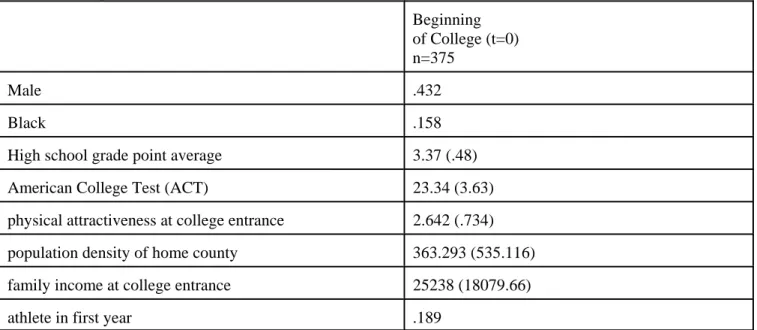
the participation rate for the baseline survey was approximately .90 and Table 1 shows
descriptive statistics for our sample of 375 students from this cohort. Approximately 43%
of students at Berea are male and 15.8% of students are black. We note that, because the
very large majority of non–black students are Caucasian, we combine all non–black students
into a group that we refer to as “white" in the remainder of the paper. Consistent with
the mission of the school to provide an education to students of “great promise but limited
economic resources," students at Berea are all relatively poor and have an average family
income of only approximately $25,000. The reality that students are quite homogenous in
this respect is noteworthy for reasons discussed later.
The number of observations for which friendship information is observed at the time of
entrance (354) is slightly smaller than the total sample size at the time of entrance (375)
because two students indicated that they had no friends and nineteen students listed no
friends that could be matched with individuals in our student data base. The latter arises
primarily because, at the time of our baseline survey, students had been at Berea for a short
time and some individuals did not know both the …rst and last names of some of their friends.
Nonetheless, students were reasonably knowledgeable about the names of their friends even
at this early point in their college careers; we were able to …nd approximately 75% of the
listed friends in our o¢cial database.
Our survey collection e¤orts also allow us to directly identify friendships for students at
the middle of the …rst, second, and third years. The total number of students for which
friendship observations are observed at these points are 335, 275, and 238, respectively. The
decrease in sample size after the baseline is almost exclusively due to attrition—response
rates were approximately 95% after the baseline survey among individuals who were still
baseline survey. We describe the sample construction in Appendix B.
While the fact that the 2000 cohort did not answer the baseline survey makes its use
problematic in some parts of the paper, this cohort is useful for examining certain issues
in which having a larger sample size is of help. For the 2000 cohort, the total number of
observations for which friendships are observed in the middle of the …rst, second, and third
years are 353, 248, and 233, respectively.
3
Evidence About Misperceptions
In this section we examine the three issues described in the Introduction that are of
interest individually and are necessary to think about whether students have misperceptions
about interracial friendship compatibility at the time of college entrance.
3.1
Sorting at the Time of Entrance
Non–trivial interactions between students of di¤erent races are necessary for a¢rmative
action policies to be useful. Given the recognition that misperceptions are likely to be
changed most easily through close friendships, one goal of recent literature has been to
document the amount of sorting that is present in close friendships on a college campus. The
empirical di¢culty that is encountered in this exercise is that friendship decisions are not
observed directly in higher education data sources. In response to this di¢culty, previous
work has found creative, although sometimes indirect, measures of close friendships. For
example, Marmaros and Sacerdote (2006) proxy for friendships using the quantity of email
that is exchanged between pairs of students. Mayer and Puller (2008) obtain a more direct
measure by examining friendship links from Facebook.com, although one might worry that
these links capture both close friendships and acquaintances.5
The BPS contains very direct measures of friendship. For reasons that we discuss in
the next subsection, we focus here on our …rst friendship measurement. At the end of
the orientation period, immediately before classes began in the freshman year, we elicited
friendship information for students in the 2001 cohort by using the following question on our
baseline BPS survey.6
Question A. Please list the names of the four people you currently consider your best friends at
Berea College and provide information about where you met each of them. Please list in order with
the person you would consider your best friend …rst.
First Name Last Name Where I met this person Circle ONE
1. Hometown At Berea College Other (specify)
2. Hometown At Berea College Other (specify)
3. Hometown At Berea College Other (specify)
4. Hometown At Berea College Other (specify)
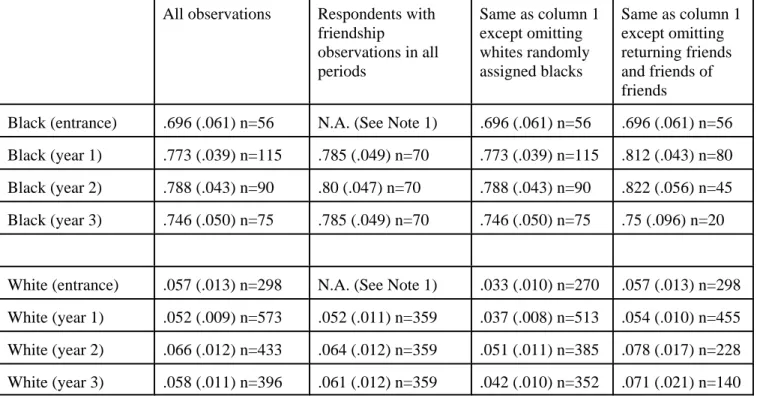
Table 2A shows that a very signi…cant amount of sorting by race is present at the start
of classes when we characterize sorting using the person that is listed as the best friend in
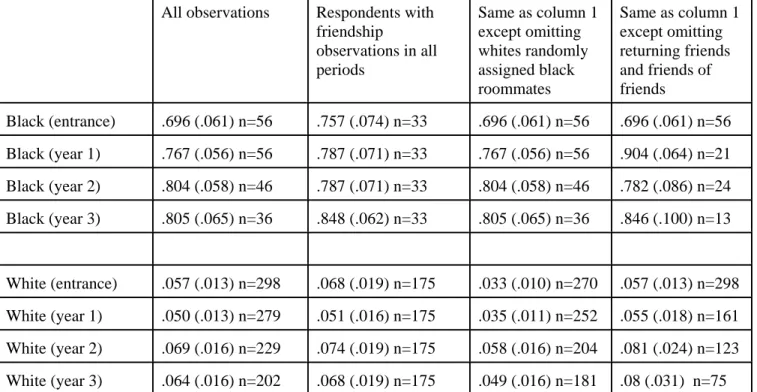
Question A. Pooling males and females and computing sample proportions, the …rst column
shows that 69.6% of black students in our sample have best friends who are black while
only 5.7% of white students in our sample have best friends who are black. If sorting were
purely random, then, in large samples, the proportion of black students who have black best
friends would be 15.8% and the proportion of white students who have black best friends
would also be 15.8%. Statistical tests overwhelmingly reject the former hypothesis, the latter
hypothesis, and the hypothesis that the two conditions are jointly true.7;8 The …rst column
6As a general note, it is never possible to know how answers to a particular survey question might be in‡uenced by respondents’ perceptions about how the question will be used. However, in this respect, it is worth noting that Question A below, which does not refer to race in any way, was embedded in a very substantial survey with an obvious focus on academic performance and educational attainment. Regardless, if such anticipation did occur and if students tend to answer questions in a politically correct manner, then the descriptive statistics discussed in the remainder of this section would understate the degree of sorting that is present, in which case our subsequent results would be strengthened further.
7The test of the null hypothesis that the proportion of black students who have black best friends is 15.8% has a standard normal test statistic of 11.334. The test of the null hypothesis that the proportion of white students who have black best friends is 15.8% has a standard normal test statistic of 4.778. A test that the proportion of black students who have black best friends is the same as the proportion of white students who have black best friends has a standard normal test statistic of 12.030.
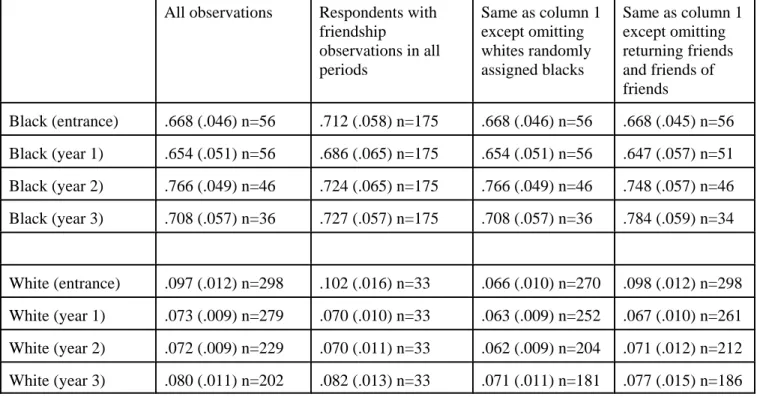
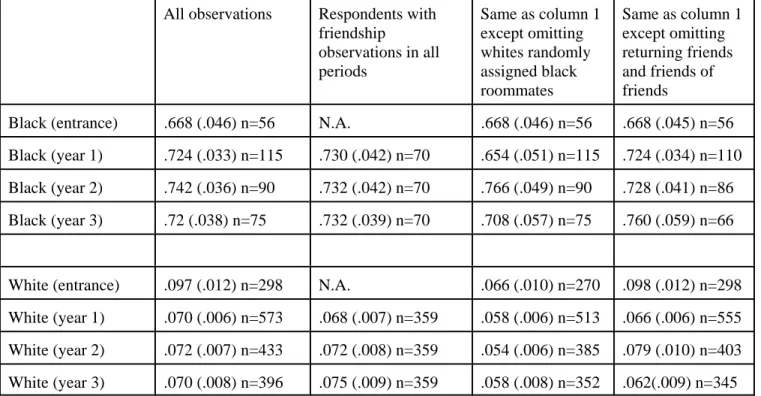
of Table 2B shows similar results at the start of classes when we characterize sorting using
information about all individuals that are listed as friends in Question A. Pooling males and
females we …nd that, on average (across sample members), 66.8% of the friends listed by a
black student are black while only 9.8% of the friends listed by a white student are black.9
As will be discussed in Section 4, it is of interest to know whether there exists evidence
that a substantial amount of the sorting in the …rst columns of Tables 2A and 2B arises
because individuals make friendship decisions on the basis of other variables that are strongly
correlated with race. The second column of Table 2A again examines the proportion of
students who have a black best friend, but uses a linear probability model, with whether
a person’s best friend is black as the dependent variable, to control for a variety of other
characteristics that we are able to observe and could be correlated with race. The second
column of Table 2B again examines the proportion of a student’s friends who are black,
but uses a regression model, with the proportion of a student’s friends that are black as
the dependent variable, to control for the same set of characteristics. In both Table 2A
and Table 2B, the entries related to the WHITE and BLACK variables remain virtually
unchanged when the additional characteristics are added.
3.2
Beliefs at the Time of Entrance
The di¢culty in identifying beliefs about interracial friendship compatibility from
ob-served friendship choices at a particular point arises because friendship choices are in‡uenced
not only by beliefs about interracial friendship compatibility, but also by the process which
governs how students meet potential friends. If the meeting process is random, then, roughly
speaking, observed choices would reveal a student’s beliefs about interracial friendship
com-at traditional levels, we do not pay speci…c com-attention to di¤erences by sex in the remainder of the paper, although we do …nd statistically di¤erent sorting patterns by sex at some points after the …rst year.
patibility. However, identi…cation problems arise if, as would be expected, the meeting
process is not random. For example, a student who believes that, on average, he is equally
compatible with students of his race and other races would still have a disproportionate
number of friends of his race if he is involved in clubs, activities, social circles, or classes in
which he meets a disproportionate number of students of his race.
Here we take advantage of the fact that, while randomness in the meeting process would
in general not be a good assumption, unique institutional details suggest that it is quite
plausibly a good assumption at Berea during the orientation period which occurs before
the freshman year. In terms of formal assignments made by the school, randomness is the
appropriate way to characterize how students are assigned to their o¢cial orientation group,
how students are assigned roommates and dormmates, and how students are assigned to a
job in Berea’s mandatory work–study program.10 Randomness also seems to be a reasonable
approximation for how students encounter potential friends through other social avenues
during orientation. Indeed, particular clubs that might interest speci…c types of students do
not begin activities during the orientation period and informal events (e.g., parties) held by
upperclassmen (which might draw disproportionate numbers of particular types of students)
are unlikely during this period since school rules imply that almost all students live on campus
and upperclassmen are not present on campus during the orientation period.11 Instead, the
primary social events would be general types of functions (e.g., cookouts, etc.) provided by
the school that would presumably be of similar interest to all types of students.12
What makes our approach feasible is the ‡exibility of our survey collection e¤orts which
allowed us to collect the friendship information at the end of the orientation period described
in the previous subsection. If randomness is indeed a good way to characterize meetings
during the orientation period, the most plausible explanation for the observed sorting in
Subsection 3.1 would seem to be that some students believe they are more compatible with
students of their own race than with students of di¤erent races. The question we need to
address is whether these perceptions are correct or not.
3.3
Evidence About Actual Compatibility
In addition to being important for examining whether misperceptions exist,
understand-ing whether black and white students are compatible as friends is of direct interest given
that arguments about the bene…ts of educational diversity are often premised on the notion
that students from di¤erent races have much in common. To the best of our knowledge, very
little evidence exists about this issue.
To provide evidence about actual interracial friendship compatibility, we take advantage
of the fact that students are assigned roommates in an entirely random manner which,
for example, does not take into account any characteristics or preferences of students. To
the extent that sharing a room makes a non–trivial amount of interaction and observation
unavoidable, this implies that some students are, in essence, forced to learn about their true
match quality with one randomly chosen roommate of the same race while other students
are, in essence, forced to learn about their true match quality with one randomly chosen
roommate of a di¤erent race. Then, seeing how roommates appear in friendship outcomes
after the point at which learning has taken place reveals evidence about true interracial
friendship compatibility.
It seems reasonable to believe that much is learned about one’s roommate after a couple
of months of sharing a room, and we examine friendship choices starting with our middle–
of–the–…rst–year survey which was collected in November. At this point, for the 2001 cohort
we have 27 white students in our 2001 sample who were identi…ed as having been randomly
assigned black roommates and 155 white students who were identi…ed as having been
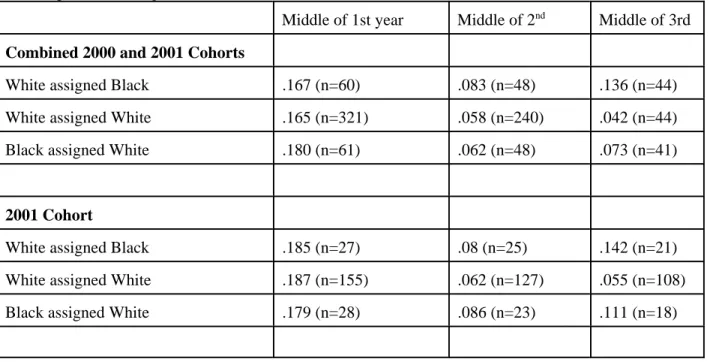
ran-domly assigned white roommates.13 The …rst column (2nd panel) of Table 3B shows that,
for this cohort, 44.4% of black roommates are listed as one of the four friends and 35.4%
of white roommates are listed as one of the four friends. The …rst column (2nd panel) of
Table 3A shows that 18.5% of black roommates become best friends and 18.7% of white
roommates become best friends.14
Combining the 2000 and 2001 cohorts to increase the number of observations, we have 60
white students who were identi…ed as having been randomly assigned black roommates and
321 white students who were identi…ed as having been randomly assigned white roommates.
The …rst column (1st panel) of Table 3B shows that 35.0% of black roommates are listed as
one of the four friends and 36.7% of white roommates are listed as one of the four friends.
The …rst column (1st panel) of Table 3A shows that 16.7% of black roommates become best
13The reality that, as described in Footnote 12, the orientation period actually consists of two portions is the primary reason that the number of observations in this section is smaller than that in Table 2—30% of students request a roommate that they have met in the …rst (summer) portion. Although we are not able to use these 30% of the observations for analyses that require randomly assigned roommates, we stress that they are not problematic for the analysis more generally because they simply represent friendship decisions that came out of a random meeting process in the summer portion of the orientation period. Of the 298 white students in Column 1 of Table 2, 24 were assigned a single room, lived o¤–campus, or we could either not determine whom the student’s roommate was or whether the student requested a roommate. Of the remaining 274 students, 193 were randomly assigned roommates (155 white, 27 black, 11 race missing–not used). Of the 56 black students in Column 1 of Table 2, 5 students were assigned a single room, lived o¤–campus, or we could either not determine whom the student’s roommate was or whether the student requested a roommate. Of the remaining 51 students, 32 were randomly assigned roommates (28 white, 3 black, 1 race missing–not used). Students who choose roommates themselves during the …rst orientation period may be di¤erent than those that do not. However, in practice, we …nd that these students have very similar proportions as the entire sample - the proportions analogous to those in the …rst column of Table 2A are .718 and .086 for this group.and the three tests described earlier in Footnote 7 continue to be overwhelmingly rejected with standard normal test statistics of 11.047, 4.314, and 8.715, respectively. We note that, technically speaking, our conclusions about whether misperceptions exist at the time of entrance are directly relevant for the group of students who are randomly assigned roommates.
friends and 16.5% of white roommates become best friends.15 Thus, because the sample
proportions are always close for black and white roommates and are often higher for black
roommates, we are never close to rejecting the null hypothesis that white students are equally
compatible with black students as they are with white students.16 In other words, consistent
with the notion that black and white students do have a lot in common, we …nd evidence in
support of the notion that white students are, on average, as compatible with black students
as they are with other white students.
It is not possible to provide much information about the compatibility of black students
with other black students since the random assignment implies that only a very small fraction
of all matches would involve two black students.17 However, we can examine whether black
students in the interracial pairs have views about their interracial roommates that are similar
to those held by the white students in the interracial pairs. We …nd that this is the case. We
have 28 black students in our initial sample who were identi…ed as having been randomly
assigned white roommates.18 In the …rst column (second panel) of Table 3B we see that,
for this cohort, 39.3% of these roommates are listed as one of the four friends (compared to
44.4% for white students in interracial pairs). In the …rst column (second panel) of Table 3A,
we see that, for this cohort, 17.9% of these students become best friends (compared to 18.5%
for white students in interracial pairs).19 Combining the 2000 and 2001 cohorts, we have
60 black students who were identi…ed as having been randomly assigned white roommates.
In the …rst column (…rst panel) of Table 3B, we …nd that 34.4% of these roommates are
15The standard errors associated with the proportions are .061, .026, .020, and .048, respectively.
16One might be interested in con…dence intervals (CI) associated with the di¤erence between the sample proportion when the roommate is black and the sample proportion when the roommate is white. While negative values will be contained in the con…dence intervals, the negative values are often not large relative to the proportion of roommates that are reported as friends. For example, the 90% CI for the di¤erence in proportions (one of four friends) in the middle of the …rst year for the 2001 cohort is (-.075, .254), so that even the lower bound is only 17% of the proportion of black roommates that are reported as friends (.444). Further, as will be discussed, some 90% con…dence intervals in later years do not even include zero.
17From Footnote 13 we see that 14.2% of the students who were randomly assigned roommates are black so that roughly(:142)2 =:002 of all matches would involve two black students. In the sample we …nd that
.014 of all matches for which the race of the roommate can be identi…ed involve two black students. 18The number of black students who have white roommates (28) does not have to be the same as the number of white students who have black roommates (27) because, in some cases, one of two roommates did not participate in the BPS.
listed as one of a the four friends (compared to 35.0% for white students in interracial pairs).
In the …rst column (…rst panel) of Table 3A, we …nd that 18.0% of these students become
best friends (compared to 16.7% for white students in interracial pairs).20 Thus, it seems
reasonable to conclude that there is evidence in support of the notion that black students
are as compatible with white students as they are with other black students. This would be
true, for example, if the compatibility of black students with other black students is roughly
the same as the compatibility of white students with other white students.
One might wonder if, for some reason, the criteria used to name an assigned roommate
as a friend is fundamentally di¤erent from the criteria used to name a non–roommate as a
friend. If this were the case, then the results in this section might provide evidence that
students from di¤erent races are very compatible as roommates, but would not necessarily
provide evidence that students from di¤erent races are very compatible as true friends. Given
our belief that students typically wish to live with their actual friends when given the choice,
this concern can be addressed by examining whether the initial roommate continued to be
named as a friend after the …rst year when there is no longer a requirement for him to remain
a roommate.21 Column two of Table 3B examines whether the original roommate was named
as one of the four best friends in the middle of the second year. Column two of Table 3A
examines whether the original roommate was named as the best friend in the middle of
the second year. The results indicate that, in all cases, white students in the sample more
often remain friends (and best friends) with their roommate in the second year if they were
assigned a black roommate than if they were assigned a white roommate. For example, the
second column (1st panel) of Table 3B shows that 22.9% of black roommates are listed as
one of the four friends in the middle of the second year and 13.3% of white roommates are
listed as one of the four friends in the middle of the second year.22 Similarly, column 3 of
Tables 3A and 3B reveal that white students in the sample more often remain friends (and
best friends) with their roommate in the third year if they were assigned a black roommate
20The standard errors associated with the proportions are .062 and .048 respectively.
21The validity of the experiment after the …rst year relies on the assumption that the race of the as-signed roommate does not in‡uence college drop–out decisions or survey participation decisions. This seems reasonable given that students are equally happy with black and white roommates.
than if they are assigned a white roommate.
One might also worry that a person’s true interracial friendship compatibility could
change as a result of spending time with someone of a di¤erent race. If this were the
case, the results of this section might provide evidence that students from di¤erent races
are very compatible as friends at a time subsequent to the time of entrance, but would not
necessarily provide evidence that students from di¤erent races are very compatible as friends
at the time of entrance. It seems that concerns about this issue should be greatly mitigated
by the fact that the ‡exibility of our survey collection did allow us to choose a time that is
quite close (2 months) to the beginning of the year. Nonetheless, we address this issue in
Sections 4 and 5, noting that a model in which the true value of interracial compatibility
changes very quickly when exposed to a roommate of a di¤erent race will typically have very
di¤erent (and testable) implications for observed friendship choices than a model in which
the true value does not change quickly.
4
A Model of Friendship Formation
Informally, the results of Section 3 put together seem to suggest that incorrect beliefs
about individuals from other races may exist at the time of entrance. However, to make
our analysis more formal and to provide a framework for considering reasons why the above
conclusion may not be appropriate, in this section we specify a simple but ‡exible model of
friendship–making under uncertainty and examine the results of Section 3 under the light
of this model. The implication of our model—that if true friendship compatibility does not
depend on race and students meet randomly during the freshman orientation period, then
sorting can only be observed if some students have incorrect perceptions about interracial
friendship compatibility—con…rms our informal interpretation of the results in Section 3.
We note that the theoretical result is hardly surprising. Nonetheless, the formulation of the
model provides a natural framework for discussing at the end of this section the attractiveness
4.1
Setup
We …rst describe payo¤s and then describe the process by which students form friendships.
Payo¤s. Students in college receive utility from friendships. At any point in time, a student
can have at most one (best) friend. The ‡ow utility that studentireceives from a friendship
with student j is uij. This utility depends on a variety of characteristics of j.
Characteris-tics of relevance may include, for instance, j’s sense of humor and other personality traits,
religious and political views, hobbies, interests, and past experiences. The key point is that
many of these friendship–relevant characteristics are not easily observable at the time two
people initially meet so that i does not know the value of uij when she …rst meets j. In
order to simplify the exposition, we take this point to an extreme by assuming that the only
characteristic that can be initially observed is a person’s race (black or white). We discuss
later why our conclusions are not sensitive to this assumption. The payo¤ toifrom a match
withj also depends oni’s own characteristics but, for ease of exposition, from now on, except
in Subsection 4.3, we make this implicit in our notation and index payo¤s and other relevant
variables by j only.
We assume that students do not care about race per se, but may be more likely to
…nd the characteristics that they do care about among students of a particular race. More
speci…cally, we posit that uj =vj when j is of the same race as i and uj = +vj when j is of the opposite race as i, where is a …xed term that can depend only on i’s race and
the vj are i.i.d. normal with mean zero and variance 2v that is the same for all students in college.23 Hence, for each race the average within-race match quality is higher than the
average interracial match quality when <0and lower when >0. Students do not know and start college with a prior belief about that is normally distributed with mean m
and variance 2
, where these quantities need not be the same for all students.
The results of Subsection 3.3 suggest that , the true value of average interracial
friend-ship compatibility, is zero. We discuss this in more detail in Subsection 4.3. The objective
23The assumption of a constant variance can be motivated, in part, by the fact that, as described earlier, students at Berea have similar socio–economic backgrounds. This assumption also means that the variance of friendship quality does not depend on whether person i is considering black or white potential friends. The analysis of this subsection can be modi…ed to accommodate a model where 2
v depends on the identity
in what follows is to determine for what values of m , the belief about average interracial
friendship compatibility, does the model predict sorting by race when is equal to zero.
Choosing Friends. The information from the last columns of the survey question shown
in Subsection 3.1 indicates that almost all friendships were formed after students arrived at
Berea.24 Here we describe how students choose friends.
Students arrive at college for an orientation program before classes begin in their freshman
year, at the end of which they complete the baseline BPS survey. We assume that each
student is assigned to an orientation group withN >1other students and spends orientation with this group. This orientation group is a somewhat arti…cial construct which is meant
to represent the types of people to which a student is exposed during the orientation period
through both the formal and informal channels described in Subsection 3.2, and, therefore,
could potentially be chosen as friends. The important point is that, as discussed in Subsection
3.2, it is reasonable to believe that the process by which a person meets potential friends is,
to a close approximation, unconditionally random.
Students choose friends in a two–stage process. First, after observing the race of each
student in their orientation group, they select a group of K < N individuals with which to
interact. For simplicity, we take K to be the same for all students. Then they observe a
signal j of match quality for each person j that is in their selected group and choose an
individual of this group with whom to form a friendship.25;26 The …rst stage re‡ects the fact
that each student encounters many other students during the orientation period, and so their
interaction with some of them will necessarily be super…cial, if it happens at all.
We note that we implicitly take a rather broad view of friendship compatibility. For
example, if a student ends up with a disproportionate number of individuals of the same race
24We …nd that 95% of friends were met at Berea. The results in Section 3.1 use all friends, but removing friends who were not met at Berea or removing students who have at least one friend who was not met at Berea leads to virtually no change in the results.
25Thus, friendship decisions in our model are unilateral. This is a weak view of friendship, where a friend is just someone that a person hangs around with or pays attention to. We do not mean for this assumption to be taken literally, although it would be broadly consistent with the notion that dorms at Berea are rather open places. This assumption is also consistent with the measure of friendship we use in Subsection 3.1.
in her subgroup because she believes that commonality in background experiences makes it
easier to “break the ice" with individuals of the same race, then we interpret this as evidence
that the student believes she is more compatible with students of her own race. Likewise,
if a student believes it is more costly for her to initiate a friendship with someone of the
opposite race, then we also interpret this as evidence that the student believes she is more
compatible with students of her own race. In other words, for our purposes, compatibility
means both having enough in common to be able to start a conversation and having the
desire to continue the relationship.
Finally, we assume that students are myopic. We argue at the end of this section that
relaxing this assumption, which is made for convenience, would strengthen our results.
4.2
Results
We do not know how informative are the signals j that a student observes in her chosen
subgroup. This is in part because we do not know exactly how students allocate their time
during the couple of days of the orientation period before they complete our baseline survey.
In what follows we consider two alternatives that are amenable to a transparent analysis.
We …rst consider the case where the signals j provide little information about payo¤s.
This, in essence, corresponds to the situation in which, during the orientation period,
stu-dents are very busy registering for courses or performing other tasks in preparation for the
start of courses so that they have little time to learn much more than the names of the
people they have chosen for their subgroup. In this case, the only thing that matters for a
student when selecting a subgroup is the expected payo¤ of forming a friendship with each
individual in her orientation group. In particular, if a student hasm = 0, then she is indif-ferent between all the possible subgroups she can select and, once a subgroup is chosen, she
is indi¤erent between all the individuals in her selected subgroup. Assuming that a student
randomizes when indi¤erent, we have the following result.
Proposition 1. Suppose signals are uninformative. Then, racial sorting can only be observed
A limitation of the case where signals are non–informative is that the amount of sorting
implied by the model is independent of the true value of . This is not true in the polar
case where the signals j are very informative, which we now consider. This corresponds to
the situation where each student spends much quality time with the students in her selected
subgroup and, as a result, is able to observe the payo¤ of forming a match with each of the
individuals in this subgroup; i.e., j =uj. The decision of which friendship to make once a subgroup is chosen is then straightforward: choose a member of the subgroup for which the
friendship payo¤ is the highest. What is left to determine is how students select subgroups.
For this, notice that if individual j in student i’s orientation group is of the same race,
theni’s perception is thatuj N(0; 2v), while ifj is of the opposite race, theni’s perception is that uj N(m ; 2o), where
2
o =
2
+ 2
v. Hence, if m = 0, then the distribution of possible payo¤s from interracial friendships has the same mean, but fatter tails. Now notice
that a student only cares about the highest friendship payo¤ in her selected subgroup. Hence,
if she believes that the average friendship payo¤ is the same for both races, then the greater
the number of individuals of the opposite race that she selects, the greater is the chance that
one of the people in her subgroup will turn out to be a very good match. Increasing the
prior mean only reinforces the bias towards opposite race matches. More importantly, since
expected payo¤s are continuous in m , this bias persists if m is not too negative. We then
have the following result. Its proof and the proof of Proposition 2 below are in Appendix A.
Lemma 1. There is m <0 such that if a student’s prior mean is greater than m, then it is optimal for her to select a subgroup with as many individuals of the opposite race as possible
no matter the racial composition of her orientation group.
Now observe if = 0for a student, then before the signals j are observed all individuals in her selected subgroup are equally likely to be chosen as a friend. The following result,
Proposition 2, follows from this observation. Together with Proposition 1 they constitute
the two main results of our model.
We show in Appendix A that the conclusion of Proposition 2 remains the same if instead
of being equal to zero for both races, is close to zero for both races.
4.3
True Friendship Compatibility and Racial Sorting
Evidence about whether = 0comes from Subsection 3.3. It is plausible to assume that, by some time T su¢ciently late in the …rst academic year, each student i has learned the
payo¤uiRof a friendship with her assigned roommateR. Then, comparing the average value
of uiR for roommate pairs where Racei = RaceR to the average value of uiR for roommate pairs where Racei 6= RaceR would provide direct evidence about whether = 0.
In reality, we do not observe match quality directly, but we do observe whether a
room-mate eventually becomes a best friend. For the exercise here it is not necessary to describe
how friendship decisions evolve over time between the beginning of the year andT. Rather,
it is su¢cient to note that at T this process would produce a best non–roommate friend B.
For simplicity, we assume that there is no uncertainty about uiB at T so that information
about whether roommates are best friends at T yields an estimate of Pr(uiR > uiB) for roommate pairs where Racei = RaceR and an estimate of Pr(uiR> uiB) for roommate pairs where Racei 6= RaceR. Then, we cannot reject the null hypothesis that individuals are, on average, equally compatible with students of the same race (i.e., the null hypothesis that
= 0) because the estimates in Subsection 3.3 provide virtually no evidence against the null hypothesis that Pr(uiR > uiB) is the same for roommate pairs whereRacei = RaceR as it is for roommate pairs where Racei 6= RaceR.27 Similarly, we can also gain information about by examining whether a roommate becomes one of a person’s four friends. In this case, the
inference concerns whether Pr(uiR > uiB4) is the same for roommate pairs Racei = RaceR as it is for roommate pairs where Racei 6= RaceR, where B4 denotes the fourth best non– roommate friend. Again, the results in Subsection 3.3 do not allow us to reject the null
hypothesis that = 0.
27An implicit assumption is that the expected value ofu
iB does not depend on whether a person’s
room-mate is of the same race or a di¤erent race. The conclusion that we learn speci…cally about by comparing
Pr(uiR > uiB) across same race and di¤erent race roommate pairs comes from our assumption that the
Therefore, under the assumptions of our model, Propositions 1 and 2 imply that some
students enter college with incorrect perceptions about the value of interracial friendship
compatibility. Thus, as discussed in the …rst paragraph of this section, the implications of
the model con…rm our informal interpretation of the results in Section 3.
4.4
Modeling Choices
Here we discuss some of our modeling choices. We begin with the assumption that
friendship decisions are myopic. Since students believe it is possible that interracial matches
are better than same–race ones, choosing someone of the opposite race to interact with
provides valuable information for future friendship decisions. Hence, if a student is forward
looking when choosing friends, she may be willing to sacri…ce some of her payo¤s during the
orientation period and include more students of the opposite race in her subgroup than she
would if she were myopic. This means that Propositions 1 and 2 not only do not depend on
the assumption of myopic behavior, but the restrictions on m and necessary to generate
racial sorting are less stringent if students are forward looking.
We also make the simplifying assumption that friendship decisions are unilateral. This
is not a realistic assumption, but, if anything, it makes it more di¢cult for racial sorting to
take place. Indeed, a model where friendship decisions are bilateral should produce stronger
conclusions regarding the e¤ect of misperceptions on friendship patterns for the simple reason
that for racial sorting to happen it is now only necessary for one side of a potential interracial
match to be biased.
Finally, we assume that an individual observes only race when she …rst meets a potential
friend. It is easy to see that our conclusions stay the same if, in addition to race, a person also
observes a set of friendship–relevant characteristics that are uncorrelated with race. Thus,
the potentially relevant case is the one where, in addition to race, a person also observes a set
of friendship–relevant characteristics that are correlated with race. At the end of Subsection
3.1 we discuss that we are not able to …nd evidence of these types of characteristics at Berea.
Nevertheless, for the sake of illustration, consider the extreme case where the sorting by
observable friendship–relevant characteristic that is strongly correlated with race. In this
case, even though the students do not consider race in any way when making friendship
decisions, they nevertheless believe that they are more compatible with individuals of the
same race (as long as they notice that the characteristic is correlated with race). Thus,
for our purposes, this case is no di¤erent than our assumed case in which individuals take
into account race when making decisions because they believe that race is correlated with
unobserved characteristics that are valuable.28
4.5
Alternative Explanations
While we think that our model captures the fundamental features of the friendship–
making process at the time of college entrance, it is worth considering possible changes to
it that might imply that our conclusions about beliefs would be wrong. One possibility is
that social norms (stigmas) imply that there is a cost to having both black friends and white
friends. For example, if the same race friends of a student criticize her for having friends of a
di¤erent race, then a person may not choose to have friends of both races even if she thinks
that she is equally compatible with students of both races. However, there are a couple of
things to note. First, if such a situation does exist, then it is strongly suggestive that at
least some people on campus believe that blacks and whites are quite di¤erent and probably
not particularly compatible—a view that is consistent with our conclusions about beliefs.
Second, in such a situation, if, social norms aside, black students were truly indi¤erent
between having black and white friends, our model suggests that they would choose to have
only white friends as they are the majority group. Of course, this would not be the case if
a black person with white friends is outwardly harassed on campus by black non–friends, a
view of things that seems very inconsistent with the environment at Berea. Thus, at least
at Berea, issues related to social norms would not seem to change our basic conclusion.29
A second possibility is that both white and black students correctly believe that they are
equally compatible with students of the other race, but at least one group believes that the
other is biased. Thus, racial sorting would occur because students do not try friendships with
individuals of the other race for fear of not being reciprocated. This is a somewhat di¤erent
view of the data, but the conclusion for policy is essentially the same: there is something to
be learned at school.
A third possibility (mentioned in Subsection 3.3) is that, while the roommate experiment
reveals the true interracial compatibility after two months in school, it might not necessarily
reveal the true interracial compatibility at the time of entrance. Suppose, for example, that
a person’s compatibility with someone of a given race depends on a race–speci…c stock of
common experiences. Then pre–college segregation could generate di¤erences at the time of
entrance that could be alleviated during the early portions of school. This scenario could
cre-ate a situation in which individuals are correctly pessimistic about interracial compatibility
at the time of entrance, even though no true di¤erences exist after two months.30 However,
a consequence of this scenario would be that, starting at the time when the true di¤erence
in compatibility disappears, the non–roommate friendship decisions of a student would vary
with the race of his randomly assigned roommate, a fact that is not supported by the data
we describe in the next section.
A fourth possibility, raised by Cornell and Welch (1996) in a labor market context, would
be that students believe they are equally compatible with students of all races, but they are
worse at evaluating their friendship compatibility with a person of a di¤erent race, making it
more likely that students become friends with other students of the same race. The results
in the next section suggest that if this is the case, then a white student randomly assigned to
a black student overcomes this de…cit in the long–run. Thus, a¢rmative action is potentially
bene…cial, but for a di¤erent reason.
29A variant of this explanation would be that social stigmas are present because of the views of parents. For example, a student who believes that she is equally compatible with students of all races might end up with more friends of the same race if it is unpleasant to introduce a friend of a di¤erent race to her family.
5
Evidence About E¤ectiveness
Here we turn to the question of the e¤ectiveness of a¢rmative action.
5.1
Interracial Interactions Over Time
From the standpoint of the data needed to use a revealed preference approach to examine
the e¤ectiveness of a¢rmative action, perhaps most fundamental is the information about
how sorting by race in friendships changes during school. The reality that previous research
on this topic has not been able to provide evidence about this issue stems from the fact that
the approaches used in these other papers for measuring friendships allowed only for the
construction of a single cross–section.31
We provide direct information about how sorting changes over time by taking advantage
of the fact that, as discussed earlier, we are able to identify friendships not only at the time
of entrance, but also in the middle of the …rst, second, and third years of college. Recall that
the …rst columns of Tables 2A and 2B show the amount of sorting at the time of entrance
for the 2001 cohort (and that friendships are not observed for the 2000 cohort at the time
of entrance). The …rst columns of Tables 4A (best friends) and 4B (all friends) repeat the
proportions from Tables 2A and 2B, respectively, and add proportions showing the amount
of sorting for the 2001 cohort in the middle of the …rst, second, and third years using all
observations that are available at each time. The second columns of Tables 4A (best friends)
and 4B (all friends) show the amount of sorting for the 2001 cohort in the middle of the …rst,
second, and third years using only observations for students who participated in all survey
waves. The results from the …rst two columns of Tables 4A and 4B provide no evidence
of decreased sorting over time, with the majority of the sample proportions moving in the
direction of more sorting after the time of entrance. The …rst two columns of Tables 4C
(best friends) and 4D (all friends) show similar results when we increase the sample size by
combining both the 2000 and 2001 cohorts. We note that attrition rates of black students
are generally similar to those of white students so that the proportion of black students at
the school, which is .158 at entrance, remains quite stable over time.
5.2
Can Policy In‡uence Interactions?
The results of Section 5.1 indicate that, for the sample as a whole, there is signi…cant racial
sorting throughout college. This is important since a well–recognized condition that is
nec-essary for a¢rmative action to be useful is that there exists interaction between individuals
of di¤erent races. It is natural to wonder whether school policy can in‡uence the amount of
interaction. Indeed, much of the literature in this area has made providing evidence about
this issue its primary objective.
The approach taken by Mayer and Puller (2008) to address this question is to specify
a model which imposes signi…cant structure on the meeting process.32 Speci…cally, they
assume that individuals …rst meet friends at random and then enter an iterative process
involving several rounds of meeting friends of friends. They calibrate the parameters of their
model using their Facebook data and use the estimates of the parameters characterizing
students’ preferences for friendships with individuals of di¤erent races to simulate the e¤ect of
counterfactual policies (e.g., changes to housing assignment rules or other changes that a¤ect
the likelihood that black and white students meet) on the amount of interracial friendships.
In the absence of an experiment, the approach of imposing structure in order to make
progress on the question of whether policy can in‡uence interactions seems reasonable. At
the same time, assumptions about the meeting process and a variety of other assumptions
that are needed for this approach to be viable are fundamentally unobservable, and it is not
readily apparent how changes to the particular structure that is imposed would in‡uence
conclusions. For example, in order to achieve identi…cation, Mayer and Puller (2008) assumes
that preferences/beliefs about people from di¤erent races are not changing over time. But
the motivation for a¢rmative action is that interaction is useful exactly because it might
change preferences/beliefs.33
We provide direct evidence about this issue by taking further advantage of the experiment
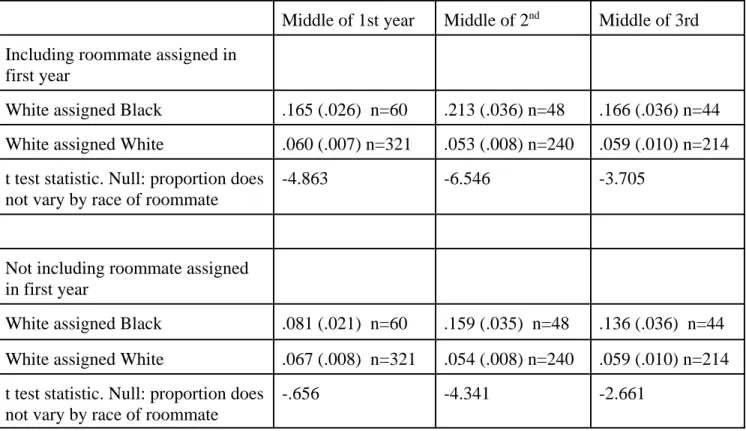
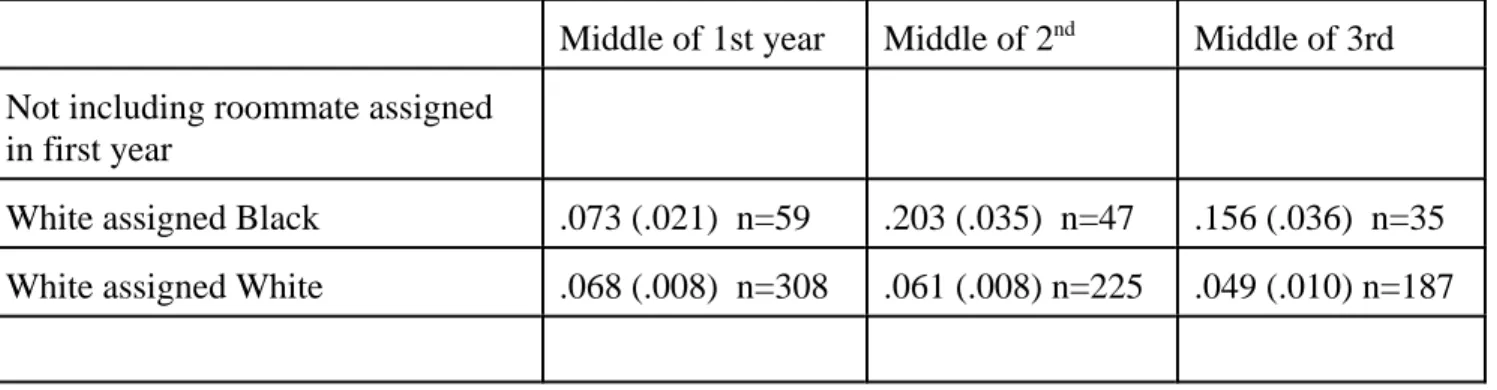
involving randomly assigned roommates described in Subsection 3.3. Table 5 shows the
percentage of a person’s friends that are black in the middle of years one, two, and three at
school, strati…ed by the race of the roommate that was randomly assigned for the freshman
year. The proportions in the …rst panel include the roommate assigned originally if this
roommate is identi…ed as a friend in the year being examined. The …rst column (…rst panel)
shows that, on average, students have 16.5% black friends in the middle of the …rst year if
they were randomly assigned a black roommate and 6.0% black friends in the middle of the
…rst year if they were randomly assigned a white roommate. The null hypothesis that the
average proportion of black friends in the middle of the …rst year does not depend on the race
of the randomly assigned roommate is rejected at all traditional signi…cance levels with the
t-statistic having a value of -4.863. The second and third columns (…rst panel) show similar
results for the middle of the second and third years. Thus, the results indicate that policy
can have a substantial e¤ect on the amount of interracial interaction. Indeed, the average
proportion of black friends in the sample for white students assigned black roommates is
greater than the proportion of black students (.158) at the school.
As shown in Subsection 3.3, many randomly assigned roommates end up being friends.
This raises the important question of whether the results in the …rst panel are being driven
entirely by interactions with the assigned roommate. To examine this issue, the proportions
in the second panel of Table 5 exclude the roommate that was randomly assigned in the
freshman year if this roommate is identi…ed as a friend in the year being examined. The
results in the …rst column (second panel) show that, on average, white students have 8.1%
black friends in the middle of the …rst year if they were randomly assigned a black roommate
and 6.7% black friends in the middle of the …rst year if they were randomly assigned a white