Annals of “Dunarea de Jos” University of Galati Fascicle I. Economics and Applied Informatics
Years XXI – no3/2015 ISSN-L 1584-0409 ISSN-Online 2344-441X
www.eia.feaa.ugal.ro
The Systemic Products as a Source of Competitive
Advantage on Healthcare Sector Example (Part II)
Izabela SZTANGRET, Justyna MATYSIEWICZ
A R T I C L E I N F O A B S T R A C T
Article history:
Accepted December Available online December
JEL Classification
Keywords:
Systemic healthcare products, Synergy relations, Value-creation system, Net-cooperation
)n the healthcare sector, different healthcare providers, such as home care, primary care, pharmacies and hospital clinics but also a financial institution, collaborate in order to increase values for patients, such as better health state, more complex services, high quality of services, and increased feeling of safety. By creating a value, flexible networks health care providers and additional actors create value through collaboration. The purpose of this article is to identify the specific character of systemic healthcare product, created in synergy relations of medical enntities in the area of new way of meeting customers’ needs. Critical analysis of literature in the field of studied category is conducted in the article; furthermore qualitative method of empirical studies case study and quantitative online questionnaire is applied for practical illustration of described processes and phenomena. The article is a second part of the stud.
© EA). All rights reserved.
1. Value-creation system
Marketing is about managing profitable customer relationships. The twofold goal of marketing is to attract new customers by promising superior value and to keep and grow current customers by delivering satisfaction [ ]. Creating value for customers has been recognized as a key concept in marketing [ , , ], making the value and value creation an important research subject [ ] At the general level, the customer value has been referred to as an overall assessment [ ], a function of consumption behavior [ ], perceived quality adjusted for the relative price [ ], emotional bond [ ], relationship, personal perception [ ], and subjective personal introspection [ ]. )n the article it is assumed that value for customers means that, after being assisted by the provision of resources or interactive processes, customers are or feel better off than before [ ].
Features of health care services quite considerably contribute to their distinctive character and, at the same time, affect the value offered to the customer/patient. On the basis of their skills and knowledge and with full observance of norms and rules prevailing in a healthcare services area, medical services firms provide services which are designed to solve problems of their customers. Customers’ participation is vital and indispensable for this cooperation[ ].
By "value-creating system" Parolini means a set of interlinked activities that create value for final customers. )n order to leverage at best their resources and competencies, firms should not limit their perspective to their value chain set of sequential activities or, even worse, to their direct suppliers and customers. )n conceiving of their strategy, they must take into account the whole value-creating system within which they operate, and, if possible, assume the point of view of the final customer [ ].
The fundamental idea in the value creation approach is that by knowing the customer's value creation process the provider can better identify the problems that the customer has concerning his business activities. )n fact, the provider can even notice those problems and concerns that the customer himself can not see. [ ] By providing a solution to these problems the provider can offer a more valuable relationship to the customer than other competitive providers can [ ].
Creation and delivery of the value for the customer, being the prerequisite for a competitive edge, is especially significant with respect to systemic-based healthcare services. An increasingly common systemic character of products and services results from the customer’s perception of their value, namely their existence in a definite and developed system of products and/or services and in networks of their users. Possible benefits gained from the purchase and from the use of systemic products depend on existence and operation of other related products or services [ , ].
2. Healthcare value networks
According to Kähkönen a value net is a dynamic, flexible network in which the actors create value through collaboration. The value net model was developed to facilitate the analysis, description and study of value-creating systems, and takes activities rather than companies as the key elements of strategic analysis [ ]. Companies are regarded as complex nodes in complex interdependent value nets, where success comes through collaboration and creating a business environment in which each actor can be successful [ ]. Any network where the participants are engaged in these kinds of exchange relations can be seen as a value network, whether the value network has been acknowledged by its participants.
Nowadays it can be noticed the growing interest of value net concept in healthcare. Progressing integration of the medical sector actors is indicated by the emergence of healthcare value nets. To the major advantages connected with the value network strategy of healthcare organizastions are [ ]:
possibilities of widening the existing offers with new services, and at the same time broadening the range of service offers,
possibilities of diminishing of doctors’ mistakes, because of the bigger number of co-operative specialists,
ensuring the safety flowing from the safety of customers directed to the organization from other co-operating doctors,
motivation for investment in new technologies what allows rising the quality of services, bigger resources for marketing activity flowing from the synergy effect.
(ealthcare organizations develop value nets to increase the chances of them being able to survival and grow. (ealthcare value nets concern service-oriented collaboration between at least two independent entities, which build economic and business relationship [ ]. Networks in the field of medical services it is a joint effort of companies already operating in the market although on a smaller scale in order to search for new market opportunities in the field of exploring new markets, identify new customers, create new, often more integrated market offers what can respond to costomers' expectations better. The process of integration of medical services can be divided into three main components, the areas of networking [ ]:
Functional Area / Administration, responsible for the supervision, management, marketing, information flow, resource allocation, and effectiveness.
Clinical area, responsible for improving service process. )t means that service have to be synchronized according to treating periods eg. before and after hospitalization , and during the period of treatment eg.: psychological support, home care . This component forms the basis for the creation of the process of service delivery.
The area of the medical system. )t is directly responsible for the quality of medical personnel and treatment process involves the active participation of doctors in the network.
The integration process affects all of these components. )t means restructuring medical practices, service offerings, organizational structures adoption
3. Systemic product concept in healthcare
The development of the category of systemic products, based on value-creation system, is one of the symptoms of changes that take place in the many sectors. As mentioned, healthcare sector is an example where that category can be identified also.
Systemic products are products that most often concomitantly satisfy the needs attributed to more than one level of needs. The consumers/purchasers recognize them as sets clusters of needs that appear simultaneously in some period of human life, for example, those related to the set of needs linked to healthcare. According to classical expressions of consumption economy, sets of needs defined in this way are satisfied by so-called strategic goods services ; but their consumption, to be satisfactory and sometimes possible at all, additionally requires a separate purchase and consumption of complementary products/services. )n case of systemic products, there is usually no such necessity because these products are offered simultaneously [ ].
Therefore, the distinctive feature of a systemic product is the fact that it contains a physical and spatial meaning, not only in one, but in a few or even several products. Technological advancement, and also a growing level of expectations for the quality and efficiency of this type of services, results in the formation of medical multi-products.
(ealthcare organizations established nowadays are institutions that offer medical services that are highly advanced with respect to technology, science, and quality, so-called multi-values, for which such a products are purchased by the patient and also designed and individualized with his/her participation.
together in the form of a one product complex offer . This product is formed and modified according to the patient’s needs [ ]. See part ): The systemic products as a source of competitive advantage on )T sector example .
. Data and methodology
The purpose of this article part )) is to identify the specific characteristic of systemic healthcare products, created in healthcare value networks. The qualitative method of empirical studies case study and quantitative online questionnaire was applied for practical illustration of researched systemic healthcare products.
During the studies of the entities that form value nets for creation of systemic offer under the patronage of healthcare sector leaders, including Medicover and Lux Med., over entities were identified that, according to studied leaders, were involved in direct network relationships. They are entities of various narrow or broad range of offer functioning within healthcare private subsectors of financial one. )n-depth case study method was applied with reference to purposely selected group of enterprises representing the core of network relationship, the so-called extended core of network and entities of the circle of healthcare sector networks table .
Table 1. Basic information about performed research
Specification Characteristics of performed study
Research technique analysis of )nternet pages, analysis of sponsored interviews in healthcare journals, direct interview
Sample selection purposeful selection
promoters of network relationship entities of extended network core Sample size
entities of network circle
Criteria of selection of sample group purposeful selection by indications of promoters and / or position in the ranking of companies by number of patients
Spatial range of research Poland and Europe
Time range of research
-)n analogy to the the studies provided in the first part of the article the in-depth case study analysis method used in this research consists in a comprehensive presentation of a real situation occurring in a particular company or in regard to one of the functions realized within the company e.g. systemic product creation , which is treated as an individual case. )t involves seeking for all necessary data enabling its in-depth analysis, formulating possible choice options and making the best possible decision, accompanied by a proper justification. The unit of analysis/the subject of the studied case are „complex situations , i. e. groups. )n the last part of article the results of the survey among patients are introduced. The study comprised adult customers. The research was conducted by means of a questionnaire distributed online among the group of
respondents in Silesian Region.
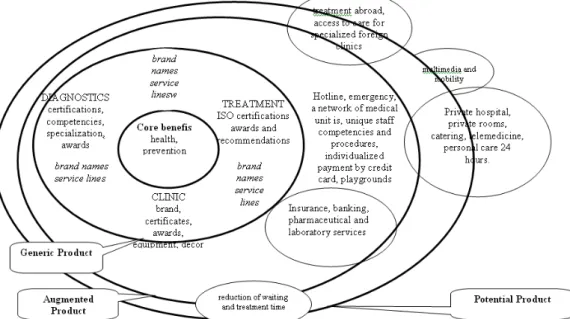
Fig. 2. Model )), multi-core healthcare product, according to the Levitt - Kotler structure
5. Theoretical models of systemic products in healthcare
Components of systemic healthcare products can be represented using the theoretical models of marketing the product, such as product concept of Levitt, Levitt - Kotler and structural model of customer value. All of them were described in details in part one of the article
(ealthcare is conected with providing two types of core benefits. The first one refers to immediate results of the process of service provision. )t is related to both clinical results such as immediate pain relief or restitution of an organ functioning, and to results that are subjectively perceived. The latters include sympathy, benevolence, satisfaction of the need of social contact, reduction of tension related to insecurity and restoration of the feeling of health safety. The second type of benefits refers to long-term effects that derive from the relationship with the service provider. As a consequence, the patients have the possibility to fulfil their roles more efficiently, to participate in social and professional life more fully and to improve the quality of this dimension of participation. The change in perceiving themselves, optimism and positive attitude towards life are associated benefits here. (ealthcare services are the medium of these revaluations that should be considered a unique benefit here.
Generic product is about healthcare service perception in the market, especially its physical evidence, brand name, price, quality, accessibility and medical procedures effectiveness. The marketers want to turn the core benefit into a basic product. At the third level, the marketer offer an augmented product that exceeds patients expectations. For healthcare, augmented products include the following features: easy access to care, coordination of care, information and education, physical comfort, continuity and transition to home, emotional support, involvement of family and friends, and respect for patient preferences. This augmented offering arises from the intense competition for patients in these markets. Differentiation takes place mainly at the level of product augmentation and leads the marketer to look at the user’s total consumption system: the way the user performs the tasks of getting and using products and related services. At the last level is the potential product, which encompasses all the possible augmentations and transformations the product or offering might undergo in the future. This is where companies search for new ways to delight customers and distinguish their offerings. We can identify on the level strong individualization, interactivity and use of all kinds of telemedicine tools.
Model )), healthcare product structure takes the multi-core form. Network cooperation, technological advancement, and also a growing level of expectations results systemic products development. This tendency is particularly observed in the private healthcare sector. Resereched medical centres becomes the institutions that offer healthcare services that are highly advanced with respect to technology, science and quality, such products are purchased by the patient but designed and individualised with his / her participation. The following elements can be included in the composition of the structure of systemic products in healthcare: a. Medical service – predominant element of the systemic product, directly related to the patient’s need.
- Technical products – they include equipment of a medical unit, technical equipment that
supports the process of diagnosis and treatment
- Ambulatory services – that perform supplementary functions, they support the process of
diagnosis.
b. Pharmaceutical products – that perform supplementary functions, they support the process of treatment. c. Financial / insurance products – that provide insurance protection of the patient financing the process
of treatment .
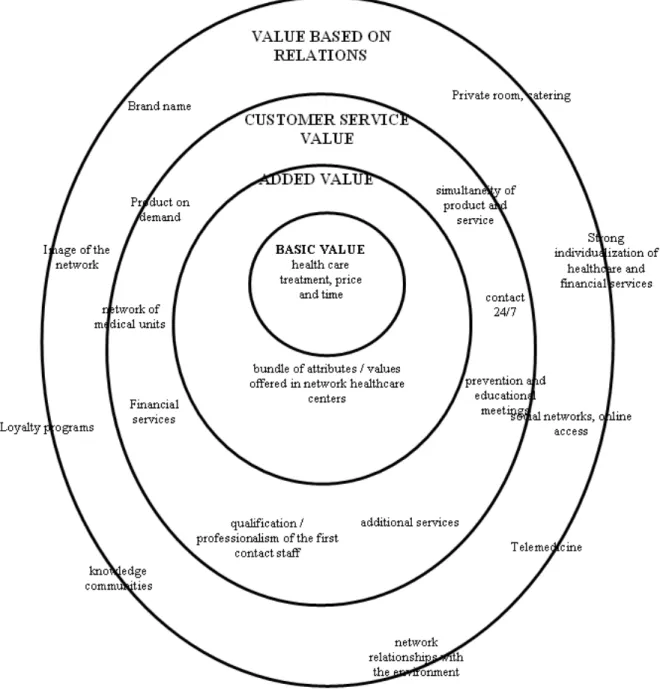
All the elements mentioned above are offered together in the form of a medical packages fig. . The last presented model is called structural model of customer value model ))) . )n that approach it is shown not only the attributes of the product, but the customer service, customer relationships and the costs associated with the acquisition and use of the product fig. .
The first level of this model is the basic advantage of the product, in case of healthcare it is price but also service access time. This is mainly due to the comparisons between public and private market in healthcare. Long waits and poor quality of services are the negative attributes of public healthcare products. Value extended to customer service is linked with associated services medical, financial, pharmaceutical as well design services process and easy access to information. Developing customer value occurs mainly on the level of additional value. Complexity of the services, means of payment and access to a network of collaborators, are the main components used at this level. At the level of the relationship the relationship building process towards patients and third parties is crucial.
Systematic products medical packages are very advanced according to its structure components , technology and patients expectations.
6. Systemic product in healthcare sector – patient perspective
There were initial tests performed in the form of an online survey consisting of a questionnaire. Aim of the tests performed was the evaluation of the weight of individual features of the healthcare product to make it consumer-friendly and get the patients to stay with it in future. Thus, the test aimed at indicating specific determinants creating the long-run relation between the health care unit and its patients among the range of the unit’s activities involvement as well as more precise defining their significance in making and strengthening such relationship. The exploratory factor analysis was used, it helped to identify five main groups of healthcare service features important for patients.
Table 2. Features of the (ealth Care Organisation’s Product – patient perspective
Factors Features of the medical
service Average
Average in groups
(ighly qualified doctors ,
(ighly qualified nurses, ,
Wild range of services ,
(igh service quality ,
Time with doctor ,
Treatment effectiveness ,
1. Professionalism and wild range of services,
personalisation
Medicine effectiveness ,
,
It can be both group 1 or 2 Personalisation , ,
Positive/friendly doctors’
behaviour ,
Fast service ,
Service waiting time ,
2. Outpatient service
Time engagement ,
,
Service availability ,
The reference to further medical results
referred ,
Availability of further
medical results ,
Toilets ,
3. Service availability and personal communication
Positive/friendly nurses’
behaviour ,
,
It can be both group 3 or 4 Advanced medical
equipment , ,
Opening h ,
Localisation ,
4. Accessibility
Accessibility ,
,
Aesthetics ,
Drinks ,
Lounge ,
5. Aesthetics
Lounge facilities ,
,
* Average scale between - , = it is not important, = it is important to call (CO consumer-friendly.
Comparing the weights attributed by the respondents to individual features of health care organisation with the respondents’ particulars enables to draw the conclusion that there is the strongest relation between the respondents’ features and their tangible personal properties, age and educational background. The data analysis suggests that the more tangible personal properties the higher the respondents evaluate individual features of health care units. The persons assessing their personal properties as very abundant pay the most attention more than other persons to high quality of the services rendered, high qualifications of doctors and nurses, friendly attitude to patients, prescribing efficient drags not only those proposed by pharmaceutical companies and esthetic toilets for patients there is the biggest difference in evaluation of this item .
The age of the respondents has little influence on differences in evaluation of the friendly health care unit. The majority of such health care unit’s feature is evaluated in the similar way by all age groups the average mark is above . The evaluation differ the most in case of these health unit’s features whose average marks are below points. They include easy access, location, -hour operation and attractive decor. These features are appreciated the most by the respondents of the - age group and the least by - years old ones.
An interesting dependence regarding educational background may be observed. The higher the educational background of the respondents, less significance is attributed to individual variables in order to call the health care unit friendly yet, differences in marks are not big . Only in case of a few variables such as easy access, high qualifications of doctors, prescribing efficient drags, short waiting time for appointments and quick patient service the dependence shows a reverse tendency. The respondents of higher educational background more often than other expect highly efficient and effective services rendered by the health care unit.
7. Conclusions
The appearance of the category of systemic products is one of the symptoms of changes that take place in the sector of healthcare services. Nowadays, these products are mainly related to private sector of healthcare services. The major actions that have impact on development of medical systemic products can include the rise and diffusion of knowledge and information, communication and production technologies.
References
1. Allee, V., Value network analysis and value conversion of tangible and intangible assets,Journal of Intellectual Capital, Vol. 9 No. 1,2008,
pp. 5-24.
2. Armstrong, G. & Kotler, P., Marketing: An Introduction. 8 th ed. New Jersey: Pearson Prentice Hall, 2007
3. Bitner M.J., W.T. Faranda, A. R. Hubbert, V.A. Ziethaml, Customer contributions and roles in service delivery, International Journal of
Service Industry Management, (8:3), 1997
4. Butz, H.E.J.; Goodstein, L.D., Measuring Customer Value: Gaining the Strategic Advantage. Organisational Dynamics, 24(Winter): 1996,
pp 63-77
5. Drucker, P. F., The practice of management. New York: Harper Collier. 1957
6. Fleury, M., Mercier, C. Integrated local networks as a model for organizing mental health services. Administration and Policy in Mental
Health, Vol. 30, No. 1. September, 2002, p. 59
7. Gale B., Zadowolenie to nie wszystko, "Marketing Service", 4, 1998
8. Grönroos Ch. A service perspective on business relationships: The value creation, interaction and marketing interface, Industrial
Marketing Management, 40. 2001, pp 240-247
9. Helander, N., & Hirvonen, P., Towards joint value creation processes in professional services. The TQM Magazine 13 (4), 2001, pp.
281-291.
10. Holbrook, M.B., Customer value and autoethnography: subjective personal introspection and the meanings of a photograph collection.
Journal of Business Research, 25: 2005, pp. 45-61
11. Matysiewicz J., Marketing organizacji sieciowych usług profesjonalnych w procesie tworzenia wartości dla klienta, Publishing House UE
Katowice, Katowice. Poland 2014
12. Parolini, C., The Value Net: A Tool For Competitive Strategy, John Wiley & Sons, 1999
13. Powell, Walter W., Kenneth W. Koput, and Laurel Smith-Doerr. Interorganizational Collaboration and the Locus of Innovation:
Networks of Learning in Biotechnology. Administrative Science Quarterly 41: 1996, pp. 116-45.
14. Rust, R. T., & Oliver, R. L., Service quality: insights and managerial implications from the frontier. In R. T. Rust & R. L. Oliver (Eds.),
Service quality: New directions for theory and practice (pp. 1-20). Thousand Oaks: Sage. 1994
15. Sheth, J. N., B.I. Newman, B. I., and B.L. Gross, Consumption Values and Market Choices: Theory and Applications. Southwestern
Publications, 1991
16. Smyczek, S., Matysiewicz, J., Systemic Products as Source of Competitive Advantage in Health Care Sector in: Frontiers of Business,
Economics, and Globalization pod red. U. Laplantaned, G. Nartea, ICBE., RPA 2012, s. 90-100
17. Woodall, T., Conceptualising value for the customer: an attributional, dispositional and structural analysis, Academy of Marketing
Science Review (Online). Available at http://www.amsreview.org/articles/woodall12-2003.pdf, 2003
18. Zeithaml, V. A., Consumer perception of price, quality and value: a means-ends-model and synthesis of evidence. Journal of Marketing,
52(July), 1988, pp 2-22
19. Żabiński L., Marketing produktów systemowych. Nowa domena współczesnego marketingu? Współczesny marketing. Trendy, działania,