Design, Immune Responses and Anti-Tumor
Potential of an HPV16 E6E7 Multi-Epitope
Vaccine
Liliane Maria Fernandes de Oliveira1☯, Mirian Galliote Morale1☯, Agatha A. Muniz Chaves1, Aline Marques Cavalher1, Aline Soriano Lopes2, Mariana de Oliveira Diniz3, Alessandra
Soares Schanoski1, Robson Lopes de Melo2, Luís Carlos de Souza Ferreira3, Maria Leonor S. de Oliveira1, Marilene Demasi4, Paulo Lee Ho1
*
1Laboratório de Biotecnologia Molecular I, Instituto Butantan, Av. Vital Brasil 1500, São Paulo-SP, Brazil, 2Laboratório Especial de Toxinologia Aplicada-CeTICS, Instituto Butantan, Av. Vital Brasil 1500, São Paulo-SP, Brazil,3Departamento de Microbiologia, Instituto de Ciências Biomédicas, Universidade de São Paulo, São Paulo-SP, Brazil,4Laboratório de Bioquímica e Biofísica, Instituto Butantan, Av. Vital Brasil 1500, São Paulo-SP, Brazil
☯These authors contributed equally to this work. *[email protected]
Abstract
Cervical cancer is a common type of cancer among women worldwide and infection with high-risk human papillomavirus (HPVs) types represents the major risk factor for the etio-pathogenesis of the disease. HPV-16 is the most frequently identified HPV type in cervical lesions and expression of E6 and E7 oncoproteins is required for the uncontrolled cellular proliferation. In the present study we report the design and experimental testing of a recom-binant multi-epitope protein containing immunogenic epitopes of HPV-16 E6 and E7. Tumor preventive assays, based on the engraftment of TC-1 cells in mice, showed that the E6E7 multi-epitope protein induced a full preventive anti-tumor protection in wild-type mice, as well as in mice deficient in expression of CD4+T cells and TLR4 receptor. Nonetheless, no anti-tumor protection was observed in mice deficient in CD8+T cells. Also, the vaccine
pro-moted high activation of E6/E7-specific T cells and in a therapeutic-approach, E6E7 protein conferred full anti-tumor protection in mice. These results show a potential use of this E6E7 multi-epitope antigen as a new and promising antigen for the development of a therapeutic vaccine against tumors induced by HPV.
Introduction
Cervical cancer is the fourth most common type of cancer among women worldwide [1]. Per-sistent infection with high-risk human papillomavirus (HPVs) is the primary risk factor for the development of the disease. As an attempt to reduce the high incidence of this infection and the deaths resulting from cervical cancer, as well as other cancer types induced by HPV, two prophylactic vaccines based on L1 antigen have been approved in more than 100 countries. Although both vaccines have proven to be highly effective in preventing HPV infection, neither one shows therapeutic effects to established HPV infections. Indeed, thousands of people still OPEN ACCESS
Citation:de Oliveira LMF, Morale MG, Chaves AAM, Cavalher AM, Lopes AS, Diniz MdO, et al. (2015) Design, Immune Responses and Anti-Tumor Potential of an HPV16 E6E7 Multi-Epitope Vaccine. PLoS ONE 10(9): e0138686. doi:10.1371/journal. pone.0138686
Editor:Maurizio Federico, Istituto Superiore di Sanita, ITALY
Received:April 12, 2015
Accepted:September 2, 2015
Published:September 21, 2015
Copyright:© 2015 de Oliveira et al. This is an open access article distributed under the terms of the
Creative Commons Attribution License, which permits unrestricted use, distribution, and reproduction in any medium, provided the original author and source are credited.
Data Availability Statement:All relevant data are within the paper and its Supporting Information files.
Funding:This research was supported by Fundação de Amparo à Pesquisa do Estado de São Paulo—
FAPESP (2010/04490-4 and 2007/51698-7), Conselho Nacional de Desenvolvimento Científico e Tecnológico—CNPQ (304467/2010-3 and 306992/
2014-0) and Fundação Butantan.
die each year with the disease despite advances in surgery, radiotherapy or chemotherapy treat-ments [2,3].
An alternative approach to treat lesions associated with HPV infection is based on therapeu-tic vaccines to tumors induced by HPV. Unlike anti-virus prophylactherapeu-tic vaccines based on the induction of neutralizing antibodies, therapeutic anti-tumor vaccines require induction of cell-mediated immune responses capable to identify and eliminate abnormal cells. To achieve an effective treatment, the therapeutic vaccines depend on a close cooperation between the innate and adaptive immune system, in particular, antigen-presenting cells (APC), CD4+helper T cells and CD8+cytotoxic T lymphocytes (CTLs) [4].
E6 and E7oncoproteins are the targets for immunotherapy against tumors induced by papil-lomavirus. These proteins are exclusively expressed by the infected tumor cells and represent ideal targets for cytotoxic responses induced by vaccinated subjects.
To increase the magnitude and quality of E6 and E7-specific immune response, we devel-oped a therapeutic vaccine candidate employing a recombinant protein consisting of a string of multi immunogenic T cell epitopes of E6 and E7 (E6E7 vaccine). The results indicate that this approach may contribute to the development of vaccines targeting tumors induced by papillomavirus.
Materials and Methods
Mice
Female, 6–10 weeks old, wild-type, CD4+or CD8+T-cells knockout C57BL/6 mice and
C57BL10/ScCr (TLR4 knockout) mice were purchased from Institute of Biomedical Science IV-USP, São Paulo, and kept in pathogen-free condition in the animal facility of Butantan Institute. These experiments were conducted according to the Ethical Principles of Animal Experimentation adopted by Brazilian College of Animal Experimentation (COBEA) and was approved by Animal Ethic Committee Guidelines of Butantan Institute (protocol number: 649/ 09).
Cell lines
TC-1 cells, generated by co-transformation of C57BL/6 mouse lung epithelial cells with HPV16 E6 and E7 and an activated ras oncogene were kindly provided by T. C. Wu, Johns Hopkins University, Baltimore, MD. The TC-1 cell line was propagated as previously described [5]. Before inoculation, TC-1 cells were harvested by trypsinization, washed three times with PBS pH 7.5 buffer and suspended in serum free DMEM media (Gibco) at a concentration of 7.5 x 10⁵cells/mL.
Peptides and antibodies
E6 and E7 synthetic peptides representing H2-Dband H2-Kbrestricted CD8 T-cells epitopes [E6 (VYDFAFRDL49-57; DKKQRFHNI127-135) and E7 (RAHYNIVTF49-57; LCVQSTHVD
67-75)] of HPV16 were synthesized at the Center for Applied Toxinology
–CAT, Butantan Institute
as described by Carpino and Han [6]. For the Elispot analysis, mouse IFN-γELISPOT kits (BD Bioscience) were used.
Plasmid construction
For construction of a vector expressing the E6E7 multi-epitope protein, the synthetic coding sequence of E6E7Ub protein was excised from pUC57 (GenScript Inc.) usingBamHI/PvuII
excising of ubiquitin (Ub) sequence from pAE-E6E7Ub through digestion withEcoRIenzyme
designed to flank the ubiquitin cDNA. The construction was designed to express the recombi-nant protein with a 6 x His tag at the N-terminus. The nucleotides sequence was confirmed by DNA sequencing using Big Dye Terminator Reaction Kit version 3.1 and ABI PRISM 3100 Genetic Analyzer (Applied Biosystems).
Expression, purification and characterization of recombinant proteins
The E6E7 recombinant protein was expressed in the BL21(DE3) Star pLysS (Novagen)E.coli
strain. Isolated colonies grown on LB agar were transferred into 0.5 L of LB with ampicillin and incubated in a shaker at 37°C until the optical density at 600 nm (OD600) reached 0.6. Protein
expression was induced by adding 1 mM isopropyl-β-thiogalactopyranoside and the cultures were incubated at 37°C for 4 h. Cells were harvested by centrifugation and lysed using a French press. Bacterial inclusion bodies were washed in washing buffer (PBS pH 7.5, 250 mM NaCl and 2 M urea) and solubilized with binding buffer (PBS pH 7.5, 250 mM NaCl, 8 M urea, 5 mMβ-mercaptoethanol and 5 mM imidazole).
The recombinant protein was purified on Chelating-Sepharose™Fast Flow (GE Healthcare). The columns with adsorbed protein were washed three times with binding buffer containing 60 mM, 80 mM and 100 mM imidazole. The E6E7 protein was eluted with elution buffer (PBS pH 7.5, 250 mM imidazole and 8 M urea). Stepwise dialysis was performed until urea reached a concentration of 2 M. The protein was quantified by spectrophotometry (NanoDrop, Thermo Scientific Inc.) according to its molar extinction coefficient.
The recombinant protein was characterized by SDS-PAGE and mass spectrometry (S1 Material and Methods).
Prophylactic immunization
Groups of five C57BL/6 mice were immunized subcutaneously (s.c) in the right flank with three doses of E6E7 (18μg/dose) or 100μl PBS/2 M urea at 14 days intervals. After two weeks from the last dose, mice were challenged (s.c) with 7.5 x 10⁴TC-1 cells into the right flank. Tumor growth was monitored daily. The mice were euthanized by CO2inhalation once the
tumors reached 1.5–2.0 cm in size. TLR4 (5–6 mice/group), CD4+T-cells (8 mice/group) or
CD8+T-cells knockout (5 mice/group) animals were immunized with E6E7 or PBS/2 M urea, following the above protocol. A group of five wild-type C57BL/6 mice immunized with PBS/2 M urea was used as a control of tumor growth in all these cases.
Therapeutic immunization
Groups of five C57BL/6 animals were first injected (s.c) into the right flank with 7.5 x 10⁴TC-1 cells. After three days, the immunization protocol was initiated, being injected (s.c) three doses of E6E7 (18μg/dose) or 100μL PBS/2 M urea at 7 days intervals. Tumor growth was monitored daily using a caliper, measuring two opposing diameters. The results are presented in measure-ment as mm2(length x width). Following the above protocol of therapeutic immunization, TLR4 knockout animals were immunized with E6E7 (4 mice) or PBS/2 M urea (4 mice). In parallel, a group of five wild-type C57BL/6 mice immunized with PBS/2 M urea was used as a control of tumor growth.
Evaluation of cellular immune response
The ELISPOT assay was performed using peripheral blood mononuclear cells (PBMCs) from animals immunized according to prophylactic protocol and challenged with TC-1 cells 20 days before the bleeding. Blood was treated with the ACK lysing buffer (0.15 M NH4Cl, 10 mM
KHCO3and 0.1 mM EDTA, pH 7.2), centrifuged and suspended in serum free RPMI media
(Gibco). 105cells were plated in a 96-well plate (Corning Life Science) previously coated with anti-mouse IFN-γ(BD Bioscience) and incubated for 48 hours at 37°C in 200μl of RPMI supple-mented with 2% fetal bovine serum, 10 ng/mL IL-2 and 10−6Mβ-mercaptoethanol. E6-specific (VYDFAFRDL49-57; DKKQRFHNI127-135) and/or E7-specific (RAHYNIVTF49-57;
LCVQSTHVD67-75) peptides were then used as stimuli at a concentration of 2μg/mL for 48 hours. After incubation, the spots were revealed according to the manufacturer instructions (mouse IFN-γELISPOT kits—BD Bioscience). Plates were dried and the number of spots counted.
Statistical analyses
Statistical significance was performed using Student's t test (Elispot assay) or Mantel-Cox curves using log-rank tests (Percentage of tumor-free mice). P<0.05 was considered
signifi-cant. All analysis and graphics were done using GraphPad Prism version 5.
Results
Design and production of E6E7 multi-epitope protein
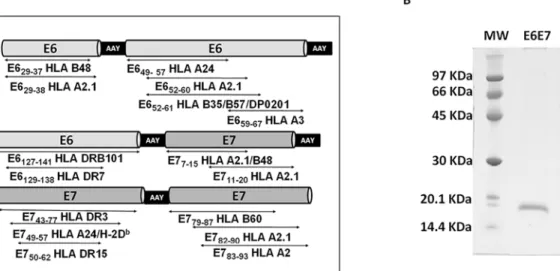
The E6E7 antigen was designed to contain HPV E6 and E7 immunogenic epitopes based on published data reporting antigen specific cellular immune responses detected in patients and/ or C57BL/6 mice. MHC class I-restricted epitopes were included as an attempt to induce T CD8+responses, known to play an important role in tumor clearance. Also, we added to the E6E7 antigen sequence epitopes that are presented to CD4+T-cells by MHC class II known to induce long lasting cytotoxic responses [8–15] (Fig 1A).
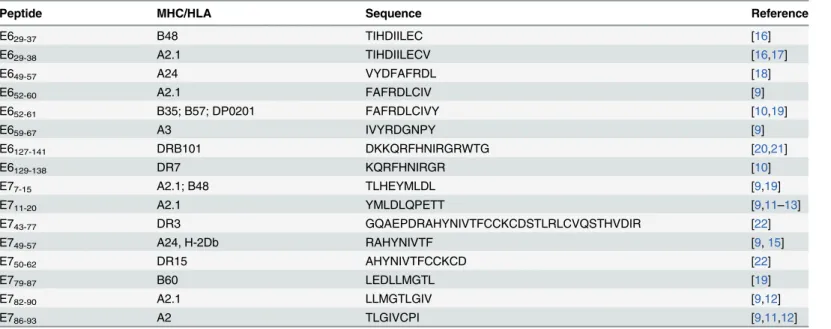
Considering the high polymorphism of HLA genes in the human population, we elected E6 and E7 regions that presented the higher number of established epitopes covering several human HLA types [16]. Thereby, the final construct contained the following regions of the HPV16 E6 and E7 proteins: E629–38, E649-67, E6127-141[9,10,16–21], E77-20, E743-77and E779-93
Fig 1. Design and purification of the vaccine antigen.(A) Scheme of the designed E6E7 antigen. Ala-Ala-Tyr (AAY) spacers were inserted between the epitopes. (B) SDS-PAGE of purified antigen stained with Coomassie Brilliant Blue. MW: molecular mass marker.
[9,11–13,15,19,22] (Table 1). The Ala-Ala-Tyr (AAY) spacers were inserted between the epi-tope sequences (Fig 1A) to increase proteasome degradation at specific sites, enabling right epi-topes to be presented [23].
The E6E7 antigen with a [His]6tag was expressed as inclusion bodies inE.coliand purified
under denaturing protocol. E6E7 protein showed apparent molecular masses of 17.4 kDa in reducing gel (Fig 1B). The antigen was also characterized by mass spectrometry allowing the identification of E6 and E7 related peptides (S1 FigandS1 Table).
Immunoprotective antitumor response
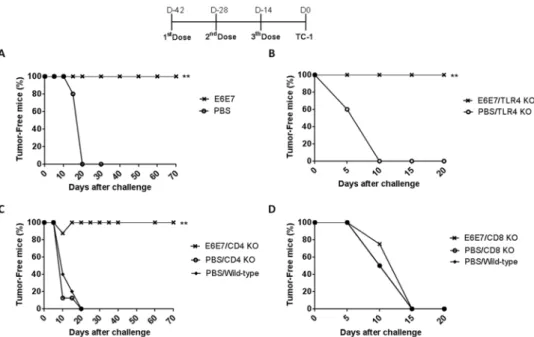
The recombinant E6E7 antigen was evaluated for its potential to induce a preventive anti-tumor response in mice engrafted with TC-1 cells. All mice inoculated with PBS/2 M urea developed tumors within fifteen days after challenge. Three doses of E6E7 antigens had the capacity to protect all mice against tumors (Fig 2A).
As the protein antigens were produced inE.coli, residual lipopolysaccharide (LPS), an
ago-nist of TLR4, are expected to be present in the vaccine preparations. To evaluate the possible impact of LPS contamination on the induced anti-tumor immune responses, we performed prophylactic immunization experiments with TLR4 knockout mice (C57BL10/ScCr). Vaccina-tion with three doses of E6E7 multi-epitope antigen conferred 100% of antitumor protecVaccina-tion in TLR4 knockout mice. All mice immunized with PBS/2 M urea developed tumor within 10 days after challenge (Fig 2B). This data showed the antitumor responses induced by the E6E7 multi-epitope vaccine are independent of LPS/TLR4 signaling pathway.
Using CD4+and CD8+T-cells knockout (KO) mice, we investigated the contribution of CD4+and CD8+T-cells to mediate an effective antitumor response in vaccinated animals. Sim-ilar to results observed with the wild-type mice (Fig 2A), the protective anti-tumor effects induced by E6E7 vaccination were not affected by the absence of CD4+T-cells (Fig 2C). In con-trast, CD8+T-cells KO mice immunized with E6E7or PBS/2 M urea developed tumors within 15 days after challenged (Fig 2D). Thus, CD8+T-cells have a critical role in the protection of mice vaccinated with E6E7 multi-epitope antigens.
Table 1. E6 and E7 epitopes used to assemble in the E6E7 protein.
Peptide MHC/HLA Sequence Reference
E629-37 B48 TIHDIILEC [16]
E629-38 A2.1 TIHDIILECV [16,17]
E649-57 A24 VYDFAFRDL [18]
E652-60 A2.1 FAFRDLCIV [9]
E652-61 B35; B57; DP0201 FAFRDLCIVY [10,19]
E659-67 A3 IVYRDGNPY [9]
E6127-141 DRB101 DKKQRFHNIRGRWTG [20,21]
E6129-138 DR7 KQRFHNIRGR [10]
E77-15 A2.1; B48 TLHEYMLDL [9,19]
E711-20 A2.1 YMLDLQPETT [9,11–13]
E743-77 DR3 GQAEPDRAHYNIVTFCCKCDSTLRLCVQSTHVDIR [22]
E749-57 A24, H-2Db RAHYNIVTF [9,15]
E750-62 DR15 AHYNIVTFCCKCD [22]
E779-87 B60 LEDLLMGTL [19]
E782-90 A2.1 LLMGTLGIV [9,12]
E786-93 A2 TLGIVCPI [9,11,12]
Immunotherapeutic treatment against TC-1 tumor cells
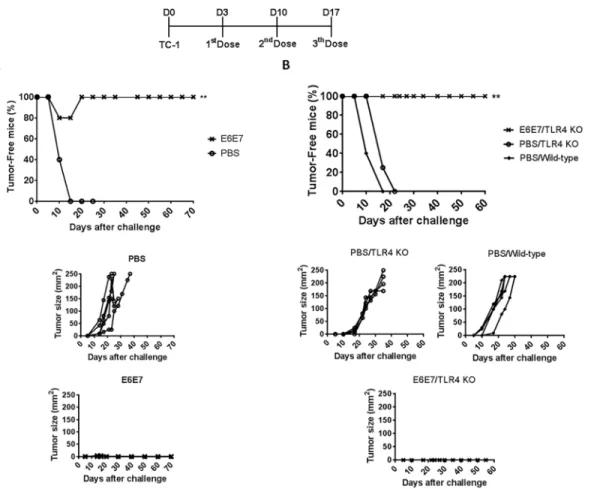
To evaluate the therapeutic anti-tumor responses induced by the tested vaccine, mice were engrafted with TC-1 cells three days before the first vaccine dose. Under such conditions, the treatment with three doses of E6E7 conferred full anti-tumor protection (Fig 3A). As noted in the graphs of tumor size, all animals treated with PBS/2M urea developed large aggressive tumor within 10–15 days after TC-1 injection (Fig 3A). Likewise, upon challenge,
TLR4-defi-cient and wild-type mice immunized with PBS/2M urea developed palpable tumor within 10–15 days which rapidly reached large size (Fig 3B), whereas the treatment of TLR4-deficient
mice with three doses of E6E7 resulted in 100% of therapeutic protection to TC-1 tumors (Fig 3B), showing that the protection does not involve LPS/TLR4 activation.
Vaccination with E6E7 antigens induces IFN-
γ
production
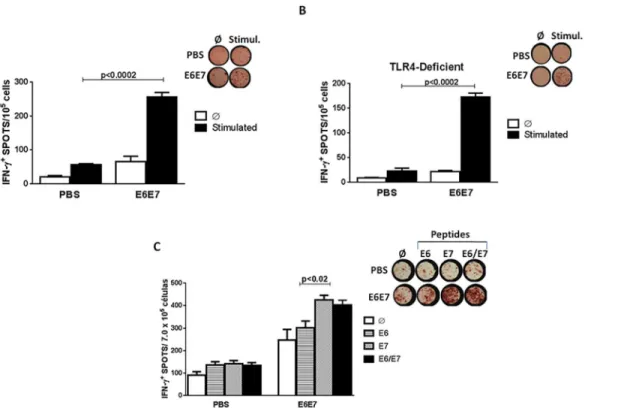
Elispot assays were carried out to detect IFN-γproduction by PBMCs cells of mice immunized with E6E7 or PBS/2 M urea and challenged with TC-1 cells. Cells were stimulatedin vitrowith
a pool of HPV-16 E6 and E7 peptides. Cells derived from mice immunized with E6E7 secreted higher IFN-γlevels compared to the control group (Fig 4A).
Similar assays were carried out with cells fromTLR4 knockout mice. After stimulation, we observed a marked increase of IFN-γby PBMCs from animals immunized with E6E7 (Fig 4B), demonstrating that the E6E7 multi-epitope antigen is capable of generating strong IFN-γ pro-duction in the absence of LPS/TLR4 signaling pathway.
An Elispot assay was performed to compare the production of IFN-γbetween PBMC stimu-lated with E6 (VYDFAFRDL49-57) and/or E7 (RAHYNIVTF49-57) specific peptides. We
Fig 2. Anti-tumor responses elicited in mice immunized with E6E7 multi-epitope protein.Mice were immunized with three doses of PBS/2M urea (PBS) or E6E7 in intervals of 14 days. Mice were challenged with TC-1 tumor cells two weeks after the last dose. (A) Groups of five C57BL/6 mice were immunized as described. (B) TLR4 KO mice (C57BL10/ScCr) were vaccinated with PBS/2M urea (5 mice, PBS) or E6E7 (6 mice). (C) Groups of eight CD4 KO mice were vaccinated with PBS/2M urea (PBS) or E6E7. (D) Groups of five CD8 KO mice were vaccinated with PBS/2M urea (PBS) or E6E7. In parallel, C57BL/6 wild-type mice (5 mice) were used as a control of tumor growth competence. Asterisk indicates statistically significant percentage of tumor-free animals when compared to control group (**p<0.005).
observed high IFN-γsecretion in PBMC cells from mice immunized with the E6E7 vaccine stimulated with E6 peptide or with E7 peptide (Fig 4C). However the IFN-γproduction was more pronounced in cells stimulated with the E7-specific peptide, evidencing the immunodo-minance of this H–2Db-restricted CD8 T cell epitope.
Discussion
Several efforts have been made to develop vaccines capable of conferring E6/E7 HPV-specific immune responses. Despite some developed vaccines have shown promising results in pre-clinical studies, there is still an urgent need to develop new strategies that can also present clini-cal efficacy. For that purpose we designed and tested a multi-epitope E6E7 antigen consisting of immunogenic epitopes of HPV-16 E6 and E7 oncoproteins in order to enhance T cells spe-cific immune responses. One advantage of this approach is to cover a large number of immu-nogenic CTLs epitopes gathered in a single recombinant protein, thereby increasing the possibility of the antigens to be processed and presented by APCs, such as dendritic cells [24]. In addition, we added to the antigen CD4+T helper epitopes to enhance activation of CD8+ T-cells and the maintenance of the long term protective immunity [25]. Finally, the design of the antigen included also a variety of promiscuous HLA epitopes enabling a wider response in genetically heterogeneous subjects.
Fig 3. Therapeutic anti-tumor responses elicited in mice immunized with E6E7.(A) Groups of five C57BL/6 mice were treated with three doses of PBS/ 2M urea (PBS) or E6E7 in intervals of seven days. The first dose was administered three days after the challenge with TC-1 tumor cells. (B) Groups of TLR4 knockout mice were treated with three doses of PBS/2M urea (4 mice, PBS) or E6E7 (4 mice) in intervals of seven days. In parallel, C57BL/6 wild-type mice (5 mice) were used as a control of tumor growth competence. The tumor size in each animal was monitored daily and is given in mm2(length x width).
Several peptides and protein-based vaccines containing CTL immunodominant epitopes have been studied and some have been tested in clinical trials. A therapeutic vaccination with thirteen synthetic long peptides (SLPs) containing both CLT and Th cells epitopes of E6 and/or E7 resulted in the induction of robust E7-specific CD8+T and CD4+Th cells responses in ani-mal model [15,26]. In clinical trials, this vaccine admixed with Montanide ISA-51 promoted complete regression of high-grade lesion, but adjuvanted SLPs could not exert effective thera-peutic effects in most patients with established cervical cancers [27]. TA-CIN (HPV16 L2E6E7 fusion protein) is another vaccine that presented promising results in pre-clinical studies. Immunization with this antigen conferred protection to tumor outgrowth with one dose of TA-CIN plus adjuvant (Novasome) administered 4 h after the challenge with TC-1 cells [28]. However in clinical trials this vaccine was weakly immunogenic and induced low CTL responses [29–31].
The peptide based vaccines have emerged as promising approaches for the development of therapeutic HPV vaccine as they are considered to be safe, easy to produce and specific [32]. Nonetheless, studies have reported that the systemic administration of vaccines consisting of short peptides (typically nine amino acid residues) may result in T cell tolerance due to the probable binding of the peptide to non-professional APC. Also the short peptides are suscepti-ble to rapid degradation by tissue and serum peptidases. To overcome this limitation, studies have suggested the use of long synthetic peptides that can be processed by professional APC, hereby promoting durable adaptive immune responses against multiple antigens [33]. As aforementioned, long peptide vaccines consisting of E6 and E7 epitopes have proven to be
Fig 4. Induction of antigen-specific IFN-γsecretion responses in mice immunized with E6E7.(A) C57BL/6 mice were immunized with three doses of PBS/2M urea (PBS) or E6E7 protein vaccine and challenged with TC-1 tumor cells two w3eeks after the last dose. The ELISPOT assay was performed with PBMC twenty days after the challenge. (B) TLR4 knockout mice were immunized with three doses of PBS/2M urea (PBS) or E6E7 and challenged with TC-1 tumor cells two weeks after the last dose. The ELISPOT assay was performed with PBMC twenty days from the challenge. The cells were stimulated with E6 (VYDFAFRDL49-57; DKKQRFHNI127-135) and E7 (RAHYNIVTF49-57; LCVQSTHVD67-75) peptides. (C) Comparative
IFN-γproduction between PBMC
stimulated with E649-57and/or E749-57specific peptides (Stimul.);Ø–Unstimulated cells.
highly immunogenic when provided together with adjuvant or imune-stimulating molecule [15,26,28,29].
Our approach to overcome the limited immunogenicity of the HPV antigens consisted of a recombinant protein containing overlapping MHC I and II epitopes of E6 and E7. In this strat-egy, epitopes are linked together by a short amino acid motif (AAY) which are a proper sub-strate for proteasome mediated cleavage or binding to the transporter associated with antigen processing (TAP) [34]. After the cleavage behind the AAY motifs, the C-terminal regions of the epitopes are suitable sites for binding to TAP transporter or other chaperons [35]. More-over, the length of the E6E7 protein is ideal to force its processing and presentation by DCs, resulting in a strong induction of T cell immune response [36]. In addition to aforementioned characteristics, our protein covers a range of epitopes from all of the possible restriction mole-cules expressed by HLA A, HLA B and HLA C. Thus, this vaccine has the potential to induce broad immune responses, at both individual and population levels.
In fact, the multi-epitope E6E7 protein has proven to be highly immunogenic in mice with-out the enhancement of any adjuvant, as three doses of vaccination was sufficient to promote full prophylactic and therapeutic anti-tumor protection in mice. The inclusion of epitope restricted to the H-2Db allele (E749-57) along to the HLA- restricted epitopes of E6 and E7
seems to have collaborated substantially for the efficient protection of the E6E7 vaccine against the TC 1 cells in mice. Indeed, this E7 immunodominant epitope (RAHYNIVTF) has been pre-viously used in several therapeutic vaccines that were tested in C57BL/6 mice, resulting in excellent immune protection against tumor which expresses HPV-16 E7 protein [37].
Although the immunodominant epitopes of E7 are likely to be critical for the immune response conferred by the E6E7 vaccine in mice, the selected epitopes of E6 have also contrib-uted to the vaccine efficacy, as we can observe high levels of IFN-γproduction by PBMCs, derived from E6E7 immunized animals, stimulated with E649-57peptide. Indeed, following the
same prophylactic protocol here described, a vaccine consisting of only E6 epitopes was capable to protect 20% of the mice against tumor growth (data not shown), being a indicative of the sig-nificance of the present selected E6 and E7 epitopes as a whole to induce the activation of tumor-specific T cells.
As observed in the prophylactic assay, the vaccination of CD4+T-cells knockout mice did not reduce the anti-tumor effects. Despite CD4+T-cells of being crucial for the maintenance of the immune response through secretion of cytokines, such as IL-2 and IFN-γ, and for playing an important role in anti-tumor effect against genital warts and cervical cancer [38], studies have shown that the protection against immortalized cells expressing E6 and E7 is more depen-dent on CD8+T-cells than CD4+T-cells response [39]. Also, a DNA vaccine encoding E7 fused to heat shock protein (HSP), generated an E7-specific CD8+T-cell responses in the absence of CD4+T-cells [40]. Similarly, in our study the antitumor response generated by E6E7 vaccination required participation of CD8+T-cells, but not CD4+T-cells.
Despite these encouraging results in mice, the multi-epitope E6E7 vaccine will probably require the reinforcement of adjuvants to be effective in clinical trials. However, due to the high immunogenicity of the E6E7 antigen, the effectiveness of an adjuvant or an immune stim-ulating fusion molecule could not be evident in this current study. Actually, as an attempt to enhance the Class I MHC antigen presentation, we have produced a fusion protein composed of E6E7 and ubiquitin. In preliminary studies, this strategy seemed to increase the activation of E6/E7-specific CD8+ T-cellsin vitroand resulted in a similar antitumor effect when compared
to E6E7 (data not shown).
resulted in a powerful protective immune response in mice [26]. Another previously study, the activation of dendritic cells and induction of T cell responses by HPV 16 L1/E7 chimeric virus-like particles were enhanced by CpG-ODN or sorbitol [42]. Several other fusing strategies (heat shock proteins, calreticulin, herpesvirus glycoprotein D) have been effective in increasing CTL response and have generated antitumor immunity of the antigens in animals [5,43–46].
In this current study, we demonstrated that immunization of mice with the E6E7 protein containing CTL and T helper epitopes of E6 and E7 can promote high activation of specific T-cells and can efficiently inhibit the tumor growth in a prophylactic and therapeutic context. Hereby, the immunogenicity of this E6E7 antigen can be intensely explored to reach the ideal-ized vaccine against cervical tumor cells.
Supporting Information
S1 Fig. Peptides identified by mass spectrometry.The aminoacid sequences of the E6E7 pro-tein. E6 (blue) and E7 (green) peptides are distinguished by color. Peptides identified by mass spectrometry are underlined.
(TIF)
S1 Material and Methods. Mass spectrometry analyses. (DOCX)
S1 Table. Peptides identified by mass spectrometry. (TIF)
Acknowledgments
We would like to thank Solange M. T. Serrano from CeTICS, Butantan Institute, for support in the mass spectrometry analysis.
Author Contributions
Conceived and designed the experiments: LMFO MGM MD PLH. Performed the experiments: LMFO AAMC AMC ASL MOD ASS. Analyzed the data: LMFO ASL LCSF MLSO MD PLH. Contributed reagents/materials/analysis tools: RLM LCSF MLSO MD PLH. Wrote the paper: LMFO MGM AAMC ASL MOD LCSF MLSO MD PLH ASS. Design of the DNA and protein sequence: LMFO MGM PLH. Provide the cell line: LCSF. Synthesis of the peptides: RLM.
References
1. Ferlay J, Soerjomataram I, Dikshit R, Eser S, Mathers C, Rebelo M, et al. Cancer incidence and mortal-ity worldwide: sources, methods and major patterns in GLOBOCAN 2012. Int J Cancer. 2015; 136: E359–86. doi:10.1002/ijc.29210PMID:25220842
2. Liu TY, Hussein WM, Toth I, Skwarczynski M. Advances in peptide-based human papillomavirus thera-peutic vaccines. Current topics in medicinal chemistry. 2012; 12: 1581–92. PMID:22827526
3. Robinson W III. Management of cervical neoplasia. Cancer treatment and research. 2001; 104: 287–
302. PMID:11227083
4. van der Burg SH. Therapeutic vaccines in cancer: moving from immunomonitoring to immunoguiding. Expert review of vaccines. 2008; 7: 1–5. doi:10.1586/14760584.7.1.1PMID:18251686
5. Diniz MO, Lasaro MO, Ertl HC, Ferreira LC. Immune responses and therapeutic antitumor effects of an experimental DNA vaccine encoding human papillomavirus type 16 oncoproteins genetically fused to herpesvirus glycoprotein D. Clinical and vaccine immunology: CVI. 2010; 17: 1576–83. doi:10.1128/ CVI.00264-10PMID:20739505
7. Ramos CR, Abreu PA, Nascimento AL, Ho PL. A high-copy T7 Escherichia coli expression vector for the production of recombinant proteins with a minimal N-terminal His-tagged fusion peptide. Brazilian journal of medical and biological research = Revista brasileira de pesquisas medicas e biologicas / Sociedade Brasileira de Biofisica [et al]. 2004; 37: 1103–9.
8. Comerford SA, McCance DJ, Dougan G, Tite JP. Identification of T- and B-cell epitopes of the E7 pro-tein of human papillomavirus type 16. Journal of virology. 1991; 65: 4681–90. PMID:1714516
9. Kast WM, Brandt RM, Sidney J, Drijfhout JW, Kubo RT, Grey HM, et al. Role of HLA-A motifs in identifi-cation of potential CTL epitopes in human papillomavirus type 16 E6 and E7 proteins. Journal of immu-nology. 1994; 152: 3904–12.
10. Piersma SJ, Welters MJ, van der Hulst JM, Kloth JN, Kwappenberg KM, Trimbos BJ, et al. Human pap-illoma virus specific T cells infiltrating cervical cancer and draining lymph nodes show remarkably fre-quent use of HLA-DQ and-DP as a restriction element. International journal of cancer Journal international du cancer. 2008; 122: 486–94. PMID:17955486
11. Ressing ME, de Jong JH, Brandt RM, Drijfhout JW, Benckhuijsen WE, Schreuder GM, et al. Differential binding of viral peptides to HLA-A2 alleles. Implications for human papillomavirus type 16 E7 peptide-based vaccination against cervical carcinoma. European journal of immunology. 1999; 29: 1292–303.
PMID:10229097
12. Ressing ME, Sette A, Brandt RM, Ruppert J, Wentworth PA, Hartman M, et al. Human CTL epitopes encoded by human papillomavirus type 16 E6 and E7 identified through in vivo and in vitro immunoge-nicity studies of HLA-A*0201-binding peptides. Journal of immunology. 1995; 154: 5934–43.
13. Schreurs MW, Kueter EW, Scholten KB, Lemonnier FA, Meijer CJ, Hooijberg E. A single amino acid substitution improves the in vivo immunogenicity of the HPV16 oncoprotein E7(11–20) cytotoxic T
lym-phocyte epitope. Vaccine. 2005; 23: 4005–10. PMID:15963358
14. Stauss HJ, Davies H, Sadovnikova E, Chain B, Horowitz N, Sinclair C. Induction of cytotoxic T lympho-cytes with peptides in vitro: identification of candidate T-cell epitopes in human papilloma virus. Pro-ceedings of the National Academy of Sciences of the United States of America. 1992; 89: 7871–5.
PMID:1381502
15. Zwaveling S, Ferreira Mota SC, Nouta J, Johnson M, Lipford GB, Offringa R, et al. Established human papillomavirus type 16-expressing tumors are effectively eradicated following vaccination with long peptides. Journal of immunology. 2002; 169: 350–8.
16. Nakagawa M, Kim KH, Gillam TM, Moscicki AB. HLA class I binding promiscuity of the CD8 T-cell epi-topes of human papillomavirus type 16 E6 protein. Journal of virology. 2007; 81: 1412–23. PMID: 17108051
17. Thomas KJ, Smith KL, Youde SJ, Evans M, Fiander AN, Borysiewicz LK, et al. HPV16 E6 29-38-spe-cific T cells kill cervical carcinoma cells despite partial evasion of T-cell effector function. International journal of cancer Journal international du cancer. 2008; 122: 2791–9. doi:10.1002/ijc.23475PMID: 18366058
18. Morishima S, Akatsuka Y, Nawa A, Kondo E, Kiyono T, Torikai H, et al. Identification of an HLA-A24-restricted cytotoxic T lymphocyte epitope from human papillomavirus type-16 E6: the combined effects of bortezomib and interferon-gamma on the presentation of a cryptic epitope. International journal of cancer Journal international du cancer. 2007; 120: 594–604. PMID:17096336
19. Nakagawa M, Kim KH, Moscicki AB. Different methods of identifying new antigenic epitopes of human papillomavirus type 16 E6 and E7 proteins. Clin Diagn Lab Immunol. 2004; 11: 889–96. PMID: 15358648
20. Smith KL, Tristram A, Gallagher KM, Fiander AN, Man S. Epitope specificity and longevity of a vaccine-induced human T cell response against HPV18. International immunology. 2005; 17: 167–76. PMID: 15623547
21. Gallagher KM, Man S. Identification of HLA-DR1- and HLA-DR15-restricted human papillomavirus type 16 (HPV16) and HPV18 E6 epitopes recognized by CD4+ T cells from healthy young women. J Gen Virol. 2007; 88: 1470–8. PMID:17412975
22. van der Burg SH, Ressing ME, Kwappenberg KM, de Jong A, Straathof K, de Jong J, et al. Natural T-helper immunity against human papillomavirus type 16 (HPV16) E7-derived peptide epitopes in patients with HPV16-positive cervical lesions: identification of 3 human leukocyte antigen class II-restricted epitopes. International journal of cancer Journal international du cancer. 2001; 91: 612–8.
PMID:11267969
24. Su JH, Wu A, Scotney E, Ma B, Monie A, Hung CF, et al. Immunotherapy for cervical cancer: Research status and clinical potential. BioDrugs. 2010; 24: 109–29. doi:10.2165/11532810-000000000-00000
PMID:20199126
25. Janssen EM, Lemmens EE, Wolfe T, Christen U, von Herrath MG, Schoenberger SP. CD4+ T cells are required for secondary expansion and memory in CD8+ T lymphocytes. Nature. 2003; 421: 852–6.
PMID:12594515
26. Vambutas A, DeVoti J, Nouri M, Drijfhout JW, Lipford GB, Bonagura VR, et al. Therapeutic vaccination with papillomavirus E6 and E7 long peptides results in the control of both established virus-induced lesions and latently infected sites in a pre-clinical cottontail rabbit papillomavirus model. Vaccine. 2005; 23: 5271–80. PMID:16054734
27. Kenter GG, Welters MJ, Valentijn AR, Lowik MJ, Berends-van der Meer DM, Vloon AP, et al. Phase I immunotherapeutic trial with long peptides spanning the E6 and E7 sequences of high-risk human pap-illomavirus 16 in end-stage cervical cancer patients shows low toxicity and robust immunogenicity. Clin-ical cancer research: an official journal of the American Association for Cancer Research. 2008; 14: 169–77.
28. van der Burg SH, Kwappenberg KM, O'Neill T, Brandt RM, Melief CJ, Hickling JK, et al. Pre-clinical safety and efficacy of TA-CIN, a recombinant HPV16 L2E6E7 fusion protein vaccine, in homologous and heterologous prime-boost regimens. Vaccine. 2001; 19: 3652–60. PMID:11395199
29. de Jong A, O'Neill T, Khan AY, Kwappenberg KM, Chisholm SE, Whittle NR, et al. Enhancement of human papillomavirus (HPV) type 16 E6 and E7-specific T-cell immunity in healthy volunteers through vaccination with TA-CIN, an HPV16 L2E7E6 fusion protein vaccine. Vaccine. 2002; 20: 3456–64.
PMID:12297390
30. Gambhira R, Gravitt PE, Bossis I, Stern PL, Viscidi RP, Roden RB. Vaccination of healthy volunteers with human papillomavirus type 16 L2E7E6 fusion protein induces serum antibody that neutralizes across papillomavirus species. Cancer research. 2006; 66: 11120–4. PMID:17145854
31. Fiander AN, Tristram AJ, Davidson EJ, Tomlinson AE, Man S, Baldwin PJ, et al. Prime-boost vaccina-tion strategy in women with high-grade, noncervical anogenital intraepithelial neoplasia: clinical results from a multicenter phase II trial. Int J Gynecol Cancer. 2006; 16: 1075–81. PMID:16803488
32. Wu CY, Monie A, Pang X, Hung CF, Wu TC. Improving therapeutic HPV peptide-based vaccine potency by enhancing CD4+ T help and dendritic cell activation. J Biomed Sci. 2010; 17: 88. doi:10. 1186/1423-0127-17-88PMID:21092195
33. Slingluff CL Jr. The present and future of peptide vaccines for cancer: single or multiple, long or short, alone or in combination? Cancer J. 2011; 17: 343–50. doi:10.1097/PPO.0b013e318233e5b2PMID: 21952285
34. Pardoll DM. Spinning molecular immunology into successful immunotherapy. Nat Rev Immunol. 2002; 2: 227–38. PMID:12001994
35. Bergmann CC, Yao Q, Ho CK, Buckwold SL. Flanking residues alter antigenicity and immunogenicity of multi-unit CTL epitopes. J Immunol. 1996; 157: 3242–9. PMID:8871618
36. Naylor PH, Egan JE, Berinstein NL. Peptide Based Vaccine Approaches for Cancer-A Novel Approach Using a WT-1 Synthetic Long Peptide and the IRX-2 Immunomodulatory Regimen. Cancers (Basel). 2011; 3: 3991–4009.
37. Monroy-Garcia A, Gomez-Lim MA, Weiss-Steider B, Hernandez-Montes J, Huerta-Yepez S, Rangel-Santiago JF, et al. Immunization with an 16 L1-based chimeric virus-like particle containing HPV-16 E6 and E7 epitopes elicits long-lasting prophylactic and therapeutic efficacy in an HPV-HPV-16 tumor mice model. Arch Virol. 2014; 159: 291–305. doi:10.1007/s00705-013-1819-zPMID:23990055
38. Hohn H, Pilch H, Gunzel S, Neukirch C, Hilmes C, Kaufmann A, et al. CD4+ tumor-infiltrating lympho-cytes in cervical cancer recognize HLA-DR-restricted peptides provided by human papillomavirus-E7. Journal of immunology. 1999; 163: 5715–22.
39. Feltkamp MC, Smits HL, Vierboom MP, Minnaar RP, de Jongh BM, Drijfhout JW, et al. Vaccination with cytotoxic T lymphocyte epitope-containing peptide protects against a tumor induced by human papillo-mavirus type 16-transformed cells. European journal of immunology. 1993; 23: 2242–9. PMID: 7690326
40. Chen CH, Wang TL, Hung CF, Yang Y, Young RA, Pardoll DM, et al. Enhancement of DNA vaccine potency by linkage of antigen gene to an HSP70 gene. Cancer research. 2000; 60: 1035–42. PMID: 10706121
42. Freyschmidt EJ, Alonso A, Hartmann G, Gissmann L. Activation of dendritic cells and induction of T cell responses by HPV 16 L1/E7 chimeric virus-like particles are enhanced by CpG ODN or sorbitol. Antivir Ther. 2004; 9: 479–89. PMID:15456078
43. Einstein MH, Kadish AS, Burk RD, Kim MY, Wadler S, Streicher H, et al. Heat shock fusion protein-based immunotherapy for treatment of cervical intraepithelial neoplasia III. Gynecol Oncol. 2007; 106: 453–60. PMID:17586030
44. Chu NR, Wu HB, Wu T, Boux LJ, Siegel MI, Mizzen LA. Immunotherapy of a human papillomavirus (HPV) type 16 E7-expressing tumour by administration of fusion protein comprising Mycobacterium bovis bacille Calmette-Guerin (BCG) hsp65 and HPV16 E7. Clin Exp Immunol. 2000; 121: 216–25.
PMID:10931134
45. Peng S, Tomson TT, Trimble C, He L, Hung CF, Wu TC. A combination of DNA vaccines targeting human papillomavirus type 16 E6 and E7 generates potent antitumor effects. Gene Ther. 2006; 13: 257–65. PMID:16177818