A New Preconditioned AOR Iterative Method and
Comparison Theorems for Linear Systems
Aijuan Li
Abstract—In this paper, a new preconditioned AOR iterative method is proposed with the preconditioner I +Sα. Some comparison theorems are given when the coefficient matrixAof linear system is an irreducibleL−matrix. Numerical example shows that our methods are superior to the basic AOR iterative method.
Index Terms—preconditioner, AOR iterative method, irre-ducible L-matrix
I. INTRODUCTION
W
E consider the linear system of n equationsAx=b, (1) where A= (aij)∈Rn×n is an n×n nonsingular matrix,
with aii ̸= 0, i = 1,2,· · ·, n and x,b are n-dimensional
vectors. IfA is split into
A=M−N
whereM is nonsingular.
Then the basic iterative method for solving (1) can be expressed in the form
x(k+1)=M−1N x(k)+M−1b, k= 0,1,· · ·
wherex(0) is an initial vector. As it is well known, the above iterative process is convergent to the unique solution x =
A−1
b for each initial value x(0) if and only if the spectral radius of the iteration matrix M−1
N satisfies ρ(M−1
N)<
1.
Throughout the paper, we assume that A =I−L−U, where I is the identity matrix, −L and −U are strictly lower triangular and strictly upper triangular matrices of A, respectively. Then the iteration matrix of the AOR iterative method [1] for solving the linear system (1) is
Lγ,ω= (I−γL)−1[(1−ω)I+ (ω−γ)L+ωU] (2)
whereω andγ are real parameters withω̸= 0.
It is well known that for certain values of the parameters
γ and ω. We can obtain the Successive Over-relaxation (SOR), JOR and Jacobi methods, whose iterative matrices are denoted byLω,ω,Jω andJ, respectively.
In order to accelerate the convergence of iterative method for solving the linear system (1), the original linear system (1) is transformed into the following preconditioned linear system
P Ax=P b, (3) whereP ∈Rn×n is nonsingular and called a preconditioner.
Then the corresponding basic iterative method is given in general by
x(k+1)=M−1
p Npx(k)+M
−1
p P b, k= 0,1,2,· · · Aijuan Li is with the School of Science, Shandong University of Technol-ogy, Zi’bo 255049, People’s Republic of China. Email:[email protected]
where P A = Mp −Np is a splitting of P A and Mp is
nonsingular. Similar to the original system (1), we call the basic iterative methods corresponding to the preconditioned system the preconditioned iterative methods, such as the preconditioned AOR method and the preconditioned SOR method.
In [2]-[9], some different preconditioners have been pro-posed by several authors. In [10], the author presented pre-conditioned AOR methods for consistent linear systems by using four types of preconditionersP =Pk(k= 1,2,3,4).
The preconditionerP1 is of the form P1=I+S1, where
S1=
0 −α1a12 0 · · · 0
0 0 −α2a23 · · · 0
..
. ... ... ... ... 0 0 0 · · · −αn−1an−1n
0 0 0 · · · 0
The preconditionerP2 is of the form P2=I+S2, where
S2=
0 0 · · · 0 0 0 · · · 0
..
. ... ... ... −αnan1 0 · · · 0
The preconditionerP3 is of the form P3=I+S3, where
S3=
0 0 · · · 0 −α2a21 0 · · · 0
−α3a31 0 · · · 0
..
. ... ... ... −αnan1 0 · · · 0
The preconditionerP4 is of the form P4=I+S4, where
S4=
0 0 · · · −α1a1n
0 0 · · · −α2a2n
..
. ... ... ... 0 0 · · · −αn−1an−1n
0 0 · · · 0
The author provided some comparison theorems which showed the improvement on convergence rates of the basic iterative methods.
In this paper, we propose a new preconditioned AOR iterative method with a preconditionerP =I+Sα, where
Sα=
0 0 · · · 0 0
−α2a21 0 · · · 0 0
0 −α3a32 · · · 0 0
..
. ... . .. ... ...
0 0 · · · −αnann−1 0
IAENG International Journal of Applied Mathematics, 42:3, IJAM_42_3_06
(Advance online publication: 27 August 2012)
For convenience, some notations, definitions, lemmas and theorems that will be used in the following parts are given below.
II. PRELIMINARIES
In this paper,ρ(A)denotes the spectral radius of the matrix
A.
Definition 2.1([11]). A matrixAis aL−matrix ifaii≥
0, i= 1,2,· · ·, nandaij≤0for alli, j= 1,2,· · ·, n,i̸=j. Definition 2.2([12]). A matrix A is irreducible if the directed graph associated toA is strongly connected.
Lemma 2.1([11]). LetAbe a nonnegative and irreducible
n×n matrix. Then
(1)Ahas a positive real eigenvalue equal to its spectral radius
ρ(A).
(2) For ρ(A), there corresponds an eigenvectorx >0. (3) ρ(A)is a simple eigenvalue ofA.
(4) ρ(A)increases when any entry ofA increases.
Lemma 2.2( [2]). Let Abe a nonnegative matrix. Then (1)If αx≤Ax for some nonnegative vector x, x̸= 0, then
α≤ρ(A).
(2)If Ax≤βxfor some positive vectorx, then ρ(A)≤β. Moreover, if A is irreducible and if 0 ̸= αx ≤Ax ≤βx,
αx ̸= Ax, Ax ̸= βx for some nonnegative vector x, then
α < ρ(A)< β andxis a positive vector.
III. PRECONDITIONEDAORITERATIVE METHOD AND COMPARISON THEOREMS
For the linear system (1), we consider its preconditioned form
P Ax=P b
whereP =I+Sα.
LetP A=AαandP b=bα, we will obtain preconditioned
system
Aαx=bα, (4)
whereAα= (I+Sα)Aandbα= (I+Sα)b.
Now, we express the coefficient matrix of (4) as
Aα = (I+Sα)(I−L−U)
=I−L−U+Sα−SαL−SαU
=Dα−Lα−Uα
whereSαU =Eα+Fα,EαandFαare diagonal matrix and
strictly upper triangular matrix of the matrix SαU, Dα =
I−Eα,Lα=L−Sα+SαL,Uα=U+Fα.
Then the preconditioned AOR iteration matrix
Lγ,ω,α= (Dα−γLα)
−1[(1−ω)D
α+(ω−γ)Lα+ωUα] (5)
whereω andγ are real parameters withω̸= 0.
Theorem 3.1 LetA andAαbe the coefficient matrices
of linear system (1) and (4), respectively. Lγ,ω andLγ,ω,α
are defined by (2) and (5), respectively. Let A be an irreducibleL−matrix. Suppose that 0< αiaii−1ai−1i <1,
αiaii−1 ̸= 0 and 0 < αi ≤ 1 for i = 2,3,· · ·, n. If
0≤γ≤ω≤1 (ω̸= 0, γ̸= 1), then (1)ρ(Lγ,ω,α)< ρ(Lγ,ω)if ρ(Lγ,ω)<1.
(2)ρ(Lγ,ω,α)> ρ(Lγ,ω)if ρ(Lγ,ω)>1.
(3)ρ(Lγ,ω,α) =ρ(Lγ,ω)if ρ(Lγ,ω) = 1.
Proof. SinceAis an irreducibleL−matrix and0≤γ≤
ω≤1, the proof whichLγ,ω is irreducible and nonnegative
has been obtained in [13]. Now we obtain that Lγ,ω,α is
irreducible and nonnegative.
Since A is an irreducible L− matrix andαiaii−1 ̸= 0, we
getαiaii−1>0. If0< αi≤1for i= 2,3,· · ·, n, then
Lγ,ω,α = (Dα−γLα)−1[(1−ω)Dα+ (ω−γ)Lα
+ωUα]
= (I−γD−1
α Lα)−1Dα−1[(1−ω)Dα
+(ω−γ)Lα+ωUα]
= (I−γD−1
α Lα)−1[(1−ω)I
+(ω−γ)D−1
α Lα+ωDα−1Uα]
= [I+γD−1
α Lα+ (γDα−1Lα)2+· · ·][(1−
ω)I+ (ω−γ)D−1
α Lα+ωDα−1Uα]
= (1−ω)I+ω(1−γ)D−1
α Lα+ωDα−1Uα+
γD−1
α Lα[(ω−γ)Dα−1Lα+ωD−α1Uα]+
[(γD−1
α Lα)2+ (γD−α1Lα)3+· · ·][(1−ω)I+
(ω−γ)D−1
α Lα+ωD−α1Uα]
≥0
Since A is irreducible L− matrix, then (1−ω)I+ω(1−
γ)D−1
α Lα+ωDα−1Uα is irreducible. Thus, Lγ,ω,α is also
irreducible and nonnegative.
From Lemma 2.1, there exists an x >0 such Lγ,ωx=λx,
whereλ=ρ(Lγ,ω), we obtain
(I−γL)−1[(1−ω)I+ (ω−γ)L+ωU]x=λx
Therefore
[(ω−γ+λγ)L+ωU]x= (ω+λ−1)x SαLx= (
λ−1 +ω ω−γ+λγSα−
ωSαU
ω−γ+λγ)x
(SαL−Sα)x= [
(λ−1)(1−γ)Sα
ω−γ+λγ −
ωSαU
ω−γ+λγ]x
Thus
Lγ,ω,αx−λx = (Dα−γLα)−1[(1−ω)Dα+
(ω−γ)Lα+ωUα]x−λx
= (Dα−γLα)−1[(1−ω)Dα+
(ω−γ)Lα+ωUα−λ(Dα−γLα)]x
= (Dα−γLα)−1[(1−ω−λ)Dα+
(ω−γ+λγ)Lα+ωUα]x
= (Dα−γLα)−1[(1−ω−λ)(I−Eα)
+(ω−γ+λγ)(L−Sα+SαL)+
ω(U+Fα)]x
= (Dα−γLα)−1[(1−ω−λ)I−
(1−ω−λ)Eα+ (ω−γ+λγ)L+ (ω−
γ+λγ)(SαL−Sα) +ω(U+Fα)]x
= (Dα−γLα)−1[−(ω−γ+λγ)L−
ωU−(1−ω−λ)Eα+ (ω−γ+λγ)L
+(ω−γ+λγ)(SαL−Sα)
+ωU+ωFα]x
= (Dα−γLα)−1[(λ+ω−1)Eα+
(ω−γ+λγ)((λ−1)(1−γ)Sα
ω−γ+λγ − ωSαU
ω−γ+λγ) +ωFα]x
= (Dα−γLα)−1[(λ+ω−1)Eα+
(λ−1)(1−γ)Sα−ωSαU+ωFα]x
= (Dα−γLα)−1[(λ+ω−1)Eα+
(λ−1)(1−γ)Sα−ω(Eα+Fα)+
ωFα]x
= (λ−1)(Dα−γLα)−1[Eα+
(1−γ)Sα]x
IAENG International Journal of Applied Mathematics, 42:3, IJAM_42_3_06
(Advance online publication: 27 August 2012)
Since αiaii−1 ̸= 0, we obtain Sα ≥ 0. We know that the
first component of [Eα+ (1−γ)Sα]x is zero and (Dα−
γLα)−1[Eα+ (1−γ)Sα]x≥0. SinceLγ,ω,α is irreducible
and Lγ,ω,αx̸=λx. Ifλ >1, From Lemma 2.2, we obtain
ρ(Lγ,ω,α) > ρ(Lγ,ω). If λ < 1, we obtain ρ(Lγ,ω,α) <
ρ(Lγ,ω). If λ = 1, we obtain ρ(Lγ,ω,α) = ρ(Lγ,ω). This
completes the proof.
In Theorem 3.1, we take γ = 0, ω = 1, then we obtain the following Corollary 3.1.
Corollary 3.1 LetAandAα be the coefficient matrices
of linear system (1) and (4), respectively. L0,1 and L0,1,α
be the Gauss-Seidel iteration matrix of basic Gauss-Seidel iterative method and preconditioned Gauss-Seidel iterative method, respectively. Let A be an irreducible L− matrix. Suppose that 0 < αiaii−1ai−1i < 1, αiaii−1 ̸= 0 and 0< αi≤1 fori= 2,3,· · ·, n. Then
(1)ρ(L0,1,α)< ρ(L0,1)ifρ(L0,1)<1.
(2)ρ(L0,1,α)> ρ(L0,1)ifρ(L0,1)>1.
(3)ρ(L0,1,α) =ρ(L0,1)ifρ(L0,1) = 1.
In Theorem 3.1, we take γ = ω, then we obtain the following Corollary 3.2.
Corollary 3.2 Let A and Aα be the coefficient
matrices of linear system (1) and (4), respectively. Lω,ω
and Lω,ω,α be the SOR iteration matrix of basic SOR
iterative method and preconditioned SOR iterative method, respectively. Let A be an irreducible L− matrix. Suppose that 0< αiaii−1ai−1i<1,αiaii−1̸= 0 and0< αi≤1for
i= 2,3,· · ·, n. Then
(1)ρ(Lω,ω,α)< ρ(Lω,ω)if ρ(Lω,ω)<1.
(2)ρ(Lω,ω,α)> ρ(Lω,ω)if ρ(Lω,ω)>1.
(3)ρ(Lω,ω,α) =ρ(Lω,ω)if ρ(Lω,ω) = 1.
IV. NUMERICAL EXAMPLE
In this section, we give the following example to illustrate the results obtained in section 3.
Example The coefficient matrix Aof (1) is given by
A=
1 −0.2 −0.3 −0.1 −0.2 −0.1 1 −0.1 −0.3 −0.1 −0.2 −0.1 1 −0.1 −0.2 −0.2 −0.1 −0.1 1 −0.3 −0.1 −0.2 −0.2 −0.1 1
We obtain the spectral radius of AOR iterative matrix under the different preconditioners with real parameters γ,ω and
αi(i= 2,3,· · ·, n).
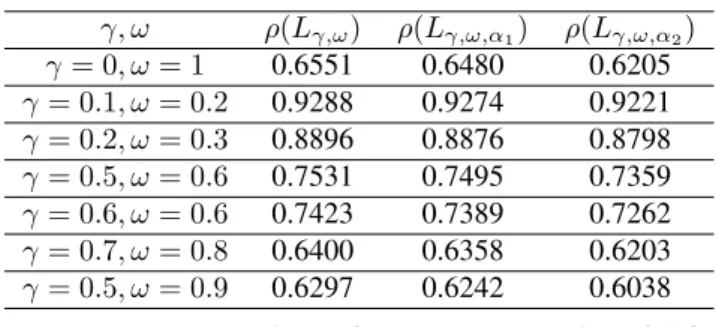
If we denote the spectral radius of the preconditioned AOR iterative matrix by ρ(Lγ,ω,α1) when α2 = 0.1, α3 = 0.2,
α4= 0.1,α5= 0.3.
We denote the spectral radius of the preconditioned AOR iterative matrix by ρ(Lγ,ω,α2) when α2 = 1, α3 = 1,
α4= 1,α5= 1.
We denote the spectral radius of the preconditioned AOR iterative matrix by ρ(Lγ,ω,α3) when α2 = 0.4, α3 = 0.5,
α4= 0.3,α5= 0.8.
We denote the spectral radius of the preconditioned AOR iterative matrix by ρ(Lγ,ω,α4) when α2 = 0.8, α3 = 0.5,
α4= 0.9,α5= 1.
Then we obtain the Table I and Table II.
Table I. The comparison of the spectral radius of AOR iterative matrix(1)
γ, ω ρ(Lγ,ω) ρ(Lγ,ω,α1) ρ(Lγ,ω,α2)
γ= 0, ω= 1 0.6551 0.6480 0.6205
γ= 0.1, ω= 0.2 0.9288 0.9274 0.9221
γ= 0.2, ω= 0.3 0.8896 0.8876 0.8798
γ= 0.5, ω= 0.6 0.7531 0.7495 0.7359
γ= 0.6, ω= 0.6 0.7423 0.7389 0.7262
γ= 0.7, ω= 0.8 0.6400 0.6358 0.6203
γ= 0.5, ω= 0.9 0.6297 0.6242 0.6038
Table II. The comparison of the spectral radius of AOR iterative matrix(2)
γ, ω ρ(Lγ,ω) ρ(Lγ,ω,α3) ρ(Lγ,ω,α4)
γ= 0, ω= 1 0.6551 0.6367 0.6388
γ= 0.1, ω= 0.2 0.9288 0.9252 0.9247
γ= 0.2, ω= 0.3 0.8896 0.8843 0.8838
γ= 0.5, ω= 0.6 0.7531 0.7437 0.7438
γ= 0.6, ω= 0.6 0.7423 0.7335 0.7341
γ= 0.7, ω= 0.8 0.6400 0.6291 0.6308
γ= 0.5, ω= 0.9 0.6297 0.6156 0.6157 From Table I and Table II, we can see that ifρ(Lγ,ω)<1,
ρ(Lγ,ω,α) < ρ(Lγ,ω), which shows that our methods are
superior to the basic AOR iterative method.
REFERENCES
[1] A.Hadjidimos, “Accelerated overrelation method,” Math Comput., V32, pp. 149-157, 1978.
[2] A.D.Gunawardena, S.K.Jain, L.Snyder, “Modified iterative methods for consistent linear systems,”Linear Algebra Appl., V154-156, pp. 123-143, 1991.
[3] D.J.Evans, M.M.Martins, M.E.Trigo, “The AOR iterative method for new preconditioned linear systems,”J.Comput.Appl.Math., V132, pp. 461-466, 2001.
[4] H.Kotakemori, K.Harada, M.Morimoto, H.Niki, “ A comparison the-orem for the iterative method with the preconditioner(I+Smax),”
J.Comput.Appl.Math., V145, pp. 373-378, 2002.
[5] A.Hadjidioms, D.Noutsos, M.Tzoumas, “More on modifications and improvements of classical iterative schemes for M-matrices,”Linear Algebra Appl., V364, pp. 253-279, 2003.
[6] H.Niki, K.Harada, M.Morimoto, M.Sakakihara, “The survey of pre-conditioners used for accelerating the rate of convergence in the Gauss-Seidel method,”J.Comput.Appl.Math., V164-165, pp. 587-600, 2004. [7] L.y.Sun, “A comparison theorem for the SOR iterative method,”
J.Comput.Appl.Math., V181, pp. 336-341, 2005.
[8] C.Y.Zhang, C.X.Xu, S.H.Luo, “Covergence of block iterative methods for linear systems with generalized H-matrices,”J.Comput.Appl.Math., V229, pp. 70-84, 2009.
[9] A.J.Li, “Improving AOR iterative methods for irreducible L-matrices,”
Engineering Letters, V19, Issue 1, pp.46-49, 2011.
[10] J.H.Yun, “Comparison results of the preconditioned AOR methods for L-matrices,”Appl.Math.Comput., V218, pp. 3399-3413, 2011. [11] D.M.Young, Iterative solution of large sinear systems, New
Y-ork,Academic.1971.
[12] R.S.Varga, Matrix Iterative Analysis, Prentice-Hall, Englewood cliff-s.NJ,1962.
[13] Y.T.Li, S.F.Yang, “A multi-parameters preconditioned AOR iterative method for linear systems, ”App.Math.Comput., V206, pp. 465-473, 2008.