Species-Specific Non-Physical Interference Competition
among Mosquito Larvae
Alon Silberbush1*, Ido Tsurim1,2, Ran Rosen3, Yoel Margalith1, Ofer Ovadia1
1Center for Biological Control (CBC), Department of Life Sciences, Ben-Gurion University of the Negev, Beer Sheva, Israel,2Department of Life Sciences, Achva Academic College, Arugot, Israel,3Department of Entomology, Agricultural Research Organization, The Volcani Center, Bet Dagan, Israel
Abstract
Individuals of different sex, size or developmental stage can compete differently and hence contribute distinctively to population dynamics. In species with complex life cycles such as insects, competitive ability is often positively correlated with larval developmental stage. Yet, little is known on how the development and survival of early-instars is influenced by interference from late-instar larvae, especially at low densities when exploitative competition is expected to be negligible. Furthermore, the specificity and mechanisms by which interference competition operates are largely unknown. We performed two complementary experiments aiming to quantify the competitive effects of late instarOchlerotatus caspiuson early instar larvae at low densities and under high resource supply rate. The first experiment examined the net effect of interference by 4thon 1stinstarO. caspiuslarvae, relative to the effect of 1stinstars on themselves. The second experiment examined the effect of species-specific, non-physical interference competition (i.e., cage larvae) by 4thon 1stinstarO. caspius larvae at low or high densities. Specifically, we compared the responses ofO. caspiuslarvae raised in the presence of caged con- or hetero-specific,Culiseta longiareolata, with that of larvae in the empty-cage control group. As expected, interference from late instar larvae had a net negative effect on the development rate of first instars. In contrast, the presence of caged con-specifics (non-physical interference) accelerated the development rate ofO. caspius, however, this pattern was only evident at the low density. Notably, no such pattern was detected in the presence of caged hetero-specifics. These results strongly suggest the existence of species-specific growth regulating semiochemicals.
Citation:Silberbush A, Tsurim I, Rosen R, Margalith Y, Ovadia O (2014) Species-Specific Non-Physical Interference Competition among Mosquito Larvae. PLoS ONE 9(2): e88650. doi:10.1371/journal.pone.0088650
Editor:Olle Terenius, Swedish University of Agricultural Sciences, Sweden
ReceivedOctober 2, 2013;AcceptedJanuary 8, 2014;PublishedFebruary 18, 2014
Copyright:ß2014 Silberbush et al. This is an open-access article distributed under the terms of the Creative Commons Attribution License, which permits unrestricted use, distribution, and reproduction in any medium, provided the original author and source are credited.
Funding:The authors have no support or funding to report.
Competing Interests:The authors have declared that no competing interests exist.
* E-mail: [email protected]
Introduction
Understanding the mechanisms that control population dynam-ics is essential for predicting ecological, economic, and health impacts of resident and invasive species [1–4]. At the heart of these mechanisms are density-dependent competitive effects on survival, development and reproduction [5–9]. Historically, ecologists distinguished between direct and indirect types of competition. Interference competition occurs through physical (e.g., aggression) or non-physical (e.g., chemical) interactions, resulting in direct negative effect on competitors fitness. In contrast, exploitation competition occurs when a shared limited resource is depleted, and consequently fitness is indirectly reduced [10–11]. A growing body of literature illustrates the importance of both exploitative and interference competition in triggering density- and frequency-dependent responses that can alter population and community dynamics [11–14]. Disentangling the negative effects of exploit-ative and interference competition requires preventing physical contact (e.g., caged competitors) [15], or creating a competitor-conditioned environment [16]. In this study, we adopted a similar approach to distinguish between physical and non-physical interference competition.
In organisms with complex life cycles, such as insects and amphibians who alter their habitat, diet and morphology over time, competitive ability can be positively correlated with developmental stage, meaning that the negative competitive effects
on survival and life history traits should be stronger among larvae at early developmental stages [3,17–20]. Such structural differ-ences in competitive abilities can play an important role in determining population dynamics [21–24].
Mosquito larvae often occur at high densities, consequently experiencing both exploitative and interference competition. Hetero- and con-specific density-dependence among larval mos-quitoes can strongly affect larvae and adult life history traits and fitness [3]. Increased larval densities negatively affect a range of life history traits including prolonged (delayed) larval development, reduced larval and adult survival, modified dispersal behavior and capabilities, and reduced female fecundity [25–33]. Such effects are largely the result of exploitative and interference competition caused by food and nutrient shortage, modified foraging behavior, and exposure to chemicals, waste products or other growth retardant factors [3,34–35]. Structural differences in competitive abilities associated with larval size or developmental stage can interact with these factors to affect population and community dynamics [4,18,36–37].
First instar larvae of the tree hole mosquito Aedes sierrensis
(i.e., caged larvae) interference by a small number of late instars (4thstage) on the development and survival of early instar larval mosquitoesOchlerotatus caspiusPallas, 1771 (Diptera: Culicidae). We hypothesized that early instar larvae should be negatively affected by non-physical interference competition from the late instars. We further posited that these effects are likely species-specific. To test this second hypothesis, we used hetero-specific competition from
Culiseta longiareolataMacquart, 1838 as control.Culiseta longiareolata
populations overlap with O. caspiusover a large geographic area [39–44]. Larvae of both species often co-occur in small temporary pools where the larger C. longiareolata larvae are superior competitors [45]. In addition, late instar C. longiareolata larvae exhibit strong interference competition against other species inhabiting the pool [44,46–47]. We hypothesized that in shared habitats, larval C. longiareolata should negatively affect various aspects of O. caspius life history, including larval survival, development rate, adult size, and possibly also adult fecundity and sex ratio. We predicted that the development rate, survival, and resulting adult size of early instars will be negatively affected by the presence of late instar larvae. Similar effects are expected also under non-physical interference competition. If these effects are species-specific, they should vary between caged fourth instar
O. caspiusandC. longiareolata.
Materials and Methods
Ethics Statement: No specific permits were required for the described field collections and lab studies. We performed two complementary experiments. The first experiment examined the net effect of interference competition (i.e., physical and non-physical) by 4th on 1st instar O. caspius larvae. The second experiment examined the effect of non-physical interference competition (i.e., cage larvae) by 4thon 1stinstarO. caspiuslarvae. To test for species-specific effects, we contrasted the responses of 1stinstarO. caspiusto caged con- or hetero-specific (C. longiareolata) 4thinstar larvae.
We used round plastic cups (8 cm diameter; 11.5 cm height), filled with 400 ml water as microcosms in the two experiments. The cups containing the larvae were placed at random order, in a temperature controlled room. Photoperiod was 13:11 hours light: dark, and room temperature was 2862uC. Larvae were fed a finely grind mixture of ‘‘Sera pond’’ bio-flakes and ‘‘Kopoleh’’ rodent chow (21.4% protein). Surface scum was removed, to prevent larvae asphyxiation, and evaporated water refilled daily. We assumed that daily formation of surface scum indicates overfeeding.
O. caspius eggs originated from a colony established from individuals taken from the Dead-Sea area over the previous year. The eggs were hatched 24 hours prior to the experiment. C. longiareolatalarvae originated from 11 egg rafts collected in the area of Beer-Sheva, Israel. In both experiments, the experimental cups were filled using a single-source tap water aged for 24 hours.
Previous work with Aedes and Ochlerotatus larvae suggest that density-dependent effects on survival either begin at 50 larvae per 400 ml (8 ml per larva), or that this density is considered low compared to natural populations [32,48–52]. We therefore used larval densities lower than this threshold, aiming to reduce crowding effects to a minimum. Larvae were overfed, reducing competition for food to a minimum.
Experiment 1 – Net effect of interference competition Larvae were allocated into two treatments:
1.Homogeneous: stocking 40 1stlarvae in a cup.
2.Heterogeneous: stocking 30 1st and 10 4th instar larvae in each cup.
To maintain a constant density of 10 4thinstar larvae per cup during the first 5 days of the experiment (until the stocked 1st instars reached 3rd instar stage), pupating 4th instar larvae were replaced with fresh ones. On day six, all stocked 4thinstar larvae were removed from the cups, so that we could continue monitoring the development of the 30 stocked 1st instar larvae. Starting from day seven, we daily removed all pupating larvae of this latter group from the cups and placed them in separate emergence vials, for sex determination and size measurements. Larvae were fed 0.06 grams food every 6 days, beginning day zero. This amount of food is considered overfeeding for larval densities used in the current study [51]. The daily accumulation of surface scum observed in our experiments is also indicative of overfeeding. Each of the two treatments was replicated 11 times; however 4 replicates of the heterogeneous treatment were excluded from the analysis owing to sudden extensive larval mortality.
Experiment 2 – Non-physical interference competition First instarO. caspiuslarvae were stocked into the experimental cups at densities of either10 or 25 larvae per cup and were subjected to one of the following treatments:
1.Caged con-specifics:Each experimental cup contained two caged 4thinstar larvae.
2.Caged hetero-specifics: Each experimental cup contained two caged 4thinstarC. longiareolatalarvae (a superior hetero-specific competitor).
3.Empty-cage control:Experimental cups contained an empty cage.
In order to minimize the possible effect of exploitative competition, we used here a smaller number of larvae than in the first experiment. In addition, the larvae in the experimental cups were fed 0.06 grams every 3 days (double the amount provided during the first experiment). The caged larvae were maintained in a cylindrical, 3 cm diameter cages of fine mesh net (0.260.2 mm holes rolled twice so that 1stinstar larvae were not able to pass). The cage, containing two 4th instar larvae, was placed at the center of each cup. Pupated or dead larvae were replaced daily until the experiment was terminated. Water in cups was stirred daily to increase the exchange of water between the cage and surrounding water. Each treatment6density combina-tion was repeated 7 times (3 treatments62 densities67 repli-cates = 42 experimental cups in total).
As in Experiment-1, we daily removed all pupating larvae from the water surrounding the cages and placed them in separate emergence vials, for sex determination and size measurements.
Data analysis
To evaluate the effects of our experimental manipulation on mosquito life history, we measured the overall larval survival, emerging adults’ sex ratio, wing length, and larval development time.
Sex ratio. We calculated sex ratio as the proportion of emerging females per cup. Data were analyzed using ANOVA after applying an angular (arcsin[sqrt(p)]) transformation [53].
Wing length. After emergence, adults were labeled and kept at230uC for subsequent measurements. Adults were then dried and their wings removed and placed on a microscope slide with an embedded scale. The wings were then photographed using Dino-Lite digital microscope (model AM-413T) at 1.3 megapixels and measured to the nearest 1023
mm using ImageJ 1.43u [54]. Wings were measured from the axillary incision to the wing tip. As in other mosquito species, O. caspius wing length correlates with adult’s weight and fitness [55]. Individual average wing length was used as the response variable. To avoid pseudo-replications individuals were nested within experimental cups, i.e., cups rather than individuals were used as replicates. In experiment 1, we used nested ANOVA to test for the effect of treatment (homogeneous vs. heterogeneous) on wing length. Practically, in the statistical model experimental cup ID was nested within treatment. In experiment 2, we used nested ANOVA to test for the effect of treatment (caged con-specifics, caged hetero-specifics, empty-cage control) and initial density on wing length. Practically, in the statistical model, experimental cup ID was nested within Treatment6Density interaction.
Larval development time. Larval development time was measured as the number of days from hatching to pupation. We used Cox proportional hazards model to analyze the effect of treatment (experiment 1), and treatment and density (experiment
2) on larval pupation rate (development time of individual larvae clustered per replicate). This method allows the evaluation of effects of different predictors on occurrence rate (i.e., larval pupation), independent of the time varying background pupation rate [56]. Using the Cox proportional hazards model allowed us to estimate a coefficient (b) for each one of the predictor variables and test for its significance. The exponent coefficient (eb), estimates the expected change in the event occurrence rate per one unit change in the covariate. For instance, eb= 0.5 for initial density means that the addition of a single competitor larva will result in halving pupation rate (i.e., lengthening of larval development time), averaged over the entire experiment duration. The significance level of each coefficient is determined using Z statistic, calculated as the ratiob/SE(b). The overall significance level of the model is determined using Wald test, examining the null hypothesis that all b’s in the model equal to zero. To avoid pseudo-replications and to account for possible correlation between individuals within each experimental cup, we used a robust jackknife variance estimator grouped by observations larvae per cup [57]. In our analyses, larval development time (from hatching to pupation) was the response variable. This analysis was performed on the total number of larvae finally emerging as adults, so that sex could be determined accurately. In experiment 1, treatment was coded as a binary explanatory variable (heteroge-neous = 0 and homoge(heteroge-neous = 1). In experiment 2, treatment was converted into a dummy variable while using the empty-cage control as the reference group (caged con-specificsO. caspius= 1,C.
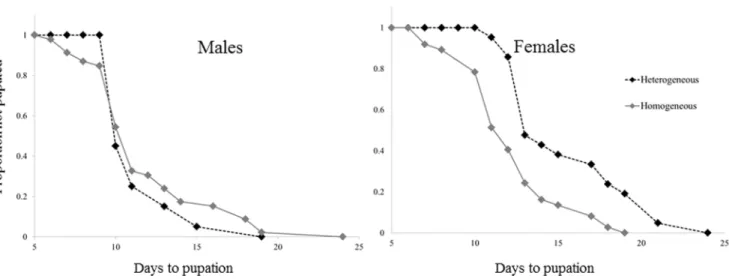
Figure 1. A Kaplan-Meier fit for the relationship between the time since hatching and the proportion of larvae not yet pupated (out of the final emerging population).Female larvae developing in the Homogeneous-stage treatment developed faster than those developing in the Heterogeneous stage treatment (in the presence of 4thinstar larvae). Males were not affected by treatment.
doi:10.1371/journal.pone.0088650.g001
Table 1.The effect of Treatment (Heterogeneous vs. Homogeneous stage) on the development rate of 1stinstar larvae to pupation: Results of Cox proportional hazards model for the effect of treatment on the rate of larval pupation.
Sex
Regression Coefficient (b) eb
SE(b) Z n P Wald test
Females 0.97 2.64 0.289 3.356 58 ,,0.001 Wald = 11.3 P,,0.001 df = 1
Males 20.193 0.825 0.305 20.633 66 0.53 Wald = 0.4 P = 0.528 df = 1
For the analysis, treatments were coded as Heterogeneous = 0, Homogeneous = 1. Higher pupation rate means shorter development time. Analysis was performed on the two sexes separately.
Figure 2. A Kaplan-Meier fit for the relationship between the time since hatching and the proportion of larvae not yet pupated (out of the final emerging population).In the lower initial density, both males and females pupated sooner in the Caged-conspecific treatment (cagedO. caspius4thinstar larvae); relative to the Empty-cage control treatment. This pattern was not evident in the higher initial larval density.
Moreover, caged-heterospecifc treatment (cagedC. longiareolata4thinstar larvae) did not affect larval pupation rate, relative to control. doi:10.1371/journal.pone.0088650.g002
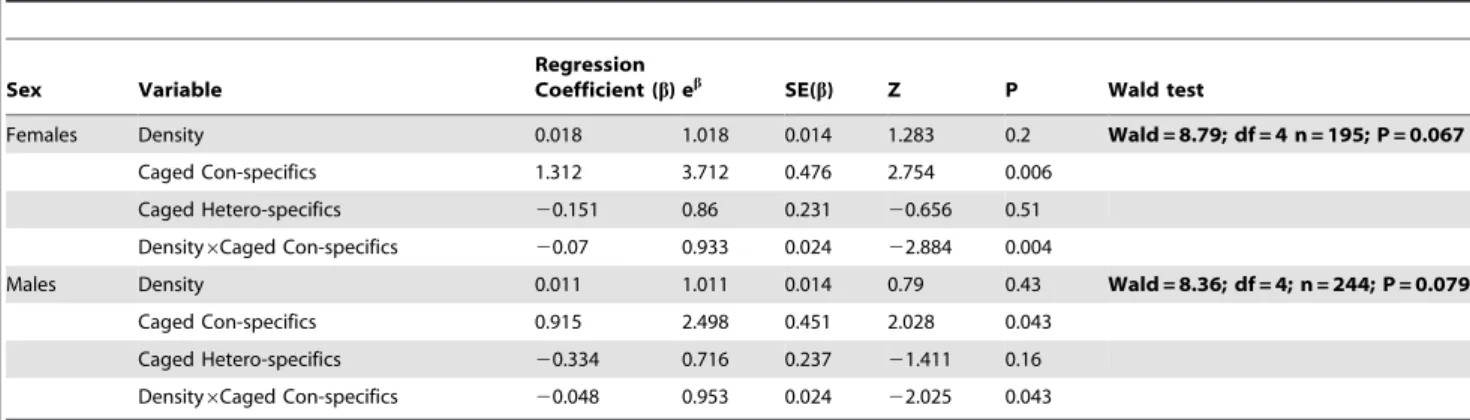
Table 2.The effect of Treatmenta, on the development rate of 1stinstar larvae to pupation.
Sex Variable
Regression Coefficient (b) eb
SE(b) Z P Wald test
Females Density 0.018 1.018 0.014 1.283 0.2 Wald = 8.79; df = 4 n = 195; P = 0.067
Caged Con-specifics 1.312 3.712 0.476 2.754 0.006
Caged Hetero-specifics 20.151 0.86 0.231 20.656 0.51
Density6Caged Con-specifics 20.07 0.933 0.024 22.884 0.004
Males Density 0.011 1.011 0.014 0.79 0.43 Wald = 8.36; df = 4; n = 244; P = 0.079
Caged Con-specifics 0.915 2.498 0.451 2.028 0.043
Caged Hetero-specifics 20.334 0.716 0.237 21.411 0.16
Density6Caged Con-specifics 20.048 0.953 0.024 22.025 0.043
Results of Cox proportional hazards model for the effect of treatment on the rate of larval pupation. Higher pupation rate means shorter development time. Analysis was performed on the two sexes separately.
longiareolata= 0; caged hetero-specifics O. caspius= 0, C. longiareo-lata= 1; empty-cage control O. caspius= 0, C. longiareolata= 0). In other words, con- and hetero-specific treatments were contrasted with the empty-cage control group. As for initial density, we used the actual number of individuals stocked into the experimental cups.
Results
Larval survival
Experiment 1 - Net effect of interference
competition. Survival of 1st instar larvae was not affected by the presence of con-specific 4thinstar larvae (F1,17= 0.02, P = 0.89;
Average proportion of surviving individuals61S.D: 0.260.12 and 0.1960.11 for the homogeneous and heterogeneous treatments, respectively).
Experiment 2 – Non-physical interference
competition. At the high density, survival of 1st instar larvae
tended to be higher in the empty-cage control group compared to the other two treatments. However, the interaction between treatment and initial density was not significant (F2,36= 1.82,
P = 0.177), nor were there significant main effects (Treatment: F2,36= 1.48, P = 0.242, Initial density: F1,36= 3.93, P = 0.055).
Sex ratio
Females comprised 47% and 45% of total emerging adults in the first and second experiments, respectively. None of the main effects or their respective interaction terms were statistically significant (Experiment 1: F1,17= 2.32, P = 0.15. Experiment 2:
Density: F1,36= 0.054, P = 0.818, Treatment: F2,36= 0.733,
P = 0.487, Treatment6Density: F2,36= 0.007, P = 0.802).
Time to Pupation
Experiment 1 - Net effect of interference
competition. Analysis using Cox proportional hazards model indicated that the presence of 4thinstar larvae caused a,2.6 fold
reduction in the female pupation rate (P,,0.001, Table 1; Fig. 1), while having no significant effect on the pupation rate of males (P = 0.528, Table 1; Fig. 1).
Experiment 2 – Non-physical interference
competition. The presence of caged con-specifics brought about a ,3.7 fold increase in female pupation rate, relative to
the empty-cage control (P = 0.006, Table 2). However, this pattern was only evident at the low density (Caged con-specifics6Density interaction, P = 0.004; Table 2; Fig. 2). We could not detect similar patterns in the caged specifics treatment (Caged hetero-specifics: P = 0.510; Caged hetero-specifics6Density interaction:
Z = 0.077, P = 0.940; Fig. 2). Similarly, the presence of caged con-specifics caused a ,2.5 fold increase in male pupation rate,
relative to the empty-cage control (P = 0.043; Table 2; Fig. 2). Here too, this pattern was only evident at the low density (Caged con-specifics6Density interaction, P = 0.043; Table 2; Fig. 2). Again, we could not detect similar patterns in the caged hetero-specifics treatment (Caged hetero-hetero-specifics: P = 0.160; Caged hetero-specifics6Density interaction: Z =20.693, P = 0.490; Fig. 2).
Wing length
Experiment 1 - Net effect of interference
competition. The presence of 4th instar larvae had no significant effect on the wing length of females (Table 3) or males (Table 4).
Experiment 2 – non-physical interference
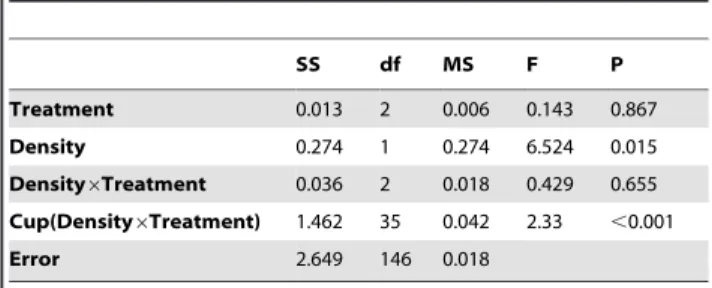
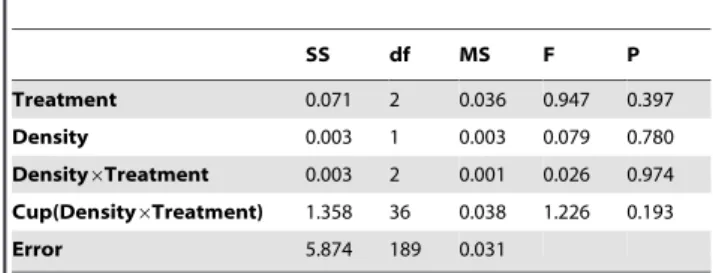
competition. Increased density resulted in a significant reduc-tion in the wing length of females (Table 5), but no such effect was evident among the males (Table 6). Both the effect of treatment, and density6treatment interaction were not significant (Tables 5 and 6 for females and males, respectively).
Discussion
Variation in competitive abilities among different developmen-tal stages within a population can play an important role in determining population dynamics [21–24]. Our results indicate that interference competition of 4th on 1st instar larvalO. caspius Table 3.The effect of Treatment (Homogeneous vs.
Heterogeneous stage), on the wing length of females emerging from the experimental cups.
SS Df MS F P
Treatment 0.014 1 0.014 0.158 0.696
Cup(Treatment) 1.355 15 0.090 2.825 0.004
Error 1.311 41 0.032
Nested ANOVA testing for the effect of treatment on female wing length. Individuals are nested within experimental cups, i.e., experimental cups rather than individuals are considered as the replicates. Practically, in the statistical model, experimental cup ID was nested within treatment. Note that the MS of this nested variable was used as the error term of treatment.
doi:10.1371/journal.pone.0088650.t003
Table 4.The effect of Treatment (Homogeneous vs. Heterogeneous stage), on the wing length of males emerging from the experimental cups.
SS df MS F P
Treatment 0.002 1 0.002 0.022 0.885
Cup(Treatment) 1.431 14 0.102 3.676 ,0.001
Error 1.332 48 0.028
Nested ANOVA testing for the effect of treatment on male wing length. Individuals are nested within experimental cups, i.e., experimental cups rather than individuals are considered as the replicates. Practically, in the statistical model, experimental cup ID was nested within treatment. Note that the MS of this nested variable was used as the error term of treatment.
doi:10.1371/journal.pone.0088650.t004
Table 5.The effect of Density and Treatment (caged con-specifics, caged hetero-con-specifics, empty-cage control) on the wing length of females emerging from the experimental cups.
SS df MS F P
Treatment 0.013 2 0.006 0.143 0.867
Density 0.274 1 0.274 6.524 0.015
Density6Treatment 0.036 2 0.018 0.429 0.655
Cup(Density6Treatment) 1.462 35 0.042 2.33 ,0.001
Error 2.649 146 0.018
Nested ANOVA testing for the effect of treatment and initial density on female wing length. Individuals are nested within experimental cups, i.e., experimental cups rather than individuals are considered as replicates. Practically, in the statistical model experimental cup ID was nested within Treatment6Density
interaction. Note that the MS of this nested variable was used as the error term of treatment, density and Treatment6Density interaction.
have significant effects on development rate, even when exploit-ative competition should be negligible. Net con-specific interfer-ence from 4thinstar larvae caused significant reduction in female pupation rate (longer development time), but no such effect was detected among males. Non-physical interference from caged con-specific 4thinstar larvae resulted in increased pupation rate of both female and maleO. caspius(shorter development time); however, this effect was evident only at low larval densities. Interestingly, no such effect was detected in the presence of caged 4th instar C. longiareolata larvae – a superior hetero-specific competitor – implying a species-specific non-physical interference competition. Negative density-dependence can shift adult sex ratio, while reducing larval survival [52] and adult size. Indeed, increased density resulted in a reduction in the wing length of female O. caspius. Consistent with our previous findings [45], adult male size ofO. caspiuswas not affected by larval density. Additionally, larval density had no detectable effects on sex ratio or survival. These findings suggest that the larval densities used in this study were not high enough to strongly affect larval life history traits by themselves. Negative density-dependence in mosquitoes has been extensively reported and discussed [25–32,48–52]. Part of these effects has been ascribed to chemicals possessing growth retardant effects, possibly excreted metabolic waste [31,35,38]. To the best of our knowledge, this is the first report of species-specific growth-related semiochemicals in mosquitoes. Our results lend further support to the importance of population structure and density-dependence for larval life history traits, even at densities considered well below carrying capacity forAedesand Ochlerotatus
[32,48–52]. Other mosquito genera are known to respond to crowding at similar densities [58–59]. We are unaware of studies exploring the differences in density-dependence among mosquito genera. However, we speculate that open-habitat mosquitoes should be more sensitive to changes in larval densities as well as to related chemical cues than container species.
Larval resource allocation to the multitude of life history traits can be facultative [60–61], allowing some deferral of competitive effects on survival or other vital traits, at the expanse of investment
in other, less vital ones. Male mosquitoes are likely subject to a stronger selection on shorter larval development time, and thus should be less conservative with respect to size or adult survival. Female mosquitoes require more investment in soma and reproductive organs, and probably experience weaker selection on larval developmental time, than on body size [62]. Indeed, in the first experiment, whose aim was to quantify net con-specific interference of 4th on 1st instar larvalO. caspius, the developmental time of females increased significantly, while that of males remained the same. This extended development time probably allowed the females to accumulate all the required resources for proper development. In addition, owing to the delayed develop-ment, females could probably experience competitive release, when the more advanced stage larvae finally pupated. Interest-ingly, in the second experiment, the presence of caged con-specific 4thinstar larvae accelerated the development rate of both female and male larvalO. caspius; however, this pattern was evident only at low density. In both experiments larval densities were below those known to have detectable negative density-dependence effects on several species ofAedes and Ochlerotatus larval survival [32,48–51] including O. caspius (Tsurim I. unpublished data). Furthermore, both the high (25 larvae) and low (10 larvae) densities used in the second experiment were much lower than that of the first experiment (40 larvae). Indeed, qualitative comparison between the two experiments (homogeneous treat-ment of the 1st experiment vs. empty cage controls of the 2nd experiment) shows that development rate was substantially higher in the second experiment, suggesting that density reductionper se
accelerates development rate. We suggest that at high density the presence of 4thinstar larvae causes a reduction in activity levels of early instar larvae and hence slower development rate. In contrast, at low densities, when perceived competition is low and accelerated development could be sustained energetically, the interference ‘‘signal’’ enhances development rate.
This study further exemplifies the complexity of density-dependent processes that regulate population dynamics, and demonstrate the potential importance of accounting for population structure, especially in organisms with a complex life cycle. Most importantly, this study probably provides the first indication of the potential role of species-specific chemical communication in regulating competition among larval mosquitoes. The exact nature of these chemicals, their evolutionary and ecological significance, and the mechanisms by which they operate to influence larval development are yet unclear to us, and should be the focus of future studies.
Acknowledgments
We thank Zvika Abramsky, Leon Blaustein and William J. Resetarits Jr. for fruitful discussions.
Author Contributions
Conceived and designed the experiments: AS IT RR YM OO. Performed the experiments: AS RR IT. Analyzed the data: IT AS OO. Contributed reagents/materials/analysis tools: IT YM OO. Wrote the paper: AS IT OO.
References
1. Levins R (1969) Some demographic and genetic consequences of environmental heterogeneity for biological control. Bulletin of the Entomological Society of America 15: 237–240.
2. Shea K, Chesson P (2002) Community ecology theory as a framework for biological invasions. Trends in Ecology & Evolution 17: 170–176.
3. Juliano SA (2009) Species interactions among larval mosquitoes: context dependence across habitat gradients. Annual Review of Entomology 54: 37–56. 4. Legros M, Lloyd AL, Huang YX, Gould F (2009) Density-Dependent Intraspecific Competition in the Larval Stage ofAedes aegypti(Diptera: Culicidae): Revisiting the Current Paradigm. Journal of Medical Entomology 46: 409–419.
Table 6.The effect of Density and Treatment (caged con-specifics, caged hetero-con-specifics, empty-cage control) on the wing length of males emerging from the experimental cups.
SS df MS F P
Treatment 0.071 2 0.036 0.947 0.397
Density 0.003 1 0.003 0.079 0.780
Density6Treatment 0.003 2 0.001 0.026 0.974
Cup(Density6Treatment) 1.358 36 0.038 1.226 0.193
Error 5.874 189 0.031
Nested ANOVA testing for the effect of treatment and initial density on male wing length. Individuals are nested within experimental cups, i.e., experimental cups rather than individuals are considered as replicates. Practically, in the statistical model experimental cup ID was nested within Treatment6Density
interaction. Note that the MS of this nested variable was used as the error term of treatment, density and Treatment6Density interaction.
5. Fretwell SD, Lucas HLJ (1969) On territorial behavior and other factors influencing habitat distribution in birds. I. Theoretical development. Acta Biotheoretica 19: 16–36.
6. Lack D (1971) Ecological isolation in birds. Harvard University Press. 404 p. 7. Royama T (1992) Analytical Population Dynamics. Chapman and Hall. 371 p. 8. Turchin P (2003) Complex Population Dynamics: a Theoretical/Empirical
Synthesis. Princeton University Press. 472 p.
9. Ginzburg L, Colyvan M (2004) Ecological orbits: How planets move and populations grow. Oxford University press. 173 p.
10. Morin PJ (1999) Community Ecology. Willey-Blackwell. 424 p. 11. Keddy PA (2001) Competition. Kluwer. 552p.
12. Reitz SR, Trumble JT (2002) Competitive displacement among insects and arachnids. Annual Review of Entomology 47: 435–465.
13. Grether GF, Losin N, Anderson CN, Okamoto K (2009) The role of interspecific interference competition in character displacement and the evolution of competitor recognition. Biological Reviews 84: 617–635. 14. Gross EM, Legrand C, Rengefors K, Tillmann U (2012) Allelochemical
interactions among aquatic primary producers. In: Bro¨nmark C, Hansson LA, editors. Chemical ecology in aquatic systems. Oxford University press. pp. 196– 209.
15. Crossland MR, Shine R (2012) Embryonic exposure to conspecific chemicals suppresses cane toad growth and survival. Biology Letters 8: 226–229. 16. Lu¨rling M, Roozen F, Van-Donk E, Goser B (2003) Response ofDaphniato
substances released from crowded congeners and conspecifics. Journal of Plankton Research 25: 967–978.
17. Dieng H, Boots M, Tuno N, Tsuda Y, Takagi M (2002) A laboratory and field evaluation ofMacrocyclops distinctus,Megacyclops viridisandMesocyclops pehpeiensisas control agents of the dengue vectorAedes albopictusin a peridomestic area in Nagasaki, Japan. Medical and Veterinary Entomology 16: 285–291. 18. Costanzo KS, Kesavaraju B, Juliano SA (2005) Condition-specific competition
in container mosquitoes: The role on noncompeting life-history stages. Ecology 12: 3289–3295.
19. Moll JD, Brown JS (2008) Competition and Coexistence with Multiple Life History Stages. American Naturalist 171: 839–843.
20. Muturi EJ, Costanzo K, Kesavaraju B, Lampman R, Alto BW (2010) Interaction of a pesticide and larval competition on life history traits ofCulex pipiens. Acta Tropica 116: 141–146.
21. Persson L, Leonardsson K, De Roos AM, Gyllenberg M, Christensen B (1998) Ontogenetic scaling of foraging rates and the dynamics of a size-structured consumer-resource model. Theoretical Population Biology 54: 270–293. 22. Claessen D, De Roos A.M. Persson L (2000) Dwarfs and Giants: Cannibalism
and Competition in Size-Structured Population. American Naturalist 155: 219– 237.
23. De Roos A, Persson L, McCauley E (2003) The influence of size-dependent life-history traits on the structure and dynamics of populations and communities. Ecology Letters 6: 473–487.
24. Miller TX, Rudolf VHW (2011) Thinking inside the box: community-level consequences of stage-structured populations. Trends in Ecology and Evolution 26: 183–192.
25. Moore CG, Fisher BR (1969) Competition in mosquitoes. Density and species ratio effects growth, mortality, fecundity and production of growth retardant. Annals of the Entomological Society of America 62: 1325–1331.
26. Peters TM, Chevone BI, Greenough NC, Callahan RA, Barbosa P (1969) Intra-specific competition inAedes aegypti(L.) larvae: I. equipment, techniques and methodology. Mosquito News 29: 667–674.
27. Barbosa P, Peters TM (1973) Some effects of overcrowding on the respiration of larvalAedes aegypti. Entomologia Experimentalis et Applicata 16: 146–156. 28. Reisen WK (1975) Intraspecific competition in Anopheles stephensi Liston.
Mosquito News 35: 473–482.
29. Rajagopalan PK, Yasuno M, Menon PK (1976) Density effect on survival of immature stages ofCulex pipiens fatigansin breeding sites in Delhi villages. The Indian journal of medical research 64: 688–708.
30. Siddiqui TF, Aslam Y, Reisen WK (1976) The effects of larval density on selected immature and adult attributes inCulex tritaeniorhynchusGiles. Tropical Medicine 18: 195–202.
31. Mori A (1979) Effects of larval density and nutrition on some attribute of immature and adultAe. albopictus. Tropical Medicine 21: 85–103.
32. Bedhomme S, Agnew P, Sidobre C, Michalakis Y (2003) Sex specific reaction norms to intraspecific larval competition in the mosquitoAedes aegypti. Journal of Evolutionary Biology 16: 721–730.
33. Muriu SM, Coulson T, Mbogo CM, Godfray HCJ (2013) Larval density dependence in Anopheles gambiae s.s., the major African vector of malaria. Journal of Animal Ecology 82: 166–174.
34. Roberts D (1998) Overcrowding of Culex sitiens (Diptera: Culicidae) larvae: population regulation by chemical factors or mechanical interference. Journal of Medical Entomology 35: 665–669.
35. Roberts D, Kokkinn M (2010) Larval crowding effects on the mosquitoCulex quinquefasciatus: physical or chemical? Entomologia Experimentalis et Applicata 135: 271–275.
36. Edgerly JS, Livdahl TP (1992) Density-dependent interactions within a complex life cycle: the roles of cohort structure and mode of recruitment. Journal of Animal Ecology 61: 139–150.
37. Alto BW, Kesavaraju B, Juliano SA, Lounibos LP (2009) Stage-dependent predation on competitors: consequences for the outcome of a mosquito invasion. Journal of Animal Ecology 78: 928–936.
38. Broadie KS, Bradshaw WE (1991) Mechanisms of interference competition in the tree hole mosquito,Aedes sierrensis. Ecological Entomology 16: 145–154. 39. Shalaby AM (1972) Survey of the mosquito fauna of Fezzan South-Western
Libya. Bulletin of the Entomological Society of Egypt 56: 301–312. 40. Margalit J, Avrahami M, Tahori AS (1973) Mosquitoes (Diptera:Culicidae)
breeding in the Dead Sea area. Israel Journal of Zoology 22: 27–37. 41. Suleman M, Khan K, Khan S (1993) Ecology of mosquitoes in Peshawar valley
and adjoining areas: species composition and relative abundance. Pakistan Journal of Zoology 25: 321–328.
42. Zuhair SA, Al-Khalili Y, Arbaji A (1997) Larval mosquitoes collected from Northern Jordan and the Jordan valley. Journal of the American Mosquito Control Association 13: 375–378.
43. Roiz D, Eritja R, Escosa R, Lucientes J, Marque`s E et al. (2007) A survey of mosquitoes breeding in used tires in Spain for the detection of imported potential vector species. Journal of Vector Ecology 32: 10–15.
44. Shaalan EA (2012) Predation capacity ofCuliseta longiareolatamosquito larvae against some mosquito species larvae. Journal of Entomology 9: 183–186. 45. Tsurim I, Silberbush A, Ovadia O, Blaustein L, Margalith Y (2013) Inter- and
Intra-Specific Density-Dependent Effects on Life History and Development Strategies of Larval Mosquitoes. Plus One 8: e57875.
46. Blaustein L, Kotler B (1993) Oviposition habitat selection by the mosquito, Culiseta longiareolata: effects of conspecifics, food and green toad tadpoles. Ecological Entomology 18:104–108.
47. Blaustein L, Margalit J (1994) Mosquito larvae (Culiseta longiareolata) prey upon and compete with toad tadpoles (Bufo viridis). Journal of Animal Ecology 63:841– 850.
48. Renshaw M, Service MW, Birley MH (1993) Density –dependent regulation of Aedes cantans(Diptera:Culicidae) in natural and artificial populations. Ecological Entomology 18: 223–233.
49. Mahmood F, Crans WJ, Savur NS (1997) Larval competition inAedes triseriatus (Diptera: Culicidae): effects of density on size, growth, sex ratio, and survival. Journal of Vector Ecology 22: 90–94.
50. Gleiser RM, Urrutia J, Gorla DE (2000) Effects of crowding on populations of Aedes albifasciatuslarvae under laboratory conditions. Entomologia Experimenta-lis et Applicata 95: 135–140.
51. Tseng M (2004) Sex-specific response of a mosquito to parasites and crowding. Proceedings of the Royal Society B-Biological Sciences 271: S186–S188. 52. Macia´ A (2009) Effects of larval crowding on development time, survival and
weight at metamorphosis in Aedes aegypti(Diptera: Culicidae). Revista de la Sociedad Entomolo´gica Argentina 68: 107–114.
53. Sokal RR, Rohlf FJ (1995) Biometry: The principals and practice of statistics in biological research. WH Freeman. 887 p.
54. Rasband WS (2011) ImageJ. U.S. National Institutes of Health.
55. Carron A (2007) Correlation between wing measurements and dry body weight in male and female Ochlerotatus caspius (Pallas,1771) (Diptera: Culicidae). European Mosquito Bulletin 24: 4–8.
56. Hosmer DW, Lemeshow S (1999) Applied survival analysis: regression modeling of time to event data. Wiley. 386 p.
57. Lin DY, Wei LJ (1989) The robust inference for the Cox proportional hazards model. Journal of the American Statistical Association 84: 1074–1078. 58. Roberts D, Kokkinn M (2010) Larval crowding effects on the mosquitoCulex
quinquefasciatus: physical or chemical? Entomologia Experimentalis et Applicata 135: 271–275.
59. Ng’habi KR, John B, Nkwengulila G, Knols BGJ, Killeen GF et al. (2005) Effect of larval crowding on mating competitiveness ofAnopheles gambiaemosquitoes. Malaria Journal 4:49.
60. Telang A, Frame L, Brown MR (2007) Larval feeding duration affects ecdysteroid levels and nutritional reserves regulating pupal commitment in the yellow fever mosquitoAedes aegypti(Diptera : Culicidae). Journal of Experimental Biology 210: 854–864.
61. Boggs CL (2009) Understanding insect life histories and senescence through a resource allocation lens. Functional Ecology 23: 27–37.