257 257 257 257 257 Mem Inst Oswaldo Cruz, Rio de Janeiro, Vol. 96(2): 257-263, February 2001
Expression of Mosquito Active Toxin Genes by a Colombian
Native Strain of the Gram-negative Bacterium
Asticcacaulis excentricus
Magally Romero, Flor M Gil, Sergio Orduz
+Unidad de Biotecnología y Control Biológico, Corporación para Investigaciones Biológicas, Apartado Aéreo 7378, Medellín, Colombia
Mosquito control with biological insecticides, such as Bacillus sp. toxins, has been used widely in
many countries. However, rapid sedimentation away from the mosquito larvae feeding zone causes a
low residual effect. In order to overcome this problem, it has been proposed to clone the Bacillus toxin
genes in aquatic bacteria which are able to live in the upper part of the water column. Two strains of Asticcacaulis excentricus were chosen to introduce the B. sphaericus binary toxin gene and B. thuringiensis
subsp. medellin cry11Bb gene cloned in suitable vectors. In feeding experiments with these aquatic
bacteria, it was shown that Culex quinquefasciatus, Aedes aegypti, and Anopheles albimanus larvae
were able to survive on a diet based on this wild bacterium. A. excentricus recombinant strains were
able to express both genes, but the recombinant strain expressing the B. sphaericus binary toxin was
toxic to mosquito larvae. Crude protease A. excentricus extracts did not degrade the Cry11Bb toxin. The
flotability studies indicated that the recombinant A. excentricus strains remained in the upper part of the
water column longer than the wild type Bacillus strains.
Key words: Asticcacaulis excentricus - Bacillus thuringiensis - recombinant bacteria - mosquito larvae
Bacillus thuringiensis, a gram-positive
bacte-rium produces toxins active against some insect species belonging to the orders Coleoptera, Diptera, and Lepidoptera. Several highly toxic strains of B.
thuringiensis have been reported for mosquito
con-trol (Goldberg & Margalit 1977, Padua et al. 1984, Orduz et al. 1992, Seleena et al. 1995, Ragni et al. 1996). The classification of the mosquito active strains in three groups, proposed by Delécluse et al. (1995), positions strains potentially important for mosquito control in group 2. These include two strains of B. thuringiensis subspecies medellin, strain 367 of the subsp. jegathesan, and Clostridium
bifermentans serovar. malaysia. These four strains
display a crystal protein pattern different from that found in B. thuringiensis subsp. israelensis, while are nearly as active. Polyacrylamide gel electro-phoresis (SDS-PAGE) analysis of purified parasporal crystalline inclusions from B.
This work received financial support from Colciencias, The Wellcome Trust, and Corporación para Inves-tigaciones Biológicas.
+Corresponding author. Fax: +57-4-441.5514. E-mail:
[email protected] Received 27 March 2000 Accepted 20 October 2000
thuringiensis subsp. medellin strain CIB 163-131
shows a polypeptide of approximately 94 kDa, multiple bands between 80 and 65 kDa, and two doublets at 40-41 and 28-30 kDa. The sequence of the 94 kDa toxin gene of B. thuringiensis subsp.
medellin encoding the Cry11Bb1 protein and its
genetic organization has been reported (Orduz et al. 1998).
Parasporal inclusions containing the mos-quitocidal toxins rapidly settle on the bottom of the ponds, away from mosquito larvae feeding zone (Murphy & Stevens 1992, Thanabalu et al. 1992, Xudong et al. 1993, Orduz et al. 1995). In order to overcome this problem, it has been proposed to clone mosquito active toxin encoding genes in aquatic bacteria, such as gram negative and cyanobacteria. Several attempts have been done to clone B. thuringiensis subsp. israelensis toxin genes in cyanobacteria, obtaining variable results (Angsuthanasombat & Panyim 1989, Chungjatupornchai 1990, Murphy & Stevens 1992). At the same time, gram negative bacteria such as Asticcacalis excentricus, Caulobacter
crescentus and Ancylobacter aquaticus have been
used to clone and to express B. thuringiensis subsp.
israelensis toxin genes, providing better
258 258 258 258
258 Larvicidal Recombinant Aquatic Bacteria Magally Romero et al.
In the present study we cloned the cry11Bb gene
of B. thuringiensis subsp. medellin and the binary
toxin gene of B. sphaericus in an A. excentricus strain isolated from mosquito larvae breeding ponds in Colombia, and present data on expres-sion and toxicity of recombinant cells to A.
albimanus,Ae. aegypti, and Cx. quinquefasciatus
first instar larvae, as well as information regarding flotability properties of the recombinant strains.
MATERIALS AND METHODS
Bacterial strains, plasmids, and growth
condi-tions - Strains JM109, and XL1 Blue MRF´ of
Es-cherichia coli were obtained from Stratagene (La
Jolla, CA, USA) and were grown at 200 rpm, 37oC in Luria-Bertani (LB) medium (Sambrook et al. 1989). Recombinant E. coli cells were grown at 200 rpm 37oC in LB medium supplemented with tetracycline 12 µg/ml. A. excentricus strain 4274 was obtained from the German Collection of
Mi-croorganism and Cell Cultures. Local A.
excentricus strains were isolated from water
samples taken from a lake near Medellin. A.
excentricus cells were grown in PYE medium (2 g
Bacto-peptone, 1 g yeast extract per liter), and their recombinants were grown in PYE supplemented with 6 µg of tetracycline per ml. B. sphaericus strain 2362 was grown in NYSM (g/l: nutrient broth, 28; yeast extract, 0.5 and supplemented with salt solution as follows: 0.7 mM CaCl2, 1 mM MgCl2, and 50 µM MnCl2) (Myers & Yousten 1978). Recombinant B. thuringiensis expressing the Cry11Bb protein was developed by Restrepo et al. (1997) and cultured by using M1 liquid me-dium. The Cry11Bb crystals were purified from a final whole culture (FWC) as described by Pendleton and Morrison (1966) with modifications introduced by Otieno-Ayayo et al. (1993). The FWC (250 ml) was washed twice in distilled wa-ter, the pellet resuspended in 0.5 M NaCl and gen-tly stirred for 1 h at 30°C; after this, it was washed twice in distilled water supplemented with 0.1 M phenyl-methy-lsulfonyl-fluoride (PMSF) and cen-trifuged for 20 min at 12,000 rpm. The pellet was then added to a mixture of equal volumes of 1% Na2SO4 and CCl4. This mixture was vigorously shaken in a separation funnel for 10 min and al-lowed to sit until the formation of two layers. The aqueous phase containing crystals was washed three times in distilled water and stored at -20°C. Crystals were solubilized in 100 mM Caps, 0.05%
β-mercaptoethanol, pH 10.6 for 1 h at 30°C, and insoluble material was removed by centrifugation at 12,000 rpm for 10 min. Protein concentration was determined by Bradford method (Bradford 1976) following the recommendations of the Pro-tein Assay Kit (Bio-Rad).
Plasmid pBTM4 containing the cry11Bb1 gene was constructed by Restrepo et al. (1997). Plas-mid pEA1 containing B. sphaericus binary toxin gene was a gift from Dr Alan Porter (Institute of Molecular and Cellular Biology, National Univer-sity of Singapore). The B. sphaericus binary toxin gene cloned in plasmid pEA1 is under the control of the ptac1 promoter, a synthetic sequence with the –35 and –10 regions of the tac promoter and a concensus ribosome binging site for C. crescentus, and downstream of the B. sphaericus binary toxin gene, a transcriptional terminator sequence from
B.thuringiensis subsp. kurstakicry gene (Yap et
al. 1994a). Plasmid pSOD2 containing the cry11Bb gene of B. thuringiensis subsp. medellin was con-structed as follows: the cry11Bb gene from plas-mid pBTM4 was cloned into the EcoRI site of the plasmid pBlueScript SK(+) to give plasmid pDEMOND (6.3 kb). Plasmid pEA1 (12.4 kb) was digested with KpnI-PstI in order to release a 2.5 kb fragment containing the B.sphaericus binary toxin gene. An adapter with the sequence 5´-CTCGCGAAGCTTAGGCCTGCA-3´ was cloned in the KpnI-PstI sites of pEA1 adding the Nru I-HindIII-StuI sites to give plasmid pSO1A. DNA sequence in both directions was determined in or-der to confirm the adapter sequence. pDEMOND was digested with HindIII, and fragment contain-ing the cry11Bb gene (3.3 kb) was cloned into the HindIII site of plasmid pSO1A, producing plas-mid pSOD2 (13.2 kb). Plasplas-mids pEA1 and pSOD2 containing the same promoter and transcriptional terminator sequences were used to transform E. coli
and A. excentricus cells.
Feeding experiments - Ae. aegypti and Cx.
quinquefasciatus were collected in the vicinity of
Medellin. A. albimanus colony was established with several egg shipments sent by Dr Victor Olano (Co-lombian National Institute of Health). All mosquito colonies are maintained under laboratory conditions at 30±2°C under a 12:12 (light:dark) photoperiod. For the feeding experiments with all mosquito spe-cies, eggs were collected the same day, washed with double distilled and sterile water, and larvae were allowed to hatch. Ten larvae of each mosquito spe-cies were placed in sterile 50 mm diameter Petri dishes with 9 ml of sterile water. One ml of the
Asticaccaulis strain C2 culture containing 1x10⁷,
259 259259 259 259 Mem Inst Oswaldo Cruz, Rio de Janeiro, Vol. 96(2), February 2001
two days. Every 24 h, and after gentle shaking of Petri dishes, 1 ml of suspension was withdrawn, and replaced with 1 ml of a fresh cell suspension in the
Ae. aegypti and A. albimanus treatments, and every
48 h in Cx. quinquefasciatus treatments. Larvae of each mosquito species were set without food as nega-tive control. Data were analyzed by Anova and means compared using Tukey´s test (Statistica, StatSoft, Inc.).
Transformation experiments - A. excentricus
cells (strains 4724 and C2) were grown in PYE to an optical density of OD600 = 1.0, harvested by centrifugation at 7,000 rpm, 4oC, during 15 min, and washed three times alternatively with ice cold distilled water and ice cold 10% glycerol. Cells were finally resuspended in 200 µl 10% glycerol. Electroporation was used to transform 10 µl of A.
excentricus cells with 3 µg of plasmids pSOD2 or
pEA1. After the pulse, cells were placed in 1 ml of PYE and incubated for 2 h at 30oC. Recombinant cells were selected by plating in PYE agar con-taining 6 µg/ml of tetracycline and were grown for 48 h. Since no A. excentricus strain C2 recombi-nants were recovered, two alternative procedures were used to treat these bacterial strains: 20 suc-cessive passes on solid media, and treatment of the native strain with the ethyl ester of the methane sulfonic acid (EMS), as described by Tao et al. (1993). After treatments, cell suspensions were plated and colonies were checked to select those maintaining Asticcacaulis morphology to perform again the electrotransformation assays.
Electrophoresis and Western blot -
Recombi-nant strains were analyzed by 10% SDS-PAGE and stained with Coomasie brilliant blue. Separated proteins were electrotransferred to nitrocellulose membranes, blocked overnight at room tempera-ture in TBS (100 mM Tris-HCl, 150 mM NaCl, pH 7.2) with 3% gelatin, and washed three times for 5 min each in TBS with 0.05% Tween-20 (TTBS). Membranes were incubated for 1 h at room temperature with mouse anti-Cry11Bb or with anti-binary toxin polyclonal antibodies raised in mice, diluted 1:1000 in TTBS with 1% gelatin. After three washes in TTBS, membranes were in-cubated for 1 h with a goat anti-mouse IgG (H+L)-alkaline phosphatase conjugated (1:1000 in TTBS with 1% gelatin). After three washes, color was developed with a solution containing nitroblue tet-razolium chloride (1 mg/ml), 5-bromo-4-chloro-3-indolylphosphate (1.5 mg/ml), and 10 ml of 100 mM NaHCO3-Na2CO3, pH 9.86.
Mosquito larvicidal assays - Native and
recom-binant A. excentricus strains were grown in liquid PYE under shaking to an optical density of A600 = 1.0. B.thuringiensis subsp. medellin was grown in M1 at 30oC, 200 rpm, for 48 h until sporulation
(Restrepo et al. 1997). Ae. aegypti and A.albimanus used in these bioassays are maintained under labo-ratory conditions as described by Restrepo et al. (1997). Petri dishes (50 mm diameter) were filled with 9.9 ml of distilled water, and 10 mosquito lar-vae of second instar were added to each dish. One hundred µl of serial dilutions of bacterial cultures were added to obtain dilutions ranging between 10-2 and 10-7. Negative controls were set by add-ing 100 µl of distilled water. Each dose was per-formed by duplicate and repeated in three differ-ent days. One hundred µl of the bacterial cultures were plated on solid PYE or LB in order to deter-mine bacterial concentration. Half lethal concen-tration (LC50) was determined by probit analysis.
Protease activity of A. excentricus extracts
-Protease activity of A. excentricus extracts was tested in order to determine if Cry11Bb protein could be degraded in the cytoplasm of the recom-binant bacteria. Cry11Bb protein was produced and purified as mentioned above. Five µg of toxin were incubated with 13 µg of crude protease extract pre-pared by sonication as described by Liu et al. (1996). Samples were ajusted to 30 µl with PBS buffer and incubated for 16 h at 30oC, separated by SDS-PAGE, and proteins were transferred to nitrocellulose membranes. Membrane was devel-oped as mentioned before.
Flotation experiments - Cells of A. excentricus
reference strain transformed and untransformed with plasmid pEA1, Asticcacaulis native strain C2, transformed with plasmid pSOD2 and untrans-formed, and final whole cultures of B. sphaericus,
B. thuringiensis subsp. medellin, B. thuringiensis
subsps. israelensis and jegathesan were grown in appropriate media as indicated above, collected by centrifugation and resuspended to an A600 = 1 in water. Two ml were placed in sterile plastic cu-vettes, sealed and kept at room temperature during six days. Cuvettes were photographed every two days in order to register their sedimentation.
RESULTS
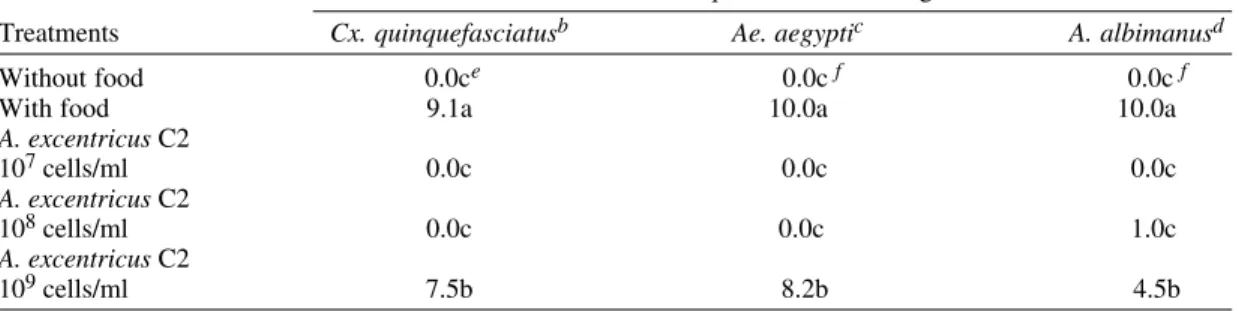
Feeding experiments - Development of
mos-quito larvae was significatively different between controls (with and without normal food) and treat-ments containing A. excentricus cells as larval food in the three mosquito species tested; however, at
the A. excentricus lower concentrations (107 and
108 cells/ml) larvae reached only second instar af-ter five days, while in treatments containing 109
A. excentricus cells/ml, 7.5, 8.2, and 4.5 third
in-star larvae were observed for Cx. quinquefasciatus,
Ae. aegypti, and A. albimanus, respectively (Table
260 260 260 260
260 Larvicidal Recombinant Aquatic Bacteria Magally Romero et al.
Transformation efficiency and expression of
toxin genes by A. excentricus cells -
Transforma-tion of native A. excentricus C2 cells with plasmid pEA1 or pSOD2 was only obtained in cells treated with EMS. Transformation efficiency of A.
excentricus C2 with plasmid pEA1 after treatment
with EMS was 5.8x10² to 2.8x10³ transformants/ µg of DNA, 2 to 9 times lower than results ob-tained with A. excentricus strain 4724. However, transformation efficiency of A. excentricus cells with plasmid pSOD2 was 2.2x10² and 2.9x10² transformants/µg of DNA in A. excentricus strains 4724 and C2, respectively.
A. excentricus cells harboring plasmids pEA1,
and pSOD2, and B. sphaericus, B. thuringiensis subsp. medellin, and recombinant B. thuringiensis grown as mentioned in materials and methods were boiled in Laemmli sample buffer and subjected to SDS-PAGE and Western blot. Proteins detected in the nitrocellulose membrane indicate that both A.
excentricus clones produce proteins
correspond-ing to the B. sphaericus binary toxin (Fig. 1, lanes 2, 4) as well as in B. sphaericus FWC culture (Fig. 1, lane 1). These two bands were absent in
Asticcacaulis strains untransformed (Fig. 1, lanes
3 and 5). Expression of Cry11Bb toxin in A.
excentricus recombinant strains was also observed
(Fig. 2, lanes 3, 5). Although the band seen in these recombinant strains were not as strong as the one shown by recombinant B. thuringiensis strain (Fig. 2, lane 2), the molecular weight of the band corre-sponds to the original Cry11Bb toxin.
Bioassays - Toxicity (LC50) of recombinant A.
excentricus strain C2 transformed with plasmid
pEA1, expressing the B. sphaericus binary toxin was 1.0x10⁵ and 1.08x10⁶ cells/ml in Cx.
quinquefasciatus and A. albimanus second instar
TABLE I
Percent of Aedes aegypti, Anopheles albimanus and Culex quinquefasciatus larvae reaching third instar after five days of feeding on different concentrations of fresh cultures of the gram negative bacterium Asticcacaulis
excentricus C2, and mosquito larvae laboratory food
Mean number of mosquito larvae reaching third instara
Treatments Cx. quinquefasciatusb Ae. aegyptic A. albimanusd
Without food 0.0ce 0.0c f 0.0c f
With food 9.1a 10.0a 10.0a
A. excentricus C2
107 cells/ml 0.0c 0.0c 0.0c
A. excentricus C2
108 cells/ml 0.0c 0.0c 1.0c
A. excentricus C2
109 cells/ml 7.5b 8.2b 4.5b
a: means within each column followed by the same letter are not significantly different (b: F=194.5, df=25; c: F=165.4, df=25; d: F=238.7, df=25; alpha=0.05, Tukey´s HSD); mean values are the result of two tests, each one with three replicates, and 10 larvae per dish; e: mosquito larvae fed with liver powder; f: mosquito larvae fed with trout feed.
116.0 97.0 66.0 45.0
29.5 kDa
42 51
1 2 3 4 5
Fig. 1: expression of the binary toxin of Bacillus sphaericus
by Asticcacaulisexcentricus recombinant cells detected by Western blot with polyclonal antibodies developed against the
B. sphaericus binary toxin. Lane 1: final whole culture of B. sphaericus strain 2362; lane 2: A. excentricus strain 4724 trans-formed with plasmid pEA1; lane 3: A. excentricus strain 4724; lane 4: native strain C2 of A. excentricus transformed with plasmid pEA1; lane 5: native strain C2 of A. excentricus. Ar-rows indicate the two bands of the binary toxin. Molecular weight is indicated to the left of the figure.
kDa
116 97
66
45
94 kDa
Fig. 2: expression of the Cry11Bb toxin of Bacillus
thuringiensis subsp. medellin by Asticcacaulisexcentricus re-combinant cells detected by Western blot with polyclonal an-tibodies developed against the Cry11Bb toxin. Lane 1: final whole culture of B. thuringiensis subsp. medellin; lane 2: re-combinant B. thuringiensis strain expressing the Cry11Bb toxin; lane 3: A. excentricus strain 4724 transformed with plas-mid pSOD2; lane 4: A. excentricus strain 4724; lane 5: native strain C2 of A. excentricus transformed with plasmid pSOD2; lane 6: strain C2 of A. excentricus. Arrows indicate the 94 kDa band of the Cry11Bb toxin. Molecular weight is indi-cated to the left of the figure.
261 261261 261 261 Mem Inst Oswaldo Cruz, Rio de Janeiro, Vol. 96(2), February 2001
larvae respectively (Table II). This strain was 11 and 7 times less toxic to Cx. quinquefasciatus and
A. albimanus larvae, respectively, than final whole
culture of wild type B. sphaericus. On the other hand, A. excentricus strain 4724 transformed with the same plasmid was 1.5 times less toxic to both mosquito larvae species than B. sphaericus. The
A. excentricus recombinant strains (C2 and 4724)
harboring plasmid pSOD2 did not show toxicity to first instar Cx.quinquefasciatus larvae in any of the concentrations tested (data not shown).
Since no toxicity was found in treatments con-taining A. excentricus cells transformed with plas-mid pSOD2, we investigated whether A.
ex-centricus protease extract could have degraded the
Cry11Bb recombinant protein once it was exported to the cytoplasm. The Western blot shown in Fig. 3 indicates that the Cry11Bb protein is degraded to a fragment of ca. 39.5 kDa in all treatments in-cluding the Cry11Bb protein without A. excentricus strain 4724 protease extract (Fig. 3, lane 7). This same pattern was observed when different concen-trations of Cry11Bb protein were incubated with cell extracts of A. excentricus strain C2 (Fig. 3, lanes 5 and 6).
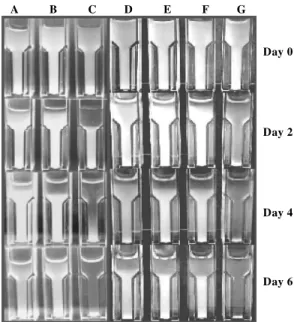
Flotation experiments - Flotability is a
desir-able character in recombinant toxin-producing bac-teria, since anopheline mosquito larvae feed in the top of the water column. A comparison of flotability of B. sphaericus and gram negative aquatic A. excentricus is shown in Fig. 4. Spores
of B. sphaericus started to sediment after two days,
and were completely sedimented six days later; however, cells of A. excentricus transformed or untransformed remained in suspension, even six days after initiated the experiment.
DISCUSSION
An important point to be considered in devel-oping recombinant bacteria for mosquito control
TABLE II
Toxicity of recombinant Asticcacaulisexcentricus strain C2 and A. excentricus strain 4274 expressing the binary toxin of Bacillus sphaericus and B. sphaericus strain 2362 against Culex quinquefasciatus and Anopheles
albimanus second instar larvae
LC50 (cells/ml, 48 h)a
Bacterial strain Cx. quinquefasciatus A. albimanus
A. excentricus (native) 0.0 0.0
A. excentricus C2 (pEA1) 1.0x10⁵ 1.08x10⁶ (7.6x10⁴ – 1.2x10⁵)b (7.01x10⁵ – 1.46x10⁶)
A. excentricus 4724 (pEA1) 2.5x10⁴ 2.47x10⁵ (1.93x10⁴ - 3.3x10⁴) (1.4x10⁵ - 3.4x10⁵)
B. sphaericus 2362 9.0x10³ 1.6x10⁵ (6x10³ – 1.11x10⁴) (1.22x10⁵ – 1.96x10⁵)
a: LC50 calculated by probit analysis; b: numbers in parenthesis indicate the confidence interval.
39.5 kDa 1 2 3 4 5 6 7
Fig. 3: Western blot of Cry11Bb protein incubated with
Asticaccaulis excentricus cell protease extract developed with mouse anti-Cry11Bb antibody. Lane 1: Bacillus thuringiensis
supbsp. medellin; lane 2: pure Cry11Bb protein; lanes 3 and 4: 5 µg of Cry11Bb protein incubated with 13 and 1.3 µg of A. excentricus strain4724cell protease extract; lanes 5 and 6: 5 µg of Cry11Bb protein incubated with 13 and 1.3 µg of A. excentricus strain C2 cell protease extract; lane 7: 13 µg of the Cry11Bb used as control.
is the ability of mosquito larvae to feed on a given bacterium host candidate. Pure cultures of A.
excentricus strains C2 and 4724 were able to
262 262 262 262
262 Larvicidal Recombinant Aquatic Bacteria Magally Romero et al.
Thiery et al. (1993). The number of cells/ml of the
A. excentricus cultures used to perform the
feed-ing experiments resembles those found in mosquito larvae breeding ponds as reported by Grant and Long (1989). Once it was determined that A.
excentricus strain C2 could support mosquito
lar-vae growth, the transformation experiments were performed.
Transformation of native A. excentricus C2 cells with plasmid pEA1 or pSOD2 was only ob-tained in cells treated with EMS. Level of trans-formation efficiency of A. excentricus C2 with plas-mid pEA1 after treatment with EMS is in corre-spondence to those reported by Tao et al. (1993), who only obtained transformants of Streptococcus
mutans after treatment with EMS.
Expression of B. sphaericus binary toxin by recombinant strains of A. excentricus was con-firmed by Western blot, as it was previously shown by Liu et al. (1996). Expression of Cry11Bb pro-tein was also seen by Western blot, but the level of expression was low as compared to the expression of the B. sphaericus binary toxin.
The level of toxicity reached by native A.
excentricus strains transformed with plasmid pEA1
is significantly greater than the toxicity obtained by unicelular cyanobacteria as reported by de Marsac et al. (1987), Xudong et al. (1993), and Sangthongpitag et al. (1997). In the same way, the
LC50 of A. excentricus strain C2 transformed with
plasmid pEA1 is two and four times higher than the toxicity obtained in previous reports by A.
aquaticus and C. crescentus, respectively
(Thanabalu et al. 1992, Yap et al. 1994b). A.
excentricus recombinant strains (C2 and 4724)
harboring plasmid pSOD2 did not show toxicity to first instar Cx.quinquefasciatus larvae in any of the concentrations tested (data not shown). Al-though the same vector was used to clone the B.
sphaericus binary toxin gene and B. thuringiensis
subsp medellin Cry11Bb toxin gene, and both con-tain the identical promoter and transcriptional ter-minator sequences, negative results shown in the bioassays could be due to modifications caused by protease activity in the cytoplasm of recombinant
A. excentricus strains, post-translational
modifica-tions, different codon usage of the host bacteria, or a combination of the above mentioned factors. We investigated if protease activity of A.
excentricus cytoplasm extracts could be
respon-sible for the lack of toxicity, and found that in the protease extract prepared by sonication of A.
excentricus cells, as well as in the Cry11Bb
con-trol treatment, the 94 kDa protein was degraded to a 39.5 kDa fragment (Fig. 3), and this protein frag-ment was probably produced by activity of con-taminant crystal proteases left during the sample preparation. Further experiments under way aimed to design new expression vectors for these gram negative aquatic bacteria will bring light on gene expression in these bacteria.
Results of flotability experiments of A.
excentricus recombinant cells indicated that this
characteristic could be possibly due to cell divi-sion that had occurred during the time of the ex-periment, and/or by movement mediated by fla-gella in those cells that reach the movile stage. Transformation of A. excentricus strains, and ex-pression of the B. sphaericus binary toxin by these recombinants did not affect the flotability proper-ties of this bacterium.
REFERENCES
Angsuthanasombat C, Panyim S 1989. Biosynthesis of 130-kilodalton mosquito larvicide in the cya-nobacterium Agmenellum quadruplicatum PR6. Appl Environ Microbiol 55:2428-2430.
Bradford MN 1976. A rapid and sensitive method for the quantification of microgram quantities of pro-teins utilizing the principle of protein-dye binding.
An Biochem 72: 248-254.
Chungjatupornchai W 1990. Expression of the mosquitocidal-protein genes of Bacillus
thurin-A B C D E F G
Day 0
Day 2
Day 4
Day 6
Fig. 4: flotation characteristics of Asticaccaulis excentricus, Bacillussphaericus and B. thuringiensis subsp. medellin. A: cells of A. excentricus strain C2 untransformed; B: cells of A. excentricus strain C2 transformed with plasmid pEA1; C: fi-nal whole culture of B. sphaericus; D: A. excentricus
trasnformed with plasmid pSOD2; E: A. excentricus strain C2 transformed with plasmid pSOD2; F: A. excentricus strain C2 untransformed; G: final whole culture of B. thuringiensis subsp.
263 263263 263 263 Mem Inst Oswaldo Cruz, Rio de Janeiro, Vol. 96(2), February 2001
giensis subsp. israelensis and the herbicide-resis-tance gene bar in Synechocystis PCC6803. Curr Microbiol 21: 283-288.
Delécluse A, Barloy F, Thiéry I 1995. Mosquitocidal toxins from various Bacillus thuringiensis and
Clostridium bifermenstans. InT-Y Feng, K-F Chak, R Smith, T Yamamoto, J Margalit, C Chilcott, R Rose (eds), Bacillus thuringiensisBiotechnology and Environmental Benefits, Hua Shiang Yuang Publish-ing Co., Taipei, p. 125-141.
de Marsac NT, de la Torre F, Szulmajster J 1987. Ex-pression of the larvicidal gene of Bacillus sphaericus
1593M in the cyanobacterium Anacystis nidulans.
Mol Gen Genet 209: 396-398.
Goldberg LJ, Margalit J 1977. A bacterial spore dem-onstrating rapid larvicidal activity against Ano-pheles sergentii, Uranotaenia unguiculata, Culex univitattus, Aedes aegypti and Culex pipiens. Mosq News 37: 355-358.
Grant WD, Long PE 1989. Microbiología Ambiental,
Acribia, Zaragoza, 221 pp.
Liu JW, Yap W, Thanabalu T, Porter AG 1996. Effi-cient synthesis of mosquitocidal toxins in
Asticcacaulis excentricus demonstrates potential of gram-negative bacteria in mosquito control. Nature Biotechnol 14: 343-347.
Merrit RW, Dadd RH, Walker ED 1992. Feeding be-havior, natural food, and nutritional relationships of larval mosquitoes. Annu Rev Entomol 37: 349-376. Murphy RC, Stevens SE 1992. Cloning and expression of the cryIVD gene of Bacillus thuringiensis subsp.
israelensis in the cyanobacterium Agmenellum quadruplicatum PR-6 and its resulting larvicidal activity. Appl Environ Microbiol 58: 1650-1655. Myers P, Yousten A 1978. Toxic activiy of Bacillus
sphaericus SSII-1 for mosquito larvae. Infect Immunol 19: 1047-1053.
Orduz S, Realpe M, Arango R, Murillo LA, Delécluse A 1998. Sequence of the cry11Bb gene from Bacil-lus thuringiensis subsp. medellin and toxicity analy-sis of its encoded protein. Biochem Biophys Acta 1388: 267-272.
Orduz S, Restrepo N, Patiño MM, Rojas W 1995. Trans-fer of toxin genes to alternate bacterial hosts for mos-quito control. Mem Inst Oswaldo Cruz 90: 97-107. Orduz S, Rojas W, Correa MM, Montoya AE, de Barjac
H 1992. A new serotype of Bacillusthuringiensis
from Colombia, toxic to mosquito larvae. J Invertebr Pathol 59:99-103.
Otieno-Ayayo Z, Chipman DM, Zaritsky A, Khawaled K 1993. Integrity of the 130 kDa polypeptide of
Bacillus thuringiensis ssp. israelensisδ-endotoxin in K-S sporulation medium. Insect Sci Appl 14: 377-381.
Padua LE, Ohba M, Aizawa K 1994. Isolation of a Ba-cillus thuringiensis strain (serotype 8a,8b) highly and selectively toxic against mosquito larvae. J Invertebr
Pathol 44: 12-17.
Pendleton IR, Morrison RB 1966. Separation of the spores and crystals of Bacillus thuringiensis. Na-ture 212: 728-729.
Ragni A, Thiery I, Delécluse A 1996. Characterization of six highly mosquitocidal Bacillus thuringiensis
strains that do not belong to H-14 serotype. Curr Microbiol 32: 48-54.
Restrepo N, Gutierrez D, Patiño MM, Thiéry I, Delécluse A, Orduz S 1997. Cloning, expression and toxicity of a mosquitocidal toxin gene of Bacillus thuringiensis subsp. medellin. Mem Inst Oswaldo Cruz 92: 257-262.
Sambrook J, Fritsch EF, Maniatis T 1989. Molecular Cloning: a Laboratory Manual, 2nd ed., Cold Spring Harbor Laboratory Press, Cold Spring Harbor, NY. Sathongpitag K, Penfold RJ, Delaney SF, Rogers PL 1997. Cloning and expression of the Bacillus sphaericus 2362 mosquitocidal genes in a non-toxic unicellular cyanobacterium, Synechococcus
PCC6301. Appl Microbiol Biotechnol 47: 379-384. Seleena P, Lee HL, Lecadet MM 1995. A new serovar of Bacillus thuringiensis possessing 28a:28c flagel-lar antigenic structure: Bacillus thuringiensis serovar.
jegathesan, selectively toxic to mosquito larvae. J Amer Mosq Control Assoc 11: 471-473.
Tao L, MacAlister TJ, Tanzer JM 1993. Transformation efficiency of EMS-induced mutants of Streptococ-cus mutans of altered cell shape. J Dent Res 72: 1032-1039.
Thanabalu T, Hindley J, Brenner S, OEI C, Berry C 1992. Expression of the mosquitocidal toxins of Bacillus sphaericus and Bacillus thuringiensis subsp.
israelensis by recombinant Caulobacter crescentus, a vehicle for biological control of aquatic insect lar-vae. Appl Environ Microbiol 58: 905-910. Thiery I, Sinegre G, Tandeu de Marsac N 1993.
Ocurrence and abundance of cyanobacteria in brack-ish marshland and their ingestibility by mosquito larvae. Bull Soc Vector Ecol 18: 164-173. Wotton RS, Chaloner DT, Yardley CA, Merrit RW 1997.
Growth of Anopheles mosquito larvae on dietary microbiota in aquatic surface microlayers. Med Vet Entomol 11: 65-70.
Xudong X, Renqiu K, Yuxiang H 1993. High larvicidal activity of intact recombinant cyanobacterium Ana-baena sp. PCC 7120 expressing Gene 51 and Gene 42 of Bacillus sphaericus sp. 2297. FEMS Microbiol Lett 107: 247-250.
Yap W, Thanabalu T, Porter AG 1994a. Influence of transcriptional and translational control sequences on the expression of foreign genes in Caulobacter crescentus. J Bacteriol 176: 2603-2610.