DIMAS MENDES RIBEIRO
RE-EVALUATION OF THE ROLE OF NITRIC OXIDE AS A
COMPONENT OF ABSCISIC ACID SIGNALLING
PATHWAY IN GUARD CELLS
Thesis presented to the Universidade Federal de Viçosa as part of the requirement of the Pos-Graduate Program in Plant Physiology for obtention of the degree of Doctor Scientiae
VIÇOSA
DIMAS MENDES RIBEIRO
RE-EVALUATION OF THE ROLE OF NITRIC OXIDE AS A COMPONENT OF ABSCISIC ACID SIGNALLING PATHWAY IN GUARD CELLS
Thesis presented to the Universidade Federal de Viçosa as part of the requirements for the obtention of the degree of Doctor Scientiae
APROVED: April 13th, 2007
_____________________________ ___________________________
Prof. Denise C. F. dos Santos Dias Prof. Elizabeth P. B. Fontes
_____________________________ ___________________________
Prof. Luíz Edson M. de Oliveira Prof. Marcelo Ehlers Loureiro
____________________________
Prof. Raimundo Santos Barros (Advisor)
ACKNOWLEDGMENTS
I thank CNPq (Brazilian Council for Advancement of Science and Technology)
for the scholarship conceded and for the financial support granted. I also thank
the Universidade Federal de Viçosa and the University of the West of England.
My gratitudes are also extended to Prof Steven J. Neill and Dr Radhika
BIOGRAPHY
Dimas Mendes Ribeiro was born in Passa Quatro (Minas Gerais State, Brazil)
and completed his graduation and MSc degree at the Universidade Federal de
Viçosa, Viçosa (MG). He spent ten moths as a doctoral student at the Centre for
Research in Plant Science, Faculty of Applied Sciences, University of the West
of England, Bristol (UK), before complete his DSc in Plant Physiology at the
ABSTRACT
RIBEIRO, Dimas Mendes, D. Sc., Universidade Federal de Viçosa, April 2007.
Re-evaluation of the role of nitric oxide as a component of abscisic acid signalling pathway in guard cells. Adviser: Raimundo Santos Barros. Co-Advisers: Fernando Luíz Finger, Rolf Puschmann and Steven John Neill
The plant hormone abscisic acid (ABA), synthesized in response to
water-deficit, induces stomatal closure via activation of a complex signalling cascade.
It has been established that nitric oxide (NO) is a key signalling molecule
mediating ABA-induced stomatal closure in several species under well watered
condition. However, the function of NO in ABA-induced stomatal closure in
response to water deficit has as yet been kept unresolved. The present study
provides pharmacological, physiological and genetic evidences that responses
of the tissues to NO differ between wilting and turgid conditions in Arabidopsis
plants. ABA triggers NO generation, and sequestration of NO by its scavenger
2-phenyl-4, 4, 5, 5-tetramethylimidazoline-1-oxyl-3-oxide inhibits stomatal
closure in turgid leaves and not in dehydrated leaves. Nitrate reductase
(NR)-mediated NO synthesis is required for ABA-induced stomatal closure in turgid
leaves but not in dehydrated ones. Moreover, in turgid leaves of the double
mutant nia1 nia2 and nia1::Ds mutant both ABA and nitrite failed to induce stomatal closure, but stomatal closure was still induced by SNP (sodium
nitroprusside), a NO donor, in these mutants. However, in water-stressed
leaves of nia1 nia2 and nia1::Ds mutant stomatal closure was induced by ABA but not by nitrite or SNP, indicating that the ABA-induced stomatal closure was
independent on NO synthesis via NR. In agreement with these results, ABA
reduced the water loss in nia1 nia2 and nia1::Ds mutants and also in wild type plants, but SNP and nitrite failed in doing the same. In the ABA-insensitive abi1-1 and abi2-1 mutants treated either with ABA or NO (applied as SNP) no significant changes in stomatal apertures occurred under both well watered and
water stress conditions, suggesting that NO was not able to bypass the effects
RESUMO
RIBEIRO, Dimas Mendes, D. Sc., Universidade Federal de Viçosa, abril de 2007. Reavaliação do papel do óxido nítrico como um componente da rota de sinalização do ácido abscísico em células-guardas. Orientador: Raimundo Santos Barros. Co-Orientadores: Fernando Luíz Finger, Rolf Puschmann e Steven John Neill
O ácido abscísico (AAB), sintetizado em resposta ao défice hídrico, induz o
fechamento dos estômatos via ativação de uma complexa cascata de
sinalização. Tem-se demonstrado que o óxido nítrico (ON) é um componente
chave na cadeia de sinalização que leva ao fechamento dos estômatos
induzido pelo AAB em várias espécies, sob boa disponibilidade hídrico.
Entretanto, a função do ON no fechamento dos estômatos induzido pelo AAB
em resposta ao défice de água não está esclarecida. O AAB induz a formação
de ON e a remoção do ON por um seqüestrador inibe o fechamento dos
estômatos em folhas túrgidas, mas não nas desidratadas. A síntese de ON
induzida pela redutase do nitrato (RN) parece necessária para o fechamento
dos estômatos induzido por AAB em folhas túrgidas de Arabidopsis, mas não
nas desidratadas. Além disso, as células-guardas de folhas túrgidas do duplo
mutante da RN nia1 nia2 e do mutante simples da RN nia1::Ds não sintetizam ON e nem fecham os estômatos em resposta ao AAB ou nitrito, embora os
estômatos desses mutantes se feche em resposta ao NPS (nitroprusado de
sódio), composto liberador de ON. Entretanto, o fechamento dos estômatos do
mutante nia1 nia2 e nia1::Ds foi induzido por AAB, mas não por nitrito ou NPS em folhas mantidas sob défice hídrico, indicando que o fechamento dos
estômatos induzido por AAB ocorreu independentemente da síntese de ON
mediada pela RN. Confirmando esses resultados, o AAB reduziu a perda de
água nos mutantes nia1 nia2 e nia1::Ds, e também em plantas do tipo selvagem, mas NPS e nitrito não diminuíram a transpiração das folhas dos
mutantes deficientes na RN e em folhas do tipo selvagem. O tratamento de
folhas de mutantes insensíveis ao AAB, abi1-1 e abi2-1, com AAB ou NPS não promoveu qualquer alteração significativa na abertura dos estômatos em folhas
tanto sob condições de défice hídrico como em folhas não estressadas,
sugerindo que o ON foi incapaz em sobrepor-se à mutação abi1-1 e abi2-1. Assim, o ON não parece necessário para o fechamento dos estômatos induzido
TABLE OF CONTENTS
INTRODUCTION... 1
OBJECTIVES... 3
MATERIAL AND METHODS... 4
Plant material and growth conditions... 4
Stomatal bioassay... 4
Measurement of water loss... 5
Drought stress in whole plants and relative water content (RWC) measurement... 5
Confocal microscopy... 6
Statistical analysis... 6
RESULTS AND DISCUSSION... 8
Responses of the stomatal to NO differ between wilting and turgid tissues.... 8
NO is not required for ABA-induced stomatal closure in leaves under drought stress... 13
NR mutations do not affect ABA-induced stomatal closure in leaves under drought conditions...24
Nitrite and L-arginine induce stomatal closure in wild type but not nia1 nia2 mutant... 31
ABA and NO signalling in ABA-insensitive mutants... 36
Stomatal response of aba1-1 mutant to NO and ABA... 38
ABA-induced drought tolerance requires functional ABA signalling but no NO signalling... 40
NO does not induce drought tolerance in Arabidopsis plants... 47
NO-induced stomatal closure is not enhanced in Arabidopsis intact plants under drought stress... 49
H2O2 is not an essential signal for ABA-induced stomatal closure in water stressed leaves... 52
FUTURE WORK ... 58
CONCLUSIONS... 59
INTRODUCTION
The limitation of water to plants during drought periods causes
adverse effects on the growth and productivity of crops. In vegetative tissues,
water stress may lead to a reduction in cell turgor which is transduced into
enhanced biosynthesis and redistribution of abscisic acid (ABA), resulting in
a variety of ABA-mediated responses such as differential gene expression
and stomatal closure (Nambara and Marrion-Poll 2005). The role of ABA in
stomatal closure is of crucial importance in the response of plants to water
deficit, what can be shown by the wilty phenotypes of both ABA-insensitive
and ABA- deficient mutants of Arabidopsis thaliana (Koornneef et al 1982; Koornneef et al 1984). Recently it has been demonstrated that stomatal
responses can be manipulated by modifying guard cell signalling
transduction elements to reduce water loss of Arabidopsis plants during
water defict periods (Saez et al 2006).
The intracellular signalling cascades by which ABA affects guard cell
are complex, with several intermediates being already identified
(Hetherington 2001; Himnelbach et al 2003). Amongst the molecules
participating in ABA-activated signalling pathways in guard cells leading to
stomatal closure, nitric oxide (NO) has been shown to be an important
intermediate (Garcia-Mata and Lamattina 2002; Neill et al 2002; She et al
2004). The importance of NO in stomatal aperture size regulation lies in the
evidence that SNP (sodium nitroprusside), an NO donor, causes stomatal
closure whilst the NO scavenger PTIO (2-phenyl-4, 4, 5,
5-tetramethylimidazoline-1-oxyl-3-oxide) impairs ABA-induced stomatal closure
in several species (Garcia-Mata and Lamattina 2001; Neill et al 2002).
Moreover, ABA-induced NO synthesis in guard cells is shown to be
associated with stomatal closure in a number of species (Garcia-Mata and
Lamattina 2001, Neill et al 2002, Desikan et al 2004). These studies
demonstrate that endogenous NO generated in response to ABA, is required
for stomatal closure.
Genetic evidence has confirmed the role of NO-generating enzymes in
Arabidopsis double mutante (nia1 nia2), deficient in the NR apoproteins NIA1 and NIA2 do not close in response to ABA or nitrite (Desikan et al 2002). On
the other hand, NO donors promote stomatal closure in the nia1 nia2 mutant (Desikan et al 2002). This means that nitrate reductase-mediated NO
synthesis is required for ABA-induced stomatal closure. In addition, the
stomatal closing response to NO also suggests that the deficiencies caused
by the nia1 nia2 mutations lie upstream of NO in the signalling pathway. In general, NO has been identified as an essential component of ABA-mediated
stomatal closure in several species under well watered condition. Thus, it is
important knowing whether NO is required for the ABA-induced stomatal
closure during plant responses to drought.
In a study, Garcia-Mata and Lamattina (2001) found that the SNP
reduced transpiration and induced stomatal closure in Vicia faba,
Tradescantia sp., Salpichroa organifolia and Triticum aestivum. These events closely related to NO responses especially confer an increased tolerance to
drought stress via stomatal aperture size regulation. In a subsequent work,
Tian and Lei (2006) supported the conclusion that NO, applied as SNP, was
able to protect Triticum aestivum against abiotic stresses such as water stress. However, water stress tolerance is a complex trait and responses to
drought are extremely different depending on the species, growth stage,
temperature and the dynamics of drought imposition (Denby and Gehring
2005, Verslus et al 2006). Hence, it is not yet definitely clear whether NO
plays a fundamental role in the regulation of plant response to water stress,
particularly during stomatal responses to ABA.
When ABA is applied to plants, it causes a rapid stomatal closure,
reducing water loss via decreased transpiration (Schroeder et al 2001).
Furthermore, NO synthesized in response to ABA seems to control the
reduction in stomatal aperture. However, NO has been also found to induce
stomatal opening in Vicia faba (Sakihama et al 2003). These contradictory results are likely to be due to the high dose (5 mM) of the NO donor S -nitrosothiol S-nitroso-N-acetyl-DL-penicillamine (SNAP) employed. In Arabidopsis NO, applied via SNP, in a range of 10-200 µM, causes stomatal
closure whilst at higher concentration (0.5-2 mM) stomata remain open and
NO can exhibit a dualism as for the stomatal movements. Given the
convergence, divergence and network of signalling pathways that occur in
response to NO in plant cells, it may be that signalling in response to ABA
does not depend solely on NO. Stomata of nia1 nia2 mutant fail to close in response to ABA. Furthermore, NO donors promote closure in the absence
of ABA (Desikan et al 2002). However, nia1 nia2 mutant does not show a wilty phenotype, despite the ABA insensitivity of its guard cells. Thus,
although NO seems to play a role in water-stress signalling (Garcia-Mata and
Lamattina 2001, Tian and Lei 2006), its function within ABA-related signalling
pathways remains unclear. Clearly, a re-evaluation of the mechanism of
ABA-induced stomatal closure via NO synthesis is required, in order to
elucidate the exact role played by NO in response to ABA and water stress in
guard cells.
OBJECTIVES
The objectives of this work were to investigate, at physiological and
genetic levels, the role of NO in promoting adaptative responses to water
stress in Arabidopsis thaliana. It also aims to examine the NO-mediated guard cell responses in Arabidopsis leaves and investigate its contribution to
MATERIAL AND METHODS
Plant material and growth conditions
Seeds of wild type and mutants of either Columbia (Col-0) and
Landsberg erecta (Ler) ecotypes of Arabidopsis thaliana were sown on Levington’s F2 compost with sand (Avoncrop, Bristol, UK), and the plants
grown under a 16-h photoperiod (60-100 µE m-2 s-1), at 20 oC and 70-80 %
relative humidity in the plant growth chambers (Sanyo Gallenkamp,
Loughborough, UK), for 4 weeks before use. The nia1 nia2 (NR deficient 1,2; background Col-0), nia1::Ds (NR deficient 1; background Ler) and nia2-5 (NR deficient 2, background Col-0) mutant seeds were obtained from Dr Nigel Crawford (University of California, San Diego, CA, USA); abi1-1 (ABA insensitive 1), abi2-1 (ABA insensitive 2) and aba1-1 (ABA deficient 1) mutant seeds (background Ler) were obtained from the Nottingham
Arabidopsis Stock Centre (Nottingham, UK). In all experiments using
mutants, the appropriate background was used for wild type controls.
Stomatal bioassay
Stomatal bioassays were performed on leaves as described by
Desikan et al (2006). Leaves detached from 4-week old plants were floated in
MES-KCl buffer (5 mM KCl, 10 mM MES, 50 µM CaCl2, pH 6.15) with abaxial
side down in Petri dishes (30 mm diameter) and incubated under continuous
illumination (60-100 µE m-2 s-1) at 20 oC, for 2.5 h to open the stomata.
Following this, leaves were treated with various compounds supplemented in
the same buffer medium for a further 2.5 h. Inhibitor compounds, tungstate,
L-NAME (Nω-nitro-L-arginine methyl ester) or PTIO, were added to the MES-KCl buffer medium on which leaves were floated 30 min prior to other
treatments. The leaves were subsequently homogenized individually with
approximately 250 ml water in a Waring blender (Christison Scientific,
Gateshead, UK), for 30 s. The epidermal fragments were collected on a 100
µm nylon mesh (Spectra-Mesh, BDH-Merck, Nottingham, UK), transferred
onto a glass slide and covered with a glass slip. Stomatal apertures from
coupled to an imaging system (LEICA QWIN Software, Leica, Milton Keynes,
UK).
To measure the effect of the various compounds on stomatal closure
under water stress condition, detached leaves were floated in MES-KCl
buffer medium under light, for 2.5 h to open the stomata, and then the
compounds were added to the buffer solution. Thereafter 2.5 h drought
stress was imposed by placing detached leaves with abaxial side up on open
Petri dishes on paper layer (Whatman number 1) under a direct light source
(50 cm from a 60 Watt bulb) on the laboratory bench, for 0.5 h. The leaves
were subsequently blended and the resulting epidermal fragments were
taken for examination of stomatal aperture immediately, as described above.
Measurement of water loss
Leaves were floated in MES-KCl buffer medium, for 2.5 h, under
light conditions (60-100 µE m-2 s-1) in a growth chamber. Following this,
leaves were treated with ABA, SNP, nitrite or sodium ferricyanide and
incubated in the same buffer medium for a further 2.5 h. Water loss of
detached leaves was measured by weighing leaves placed abaxial side
up on open Petri dishes (30 mm diameter) with one layer of filter paper
(Whatman number 1), under a direct light source (50 cm from a 60 Watt
bulb), on the laboratory bench. The weight of each set of leaves was
determined every 20 min over a period of 3 h. Water loss was expressed
as the percentage of the initial weight.
Drought stress in whole plants and relative water content (RWC) measurement
Aerial parts of four-week-old Arabidopsis plants were submerged in
MES-KCl buffer medium or in solutions of ABA (50 µM), SNP (50 µM) or
sodium ferricyanide (50 µM), prepared in MES-KCl buffer solution, for 5 s
every day, for 3 days. Drought was induced by withholding watering of
plants maintained in the growth chamber under light (16-h photoperiod,
60-100 µE m-2 s-1), at 20 oC and 70-80 % relative humidity. To minimize
experimental variations, Arabidopsis plants were grown single on 0.17-L
with plastic film (Parafilm “M” Chicago, IL, USA) during the water deficit
imposition of the plants. Ten leaves from four different plants were
removed after different periods of drought and fresh weight (FW) were
immediately recorded. Subsequently, leaves were incubated in distilled
water for 3 h in the growth chamber, and the turgid weight (TW) was
recovered. After drying for 24 h at 80 oC, dry weight (DW) was recorded.
RWC was estimated according to the formula: RWC (%) =
[(FW-DW)/(TW-DW)]x 100.
Confocal microscopy
Nitric oxide was visualized using the DAF2-DA (4,5-diaminofluorescein
diacetato; Calbiochem, Nottingham, UK). The leaves were homogenized
individually with water in a Waring blender (Christison Scientific, Gateshead,
UK), for 30 s. The epidermal fragments were collected on a 100 µm nylon
mesh (spectra-Mesh, BDH-Merck, Nottingham, UK) and transferred to 2 ml
MES-KCl buffer in a Petri-dish. Epidermal fragments were incubated under a
direct light source for 2 h. After this step, the epidermal fragments were load
with 15 µM DAF2-DA for 15 min, followed by a wash step with MES-KCl
buffer, for 20 min. Following this, fragments were treated with various
compounds supplemented in the MES-KCl buffer for further 25 min. Confocal
laser scanning was used to visualize fluorescence, using an excitation
wavelength of 488 nm and a emission wavelength of 515 nm (Nikon PCM
2000; Nikon, Kingston-upon-Thames, UK). Images acquired from the
confocal microscope were analysed using SCION IMAGE software (Scion
Corp, Frederick, MA, USA). Data represent pixel intensities expressed as a
percentage of the control values, from guard cells analyses in different
experiments.
Statistical analysis
Data from stomatal apertures assays, confocal, RWC and water loss
analyses were subjected to analysis of variance (ANOVA) and P >0.05 was considered as not significant. Differences in stomatal apertures means,
0.05). All mean comparisons were performed with SPSS (Statistical Package
RESULTS AND DISCUSSION
Responses of the stomatal to NO differ between wilting and turgid tissues
Stomatal are known to close in response to drought to reduce water
loss by transpiration. During this process, ABA is synthesized and plays a
role in closing stomata. The intra-cellular signalling cascades by which ABA
affects guard cell resulting in stomatal closure are complex; several new
signalling intermediates have already been identified (Hetherington 2001).
Among the molecules participating in ABA-activated signalling pathways in
guard cell, NO has been identified as a key intermediated in ABA-induced
stomatal closure in several species, under well watered conditions (Neill et al
2002, Garcia-Mata and Lamattina 2002, Neill et al 2003). Thus, to study the
effect of NO on stomatal closure under drought stress, Arabidopsis leaves
previously treated with SNP, a NO donor, or ABA (positive control) were
submitted to a time-course cycle of dehydration under the dry atmosphere of
laboratory. Following treatment of leaves from wild type plants with buffer
solution (control), ABA and SNP, the stomatal apertures were 2.58, 1.33 and
1.39 µm, respectively (Fig 1). Time-course observations demonstrated that
within 5 min from the start of drought, the stomata of control plants closed,
with stomatal apertures decreasing to 1.53, which corresponded to a 40 %
reduction in width. The stomatal closure did not enhance further in every
time-course observation in leaves treated with SNP and submitted to dry
conditions. However, in leaves treated with ABA the stomatal closure
enhanced within 5 min after water stress treatment, with 33 % reduction in
width, and being maintained in this condition for at least 60 min. Although the
initial stomatal apertures caused by both ABA and SNP treatment were
similar, stomata still closed in response to ABA in dry atmosphere.
To test the possibility that NO could cause a loss of viability of guard
cell stomatal behaviour was measured in washout experiments. At the
concentration tested (50 µM), the effects of SNP and ABA on stomatal
aperture were fully reversible both in fully turgid leaves and water stressed
between the apertures of stomata treated with SNP or ABA for 2.5 h followed
by a 2 h washout and those incubated under the same conditions for 4.5 h in
the buffer alone (control) (Fig 2 a). This is similar to that reported previously
for guard cells of Commelina communis and Vicia faba treated with H2O2
(McAinsh et al 1996, Zhang et al 2001). In previously stressed leaves, the
effects of SNP and ABA
Time of drought (min)
0 10 20 30 40 50 60
S
tom
at
al
ape
rt
ur
e
w
id
th (
µ
m
)
Control ABA SNP
0 0.5 1.0 1.5 2.0 2.5
Figure 1 - Time-course changes in stomatal apertures after water stress treatment. Leaves from 4-week-old plants (Col-0) were treated with ABA (50 µM) or SNP (50 µM) and stomatal apertures width were determined after exposing the leaves to a direct light source (50 cm from a 60 Watt bulb) on the laboratory bench. The data are representative of 5 independent experiments with the means of 150 stomata + standard errors
on stomatal behaviour were also reversed, as their stomatal aperture did not
differ significantly from control ((P < 0.05 by Tukey test, Fig 2 b). Together,
these data indicate that at the concentration tested, SNP and ABA did not
reduce the viability of guard cells and that the plasma membrane remained
capable of regulating the transport of ions required for both stomatal opening
ABA>Buffer SNP>Buffer Control>Buffer
a b b A a a a 0 0.5 1.0 1.5 2.0 2.5 3.0
Control ABA SNP
S to m at al ap er tur e s w idt h ( µ m ) a b b A
Control ABA SNP
St om at al aper tu re s w idt h (µ m )
a a a
a b a 0 0.5 1.0 1.5 2.0 2.5 3.0
Control>Buffer ABA>Buffer SNP>Buffer
B
Figure 2 - Reversible inhibition of stomatal closure by ABA and SNP. Wild type Arabidopsis (Col-0) leaves were floated in MES-KCl buffer to induce stomatal opening and then incubated in ABA (50 µM) or SNP (50 µM) for 2.5 h. Turgid leaves (A) and water stressed (30 min under a direct light source) leaves (B) treated with ABA or SNP were then transferred to MES-KCl buffer and incubated for another 2 h under opening conditions. Stomatal apertures were determined at the end of the initial 4.5 h incubation and at the end of the subsequent 2 h wash-out experiments with the means of 100 stomata + standard errors
In an attempt to clarify the effect of NO on the stomatal movement,
wild type Arabidopsis leaves were treated with increasing concentration of
SNP. As expected, SNP induced stomatal closure in a dose dependent
at concentrations as low as 10 µM (P < 0.05 by Tukey test). The maximum
significant effect induced by SNP occurred at 50 µM when stomatal aperture
was reduced by 44 % as compared with control. No further significant
reduction in stomatal aperture occurred in the range 100-150 µM. These data
support previous studies that demonstrated that NO mediates in a
dose-dependent manner stomatal closure in a number of species (Garcia-Mata
and Lamattina 2001, Neill et al 2002). To measure the effect of NO on
stomatal closure under drought condition, wild type leaves were treated with
increasing of SNP amounts and then water stress was imposed by placing
leaves under the dry atmosphere of laboratory. After 30 min under water
stress, NO applied as SNP failed to induce stomatal closure in leaves
stressed by water deficit (Fig 3, striped bars), whereas there was a clear
dose-response in the stomatal closure in fully turgid leaves. The insensitivity
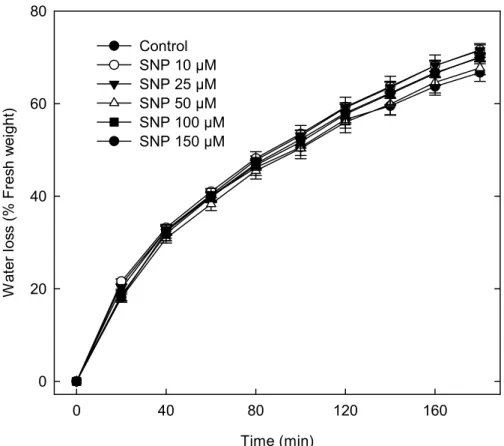
of wild type stomata under water stress to NO correlated with inability of NO
to reduce water loss as evaluated by the decline in fresh weight of detached
leaves (Fig 4). The leaves from wild type plants lost about 70 % of their fresh
weight within 3 h, regardless of whether they were treated with SNP in a
range 10-150 µM. However, Garcia-Mata and Lamattina (2001) found that
the NO, administered via SNP (150 µM), reduced transpiration and induced
estomatal closure in Triticum aestivum. This discrepancy might be then species-specific or might reflect that NO does not protect Arabidopsis plants
against water stress.
In an attempt to further analyse stomatal responses to NO in
Arabidopsis, the specific NO scavenger PTIO was used. Fig 5 (white bars)
shows that upon treatment of leaves with PTIO plus SNP the stomatal
apertures remained at the same level of the control leaves through all SNP
concentrations tested. This shows that SNP-induced stomatal closure in
Arabidopsis leaves, under well watered conditions, might be mediated via NO
released from SNP. Importantly PTIO alone at 200 µM caused no effect on
stomatal apertures as compared to control (P < 0.05 by t test). However, under water stress conditions the stomatal apertures in Arabidopsis leaves
treated with SNP (50 µM) alone did not differ significantly from control (P <
with either PTIO or SNP and with PTIO plus SNP remained constant through
all tested SNP concentrations, suggesting that NO was not a key component
for stomatal closure in Arabidopsis leaves under water stress.
SNP (µM)
S
tom
a
tal
ape
rt
u
re w
id
th (
µ
m
)
0 0.5 1.0 1.5 2.0 2.5 3.0
0 10 25 50 100 150
A
B
C
DE D
E a
a a a a a
Figure 3 - Negation of the effect of SNP on the stomatal closure in Arabidopsis leaves under water stress conditions. Wild type Arabidopsis (Col-0) leaves were floated in MES-KCl buffer to induce stomatal opening and then incubated in SNP (10-150 µM) for 2.5 h. Stomatal apertures were measured before dehydration (white bars) and 30 min after submitting the leaves the dehydration (striped bars) under a direct light source (50 cm from a 60 Watt bulb) on the laboratory bench. The data are representative of 4 independent experiments with the means of 100 stomata + standard errors
A major concern over the use of SNP as a NO donor was its
concurrent generation of both NO and cyanide. Cyanide was recently shown
to break seed dormancy in Arabidopsis as did NO gas and each effect was
inhibited by PTIO (Bethke et al 2006). Thus, it was necessary to determine
whether cyanide also affects stomatal responses. Cyanide, applied as
sodium ferricyanide, did not induce stomatal closure both in turgid and
dehydrated leaves (Fig 6). These data provide evidence that SNP induced
stomatal closure in leaves under well watered conditions is mediated via NO
Time (min)
0 40 80 120 160
W
at
er
l
os
s
(
%
F
res
h
w
ei
ght
)
0 20 40 60 80
Control SNP 10 µM SNP 25 µM SNP 50 µM SNP 100 µM SNP 150 µM
Figure 4 - SNP does not reduce water loss produced by water stress. Leaves at the same developmental stage and size from 4-week-old plants (Col-0) were floated in MES-KCl buffer to induced stomatal apertures. After that, leaves were incubated in SNP (10-150 µM) for 2.5 h. The water loss of detached leaves was measured by weighing fresh leaves exposed to a direct light source (50 cm from a 60 Watt bulb) on the laboratory bench. Water loss was expressed as the percentage of initial weight at each time point. Data are means of two independent experiments with 4 replicates (Petri dishes with 4 leaves) for each treatment + standard errors
NO is not required for ABA-induced stomatal closure in leaves under water stress conditions
The signalling process in guard cell is highly complex and modulated
by many stimuli, most notably ABA (Hetherington 2003, Fan et al 2004).
Several works have reported that NO is an important signalling intermediate
in ABA-induced stomatal closure (Neill et al 2002, Garcia-Mata and
Lamattina 2002, She et al 2004). However, a report that ABA have failed to
induce NO synthesis in tobacco cell suspension cultures suggested that it
may be restricted to specialized ABA target cells such as guard cells (Tun et
Cyanide (µM)
St
o
m
at
al
ape
rt
ur
e w
idt
h
(
µ
m
)
0 0.5 1.0 1.5 2.0 2.5 3.0
0 10 25 50 100 150
A
A A A A A
a
a a a a
a
Figure 6 - Sodium ferricyanide does not induce stomatal closure in Arabidopsis leaves. Wild type Arabidopsis (Col-0) leaves were floated in MES-KCl buffer to induce stomatal opening and then incubated in sodium ferricyanide (10-150 µM) for 2.5 h. Stomatal apertures were measured before dehydration (white bars) and 30 min after submitting the leaves the dehydration (striped bars) under a direct light source (50 cm from a 60 Watt bulb) on the laboratory bench. The data are representative of 4 independent experiments with the means of 100 stomata + standard errors
the process of response to ABA. ABA signalling, by regulating stomatal
aperture, plays a crucial role to reduce water loss under water shortage.
Different analyses were performed to evaluated response of NO in
ABA-induced stomatal closure. Thus, stomatal response to ABA was evaluated by
directly measuring stomatal closure in Arabidopsis leaves under water
deprivation. ABA induced stomatal closure in a dose-dependent manner,
causing significant reduction in stomatal width (Fig 7, white bars) at
concentration as low as 0.1 µM (P < 0.05 by Tukey test). The
dose-dependent manner that ABA-mediated response in Arabidopsis turgid leaves
was similar to leaves treated with ABA and submitted to the dry atmosphere
for 30 min (Fig 7, striped bars). The maximum significant effect induced by
St
om
a
tal
a
p
e
rt
ures
w
id
th (µm
)
0 0.5 1.0 1.5 2.0 2.5 3.0
Control SNP
50µM PTIO 200µM
PTIO PTIO PTIO PTIO PTIO
+ SNP 10µM
+ SNP 25µM
+ SNP 50µM
+ SNP 100µM
+ SNP 150µM
Figure 5 - NO does not induce stomatal closure in Arabidopsis leaves under water stress conditions. Wild type (Col-0) Arabidopsis leaves were floated in MES-KCl buffer under light to induce stomatal opening and then treated with the NO scavenger PTIO (200 µM) in MES-KCl buffer for 30 min prior to treatment with SNP (10-150 µM) for 2.5 h. Stomatal apertures were measured before dehydration (white bars) and 30 min after submitting the leaves to dehydration (striped bars) under a direct light source on the laboratory bench. The data are representative of 4 independent experiments with means of 100 stomata + standard errors
in turgid Arabidopsis, which correspond to a 42 % reduction as compared to
control apertures. On the other hand, in dehydrated leaves the maximum
significant effect induced by ABA occurred at 50 µM when stomatal aperture
was reduced to 0.88 µM, which correspond to 47 % reduction compared to
control apertures. Moreover, ABA induced stomatal closure in a
dose-dependent manner that correlated with the ability of ABA to reduce
transpiration (Fig 8), that was evaluated by the decline in fresh weight of
detached leaves (Verslues et al 2006). The results demonstrated that leaves
exposed to ABA (0.1-50 µM) showed an accelerated decrease of the weight
ABA (µM)
St
om
at
al
aper
tu
re w
idt
h (
µ
m
)
0 0.5 1.0 1.5 2.0 2.5 3.0
0 0.1 1 10 50
A
B
B
C
C a
b
b
c
d
Figure 7 - ABA-induced stomatal closure in wild type Arabidopsis leaves. Wild type Arabidopsis (Col-0) leaves were floated in MES-KCl buffer to induce stomatal opening and then incubated in ABA (0.1-50 µM) for 2.5 h. Stomatal apertures were measured before dehydration (white bars) and 30 min after submitting the leaves to dehydration (striped bars) under a direct light source (50 cm from a 60 Watt bulb) on the laboratory bench. The data are representative of 4 independent experiments with the means of 100 stomata + standard errors
effect induced by ABA occurred at 50 µM, which led to an approximately
1.3-fold decrease in the water loss within 3 h.
The observation that ABA induces a reduction in stomatal apertures in
a concentration-dependent manner in Arabidopsis leaves under water
deprivation contrast to the effect of NO, applied as SNP, which failed to
induce stomatal closure and to reduce transpiration in leaves under drought
stress (Figs 3 and 4). This suggests that NO might not to be required for the
ABA-induced stomatal closure during adaptative plant responses to water
stress. To determine whether ABA-induced stomatal closure in leaves under
water stress does not require NO, Arabidopsis leaves were pre-treated with
the NO scavenger PTIO prior to ABA application. PTIO (200 µM) significantly
inhibited the effects of ABA in Arabidopsis turgid leaves (Fig 9, white bars;
Time (min)
0 40 80 120 160
W
a
te
r l
o
s
s
(
%
F
res
h w
ei
ght
)
0 10 20 30 40 50 60 70
Control ABA 0.1 µM ABA 1 µM ABA 10 µM ABA 50 µM
Figure 8 - ABA reduces water loss produced by drought. Leaves at the same developmental stage and size from 4-week-old plants (Col-O) were floated in MES-KCl buffer to induced stomatal apertures. After that, leaves were incubated in ABA (0.1-50 µM) for 2.5 h. The water loss of detached leaves was measured by weighing fresh leaves placed under a direct light source (50 cm from a 60 Watt bulb) on the laboratory bench. Water loss was expressed as the percentage of initial weight at each time point. Data are means of two independent experiments with 4 replicates (Petri dishes with 4 leaves) for each treatment + standard errors
(P < 0.05 by Tukey test). These data confirm that NO was required for
ABA-induced stomatal closure in non-stressed leaves of Arabidopsis, thereby
supporting the findings of previous studies (Neill et al 2002, Garcia-Mata and
Lamattina 2002, Desikan et al 2002). On the other hand, ABA-induced
stomatal closure was not suppressed by PTIO after submitting the leaves to
a drought stress treatment for 30 min (Fig 9, striped bars; see also Fig 5).
Furthermore, PTIO alone has no effect on stomatal apertures as compared to
controls (P < 0.05 by t test). These data suggest that NO was not an essential component for ABA-induced stomatal closure in Arabidopsis leaves
St
om
a
tal
ap
e
rt
u
re
s
w
idt
h
(
µ
m
)
Control PTIO PTIO PTIO PTIO PTIO
0.5 1.0 1.5 2.0 2.5 3.0
+
ABA 0.1µM ABA 1µM +
+ ABA 10µM
+ ABA 50µM
A A A A A A
a a a
b
c
d
Figure 9 - Negation of the antagonistic effect of the NO scavenger PTIO on ABA-induced stomatal closure in Arabidopsis leaves under water stress conditions. Wild type (Col-0) Arabidopsis leaves were floated in MES-KCl buffer under light to induce stomatal opening and then treated with NO scavenger PTIO (200 µM) in MES-KCl buffer for 30 min prior to treatment with ABA (0.1-50 µM) for 2.5 h. Stomatal apertures were measured before dehydration (white bars) and 30 min after submitting the leaves the dehydration (striped bars) under a direct light source on the laboratory bench. The data are representative of 4 independent experiments with means of 100 stomata + standard errors
treated with SNP showed reduced relative water content (RWC) as
compared to leaves treated with ABA (Fig 10). After 2 h of water stress
leaves treated with ABA (50 µM) retain approximately 33 % more water than
the control leaves. However, leaves treated with SNP did not exhibit
significant difference in the RWC compared with control (P < 0.05 by Tukey
test). When SNP was added together with ABA, RWC was not significantly
different from that measured in leaves treated with ABA alone suggesting
that ABA was responsible for inducing tolerance to water stress in
ABA+SNP+PTIO did not exhibit significantly difference in the RWC as
compared with leaves treated with ABA alone (Fig 10). Importantly, RWC in
RW
C
(
%
)
0 20 40 60 80
Control ABA SNP PTIO ABA
+ PTIO ABA
+ SNP
SNP + PTIO
ABA + SNP
+ PTIO b
a
b b
a a
b
a
Figure 10 - NO does not protect Arabidopsis leaves against drought. Wild type (Col-0) Arabidopsis leaves at the same developmental stage and size were incubated in 5 ml MES-KCl buffer for 2.5 h under light conditions (60-100 µE m-2 s-1) in a growth chamber. After that, leaves were treated with various compounds and incubated in the same buffer for 2.5 h. Drought stress was performed by placing different sets of detached leaves with abaxial side up in open Petri dishes on a white paper under a direct light source (50 cm from a 60 Watt bulb) on the laboratory bench. After 2 h drought stress, RWC measurements were determined, according to the formula: RWC (%) = (FW-DW)/(TW-DW) x 100. The values are average of 4 replicates (Petri dishes with 4 leaves) + standard errors.
leaves treated with PTIO alone did not differ significantly from control,
indicating that alone, PTIO causes no effect on transpiration. In another test
of response to ABA, the fresh mass of detached leaves was determined in
leaves treated with ABA, ABA+PTIO, SNP and SNP+PTIO during
desiccation. Leaves treated with 50 µM SNP did not show a significant
reduction in the amount of water loss as compared with control treatment
Time (min)
0 40 80 120 160
W
at
er
l
os
s
(
%
F
res
h w
ei
ght
)
0 20 40 60
Control ABA 50 µM SNP 50 µM ABA+PTIO 200µM SNP+ PTIO 200µM
Figure 11 - NO does not reduce water loss caused by water stress. Wild type (Col-0) Arabidopsis leaves at the same developmental stage and size were floated in MES-KCl buffer for 2.5 h under light conditions (60-100 µE m-2 s-1) in a growth chamber. After that, leaves were treated with various compounds and incubated in the same buffer for 2.5 h. The transpiration of detached leaves was measured by weighing leaves placed abaxial side up in open Petri dishes with one layer of filter paper under a direct light source (50 cm from a 60 Watt bulb) on the laboratory bench. The weight of each set of leaves was determined every 20 min over a period of 3 h. Water loss was expressed as the percentage of initial fresh weight. The values are the average of 4 replicates (Petri dishes with 4 leaves each) + standarderrors.
in 30 % after 3 h under drought. When combined with ABA, PTIO was not
able to prevent the ABA-mediated decrease of the transpiration. Importantly,
SNP+PTIO did not cause any effect on transpiration as compared with
control leaves. Together, these data suggest that NO is not required for
ABA-induced tolerance against water stress.
NO production can be visualized as an increase in fluorescence
emission from the cell-permeant probe DAF-2A (4,5-diaminofluorescein
diacetate). To demonstrate the effects of ABA on guard cell NO generation,
wild type Col-0 epidermal fragments were loaded with DAF-2A and confocal
fluorescence in response to treatment with ABA (50 µM) and PTIO. Fig 12
shows that significant NO production occurred at ABA concentration 50 µM,
causing a 128 % increase in DAF-2 fluorescence compared to controls. On
the other hand, PTIO (200 µM) abolished de DAF-2 fluorescence induced by
ABA, significantly reducing NO synthesis to the levels of controls (P < 0.05
by Tukey test). Importantly, NO synthesis in epidermal fragments treated with
PTIO alone do not differ significantly from controls (P < 0.05 by Tukey test)
indicating that alone, PTIO has no effect on guard cell NO synthesis (Fig 12).
Together, these data show that guard cells generate NO in response to ABA
in turgid leaves.
Control ABA PTIO ABA+PTIO
DAF
2
f
luor
es
c
e
n
c
e (
p
ix
el
i
n
te
n
s
it
y
)
0 50 100 150 200 250
b
a
b b
Figure 12 - ABA-induced NO synthesis is abolished by PTIO. Wild type Arabidopsis leaf epidermal fragments were incubated with DAF-2DA in MES-KCl buffer. NO synthesis was monitored 30 min after treatment with 50 µ ABA, 200 µM PTIO, ABA+PTIO and in controls. Confocal microscopy data are displayed as mean pixel intensities of 4 independent replicates + standard errors
The observation that ABA-induced stomatal closure in water-stressed
leaves does not require NO (see Figs 1, 7 and 9) was investigated in further
detail using a nitrate reductase inhibitor and a nitric oxide synthase inhibitor.
nitrate reductase (NR). NOS is a family of well characterized enzymes in
mammalian cells that catalyze the conversion of L-arginine to L-citrulline and
NO (Alderton 2001). NOS activity was first demonstrated in plant tissues by
monitoring the conversion of radiolabelled arginine to radiolabelled citrulline
(Cueto et al 1996) and the inhibition of this reaction by the arginine
analogues N6-nitro-L-arginine (L-NNA) and L-NAME (Nimerman and Maier 1996). However, the identified gene and protein (AtNOS1) responsible for
arginine-dependent NO synthesis in Arabidopsis thaliana shows no sequence similarities to the NOS family of enzymes in animals (Guo et al
2003). NO synthesis in plants has also been attributed to NR. NR is a central
enzyme of nitrogen assimilation in plants, catalyzing the transfer of two
electrons from nicotinamide-adenine dinucleotide phosphate (NADPH) to
nitrate to produce nitrite (Lea 1999). NR also shows the capacity to generate
NO from nitrite utilising NADPH as an electron donor (Rockel et al 2002).
This function of NR has been demonstrated in vitro and in vivo in a number of species (Yamasaki and Sakihama 2000, Rockel et al 2002, Dordas et al
2003). Tungstate serves as molybdenum analogue and has been used to
block NR activity in plants because NO is thought to be generated by
reduction of nitrite at the molybdopterin site (Meyer et al 2005, Deng et al
1989). The NR inhibitors (tungstate) and NOS inhibitor (L-NAME) have been
used to demonstrate that NR and NOS are sources of NO in several plant
species (Delledonne et al 1998, Garces et al 2001, Neill et al 2002, Bright et
al 2006). Incubation of turgid leaves of Arabidopsis with either tungstate or
L-NAME alone had no significant effect on the stomatal response (Fig 13, white
bars). However, in fully turgid leaves of Arabidopsis ABA-induced stomatal
closure was partially inhibited by tungstate. Tungstate (100 µM) caused 27 %
inhibition of ABA induced stomatal closure in Arabidopsis leaves under well
watered condition (see ABA+Tungstate; Fig 13 white bars). On the other
hand, L-NAME had little effect (9 %) on ABA-induced stomatal closure (see
ABA+L-NAME) implying that NR can be the predominant source of NO in
guard cells exposed to ABA, which is the same as that seen in previous work
(Desikan et al 2002, Bright et al 2006). ABA-mediated stomatal closure was
not completely abolished by tungstate or NAME or by tungstate plus
S
tom
at
al
ape
rt
ur
es
w
idt
h
(
µ
m
)
0 0.5 1.0 1.5 2.0 2.5 3.0
Control Tungstate
L-NAME ABA ABA ABA ABA
+
TungstateL-NAME +
+ L-NAME
+ Tungstate
a a a
b b b b
A A A
C
B
C
B
Figure 13 - Negation of the antagonistic effects of tungstate and L-NAME on ABA-induced stomatal closure in Arabidopsis leaves under water stress. Wild type (Col-0) Arabidopsis leaves were floated in MES-KCl buffer under light to induce stomatal opening and then treated with tungstate (100 µM), L-NAME (200 µM) or tungstate plus L-L-NAME in MES-KCl buffer for 30 min prior to treatment with ABA (50 µM) for 2.5 h. Stomatal apertures were measured before dehydration (white bars) and 30 min after submitting the leaves the dehydration (striped bars) under a direct light source on the laboratory bench. The data are representative of 4 independent experiments with means of 100 stomata + standard errors
solely dependent on the NR or NOS or, in fact, NO (Figs 13, white bars).
Interestingly, the inhibitory effects of tungstate, L-NAME and tungstate plus
L-NAME on ABA-induced stomatal closure were completely abolished after
submitting the leaves for 30 min to the drying atmosphere of the laboratory,
indicating that NO does not play a central role in response to ABA-induced
stomatal closure under water stress conditions (Fig 13, striped bars). Taken
together, the lack of inhibition by PTIO to ABA-induced stomatal closure in
leaves under drought (see Fig 9) and the fact of NO failed to reduce the
not required in the ABA signalling cascade in Arabidopsis guard cell under
water deprivation.
However, pharmacological experiments could lead to
misinterpretations of data due to the possibility of compound-specific side
effects that can occur within a biological system. Consequently, a genetic
approach was used to substantiate the pharmacologically-based findings.
NR mutations do not affect ABA-induced stomatal closure in leaves under water stress conditions
Two genes in the Arabidopsis genome, NIA1 and NIA2, encode nitrate reductase. NIA2 accounts for 90 % of the total NR activity in seedlings whilst
NIA1 accounts for the remaining 10 % (Wilkinson and Crawford 1991); this
work, however, relates only to NR reduction of nitrate to nitrite and not to
NR-generation of NO. The two genes are approximately 70 % identical in
nucleotide sequence and 76 % identical at the amino acid level (Wilkinson
and Crawford 1993) The Arabidopsis double mutant, nia1 nia2, that has less than 1 % of the NR activity of the wild type (Wilkinson and Crawford 1993),
did not emit NO under conditions in which the wild type did (Magalhães et al
2000, Desikan et al 2002). It is also known which of the two NIA genes (NIA1
and NIA2) are expressed in guard cells (Bright 2006). The presence of expressed NIA1 and NIA2 further supports the possibility that these enzymes
may be involved in guard cell response. Desikan et al (2002) used both
pharmacological and genetic approach to show that nia1 nia2 guard cell did not generate NO in response to ABA or nitrite, nor did nia1 nia2 stomata closed in response to both stimuli. Importantly, nia1 nia2 guard cells do respond to SNP indicating that NR lies upstream of NO in the signalling
pathway leading to closure. Moreover, Bright (2006) demonstrated that
treatment with ABA did not induce NO synthesis in nia1::Ds guard cells, suggesting that NIA1 was responsible for NO production and stomatal
closure in response to ABA. The guard cells of nia1::Ds mutants did not respond to ABA or nitrite whist the guard cells of nia2-5 mutants responded in the same manner as the wild type Arabidopsis (Bright 2006). As described
above, several studies support a major role of NO in modulating the
correlation between ABA-induced stomatal closure, via NO, and drought
tolerance has not been well established. Thus, the relationship between ABA
and NO in stomatal closure was investigated under drought conditional using
NR mutants: nia1 nia2; nia1::Ds and nia2-5.
In guard cells of nia1 nia2 mutant, which does not produce NO in response to ABA or nitrite (Desikan et al 2002), both ABA and nitrite had little
effect on stomatal closure in leaves under well watered conditions (Fig 14).
Stomatal apertures were found to be 64 % and 81 % greater in nia1 nia2
mutants than wild type leaves treated with ABA or nitrite, respectively. On the
other hand, in wild type plants ABA and nitrite induced stomatal closure
causing a significant reduction in stomatal aperture width (P < 0.05 by t test). Moreover, incubation in NaCl (as a negative control for sodium nitrite) did not
induce stomatal closure, indicating that nitrite effect were not simply ionic (Fig
14). Although it was assumed that nitrate would be converted into nitrite once
inside the cell, no stomatal response was observed both in turgid leaves from
wild type and nia1 nia2 plants. One explanation for these results is that nitrate can work as inhibitor of NR-NO activity (Rockel et al 2002).
Alternatively, in guard cells, exogenous nitrite is made accessible by NR,
whilst nitrate-derivate nitrite may be sequestered into the chloroplast (see
Crawford and Forde 2002) before it can be further reduced to NO. To confirm
that the insensitivity of nia1 nia2 stomata to ABA and nitrite was caused by reduced NR activity, leaves were exposed to NO, via incubation in SNP. nia1 nia2 stomata showed a response similar to wild type stomata (Fig 14). In wild type plants, SNP caused a 49 % reduction in stomatal aperture whereas a 47
% difference in aperture width was observed in nia1 nia2 plants. To determine if nia1 nia2 mutant are also altered in ABA-induced stomatal closure in response to desiccation, leaves from wild type and mutant plants
were treated with ABA and then placed under dry atmosphere of the
laboratory. Both mutant and wild type plants showed similar stomatal closure
by ABA (Fig 14), indicating that NR was not required to ABA-induced
stomatal closure in dehydrating conditions. In other word, ABA-induced
stomatal closure was independent on NO synthesized via NR. This was
nitrite, a substrate for NO synthesis (Garcia-Mata and Lamattina 2003, Neill
et al 2003). When NO2- was replaced by Cl- or NO3- both mutant and wild
type plants showed similar stomatal apertures. Moreover, nia1 nia2 and wild type stomata did not display enhanced stomatal closure when leaves were
exposed to NO via incubation in SNP and placed in dry atmosphere (Fig 14),
indicating ABA-induced stomatal closure does not requires NO synthesis.
Control ABA SNP Nitrite Nitrate NaCl Cyanide
St
om
a
tal
a
per
tu
re
w
idt
h (
µ
m
)
0 0.5 1.0 1.5 2.0 2.5 3.0
Figure 14 - ABA-mediated stomatal closure is impaired in nai1 nia2
Arabidopsis turgid leaves but not in leaves under water stress conditions. Leaves from wild-type (Col-0) or nia1 nia2 plants were floated in MES-KCl buffer under light to induced stomatal aperture. Afterwards, leaves were incubated for 2.5 h in buffer alone (control), 50 µM ABA, 50 µM SNP, 1 mM nitrite, 50 µM sodium ferricyanide, 1mM nitrate or 1mM NaCl. Stomatal apertures were measured before dehydration (white bars, Col-0; checkered bars, nia1 nia2) and 30 min after submitting the leaves to dehydration (striped bars, Col-0; black bars, nia1 nia2) under a direct light source on the laboratory bench. The data are representative of 4 independent experiments with means of 100 stomata + standard errors
Further confirmations that the loss of NR does not suppress stomatal
closure induced by ABA in leaves under water stress were obtained with two
which has a у-irradiation-mediated deletion in the NIA2 gene (Wilkinson and Crawford 1991). ABA-mediated closure was 68 % less effective in nia1::Ds leaves compared to the wild type response, under well watered condition (Fig
15). In turgid leaves from wild type plants, nitrite caused a 51 % reduction
Control ABA SNP Nitrite Nitrate NaCl Cyanide
St
om
a
tal
a
per
tu
re
w
idt
h (
µ
m
)
0 0.5
1.0 1.5 2.0 2.5 3.0 3.5 4.0
Figure 15 - ABA-mediated stomatal closure is impaired in turgid leaves from
nia1::Ds plants but not in leaves under water stress conditions. Leaves from wild-type (Ler) or nia1::Ds plants were floated in MES-KCl buffer under light to induced stomatal aperture. Afterwards, leaves were incubated for 2.5 h in buffer alone (control), 50 µM ABA, 50 µM SNP, 1 mM nitrite, 50 µM sodium ferricyanide, 1mM nitrate or 1mM NaCl. Stomatal apertures were measured before dehydration (white bars, Ler; checkered bars, nia1::Ds) and 30 min after submitting the leaves the dehydration (striped bars, Ler; black bars,
nia1::Ds) under a direct light source on the laboratory bench. The data are representative of 4 independent experiments with means of 100 stomata + standard errors
in stomatal aperture compared to control. When NO2- was replaced with Cl
-or NO3- no significant difference in stomatal apertures (P < 0.05% by t test)
was observed in relation to control indicating that stomatal closure was
dependent on nitrite. However, nitrite-induced stomatal closure was
abolished in mutant plants such that the mean aperture width observed in
that subsequently mediated stomatal responses. In agreement with this
result, stomatal of mutant leaves responded to SNP in the same manner as
stomata of wild type suggesting that NR1 lies upstream of NO in the
signalling pathway leading to closure in leaves under well watered conditions.
Importantly, sodium ferricyanide (as a negative control for SNP) did not
induce closure both in wild type and mutant leaves, indicating (Fig 15) again
that NO synthesis is required for stomatal closure in non-stressed leaves. In
keeping with these data, nitrite treatment did not induce NO generation in
nia1::Ds guard cells. DAF2 fluorescence did not significantly alter with nitrite treatment compared to control. However, nitrite induced an 80 % increase in
DAF2 fluorescence in wild type guard cells compared to control treatment
(Fig 16).
The effect of NIA1 mutation was analyzed on ABA-induced stomatal
closure under water deprivation. To this end, wild type and nia1::Ds Arabidopis leaves were treated with ABA and after submitting the leaves to
drying atmosphere of the laboratory for 30 min stomatal closure was assayed
in leaves from wild type and nia1::Ds plants. Results demonstrated that ABA-induced stomatal closure was not affected by the NIA1 mutation in
water-stressed leaves (Fig 15). There was no significant difference between the
apertures of stomata in wild type and nia1::Ds leaves treated with ABA (P < 0.05 by t test) suggesting that ABA-induced stomatal response presumably occurred via a NO-independent mechanism. In agreement with this result,
nitrite-induced stomatal closure was abolished in stressed leaves of wild-type
plants such that the mean aperture width observed in wild type leaves treated
with nitrite or NaCl (as a control to nitrite) was not significantly different from
control apertures (P < 0.05 by t test), i.e., wild type leaves treated with buffer alone. Moreover, nia1::Ds stomata responded to NO, applied as SNP, and cyanide (as a control for SNP decomposition) in the same manner as wild
type stomata of stressed leaves treated with NO or sodium ferricyanide (Fig
15). These data indicate that a functional NR1 is not required for
ABA-mediated stomatal closure in leaves under water stress.
Bright (2006) has shown that NIA2 is also expressed in Arabidopsis
Control Nitrite
DAF
2
f
luo
re
s
c
ence (pi
x
el
i
n
tens
it
y
)
0 50 100 150 200
Control Nitrite
WT - Ler nia1::Ds
Figure 16 - Nitrite do not induce NO synthesis in nia1::Ds guard cells. Wild type (Ler) and nia1::Ds Arabidopsis leaf epidermal fragments were incubated with DAF2-DA in MES-KCl buffer. Fragments were treated with 1 mM nitrite. NO synthesis was monitored 30 min after treatment with nitrite and controls. Confocal microscopy data are displayed as mean pixel intensities of 4 independent replicates + standard errors
ABA-, SNP- and nitrite-induced stomatal closure was not abolished in fully
turgid leaves from mutant plants such that the stomatal aperture width
observed in nia2-5 leaves was significantly different (P < 0.05 by t test) from control apertures (Fig 17), which is consistent with the previous report by
Bright (2006). nia2-5 stomata responded to ABA, SNP and nitrite in the same manner as wild type stomata, indicating that NR2 functions is not required for
NO signalling in guard cells, under well watered conditions. Consistent with
these findings, nitrate and NaCl (as negatives controls to nitrite) did not
induce stomatal closure in leaves of nia2-5 mutant and wild type indicating that stomatal closure was dependent on NO2-. Moreover, sodium ferricyanide
(as a negative control for SNP) caused no significant effect on stomatal
apertures as compared to controls (P < 0.05 by t test) showing that NO released from SNP induced stomatal closure (Fig 17).
Under water stress condition, stomata of wild type plants and nia2-5
mutant did not respond significantly (P < 0.05 by t test) to SNP and nitrite. However, ABA induced stomatal closure caused a reduction of 34 % and
Control ABA SNP Nitrite Nitrate NaCl Cyanide
S
tom
at
al
ape
rt
ur
e
w
id
th (
µ
m
)
0 0.5 1.0 1.5 2.0 2.5 3.0
Figure 17 - Negation of the effect of SNP and nitrite on the stomatal closure in leaves from nia2-5 plants under stress conditions. Leaves from wild-type (Col-0) or nia2-5 plants were floated in MES-KCl buffer under light to induced stomatal aperture. Afterwards, leaves were incubated for 2.5 h in buffer alone (control), 50 µM ABA, 50 µM SNP, 1 mM nitrite, 50 µM sodium ferricyanide, 1mM nitrate or 1mM NaCl. Stomatal apertures were measured before dehydration (white bars, Col-0; checkered bars, nia2-5) and 30 min after submitting the leaves the dehydration (striped bars, Col-0; black bars, nia2-5) under a direct light source on the laboratory bench. The data are representative of 4 independent experiments with means of 100 stomata + standard errors
with ABA. The effects of ABA-induced stomatal closure under water stress on
nia2-5 was similar to those of nia1::Ds and nia1 nia2 double mutant, revealing that a functional NR is not required for ABA-induced stomatal
closure in Arabidopsis leaves subject to water shortage. Previous studies
have demonstrated that NR-mediated NO synthesis is required for
ABA-induced stomatal closure (Desikan et al 2002, Neill et al 2002, Garcia-Matta
and Lamattina 2002) under well watered conditions. These results were
confirmed here and it was shown that NO likely is not an essential
component in guard cell under water deprivation. Other works have also
shown no dependence on NR-mediated NO synthesis. NO accumulation in
(Zhang et al 2003). Mechanical stress-induced NO formation in Arabidopsis
was reported to be inhibited by NOS inhibitors but not reduced in nia1 nia2
mutant (Garcês et al 2001). In addition, Modolo et al (2006) reported that the
nia1 nia2 mutant plants displayed reduced levels of nitrite and free amino-acids, particularly L-arginine, other important substrate for NO synthesis.
Thus, the effects of L-arginine on stomatal responses were examined in
leaves of wild type and nia1 nia2 mutant plants under well watered conditions.
Nitrite and L-arginine induce stomatal closure in wild type but not nia1
nia2 mutant
Desikan et al (2002) showed that in the nia1 nia2 Arabidopsis NR-deficient mutants nitrite did not induce NO synthesis and stomatal closure.
Bright (2006) also found that in detached leaves of nia1 nia2 double mutants, nitrite-induced stomatal closure and NO synthesis was abolished. These
results indicated that NR is the predominant source of NO in guard cell. On
the other hand, Modolo et al (2006) reported that nia1 nia2 leaves had reduced levels of free amino acids, with the content of L-arginine (substrate
for NO synthesis) being 10-fold lower in double mutants than in wild type
plants. Thus, the double mutant was used to determine the effect of
L-arginine on stomatal movements. As expected nitrite failed to induce
stomatal closure in leaves of nia1 nia2 mutants, whereas there was a clear dose-response in the wild type plants (Fig 18). The maximum effect induced
by applied nitrite occurred at 1 mM, whereas stomatal aperture was reduced
to 1.35 µm (Fig 18, white bars; P < 0.05 by Tukey test) which corresponds to
a 40 % reduction in width compared to control apertures. A similar pattern of
changes in stomatal aperture was observed in the wild type plants treated
with L-arginine (Fig 19, white bars). Arginine induced dose-dependent
stomatal closure in wild type Arabidopsis leaves which was significant at a
concentration of L-arginine > 0.1 mM (P < 0.05 by Tukey test). The maximum
promotion of stomatal closure was observed after treatment with 1 mM
L-arginine, in which conditions stomatal apertures were 1.33 µm, or 44 % of
the control value (Fig 19, white bars). In contrast to wild type plants, nia1 nia2
Nitrite (mM)
St
o
m
a
tal
ap
ert
u
re
w
idt
h
(µm
)
0 0.5 1.0 1.5 2.0 2.5 3.0
0 0.1 0.5 1
a
a
a
a A
B
C
D
Figure 18 - Nitrite does not induce stomatal closure in nia1 nia2 NR-deficient mutant. Leaves of either wild type (white bars) or nia1 nia2 (striped bars) were floated in MES-KCl buffer under light to induced stomatal aperture, and then incubated in nitrite (0.1-1 mM). Stomatal apertures were measured after 2.5 h. The data are representative of 4 independent experiments with means of 100 stomata + standard errors
difference (P < 0.05 by Tukey test) between the apertures of stomatal in nia1 nia2 leaves treated with L-arginine (0.1-1.0 mM) as compared to control (Fig 19, striped bars). These data suggest that NR might be one of several
sources that contribute to NO-mediated stomatal response. In other words,
the insensitivity of nia1 nia2 stomata to arginine and nitrite reflects that the sources that contribute to NO-mediated responses in guard cells of
NR-mutant can be classified as nitrite-mediated and arginine-mediated (Crawford
2006). Nitrite-mediated source include NR and the arginine-mediated source
would be nitric oxide synthase (NOS). A test of the multiple source models
provided evidence for NR and NOS participating in NO production during
Arginine (mM)
St
o
m
a
tal
ape
rt
u
re w
id
th (
µ
m
)
0 0.5 1.0 1.5 2.0 2.5 3.0
0 0.1 0.5 1
a a
a
a A
B
C
D
Figure 19 - Arginine does not induced stomatal closure in nia1 nia2 NR-deficient mutant. Leaves of either wild type (white bars) or nia1 nia2 (striped bars) were floated in MES-KCl buffer under light to induced stomatal aperture, and then incubated in arginine (0.1-1 mM). Stomatal apertures were measured after 2.5 h. The data are representative of 4 independent experiments with means of 100 stomata + standard errors
In order to establish that nitrite- and L-arginine-mediated stomatal
closure was related to NO synthesis, wild type and nia1 nia2 leaves were treated with PTIO prior to nitrite plus arginine application. Arginine and nitrite
application closed significantly the stomata in wild type plants but not nia1 nia2 mutant (Fig 20, P < 0.05 by t test), which is the same as the results reported previously (see Figs 18 and 19). When arginine plus nitrite were
applied after treatment with PTIO to the wild type leaves, arginine- and
nitrite-induced stomatal closure was suppressed. PTIO (200 µM) significantly
inhibited the effects of arginine plus nitrite, as stomatal apertures width were
not different from control apertures (P < 0.05 by t test). On the other hand, arginine plus nitrite failed to induce stomatal closure in leaves of nia1 nia2
mutants. Treatments of the leaves with arginine plus nitrite together with
S
tom
at
a
l a
per
tur
e
w
idt
h (
µ
m
)
0 0.5 1.0 1.5 2.0 2.5 3.0
Control Nitrite Arginine Nitrite Nitrite SNP Citrulline NaCl PTIO
+
Arginine Arginine+
+ PTIO
Figure 20 - PTIO treatment impairs stomatal closure induced by nitrite and arginine treatment. Leaves from wild type (Col-0, white bars) or nia1 nia2
(striped bars) plants were floated in MES-KCl buffer under light to induced stomatal aperture. Afterwards, leaves were incubated in buffer alone, 1 mM nitrite, 1mM arginine, nitrite+arginine, nitrite+arginine+PTIO, 50 µM SNP, 1 mM cintrulline, 1 mM NaCl or 200 µM PTIO and stomatal apertures measured after 2.5 h. The data are representative of 4 independent experiments with means of 100 stomata + standard errors
promotes stomatal closure in leaves under well watered conditions via a
pathway involving NO. To confirm that the insensitivity of nia1 nia2 stomata to arginine and nitrite reflects their reduced NO synthesis, leaves were
exposed to NO via incubation in SNP. nia1 nia2 stomata showed a response similar to wild type stomata. In wild type plants, SNP caused a 43 %
reduction in stomatal aperture whereas a 42 % difference in aperture width
was observed in nia1 nia2 plants (Fig 20). PTIO caused significant inhibition of SNP-induced stomatal closure in both wild type and nia1nia2 plants, suggesting that insensitivity of nia1 nia2 stomata to arginine and nitrite correlated with their inability to generate NO. Importantly, incubation in NaCl