Term Nitrogen Fertilization in a Broad-Leaved Korean
Pine Mixed Forest in Northeastern China
Cunguo Wang1,2, Shijie Han1*, Yumei Zhou1, Caifeng Yan1,2, Xubing Cheng1,2, Xingbo Zheng1,2, Mai-He Li1,3*
1State Key Laboratory of Forest and Soil Ecology, Institute of Applied Ecology, Chinese Academy of Sciences, Shenyang, China,2Graduate University of Chinese Academy of Sciences, Beijing, China,3Swiss Federal Research Institute WSL, Zuercherstrasse, Birmensdorf, Switzerland
Abstract
Knowledge of the responses of soil nitrogen (N) availability, fine root mass, production and turnover rates to atmospheric N deposition is crucial for understanding fine root dynamics and functioning in forest ecosystems. Fine root biomass and necromass, production and turnover rates, and soil nitrate-N and ammonium-N in relation to N fertilization (50 kg N ha21 year21) were investigated in a temperate forest over the growing season of 2010, using sequential soil cores and ingrowth cores methods. N fertilization increased soil nitrate-N by 16% (P,0.001) and ammonium-N by 6% (P,0.01) compared to control plots. Fine root biomass and necromass in 0–20 cm soil were 13% (4.61 vs. 5.23 Mg ha21,
P,0.001) and 34% (1.39 vs. 1.86 Mg ha21,
P,0.001) less in N fertilization plots than those in control plots. The fine root mass was significantly negatively correlated with soil N availability and nitrate-N contents, especially in 0–10 cm soil layer. Both fine root production and turnover rates increased with N fertilization, indicating a rapid underground carbon cycling in environment with high nitrogen levels. Although high N supply has been widely recognized to promote aboveground growth rates, the present study suggests that high levels of nitrogen supply may reduce the pool size of the underground carbon. Hence, we conclude that high levels of atmospheric N deposition will stimulate the belowground carbon cycling, leading to changes in the carbon balance between aboveground and underground storage. The implications of the present study suggest that carbon model and prediction need to take the effects of nitrogen deposition on underground system into account.
Citation:Wang C, Han S, Zhou Y, Yan C, Cheng X, et al. (2012) Responses of Fine Roots and Soil N Availability to Short-Term Nitrogen Fertilization in a Broad-Leaved Korean Pine Mixed Forest in Northeastern China. PLoS ONE 7(3): e31042. doi:10.1371/journal.pone.0031042
Editor:Ben Bond-Lamberty, DOE Pacific Northwest National Laboratory, United States of America
ReceivedSeptember 12, 2011;AcceptedDecember 30, 2011;PublishedMarch 6, 2012
Copyright:ß2012 Wang et al. This is an open-access article distributed under the terms of the Creative Commons Attribution License, which permits unrestricted use, distribution, and reproduction in any medium, provided the original author and source are credited.
Funding:Financial support was obtained from National Basic Research Program of China (NO. 2011CB403200), National Natural Science Foundation of China (NO. 40930107) and Knowledge Innovation Program of Chinese Academy of Sciences (NO. KSCX-YW-Z-1022). The funders had no role in study design, data collection and analysis, decision to publish, or preparation of the manuscript.
Competing Interests:The authors have declared that no competing interests exist.
* E-mail: [email protected] (SH); [email protected] (MHL)
Introduction
Fine roots (,2 mm in diameter) are important nutrient sources and sinks, and play important roles in water and nutrient uptake in terrestrial ecosystems [1,2]. Fine root biomass represents less than 2% of total ecosystem biomass, whereas fine root production may account for up to 30–75% of total net primary production [1,3,4]. In addition, fine root turnover can serve as a modulator of soil C and N cycling and can contribute equivalent or greater C and N than aboveground litterfall to soil organic matter pools [3,5].
Anthropogenic N deposition significantly increases biologically available N in ecosystems [6,7], and soil N availability is one of the crucial factors affecting fine root dynamics [4,8,9]. During the past decades, the effects of N availability on fine root production and turnover have been studied extensively. However, knowledge of potential effects of N availability on fine root dynamics is still insufficient to develop a conclusive explanation of the N effects on fine root dynamics [8,10]. Previous studies found that there was a negative relationship between fine root (including mycorrhizal) biomass and soil N availability [8,11,12]. Four possible relationships among fine root production, turnover rates and increased soil N availability have been reported [8,13]: (1) fine root production and turnover rates
increased; (2) fine root production and turnover rates decreased; (3) fine root production increased, while fine root turnover rates decreased; and (4) fine root production decreased, while fine root turnover rates increased with increase in soil N availability. Aber et al. [14] found that the form of N may be more important to fine root mass than the total amount of N, and they [14] reported that the seasonal dynamics of fine root biomass in stands with ammonium-N as the dominant N form significantly differed from those in stands with nitrate-N as the dominant N form. However, only a few attempts have been made to confirm those relationships between different N forms and fine root mass in different forest ecosystems with different soil properties, tree species, and ecosystem productivity.
The broad-leaved Korean pine (Pinus koraiensisSiebold & Zucc) mixed forest is the dominant vegetation type in northeastern China. Wet and dry N deposition in that area has reached 23 kg N ha21 year21 exceeding the critical load in the broad-leaved Korean pine mixed forest [20,21]. We used sequential soil cores combined with ingrowth cores method to investigate fine roots in relation to soil N availability after N fertilization in the broad-leaved Korean pine mixed forest. Soil nitrate-N and ammonium-N contents, fine root biomass, necromass, production, and turnover rates were determined. Our primary objective was to understand effects of different forms of N on fine root dynamics. We hypothesized that: (1) N fertilization decreases fine root biomass and necromass; (2) fine root production and turnover rates increase with N fertilization, and (3) fine root mass is correlated with soil nitrate-N and ammonium-N contents.
Materials and Methods
No specific permits were required for the described field studies. The study was carried out within the research forest of Changbai Forest Ecosystem Research Station (CBFERS) established in 1979. Research activities within that research forest do not need any specific permissions from any government levels, but need to inform Professor Han SJ (Director CBFERS, co-author of the present paper).
Study area and experimental design
The study was conducted in an old growth forest (,200 years
old) of broad-leaved Korean pine mixed forest in Changbai Mountain (42u249N, 128u59E), northeastern China. Mean annual temperature is 3.5uC, with the highest monthly mean temperature of 20.5uC occurring in August and the lowest monthly mean temperature of216.5uC occurring in January. The mean annual precipitation is 700 mm, 70–80% of which falls during the growing season from May to October. The soil, developed from volcanic ash, is classified as Eutric cambisol (FAO classification) with high organic matter content in surface layer. The soil is sandy loam in 3–8 cm and gravelly sand in 8–24 cm depth. Soil bulk density is 0.35 g cm3in 0–10 cm, 0.68 g cm3in 10–20 cm layer. The other soil characteristics in the experimental site are shown in Table 1. The dominant tree species are P. koraienssis, Fraxinus mandschurica, Acer mono, and Tilia amurensis. The mean canopy height and diameter at breast height were 15 m and 34.2 cm, respectively. The tree density was 560 trees ha21. The above-ground tree litterfall is 4.03 Mg ha21, and aboveground produc-tivity is 10.02 Mg ha21. The main shrub species are Philadelphus schrenkii,Euonymus alatus,Lonicera japonica,Corylus mandshurica,Deutzia scabra, and the main herbaceous species are Anemone raddeana,
Anemone cathayensis,Cyperus microiria,Funaria officinalis,Adonis vernalis,
Brachybotrys paridiformis, andFilipendula palmate.
Six 50650 m plots (3 N-addition plots and 3 control plots) with a buffer zone of .20 m between any two plots were randomly established in September 2009. NH4NO3was diluted in 40 L of
deionized water. The additions were done monthly (six times from
May to October 2010) with a sprayer. The application rates of 50 kg N ha21 year21 were about double the annual total N deposition (23 kg N ha21year21) in this area [21]. Three control plots were simultaneously supplied with the same amount of deionized water.
Soil collection and separation of roots
Two weeks after each N fertilization date, twenty soil cores were collected randomly at each plot from May to October (May 20, June 20, July 25, August 25, September 20, October 18), 2010. Soil cores with 5 cm internal diameter were taken to a soil depth of 20 cm and separated into 0–10 cm and 10–20 cm soil samples. According to Yang and Li [23], a sampling depth of 20 cm can cover 80% of the total fine roots in this forest. The distance between any two sampling locations was not less than 5 m. Each sampled location was marked with a wooden stake to avoid repeated sampling at the same or nearby locations. Soil cores were placed immediately into plastic bags and kept at24uC until later processing (within one week). In the laboratory, ten out of the twenty samples were washed free of soil by deionized water (1– 2uC) through a 0.5 mm mesh sieve. Roots,2 mm in diameter were separated into live and dead roots according to visible morphological features (colour, luster, elasticity, degree of cohesion of cortex, periderm and stele) through microscopic inspection [9,24,25]. Roots were dried at 65uC to a constant mass and weighed. Ash content was determined for a composite of fine root samples for each plot and each sampling date.
The other ten soil cores were used to measure nitrate-N and ammonium-N content. About 20 g of fresh soils were extracted with 100 mL of 2.0 mol L21 KCl solution and shaken for one hour. Extracts were settled for approximately 20 minutes and filtered. Ammonium-N content was determined using the indophenol blue colorimetric method [26], and nitrate-N was determined using the cadmium reduction method [27].
Ingrowth cores
Sixty polyethylene (2 mm mesh) bags (20 cm in length65 cm in
diameter) served as root ingrowth cores. Root-free soil was collected outside the plots but within the same forest, sieved through a 2 mm mesh and air-dried. Each bag filled with root-free soil was put into a hole of 20 cm depth and 5 cm diameter in both N fertilization and control plots in September 2009, and the distance between any two ingrowth cores was not less than 5 m. The ingrowth cores were re-sampled in September 2010, and separated into 0–10 cm and 10–20 cm soil layer.
Calculation of fine root production and turnover rates
The fine root production was calculated using (1) sequential soil cores in combination with the maximum-minimum method (SC-MM) [17,18,24], and (2) ingrowth cores method (IC) [10,18], respectively. In the SC-MM method, the production was calculated from the differences between maximum and minimum of the fine root biomass from May to October [28].
Table 1.Characteristics of the 0–20 cm soil in the studied forest sites.*
Total C g?kg21
Total N g?kg21
Total K g?kg21
Total P g?kg21
Soil pH (H2O) Organic matter g?kg21 C/N
Mean 156.60 7.17 12.20 0.97 5.85 270.00 21.84
SE 9.90 0.65 0.38 0.08 0.06 17.10 0.96
*adapted from Zhang et al. [22]. Note g kg21= g per kg soil.
Mean values of fine root biomass per plot were calculated for each sampling date. For the IC method, fine root biomass in the cores refers directly to the fine root production [17]. Fine root turnover rates were estimated as the ratio of the total fine root produced in the growing season to the fine root biomass [14,29].
Statistical analysis
Homogeneity of variances was tested by Levene’s test. Fine root biomass and necromass were Square-Root-transformed, and contents of soil nitrate-N and ammonium-N were log-transformed. Effects of N treatment, sampling dates, soil layers, and their interactions on fine roots, soil nitrate-N and ammonium-N were analyzed using three-way ANOVAs. Differences in production and turnover rates of fine roots between N fertilization and control plots, and between 0–10 cm and 10–20 cm soil layers were analyzed by independent samplest-test. Pearson correlation was used to detect the relationships among fine root biomass, necromass, soil nitrate-N and ammonium-N content. All statistical analyses were conducted with SPSS 17.0 (SPSS Inc., USA).
Results
Soil nitrate-N and ammonium-N
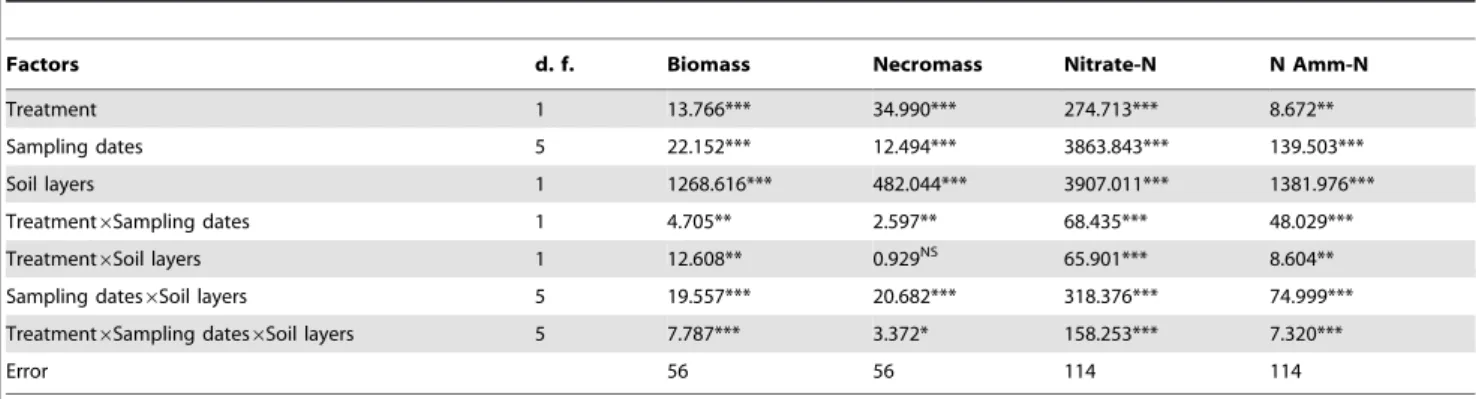
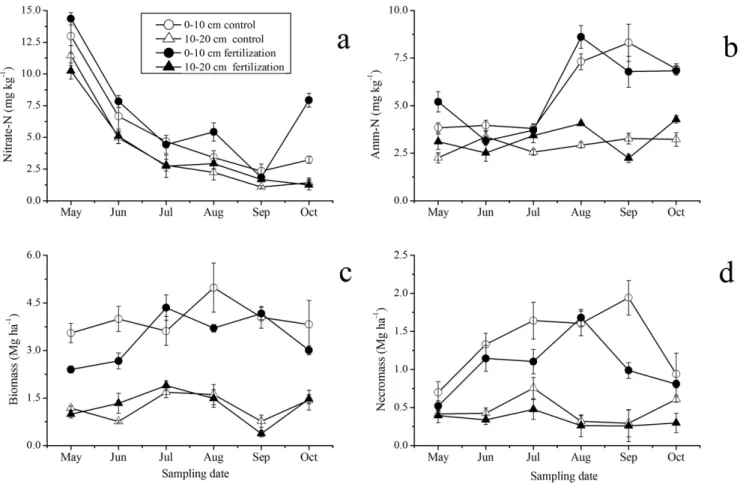
Soil nitrate-N and ammonium-N were affected significantly by N fertilization (P,0.01), soil layers (P,0.001), and sampling dates (P,0.001) (Table 2). N fertilization significantly increased soil nitrate-N by 16% (9.33 vs. 10.82 mg kg21) and ammonium-N by 6% (8.58 vs. 9.09 mg kg21) in 0–20 cm soil (Fig. 1a, Table 2). Nitrate-N and ammonium-N in 0–10 cm soil were significantly higher than those in 10–20 cm soil for both N fertilization and control plots (Fig. 1a, Table 2). Soil nitrate-N contents with the highest level in the early growing season (May) decreased from May to October (Fig. 2a). Compared to nitrate-N, high ammonium-N contents in 0–10 cm soil were observed during the late growing season (August to October), whereas ammonium-N contents in 10–20 cm soil did not exhibit clear seasonal fluctuation (Fig. 2b).
Fine root biomass and necromass
Both fine root biomass and necromass were influenced significantly by N fertilization, sampling dates, and soil layers, respectively (Table 2). Fine root biomass in 0–10 cm soil layer in N fertilization plots was 19% less than that in control plots (3.35 vs. 3.98 Mg ha21) across the sampling dates (Fig. 1b). The fine root
biomass and necromass in both N fertilization and control plots showed significant seasonal fluctuation, with two peaks in July and September in N fertilization plots and one peak in August in control plots (Fig. 2c). Fine root biomass in 10–20 cm soil exhibited the same seasonal pattern in plots for both treatments, peaking in July (Fig. 2c).
Mean fine root necromass in 0–10 cm soil in N fertilization plots was 31% less than that in control plots (1.05 vs. 1.38 Mg ha21) (Fig. 1b). Fine root necromass in both N fertilization and control plots showed significant seasonal fluctu-ation, with the maximum values occurring in September in control plots but in August in N fertilization plots. The fine root necromass in N treated and control plots was lowest in May (Fig. 2d). Fine root necromass in 10–20 cm soil exhibited similar seasonal pattern to that in 0–10 cm soil, and the fine root necromass in control plots was 41% greater than that in N fertilization plots (0.48 vs. 0.34 Mg ha21).
Fine root mass in relation to soil nitrate-N and ammonium-N
Both fine root biomass and necromass in 0–10 cm soil were significantly negatively correlated with soil nitrate-N, and total N availability (nitrate-N+ammonium-N), but not with soil ammoni-um-N contents (Table 3). No statistically significant correlations between fine root mass and soil nitrate-N or ammonium-N in 10– 20 cm soil layer were found. There was significantly positive relationship between fine root biomass and necromass, and negative relationship between soil nitrate-N and ammonium-N in both 0–10 and 10–20 cm soil layer, respectively (Table 3).
Production and turnover rates of fine roots
Production and turnover rates of fine roots estimated by sequential soil cores method differed from that estimated by ingrowth cores method (Table 4). Compared to control treatment, N fertilization did not affect production and turnover rates of fine roots estimated by sequential soil cores (Table 4). However, production and turnover rates of fine roots were found to significantly increased by N fertilization using ingrowth cores method (Table 4). Using ingrowth cores method, fine root production in 0–10 and 10–20 cm soil in N fertilization plots was 42% and 55% greater than those in control plots (0.64 vs. 0.45 Mg ha21and 0.17 vs. 0.11 Mg ha21, respectively. Table 4), and turnover rates of fine roots in 0–10 and 10–20 cm soil in N fertilization plots was 73% and 44% greater than those in control
Table 2.Effects of N treatment, sampling dates, soil layers, and their interactions on fine root biomass, necromass, soil nitrate-N and ammonium-N (Amm-N), analyzed using 3-way ANOVAs.
Factors d. f. Biomass Necromass Nitrate-N N Amm-N
Treatment 1 13.766*** 34.990*** 274.713*** 8.672**
Sampling dates 5 22.152*** 12.494*** 3863.843*** 139.503***
Soil layers 1 1268.616*** 482.044*** 3907.011*** 1381.976***
Treatment6Sampling dates 1 4.705** 2.597** 68.435*** 48.029***
Treatment6Soil layers 1 12.608** 0.929NS 65.901*** 8.604**
Sampling dates6Soil layers 5 19.557*** 20.682*** 318.376*** 74.999***
Treatment6Sampling dates6Soil layers 5 7.787*** 3.372* 158.253*** 7.320***
Error 56 56 114 114
d.f.: degree of freedom. Significance level: NS: not significantP.0.05; *P,0.05; **P,0.01; ***P,0.001. The biomass and necromass are gained from sequential soil cores.
F-values are given.
plots (0.19 vs. 0.11 year21and 0.13 vs. 0.09 year21, respectively, Table 4).
Discussion
Seasonal dynamics of fine root biomass and necromass
A substantial seasonal variation of fine root biomass and necromass was observed in each of the two soil layers (i.e. 0–10 cm and 10–20 cm) during the growing season (Fig. 2c, d). Vogt et al. [30] found modal or bimodal peaks of fine root biomass followed by periods of high necromass in forest ecosystems. However, the largest fine root biomass in an Asian white birch forest was found in August, while the largest necromass occurred in June [29]. In the present study, the largest fine root biomass and necromass in 0–10 cm soil were found in August and September, respectively, which is consistent with the seasonal pattern that the peaks of fine root biomass is followed by a period of high necromass [30,31,32]. The average fine root biomass (0–20 cm soil) in control plots was 5.23 Mg ha21, within the range of 2.59 to 8.28 Mg?ha21 reported for the broad-leaved Korean pine mixed forest in Changbai Mountain [23,33,34]. The fine root necromass of 1.86 Mg ha21 was lower than the results (1.88–3.42 Mg ha21) reported by Shan et al. [33] and Yang and Li [23] for the same forest type. Fine root mass displayed a large variability between years investigated, indicating a highly temporal heterogeneity associated with inter-annual environmental variations in the broad-leaved Korean pine mixed forest [34].
Seasonal variations in fine root biomass were correlated with seasonal variations in soil N availability [4,35,36]. In aLarix gmelini
plantation in northeastern China, 58–73% seasonal variation in
fine root biomass is explained by changes in soil N availability [37]. But the amount of live and dead fine roots depends on a variety of abiotic and biotic factors [25,29]. A meta analysis showed that the fine root biomass in the boreal forests were significantly correlated with soil nutrient availability, temperature, and moisture [38]. Moreover, stand age was also found to have marked effects on fine root biomass [25,31]. Yang et al. [31] reported diverse seasonal dynamics of fine root biomass and necromass along a successional chronosequences. However, Fine´r et al. [2] analyzed a database of fine root biomass of 512 forest stands from the literature, and found that environmental factors (latitude, mean annual precipitation, elevation, temperature) could not explain a significant amount of the variation in fine root biomass, whereas the mean basal area of the forest stand could explain 49% of the fine root biomass variation at stand level.
Responses of fine root mass, production and turnover rates to N fertilization
The present study indicated that N fertilization led to a significant decrease in fine root biomass and necromass in top soil layers, which supported our hypothesis 1 that N fertilization decreases fine root biomass and necromass.. Cost-benefit analysis indicated that more resources are devoted to aboveground when soil resource availability was high [39,40]. The relatively less C allocated to roots led to a decline in fine roots with increasing soil N availability [41]. However, in aFraxinus mandshuricaplantation in northeastern China and aPinus resinosaforest in Wisconsin, USA, N fertilization reduced fine root biomass, but dramatically increased the fine root necromass [28,42]. Pregitzer et al. [43] also found that fine root biomass ofPopulus tremuloidessignificantly
Figure 1. The averaged soil nitrate-N and ammonium-N (amm-N) (a), and fine root biomass and necromass (b) in 0–10 and 10– 20 cm soil in N fertilization and control plots across the study period from May to October, 2010 (Mean±SE,n= 3).The biomass and necromass are gained from sequential soil cores.
increased in high N soil compared to low N soil. The variations in fine root biomass and necromass in response to N fertilization were highly tree species-specific [10]. Furthermore, the response of fine roots to N fertilization may also depend on soil type, forest age and productivity, land use history, etc.
The present study found that, compared to control plots, N fertilization did not alter fine root production and turnover rates in 0–10 and 10–20 cm soil estimated by sequential soil cores approach (Table 4). However, fine root production and turnover rates estimated by ingrowth cores approach were found to be
Figure 2. Seasonal changes in soil nitrate-N (a), ammonium-N (Amm-N) (b), fine root biomass (c), and necromass (d), in 0–10 and 10–20 cm soil in N fertilization and control plots (Means±SE,n= 3).The biomass and necromass are from sequential soil cores. doi:10.1371/journal.pone.0031042.g002
Table 3.Pearson correlations among fine root biomass, necromass, soil nitrate-N and ammonium-N (Amm-N) in 0–10 cm and 10– 20 cm soil layer during the sampling period, 2010.
Necromass
Biomass and
necromass Nitrate-N Amm-N N availability (nitrate-N+amm-N)
0–10 cm soil layer
Biomass 0.379* 0.913** 20.629** 0.203 20.574**
Necromass 0.722** 20.553* 0.229 20.471**
Biomass and necromass 20.714** 0.253 20.637**
Nitrate -N 20.477** 0.811**
Amm-N 0.127
10–20 cm soil layer
Biomass 0.416** 0.959** 0.022 0.286 0.112
Necromass 0.654** 0.118 20.100 0.093
Biomass and necromass 0.046 0.209 0.114
Nitrate -N 20.335* 0.955**
Amm-N 20.042
significantly higher in N fertilization plots than those in control plots (Table 4). These results supported our hypothesis 2 that fine root production and turnover rates increase with increasing N availability. Besides, our data showed that the fine root production and turnover rates estimated by the ingrowth cores method were widely lower than those estimated by the sequential soil cores (Table 4), and no dead fine root was found in ingrowth cores. Thus, results of fine root production and turnover rates may be highly dependent on the investigation methods used. However, due to lack of appropriate methods for directly measuring fine root production and turnover rates, both methods have still been used in many studies of forest ecosystems [10,15]. The ingrowth cores method probably is more reliable for comparing fine roots affected by different treatments [12,17,20]. Our data gained from P. koraiensis stand using the ingrowth cores method (Table 4) supported the viewpoint that N fertilization increased fine root production and turnover rates [8,13]. However, a study carried out inLarix leptolepisplantations indicated that N fertilization did not affect fine root production and turnover rates [44]. These differences may be resulted from species-specific responses to N fertilization [12], and the effects of short-term N fertilization in the present study may also differ from those of long-term N fertilization in other studies [13,45].
Soil N availability in relation to N fertilization and its effects on fine root mass
In line with our results, Moore and Houle [46] found a significant increase in soil nitrate-N and ammonium-N after N fertilization in a northern hardwood forest in Que´bec. N addition experiments in coniferous and boreal forests in Sweden showed that soil nitrate-N and ammonium-N contents increased following N addition treatment [47,48]. The ecosystem-level experiments of the NITREX project (NITRogen saturation EXperiments) indicated that N deposition accelerated soil N mineralization rate, consequently, increased soil N availability [49]. However, Hu et al. [50] found that N fertilization in NH4NO3pellet form at a rate of
100 kg N ha21 year21 in a Dahurian larch plantation in northeastern China, significantly increased the contents of nitrate-N but not ammonium-N, because the latter may quickly transform to the former following N addition. Chappell et al. [51]
found no sustained increase in N availability 8–12 years after repeated N fertilization at an application rate of 150 kg N ha21 year21, as the bulk of N must be bound to soil or immobilized [52]. Therefore, the effects of N fertilization on soil N availability depend on various factors including N application rate, type of fertilizer, application method, application time, weather, soil type, and forest types [7].
In the present study, a downtrend in soil nitrate-N with sampling date was observed in 0–10 and 10–20 cm soil layer (Fig. 2a). This trend may be caused by the rainfall in the Asian monsoon area in summer. Larger rainfall in summer led to excessive nitrate-N leaching out of soil due to the greater mobility of soil nitrate-N [53]. Compared to nitrate-N, the higher contents of ammonium-N were observed during the late growing season (August to October) (Fig. 2b), which may be related to higher soil mineralization rate associated with higher temperature in summer. The mineralization rate in August was 13.8 kg ha21, contributing to 23.6% of the annual total mineralization of 58.5 kg ha21in the same research area [54].
Our results showed that both fine root biomass and necromass in 0–10 cm soil were negatively correlated with soil nitrate-N content and total N availability (Table 3). These imply that not only the total N availability but also the form of N determine fine root mass. A previous study reported that mean annual fine root biomass was not correlated with N mineralization, but significantly negatively correlated with nitrification in deciduous stands [14]. Neatrour et al. [53] also found a negative relationship between fine root biomass and nutrient availability.
Fine roots contribute substantially to forest soil C flux, because of their rapid production and turnover [55]. Our results indicated that fine root mass was significantly negatively correlated with soil N availability, suggesting that N fertilization may decrease C allocation to fine roots, leading to a decline in fine root mass. Lower fine root mass in high N soil may cause greater N uptake per unit fine root mass which may lead to increased root predation by soil invertebrates and increased fine root turnover rate, resulting in a rapid underground carbon cycling. Although high N supply has been widely recognized to promote aboveground growth rates, the present study suggests that high levels of nitrogen supply may reduce the pool size of the underground carbon. Hence, we conclude that high levels of atmospheric N deposition will stimulate the belowground carbon cycling, leading to changes in the carbon balance between aboveground and underground storage. Our results also suggest that carbon model and prediction need to take the effects of nitrogen deposition on underground system into account.
Acknowledgments
We thank Yan Zhang, Jing Zhao, Lufu Zhao, Fenghua Wang, Guanhua Dai and Xichang He for their assistance in the field and laboratory. We thank Dr. Xuefeng Li for greatly improving the manuscript with his valuable suggestions. Special thanks also go to Shifu Lin who spent countless hours maintaining the experimental instruments.
Author Contributions
Conceived and designed the experiments: SJ CG. Performed the experiments: CG YM CF. Analyzed the data: CG YM XC. Contributed reagents/materials/analysis tools: XZ. Wrote the paper: CG YM MH.
References
1. Jackson RB, Mooney HA, Schulze ED (1997) A global budget for fine root biomass, surface area, and nutrient contents. Proceedings of the National Academy of Sciences 94: 7362–7366.
2. Fine´r L, Ohashi M, Noguchi K, Hirano Y (2011) Factors causing variation in fine root biomass in forest ecosystems. Forest Ecology and Management 261: 265–277.
Table 4.Production (Mg ha21year21) and turnover rates of fine roots (year21) in 0–10 and 10–20 cm soil in N fertilization and control plots.
Method 0–10 cm soil layer 10–20 cm soil layer
Control Fertilization Control Fertilization
Production SC-MM 3.3360.24a3.90
60.17a 1.66
60.07a1.83
60.18a
IC 0.4560.11a0.64
60.14b 0.11
60.01a0.17
60.02b
Turnover rates SC-MM 0.8460.06a1.17
60.05a 1.33
60.05a1.45
60.14a
IC 0.1160.03a0.19
60.04b 0.09
60.01a0.13
60.01b
Means (Mean6SE,n= 3) sharing the same letter in the same row within each soil layer indicated that the differences were not significant at 0.05 level. SC-MM, sequential soil cores with minimum-maximum calculation; IC, ingrowth cores.
3. Nadelhoffer KJ, Raich JW (1992) Fine root production estimates and belowground carbon allocation in forest ecosystems. Ecology 73: 1139–1147. 4. Vogt KA, Vogt DJ, Palmiotto PA, Boon P, O’Hara J, et al. (1996) Review of
root dynamics in forest ecosystems grouped by climate, climatic forest type and species. Plant and Soil 187: 159–219.
5. West JB, Espeleta JF, Donovan LA (2004) Fine root production and turnover across a complex edaphic gradient of a Pinus palustris-Aristida strictasavanna ecosystem. Forest Ecology and Management 189: 397–406.
6. Galloway JN, Schlesinger WH, Levy IA, Michaels A, Schnoor JL (1995) Nitrogen fixation: anthropogenic enhancement-environmental response. Global Biogeochemical Cycles 9: 235–252.
7. Ring E, Jacobson S, Ho¨gbom L (2011) Long-term effects of nitrogen fertilization on soil chemistry in three Scots pine stands in Sweden. Canadian Journal of Forest Research 41: 279–288.
8. Nadelhoffer KJ (2000) The potential effects of nitrogen deposition on fine-root production in forest ecosystems. New Phytologist 147: 131–139.
9. Adamek M, Corre MD, Ho¨lscher D (2011) Responses of fine roots to experimental nitrogen addition in a tropical lower montane rain forest, Panama. Journal of Tropical Ecology 27: 73–81.
10. Jourdan C, Silva EV, Gonc¸alves JLM, Ranger J, Moreira RM, et al. (2008) Fine root production and turnover in Brazilian Eucalyptus plantations under contrasting nitrogen fertilization regimes. Forest Ecology and Management 256: 396–404.
11. Clemensson-Lindell A, Persson H (1995) Fine-root vitality in a Norway spruce stand subjected to various nutrient supplies. Plant and Soil 168–169: 167–172. 12. Mei L, Gu JC, Zhang ZW, Wang ZQ (2010) Responses of fine root mass, length, production and turnover to soil nitrogen fertilization inLarix gmeliniiandFraxinus mandshurica forests in Northeastern China. Journal of Forest Research 15: 194–201.
13. Guo DL, Fan PP (2007) Four hypotheses about the effects of soil nitrogen availability on fine root production and turnover. Chinese Journal of Applied Ecology 18: 2354–2360.
14. Aber JD, Melillo JM, Nadelhoffer KJ, McClaugherty CA, Pastor J (1985) Fine root turnover in forest ecosystems in relation to quantity and form of nitrogen availability: a comparison of two methods. Oecologia 66: 317–321. 15. Hendricks JJ, Hendrick RL, Wilson CA, Mitchell RJ, Pecot SD, et al. (2006)
Assessing the patterns and controls of fine root dynamics: an empirical test and methodological review. Journal of Ecology 94: 40–57.
16. Ostonen I, Le˜hmus K, Pajuste K (2005) Fine root biomass, production and its proportion of NPP in a fertile middle-aged Norway spruce forest: Comparison of soil core and ingrowth core methods. Forest Ecology and Management 212: 264–277.
17. Vogt KA, Vogt DJ, Bloomfield J (1998) Analysis of some direct and indirect methods for estimating root biomass and production of forests at an ecosystem level. Plant and Soil 200: 71–89.
18. Hertel D, Leuschner C (2002) A comparison of four different fine root production estimates with ecosystem carbon balance data in aFagus-Quercus
mixed forest. Plant and Soil 239: 237–251.
19. Helmisaari HS, Hallba¨cken L (1999) Fine-root biomass and necromass in limed and fertilized Norway spruce (Picea abies(L.) Karst.) stands. Forest Ecology and Management 119: 99–110.
20. Nordin A, Strengbom J, Witzell J, Na¨sholm T, Ericson L (2005) Nitrogen deposition and the biodiversity of boreal forests: implications for the nitrogen critical load. Ambio 34: 20–24.
21. Lu¨ C, Tian H (2007) Spatial and temporal patterns of nitrogen deposition in China: Synthesis of observational data. Journal of Geophysical Research 112: D22S05.
22. Zhang CY, Zhao XH, Zheng JM (2006) A study on soil properties in forest gaps and under canopy in broad-leavedPinus koriensisforest in Changbai Mountain. Forest Research 19: 347–352.
23. Yang LY, Li WH (2005) Fine root distribution and turnover in a broad-leaved and Korean pine climax forest of the Changbai Mountain in China. Journal of Beijing Forestry University 27: 1–5.
24. McClaugherty CA, Aber JD, Melillo JM (1982) The role of fine roots in the organic matter and nitrogen budgets of two forested ecosystems. Ecology 63: 1481–1490.
25. Persson HA˚ , Stadenberg I (2010) Fine root dynamics in a Norway spruce forest (Picea abies(L.) Karst) in eastern Sweden. Plant and Soil 330: 329–344. 26. Dorich RA, Nelson DW (1983) Direct colorimetric measurement of ammonium
in potassium chloride extracts of soils. Soil Science Society of America Journal 47: 833–836.
27. APHA (1998) Cadmium reduction method. In Standard Methods for the Examination of Water and Wastewater, APHA, Washington, DC.
28. Mei L, Wang ZQ, Zhang XJ, Yu LZ, Du Y (2008) Effects of nitrogen fertilization on fine root biomass production and turnover ofFraxinus mandshurica
plantation. Chinese Journal of Ecology 27: 1663–1668.
29. Xiao CW, Sang WG, Wang R-Z (2008) Fine root dynamics and turnover rate in an Asia white birch forest of Donglingshan Mountain, China. Forest Ecology and Management 255: 765–773.
30. Vogt KA, Grier CC, Vogt DJ (1986) Production, turnover, and nutrient dynamics of above- and belowground detritus of world forests. Advances in Ecological Research 15: 303–377.
31. Yang LY, Wu ST, Zhang LB (2010) Fine root biomass dynamics and carbon storage along a successional gradient in Changbai Mountains, China. Forestry 83: 379–387.
32. Konoˆpka B, Noguchi K, Sakata T, Takahashi M, Konoˆpkova´ Z (2006) Fine root dynamics in a Japanese cedar (Cryptomeria japonica) plantation throughout the growing season. Forest Ecology and Management 225: 278–286.
33. Shan JP, Tao DL, Wang M, Zhao SD (1993) Fine roots turnover in a broad-leaved Korean pine forest of Changbai mountain. Chinese Journal of Applied Ecology 4: 241–245.
34. Wang ST, Han SJ, Zhang JH, Wang CG (2010) Woody plant fine root biomass and its spatial distribution in top soil of broad-leaved Korean pine forest in Changbai Mountain. Chinese Journal of Applied Ecology 21: 583–589. 35. Persson H, Ahlstro¨m K (2002) Fine-root response to nitrogen supply in nitrogen
manipulated Norway spruce catchment areas. Forest Ecology and Management 168: 29–41.
36. Shemesh H, Arbiv A, Gersani M, Ovadia O, Novoplansky A, et al. (2010) The effects of nutrient dynamics on root patch choice. Plos One 5: e10824. 37. Cheng YH, Han YZ, Wang QC, Wang ZQ (2005) Seasonal dynamics of fine
root biomass, root length density, specific root length and soil resource availability in alarix gmeliniplantation. Acta Phytoecologica Sinica 29: 403–410. 38. Yuan ZY, Chen HYH (2010) Fine root biomass, production, turnover rates, and nutrient contents in boreal forest ecosystems in relation to species, climate, fertility, and stand age: literature review and meta-analyses. Critical Reviews in Plant Sciences 29: 204–221.
39. Mei L, Gu JC, Zhang ZW, Wang ZQ (2010) Responses of fine root mass, length, production and turnover to soil nitrogen fertilization inLarix gmeliniiandFraxinus mandshurica forests in Northeastern China. Journal of Forest Research 15: 194–201.
40. Eissentat DM, Yanai RD (1997) The ecology of root lifespan. Advances in Ecological Research 27: 1–60.
41. Zhou YM, Tang JW, Melillo JM, Butler S, Mohan JE (2011) Root standing crop and chemistry after six years of soil warming in a temperate forest. Tree Physiology 31: 707–717.
42. Haynes BE, Gower ST (1995) Belowground carbon allocation in unfertilized and fertilized red pine plantations in northern Wisconsin. Tree Physiology 15: 317–325.
43. Pregitzer KS, Zak DR, Maziasz J, DeForest J, Curtis PS, et al. (2000) Interactive effects of atmospheric CO2and soil N availability on fine roots of populus tremuloides. Ecological Applications 10: 18–33.
44. Son Y, Hwang JH (2003) Fine root biomass, production and turnover in a fertilizedLarix leptolepisplantation in central Korea. Ecological Research 18: 339–346.
45. Burton AJ, Pregitzer KS, Hendrick RL (2000) Relationships between fine root dynamics and nitrogen availability in Michigan northern hardwood forests. Oecologia 125: 389–399.
46. Moore JD, Houle D (2009) Soil solution and sugar maple response to NH4NO3 additions in a base-poor northern hardwood forest of Que´bec, Canada. Environmental Monitoring and Assessment 155: 177–190.
47. Ho¨gberg P, Fan H, Quist M, Binkley D, Tamm CO (2006) Tree growth and soil acidification in response to 30 years of experimental nitrogen loading on boreal forest. Global Change Biology 12: 489–499.
48. Ring E, Jacobson S, Nohrstedt HO¨ (2006) Soil-solution chemistry in a coniferous stand after adding wood ash and nitrogen. Canadian Journal of Forest Research 36: 153–163.
49. Gundersen P, Emmett BA, Kjønaas OJ, Koopmans CJ, Tietema A (1998) Impact of nitrogen deposition on nitrogen cycling in forests: a synthesis of NITREX data. Forest Ecology and Management 101: 37–55.
50. Hu YL, Zeng DH, Liu YX, Zhang YL, Chen ZH, et al. (2010) Responses of soil chemical and biological properties to nitrogen addition in a Dahurian larch plantation in Northeast China. Plant and Soil 333: 81–92.
51. Chappell HN, Prescott CE, Vesterdal LV (1999) Long-term effects of nitrogen fertilization on nitrogen availability in coastal Douglas-fir forest floors. Soil Science Society of America Journal 63: 1448–1454.
52. Nadelhoffer KJ, Colman BP, Currie WS, Magill A, Aber JD (2004) Decadal-scale fates of15
N tracers added to oak and pine stands under ambient and elevated N inputs at the Harvard Forest (USA). Forest Ecology and Management 196: 89–107.
53. Neatrour MA, Jones RH, Golladay SW (2005) Correlations between soil nutrient availability and fine-root biomass at two spatial scales in forested wetlands with contrasting hydrological regimes. Canadian Journal of Forest Research 35: 2934–2941.
54. Liu QJ, Xu QQ, Zhang GP, Zhou CP (2009) Temporal and spatial variation of soil nitrogen mineralization in northern slope of Changbai Mountain in Northeast China. Acta Ecologica Sinica 29: 5656–5664.