BGD
12, 3505–3545, 2015Implications for soil and paleoecological
studies
W. Clymans et al.
Title Page
Abstract Introduction
Conclusions References
Tables Figures
◭ ◮
◭ ◮
Back Close
Full Screen / Esc
Printer-friendly Version Interactive Discussion
Discussion
P
a
per
|
Discussion
P
a
per
|
Discussion
P
a
per
|
Discussion
P
a
per
|
Biogeosciences Discuss., 12, 3505–3545, 2015 www.biogeosciences-discuss.net/12/3505/2015/ doi:10.5194/bgd-12-3505-2015
© Author(s) 2015. CC Attribution 3.0 License.
This discussion paper is/has been under review for the journal Biogeosciences (BG). Please refer to the corresponding final paper in BG if available.
The contribution of tephra constituents
during biogenic silica determination:
implications for soil and paleoecological
studies
W. Clymans1, L. Barão2, N. Van der Putten1, S. Wastegård3, G. Gísladóttir4, S. Björck1, B. Moine5, E. Struyf2, and D. J. Conley1
1
Department of Geology, Lund University, Sölvegatan 12, 22362 Lund, Sweden 2
Department of Biology, Ecosystem Management, University of Antwerp, Universiteitsplein 1, 2610 Wilrijk, Belgium
3
Department of Physical Geography, Stockholm University, 10691 Stockholm, Sweden 4
Department of Geography and Tourism, Institute of Earth Sciences, and the Nordic Volcanological Center, University of Iceland, Sturlugata 7, 101 Reykjavík, Iceland 5
BGD
12, 3505–3545, 2015Implications for soil and paleoecological
studies
W. Clymans et al.
Title Page
Abstract Introduction
Conclusions References
Tables Figures
◭ ◮
◭ ◮
Back Close
Full Screen / Esc
Printer-friendly Version Interactive Discussion
Discussion
P
a
per
|
Discussion
P
a
per
|
Discussion
P
a
per
|
Discussion
P
a
per
|
Received: 7 November 2014 – Accepted: 13 February 2015 – Published: 25 February 2015
Correspondence to: W. Clymans ([email protected])
BGD
12, 3505–3545, 2015Implications for soil and paleoecological
studies
W. Clymans et al.
Title Page
Abstract Introduction
Conclusions References
Tables Figures
◭ ◮
◭ ◮
Back Close
Full Screen / Esc
Printer-friendly Version Interactive Discussion
Discussion
P
a
per
|
Discussion
P
a
per
|
Discussion
P
a
per
|
Discussion
P
a
per
|
Abstract
Biogenic silica (BSi) is used as a proxy by soil scientists to identify biological effects
on the Si cycle and by paleoecologists to study environmental changes. Alkaline ex-tractions are typically used to measure BSi in both terrestrial and aquatic environ-ments. The dissolution properties of volcanic glass in tephra deposits and their
nano-5
crystalline weathering products are hypothesized to overlap those of BSi, however, data to support this behavior are lacking. The understanding that the Si-bearing fractions that dissolve in alkaline media (SiAlk) do not necessarily correspond to BSi, question the applicability of BSi as a proxy. Here, analysis of 15 samples reported as tephra-containing allows us to reject the hypothesis that tephra constituents produce an
iden-10
tical dissolution signal to that of BSi during alkaline extraction. We found that disso-lution of volcanic glass shards is incomplete during alkaline dissodisso-lution. Simultaneous measurement of Al and Si used here during alkaline dissolution provides an important parameter to enable us to separate glass shard dissolution from dissolution of BSi and other Si-bearing fractions. The contribution from volcanic glass shard (between 0.2–
15
4 wt.% SiO2), the main constituent of distal tephra, during alkaline dissolution can be substantial depending on the total SiAlk. Hence, soils and lake sediments with low BSi concentrations are highly sensitive to the additional dissolution from tephra constituents and its weathering products. We advise evaluation of the potential for volcanic or other non-biogenic contributions for all types of studies using BSi as an environmental proxy.
20
1 Introduction
Many plant and algae species take up dissolved silica (DSi) from the environment and produce biogenic silica (BSi), a hydrated, amorphous SiO2 polymorph that provides structural and physiological benefits (Guntzer et al., 2012). BSi is regularly estimated by soil scientists or paleoecologists using various alkaline extraction techniques. These
25
BGD
12, 3505–3545, 2015Implications for soil and paleoecological
studies
W. Clymans et al.
Title Page
Abstract Introduction
Conclusions References
Tables Figures
◭ ◮
◭ ◮
Back Close
Full Screen / Esc
Printer-friendly Version Interactive Discussion
Discussion
P
a
per
|
Discussion
P
a
per
|
Discussion
P
a
per
|
Discussion
P
a
per
|
deposits, lake and marine sediments, wetland and floodplain deposits and suspended matter in rivers (Andresen et al., 2004; Clymans et al., 2011a, b; Cornelis et al., 2010; Fernández et al., 2013; Frings et al., 2014b; Verschuren et al., 2002). In terrestrial ecosystems vegetation may buffer DSi delivery to streams and rivers (Churchman and Lowe, 2012; Struyf and Conley, 2012). Hence, the magnitude of BSi accumulation in
5
soils is a key component in the biological buffering capacity of the Si cycle in an ecosys-tem. Paleoecologists use BSi as a proxy for diatom productivity, and apply this to infer changes in e.g. nutrient availability (Conley et al., 1993; Heathcote et al., 2014), hy-drology (Andresen et al., 2004), atmospheric circulation (Harper et al., 1986; Johnson et al., 2011; Verschuren et al., 2002) and temperature (Adams and Finkelstein, 2010;
10
Prokopenko et al., 2006).
The methods vary in detail but all assume a difference in dissolution rate that forms the basis of the separation of Si from mineral silicates and amorphous biological frac-tions. Within the range of alkaline solutions used in the experiments a fraction of the material may release Si at a slow and apparently constant rate over the duration of
15
the extraction (from here on referred to as a “linearly dissolving fraction”). This corre-sponds to dissolution of mineral silicates (Conley and Schelske, 2001; Koning et al., 2002). Some fractions may rapidly release some or all of their Si within the duration of the extraction (from here on “non-linearly dissolving fractions”) and this non-linear fraction is conventionally interpreted as the BSi fraction (DeMaster, 1981).
20
Unfortunately, various non-BSi fractions also release Si either completely or partly in a non-linear manner in alkaline media, questioning the interpretation of the non-linear part as biological in origin (Cornelis et al., 2011a; Gehlen and van Raaphorst, 1993; Koning et al., 2002). Cornelis et al. (2011b) reviewed sources that may completely dis-solve and find that in addition to biogenic remains (e.g. phytoliths, diatoms), inorganic
25
proce-BGD
12, 3505–3545, 2015Implications for soil and paleoecological
studies
W. Clymans et al.
Title Page
Abstract Introduction
Conclusions References
Tables Figures
◭ ◮
◭ ◮
Back Close
Full Screen / Esc
Printer-friendly Version Interactive Discussion
Discussion
P
a
per
|
Discussion
P
a
per
|
Discussion
P
a
per
|
Discussion
P
a
per
|
dural term “SiAlk” (alkaline extracted Si) to refer to the full range of Si-bearing phases that dissolve non-linearly under normal experimental conditions. It is becoming appar-ent that SiAlkdoes not necessarily correspond only to the BSi fraction, and thus caution is warranted due to its implications for interpretation of the putative BSi record in both soil and paleoecological studies.
5
Several studies have suggested that glass shards and their weathering products (e.g. nanocrystalline minerals and secondary clays) could affect SiAlk measurements, as their dissolution characteristics in alkaline solutions can overlap with the biogenic fraction (Barão et al., 2015; Hashimoto and Jackson, 1958; Sauer et al., 2006). Dis-crete volcanic ash deposits, composed of shards, minerals together with pumice and
10
rock fragments, known as tephra are common in sedimentary archives; indeed, they form the basis of tephrochronology (e.g. Lowe, 2011), a powerful technique for estab-lishing age-equivalence between sites. If dissolving glass (or mineral grain) in a tephra releases Si in a similar way to BSi during dissolution in alkaline solutions, it has the po-tential to make interpretation of SiAlkdifficult, since a change will not uniquely represent
15
a change in environmental conditions but also perhaps periods of volcanic activity. Ad-ditionally, because of their often rapid dissolution, glass, pumice, and other constituents in tephra can potentially induce elevated DSi concentrations in lakes, causing shifts in phytoplankton communities (Lotter et al., 1995; Hickman and Reasoner, 1994). Such a shift in the sedimentary record may be incorrectly ascribed to a change in
environ-20
mental conditions providing a secondary indirect pathway to biased interpretations. Here, we investigate volcanic glass shards and their weathering products as a con-founding factor during SiAlk determination. We tested (1) dissolution characteristics of glass in tephra deposits, and (2) whether tephra-derived constituents contribute to SiAlk measurements during alkaline extraction, and (3) how such contributions affect the SiAlk
25
BGD
12, 3505–3545, 2015Implications for soil and paleoecological
studies
W. Clymans et al.
Title Page
Abstract Introduction
Conclusions References
Tables Figures
◭ ◮
◭ ◮
Back Close
Full Screen / Esc
Printer-friendly Version Interactive Discussion
Discussion
P
a
per
|
Discussion
P
a
per
|
Discussion
P
a
per
|
Discussion
P
a
per
|
are encountered in environmental archives with important repercussions for soil and paleoecological studies.
2 Materials and methods
2.1 Tephra samples
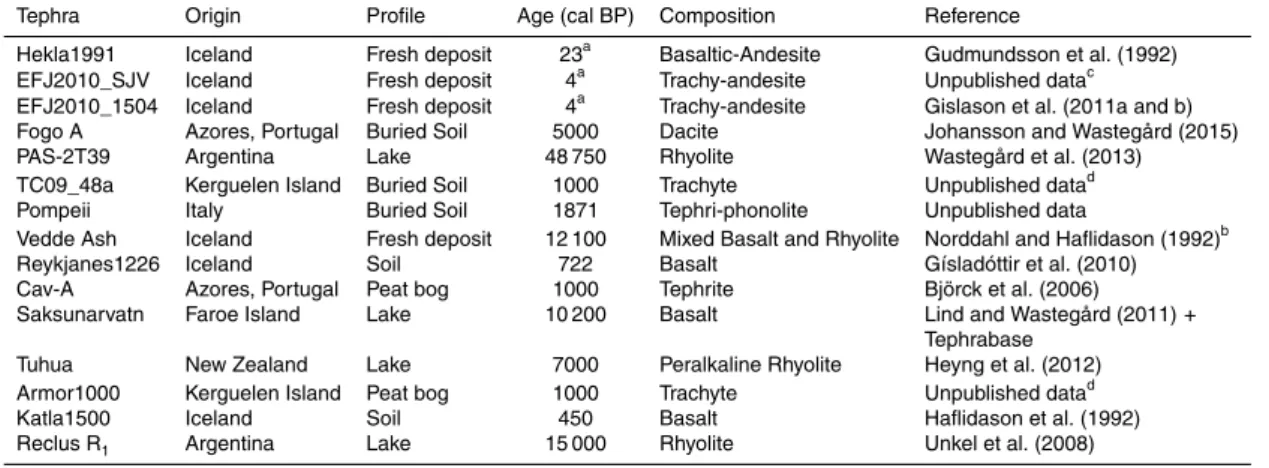
Fifteen samples reported as tephra-containing and covering a representative range
5
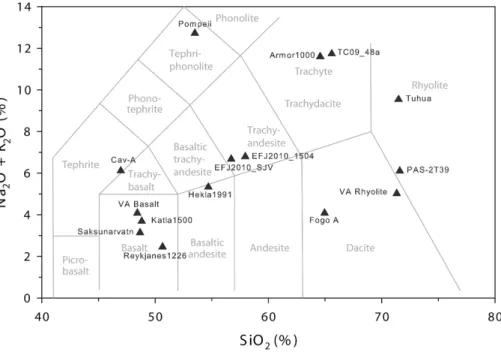
of chemical composition (basaltic to rhyolitic), eruption dates (from 2010 AD un-til 48 ka BP), geographical provenance (northern and southern latitudes) and envi-ronments (fresh deposits, soils, lakes and peat archives) have been retrieved from archived samples (Table 1; Fig. 1). We used tephra collections from tephra deposits described previously in soil and paleoecological studies representing a gradient in
10
weathering state.
2.2 Sample treatment
All samples were split in two parts to develop two distinct sample sets: untreated vs. treated. Untreated samples were immediately subjected to alkaline extraction (Sect. 2.3). The goal of treating samples is to isolate relatively pure biogenic and
vol-15
canic glass derived fractions, which will allow us to evaluate the robustness of the infer-ences made from the dissolution of the untreated samples. Samples were subjected to standard pre-treatment and heavy-liquid separation, described below, with additional magnetic separation or sieving steps where necessary (Mackie et al., 2002; Morley et al., 2004; Turney, 1998).
20
2.2.1 Pre-treatment
BGD
12, 3505–3545, 2015Implications for soil and paleoecological
studies
W. Clymans et al.
Title Page
Abstract Introduction
Conclusions References
Tables Figures
◭ ◮
◭ ◮
Back Close
Full Screen / Esc
Printer-friendly Version Interactive Discussion
Discussion
P
a
per
|
Discussion
P
a
per
|
Discussion
P
a
per
|
Discussion
P
a
per
|
reaction cessation. One millilitre of 10 % HCl solution was added to disaggregate the material and dissolve any soluble inorganics (e.g. carbonates) and left until the reaction ceased. After each treatment step, the sample was washed three times in deionized water (MilliQ).
2.2.2 Heavy-liquid separation
5
Heavy liquid separation is used to obtain concentrated siliceous organism samples (i.e. diatoms and sponges) (Morley et al., 2004) and concentrated glass shard sam-ples (e.g. Turney, 1998). The biogenic part is concentrated by centrifuging in sodium polytungstate (SPT) having a relative density of 2.3 g cm−3. Prior to each centrifuge step, samples were thoroughly mixed, and if necessary placed in an ultrasonic bath to
10
disaggregate the material. The floating material (<2.3 g cm−3) was dried (70◦C) and assessed with SEM for purity, i.e. biogenic material, or possible contamination from pumice and other non-biogenic light fractions. The residue (>2.3 g cm−3) was cen-trifuged in SPT at a relative density of 2.5 g cm−3. Both floating material (between 2.3 and 2.5 g cm−3) and residue (>2.6 g cm−3) were washed with MilliQ. The latter should
15
contain heavy minerals, and only a limited amount of glass shards, which should in-stead be concentrated within the 2.3 to 2.5 g cm−3 bracket. All residues were micro-scopically checked for their purity.
The separation only rarely resulted in high-purity end-products. Additional ad hoc sample specific treatments were conducted to improve the separation. In case of
20
high concentration of low-density shards (e.g. pumice) within the biogenic sample (< 2.3 g cm−3), a wet-sieving step was used to separate the biogenic siliceous bodies from
shards. Size-distributions for each fraction were determined using light microscopy (Nikon SMZ1500, x16) and the NIS-Elements software for size measurements. The se-lected mesh size corresponded with the point of minimum overlap. In case of basaltic
25
BGD
12, 3505–3545, 2015Implications for soil and paleoecological
studies
W. Clymans et al.
Title Page
Abstract Introduction
Conclusions References
Tables Figures
◭ ◮
◭ ◮
Back Close
Full Screen / Esc
Printer-friendly Version Interactive Discussion
Discussion
P
a
per
|
Discussion
P
a
per
|
Discussion
P
a
per
|
Discussion
P
a
per
|
2.3 Alkaline extraction techniques
Two different alkaline extractions were used to determine the Si
Alkcontent and
dissolu-tion characteristics of the untreated and the isolated tephra and biogenic silica fracdissolu-tions of the treated samples: the sequential 0.1 M Na2CO3 and the continuous 0.5 M NaOH method.
5
2.3.1 Sequential wet-alkaline extraction method: 0.1 M Na2CO3
The Na2CO3 extraction is a weak-base method developed by DeMaster (1981) who described that while alumino-silicates release Si linearly over time, most BSi dis-solves completely within the first 2 h of the digestion. In our analysis (Conley and Schelske, 2001), approximately 30 mg of dried sample (<2 mm) was mixed in 40 mL
10
of 0.1 M Na2CO3 solution and digested for 5 h at 85◦C. A 0.5 mL aliquot was removed after 3, 4 and 5 h and neutralized with 4.5 mL of 0.021 M HCl, before DSi determination by the automated molybdate-blue method (Grasshoffet al., 1983) using a Smartchem 200 (AMS Systea) discrete analyser. The SiAlkwas calculated by determining the inter-cept of the regression between total extracted Si and extraction time. Extrapolating the
15
Si release to the intercept is assumed to correct for mineral dissolution of Si. To evalu-ate its suitability to correct for mineral dissolution, the typical subsampling scheme was prolonged to 24 h and additional 0.5 mL subsamples were taken at 9, 10 and 11 h and again at 20, 22 and 24 h, and diluted in 9.5 mL 0.010 M HCl instead of 4.5 mL to obtain optimal dilution.
20
2.3.2 Continuous extraction method: 0.5 M NaOH
We applied a stronger NaOH (0.5 M) digestion protocol (Barão et al., 2014; Koning et al., 2002) with continuous monitoring of the extracted Si and aluminium (Al) con-centration through time. Briefly, between 20 and 100 mg of a sample was mixed with 180 mL of 0.5 M NaOH (pH=13.7) in a stainless steel vessel. The vessel was
BGD
12, 3505–3545, 2015Implications for soil and paleoecological
studies
W. Clymans et al.
Title Page
Abstract Introduction
Conclusions References
Tables Figures
◭ ◮
◭ ◮
Back Close
Full Screen / Esc
Printer-friendly Version Interactive Discussion
Discussion
P
a
per
|
Discussion
P
a
per
|
Discussion
P
a
per
|
Discussion
P
a
per
|
bated in a water bath at a constant temperature of 85◦C and continuously stirred with a rotor to obtain a homogeneous mixture. The vessel was sealed to prevent evaporation. The extraction fluid was fed into a Skalar continuous flow analyzer at 0.42 mL min−1. Si and Al concentrations were determined simultaneously using the spectrophotometric molybdate–blue method for Si (Grasshoffet al., 1983) and
lumo-5
gallion fluorescence for Al (Hydes and Liss, 1976) for 30–40 min.
A simultaneous fit of dissolved Si and Al curves was performed using Eq. (1).
Sit=
n
X
x=1
SiAlk,x×(1−e−kx×t) !
+b×t (1)
Alt=
n
X
x=1 SiAlk,x
Si : Alx ×(1−e −kx×t)
!
+ b×t
Si : Almin
where Sit and Alt is the pool of extracted silica and aluminum at time t (µmol L−1);
10
SiAlk,xis the total pool of SiAlk(µmol L−1) of fractionx;k is a parameter that reflects the non-linear reactivity of the sample (min−1); b reflects the linear reactivity and Si : Alx and Si : Almin represent their respective Si : Al ratios. The dissolution curves of Si and Al were used to identify fractions based on their Si : Al ratios. This principle was first applied by Koning et al. (2002) in marine sediment samples, where almost all alkaline
15
extracted Si has a biogenic source, overprinted by a low Si : Alx component from clay minerals dissolution. They showed that some fractions that would be considered as biogenic using linear phase extrapolation (i.e. the sequential extraction, above) were actually clay contamination, based on the low Si : Alx ratios (between 1 and 4) in these fractions. We hypothesize that glass from tephra will resemble such behaviour because
20
of their relatively high Al content.
BGD
12, 3505–3545, 2015Implications for soil and paleoecological
studies
W. Clymans et al.
Title Page
Abstract Introduction
Conclusions References
Tables Figures
◭ ◮
◭ ◮
Back Close
Full Screen / Esc
Printer-friendly Version Interactive Discussion
Discussion
P
a
per
|
Discussion
P
a
per
|
Discussion
P
a
per
|
Discussion
P
a
per
|
3 Results
3.1 Sequential wet-alkaline extraction method: 0.1 M Na2CO3
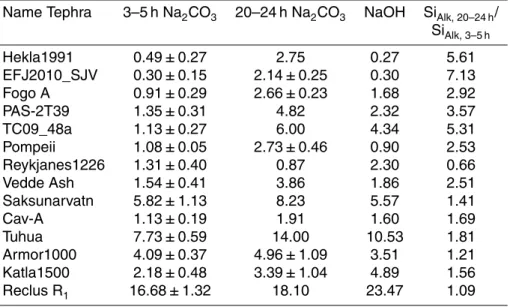
Alkaline silica (SiAlk) extracted from a total of 14 tephra-containing samples (EFJ2010_1504 not included) based on the 3–5 h mineral dissolution slope (MDS) vary between 0.3 and 16.7 wt.% SiO2with an average of 3.01±3.91 wt.% SiO2. MDS ranges
5
between 0.03 and 0.65 wt.% SiO2h−1with an average of 0.35
±0.21 wt.% SiO2h−1. This
high standard deviation suggests variability within samples, but is heavily influenced by two outliers (Reclus R1and Tuhua tephra); median SiAlkand MDS are 1.56 wt.% SiO2 and 0.28 wt.% SiO2h−1, respectively.
The median SiAlkusing the 20–24 h MDS was 3.63 wt.% SiO2 with a median slope
10
of 0.12 wt.% SiO2h−1. A pairedttest (signed rank) showed that both (corrected) Si
Alk
concentrations and MDS differed significantly between the 3–5 h and the 20–24 h sam-pling intervals.
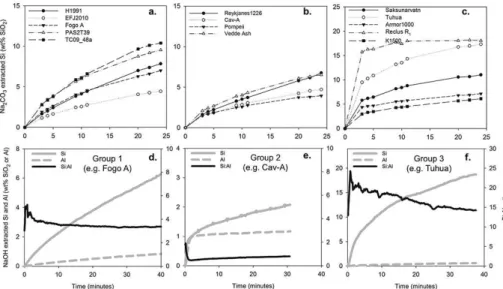
There is a large variability in the shape of the curves in extracted Si through time (Fig. 2). Some samples exhibit a continuously gently decreasing slope with time
15
(Fig. 2a), while others show initial rapid dissolution followed by a steep linear increase (Fig. 2b), whereas others increase rapidly but are followed by no increase or only a min-imal increase in Si extracted with time (Fig. 2.c). Numerically, we define this gradient through comparing the SiAlkafter 3–5 h with those obtained after 20–24 h (Table 2): we observe respectively high (3.0–7.1), medium (1.5–2.5) and low (1–1.8) ratios. Ideally,
20
BGD
12, 3505–3545, 2015Implications for soil and paleoecological
studies
W. Clymans et al.
Title Page
Abstract Introduction
Conclusions References
Tables Figures
◭ ◮
◭ ◮
Back Close
Full Screen / Esc
Printer-friendly Version Interactive Discussion
Discussion
P
a
per
|
Discussion
P
a
per
|
Discussion
P
a
per
|
Discussion
P
a
per
|
3.2 Continuous alkaline extraction method: 0.5 M NaOH
3.2.1 Curve decomposition
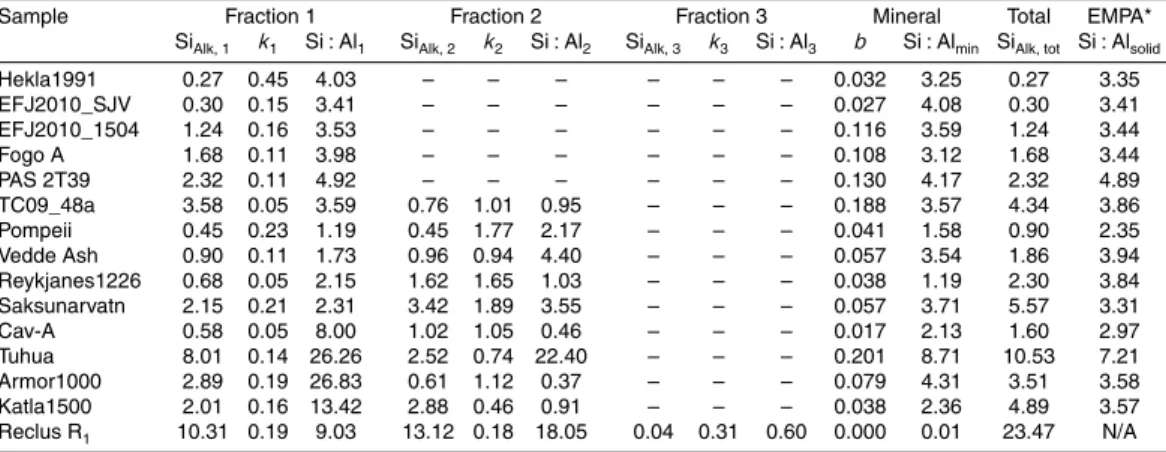
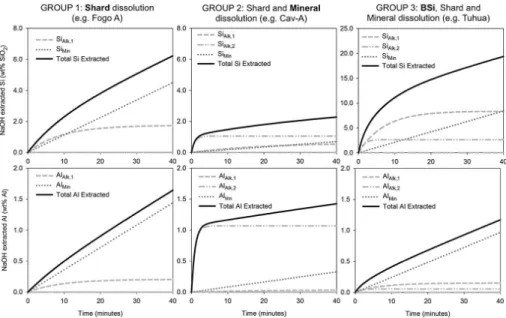
Results of curve fitting the continuous monitored Si and Al data during the extractions are presented in Table 3 and Figs. 2 and 3. SiAlkconcentrations vary between 0.27 and 23.4 wt.% SiO2 with an average of 4.54±6.08 wt.% SiO2 and a median of 2.31 wt.%
5
SiO2. These values are significantly higher than those measured during the Na2CO3 3–5 h extraction (Sect. 3.1;p=0.0016), but do not differ significantly with the Na
2CO3
20–24 h extraction (p=0.1540; non-parametric t test). However, relative differences
between the two values can be up to factor 2–5, and values tend to be lower than those measured during the Na2CO320–24 h extraction.
10
The shape of the dissolution curves suggests the presence of three distinct disso-lution patterns similar to using the Na2CO3 methodology. A first set of curves show a gently decreasing slope with time, and limited contribution of Al (Fig. 2d – Group 1). The second set of curves shows a rapid increase at the onset for both Si and Al, and afterwards evolves towards a more linear increase (Fig. 2e – Group 2). The final set
15
is characterized by a rapid increase at the onset with varying contributions of Al, but mostly an order of magnitude lower than extracted Si concentrations with a near zero or high mineral dissolution slope (Fig. 2f – Group 3).
Optimal fits of the model to predict the dissolution curve included between one to three different SiAlk fractions each with a specifick parameter and Si to Al ratio
(Ta-20
ble 3). We used the number of non-linear fractions (first order – see Eq. 1) and their Si : Alx to group the samples (see discussion, Fig. 2d–f, and Table 3). One group of samples exhibited one non-linear fraction that was released slowly with ak between 0.05 and 0.5 min−1. The linear dissolution is responsible for the majority of the increase in Si and Al concentrations through time. Si : Alx ratios for both fractions are
approxi-25
mately equal and range between 3 and 5.
BGD
12, 3505–3545, 2015Implications for soil and paleoecological
studies
W. Clymans et al.
Title Page
Abstract Introduction
Conclusions References
Tables Figures
◭ ◮
◭ ◮
Back Close
Full Screen / Esc
Printer-friendly Version Interactive Discussion
Discussion
P
a
per
|
Discussion
P
a
per
|
Discussion
P
a
per
|
Discussion
P
a
per
|
dissolution. The Si : Alx ratio of the slow fraction falls between 1 and 2.5. The rapid reaction releases typically more Al leading to low Si : Al ratios (<1). The Si : Almin ratio of the linear fraction ranges between 1 and 3.5. Finally, two fractions that dissolve non-linearly typify a third set of samples: a rapid (k >0.7 min−1) fraction with Si : Alxmostly below 1 and a slow fraction (k <0.5 min−1) with Si : Al
xabove 8. One exception (Reclus
5
R1) has three fractions but no mineral fraction and differs by having two slow fractions
instead of one.
3.2.2 Validation of curve decomposition procedure
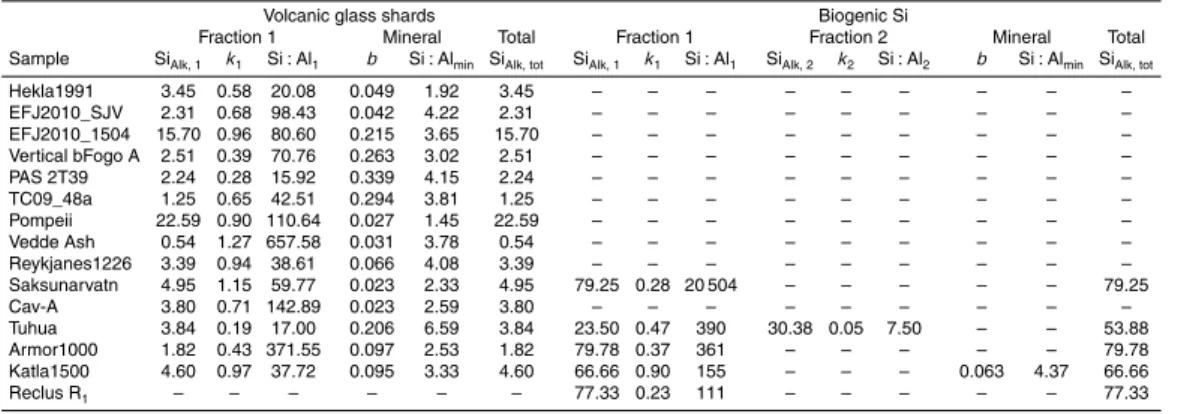
Dissolution curves using 0.5 M NaOH for all concentrated shard samples (rhyolitic: be-tween 2.3 to 2.5 g cm−3; basaltic >2.5 g cm−3) were best approximated with a single
10
non-linear fraction and a linear (i.e. mineral) fraction indicating successful physical sep-aration of shards (see Table 4). Mineral dissolution contributions were typically large in total Si and Al release, being the main source after on average 5 min of dissolution for Al release. The initial Si and Al release appears to be faster than before the cleaning and separation treatment. This is reflected in higher Si : Alx ratios andk values. One
15
exception – the Reclus R1sample – did not contain a retrievable amount of shards. The BSi rich samples (<2.3 g cm−3) were fitted with a single non-linear fraction in absence of a linear fraction. The only exception is the Tuhua tephra where two non-linear fractions with varying dissolution rate were fitted: defined as a rapid (0.47) and slow (0.05)k. All Si : Alxwere higher than 100. The total extracted Si content averaged
20
on 72±11 wt.% SiO2.
4 Discussion
Earlier studies have hypothesized that volcanic glass shards substantially contribute to measured SiAlk (Cornelis et al., 2011b; Lyle and Lyle, 2002; Sauer et al., 2006). In the following, we discuss the specific dissolution characteristics of glass shards, during
BGD
12, 3505–3545, 2015Implications for soil and paleoecological
studies
W. Clymans et al.
Title Page
Abstract Introduction
Conclusions References
Tables Figures
◭ ◮
◭ ◮
Back Close
Full Screen / Esc
Printer-friendly Version Interactive Discussion
Discussion
P
a
per
|
Discussion
P
a
per
|
Discussion
P
a
per
|
Discussion
P
a
per
|
alkaline extraction and implications for soil and paleoecological studies. We formulate guidelines for the use of alkaline extraction techniques to determine BSi in soils and sediments.
4.1 Incomplete dissolution during digestion
In theory, SiAlk should be insensitive to the choice of aliquot times during Na2CO3
5
extraction, if the dissolution of minerals does not violate the two key assumptions of the original protocol outlined by DeMaster (1981): (i) complete dissolution of all SiAlk fractions within three hours, and (ii) the mineral fraction should exhibit linear behavior during the course of the dissolution experiment. The linear behavior is assumed to be caused by minimal changes in reactive surface area of crystalline minerals during
10
dissolution in a weak base, e.g. 0.1 M Na2CO3.
Higher SiAlk concentrations (Table 2) and lower MDS values after 20–24 h for our samples suggest a prolonged non-linear behavior. We interpret this as evidence for incomplete dissolution of alkali extractable fractions within the first 3 h of extraction. Complete dissolution of glass takes considerably longer than 3 h causing SiAlk to be
15
underestimated when sub-sampling only over the 3–5 h time period. In addition, a de-crease in reactivity during the 24 h extraction violates the second assumption. Our samples must contain another fraction that violates the second assumption, and only reaches a state of apparent linear dissolution after the 5 h sampling.
We observe a gradient in the severity (high degree, medium degree and low
de-20
gree) of incomplete dissolution expressed as the deviation from an ideal SiAlk (22– 24 h/3–5 h) ratio of 1. Samples were grouped according to their extent of deviation from the ideal. Most samples are not newly formed pure volcanic deposits but instead are a complex set of samples from lakes, soils and peat bogs (Table 1). We suggest that the differences in the extent of dissolution and in their dissolution curves represent
25
BGD
12, 3505–3545, 2015Implications for soil and paleoecological
studies
W. Clymans et al.
Title Page
Abstract Introduction
Conclusions References
Tables Figures
◭ ◮
◭ ◮
Back Close
Full Screen / Esc
Printer-friendly Version Interactive Discussion
Discussion
P
a
per
|
Discussion
P
a
per
|
Discussion
P
a
per
|
Discussion
P
a
per
|
4.2 Towards separation of the different fractions
The use of Si : Al ratios using the continuous NaOH extraction methodology can im-prove the interpretation of dissolution and uncertainty of the Si source (Barão et al., 2014). NaOH should also be more efficient in dissolving all amorphous and nanocrys-talline material present (Müller and Schneider, 1993; Gehlen and van Raaphorst,
5
1993). We combine dissolution parameters in NaOH with microscopy to attribute spe-cific dissolving or releasing fractions to our three defined groups (see Sect. 3.2.1 and Fig. 3).
4.2.1 A shard signature
Group 1 represents relatively pure tephra samples (Fig. 2a and d) where dissolution of
10
glass shards dominates. Our data suggests that glass shards release the majority of Si and Al at a rapid and a constant rate during the time period (ca. 30 min) we monitor dissolution in NaOH. In contrast to Na2CO3, the stronger NaOH seems to obtain ap-parent linear dissolution within the course of the experiment, after an initial non-linear release. This initial decrease in reactivity followed by a substantial constant Si and Al
15
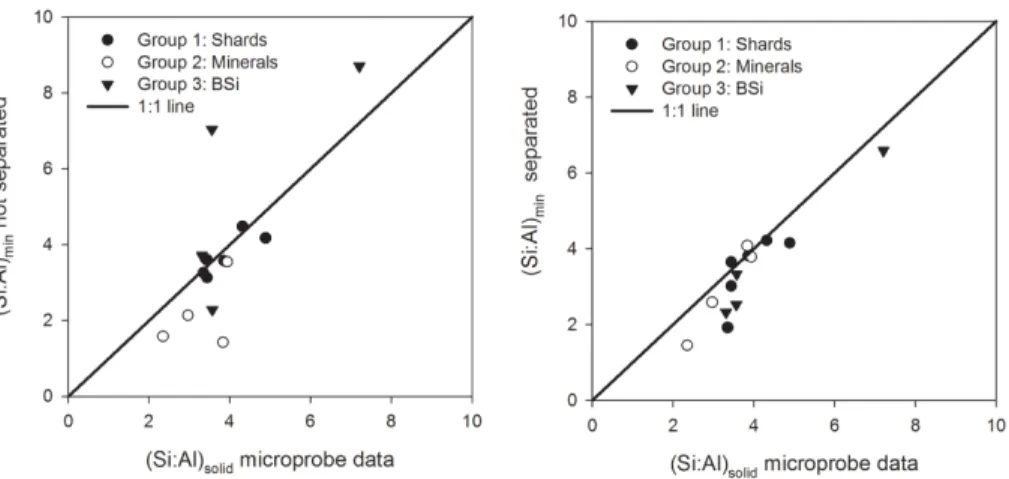
release corroborates previous observations describing the stoichiometric dissolution of glass shards (Oelkers and Gislason, 2001; Stephens and Hering, 2004). Si : Al ratios of the non-linear SiAlkand linear fraction coincide with Si : Al ratios from unweathered glass shards (Si : AlSolid). Si : Al ratios of the pure tephra samples (presumably mainly glass) are plotted along the 1 : 1 line demonstrating stoichiometric behavior (Fig. 4a).
20
Oelkers and Gislasson (2001) delivered a theoretical framework for volcanic glass shard dissolution at acidic and alkaline conditions that adequately describes our ob-served dissolution patterns in both Na2CO3 and NaOH solutions. Initially, proton ex-change reactions will lead to the removal of univalent and divalent cations from the shard surfaces, followed by a partial removal of Al from the framework through the
25
BGD
12, 3505–3545, 2015Implications for soil and paleoecological
studies
W. Clymans et al.
Title Page
Abstract Introduction
Conclusions References
Tables Figures
◭ ◮
◭ ◮
Back Close
Full Screen / Esc
Printer-friendly Version Interactive Discussion
Discussion
P
a
per
|
Discussion
P
a
per
|
Discussion
P
a
per
|
Discussion
P
a
per
|
or two bridging oxygen atoms primarily located at the edges and tips of the shard. As smoothening of the shards progresses, and depending on the abundance of hydrated sites, the weakened state of Si at the edges can lead to faster release of Si at the onset, which decreases as the edges become rounded. The rounding of edges is responsi-ble for the observed SiAlk content when glass shards are dissolved. Afterwards, glass
5
shards will continue to release Si and Al at a steady stoichiometric rate (see also Hod-der et al., 1990). Hence, the dissolution pattern reflects the continuous but incomplete dissolution of glass shards. This process makes the dissolution of glass shards distinct from the dissolution of other non-biogenic (e.g. nanocrystalline minerals) or biogenic fractions and adsorbed Si and Al release. These processes occur rapidly at the onset
10
of NaOH extraction but do not lead to a fast constant release after unspecified time (Barão et al., 2014; Hashimoto and Jackson, 1958).
Based on the pure samples of tephra (i.e. glass rich), we suggest that shards have a distinct dissolution signature discernable using continuous monitoring during a 0.5 M NaOH extraction. The three defining characteristics are: (1) the mineral
disso-15
lution slope is extremely high (0.028–0.120 wt.% SiO2min−1) with (2) a Si : Al ratio in the extracted aqueous phase between 3 and 5 equal to that of un-weathered shards confirming stoichiometric dissolution and its volcanic origin, and (3) a slow non-linear fraction with (Si : Alaq/Si : Alsolid)=±1 indicates an initial stoichiometric dissolution
un-til edges are rounded (Table 3; Fig. 4). Re-analysis with the NaOH method of isolated
20
glass shards is consistent with a constant and stoichiometric dissolution of shards with time (Fig. 5b). Unfortunately, chemical pre-treatment with HCl and H2O2 has affected the dissolution characteristics of the shards creating an initial more rapid release of Si and Al.
We propose that acidic conditions during the cleaning procedure lead to partial
dis-25
BGD
12, 3505–3545, 2015Implications for soil and paleoecological
studies
W. Clymans et al.
Title Page
Abstract Introduction
Conclusions References
Tables Figures
◭ ◮
◭ ◮
Back Close
Full Screen / Esc
Printer-friendly Version Interactive Discussion
Discussion
P
a
per
|
Discussion
P
a
per
|
Discussion
P
a
per
|
Discussion
P
a
per
|
of Si (Oelkers and Gislason, 2001). However, Al is preferentially released due to the formation of a silica gel layer at pH<9 with a thickness depending on the exposure time to acids (Pollard et al., 2003). Of course, addition to an alkaline environment led to a rapid dissolution of any enriched silica gel coating. This provides an explanation for the high Si : Alx ratios and rapid Si release rates after pre-treatment (Table 4). We
5
advise against chemical pre-treatment when analyzing for BSi, because it causes the extraction of non-biogenic fractions.
4.2.2 Discerning a shard signature from non-biogenic SiAlk
In group 2 and 3 (Fig. 2), multiple non-linear fractions were observed when modelling dissolution curves. We attribute the contribution of shards to the SiAlk fraction that
10
evolves slowest to constant release (i.e. lowest k) while a low Si : Alx ratio suggests
a non-biogenic source for the more rapid second SiAlkfraction.
Group 2 and 3 are samples from lake, soil and peat records. Here, shards are mixed with a variety of materials during deposition including organic carbon, miner-als and siliceous organisms. The tephra samples with the highest contribution of the
15
secondary SiAlk fraction (e.g. Katla, Reykjanes, Saksunarvatn) have a lower stability according to Pollard’s theoretical stability modeling (2003). Likewise, the Parker index value for the Tuhua tephra indicates a higher propensity for rapid weathering (Lowe, 1988). We suggest that enhanced weathering in these environments leads to the for-mation of secondary mineral and nanocrystalline fractions (Hodder et al., 1990). This
20
would create an additional non-biogenic, alkaline extractable source. Such weathering products are typically enriched in Al with structural Si : Alx ratios between 1–3 for clay minerals (Dixon and Weed, 1989) and below 1 for nanocrystalline structures (Levard et al., 2012). In fact, they dissolve or release Si and Al more rapidly, and sometimes incongruently, at the beginning of a NaOH extraction (Hashimoto and Jackson, 1958;
25
BGD
12, 3505–3545, 2015Implications for soil and paleoecological
studies
W. Clymans et al.
Title Page
Abstract Introduction
Conclusions References
Tables Figures
◭ ◮
◭ ◮
Back Close
Full Screen / Esc
Printer-friendly Version Interactive Discussion
Discussion
P
a
per
|
Discussion
P
a
per
|
Discussion
P
a
per
|
Discussion
P
a
per
|
clay dissolution (Si : Alx ratio: 1–4) or complete dissolution of nanocrystalline minerals (Si : Alxratio: 0.5–1).
Clay minerals will dissolve at a constant rate after an initial rapid release (Koning et al., 2002) similar to primary glass shards. Consequently, the linear part of the disso-lution will reflect stoichiometric dissodisso-lution of glass shards (Si : Alminratio: 3–5) and clay
5
minerals (Si : Almin ratio: 1–3). Samples with increased abundance of clay contribution will have lowered Si : Almin ratios compared to un-weathered shards (Fig. 4a).
4.2.3 Discerning a shard signature from biogenic SiAlk
In group 3, higher Si : Alx ratios>5 for the slower fraction suggest the presence of an additional biogenic SiAlkfraction. Biogenic fractions including diatoms, sponge spicules
10
and phytoliths were identified in these samples microscopically. BSi measurements of the separated biogenic fraction using the continuous NaOH methodology had a sin-gle non-linear SiAlkfraction, except Tuhua, with on average 72 wt.% SiO2. This fraction contains negligible amounts of Al and mineral dissolution is absent confirming the bio-genic nature of the separated material. The combined presence of diatoms and sponge
15
spicules in the Tuhua samples explains the observation of two distinct BSi fractions (based on reactivity), as alkaline dissolution rates are known to vary between different siliceous organisms (Conley and Schelske, 2001).
Hence, it seems that the rounding of glass shards overlaps with the dissolution of biogenic material, having similar reactivity but higher Si : Alxratios. The distinct pattern
20
of pure shards can be used to make a minimum estimate of its contribution to the slower reacting fraction. Identification of glass shards’ dissolution behavior is essential to evaluate the methods ability to estimate the biogenic SiAlkcontent and evaluate the relative contribution of shard dissolution to SiAlk. The separation is based on the near to one ratio between Si : Alx with the Si : AlSolid(Fig. 4).
25
BGD
12, 3505–3545, 2015Implications for soil and paleoecological
studies
W. Clymans et al.
Title Page
Abstract Introduction
Conclusions References
Tables Figures
◭ ◮
◭ ◮
Back Close
Full Screen / Esc
Printer-friendly Version Interactive Discussion
Discussion
P
a
per
|
Discussion
P
a
per
|
Discussion
P
a
per
|
Discussion
P
a
per
|
OR
Si
Al
1
≈
Si
Al
Solid
Assumption 2: All Al originates from shards for the slow fraction i.e. no Al release from the biogenic fraction. This leads to an overestimation of Al as small amounts (<0.05 wt.%) of Al are found in phytoliths and diatoms (Kameník et al., 2013; Van
5
Cappellen et al., 2002).
Al1=AlBsi+AlSolidwith AlBSi=0 So,
Al1=Al
Solid
The Si coming from shards can then be calculated by substitution:
10
SiSolid=
Si Al
Solid
·Al1
We know that,
Si1=SiBSi+SiSolid This delivers:
SiBsi=Si1−SiSolid
15
BGD
12, 3505–3545, 2015Implications for soil and paleoecological
studies
W. Clymans et al.
Title Page
Abstract Introduction
Conclusions References
Tables Figures
◭ ◮
◭ ◮
Back Close
Full Screen / Esc
Printer-friendly Version Interactive Discussion
Discussion
P
a
per
|
Discussion
P
a
per
|
Discussion
P
a
per
|
Discussion
P
a
per
|
R1sample did not contain observable amounts of shards, our results support the phys-ical observation of no retrievable shard fraction by heavy liquid separation. If anything, it supports the appropriateness of the chemical analysis to detect the occurrence of shards.
Initial dissolution of shard edges varies between 0.1 to 8 wt.% SiO2 with a median
5
contribution of 1.8 wt.% SiO2. The variation in contribution depends on how fragmented and weathered (i.e. partially dissolved) the glass shards are. There will be a decrease in its contribution if edges have been smoothed during natural dissolution processes. It shows that dissolution of glass shards can contribute substantially to the determination of BSi. Likewise, the non-biogenic Si sources (defined as “minerals” here) contribute
10
between 0.2 to 5 wt.% SiO2 with a median contribution equal to 0.89 wt.% SiO2. The combined effect potentially exceeds the biogenic fraction (e.g. K1500), while for others it contributes to less than 10 % of the total extracted Si pool (e.g. Armor1000 and Reclus R1).
4.3 The tephra factor in soil and paleoecological studies
15
4.3.1 Implications for soil scientists
The global median SiAlk in the top 1 m of the soil column using alkaline extraction techniques ranges between 0.79–1.12 wt.% SiO2 (e.g. Melzer et al., 2012; Saccone et al., 2007; Sommer et al., 2013). The magnitude overlaps with SiAlkcontent attributed to tephra, to the initial rapid dissolution of clay minerals and/or complete dissolution of
20
nanocrystalline fractions in our experiments (Fig. 5). A similar magnitude of Si release between soil samples and our untreated tephra samples during alkaline extraction, implies that the combined dissolution of glass shard, and their weathering products, if present, can disguise the environmental signal of the BSi proxy.
Glass shards are an important direct source of methodological bias in tephra-based
25
BGD
12, 3505–3545, 2015Implications for soil and paleoecological
studies
W. Clymans et al.
Title Page
Abstract Introduction
Conclusions References
Tables Figures
◭ ◮
◭ ◮
Back Close
Full Screen / Esc
Printer-friendly Version Interactive Discussion
Discussion
P
a
per
|
Discussion
P
a
per
|
Discussion
P
a
per
|
Discussion
P
a
per
|
the surface covers 6.6 % of the land surface (Hartmann and Moosdorf, 2012) and is known to contain limited amounts of glass shards, which are a potential source of SiAlk in soils. Further, glass shards can be an important component of soils developed in aeolian deposits in the Great Plains, USA (Reyerson, 2012). The inheritance of glass shards in some types of aeolian material might partly explain high SiAlk in aeolian
5
deposits measured by other studies (e.g. 4 wt.% SiO2; Saccone et al., 2007).
Limited knowledge of the mineralogical composition of our samples could have aided our classification of the non-biogenic fractions. Weathering products of glass shards are proposed to be the largest contributor to the SiAlkfraction. A Si : Alx ratio between 0.39 and 1.02 (5 out of 8 samples) for this fraction suggest its source to be
nanocrys-10
talline fractions. These fractions are typically described as allophanes and imogolites with a Si : Alx ratio between 0.5–1 (Levard et al., 2012), and dissolve completely within the first 5 min of alkaline extraction (Hashimoto and Jackson, 1958; Kamatani and Oku, 2000). Various studies have shown that these nanocrystalline minerals also develop in soils without a volcanic origin (Gustafsson et al., 1999; Parfitt, 2009). For example, in
15
podzols supersaturation of Al species at ambient dissolved Si concentration leads to the formation of allophanes and imogolites. Nanocrystalline structures are stable at ambient pH conditions above 5 (Parfitt, 2009). Extraction of SiAlk will include them in the biological pools (Clymans et al., 2014) and lead to an overestimation of BSi in both volcanic and non-volcanic soils at ambient pH conditions.
20
We recommend caution when interpreting SiAlk measurements from Andosols, or soils developed on volcanic bedrock, at sites where inheritance of volcanic material through aeolian or water deposition is likely. The NaOH method (after Koning et al., 2002) proved its ability to pinpoint problematic samples, and to separate the biogenic from non-biogenic fractions. The method delivers an excellent opportunity to improve
25
BGD
12, 3505–3545, 2015Implications for soil and paleoecological
studies
W. Clymans et al.
Title Page
Abstract Introduction
Conclusions References
Tables Figures
◭ ◮
◭ ◮
Back Close
Full Screen / Esc
Printer-friendly Version Interactive Discussion
Discussion
P
a
per
|
Discussion
P
a
per
|
Discussion
P
a
per
|
Discussion
P
a
per
|
4.3.2 Implications for paleoecological studies
Biogenic silica, estimated as SiAlk, has proven to be a valuable tool in paleoecological studies as an indicator of environmental changes (e.g. changes in productivity, cli-mate, precipitation and nutrient supply). In lacustrine sediment cores, BSi content can range from the detection limit to>70 wt.% SiO2 (Frings et al., 2014a). The downcore
5
variations in BSi through time vary from as little as 2 wt.% SiO2 (Adams and Finkel-stein, 2010; Ampel et al., 2008) to a high of 10–20 wt.% SiO2 (Johnson et al., 2011; Prokopenko et al., 2006) and depends on several interacting factors such as mineral matter or organic matter accumulation, diatom productivity and preservation/dissolution processes. Hence, these processes control the relative effect that tephra constituents
10
(<3 wt.% SiO2, Fig. 5) have on SiAlk determination. In paleorecords, where there is a potential contribution of tephra combined with low SiAlkconcentrations or small down-core variations in SiAlk, the use of SiAlkas an environmental proxy should be used with caution.
The accuracy of the alkaline extraction methods as a proxy for BSi concentrations
15
in sediment will depend on the origin of the mineral matter. Koning et al. (2002) sug-gested that good results with the NaOH method can be obtained for BSi/clay ratios of about 0.005, whereas for Na2CO3 good values can be obtained from a 0.02 ratio. We show that for tephra samples it is a bit more complicated as rounding of the glass shards edges and dissolution of its weathering products (i.e. nanocrystalline
miner-20
als and secondary minerals) also contribute to the apparent BSi fraction. Obviously, the spatial and therefore temporal extent of potential contribution is restricted to core sections representing episodes of (1) direct tephra deposition, and subsequent in-situ reworking; or (2) indirect contribution through mobilization of tephra and its weathering products in a tephra covered landscape.
25
BGD
12, 3505–3545, 2015Implications for soil and paleoecological
studies
W. Clymans et al.
Title Page
Abstract Introduction
Conclusions References
Tables Figures
◭ ◮
◭ ◮
Back Close
Full Screen / Esc
Printer-friendly Version Interactive Discussion
Discussion
P
a
per
|
Discussion
P
a
per
|
Discussion
P
a
per
|
Discussion
P
a
per
|
water chemistry, causing altered diatom growth and/or preservation (for a review see Harper et al., 1986). In such case, the increase in BSi accumulation can be attributed to tephra deposition rather than to environmental changes. Reported timeframes wherein sustained effects of tephra on diatom productivity can be observed varies between 7 and more than 100 yr (cit. Barsdate and Dugdale, 1972 in Hickman and Reasoner,
5
1994). This temporal resolution can only be obtained in systems with a high accu-mulation rate and an excellent chronological constraint, e.g. in varved records (Lotter et al., 1995). On longer timescales, the effect of tephra deposition will be minimized and consequently BSi remains a stable and valid proxy (Hickman and Reasoner, 1994; Johnson et al., 2011).
10
We suggest that paleoecological studies reporting high temporally resolved records should rely on multiple proxies to reduce the risk of overestimation of the BSi content. The methods used in our study cannot distinguish between tephra induced diatom blooms and those resulting from short- or long-term environmental change. Neverthe-less, zones in a sediment record potentially prone to a tephra-induced bloom can be
15
highlighted based on reconnaissance of glass shard contributions. This research topic warrants further investigation.
4.3.3 Implications for pre-treatment steps of EPMA during tephrochronological studies
Tephrochronology requires geochemical fingerprinting of tephra through electron probe
20
microanalysis (EPMA) (Lowe, 2011). EPMA on tephra requires that they are unaltered by natural or laboratory processes. Unfortunately, tephra shards are sensitive to disso-lution at high and low pH, conditions that are both naturally occurring and frequently applied during pre-treatment (e.g. Blockley et al., 2005; Dugmore et al., 1992). There-fore, corrosive chemical pre-treatment is increasingly avoided in tephrochronological
25
BGD
12, 3505–3545, 2015Implications for soil and paleoecological
studies
W. Clymans et al.
Title Page
Abstract Introduction
Conclusions References
Tables Figures
◭ ◮
◭ ◮
Back Close
Full Screen / Esc
Printer-friendly Version Interactive Discussion
Discussion
P
a
per
|
Discussion
P
a
per
|
Discussion
P
a
per
|
Discussion
P
a
per
|
et al., 2013) should be used with great caution. Our study demonstrates that alkaline treatments lead to severe dissolution of shards, and can negatively affect the recon-naissance of shards for EPMA analysis. Our data show that dissolution of the shards was equivalent to 4 wt.% SiO2 in the first 40 min (Fig. 2a) and that a complete dissolu-tion is attained in less than a day. The severity of the dissoludissolu-tion effect depends on the
5
duration of extraction, the temperature at which extraction is performed and the molar-ity of the solution used (Müller and Schneider, 1993). Good criteria for NaOH cleaning are that extraction times should (1) allow complete BSi dissolution, and (2) limit shard dissolution to a maximum of 10 wt.% SiO2 so that a sufficient number of undamaged shards remain for EPMA analysis. Finally, the Si and Al data suggest stoichiometric
dis-10
solution of shards implying that their geochemical composition will remain unaltered. We cannot be conclusive as modeled Si : Al are too imprecise and the release of other dominant constituents (e.g. Na, K) were not monitored. EPMA on samples before and after alkaline treatment (preferentially NaOH) could resolve this issue.
5 Conclusions
15
Various wet chemical alkaline extraction techniques commonly used to measure SiAlk content have been criticized for their usefulness outside marine sciences. Problems are attributed to dissolution of non-biogenic fractions and incomplete dissolution of the biogenic fraction. We evaluated two alkaline extraction techniques using 0.1 M Na2CO3 and 0.5 M NaOH solutions for measuring SiAlkas a proxy for environmental change in
20
soil, peat and lake records with volcanic inputs.
Alkaline extraction techniques should be used with caution in tephra-based soil pro-files, soils developed on volcanic bedrock or soils with aeolian input containing vol-canic material. The influence of the dissolution of glass shards on BSi measurements in paleoecological records can be significant in oligotrophic environments with a low
25
Oth-BGD
12, 3505–3545, 2015Implications for soil and paleoecological
studies
W. Clymans et al.
Title Page
Abstract Introduction
Conclusions References
Tables Figures
◭ ◮
◭ ◮
Back Close
Full Screen / Esc
Printer-friendly Version Interactive Discussion
Discussion
P
a
per
|
Discussion
P
a
per
|
Discussion
P
a
per
|
Discussion
P
a
per
|
erwise, SiAlkdetermined with traditional alkaline methods can be freely used as a proxy to evaluate environmental changes, especially when part of a multi-proxy studies.
Determination of the time course of dissolution during the first 5 h of extraction using 0.1 M Na2CO3has proven to be a sensitive indicator of other forms of SiAlk. In addition, the sequential Na2CO3extraction is a rather simple method and the results show a high
5
recovery of the biogenic Si fraction (Meunier et al., 2014; Saccone et al., 2007). The main advantage of the method is that a relatively large number of samples can be measured in a relatively short time span. In environments with a high BSi content, the 0.1 M Na2CO3method is the preferred one.
We also show that the continuous monitoring of Si and Al extraction in NaOH
ad-10
dresses the main disadvantages of the sequential Na2CO3 method. Our analysis of pure tephra (i.e. mainly containing glass shards) samples provided important informa-tion about the dissoluinforma-tion characteristics of volcanic glass shards. Our study confirms that the dissolution of tephra contributes to SiAlk determination, but the distinct sig-nature of glass shard dissolution can help to isolate its contribution to the biogenic
15
fraction. Continuous monitoring of Si and Al is promoted to analyze complex samples from any environmental record to reduce uncertainty on biological reactive fractions. Future studies should address the reliability and precision of the separation of different
fractions through modelling of dissolution parameters.
Author contributions. W. Clymans, N. Van der Putten, D. J. Conley were responsible for the
20
concept and design of this study. S. Wastegård, S. Björck, N. Van der Putten, B. Moine and G. Gísladóttir advised on, and helped with sample collection. W. Clymans, L. Barão and N. Van der Putten prepared and analyzed samples. W. Clymans was responsible for data analysis and interpretation with inputs on methodology of L. Barão, E. Struyf and D. J. Conley, and interpretation of paleoecological data by all other authors. W. Clymans provided a first draft. All
25
authors contributed to the writing of the paper.
Acknowledgements. The following people are thanked for their invaluable assistance: S. R. Gíslason for providing fresh tephra (Eyjafjallajökull). A. Cools, D. U. Belmonte for assistance during the continuous extractions. A. Gosh helping with microscopic analysis. G. Fontorbe, P. Abbott, S. Davies for advice on sample preparation. Comments by P. Frings,
BGD
12, 3505–3545, 2015Implications for soil and paleoecological
studies
W. Clymans et al.
Title Page
Abstract Introduction
Conclusions References
Tables Figures
◭ ◮
◭ ◮
Back Close
Full Screen / Esc
Printer-friendly Version Interactive Discussion
Discussion
P
a
per
|
Discussion
P
a
per
|
Discussion
P
a
per
|
Discussion
P
a
per
|
G. Fontorbe, H. Alfredsson, B. Alvarez de Glasby, and J. Stadmark improved the manuscript. This research was funded by the Knut & Alice Wallenberg Foundation, FWO en Belspo (SOGLO). LB thanks Special Research Funding from the University of Antwerp (BOF-UA and NOI) for the PhD fellowship funding.
References
5
Adams, J. K. and Finkelstein, S. A.: Watershed-scale reconstruction of middle and late Holocene paleoenvironmental changes on Melville Peninsula, Nunavut, Canada, Quaternary Sci. Rev., 29, 2302–2314, doi:10.1016/j.quascirev.2010.05.033, 2010.
Ampel, L., Wohlfarth, B., Risberg, J., and Veres, D.: Paleolimnological response to mil-lennial and centennial scale climate variability during MIS 3 and 2 as suggested
10
by the diatom record in Les Echets, France, Quaternary Sci. Rev., 27, 1493–1504, doi:10.1016/j.quascirev.2008.04.014, 2008.
Andresen, C. S., Björck, S., Bennike, O., and Bond, G.: Holocene climate changes in southern Greenland: evidence from lake sediments, J. Quaternary Sci., 19, 783–795, doi:10.1002/jqs.886, 2004.
15
Barão, A., Vandevenne, F., Clymans, W., Frings, P., Ragueneau, O., Meire, P., Conley, D. J., and Struyf, E.: Alkaline-extractable silicon from land to ocean: a challenge for biogenic Silicon determination., Limnol. Oceanogr.-Meth., in press, 2015.
Barão, L., Clymans, W., Vandevenne, F., Meire, P., Conley, D., and Struyf, E.: Pedogenic and biogenic alkalineextracted silicon distributions along a temperate landuse gradient, Eur. J.
20
Soil Sci., 65, 693–705, 2014.
Björck, S., Rittenour, T., Rosén, P., França, Z., Möller, P., Snowball, I., Wastegård, S., Ben-nike, O., and Kromer, B.: A Holocene lacustrine record in the central North Atlantic: proxies for volcanic activity, short-term NAO mode variability, and long-term precipitation changes, Quaternary Sci. Rev., 25, 9–32, doi:10.1016/j.quascirev.2005.08.008, 2006.
25
BGD
12, 3505–3545, 2015Implications for soil and paleoecological
studies
W. Clymans et al.
Title Page
Abstract Introduction
Conclusions References
Tables Figures
◭ ◮
◭ ◮
Back Close
Full Screen / Esc
Printer-friendly Version Interactive Discussion
Discussion
P
a
per
|
Discussion
P
a
per
|
Discussion
P
a
per
|
Discussion
P
a
per
|
Churchman, J. and Lowe, D. J.: Alteration, formation, and occurrence of minerals in soils, in:, Handbook of Soil Sciences, vol. 1: Properties and Processes, 2nd edn., edited by: Huang, P. and Li, Y., CRC Press, Boca Raton, FL, 20.1–20.71, 2012.
Clymans, W., Govers, G., Van Wesemael, B., Meire, P., and Struyf, E.: Amorphous silica anal-ysis in terrestrial runoffsamples, Geoderma, 167–168, 228–235, 2011a.
5
Clymans, W., Struyf, E., Govers, G., Vandevenne, F., and Conley, D. J.: Anthropogenic impact on amorphous silica pools in temperate soils, Biogeosciences, 8, 2281–2293, doi:10.5194/bg-8-2281-2011, 2011b.
Clymans, W., Lehtinen, T., Gísladóttir, G., Lair, G., Barão, L., Ragnarsdóttir, K., Struyf, E., and Conley, D.: Si precipitation during weathering in different icelandic andosols, Procedia Earth
10
Planet. Sci., 10, 260–265, 2014.
Conley, D. and Schelske, C.: Biogenic silica, in: Tracking Environmental Change Using Lake Sediments: Biological Methods and Indicators, edited by: Smol, J., Birks, H., and Last, W., Kluwer Academic Press, Dordrecht, the Netherlands, 281–293, 2001.
Conley, D., Schelske, C., and Stoermer, E.: Modification of the biogeochemical cycle of silica
15
with eutrophication, Mar. Ecol.-Prog. Ser., 101, 179–192, 1993.
Cornelis, J. T., Ranger, J., Iserentant, A., and Delvaux, B.: Tree species impact the terrestrial cycle of silicon through various uptakes, Biogeochemistry, 97, 231–245, doi:10.1007/s10533-009-9369-x, 2010.
Cornelis, J.-T., Titeux, H., Ranger, J., and Delvaux, B.: Identification and distribution of the
20
readily soluble silicon pool in a temperate forest soil below three distinct tree species, Plant Soil, 342, 369–378, doi:10.1007/s11104-010-0702-x, 2011a.
Cornelis, J.-T., Delvaux, B., Georg, R. B., Lucas, Y., Ranger, J., and Opfergelt, S.: Tracing the origin of dissolved silicon transferred from various soil-plant systems towards rivers: a review, Biogeosciences, 8, 89–112, doi:10.5194/bg-8-89-2011, 2011b.
25
Davies, S. M., Wastegård, S., and Wohlfarth, B.: Extending the limits of the Borrobol Tephra to Scandinavia and detection of new early Holocene tephras, Quaternary Res., 59, 345–352, 2003.
DeMaster, D.: The supply and accumulation of silica in the marine-environment, Geochim. Cos-mochim. Ac., 45, 1715–1732, 1981.
30
BGD
12, 3505–3545, 2015Implications for soil and paleoecological
studies
W. Clymans et al.
Title Page
Abstract Introduction
Conclusions References
Tables Figures
◭ ◮
◭ ◮
Back Close
Full Screen / Esc
Printer-friendly Version Interactive Discussion
Discussion
P
a
per
|
Discussion
P
a
per
|
Discussion
P
a
per
|
Discussion
P
a
per
|
Dugmore, A. J., Newton, A. J., Sugden, D. E., and Larsen, G.: Geochemical stability of fine-grained silicic Holocene tephra in Iceland and Scotland, J. Quaternary Sci., 7, 173–183, doi:10.1002/jqs.3390070208, 1992.
Fernández, M., Björck, S., Wohlfarth, B., Maidana, N. I., Unkel, I., and Van der Putten, N.: Di-atom assemblage changes in lacustrine sediments from Isla de los Estados, southernmost
5
South America, in response to shifts in the southwesterly wind belt during the last deglacia-tion, J. Paleolimnol., 50, 433–446, doi:10.1007/s10933-013-9736-4, 2013.
Frings, P., Clymans, W., Jeppesen, E., Lauridsen, T., Struyf, E., and Conley, D.: Lack of steady-state in the global biogeochemical Si cycle: emerging evidence from lake Si sequestration, Biogeochemistry, 117, 255–277, doi:10.1007/s10533-013-9944-z, 2014a.
10
Frings, P. J., Clymans, W., and Conley, D. J.: Amorphous Silica Transport in the Ganges Basin: Implications for Si Delivery to the Oceans, Procedia Earth Planet. Sci., 10, 271–274, 2014b. Gehlen, M. and van Raaphorst, W.: Early diagenesis of silica in sandy North sea sediments:
quantification of the solid phase, Mar. Chem., 42, 71–83, doi:10.1016/0304-4203(93)90238-J, 1993.
15
Gísladóttir, G., Erlendsson, E., Lal, R., and Bigham, J.: Erosional effects on terrestrial re-sources over the last millennium in Reykjanes, southwest Iceland, Quaternary Res., 73, 20–32, doi:10.1016/j.yqres.2009.09.007, 2010.
Gislason, S. R., Alfredsson, H. A., Eiriksdottir, E. S., Hassenkam, T., and Stipp, S. L. S.: Volcanic ash from the 2010 Eyjafjallajökull eruption, Appl Geochem, 26, S188–S190,
20
doi:10.1016/j.apgeochem.2011.03.100, 2011a.
Gislason, S. R., Hassenkam, T., Nedel, S., Bovet, N., Eiriksdottir, E. S., Alfredsson, H. A., Hem, C. P., Balogh, Z. I., Dideriksen, K., Oskarsson, N., Sigfusson, B., Larsen, G., and Stipp, S. L.: Characterization of Eyjafjallajokull volcanic ash particles and a protocol for rapid risk assessment, P. Natl. Acad. Sci. USA, 108, 7307–7312, doi:10.1073/pnas.1015053108,
25
2011b.
Grasshoff, K., Ehrhardt, M., and Kremling, K.: Methods of Sea Water Analysis, Verlag Chemie,
Weinheim, Germany, 314 pp., 1983.
Gudmundsson, A., Oskarsson, N., Gronvold, K., Saemundsson, K., Sigurdsson, O., Stefans-son, R., GislaStefans-son, S., EinarsStefans-son, P., Brandsdottir, B., Larsen, G., JohannesStefans-son, H., and
Thor-30
darson, T.: The 1991 eruption of Hekla, Iceland, B. Volcanol., 54, 238–246, 1992.
BGD
12, 3505–3545, 2015Implications for soil and paleoecological
studies
W. Clymans et al.
Title Page
Abstract Introduction
Conclusions References
Tables Figures
◭ ◮
◭ ◮
Back Close
Full Screen / Esc
Printer-friendly Version Interactive Discussion
Discussion
P
a
per
|
Discussion
P
a
per
|
Discussion
P
a
per
|
Discussion
P
a
per
|
Gustafsson, J. P., Bhattacharya, P., and Karltun, E.: Mineralogy of poorly crystalline aluminium phases in the B horizon of Podzols in southern Sweden, Appl. Geochem., 14, 707–718, doi:10.1016/S0883-2927(99)00002-5, 1999.
Haflidason, H., Larsen, G., and Ólafsson, G.: The recent sedimentation history of Thing-vallavatn, Iceland, Oikos, 64, 80–95, doi:10.2307/3545044, 1992.
5
Harper, M. A., Howorth, R., and McLeod, M.: Late Holocene diatoms in Lake Poukawa: effects of airfall tephra and changes in depth, New Zeal. J. Mar. Fresh., 20, 107–118, doi:10.1080/00288330.1986.9516135, 1986.
Hartmann, J. and Moosdorf, N.: The new global lithological map database GLiM: A repre-sentation of rock properties at the Earth surface, Geochem. Geophy. Geosy., 13, Q12004,
10
doi:10.1029/2012GC004370, 2012.
Hashimoto, I. and Jackson, M.: Rapid dissolution of allophane and kaolinite-halloysite after dehydration, in: 7th Natl. Conf. on Clays and Clay Minerals, Washington, 102–113, 1958. Heathcote, A., Ramstack Hobbs, J., Anderson, N. J., Frings, P., Engstrom, D., and Downing, J.:
Diatom floristic change and lake paleoproduction as evidence of recent eutrophication in
15
shallow lakes of the midwestern USA, J. Paleolimnol., 53, 17–34, doi:10.1007/s10933-014-9804-4, 2014.
Heyng, A. M., Mayr, C., Lücke, A., Striewski, B., Wastegård, S., and Wissel, H.: Environmental changes in northern New Zealand since the Middle Holocene inferred from stable isotope records (δ15N, δ13C) of Lake Pupuke, J. Paleolimnol., 48, 351–366,
doi:10.1007/s10933-20
012-9606-5, 2012.
Hickman, M. and Reasoner, M. A.: Diatom responses to late Quaternary vegetation and climate change, and to deposition of two tephras in an alpine and a sub-alpine lake in Yoho National Park, British Columbia, J. Paleolimnol., 11, 173–188, 1994.
Hodder, A., Green, B., and Lowe, D.: A two-stage model for the formation of clay minerals from
25
tephra-derived volcanic glass, Clay Miner., 25, 313–327, 1990.
Hydes, D. and Liss, P.: Fluorimetric method for the determination of low concentrations of dis-solved aluminium in natural waters, Analyst, 101, 922–931, 1976.
ISSS-ISRIC-FAO: World Reference Base for Soil Resources, World Soil Resources Reports, edited by: FAO, Rome, 1998.
30