American Journal of Engineering Research (AJER)
2015
American Journal of Engineering Research (AJER)
e-ISSN: 2320-0847 p-ISSN : 2320-0936
Volume-4, Issue-9, pp-108-119
www.ajer.org
Research Paper Open Access
Quali-quantitative evaluation for the definition of antiseismic
recovery interventions in historical buildings.
D. Colapietro
1, M. Pinto
3, A. Fiore
2,F. Fatiguso
1, G.C. Marano
2 1(Department of Civil Engineering, Environment and Territory, Construction and Chemistry, Politecnico di Bari, Via E. Orabona, 4 - BARI, Italy)
2
(Department of Civil Engineering and Architecture, Politecnico di Bari, Via E. Orabona, 4 - BARI, Italy)
3
(CFENG: Ingegneria Strutturale & Consulting, Via Ninna, 30 – CASAMASSIMA (BARI), Italy)
ABSTRACT:
The evaluation of the seismic vulnerability in historical buildings represents an area of recent interest in relation to the need to define appropriate interventions to improve the quality, compatibility with the historical-architectural characters, as well as with the static behaviour. The present work shows a completion of an operational methodology for the definition and evaluation of effectiveness of antiseismic recovery interventions in historical buildings defined qualitative-quantitative approach. The methodology allows you to define a coordinated system of structural interventions, appropriate in relation to the specific historical-architectural and technical-constructive characters of these structures giving a higher degree of security. The articulation operates as to take into account both the qualitative aspects, related to the technology of construction and to the rule of the art, and the quantitative aspects of the numerical analysis of the characteristics of resistance of the structural elements. The methodological approach has found a specific validation with reference to a masonry and concrete structure: a public housing complex called “Gruppo Piave – ex Gondar” in the city of Bari (Italy).Keywords
-
historic masonry building, qualitative-quantitative approach, linear and nonlinear analysis, seismic vulnerability, index of elastic-seismic improvement.I.
INTRODUCTION
all the aspects that are unlikely to be integrated within a mechanical model, even if it is refined. In this way the intervention, that comes from it, is certainly appropriate, because it poses as not a distortion of the "logic" (formal and spatial-material) of the pre-existent and in continuity with the "modal logic" (procedural) that it approves.
II.
O
BJECTIVE OF THE STUDY AND METHODThe following work presents a methodology for defining and assessing the effectiveness of interventions of earthquake recovery, defined quali-quantitative, through which improve the security level of an existing building, through a respect for its historicity. The approach selects quantitatively, as a result of dynamic analysis, combinations of interventions, adequately defined qualitatively related to conservative aspects of the product. In this way the need for conservation is not an obstacle but rather a guide to planning really effective antiseismic interventions. In other words, ways of knowledge and analysis are proposed in which the judgment on the suitability of an intervention emerges from the comparison between the ability of the structure, evaluated following a qualitative and quantitative knowledge of construction, and the seismic action. This comparison is not to be understood as binding occurs between strength of the structure and demand; on the contrary, it is attested, for each intervention, a quantitative parameter to bring into account, in conjunction with others, in a qualitative assessment that contemplates the desire to preserve the product from damage with seismic safety requirements about the enjoyment and the function [8]. The objective is to avoid unnecessary works, thus favoring the criterion of minimum intervention, but also by highlighting the cases in which it is appropriate to act more decisively. This study wants tohighlight only which can be made in full compliance with the historical nature of the construction and excluding the rest.
III.
Q
UALI-
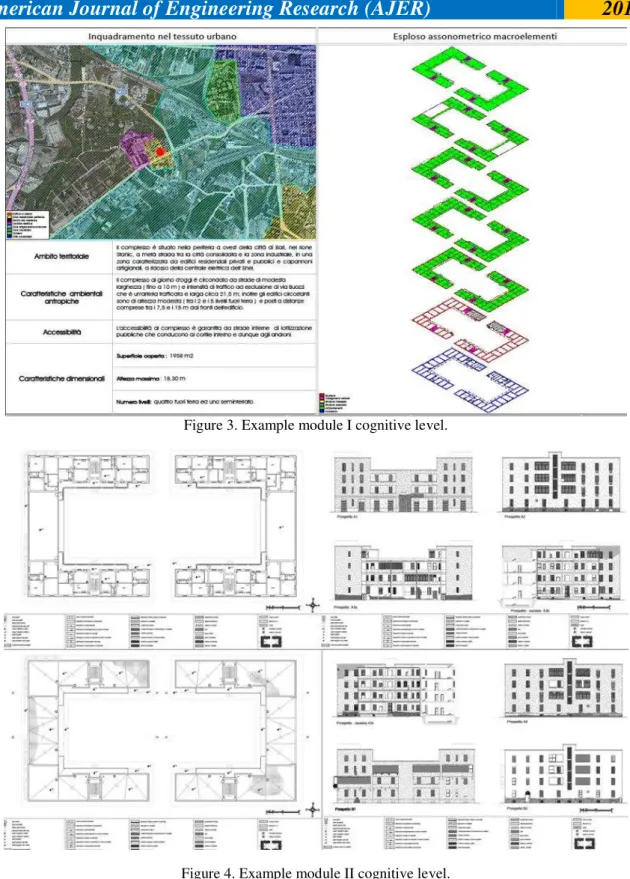
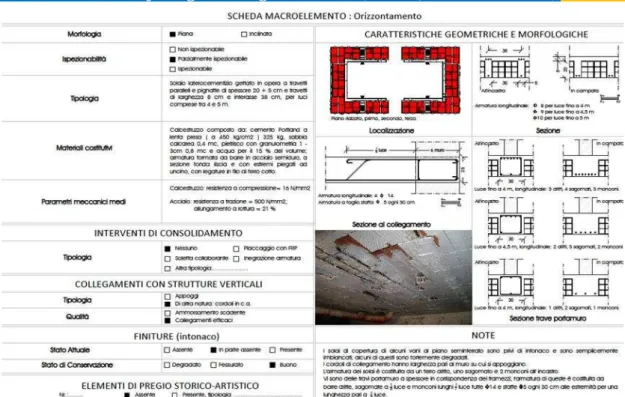
QUANTITATIVE METHODOLOGICAL APPROACHThe methodological approach starts from the knowledge of the structure according to three levels of different deepening, necessary both for the purposes of a reliable evaluation of the seismic safety current, and for the choice of an effective intervention to improve seismic behaviour [9]. The purpose is certainly to put in place a model that allows a qualitative interpretation of the mechanism of structural operation, as many as the real structural analysis, for a quantitative assessment. Problems are those related to the recognition of geometric data, the changes occurred in the course of time, due to the phenomena of damage, resulting from anthropic transformations, aging of materials and by natural disasters. The first level unfolds therefore in an analysis of the building, showing the data collected in appropriate forms mostly cataloguing, suitably designed, in order of:
1.1 identification of building organism in its organic structure;
1.2 characterization of the spatial and functional relationships with respect to the bordering territories; 1.3 recognition of individual building block;
1.4 understanding of evolution of transformative structure in correlation to the successive uses in the course of time, through extensive historical-archival investigations;
Of course for the purposes of proper identification of the structural system, the reconstruction of the entire building history, the construction process and the subsequent transformations, play a decisive role. Historical analysis allows both to limit the number of investigations in historically homogeneous areas, and to focus on those parts that are less known or to possible solutions of continuity, identifying simultaneously previous consolidation interventions. However, the study of the historical evolution of the building cannot be separated from knowledge of the sequence of earthquakes [10] that have involved the same product in the past; it shows a real testing from which emerges awareness on the state of seismic stress which has been subjected. A second level of analysis is oriented towards complete spatial identification and diagnostics of the organism itself, through operations both of geometric survey, strain behavior, and of study of geomorphologic and structural plan. The knowledge and characterization of these latter aspects is of great importance in the prediction of seismic behavior due to the interaction ground - foundation – structure.
For buildings regular in plan and elevation this operator, Eq. (1) is configured for each combination of intervention, such as normalized ratio between total pseudo- acceleration of consolidation and pre-consolidation. Both pseudo - accelerations derive from the elastic response spectrum, specific of the reference site, by a combination of partial values of accelerations, corresponding to periods relating to vibration modes with participating mass more than 1 %.
� � = �����. =
�� ∙ �∗
2
�=1 ∙
� .
�� ∙ �∗
2
�=1 ∙
��.
(1)
With: mi* = mass normalized modal, nm = number of modes involved, ai = modal pseudo- acceleration.
Instead in buildings with irregularities in plan and elevation, and wherein the second mode of vibration result of torsional type index of elastic-seismic improvement is defined as follows:
� � = �����. =
�� ∙ �∗
2
�=1 ∙ ∙�
0.65
� .
�� ∙ �∗
2
�=1 ∙ ∙�
0.65
��.
(2)
With:�t = max ��� ′; �� ′ min ��� ′; �� ′ ;
MPx'(%)= percentage of participating mass in the direction X 'of the torsional mode of vibration; MPy'(%)= percentage of participating mass in the direction Y 'of the torsional mode of vibration.
In equation (2) is introduced the torsional factor β_t^0.65. This factor, obtained as a result of several experimental evaluations and interpolations of statistical data, refines the estimate of the index of elastic-seismic improvement evaluating the contribution due to the torsional motion.
In both equations, with the increase of the index of elastic-seismic improvement, induced by an increase in overall elasticity with respect to the pre-consolidated condition, building attenuates its vulnerability, in other words its propensity to suffer damage. The structure dissipates part of energy into the elastic phase and leaves the remaining contribution to plastic phase. Whether working on buildings of high historical and architectural interest or on solutions with lower value but still of undeniable interest, the approach provides an opportunity to recognize the combination of effective interventions quantitatively and qualitatively consistent with the history of artifact, promoting reduced invasiveness and reversibility of the same.
IV.
R
EAL APPLICATION OF THE METHODOLOGICAL APPROACHIV.I Case of study
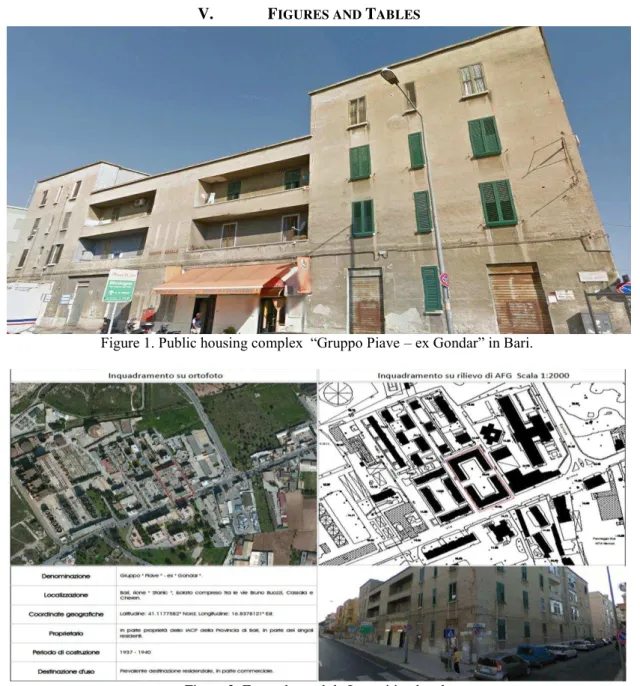
The methodological approach has found a specific validation with reference to a public housing complex dating back to the late thirties of the twentieth century (built between 1937 and 1940) called “Gruppo Piave – ex Gondar” in the city of Bari (Italy)(Fig.1). It is formed by two C-shaped symmetrical bodies and is isolated from other adjacent buildings. The buildings are spread over four levels above ground and one basement and show irregularities in plan and elevation. The complex has a mixed construction type with presence of load-bearing masonry and vertical and horizontal elements in reinforced concrete (floor slabs, beams, pillars, curbs) and the building is of gallery type, unusual for the city of Bari, which was chosen for economic reasons. During the war, the complex has not been damaged or modified in any way; in subsequent years, until today, the building structure has not undergone substantial changes to anything, nor the structural parts; the few interventions concern a lacking and low end maintenance and numerous accretions. Concerning the seismic history the building has undergone during its existence a series of earthquakes including some quite significant to the local context in question, with peaks of intensity at the site of the 6th degree of the MCS scale, which suggests that it has been somehow stressed, though not seriously, from the seismic action over time.
IV.II Knowledge of the historical building
examined the material - structural and mechanical properties of each structural macro – element using both parameters provided by the legislation and data obtained from diagnostic tests performed on the artifact (cover meter and thermographic tests) and the archival documents. The mechanical values [7] have been appropriately scaled by applying the confidence factors related to the masonry and the reinforced concrete that are both equal to the level of knowledge and LC2 that is corresponding to a value of Fc equal to 1.20, based on the level of detail achieved, according to the Italian regulations [4].
IV.III Mechanical modeling and analysis
The modeling of the building under study was made according to the method SAM II (Simplified Analysis of Masonry buildings) based on a macro-elements modeling (pier elements, spandrel beam elements, joint elements) of the masonry structure, such as to enable analysis of entire buildings with a reduced computational analysis. The method idealizes a masonry wall by means of an equivalent frame constituted by pier elements (vertical axis), spandrel beam elements (horizontal axis), modeled with the introduction of rigid offsets at the ends. In order to avoid the processing of redundant data, modeling was made by considering one of the two buildings that constitute the complex "Gondar", in particular the one willing to south on Via Bruno Buozzi, this was possible given the symmetry and the complete correspondence of the geometric and material - constructive parameters of the two buildings(Fig.8). For more caution in the modeling were not considered masonry spandrel beam elements present above and below the openings, as deemed low resistance. For modeling and subsequent analysis the software CDMA Win (Computer Design of Masonries) of the STS s.r.l. which implements the method SAM II extending the three-dimensional case was used. The program is interfaced with the calculation engine Opensees (Open System for Earthquake Engineering Simulation), developed at the University of California at Berkeley, having high computing power and reliability. It follows a three-dimensional equivalent frame configuration of the various macroelements with elements, diversified according to the type of wall or element in reinforced concrete, but all linked together in joints, and solicited by the loads transmitted from the floor slabs, so as to obtain a complete and proper description of the structure together with a convenient method of modeling (for one-dimensional beam-column elements) and sufficiently suitable for the description of the behavior of masonry and reinforced concrete elements which make up the building object of study. The analysis, carried out in accordance with the regulations [1], were kind of dynamic modal and nonlinear static (pushover analysis). The verification of resistance of individual pier elements was carried out for the vertical loads and horizontal ones. For the static analysis was performed the calculation of slenderness and eccentricity of each wall. Were taken into account both the bending and the shear failure modes with the respective values of limit shifts laid down in the seismic regulations. For the seismic response analysis of the building have been used the response spectrum parameters of the area where the artifact is. The results of the analysis showed an inability of the structure to ensure the resistance to seismic action pending in the site at Limit State of Preservation of Life (SLV). In particular, the structural deficiencies are highlighted in the tabulation of data on the pushover curves generated by the software due to non-linear static analysis of the structure [12], in which are not verified at the SLV the curves corresponding to the numbers: 1, 2, 9, 10 as the demand structure displacement exceeds the capacity of the same determining the collapse. The curves in question (Figs.9, 10) correspond to a seismic action in the X direction according to the reference system established in the modeling with the software. Given the insufficient resistance to seismic action of the building a seismic recovery intervention was determined and then modeled and evaluated according to the quali - quantitative approach.
IV.IV Evaluation of the efficacy
obtained. In addition was also made a pushover analysis in the adopted consolidated state that has further confirmed the fulfillment of the seismic demand in terms of moving for the site where the artifact is.
IV.V Results
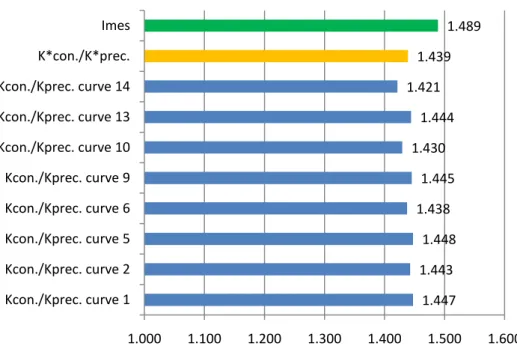
For the effectiveness assessment of the proposed intervention the elastic - seismic improvement index has been calculated according to the formulation proposed in this paper. Firstly the data of the pre – consolidated state, obtained by modal analysis, have been defined as summarized in table 2. These were compared with the consolidated state data. The results of the modal analysis of the building showed that, despite irregularities in plan and elevation, the first two modes of vibration are of bending, singular condition due to the nearly coincidence between the center of mass and center of rigidity of the structure, therefore it was possible to use the equation 1 for the definition of the index. So it is derived the elasto - seismic improvement index. Afterwards the value of the index was compared with the values of the SDOF (single degree of freedom) elastic stiffness obtained from the bilinearization of the 8 pushover curves of the investigated direction (X) in the pre-and post-intervention (Table 3). The average values of the coefficients (K *) in the two conditions were defined, then it is considered the ratio between the SDOF stiffness coefficient (K) pre and post consolidation for each pushover curve and it is compared with the ratio between the average values of the coefficients (K *) and the value of the elasto - seismic improvement index (Table 4) (Fig.12). Finally, the standard deviation between these values that is equal to approximately 1.77% has been calculated.
V.
F
IGURES ANDT
ABLESFigure 1. Public housing complex “Gruppo Piave –ex Gondar” in Bari.
Figure 3. Example module I cognitive level.
Figure 5. Example module III cognitive level.
Figure 7. Example module III cognitive level.
Figure 9. Unverified pushover curves, pre-consolidation state, X direction.
Figure 11. Localization of the seismic improvement intervention.
Figure 12. Graph comparing the values of the ratios between coefficients of elastic stiffness in pre and consolidated state for each pushover curve in the X direction and between their mean values and the elastic - seismic improvement index.
1.447 1.443
1.448 1.438
1.445 1.430
1.444 1.421
1.439 1.489
1.000 1.100 1.200 1.300 1.400 1.500 1.600
VI.
C
ONCLUSIONelastic stiffness and the decrease of the oscillation period of the structure, resulting in an attenuation of the request displacement expected for the site and therefore a reduction of the seismic vulnerability of the building. The study has also shown how the reliability of the evaluation approach is strongly influenced by the level of knowledge of the construction. The approach is therefore a tool able to grasp, with a reduced computational burden and an appropriate level of accuracy, the response in terms of improving the seismic vulnerability of the historical buildings, otherwise punishable by methodologies of much more complex analyses. For this way, it can be considered that the proposed approach, together with other practices for the assessment and mitigation of seismic risk, is capable to drive the design of interventions in existing buildings.
R
EFERENCES[1] L. Lagomarsino, On the vulnerability assessment of monumental buildings. Bull. Earthq. Eng , 4, 2006, 445–463.
[2] Italian Technical norms for the constructions, D.M. 14 January 2008.
[3] G. Magenes, A. Della Fontana, Simplified non-linear seismic analysis of masonry buildings,Proceedings of the Fifth,
International Masonry Conference, British Masonry Society, No. 8, 1998, 190-195.
[4] D. D’Ayala, E.Speranza, Definition of collapse mechanisms and seismic vulnerability of historic masonry buildings,Earthq
Spectra, 19(3), 2003, 479–509.
[5] D. D’Ayala, Seismic Vulnerability and Risk Assessment of Cultural Heritage Buildings in Istanbul, Turkey,Proceedings of the
14th world conference on earthquake engineering, Beijing, 2008.
[6] G.Augusti, M. Ciampoli, P.Giovenale, Seismic vulnerability of monumental buildings,Structural Safety, 23, 2001,253–274.
[7] D. D’Ayala, E.Speranza, An integrated procedure for the assessment of seismic vulnerability of historic buildings,Proceedings of
12th European conference of earthquake engineering, Paper Reference 561, Elsevier Science Limited, London, 2002.
[8] A. Borri, G. Castori, A. Grazini, A. Giannantoni, Performance of masonry elements strengthened with steel reinforced grout,
Fiber-reinforced polymer reinforcement for concrete structures (FRPRCS-8) international symposium proceedings, Patras,
Greece, 2007.
[9] L. Binda, A. Saisi, C. Tiraboschi, Investigation procedures for the diagnosis of historic masonries, Construction and Building
Materials, Elsevier, 14, 2000, 199-233.
[10] M. Stucchi, et al,DBMI11,the database of macroseismic survey of Italian earthquakes used for the seismic parametric catalogue
CPTI11, (http://emidius.mi.ingv.it/DBMI11/), 2011.
[11] A. Borri, M. Corradi, E. Speranzini, A. Giannantoni, Consolidation and reinforcement of stone walls using a reinforced repointing grid,Structural analysis of historic constructions, VI Intern. Conference, Bath, UK, 2008.