ISSN 1553-345X
© 2010 Science Publications
Corresponding Author: Jaber Almedeij, Department of Civil Engineering, Kuwait University, P.O. Box 5969, Safat 13060, Kuwait
Representative Particle Size of Sediment in Storm Sewer Inlets
Jaber Almedeij, Ebtehal Ahmad and Jasem Alhumoud
Department of Civil Engineering, Kuwait University, P.O. Box 5969, Safat 13060, Kuwait
Abstract: Problem statement: The aim of this study was examine the representative particle size of noncohesive sediment samples collected from different storm sewer inlets in residential catchments within Kuwait. Approach: A number of 25 sediment samples were collected from storm sewer inlets located in five residential areas in Kuwait: Bayan, Al-Nuzha, Al-Feiha, Al-Andalos and Al-Rumaithya. All the impervious areas for the selected sites are hydraulically connected to the drainage system, including the roofs for houses which are piped to the roads with gutters and thus have pronounced influence on catchment hydrology. Results: It was found that the sample median and mean particle sizes vary locally within each site and spatially compared to others, while the mode is invariant for most of the cases. This result suggests that the mode particle size is more stable in terms of magnitude than the median and mean and may constitute a robust estimator for sediment sizes reflecting the similarity found in watershed characteristics. Conclusion/Recommendations: This is the first such study conducted in Kuwait on sediment samples collected from five residential storm sewer inlets were employed to examine the average particle size readily available for transportation into the conduit. Key words: Bimodal and unimodal, mode, robust estimator, sieve analysis
INTRODUCTION
An important feature of sediment deposits in storm sewers is the complex pattern of the surface material with varying flow discharges. The deposited bed material is usually well represented by either a unimodal or bimodal grain size distribution. In the latter case, the variation of the makeup of the surface material with flow discharges complicates the sediment transport rate estimation (Roberts et al., 1988). The presence of cohesive sediment such as clay or smaller sizes in storm sewers complicates the picture even further. The cohesive material is resistant to the initial motion and it may be cemented and become permanent if not disturbed for a long period, thereby accounting for the loss of hydraulic capacity of the sewer (Zipparro and Hasen, 1992; Delleur, 2001).
Sediment deposits in storm sewers can have adverse impact on the environment and urban drainage systems. For example, the deposited sediment materials become polluted if they remain intact for a long period of time acting as pollution store or generator and can be washed out by the first flash into receiving water (Crabtree et al., 1995; Fan et al., 2003; Artina et al., 2007). Hydraulic problems associated with sediment deposits may be loss of pipeline capacity due to reduction in flow cross section and increase in bed roughness (Mark et al., 1995; May et al., 1996). The
loss of hydraulic capacity causes, in turn, surcharged water flow, under which sewers run with positive pressure resulting in potential flooding of roads, surfaces, gardens, basements and other residential properties (Butler and Davies, 2004).
Indications of these problems have been noticed during the rainfall events at many drainage locations. This is the case also for the storm sewers in the residential areas of Kuwait, where rainstorms are infrequent and have short duration, but are torrential. Numerous storm sewers suffered from loss of hydraulic capacity and blockage and the existing drainage system has frequently encountered ponding, which tends to increase the water width over the road pavement (Almedeij et al., 2006a). Observations from field studies reported by the ministry of public works in Kuwait indicate sediment deposits mainly of noncohesive properties such as sand and gravel. Knowledge of the average size of these deposits is important to provide basic information for the development of self cleansing storm sewers.
Owing to the reason that the source of sediment is highly interrelated with factors such as rainfall intensity, wind speed and direction, traffic movement, street sweeping methods, impervious coverage and the presence of source contamination such as construction works, it is impractical to collect samples directly from the watershed surface; rather, the storm sewer inlet can possibly be used to examine the sediment sizes readily available for transportation into the conduit (Ahmad, 2007; Deletic et al., 2000). The second issue is a matter of estimating a robust average particle for a given sediment sample distribution. Robust average particle means that minor departure of sediment sample from original distribution will not seriously affect its size. Accordingly, if sediment samples were collected from different locations but with similar watershed characteristics, then by definition a robust average particle will estimate nearly equivalent size reflecting the existing similarity in watershed characteristics.
The aim of this study is to investigate the representative particle size of noncohesive sediment entering residential storm sewer inlets in Kuwait. This study will select sites with similar catchment size and type and sewer inlet geometry and upstream activities to exclude the variation of watershed characteristics and thus identify a robust average particle for the samples. Initially, the study reports the sampling method and laboratory study undertaken to collect, test and classify sediment sizes. Then the results are analyzed and discussed.
MATERIALS AND METHODS
A number of 25 sediment samples were collected from storm sewer inlets located in five residential areas in Kuwait: Bayan, Al-Nuzha, Al-Feiha, Al-Andalos and Al-Rumaithya. The sampling was conducted after a wet season, in April 2006, about 14 days from the last rainfall event and 200 days from the annual sewer cleaning conducted by the ministry of public works. The chosen inlet for each site serves a relatively small catchment area of about 0.25~0.26 ha with a flat topography of a mean slope ~0.4% and an imperviousness of about 75~79%, which is composed of roads, car parks and roofs for houses. All the impervious areas for the selected sites are hydraulically connected to the drainage system, including the roofs for houses which are piped to the roads with gutters and thus have pronounced influence on catchment hydrology. The sediment samples were collected from storm sewer inlets with no upstream conduits and of single grate type located on grade. The size of inlet opening is 55 cm long and 45 cm wide. The structure
depth for the inlets varies from 1-1.3 m and the depth below the pipe invert, the sump, from 15-20 cm.
As was mentioned previously, the choice of the inlet as the main input location to collect sediment samples for a sewer system was considered here to provide information about the grain size characteristics readily available for transportation into the conduit. In Kuwait, rainfall events are also rare. Hence, sampling directly from the bottom of the inlet is more efficient in terms of time compared to other techniques including that based on sitting a box trap below the inlet and observing sediment build up during rainfall. This technique though provides information about the characteristics of sediment deposited from a relatively long period of time and the results should be interpreted according to that.
An amount of water was found inside the inlets, mostly caused by onsite watering activities and it was necessary to drain it out before starting sediment collection. A pump was used to drain carefully that water. Only a little amount of water was kept on top to a depth of ~1 cm to protect the settled finer grains from being sucked by the pump. The wet samples were then collected and placed in plastic containers, which were carefully sealed and labelled.
A sample from each area was chosen to be from an inlet near a civil construction study, in order to examine any effect of this activity on sediment size characteristics. To test specifically the influence of workers, the construction materials were chosen to be located downstream of the inlets so that to reduce the chance of sediment input by flowing water due to human-induced activities.
Laboratory testing:
amount retained on each sieve was then weighted again. Percentages of sediment retained on and passed from each sieve were calculated. With these data, the grain-size distribution, which shows the percentage retained against particle diameter and of cumulative grain-size distribution, showing the percentage passing against diameter, were drawn on a semi-logarithmic study. Figure 1 shows the cumulative grain-size distribution for the examined samples.
Specific gravity: Specific gravity was estimated as the ratio of sediment density to water density at a reference temperature of 4°C. The water density at this temperature is considered ~1000 kg m−3 and the sediment density was estimated for dried samples passing through a sieve opening of 2.36 mm. The latter was obtained by dividing the sediment sample mass by its volume, measured using an electronic balance and a volumetric flask of 500 mL capacity, respectively.
Fig. 1: Cumulative grain-size distribution for all samples
RESULTS AND DISCUSSION
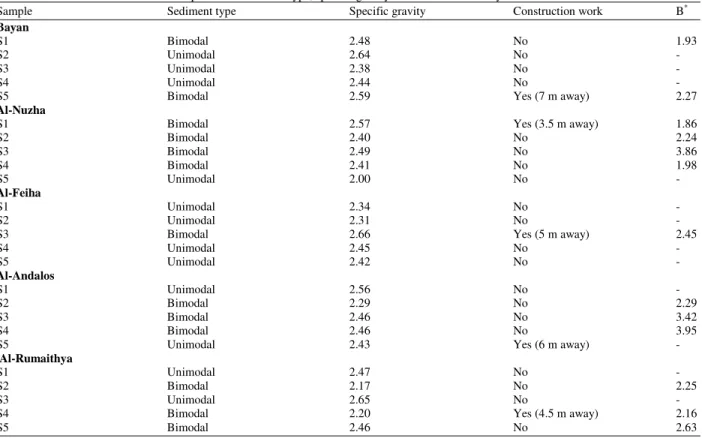
The results of the sieve analysis for the 25 sediment samples are summarized in Table 1. It is seen that 13 sediment samples have bimodal grain size distributions and the remainders are unimodal. The specific gravity for the samples ranges from 2-2.66, with an overall mean of 2.43. As for natural sediment, a specific gravity of 2.65 is more common. The smaller mean value obtained for the samples resulted from the content of lighter organic materials such as plant leaves and animal litters, washed by weather currents during wet or dry periods. While construction works can have high influence on the sediment characteristics of storm sewer inlets, it is not the case here for most of the relevant samples. There is no apparent evidence from Table 1 and the forthcoming analyses suggesting systematic changes in sediment properties from this activity. The reason can be related to the strict regulations imposed by the government to prevent workers from accidentally disposing construction materials like coarse or fine aggregate particles into storm sewer inlets. An exception is for the sample of Al-Feiha S3 containing higher proportion of coarse particles (Fig. 2).
(a) (b)
(c) (d)
(e)
Table 1: General information for all samples about sediment type, specific gravity and construction study
Sample Sediment type Specific gravity Construction work B*
Bayan
S1 Bimodal 2.48 No 1.93
S2 Unimodal 2.64 No -
S3 Unimodal 2.38 No -
S4 Unimodal 2.44 No -
S5 Bimodal 2.59 Yes (7 m away) 2.27
Al-Nuzha
S1 Bimodal 2.57 Yes (3.5 m away) 1.86
S2 Bimodal 2.40 No 2.24
S3 Bimodal 2.49 No 3.86
S4 Bimodal 2.41 No 1.98
S5 Unimodal 2.00 No -
Al-Feiha
S1 Unimodal 2.34 No -
S2 Unimodal 2.31 No -
S3 Bimodal 2.66 Yes (5 m away) 2.45
S4 Unimodal 2.45 No -
S5 Unimodal 2.42 No -
Al-Andalos
S1 Unimodal 2.56 No -
S2 Bimodal 2.29 No 2.29
S3 Bimodal 2.46 No 3.42
S4 Bimodal 2.46 No 3.95
S5 Unimodal 2.43 Yes (6 m away) -
Al-Rumaithya
S1 Unimodal 2.47 No -
S2 Bimodal 2.17 No 2.25
S3 Unimodal 2.65 No -
S4 Bimodal 2.20 Yes (4.5 m away) 2.16
S5 Bimodal 2.46 No 2.63
Fig. 3: Typical unimodal and bimodal sediment distributions showing the location for the mode grain size. The unimodal distribution is for sample Al-Rumaithya S3 with a mode of 0.3 mm and the bimodal is for Al-Nuzha S2 with finer and coarser modes of 0.3 mm and 4.5 mm
The grain size analysis for the sediment samples can be separated according to the material types of unimodal and bimodal. Figure 3 shows an example for the grain size distribution of these two materials. Such classification becomes important in storm sewers because of the difference in dynamic transport process of unimodal and bimodal materials. In the latter case, the movement of one mode becomes influenced by the other. For certain applications, the material represented by the finer mode tends to hide in the crevices created by the coarser one and requires a higher shear stress to be entrained compared to that necessary for the same size when available as unimodal. In contrast, the coarser grain size becomes more exposed to the hydrodynamic forces and can be moved by shear stresses lower than that necessary for the same size when available as unmoral.
*
2 1 md 2 md1 B = ∅ − ∅| | (f / f )
Where:
B* = Bimodality parameter
∅ = Mode grain size in phi units, ∅ = log2dmd
The subscripts 1 and 2 in fad refer to the primary and secondary modes in terms of sediment proportion of sample by weight, respectively; if the two modes are of exactly equal amplitudes, then subscript 1 refers to the coarser one. A reference value suggested by this criterion is equal to B* = 1.7. Above that, the bimodality is considered effective and below that it is treated as unimodal. Table 1 shows that all the bimodal samples have B* values greater than 1.7 suggesting effective bimodality degree.
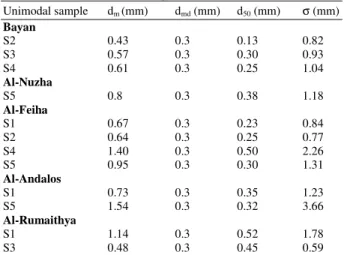
The grain size characteristics for the unimodal samples are provided in Table 2. This Table 2 classifies the information in terms of average size parameters, which are the median dso, mean dm and mode dmd and of
size variability, which is the standard deviation σ. The values of dmd and dso were estimated from the grain-size
and cumulative grain-size distributions, respectively; while dm and σ were determined mathematically from
the expressions: j i i i 1 m j i i 1 f d d f = = =
∑
∑
and: 1/ 2 j 2i i m i 1
j i i 1 f (d d )
( f )
= = − σ =
∑
∑
Where:di = Mean size of ith class
fi = Percentage of sample by weight of ith class
j = Total number of classes
The robustness of the average particle size varies according to the nature of sediment data. It is well documented that the mean parameter dm, in general,
does not resist the minor departure of sediment data from original grain size distribution. The median dso,
which has a value that lies in the middle of the data when arranged in ascending order, is a robust estimator if the weight of each particle size is equivalent, since its value will not change as the magnitude of one size far away in the distribution changes. However, if the weight of sizes is different, which is the case for sediment deposits, then the median becomes unstable for minor departure from original data.
Table 2: Average size and standard deviation characteristics for unimodal sediment samples
Unimodal sample dm (mm) dmd (mm) d50 (mm) σ (mm) Bayan
S2 0.43 0.3 0.13 0.82
S3 0.57 0.3 0.30 0.93
S4 0.61 0.3 0.25 1.04
Al-Nuzha
S5 0.8 0.3 0.38 1.18
Al-Feiha
S1 0.67 0.3 0.23 0.84
S2 0.64 0.3 0.25 0.77
S4 1.40 0.3 0.50 2.26
S5 0.95 0.3 0.30 1.31
Al-Andalos
S1 0.73 0.3 0.35 1.23
S5 1.54 0.3 0.32 3.66
Al-Rumaithya
S1 1.14 0.3 0.52 1.78
S3 0.48 0.3 0.45 0.59
Typically, the median is the particle diameter most widely adopted in the literature to represent a sediment mixture and to estimate bedload or suspended load transport rates. This parameter is a suitable choice for a lognormally distributed material as it coincides with the geometric mean and mode sizes. Nevertheless, the grain size distribution for many deposits is not lognormal; rather, it tends to be skewed (Kondolf and Wolman, 1993). Thus, the median may not be the most appropriate parameter to describe the grain size distribution for many deposits. The median can also become sensitive to the shape of the data set distribution and thus it often does not depict the typical outcome. This is especially evident in bimodal materials when the median falls in the gap between two significant modes and, therefore, represents a size class containing a small percentage of the overall sediment. However, attention is drawn here to the mode dmd as
being especially useful in studying mixed sources of materials and has a great significance in deciphering origin. The mode is a less bias statistical parameter as by definition it has always the highest percentage of particles by weight and covers the largest portion of the bed surface area compared to any other size class. Relevant applications evaluating the efficiency of the mode parameter in the estimation of bedload transport rates is presented in details by Almedeij and Diplas (2003) and Almedeij et al. (2006b) for the cases of unimodal and bimodal materials, respectively.
Table 3: Size characteristics of sand and gravel fractions for bimodal sediment samples
Fine fraction Coarse fraction
--- ---
dm dmd d50 σ fmd dm dmd d50 σ fmd
Bimodal sample (mm) (mm) (mm) (mm) (%) (mm) (mm) (mm) (mm) (%)
Bayan
S1 0.34 0.30 0.18 0.29 21.0 6.03 5.0 3.8 2.86 11.0
S5 0.47 0.31 0.25 0.34 23.0 7.11 5.0 3.6 4.90 13.5
Al-Nuzha
S1 0.46 0.30 0.25 0.35 24.0 6.06 5.0 3.1 4.35 11.0
S2 0.56 0.30 0.30 0.37 15.5 4.77 4.5 2.8 3.09 27.0
S3 0.48 0.30 0.26 0.34 19.5 6.86 5.0 3.5 4.67 20.5
S4 0.44 0.30 0.25 0.32 23.0 4.91 5.0 3.2 2.42 11.0
Al-Feiha
S3 0.47 0.30 0.25 0.33 15.8 8.35 10.0 6.1 3.48 33.0
Al-Andalos
S2 0.50 0.32 0.27 0.36 22.5 5.19 5.0 3.0 3.33 13.0
S3 0.38 0.30 0.20 0.32 19.0 5.57 5.0 4.0 2.26 16.0
S4 0.43 0.30 0.22 0.35 16.0 6.49 5.0 3.5 3.50 18.0
Al-Rumaithya
S2 0.46 0.30 0.25 0.36 15.5 5.85 5.0 2.4 3.46 28.0
S4 0.41 0.30 0.20 0.35 8.0 9.59 6.0 6.5 4.92 16.0
S5 0.42 0.30 0.20 0.36 18.5 4.08 5.0 2.8 1.62 12.0
However, it is interesting to note that the mode grain size is invariant for the samples collected, equal to 0.3 mm. This suggests that the mode parameter is more stable than the median and mean in terms of magnitude, as it is insensitive to the motion of smaller particles and thus can be estimated in field more accurately. Owing to the similarity in watershed and sewer inlet characteristics and upstream activities, the mode for those samples is considered more representative than the median and mean.
For the bimodal samples, the size characteristics are summarized in Table 3. Here, the information are classified in terms of finer and coarser sediment fractions. As can be seen, the size of the finer fraction is within the sand range and the coarser fraction within the gravel. Similar to unimodal data, the bimodal samples possess mode grain sizes that are nearly invariant. All the samples have mode of finer fraction equal to ~0.3 mm, while most of them have mode of coarser fraction equal to 5 mm. The difference is found in sample Al-Feiha S3 possessing a coarser mode of 10 mm. The percentage of sample by weight of this mode size fmd is equal to 33%. As it was mentioned earlier,
this sample had been collected from a site near a civil construction study, which is about 5 m distant and the results are possibly interpreted according to the influence of this activity as the workers can accidentally dispose large material sizes into the inlet. If this size class was removed from the sample, then the sediment distribution would still be bimodal but with a coarser mode of 5 mm coinciding with the other results. The implication here is that the mode size can be useful to
detect the significant influence of one factor contaminating the source of sediment supply.
The present environment of deposition affects the relative proportion of the mode size in the sample distribution. The mode size of ~0.3 mm is significant in all the data sets of unimodal and bimodal sediment. This is not a surprising result, as smaller grains are transported from the catchment surface into and then out of, the inlets effortlessly under different water flow conditions and thus may reflect more closely the similarity in watershed properties for the chosen areas. The presence of the mode of the coarser fraction in bimodal samples is also interesting. The origin of the coarser fraction is difficult to evaluate from the available source of supply because of many prevailing factors that can have direct influence on the pattern of onsite sediment deposition. For example, larger grains may be transported from the source of supply in different proportions based on street sweeping mechanical or manual, outdoor watering activities, traffic movement over or away from unpaved areas and the degree of exposure of unpaved areas to wind currents. Owing to the expected preferential retention, the proportion of larger grains may increase for a relevant inlet and become even higher than that found in the watershed surface.
The stability of the mode parameter for each sediment sample can be compared to the stability of the median and mean using the ratio d / d; where d is arithmetic mean for the parameter (median, mean, or mode),
n
k k
k 1
Fig. 4: Comparison of the ratio d / d calculated for the median, mean and mode particle sizes for total sediment samples n = 25. For bimodal samples only the finer sediment fraction is considered
(a)
(b)
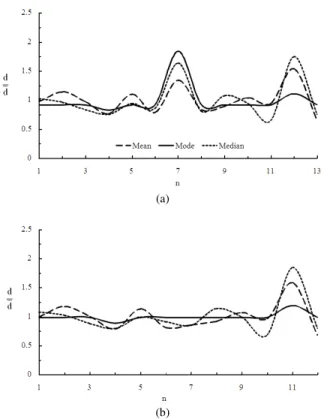
Fig. 5: Comparison of the ratio d / d calculated for the median, mean and mode particle sizes for the coarser fractions of bimodal sediment: (a) total number of sediment samples n = 13; (b) total number of sediment samples n = 12 by excluding Al-Feiha S3
Figure 4 shows the results of the sediment samples with n = 25. Where it can be observed that only the finer fractions of bimodal samples are considered. Apparently, the mode ratio d / d has very small
variability with statistical variance of σ2 = 0.0002 compared to that for the mean 0.245 and median 0.113. The same analysis but for the coarser fractions of bimodal samples n = 13 is presented in Fig. 5, showing how much influence the sample of Al-Feiha S3 has on the average size parameter stability. The estimated variance of the mode ratio d / d with sample Al-Feiha S3 included, of a coarser mode of 10 mm, is equal to σ2
= 0.068 (Fig. 5a), compared to that for the mean 0.059 and median 0.11. Treating this sample as an outlier (Fig. 5b) and thus deleting it from the analysis improved the variance considerably, with a variability for the mode equal to σ2
= 0.0044 compared to that for the mean 0.056 and median 0.088.
CONCLUSION
Sediment samples collected from five residential storm sewer inlets were employed to examine the average particle size readily available for transportation into the conduit. The specific gravity for the samples has an overall mean of 2.43. Despite the similarity in catchment size and type and sewer inlet geometry and upstream activities, it has been found that the sample median and mean grain sizes vary locally within the residential site and spatially compared to others, while the mode size is more stable reflecting the similarity found in watershed characteristics. The single mode for the unimodal samples is equal to 0.3 mm and the finer and coarser modes for most of the bimodal samples are 0.3 and 5 mm. The degree of bimodality for the relevant samples is effective.
There is no apparent evidence showing influence of civil construction works on sediment size characteristics except for sample Al-Feiha S3. The reason may be related to the strict regulations imposed by the government to prevent workers from accidentally disposing construction materials into storm sewer inlets. This sample demonstrated a possible implication of the mode parameter in detecting the significant influence of one factor contaminating the source of sediment supply to storm sewers.
ACKNOWLEDGEMENT
The authors would like to thank the distinguished reviewers of the journal for their useful comments and suggestions.
REFERENCES
Almedeij, J., A. Alsulaili and J. Alhomoud, 2006a. Assessment of grate sag inlets in a residential area based on return period and clogging factor. J. Environ. Manage., 79: 38-42. PMID: 16171936 Almedeij, J.H., P. Diplas and F. Al-Ruwaih, 2006b.
Approach to separate sand from gravel for bed-load transport calculations in streams with bimodal sediment. J. Hydraul. Eng., 132: 1176-1185. DOI: 10.1061/(ASCE)0733-9429(2006)132:11(1176) Ahmad, E., 2007. Sediment size characteristics in
residential storm sewer inlets. M.S. Thesis, Kuwait University.
Artina, S., A. Bolognesi, T. Liserra and M. Maglionico, 2007. Simulation of a storm sewer network in industrial area: Comparison between models calibrated through experimental data. Environ. Model. Software, 22: 1221-1228. DOI: 10.1016/j.envsoft.2006.11.002
Butler, D. and J. Davies, 2004. Urban Drainage. 2nd Edn., Taylor and Francis, UK., London, ISBN: 10: 0415306078, pp: 568.
Crabtree, R.W., R. Ashley and R. Gent, 1995. Mousetrap: Modeling of real sewer sediment characteristics and attached pollutants. Water Sci. Technol., 31: 43-50. DOI: 10.1016/0273-1223(95)00321-D
Deletic, A., R. Ashley and D. Rest, 2000. Modeling input of fine granular sediment into drainage systems via gully-pots. Water Res., 34: 3836-3844. DOI: 10.1016/0273-1223(95)00321-D
Delleur, J.W., 2001. New results and research needs on sediment movement in urban drainage. J. Water Resour. Manage., 127: 186-193. DOI: 10.1016/0273-1223(95)00321-D
Fan, C.Y., R. Field and F. Lai, 2003. Sewer-sediment control: Overview of an environmental protection agency wet-weather flow research program. J. Hydraul. Eng., 129: 253-259. DOI: 10.1016/0273-1223(95)00321-D
Kondolf, G.M. and M.G. Wolman, 1993. The sizes of salmonid spawning gravels. Water Resour. Res., 29: 2275-2285. DOI: 10.1029/93WR00402
Mark, O., C. Appelgren and T. Larsen, 1995. Principles and approaches for numerical modeling of sediment transport in sewers. Water Sci. Technol., 31: 107-115. DOI: 10.1016/0273-1223(95)00328-K May, R.W.P., J.C. Ackers, D. Butler and S. John, 1996.
Development of design methodology for self-cleansing sewers. Water Sci. Technol., 33: 195-205. DOI: 10.1016/0273-1223(95)00328-K
Roberts, A.H., J.B. Ellis and W.B. Whalley, 1988. The progressive alteration of fine sediment along an urban storm drain. Water Res., 22: 775-781. DOI: 10.1016/0043-1354(88)90190-X
Smith, G.H.S., A.P. Nicholas and R.I. Ferguson, 1997. Measuring and defining bimodal sediments: Problems and implications. Water Resour. Res., 33: 1179-1185. DOI: 10.1029/97WR00365