COMMON ENVIRONMENTAL DESCRIPTORS OF TWO BENTHIC
AMPHI-ATLANTIC MOLLUSC ASSEMBLAGES
Ricardo S. Absalão1,2*; J. Moreira3** & Jesus S. Troncoso3***
1
Universidade Federal do Rio de Janeiro Departamento de Zoologia, Instituto de Biologia, CCS (Ilha do Fundão, 21941-570 Rio de Janeiro, RJ, Brasil)
2
Univeridade do Estado do Rio de Janeiro Departamento de Zoologia, Instituto de Biologia (Rua São Francisco Xavier 524, 20550-900, Maracanã, RJ, Brasil)
3
Facultad de Ciencias del Mar, Universidad de Vigo Departamento de Ecología y Biología Animal
(Vigo E-36310, Spain)
*[email protected], **[email protected], ***[email protected]
A
B S T R A C TTwo benthic mollusc assemblages of the continental shelf on both sides of the Atlantic Ocean, a tropical one in Rio de Janeiro, Brazil, and another, temperate, in Galicia, Spain were investigated, with a view to finding common environmental descriptors which would explain, on a macro-scale, why these assemblages are there. Both of the assemblages concerned show approximately the same species richness, about 150 taxa each. The molluscan fauna of both regions live on sandy sediments. The Galician assemblages are at about 2-12 m depth, while those in Rio de Janeiro are at about 10-40 m depth. Malacological assemblages were defined through Cluster Analysis and Multiple Discriminant Analysis of the environmental data showed that each assemblage has its own environmental space. These assemblages have no species in common, but show the same phenological characters associated with each sedimentological facies. The same set of environmental variables (median sediment grain size, skewness, kurtosis, sorting, fine and medium sand fractions and depth) were selected as controlling these assemblages, suggesting that they play their role as general environmental descriptors.
R
E S U M ODuas associações de moluscos bênticos litorais foram estudadas em ambos os lados do oceano Atlântico, uma tropical no Rio de Janeiro, Brasil, e outra temperada na Galicia, Espanha, procurando-se por descritores ambientais comuns, a ambas, que pudesprocurando-sem explicar, em macro escala, o porquê de essas associações estarem onde estão. As duas associações apresentam, aproximadamente, a mesma riqueza de espécies, cerca de 150 táxons cada uma. Ambas as faunas malacológicas habitam sedimentos arenosos em profundidades variando entre 2-12 m, na Galicia, e 10-40 m, no Rio de Janeiro. As associações malacológicas foram definidas através de Análise de Grupamento e caracterizadas ambientalmente com a aplicação da Análise Discriminante Múltipla realizada sobre os dados abióticos. Não existem espécies em comum entre as associações estudadas; contudo estes táxons apresentam caracteres fenológicos similares em função de habitarem as mesmas fácies sedimentológicas. Um mesmo conjunto de variáveis ambientais (tamanho médio do grão do sedimento, assimetria, curtose, grau de selecionamento, frações de areias fina e média e a profundidade) foram identificadas por condicionarem a presença dessas associações, sugerindo que possam ter um papel relevante como descritores ambientais gerais.
Descriptors: Benthic ecology; Marine malacological assemblages; Multiple discriminant analysis; Environmental descriptors; Sedimentological parameters; Atlantic Ocean.
Descritores: Ecologia bêntica, Associações malacológicas, Análise discriminante múltipla, Descritores ambientais, Parâmetros sedimentológicos, Oceano Atlântico.
I
NTRODUCTIONBenthic assemblages have been described ever since the initial works of Petersen (1911, 1913), responsible for the forecasting of fisheries production using the benthic assemblage biomass used as food, at
techniques (Robert, 1979; Field et al., 1982; Absalão, 1989; Warwick & Clarke, 1991; Dolédec & Chessel, 1994; Karakassis & Eleftheriou, 1997; van der Meer, 1999). Although the initial studies of benthic assemblages were descriptive, knowledge of their systemic functionality has much improved (Pearson, 2001; Peterson & Heck, 2001), as a result of computer development and multivariate statistical techniques.
The intimate fauna-sediment relationship was demonstrated long ago (Lindroth, 1935; Jones, 1950; Rhoads & Young, 1970; Glémarec, 1973). Although researchers know intuitively which variables may determine the presence of a faunal assemblage on a local scale, we still lack a general principle that would establish which variables are ecologically important to the mollusc assemblages. Many investigators have related mollusc assemblages to a variety of ecological features (Driscoll & Brandon, 1973; Franz, 1976; Harry, 1976; Shin, 1982; Absalão, 1989; Absalão, 1991), but none has established the existence of environmental descriptors. In our opinion, these environmental descriptors may be abiotic variables with an evident ecological/biological role, whose effect could be generalized beyond their local application. In view of this, our goal was the investigation of two marine mollusc assemblages, one
on each side of the Atlantic Ocean, in the quest for environmental similarities which might explain, in a general way, the nature of both.
M
ATERIALS ANDM
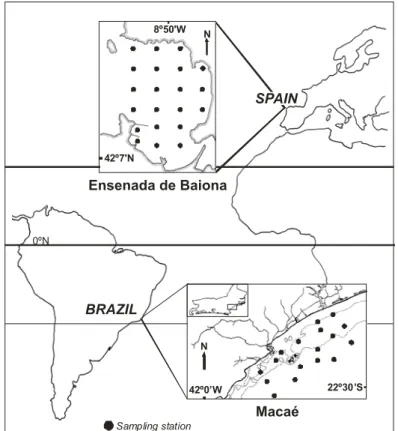
ETHODSSouth Atlantic: Brazilian coast, state of Rio de Janeiro (Macaé), approximately 22º30´S - 42º00´W. Samples were taken at 17 oceanographic stations, at depths of from 10 to 40 m (Fig. 1). At each station, 3 samples were taken with a Van Veen grab (0.13 m2). A small subsample of the sediment (about 150 g) was collected and mixed with other samples from the same station, to represent the local sediment. The residual samples were pooled and washed with seawater through a net (0.5 mm mesh). The residue was fixed with 4% formaldehyde for later separation under magnification in the laboratory. A Nansen bottle was used to sample deep water, of which the temperature, pH, and dissolved oxygen were measured (Absalão et al., 1999). The molluscs were identified in accordance with Rios (1994). The specimens were deposited in the Mollusc Collection of the Department of Zoology, Institute of Biology, Federal University of Rio de Janeiro (UFRJ). For additional details of procedures see Absalão et al. (1999).
BRAZIL
SPAIN
Sampling station
0ºN
N
22º30’S 42º0’W
Macaé
N 8º50'W
Ensenada de Baiona
42º7'N
North Atlantic: The Ensenada de Baiona is located on the southern edge of the mouth of the Ría de Vigo, at 42º07’N – 42º09’N and 08º51’W – 08º49’W. The samples came from 21 stations, at depths of between 2 and 12 m (Fig. 1). Stations 1 and 4 were disregarded because their stony nature made interpretation of the analyses difficult, and because of insufficient sample content for station 4. Five samples were collected from each station, with a Van Veen grab (0.056 m2). The samples were washed with seawater through a net (0.5 mm mesh), pooled and later fixed with 4% formaldehyde. The molluscs were identified in accordance with Tebble (1966) and Graham (1988). The specimens were deposited in the Department of Ecology and Animal Biology of the University of Vigo. For additional details of procedures see Moreira et al. (2005).
Common Procedures
The sediment analyses for both studies were based on Suguio (1973), and the finest fractions (silt and clay) were considered together. The granulometric features (Md - median, KG - kurtosis, SK - skewness, So - sorting) were calculated in accordance with Folk & Ward (1957). In addition to these features, the granulometric fractions were, in later analyses, considered as separate variables.
To define the mollusc association only specimens collected alive were used as station features. The presence and/or absence of molluscs (Sorensen’s index) were used in the Brazilian study (for more details see Absalão et al., 1999), while density was considered (Bray-Curtis index) in the Spanish one (see Moreira et al., 2005). Binary data were preferred in the Brazilian study because of the high richness and low density observed. On the other hand, the patterns of density and richness in the Spanish study allow us to consider the numerical (density) data as trust worthy. In both cases the similarity/dissimilarity matrixes were submitted to a Cluster Analysis (CA) (mode Q) using the unweighted method (Romesburg, 1984). A Discriminant Analysis (DA) (Pielou, 1977; Klecka, 1980) based on the CA results, was applied for the grouping of the stations, in order to detect the possible interactions between them and with the features measured abiotic (Shin, 1982; Absalão, 1986, 1989, 1991). The Discriminant Analysis seeks the best linear combination of variables that produces the highest match score between pre-assigned elements (members of a group) and the classification based on these variables. For details of Discriminant Analysis see Klecka (1980). A preliminary correlation analysis covering all the variables was performed to ensure their independence. Strongly correlated variables were excluded, and the
data matrix was standardized in accordance with Romesburg (1984). The variables were verified for normality through normal probability plots.
R
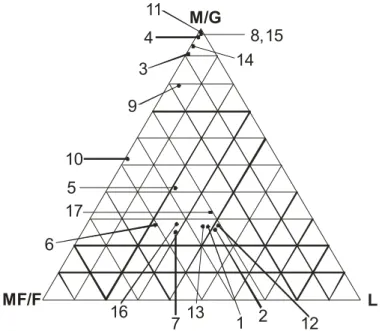
ESULTS South Atlantic SedimentologyThe mainly sandy sediment was roughly separable into two associations: A- composed of coarse sand (stations 3, 4, 8, 14, 15), medium sand (10) and very coarse sand (11); and B- composed of fine sand (1, 2, 5, 6, 12, 13, 16, 17). This second association consisted almost entirely of very fine sand with traces of mud, i.e., was poorly sorted. The presence of mud was indicated by the SK positive values. The coarse-sand sediments were moderately sorted and asymmetrically negative, indicating a granulometric spectrum skewed toward coarser grains. Figure 2 shows the sediment classification of the stations. For more details see Absalão et al. (1999).
Biological Results
The 152 molluscan taxa identified from Macaé included 108 Gastropoda, 38 Pelecypoda, 5 Scaphopoda, and 1 Polyplacophora. Of these, 48 were collected alive and were used in the analyses. Absalão et al. (1999) shown the complete taxa list and provide a test for using the dead specimens collected.
Mollusc Assemblages
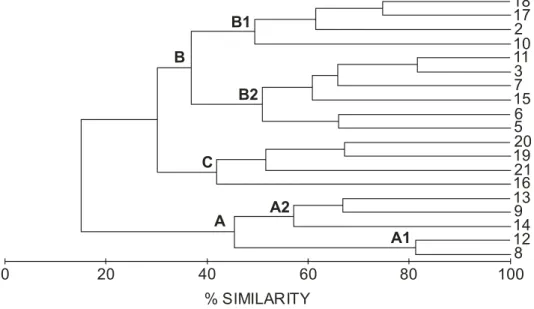
Figure 3 shows the two mollusc groups found, in conformity with the two main sedimentary groups in the region. The mollusc assemblage at stations 3, 4, 8, 9, 10, 11, 14, 15, 16 was present in coarser sandy bottoms, and included animals without siphons or with short ones, e.g., the pelecypods Americuna besnardi, Crassinella martinicensis, Glycymeris longior, and Carditamera floridana, and the gastropods Halistylus columna and Caecum ryssotitum. The mollusc assemblage at stations 1, 2, 5, 6, 7, 12, 13, 17 in fine sand with some mud, included deposit-feeders such as Adrana electa, Nuculapuelcha and Cadulus braziliensis, and Periploma compressa and Macoma tenta, filter-feeders with long siphons.
Animal-Sediment Relationships
M/G
L
MF/F
4
8,15
9
13
14
3
17
2
10
7
12
6
5
11
1
16
Fig. 2. Sheppard’s triangle diagram showing the sediment classification at Macaé, Rio de Janeiro, Brazil. M = mud/clay, F= fine and very fine sand, MC= median and coarse sand plus gravel.
8
12
14
9
13
16
1
4
5
6
15
7
3
11
10
2
17
0.8
0.6
0.4
0.2
0.0
SIMILARITY
A
B
Table 1. Results of the DA for the sediment data from Macaé, Rio de Janeiro, Brazil.
Discriminant Function eigen-value rel. percent. cum. p-level
1 40.13 1.00 0.0000
Matches : 100 %
Table 2. Standardized coefficients of the discriminant function (DF) constructed from the abiotic data for the malacological associations at Macaé, Rio de Janeiro, Brazil. Md = median, So = sorting, SK= skewness, KG= kurtosis, CS= coarse sand, MS= medium sand, FS= fine sand, and Mud = silt/clay.
Variables Discriminant Function (DF)
CS 1.21 MS 3.47 FS -0.98 Mud -2.15 Md 4.15 So -2.34 SK 2.11 KG 3.56
North Atlantic Sedimentology
The Ensenada de Baiona has a mainly sandy bottom (Fig. 4), with some mud near Baiona harbour. The sandy sediment may be separated into two subgroups, one composed of coarse sand (8, 12) and medium sand (9, 13, 14) and the other of fine to very fine sand (2, 3, 5-7, 10, 11, 15, 17, 18). In the sandy sediment, the mud/clay fraction was present in low proportions ranging from 1 to 12 %; for additional details see Moreira et al. (2005). The selection and asymmetry values showed that these sediments were mixed, much as those at Macaé.
Biological Results
A total of 94 species were identified, all collected alive: 50 Pelecypoda, 40 Gastropoda, 3 Polyplacophora, and 1 Scaphopoda. For the complete list see Moreira et al. (2005).
M/G
L
MF/F
12
8
9
13
14
18
17
2
10
7
15 6 3
5
11
21
16
20
19
Mollusc Assemblages
The dendogram (Fig. 5) shows the presence of three main mollusc assemblages, in agreement with the groups (A, B, C) defined by the sediment distribution. The fauna inhabiting the sandy sediment could be separated into two subgroups, one at the coarse-sand stations (group A1), and the other at the medium-sand stations (group A2). Similarly, the fauna in medium, fine-very fine sand could be divided into two groups, one in the medium sand (stations 2, 10, 17, 18 -group B1-) and the other in very fine sand (3, 5, 6, 7, 11, 15 -group B2-). The last group (C) was present in muddy sediments (16, 19, 20, 21).
The fauna in the coarse- and medium-sand sediment was composed of suspension-feeding bivalves with no or short siphons, e.g., Goodalia triangularis, Digitaria digitaria and Clausinella fasciata,and the gastropod Caecum imperforatum. In fine-very fine sandy sediments the fauna was dominated by suspension-feeding bivalves with large siphons, such as Venerupis senegalensis, Fabulina fabula, and Angulus tenuis,and others with medium-sized siphons, such as Chamelea striatula and Spisula subtruncata. In the muddy sediments, suspension-feeders (Abra alba and Loripes lacteus), detritivores (Thyasira flexuosa) and bivalves such as A. nitida show that both alimentary strategies were present.
Animal-Sediment Relationships
Although up to four discriminant functions might be generated, the minimal contribution of the
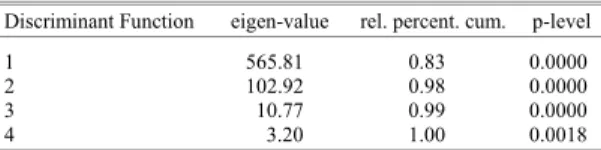
relative proportion of DF 3 and 4 (Table 3 and 4) enables us to use the first two discriminant functions to determine three sedimentary environments (e.g. coarse-medium sands, fine-very fine sands and muddy sediments) inhabited by each associated mollusc assemblage. Such a discriminant model produces a match which is 100 % efficient in discriminating among the three main malacological associations. SK and KG are the most important variables in both DF1 and DF2.
D
ISCUSSIONBiological Characteristics
The Macaé mollusc assemblage (154 species) was about 30 % richer than the Baiona assemblage (94 species). However, only 48 species from Macaé were collected alive, whereas all the species from Baiona were so collected. These data may indicate the existence of a complex relationship between the thanatocoenosis and the actual assemblage of living animals at Macaé, or may be the consequence of low species density (Absalão et al., 1999). At Baiona the mollusc thanatocoenosis was not recorded, although we believe (by subjective evaluation) that the mollusc richness is approximately equal in the two regions (Absalão et al. 1999 and Kidwell, 2001 shows that dead molluscs can be used). The higher number of live species found at Baiona may be related to the higher population densities there (Moreira et al., 2005).
8
12
14
9
13
16
21
19
20
5
6
15
7
3
11
10
2
17
18
100
80
60
40
20
0
% SIMILARITY
B
C
A
A1
A2
B1
B2
Table 3. Results of the DA for the sediment data from Ensenada de Baiona, Galicia, Spain
.
Discriminant Function eigen-value rel. percent. cum. p-level
1 565.81 0.83 0.0000 2 102.92 0.98 0.0000 3 10.77 0.99 0.0000 4 3.20 1.00 0.0018 Matches: 100 %
Table 4. Standardized coefficients of the discriminant function (DF) constructed from the abiotic data for the malacological associations at Ensenada de Baiona, Galicia, Spain. Abbreviations as in Table 2.
Variables DF1 DF2 DF3 DF4
Md -2.98 -0.78 0.31 -0.39 So -1.24 0.56 -0.33 -0.29 MS 0.65 0.54 -1.06 0.04 FS 2.21 -0.38 0.78 -1.80 SK 3.58 -0.83 0.09 -1.22 KG -3.35 0.62 0.53 -0.66 Depth -0.84 -0.20 0.02 -0.50
Eigen-values 565.81 102.92 10.77 3.20
% rel. Cum. 0.83 0.98 0.99 1.00
Leaving aside the inherent population differences between the study areas, we observe a respectable similarity between the sediment types. Furthermore, the phenological features of both mollusc assemblages are comparable. Absalão (1991) for marine molluscs and Townsend & Hildrew (1994) and Usseglio-Polatera et al. (1999) for freshwater invertebrates have also noted this relationship. Bivalves without siphons or with short siphons live in coarse sandy sediment in both areas. Caecum ryssotitum (Macaé) and Caecum imperforatum (Baiona) are siphonless gastropods, which are dependent on a high-porosity sediment which permits their life style (respiration, locomotion, predation, etc.). In fine sandy sediment, suspension-feeding bivalves with long siphons are present, while muddy sediment is inhabited by depositivores, characterizing the phenological constancy between the molluscs which inhabit each sediment type.
Animal-Sediment Relationships
The DA is a powerful tool for the investigation of situations with previous definitions of the objects and their relationships to a specific group of variables. The DA may act as a secondary evaluation test of previously defined objects (Romesburg, 1984). In spite of its relative objectivity and easy procedure, this test has been little used in
benthic studies (Shin, 1982; Absalão, 1989; Hyland et al., 1991; Alves et al., 2004).
A comparison of Tables 2 and 4, which show the standardized coefficients of the variables selected as the best environmental discriminants for the mollusc assemblages from Macaé and Baiona, reveals a high degree of correspondence between them. The selection of the same variables for two geographically distant mollusc assemblages which live under such different oceanographic conditions suggests the main ecological role of these variables, in spite of their local ecological features. The measures of central tendency (mean, mode, or median) indicated the main sediment type that determines the kind of fauna which can inhabit it in both areas. The sand fractions are the main factors, and because of this, one or more of them were selected as the best environmental descriptors. The sorting coefficient shows the degree of heterogeneity of the sediment, and therefore, the higher or lower niche availability to the molluscs. This information is completed by the asymmetry, which indicates which granulometric fraction contributes to this sediment diversity. Kurtosis provides information about the transport and sedimentation of all the granulometric fractions. All the variables inform us as to the kind of sediment, its composition and environmental dynamics. How these features may determine the benthic fauna, and particularly the molluscan fauna, has been demonstrated in several studies (Franz, 1976; Harry, 1976; Garlo, 1980; Moss et al., 1987; Oyarzún et al., 1987; Jorgensen et al., 1999; Bergen et al., 2001; Alves et al., 2004). Its selection in unrelated environments is not therefore surprising.
It is easy to imagine the important role that depth (bathymetric pressure) plays as regards living organisms, and it is an important factor even on a lower bathymetric scale. In shallower environments, depth per se is not so important, but the associated oceanographic features are very significant. For example, McCall (1977) and Absalão (1991) showed that some storm waves can disturb the sediment below a depth of 20 m, and favour the selection of opportunists or species resistant to this physical disturbance.
oceanic influence. The higher sediment diversity at Baiona leads to a higher diversity of mollusc assemblages, each of them inhabiting a different location. Although not represented on the graph, the same occurred in the two assemblages at Macaé (see Absalão et al., 1999). The ecological role of the selected variables in both studies suggests the existence of true environmental descriptors, which are important because they reflect physical and chemical factors and/or oceanographic processes which affect the benthos and particularly the molluscs.
Many biological interactions contribute to, and in some cases define, the structure of benthic invertebrate assemblages in the marine environment (Ragnarsson & Rafaelli, 1999; Posey et al., 2002). However, these interactions act mainly on a smaller spatial scale than this study was intended to investigate on a large spatial scale, in the quest for general patterns, the abiotic variables establish the “background” against which the biological interactions act in the fine adjustment of the assemblage structure, adapted to specific local conditions (Dittmann, 1996; Botto & Iribarne, 1999; Duffy & Harvilicz, 2001). We would not assert that biological interactions are unimportant in defining the assemblage structure, because on a certain spatial scale they are indeed important. However we consider that on a large spatial scale (Zajac et al., 1998) the environmental descriptors will be found to be such abiotic factors as have been defined in this paper.
If the existence and efficiency of these environmental descriptors are confirmed in diverse kinds of environment, we shall be able to take a great step forward in comprehending the determinant factors which affect the benthic and specifically molluscan assemblages, as a simple and testable model.
A
CKNOWLEDGEMENTSWe are indebted to Dr. Rutger Rosenberg of the Kristineberg Marine Research Station (Sweden) and two anonymous referees for their suggestions on the MS.; this paper has been partially financed by the project PHB2002-0045-PC of the Dirección General de Universidades del Ministerio de Educación y Ciencia (MEC, Spain) and by CAPES (Brazil).
R
EFERENCESAbsalão, R. S. 1986. Moluscos da Comissão oceanográfica de Geocosta Río I, RJ, Brasil. Rev. Bras. Biol., 46:27– 31.
Absalão, R. S. 1989. Ophiuroid assemblages off Lagoa dos Patos outlet, Southern Brazil. Ophelia, 31:133–143. Absalão, R. S. 1991. Environmental discrimination among
soft-bottom mollusc association of Lagoa dos Patos, South Brazil. Estuar. coast. Shelf Sci., 32:71–85.
Absalão, R. S.; Pimenta, A. D.; Gomes, R. S. & Cecchetti, F. 1999. Associações malacológicas dos substratos inconsolidados na Área de Proteção Ambiental do Arquipélago de Santana, Macaé, Rio de Janeiro. In: Silva, S. H. G. & Lavrado, H. P. eds. Ecologia dos Ambientes Costeiros do Estado do Rio de Janeiro. Série Oecologia Brasiliensis, vol. VII. PPGE-UFRJ, p. 272– 289.
Alves, O. F. S.; Manso, C. L. R.; Absalão, R. S. & Paiva, P. C. 2004. Geoecology of sublittoral benthic communities in Todos os Santos Bay (Bahia, Brazil): Biotic and sedimentological diversity. J. coast. Res., 39 (in press). Bergen, M.; Weisberg, S. B.; Smith, R. W.; Cadien, D. B.;
Dalkey, A.; Montagne, D. E.; Stull, J. K.; Velarde, R.G. & Ranasinghe, J. A. 2001. Relationship between depth, sediment, latitude, and the structure of benthic infaunal assemblages on the mainland shelf of southern California. Mar. Biol., 138:637–647.
Botto, F. & Iribarne, O. 1999. Effect of the burrowing crab Chasmagnathus granulata (Dana) on the benthic community of a SW Atlantic coastal lagoon. J. expl. Mar. Biol. Ecol., 241:263–284.
Driscoll, E. G. & Brandon, D. E. 1973. Mollusc-sediment relationships in Northwestern Buzzards Bay, Massachussetts, USA. Malacologia, 12:13–46.
Dittmann, S. 1996. Effects of macrobenthic burrows on infaunal communities in tropical tidal flats. Mar. Ecol. Prog. Ser., 134:119–130.
Dolédec, S. & Chessel, D. 1994. Co-inertia analysis: an alternative method for studying species-environment relationships. Freshwat. Biol., 31:277–294.
Duffy, J. E. & Harvilicz, A. M. 2001. Species-specific impacts of grazing amphipods in an eelgrass-bed community. Mar. Ecol. Prog. Ser., 223:201–211. Field, J. G.; Clarke, K. R. & Warwick, R. M. 1982. A
practical strategy for analysing multispecies distribution patterns. Mar. Ecol. Prog. Ser., 8:37–52.
Franz, D. 1976. Benthic molluscan assemblages in relation to sediment gradients in Northeastern Long Island Sound, Connecticut. Malacologia, 15:377–399.
Folk, R. L. & Ward, W. C. 1957. Brazos River Bar: a study of the significance of grain size parameters. J. Sediment. Petrol., 27:3–26.
Foreman, K.; Valiela, I. & Sardà, R. 1995. Controls of benthic marine food webs. Sci. Mar., 59:119–128. Garlo, E. V. 1980. Abundance and distribution of benthic
macroinvertebrates near Little Egg Inlet, New Jersey from 1972 to 1974. Int. Rev. Ges. Hydrobiol., 65:345– 356.
Glémarec, M. 1973. The benthic communities of the European North Atlantic continental shelf. Oceanog. Mar. Biol. a. Rev., 11:263–289.
Graham, A. 1988. Molluscs: Prosobranch and pyramidellid gastropods. Synopses of the British Fauna, 2:1–662. Harry, H. W. 1976. Correlation of benthic Mollusca with
substrate composition in Lower Galveston Bay, Texas. Veliger, 19:135–152.
Hyland, J.; Baptiste, E.; Campbell, J.; Kennedy, J.; Kropp, R. & Williams, S. 1991. Macroinfaunal communities of the Santa Maria Basin on the California outer continental shelf and slope. Mar. Ecol. Prog. Ser., 78:147–161. Jones, N. S. 1950. Marine bottom communities. Biol. Rev.,
Jorgensen, L. L.; Pearson, T. H.; Anisimova, N. A.; Gulliksen, B.; Dahle, S.; Denisenko, S. G. & Matishov, G. G. 1999. Environmental influences on benthic fauna associations of the Kara Sea (Arctic Russia). Polar Biol., 22:395–416.
Karakassis, I. & Eleftheriou, A. 1997. The continental shelf of Crete: structure of macrobenthic communities. Mar. Ecol. Prog. Ser., 160:185–196.
Kidwell, S. M. 2001. Preservation of species abundance in marine depth assemblages. Science, 294:1091-1094. Klecka, W. R. 1980. Discriminant Analysis. London, Sgae
Publications. 72p.
Lindroth, A. 1935. Die association der marinen Weichdoden. Zool. Bidrag Uppsala, 15:331–366.
McCall, P. L. 1977. Community patterns and adaptative strategies of the infaunal benthos of Long Island Sound. J. mar. Res., 35:221–266.
Moreira, J.; Quintas, P. & Troncoso, J. S. 2005. Distribution of the molluscan fauna in the subtidal soft bottoms of the Ensenada de Baiona (NW Spain). Am. Malac. Bull., 20 (1/2):75-86.
Moss, D.; Furse, M. T.; Wright, J. T. & Armitage, P. D. 1987. The prediction of macro-invertebrate fauna of unpolluted running-water sites in Great Britain using environmental data. Freshw. Biol., 17:41–52.
Oyarzún, C.; Carrasco, F. D. & Gallardo, V. A. 1987. Some characteristics of macrobenthic fauna from the organic-enriched sediments at Talcahuano, Chile. Cah. Biol. Mar., 28:429–446.
Pearson, T. H. 2001. Functional group ecology in soft-sediment marine benthos: the role of bioturbation. Oceanogr. Mar. Biol.: Ann. Rev., 39:233–267.
Petersen, C. G. 1911. Valuation of the sea. I. Animal life of the sea-bottom, its food and quantity. Rep. Dan.Stat.Biol., 20:1–81.
Petersen, C. G. 1913. Valuation of the sea. II. The animal communities of the sea bottom and their importance for marine zoogeography. Rep. Dan. Stat. Biol., 21:1–44. Peterson, B. J. & Heck, K. L. 2001. Positive interactions
betwenn suspension-feeding bivalves and seagrass – a facultative mutualism. Mar. Ecol. Prog. Ser., 213:143– 155.
Pielou, E. C. 1977. Mathematical Ecology. New York, John Wiley & Sons. 386p.
Posey, M. H.; Alphin, T. D.; Cahoon, L. B.; Lindquist, D. G.; Mallin, M. A. & Nevers, M. B. 2002. Top-down versus bottom-up limitation in benthic infaunal communities: Direct and indirect effects. Estuaries, 25:999–1014. Ragnarsson, S. A. & Raffaelli, D. 1999. Effects of the mussel
Mytilus edulis L. on the invertebrate fauna of sediments. J. expl. Mar. Biol. Ecol., 241:3143.
Rhoads, D.C. & Young, D.K. 1970. The influence of the deposit feeding organisms on sediment stability and community trophic structure. J. Mar. Res., 28:150-178. Rios, E. C. 1994. Seashells of Brazil. Museu Oceanográfico
Professor Eliezer de Carvalho Rios da Universidade de Rio Grande. 368p.,113pls.
Robert, G. 1979. Benthic molluscan fauna of the St. Lawrence Estuary and its ecology as assessed by numerical methods. Natur. Canad, 106:211–227. Romesburg, H. C. 1984. Cluster Analysis for Researches.
Lifetime Learning Publications, Belmont. 344pp. Rosenberg, R. 2001. Marine benthic faunal successional
stages and related sedimentary activity. Sci. Mar., 65 (Suppl. 2):107–119.
Shin, P. K. S. 1982. Multiple discriminant analysis of macro-benthic infaunal assemblages. J. expl. Mar. Biol. Ecol., 59:39–50.
Suguio, K. 1973. Introdução à sedimentologia. São Paulo, Edgar Blücher. 317p.
Tebble, N. 1966. British bivalve Seashells. London, Trustees of the British Museum (Nat. Hist.). 214pp.
Thorson, G. 1957. Bottom communities (sublittoral or shallow shelf). Mem. Geol. Soc. Am., 67:461–534. Townsend, C. R. & Hildrew, A. G. 1994. Species traits in
relation to a habitat template for river systems. Freshw. Biol., 31:265–275.
Troncoso, J. S.; Urgorri, V. & Parapar, J. 1993. Cartografía de los moluscos infralitorales de sustratos blandos de la ría de Ares y Betanzos (Galicia, NO de España). Publ. Esp. Inst. Esp. Oceanogr., 11:131–137.
Usseglio-Polatera, P.; Thomas, S.; Beisel, J.-N. & Moreteau, J.-C. 1999. Illustration de la valeur indicatrice des caractéristiques biologiques des macroinvertébrés d’une commonauté benthique à différentes échelles d’observation. Annls. Limnol., 35:71–80.
Van der Meer, J. 1999. Keeping things in order : Multivariate direct gradient analysis of a strongly fluctuating benthic community. J. Sea Res., 42:263–273
Warwick, R. M. & Clarke, K. R. 1991. A comparison of some methods for analysing changes in benthic community structure. J. Mar. Biol. Assoc. U. K., 71:225– 244.
Zajac, R. N.; Whitlatch, R. B. & Thrush, S. F. 1998. Recolonization and succession in soft-sediment infaunal communities: the spatial scale of controlling factors. Hydrobiologia, 375/376:227–240.