STUDY OF Ce0.9Tb0.05Ln0.05O1.975 COMPOUNDS AS CERAMIC
PIGMENTS
P. Šulcová, L. Vitásková and M. Trojan
Department of Inorganic Technology, Faculty of Chemical Technology, University of Pardubice, Legions Sq. 565,
532 10 Pardubice, Czech Republic
Dedicated to Prof. Ing. Jaroslav Šesták, DrSc. at the occasion of his 70th birthday
(Received 15 July 2008; accepted 30 October 2008)
Abstract
New inorganic pigments based on CeO2 were synthesized as high-temperature environment-friendly inorganic pigments. This work is focused on mixed oxides based on ceria which are doped by rare earth elements, i.e. compounds with formula Ce0.9Tb0.05Ln0.05O1.975, where Ln means lanthanides. The pigments were prepared by the solid state reaction. Their colour properties were investigated depending on content of selected lanthanides and calcination temperature. All prepared pigments were applied into organic matrix and ceramic glaze. The pigments were evaluated from the standpoint of their structure, colour properties and particle sizes.
Keywords: Solid solutions, Rare earth mixed oxides, Ecological pigments, Colour properties
* Corresponding author: [email protected]
DOI:10.2298/JMMB0801083S
M i n i n g a n d M e t a l l u r g y Journal of Mining and Metallurgy 44 B (2008) 83 - 89
1. Introduction
Many pigments used just now are questionable from the hygienic point of view. The fact, that the most of the pigments contain problematic elements, opens necessity of substitution of pigments containing toxic metals (lead, chromium).
contain elements of the rare earth. In harmony with this postulate the pigments based on CeO2 represent new special inorganic pigments with high-temperature stability. Their commercial significance is in thermal, chemical and light stability, combined with their low toxicity [2,3].
In the past several years, CeO2 - based materials have been intensely investigated as catalysts, structural and electronic promoters of heterogeneous catalytic reactions, and oxide ion conducting solid electrolytes in electrochemical cells. The compounds based on CeO2 can be also used as ceramic pigments, in this case the fluorite lattice CeO2 is doped by Pr4+ ions that perform as chromophore [4]. Pigments with supporting structures of the fluorite lattice CeO2 and ions of terbium which work like a chromophore and look as promising. The pigment is created by the solid solution Ce1-xTbxO2 and is produced during high-temperature calcination (>1300°C), i.e. when the terbium oxide is dissolved in CeO2. The colour hue of pigment depends on the terbium content.
The raw material for the preparation of the Ce1-xTbxO2 pigment was mixed oxide Tb4O7. Terbium ions are available in two oxidation states in this mixed oxide Tb4O7, i.e. 2TbO2.Tb2O3.
During the high-temperature calcination (1300 – 1600°C) terbium ions enter the CeO2 and forming Ce1-xTbxO2 solid solution. The colour of pigment depends on the terbium content, temperature of calcination and on the way of application,
In the present study, the formula Ce1-(x+y)TbxLnyO2-y/2 of new pigments was studied. The goal was to develop conditions for the synthesis of the CeO2 -TbO2 - Ln2O3 pigments and to determine the influence of various lanthanides on the colouring effects of Ce0.9Tb0.05Ln0.05O1.975 pigments. The pigments with formula Ce0.9Tb0.05Ln0.05O1.975 were prepared by the solid state reaction. The pigment mixtures containing the basic starting oxides ( CeO2, Tb4O7 and Ln2O3) were calcinated at high temperature. The calcination temperature range was from 1300 to 1600°C.
2. Experimental
10% w/w and glaze was glazed at 1000°C and the temperature was held for 15 min.
The colour of pigments was measured in the visible region of light (400 – 700 nm) using ColorQuest XE (HunterLab, USA).
The measurement conditions were following: an illuminant D65, 10° complementary observer and measuring geometry d/8°. The colour properties are described in terms of CIE L*a*b* system (1976). In this system, L* is a degree of lightness and darkness of colour in relation to scale extending from white (L* = 100) to black (L* = 0), the values a* [the green (-a*) to red (+a*) axis] and b* [the blue (-b*) to yellow (+b*) axis] indicate the colour hue.
The value C (chroma) represents saturation of the colour and is calculated according to the formula: C = (a*2 + b*2)1/2.
The colour of pigments is also expressed by the hue angle H° defined by an angular position in the cylindrical colour space (for the red is H°= 0-35°, for the orange H°= 35-70°, for the yellow H°= 70-105°).
The equation for calculation of the hue angle is H°= arc tg (b*/a*) [6].
The distribution of particle sizes of the calcinated powders was obtained by laser
scattering using Mastersizer 2000/MU (Malvern Instruments, GB). It is a highly integrated laser measuring system (He-Ne laser, λ= 633 nm) for the analysis of particle
size distribution.
The structure of the prepared pigments was also investigated. The pigments were studied by ray diffraction analysis. The X-ray diffractograms of the samples were obtained using by an equipment Diffractometer D8 (Bruker, GB), CuKα
radiation with scintillation detector.
3. Results and Discussion
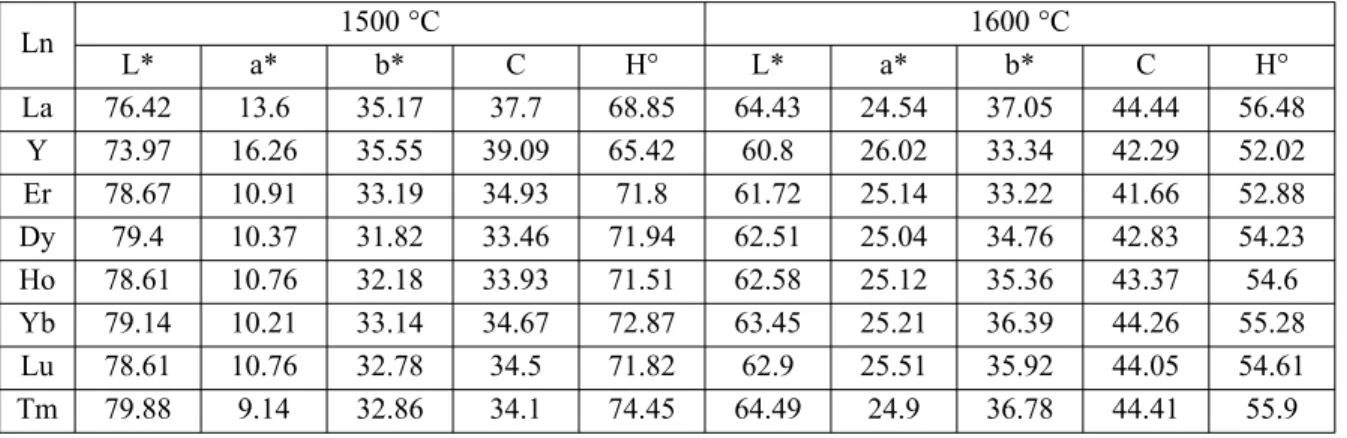
The aim of the present work was to investigate an influence of selected lanthanides on colour properties of the Ce0.9Tb0.05Ln0.05O1.975 where Ln = La, Y, Er, Dy, Ho, Yb, Lu and Tm.
By the all pigments applied into ceramic glaze their colour hue is cream and is practically unchanging with temperature of calcination (1300 and 1400°C). Their colour properties do not differ for these temperatures. The change in a colour hue is also apparent for the pigments after calcination at the temperature of 1500 and 1600°C (Table 1). Pigments with calcination
Ln 1500 °C 1600 °C
L* a* b* C H° L* a* b* C H°
La 76.42 13.6 35.17 37.7 68.85 64.43 24.54 37.05 44.44 56.48
Y 73.97 16.26 35.55 39.09 65.42 60.8 26.02 33.34 42.29 52.02
Er 78.67 10.91 33.19 34.93 71.8 61.72 25.14 33.22 41.66 52.88
Dy 79.4 10.37 31.82 33.46 71.94 62.51 25.04 34.76 42.83 54.23
Ho 78.61 10.76 32.18 33.93 71.51 62.58 25.12 35.36 43.37 54.6
Yb 79.14 10.21 33.14 34.67 72.87 63.45 25.21 36.39 44.26 55.28
Lu 78.61 10.76 32.78 34.5 71.82 62.9 25.51 35.92 44.05 54.61
Tm 79.88 9.14 32.86 34.1 74.45 64.49 24.9 36.78 44.41 55.9
hue after application into ceramic glaze. Based on values L* it can be seen that the highest calcination temperature (1600°C) decreases the brightness and the final colour of pigments becomes gradually darker. The pigments prepared by calcination at 1600°C
are characterized by higher values of colour coordinates a* and b*. The chroma C demonstrates the same course. The pigments calcinated at 1600°C produce orange hue because the value H° of these pigments lies from 52.02 to 56.48.
The influence of selected lanthanides was also monitored except influence of calcination temperature. From the wide range of the rare elements, the best results of colour were obtained by the pigments containing yttrium (Fig. 1). This pigment prepared by calcination at 1600°C is characterized by the highest value a* (red hue) and at the same time by the lowest value L* (lightness). This pigment gives the
The effect of calcination temperature on colour hue of the pigment Ce0.9Tb0.05Y0.05O1.975 after its application into organic matrix and ceramic glaze is demonstrated in Fig. 2.
Pigments applied into organic matrix give
grey-brown hue for temperature range from 1300 to1500°C, higher temperature, i.e. 1600°C, produces brown-orange hue, that is connected with considerable increase of value a* (red hue) and chroma C (Table 2).
Pigments calcinated at lower temperatures (1300 and 1400°C) after their application into ceramic glaze give light pink-orange hues. The higher temperature of calcination (1500°C) causes the increase of value a* (red hue) and b* (yellow hue) and the colour is shifted to orange. At the same time the value L* (lightness) is decreased and colour becomes darker. The highest temperature of calcination (1600°C)
produces intensive orange hue because the value H° is the lowest from all prepared pigments and is also characterized by the low brightness of value L*.
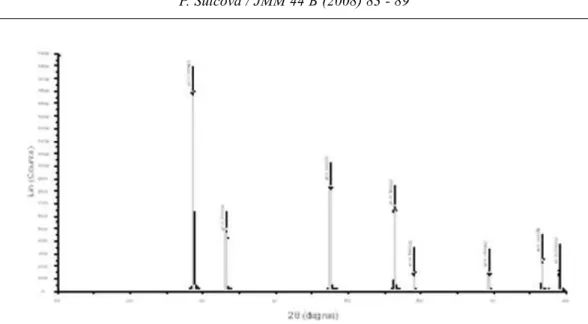
The pigment Ce0.9Tb0.05Y0.05O1.975 was also studied by powder X-ray diffraction analysis. It was found that the sample calcinated at the 1300°C is heterogeneous because free Tb2O3 was also identified beside cubic CeO2. The higher temperature, i.e. 1400°C (Fig. 3) produced single-phased compound. The fluorite type CeO2 structure of the samples with cubic symmetry was
determined. The same results were obtained for the pigments prepared at temperature 1500 and 1600 °C.
The particle size and particle size distribution can markedly affect the colour properties of inorganic pigments. Therefore the synthesized samples were measured from this point of view. The mean particle sizes (d50) of pigments used for colouring of ceramic glazes or bodies lie in region from 5 to 15 µm. The test was carried out with unmilled pigments.
The values of pigment particles are in range from 1.5 µm (d10) to 30 µm (d90) for
Fig. 2: The influence of calcination temperature on the colour co-ordinates a* and b* of the Ce0.9Tb0.05Y0.05O1.975 pigment applied into organic matrix () and ceramic glaze ()
T [°C] 1500 °C 1600 °C
L* a* b* C H° L* a* b* C H°
1300 56.74 9.16 10.43 14.01 48.09 85.53 3.45 21.48 21.76 80.88 1400 49.18 9.41 10.38 14.35 46.29 83.69 5.37 25.79 26.34 78.23 1500 40.82 9.92 12.92 12.29 40.08 73.97 16.26 35.55 39.09 65.42 1600 46.54 20.88 19.62 28.65 43.21 60.8 26.02 33.34 42.29 52.02
pigments calcinated at 1300 and 1400°C. The mean particle sizes (d50) of these pigments lies from 6.5 to 8.5 µm. The higher temperature of calcination produces the increase of particle sizes (d10 is about 2.5 µm and d90 about 35 µm) and value d50 is in range from 7 to 10.5 µm. The mean particle sizes d50 of pigments calcinated at 1600°C are shifted to higher values, i.e. from 9.5 to 14 µm. From the Table 3 it follows that the growing temperature of calcination in samples containing yttrium subsequently increases the mean particle size (d50) from value 7.01 to 10.15 µm. The range of the mean particle size of all
pigments is proceed from 5 µm to 15 µm and it means that these compounds are applicable to colouring glazes.
4. Conclusion
On the base of objective colour rating, pigments give more interesting colours at higher temperature. All lanthanides make the light pink-orange hues at 1300°C and the higher temperature produces orange hues. The best orange colour have pigments containing yttrium. The pigment Ce0.9Tb0.05Y0.05O1.975 calcinated at 1600 °C provides the best results of colour after application into ceramic glaze whose final colour is dark orange. The value of hue angle H°, that is 52.02, corresponds with orange tinge and also confirms this conclusion.
Acknowledgements
This research is supported by the grant No. 104/08/0289 from the Grant Agency of
Fig. 3. Powder X-ray diffraction pattern of the Ce0.9Tb0.05Y0.05O1.975 pigment obtaining by calcinations at 1400 °C
T [°C] d10 [µm] d50 [µm] d90 [µm]
1300 0.94 7.01 28.45
1400 1.84 7.14 29.26
1500 1.9 9.13 33.95
1600 2.18 10.15 39.31
Czech Republic and MSM (No. 0021627501). Authors thank to doc. Ing. Ludvík Beneš, CSc. for X-ray crystallography.
References
1. S.O. Tumanov, V.A. Pavlova, Steklo i keramika, 2 (1974) 28
2. P. Šulcová, M. Trojan, Z. Šolc, Dyes and Pigments, 37 (1998) 65.
3. E. Tomaszewicz, J. Thermal Anal. and Calorimetry, 90 (2007) 235.
4. P. Šulcová, L. Vitásková, Sci. Pap. Univ. Pardubice, A13 (2007) 121.
5. L.S. Kumari, G. Georgie, P.P. Rao, M.L.P. Reddy, Dyes and Pigments, 77 (2008) 427.