Croat. Chem. Acta88 (2) (2015) 151–157.
http://dx.doi.org/10.5562/cca2591
Original Scientific Article
Synthesis of Orthogonally Protected Muramic Acid Building Blocks for
Solid Phase Peptide Synthesis
Kristina Vlahoviček-Kahlina and Andreja Jakas*
Division of Organic Chemistry and Biochemistry, Ruđer Bošković Institute, Bijenička c. 54, 10000 Zagreb, Croatia
RECEIVED JANUARY 29, 2015; REVISED MARCH 23, 2015; ACCEPTED APRIL 15, 2015
Abstract. Muramic acid is found in many peptide natural products containing oligo(poly)saccharide moie-ties. Taking into consideration that the Fmoc methodology is routinely used for solid-phase peptide syn-thesis, preparation of orthogonally protected muramic acid building blocks for total solid-phase synthesis of these natural products is of particular practical importance. Herein a simple and efficient synthesis of benzyl 2-amino-4,6-O-benzylidene-3-O-[(R)-1-carboxyethyl]-2-deoxy-N- 9-fluorenylmethyloxycarbonyl-α-D-glucopyranoside (6) from N-acetylglucosamine (1)is described. Important improvements over previ-ous synthetic approaches to glucopyranosides 2 (benzyl 2-acetamido-2-deoxy-α-D-glucopyranoside) and 3
(benzyl 2-acetamido-4,6-O-benzylidene-2-deoxy-α-D-glucopyranoside), key building blocks in prepara-tion of 6, include synthesis simplification and efficient isolation and purification. Optically pure (S )-2-chloropropionic acid 7 was prepared and introduced to the positon 3-O of sugar moiety to give compound 4 (benzyl 2-acetamido-4,6-O-benzylidene-3-O-[(R)-1-carboxyethyl]-2-deoxy-α-D-glucopyranoside) with the (R)-configuration of the lactyl side-chain in excellent overall yield and optical purity. Deacetylation of amino group gave compound 5 (benzyl 2-amino-4,6-O-benzylidene-3-O-[(R
)-1-carboxyethyl]-2-deoxy-α-D-glucopyranoside) suitable for incorporation of the Fmoc protecting group to give protected muramic ac-id derivative 6, auseful building block in peptide synthesis.
Keywords: dipeptide isostere, muramic acid, solid phase peptide synthesis (SPPS), sugar amino acid (SAA)
INTRODUCTION
Sugar amino acids (SAAs) are defined as carbohy-drate-based compounds that feature an amine and a carboxylate.1–7 As such, SAAs are widely spread in
nature, and neuraminic acid and N-acetylmuramic acid constitute important structural elements in many oligo-(poly)saccharides and glycoconjugates.1 Muramic acid
has been shown to be the main component of the peptidoglycan chain, which constitutes a building unit of the bacterial cell walls and spores.8 The discovery
that the minimal adjuvant active structure of bacterial peptidoglycans is the muramyl dipeptide N -acetyl-muramyl-L-alanyl-D-isoglutamine (MDP) has
generat-ed a great deal of interest in muramic acid derivatives preparation.9,10 The potential utilisation of a simple
and well-defined synthetic adjuvant molecule as MDP, showing maximal stimulation of the immune response but little toxicity and other side effects, has heralded a new era in immunology especially in the field of new vaccine development.11 Interestingly, SAAs in nature
are almost exclusively linked through interglycosidic
bonds, not through amide bonds. The relevance of the hybrid nature of SAAs is evident by the multitude of reported applications in which selected amino acid residues are replaced by SAA in biologically relevant oligopeptides. Thus the outcome of this replacement can be twofold: 1) The nature of the parent carbohy-drate (the furan or pyran ring) in combination with the positioning of the amine and carboxylate may affect a desired secondary structure on the target oligopeptide, 2) the residual functionalities on the furan/pyran core may be used to introduce additional desirable proper-ties to the peptide.12 Despite the growing interest for
the use of SAAs in preparation of unusual peptides with unique structural and biological properties, there is no reported strategy that describes efficient synthe-sis of orthogonally protected SAA suitable for the Fmoc-solid phase peptide synthesis.13–18 Herein we
EXPERIMENTAL
Melting points were determined on a Tottoli (Büchi) apparatus and are uncorrected. Optical rotations were measured at 25 °C using an Optical Activity LTD auto-matic AA-10 polarimeter. NMR spectra were recorded on a Bruker AV 600 spectrometer, operating at 150.91 MHz for 13C and 600.13 MHZ for 1H nuclei. The
spec-tra were measured in DMSO-d6 and CDCl3 solutions at
25 °C. Chemical shifts in parts per million were refer-enced to tetrametylsilane (TMS) and expressed in ppm. Spectra were assigned based one dimensional 1H, 13C
and APT (Attached Proton Test) and 2D homonuclear COSY (Correlation Spectroscopy) and heteronuclear HMQC (Heteronuclear Multiple-Quantum Correlation) and HMBC (Heteronuclear Multiple Bond Correlation) experiments. Mass spectra were recorded on a triple quadrupole Agilent 6410 spectrometer operating in Electrospray ionization (ESI) mode. Analytical TLC was carried out on silica gel 60 with detection by char-ring with 10 % H2SO4. Column chromatography was
performed on silica gel (Merck, 0.040–0.063 mm). Following solvent systems were used: A) EtOAc: EtOH: HOAc: H2O = 70 : 10 : 2 : 2 v/v/v/v; B) EtOAc: HOAc:
H2O = 70 : 2 : 2 v/v/v; C) CH2Cl2: MeOH = 9 : 1 v/v; D)
EtOAc: HOAc: H2O = 70 : 1 : 1 v/v/v; E) EtOAc: EtOH:
HOAc: H2O = 70:20: 2:2 v/v/v/v. N-acetylglucosamine
(1), benzyl alcohol, p-toluene sulfonic acid monohydra-te, benzaldehyde, Fmoc-OSu, NaH and ZnCl2 were
pur-chased from Sigma-Aldrich.
Benzyl 2-acetamido-2-deoxy-α-D-glucopyranoside (2)19
N-acetylglucosamine (1) (10 g, 0.045 mol) and benzyl alcohol (72 mL) were suspended in toluene (120 mL) and p-toluene sulfonic acid monohydrate (500 mg) was added. The reaction mixture was refluxed (130 °C) in a Dean-Stark apparatus with water removal by azeotropic mixture. After 4 h, the reaction mixture was cooled to ambient temperature and saturated solution of sodium hydrogen carbonate was added to pH ~ 6. Toluene was removed under reduced pressure. Residue was split into ether-hexane (vol. ratio = 2:1, 260 mL) mixture. Reac-tion mixture was vigorously stirred for 3h and left over-night in refrigerator. The amorphous precipitate was filtered off, washed with ether and the crude product re-crystallized from 2-propanol to yield colourless crystals
2 (10.1 g, 72% yield). Rf (A) = 0.42; m.p. 186–187 °C
(lit. 185–186 °C)20; [α]D = +170 ° c1, water (lit. [α]D =
+168 ° c1, water)20; 1H NMR (DMSO-d6) δ/ppm: 7.81
(d, 1H, J= 8.2 Hz, NH), 7.35–7.28 (m, 5H, Ph), 5.01 (d, 1H, J= 5.8 Hz, OH-4), 4.73 (d, 1H, J= 5.8 Hz, OH-3), 4.70 (d, 1H, J= 3.2 Hz, H-1), 4.66 (d, 1H, J= 12.3 Hz,
CH2b-Ph), 4.54 (t, 1H, J= 5.8 Hz, OH-6), 4.41 (d, 1H,
J= 12.3 Hz, CH2a-Ph), 3.68 (m, 1H, H-2), 3.65 (m, 1H,
H-6b), 3.53 (m, 1H, H-3), 3.50 (m, 1H, H-6a), 3.45 (m, 1H, H-5), 3.16 (m, 1H, H-4), 1.83 (s, 3H, CH3-CON
acetyl); 13C NMR (DMSO-d6) δ/ppm: 169.4 (CO
ace-tyl), 137.9 (Ph (C)), 128.1–127.4 (Ph(CH)), 95.9 (C-1), 73.1 (C-5), 70.9 (C-4), 70.6 (C-3), 67.7 (CH2-Ph), 60.8
(C-6), 53.7 (C-2), 22.5 (CH3-CON acetyl); MS-ESI m/z
312 [M+H]+.
Benzyl 2-acetamido-4,6-O-benzylidene-2-deoxy-α-D
-gluco-pyranoside (3)21
Suspension of compound 2 (6 g, 0.019 mol), benzalde-hyde (100 mL) and anhydrous ZnCl2 (6 g) was stirred at
room temperature for 16 h. Solution was spilt in ice-cold water-petrol ether mixture (80 mL: 60 mL). Solu-tion was mixed for addiSolu-tional 15 min, after which the formed precipitate was filtrated, washed with water and hexane. Crude product was recrystallized from mixture of 2-propanol (50 mL) and dioxane (20 mL) and crys-tals were filtrated and washed with cold 2-propanol to give compound 3 (6.1 g, 80 % yield). Rf (B) = 0.72;
m.p. 240–242 °C (lit. 263–264 °C)21; [α]D = +110 ° c1,
pyridine (lit. [α]D = +108 ° c1, pyridine)22; 1H NMR
(DMSO-d6) δ/ppm: 7.97 (d, 1H, J= 8.3 Hz, NH), 7.46–
7.30 (m, 10H, Ph), 5.62 (s, 1H, CH-Ph) 5.16 (d, 1H,
J= 5.8 Hz, OH-3), 4.80 (d, 1H, J= 3.6, H-1), 4.69 (d, 1H, J= 12.3 Hz, CH2b-Ph), 4.48 (d, 1H, J= 12.3 Hz,
CH2a-Ph), 4.14 (m, 1H, H-6b), 3.84 (m, 1H, H-2),
3.74–7.71 (m, 2H, H-3, H-6a), 3.69 (m, 1H, H-5), 3.51
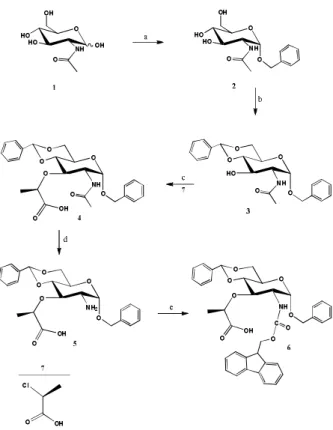
Figure 1. Synthesis of protected muramic derivative 6 from
N-acetylglucosamine (1). Reagents and conditions: BnOH, toluene, p-toluene sulfonic acid monohydrate, 130 °C, 4 h (a); benzaldehyde, ZnCl2,16 h (b); NaH, 70 °C, 24 h (c); 5 M KOH,
(t, 1H, J= 8.8 Hz, H-4), 1.84 (s, 3H, CH3-CON acetyl);
13C NMR (DMSO-d6) δ/ppm: 169.4 (CO acetyl),
137.7 (Ph(C)), 129.2–126.4 (Ph(CH)), 100.8 (CH-Ph), 96.9 (C-1), 82.1 (C-4), 68.6 (CH2-Ph), 68.0 (C-6), 67.2
(C-3), 62.8 (C-5), 54.2 (C-2), 22.5 (CH3-CON acetyl);
MS-ESI m/z 400 [M+H]+.
Benzyl 2-acetamido-4,6-O-benzylidene-3-O-[(R )-1-carboxy-ethyl]-2-deoxy-α-D-glucopyranoside (4)23
Compound 3 (4g, 0.010 mol) was dissolved in anhy-drous dioxane (170 mL) and stirred at 80–90 °C until dissolved. The temperature was lowered to 70 °C and NaH (3.1 g, 0.130 mol, 80 % oil dispersion) in small portions was added to solution. Reaction mixture was stirred for 1 h at 95 °C then cooled to 65 °C, and solu-tion of (S)-2-chloropropionic acid (7, 3.2 g, 0.030 mol) in anhydrous dioxane (10 mL) was added dropwise. After 1h stirring at 65 °C the additional amount of NaH (1.9 g, 0.080 mol) was added and reaction mixture was stirred at 70 °C for 24 h. Reaction mixture was cooled in ice-water bath and ice cold water was added dropwise. After the extraction upper light yellow layer was filtrat-ed and dioxane was evaporatfiltrat-ed in vacuum to 30 mL. The residue was dissolved in water (50 mL) and ex-tracted with dichloromethane (DCM, 2 × 20 mL). Or-ganic layer was washed with 20 mL water. Water layers were cooled to 0 °C and adjusted to pH = 3 (2M HCl) and stirred for 15 min. The precipitated product was washed with ice cold water and evaporated. Crude product was purified by flash silica gel column chroma-tography in solvent system C to give compound 4 (3.7 g, 78 % yield) white amorphous crystalline. Rf (D) =
0.52; m.p. 238–240 °C (lit. 237–239 °C)22; [α]D =
+133 ° c1, MeOH (lit. [α]D = +117 ° c0.5, MeOH)22; 1H NMR (DMSO-d6) δ/ppm: 7.97 (d, 1H, J= 5.2 Hz,
NH), 7.42–7.30 (m, 10H, Ph), 5.70 (s, 1H, CH-Ph), 5.04 (d, 1H, J= 3.2 Hz, H-1), 4.69 (d, 1H, J= 12.3 Hz,
CH2b-Ph), 4.48 (d, 1H, J= 12.3 Hz, CH2a-Ph), 4.28
(q,1H, J= 6.9 Hz, CH-CH3 lactyl), 4.14 (m, 1H, H-6b),
3.80 (m, 1H, H-2), 3.77 (m, 1H, H-6a), 3.73 (m, 1H, H-3) 3.72 (m, 1H, H-2) 3.70 (m, 1H, H-5), 1.85 (s, 3H,
CH3-CON acetyl), 1.27 (d, 3H, J= 6.9 Hz, CH-CH3
lactyl); 13C NMR (DMSO-d6) δ/ppm: 175.2 (COOH),
169.3 (CO acetyl), 137.6 (Ph(C)), 128.7–125.8 (Ph(CH)), 100.2 (CH-Ph), 96.8 (C-1), 81.5 (C-4), 75.1 (C-3), 75.0 (CH-CH3 lactyl), 68.9 (CH2-Ph), 67.8 (C-6),
62.9 (C-5), 53.5 (C-2), 22.6 (CH3-CON), 18.6 (CH-CH3
lactyl); MS-ESI m/z 472 [M+H]+.
Benzyl 2-amino-4,6-O-benzylidene-3-O-[(R )-1-carboxy-ethyl]-2-deoxy-α-D-glucopyranoside (5)19
Compound 4 (2 g, 4.2 mmol) was dissolved in 5 M KOH in ethanol (28 mL). Reaction mixture was stirred 16 h at 120 °C under nitrogen. Saturated solution of NH4Cl was added in reaction mixture and extracted with
DCM (3 × 50 mL). Solvent was evaporated and crude product was purified on flash silica gel column chroma-tography using solvent system E to elute impurities and solvent system C to give compound 5 (1.46 mg, 81 % yield). Rf (E) = 0.52; m.p. 175–176 °C; [α]D = +128 °
c1, MeOH; 1H NMR (DMSO-d6) δ/ppm: 7.97 (d, 1H,
J= 5.2 Hz, NH2), 7.43–7.30 (m, 10H, Ph), 5.68 (s, 1H,
CH-Ph), 5.08 (d, 1H, J= 3.7 Hz, H-1), 4.69 (d, 1H,
J= 11.8 Hz, CH2b-Ph), 4.57 (d, 1H, J= 11.8 Hz, CH2
a-Ph), 4.11 (m, 1H, H-6a), 3.91 (q, 1H, J= 7.0 Hz, CH -CH3 lactyl), 3.72 (m, 1H, H-6b), 3.66 (m, 1H, H-4) 3.63
(m, 1H, H-5), 3.61 (m, 1H, H-3), 3.11 (m, 1H, H-2), 1.22 (d, 3H, J= 6.9 Hz, CH-CH3 lactyl); 13C NMR
(DMSO-d6) δ/ppm: 175.7 (COOH), 137.3 (Ph(C)),
128.8–125.8 (Ph(CH)), 100.2 (CH-Ph), 96.8 (C-1), 80.9 (C-4), 78.6 (CH-CH3 lactyl), 76.8 (C-3), 69.4 (CH2-Ph),
67.6 (C-6), 62.9 (C-5), 53.4 (C-2), 19.3 (CH-CH3
lactyl); MS-ESI m/z 430 [M+H]+; HRMS calcd. for
C23H28NO7 430.1860 found: 430.1849.
Benzyl 2-amino-4,6-O-benzylidene-3-O-[(R )-1-carboxy-ethyl]-2-deoxy-N-9-fluorenylmethyloxycarbonyl-α-D
-glucopyranoside (6)
Compound 5 (1 g, 2.3 mmol) was dissolved in DMF (20 mL) and sodium hydrogen carbonate (392 mg, 2 eq.) in water (20 mL) was added. Reaction mixture was kept at 0 °C and cold solution of Fmoc N-hydroxysuccinimide ester (Fmoc-OSu, 865 mg, 1.1 eq.) in DMF (20 mL) was added dropwise. Reaction was stirred in ice-water bath for 2 h. Water (100 mL) was added to the reaction mixture and formed precipitate was filtrate and washed with water. Product was evaporated under vacuum and then purified on flash silica gel column in solvent sys-tem C which gave 1.35 g (90 % yield) of compound 6.
Rf (C) = 0.48; m.p. 179–180 °C; [α]D = +71 ° c1, DMF; 1H NMR (DMSO-d6) δ/ppm: 7.95 (NH), 7.91–7.89 (m,
2H, Fmoc), 7.75–7.71 (m, 2H, Fmoc), 7.43–7.28 (m, 10H, Ph; 2H, Fmoc), 7.22–7.20 (m, 2H, Fmoc) 5.69 (s, 1H, CH-Ph), 5.21 (d, 1H, J= 3.1 Hz, H-1), 4.69 (d, 1H, J= 12.4 Hz, CH2b-Ph), 4.48 (d, 1H, J= 12.4 Hz,
CH2a-Ph), 4.23 (m, CH2b-CH-Fmoc), 4.22 (m,
CH-Fmoc), 4.15 (m, 1H, H-6a), 4.11 (m, CH2
a-CH-Fmoc), 4.10 (q, 1H, J= 7.0 Hz, CH-CH3 lactyl), 3.79
(m, 1H, H-6b), 3.85 (m, 1H, H-3) 3.77 (m, 1H, H-4) 3.71 (m, 1H, H-5), 3.44 (m, 1H, H-2), 1.26 (d, 3H,
J= 7.4 Hz, CH-CH3 lactyl); 13C NMR (DMSO-d6)
δ/ppm: 177.2 (COOH), 156.4 (CO Fmoc), 143.8 (Fmoc (C)),140.6 (Fmoc (C)), 137.7 (Ph (C)), 128.9–125.3 (Ph (CH)), 120.1–120.0 (Fmoc (CH)), 100.21 (CH-Ph), 96.7 (C-1), 82.56 (C-4), 77.5 (CH-CH3 lactyl), 72.8
(C-3), 68.8 (CH2-Ph), 67.9 (C-6), 65.8 (CH2-CH Fmoc),
63.1 (C-5), 55.8 (C-2), 46.6 (CH2-CH Fmoc), 19.3
(CH-CH3 lactyl); MS-ESI m/z 674 [M+Na]+; HRMS
(S)-2-Chloropropionic acid (7)24
L-Alanine (6 g, 0.067 mol) was dissolved in 8 M HCl
(84 mL) and cooled to 0 °C and then solution of NaNO2
(7.6 g in 24 mL water) in water was added dropwise with vigorous stirring. Temperature was kept at 5 °C for 2 h, and after that the reaction mixture was stirred at 2 °C for additional 4 h, and overnight at room tempera-ture in inert conditions (under nitrogen). Sodium hydro-gen carbonate (6.6 g) was added to the reaction mixture in small portions with vigorous stirring. Reaction was extracted with ether (2 × 50 mL, 1 × 30 mL) and collect-ed ether’s extracts were washcollect-ed with saturatcollect-ed soluti- on of calcium chloride (20 mL) and re-extracted with ether (30 mL). Ether’s extracts were dried for 2 h on calcium chloride. Ether was evaporated under reduced pressure and oil residue was distilled in vacuum to give pure (S)-2-chloropropionic acid (5.3 g, 73 % yield). b.p. 89 °C at p = 2.66 kPa; [α]D = –16.3 ° (lit. [α]D =
–13.98 °)24; 1H NMR (CDCl3) δ/ppm: 1.74 (d, 3H,),
4.45 (q, 1H,), 10.5 (s, 1H); 13C NMR (CDCl3) δ/ppm:
21.3; 52.1; 176.0; MS-ESI m/z 153.1 [M+2Na]2+ (100 %);
155.0 [M+2+2Na]2+ (32 %).
RESULTS AND DISCUSSION
The first three reaction steps were part of the established synthesis of N-acetylmuramic acid.25–29 The synthesis
started from N-acetylglucosamine 1, which was protect-ed by benzylation with benzyl alcohol at the anomeric position.19 The p-toluene sulfonic acid was used as a
catalyst in the reaction which was carried out in toluene. The synthesis resulted in a α/β mixture of benzyl anomer 2, however the pure benzyl α-anomer 2 can be obtained with thermodynamic control of the reaction by high temperature in refluxing toluene.29 The
incorpora-tion of a benzylidene protecincorpora-tion group in the 4-O and
Table 1. NMR data (δ in ppm) of compounds 4–6 in DMSO-d6
Position 1H NMR 13C NMR
4 5 6 4 5 6
CH-1 5.04 5.08 5.21 96.8 96.8 96.7
CH-2 3.80 3.11 3.44 53.5 53.4 55.8
CH-3 3.73 3.61 3.85 75.1 76.8 72.8
CH-4 3.72 3.66 3.77 81.5 80.9 82.6
CH-5 3.70 3.63 3.71 62.9 62.9 63.1
CH-6a 3.77 3.72 3.79 67.8 67.6 67.9
CH-6b 4.14 4.11 4.15 – – –
CH-CH3 4.28 3.91 4.10 75.0 78.6 77.5
CH-CH3 1.27 1.22 1.26 18.6 19.3 19.3
CH3-CON 1.85 22.6
CH2a-Ph 4.48 4.57 4.48 68.9 69.4 68.8
CH2b-Ph 4.69 4.69 4.69 – – –
CH-Ph 5.70 5.68 5.69 100.2 100.2 100.2
Ph (CH) 7.30–7.42 7.32–7.43 7.28–7.43 125.8–128.7 125.8–128.8 125.3–128.9
Ph (C) – – – 137.6 137.3 137.7
NH 7.97 7.97 7.95 – – –
CON – – – 169.3 – –
COOH – – – 175.2 175.7 177.2
CO-Fmoc – – – – – 156.4
Fmoc (C) 140.6;143.8
Fmoc (CH) 7.71–7.91, 7.20–7.22 120.0–120.1
CH2a-CH Fmoc 4.11 65.8
CH2b-CH Fmoc 4.23 –
6-O-hydroxy positions was carried out according to previously published Gross and Jeanloz strategy to afford protected N-acetylglucosamine derivative 3 with a free 3-hydroxy group.21 The method for the effici-
ent and easy synthesis of 4,6-benzylidne-derivative of
N-acetylglucosamine, using pyridinium perchlorate as catalyst in the reaction with benzaldehyde dimethyla-cetal, was recently published.30 By treating 3 with
opti-cally pure (S)-2-chloropropionic acid 7, the Williamson stereoselective ether synthesis proceeded in good yield (78 %), to afford 4.31 The synthesis of muramic acid
previously reported in the literatureis based on conden-sation of D-glucosamine derivatives with a
2-halogeno-propionic acid derivative, forming an ether link with the hydroxyl group at C-3.23,31 In most of these approaches,
methyl 2-acetamido-4,6-O-benzylidene-2-deoxy-α-D
-glucopyranoside or benzyl 2-acetamido-4,6-O -benzyli-dene-2-deoxy-α-D-glucopyranoside (3) have been used
as a starting material. However, alkylation of the unpro-tected 3-O group of 3 with racemic 2-halogeno-propio-nic acid derivatives led to the formation of a mixture of epimeric (R) and (S) ethers (muramic and isomuramic acid derivatives), and the described methods require additional separation of the epimeric mixture in order to obtain pure diastereomers.32 Improvement in the
synthe-sis of muramic acid was achieved by the use of enanti-opure (S)-2-chloropropionic acid 7 as the alkylation agent in the critical condensation step.23 It was found
that when (S)-2-chloropropionic acid was condensed with an alkoxide, it underwent Walden inversion.33
Therefore, the condensation of 3 with pure (S )-2-chloro-propionic acid led stereospecifically to muramic acid, with (R) configuration of the lactic acid moiety. Alt-hough this method avoids chromatographic separation of 4, it was not explored due to the difficult preparation of optically pure reagent.32 Our modified approach for
(S)-2-chloropropionic acid synthesis from (S)-alanine 24
resulted in the optically pure compound 7 in 73 % yield. The introduction of lactic acid moiety was achieved in presence of NaH according to the paper published by Sinaÿ et al. for the synthesis of manno derivative of muramic acid with some modification in time, tempera-ture and purification of compound.34 The compound 4
was purified by flash chromatography and the stereose-lectivity of the reaction was determined by 1H NMR.
The benzylidene proton at 5.68 ppm for the muramic acid derivative 4 is indicative of the muramic acid de-rivative with the (R)-configuration of the lactyl side-chain according to the published data by Babič and Pečar which are for the muramic acid 5.66 ppm and for the isomuramic acid 5.55 ppm.29 The determination of
the absolute configuration was especially important in the next step in the reaction of saponification of the compound 4, to deprotect amino group and give com-pound 5. This reaction conditions enable racemisation.
1H NMR analysis shows benzylidene proton of
com-pound 5 at 5.68 ppm (Table 1) which in comparison to compound 4 showed that we did not lose the optical purity in compound 5 with the (R) configuration of the lactyl group. The introduction of the Fmoc protecting group, the major group that enables utilisation of mu-ramic acid in SPPS, was obtained with Fmoc-OSu in DMF/water solvent mixture with sodium hydrogen carbonate under low temperature (0 °C) to avoid by-products formation. The synthesis with Fmoc-Cl as reagent was also examined but the reaction yields were poor. Upon the completion of the reaction the product
6 was precipitated with water, filtrated and purified on silica gel column in solvent system C. The optical purity was confirmed by 1H NMR analysis which shows
single signal for benzylidene proton of compound 6 at 5.69 ppm (Table 1) which is in agreement with chem-ical shifts of compound 4 (5.70 ppm, Table 1) and compound 5 (5.68 ppm, Table 1), respectively, for (R)-configuration of the lactyl group. Synthesised Fmoc protected muramic acid can be used in SPPS as
dipeptide isostere building block. Protecting groups are necessary during the synthesis especially for synthesis of longer peptides to avoid by-products formation and to facilitate product purification. Orthogonal protection of muramic acid allows removal of Fmoc protecting group during peptide synthesis, while benzylidene group and benzyl protecting group can be easily removed after peptide condensation under acidic conditions and cata-lytic hydrogenolysis.
MS/MS fragmentation of prepared compounds
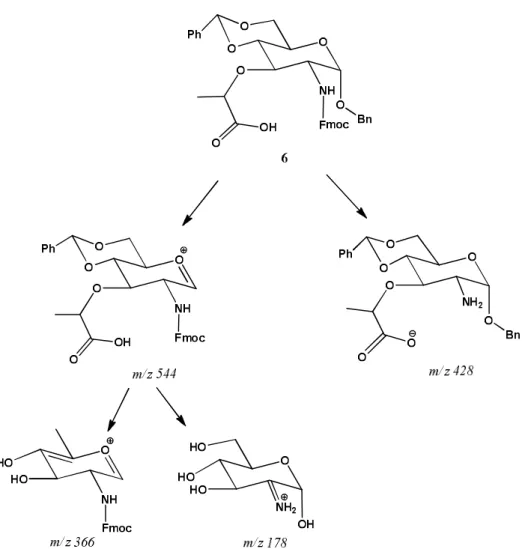
Electrospray ionization (ESI) as soft-ionization method was used to determine the mass spectrometric properties of prepared compounds. The MS/MS fragmentation of all synthesised compounds from 2–6 showed the same tendency. The elimination of benzyl protecting group from 1-O of compounds 2–6 was confirmed with fol-lowing detected fragments 204 (2), 292 (3), 364 (4), 322 (5, Figure 2) and 544 (6, Figure 3) Da, for each com-pound, respectively.35,36 The fragments 258 (4), 216 (5,
figure 2) and 366 (6, Figure 3) Da are results of benzyl-idene protecting group elimination. Further most intense
signal in MS/MS spectrum of compound 5 is 182 which response to the lactone structure shown on Figure 2. Fragmentation of compound 6 in positive mode com-pletely differs from that one in negative mode. While positive mode shows the elimination of protecting groups as well as dehydration of molecule, in negative mode the main and only observed fragment was 428 Da which responding to the Fmoc deprotected molecule (Figure 3).
CONCLUSION
In this work we reported simple and efficient synthesis of orthogonally protected muramic acid suitable for Fmoc solid-phase peptide synthesis. The advantages of our approach include simplified synthesis, use of readily available starting materials and high yield (~ 70–90 %) of desired optically pure (R)-isomers of products 4–6. The described synthesis of orthogonally protected mu-ramic acid building blocks will allow an access to a variety of linear and cyclic peptides with unique struc-tural properties and consequently biological activities.
Supplementary Materials. – Supporting information to the paper is enclosed to the electronic version of the article.
Acknowledgements. We gratefully acknowledge the financial support of the NATO Public Diplomacy Division, Science for Peace and Security Programme (SfP 983154) and Ministry of Science, Education and Sport of the Republic of Croatia (098-0982933-2936). The authors thank also prof. M. Cudic and prof. P. Cudic for useful suggestions and comments.
REFERENCES
1. S. A. W. Gruner, E. Locardi, E. Lohof, and H. Kessler, Chem. Rev.102 (2002) 491–514.
2. F. Schweizer, Angew. Chem. Int. Ed.41 (2002) 230–253. 3. T. K. Chakraborty, S. Ghosh, and S. Jayaprakash, Curr. Med.
Chem.9 (2002) 421–435.
4. T. K. Chakraborty, S. Jayaprakash, and S. Ghosh, Comb. Chem. High T. Scr. 5 (2002) 373–387.
5. J. Gervay-Hague and T. M. Jr. Weathers, J. Carbohydr. Chem.
21 (2002) 867–910.
6. T. K. Chakraborty, P. Srinivasu, S. Tapadar, and B. K. Mohan,
J. Chem. Sci.116 (2004) 187–207.
7. K. J. Jensen and J. Brask, Biopolymers80 (2005) 747–761. 8. M. R. J. Salton, Microbial Cell Walls, Wiley, New York, 1960,
pp. 39–42.
9. F. Ellouz, A. Adam, R. Ciobvaru, and E. Lederer, Biochem. Biophys. Res. Commun.59 (1974) 1317–1325.
10. L. Habjanec, B. Halassy, and J. Tomašić, Int. Immunopharmacol.
10 (2010) 751–759.
11. F. Coulombe, S. Fiola, S. Akira, Y. Cormier, and J. Gosselin,
PLoS 1 4 (2012) e36734.
12. A. B. III Smith, S. Sasho, B. A. Barwis, P. Sprengeler, J. Barbosa, R. Hirschmann, and B. S. Cooperman, Bioorg. Med. Chem. Lett.8 (1998) 3133–3136.
13. L. Poitout, Y. Le Merrer, and J. Depezay, Tetrahedron Lett.36 (1995) 6887–6890.
14. J. P. McDevitt and P. T. Jr. Lansbury, J. Am. Chem. Soc.118 (1996) 3818–3828.
15. N. L. Hungerford, T. D. W. Claridge, M. P. Watterson, R. T.
Aplin, A. Moreno, and G. W. J. Fleet, J. Chem. Soc., Perkin Trans.1 (2000) 3666–3679.
16. M. Raunkjær, F. El Oualid, G. A. van der Marel, H. S. Overk-leeft, and M. Overhand, Org. Lett.6 (2004) 3167–3170. 17. A. A. Edwards, G. J. Sanjayan, S. Hachisu, R. Soengas, A.
Stew-art, G. E. Tranter, and G. W. J. Fleet, Tetrahedron 62 (2006) 4110–4119.
18. B. Lastdrager, M. S. M. Timmer, G. A. van der Marel, H. S. Overkleeft, and M. Overhand J. Carbohydr. Chem.26 (2007) 41–59.
19. R. Enugala, M. Manuel, and B. Marques, ARKIVOC (2012) (vi) 90–100.
20. M. L. Shulman and A. Ya Khorlin, Carbohydr. Res.27 (1973) 141–147.
21. P. H. Gross and R.W. Jeanloz, J. Org. Chem.32 (1967) 2759– 2763.
22. P. H. Gross and M. Rimpler, Liebigs Ann. Chem. (1986) 37–45. 23. Y. Matsushima and J. T. Park, J. Org. Chem.27 (1962) 3581–
3583.
24. B. Koppenhoefer and V. Schurig in: G. N. Reddy, J. D. White (Eds), Org. Synth., Coll., Vol. 8, Organic Syntheses, Inc., 1993, p119. 25. R. Lambert and F. Zilliken, Chem. Ber.93 (1960) 2915–2923. 26. R. Gigg and P. M. Carroll, Nature191 (1961) 495–496. 27. H. M. Flowers and R. W. Jeanloz, J. Org. Chem. 28 (1963)
1564–1467.
28. T. Osawa and R.W. Jeanloz, J. Org. Chem.30 (1965) 448–450. 29. A. Babič and S. Pečar, Tetrahedron-Asymmetr.19 (2008) 2265–
2271.
30. S. S. Pertel, S. A. Gunchak, E. S. Kakayan, V. Y. Chirva, and S. Vidal, 2-Acetamido-4,6-O-benzylidene-2-deoxy-D-glucopyranose, in: P. Kováč (Ed.), Carbohydrate Chemistry: Proven Synthetic Methods, CRC Press, Vol. 1, Chap. 21, 2011, pp 199–203. 31. D. Craig, J. P. Tierney, and C. Williamson, Tetrahedron Lett.38
(1997) 4153–4156.
32. V. Ragoussis, L. Leondiadis, E. Livaniou, and J. P. Evangelatos,
Carbohydr. Res.297 (1997) 289–295.
33. E. D. Hugges, C. K. Ingold, R. J. L. Martin and D. F. Meigh,
Nature166 (1950) 679–680.
34. P. Sinaÿ, M. D. A. Halford, M. S. Choudhary, P. H. Gross, and R. W. Jeanloz, J. Biol. Chem. 247 (1972) 391–397.
35. Š. Horvat and A. Jakas, J. Peptide Sci.10 (2004) 119–137. 36. I. Jerić, C. Verslius, Š. Horvat, and A. J. R. Heck, J. Mass
Compound 4:
SpinWorks 2.5: Vlahovicek D4/77/mur
PPM 7.6 7.2 6.8 6.4 6.0 5.6 5.2 4.8 4.4 4.0 3.6 3.2 2.8 2.4 2.0 1.6 1.2 0.8 0.4 -0.0
file: G:\DOKTORAT_2015\NMR_Fmoc_Mur_(Bn)\NMR_D4_77Mur\1\fid expt: <zg30> transmitter freq.: 600.135401 MHz
time domain size: 32768 points width: 12019.23 Hz = 20.027532 ppm = 0.366798 Hz/pt number of scans: 86
freq. of 0 ppm: 600.129999 MHz processed size: 32768 complex points LB: 0.000 GB: 0.0000
SpinWorks 2.5: Vlahovicek D4/77/mur
PPM 170.0 160.0 150.0 140.0 130.0 120.0 110.0 100.0 90.0 80.0 70.0 60.0 50.0 40.0 30.0 20.0 10.0
file: G:\DOKTORAT_2015\NMR_Fmoc_Mur_(Bn)\NMR_D4_77Mur\5\fid expt: <jmod> transmitter freq.: 150.917899 MHz
time domain size: 65536 points width: 39370.08 Hz = 260.870838 ppm = 0.600740 Hz/pt number of scans: 10143
Compound 5:
SpinWorks 2.5: K. Vlahovicek D5_63_2
PPM 7.2 6.8 6.4 6.0 5.6 5.2 4.8 4.4 4.0 3.6 3.2 2.8 2.4 2.0 1.6 1.2 0.8 0.4 -0.0
file: G:\DOKTORAT_2015\NMR_Fmoc_Mur_(Bn)\NMR_skodanje_Ac\1\fid expt: <zg30> transmitter freq.: 300.132701 MHz
time domain size: 32768 points width: 6172.84 Hz = 20.567034 ppm = 0.188380 Hz/pt number of scans: 32
freq. of 0 ppm: 300.130001 MHz processed size: 32768 complex points LB: 0.000 GB: 0.0000
SpinWorks 2.5: K. Vlahovicek D4/83
PPM 170.0 160.0 150.0 140.0 130.0 120.0 110.0 100.0 90.0 80.0 70.0 60.0 50.0 40.0 30.0 20.0 10.0
file: G:\DOKTORAT_2015\NMR_Fmoc_Mur_(Bn)\NMR_D4_83_skidanje_acetila\5\fid expt: <jmod> transmitter freq.: 150.917899 MHz
time domain size: 65536 points width: 39370.08 Hz = 260.870838 ppm = 0.600740 Hz/pt number of scans: 10302
Compound 6:
SpinWorks 2.5: K. Vlahovicek-Kahlina D4/93
PPM 7.6 7.2 6.8 6.4 6.0 5.6 5.2 4.8 4.4 4.0 3.6 3.2 2.8 2.4 2.0 1.6 1.2 0.8 0.4 -0.0
file: G:\DOKTORAT_2015\NMR_Fmoc_Mur_(Bn)\NMR_D4_93_Fmoc_Mur\1\fid expt: <zg30> transmitter freq.: 600.135401 MHz
time domain size: 32768 points width: 12019.23 Hz = 20.027532 ppm = 0.366798 Hz/pt number of scans: 64
freq. of 0 ppm: 600.129998 MHz processed size: 32768 complex points LB: 0.000 GB: 0.0000
SpinWorks 2.5: K. Vlahovicek-Kahlina D4/93
PPM 150.0 140.0 130.0 120.0 110.0 100.0 90.0 80.0 70.0 60.0 50.0 40.0 30.0 20.0 10.0
file: G:\DOKTORAT_2015\NMR_Fmoc_Mur_(Bn)\NMR_D4_93_Fmoc_Mur\5\fid expt: <jmod> transmitter freq.: 150.917899 MHz
time domain size: 65536 points width: 39370.08 Hz = 260.870838 ppm = 0.600740 Hz/pt number of scans: 10349