Article
Printed in Brazil - ©2017 Sociedade Brasileira de Química0103 - 5053 $6.00+0.00*e-mail: [email protected]; [email protected]; [email protected]
Effect of Sulfamic Acid on 1,3-Dipolar Cycloaddition Reaction:
Mechanistic Studies and Synthesis of 4-Aryl-
NH
-1,2,3-triazoles from Nitroolefins
Pankaj Sharma,a Niggula P. Kumar,a Kishna R. Senwar,a Oscar Forero-Doria,b
Fabiane M. Nachtigall,*,b,c,d Leonardo S. Santos*,b,c and Nagula Shankaraiah*,a
aDepartment of Medicinal Chemistry, National Institute of Pharmaceutical Education and
Research (NIPER), 500-037 Hyderabad, India
bLaboratory of Asymmetric Synthesis, Chemistry Institute of Natural Resources,
cFraunhofer Chile Research Foundation (FCR-CSB), Nanobiotechnology Division and
dInstituto de Innovación Basada en Ciencia, University of Talca, P. O. Box 747, Talca, Chile
A facile and new metal-free 1,3-dipolar cycloaddition reaction for the synthesis of 4-aryl-NH-1,2,3-triazoles from nitroolefins and NaN3 employing NH2SO3H has been developed.
Sulfamic acid proved to be an efficient additive in this transformation by inhibiting the formation of triaryl benzene. Mechanistic aspects and key intermediates associated with this transformation have also been characterized by online monitoring of the reaction using electrospray ionization tandem mass spectrometry method (ESI-MS/MS). The protocol emphasizes broad substrate scope for many functionalities, simple reaction conditions such as stability to open air, less reaction time, easy work-up, eco-friendly and with good to excellent yields.
Keywords: bioactive triazoles, electrospray ionization, reaction mechanism, green chemistry
Introduction
The development of drug-like heterocyclic molecules from simple precursors is one of the utmost important and promising area in synthetic organic chemistry. Triazoles are one of these heterocycles known to exist as 1,2,3- and 1,2,4-triazoles according to their position of nitrogen atoms. Particularly, the 1,2,3-triazoles act as an important class of nitrogen rich five-membered heterocycles that are known
to exhibit their importance in medicinal chemistry.1
Apart from medicinal properties, 1,2,3-triazoles are found to have wide range of industrial applications such as dyes, agrochemicals, materials, corrosion inhibitors and photostabilizers.2 Huisgen et al.3 have been intensively
developing the conventional route for the synthesis of 1,2,3-triazoles which involves the 1,3-dipolar cycloaddition between azides and alkynes. However, these cycloaddition reactions have required high activation energy, temperature, prolonged reaction time and the products turn out to be a mixture of two 1,4- and 1,5-regioisomers. With the intention of controlling the regioselectivity of this reaction and to improve the reaction conditions, several methodologies
have been developed by using various transition-metal catalysts.
Originally, Rostovtsev et al.4 and Tornøe et al.5
have independently defined click chemistry in which
CuI-catalyzed azide-alkyne cycloaddition (CuAAC)
allowed the best regioselectivity (1,4-regioisomer). Till
date, CuI stands out to be the only metal-catalyst for
the facile and reliable 1,4-regiospecific azide-alkyne cycloaddition. Further, ruthenium catalyzed azide-alkyne cycloaddition (RuAAC) was also discovered for the
synthesis of 1,5-regioisomer.6 CuAAC is mainly well
recognized with quite different catalysts and ligands.7,8
Since all these protocols needed terminal alkynes and organic azides, thus are limited to the synthesis of
N1-substituted 1,2,3-triazoles. Several other methods
have also been reported, like organo-catalyzed
azide-ketone cycloaddition,9 I
2/TBPB oxidative cyclization
of N-tosylhydrazones and anilines,10 Ir-catalyzed
azide-alkyne cycloaddition (IrAAC)11 and metal-free
multi-component reactions.12 However, even after great
routes for new scaffolds is already practiced in which short or concise routes are needed.
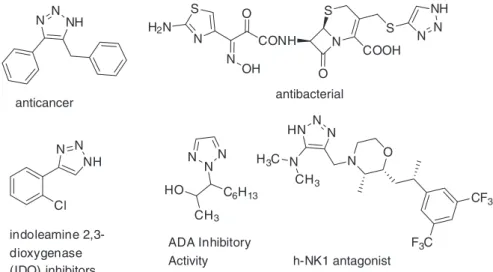
The NH-1,2,3-triazoles possess different biological
properties like anticancer, antibacterial, etc. This class of compounds is also known to exert its bioactivity through inhibitions of different enzymes like indoleamine 2,3-dioxygenase (IDO), adenosine deaminase (ADA)
and h-NK1 antagonist (Figure 1).13 The difficulty in the
deprotection of alkyl or aryl group from the N1-substituted 1,2,3-triazole framework poses a challenging task to the
researchers for the synthesis of NH-1,2,3-triazoles. A
good number of 1,2,3-triazoles has been reported in the literature.14 However, very less attention has been paid to
cycloaddition of nitrostyrenes with azide.15 The methods
for the synthesis of N-unsubstituted 1,2,3-triazoles are
still limited to the cycloaddition of terminal alkyne
and hydrazoic acid (in situ generated from sodium
azide and acid).16 Amantini et al.17 have reported that
tetrabutylammonium fluoride (TBAF) promoted the addition of azides with nitroethenes under solvent-free
conditions. Other methods, such as cycloaddition of TMSN3
(trimethylsilyl azide) with alkynes by using CuI-catalyst18
and Pd-catalyzed reaction of vinyl bromides with azides,19
have been reported. Recently, Quan et al.20 have also
reported a method by employing p-toluenesulfonic acid
for the synthesis of this class of molecules.
In recent years, the use of solid acids as heterogeneous catalyst has attracted interest in synthetic chemistry, one
of such heterocatalyst, i.e., sulfamic acid (NH2SO3H)
has emerged as a promising substitute for conventional Brønsted/Lewis acid as it is a stable, inexpensive, non hygroscopic, non-volatile, non-corrosive and efficient green catalyst. It possesses unique catalytic features related to its zwitterionic nature and displays an excellent activity over a wide range of acid catalyzed
organic transformations, like acetalytion,esterification,
Biginelli condensation,Beckmann rearrangement,
Diels-Alder reactions,Mannich,Hantzsch,Michaeland
Pechmann reactions.21 In continuation of our interest
in the development of new methodologies related to
1,2,3-triazoles,22 we herein reported the use of sulfamic
acid as a new catalyst for the metal-free 1,3-dipolar
cycloaddition reaction from nitroolefins with NaN3, and
the key intermediates associated with this transformation have been characterized by on line monitoring of the reaction by using electrospray ionization tandem mass spectrometry method (ESI-MS/MS).
Experimental
All the starting materials and other reagents were commercially available of the best grade and were used without further purification. All the nitroolefins were
prepared according to already known procedures.23 The
progress of the reactions was monitored by thin layer
chromatography (TLC), performed on silica gel 60-F254
plates. Spots were visualized by UV light. All nuclear magnetic resonance (NMR) spectra were recorded using
a Bruker spectrometer. 1H and 13C NMR spectra were
recorded on 300 and 500 MHz spectrometers using tetramethylsilane (TMS) as internal standard. Chemical shifts are reported relative to internal standard (TMS at dH 0.00 or CDCl3 at dH 7.26 or DMSO-d6 at dH 2.50).
Data are presented as follows: chemical shift (d, ppm),
multiplicity (s = singlet, d = doublet, t = triplet, q = quartet, m = multiplet, br = broad). Coupling constants are
reported in hertz (Hz). 13C NMR spectra were recorded
at 75 and 100 MHz. The following internal reference was used: CDCl3 at d 77.0 or DMSO-d6 at d 39.5. HRMS
were determined with Agilent QTOF mass spectrometer
6540 series instrument. ESI-MS and ESI-MS/MS analyses were conducted in a Bruker Daltonics AmaZon SL ion trap mass spectrometer (Bruker Daltonics, Bremen, Germany). The ESI source and the mass spectrometer were operated in the negative ion mode, and the capillary voltage and drying gas temperature were –4.0 kV and 220 oC, respectively, with
m/z scan range of 70-2000. Drying gas flow and nebulizing
gas pressure were set to 5.0 L min-1 and 8.0 psi, respectively.
MS/MS experiments were carried out by mass selection of a specific ion in ion-trap, which was then submitted to collision-induced dissociation (CID) with helium (He) in the collision chamber. Column chromatography was performed using silica gel of 60-120 and 100-200 µm with hexane and ethyl acetate as eluent.
General procedure for the synthesis of compounds 2a-u
Sulfamic acid (0.4 mmol) was added to a solution of
nitroolefin 1a (1.3 mmol) and sodium azide (2.0 mmol)
in DMF (dimethylformamide). The reaction mixture was allowed to stir at 60 oC in air for the specified time. After
completion of the reaction as indicated by TLC, the reaction mixture was quenched with ice-water and extracted with ethyl acetate (2 × 15 mL). The organic layer was dried over anhydrous sodium sulfate and evaporated under reduced pressure to afford crude residue. The crude was purified
by using column chromatography (SiO2, EtOAc/hexanes)
to afford the products 2a. All the 4-aryl-NH-1,2,3-triazoles
(2a-u) were prepared by the similar procedure (see
electronic Supplementary Information (SI) section).
Results and Discussion
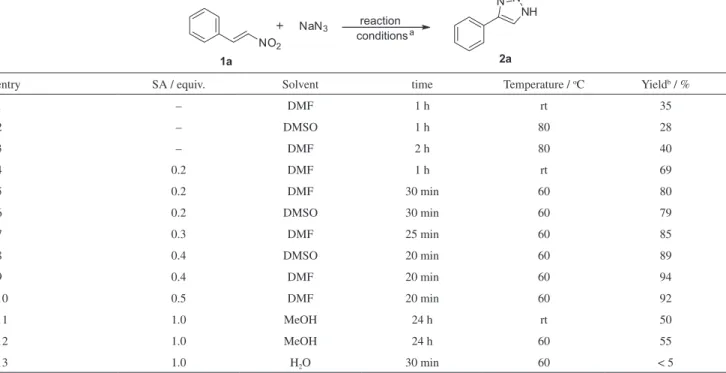
Initially, we carried out some of the model reactions with nitrostyrene (1a) and NaN3 by using sulfamic acid in
different solvents and reaction conditions to achieve the
product 4-phenyl-NH-1,2,3-triazole (2a, Table 1). When
the reaction was performed in the absence of sulfamic
acid, the yields of 2a were observed sluggishly even at
80 oC either by using DMSO or DMF as solvent (35, 28
and 40% yields, respectively, entries 1-3, Table 1) and the reaction led to the formation of considerable quantities of triarylbenzene.15,20 To our delight, a significant increase
in the yield was observed when sulfamic acid (0.2 equiv.) was used (69%, entry 4, Table 1) as additive in DMF at room temperature for 1 h. Later, we thought to optimize the reaction temperature and to increase the stoichiometric ratio of sulfamic acid (from 0.2 to 0.4 equiv.). It is interesting to observe that the reaction conversion and yields (80, 79, 85, 89 and 94%, respectively, entries 5-9, Table 1) were enhanced even with less reaction time. Next, we further increased the stoichiometric ratio of the sulfamic acid (up to 0.5 equiv.), but we did not observe any improvement in the yields (entry 10, Table 1).
Table 1. Optimization of the reaction conditions for the synthesis of 2a from 1aa
entry SA / equiv. Solvent time Temperature / oC Yieldb / %
1 – DMF 1 h rt 35
2 – DMSO 1 h 80 28
3 – DMF 2 h 80 40
4 0.2 DMF 1 h rt 69
5 0.2 DMF 30 min 60 80
6 0.2 DMSO 30 min 60 79
7 0.3 DMF 25 min 60 85
8 0.4 DMSO 20 min 60 89
9 0.4 DMF 20 min 60 94
10 0.5 DMF 20 min 60 92
11 1.0 MeOH 24 h rt 50
12 1.0 MeOH 24 h 60 55
13 1.0 H2O 30 min 60 < 5
aReaction was carried out with 1a (1.3 mmol), NaN
The reaction was also carried out in MeOH, however, optimal conversion was not observed (50 and 55%, and entries 11-12, Table 1). In the context of green chemistry point of view, we replaced organic solvent such as DMF with water and obtained only negligible yield (lower than 5%) (entry 13, Table 1). After optimization of the
reaction conditions, finally the product 2a was achieved
in 94% yield by using sulfamic acid (0.4 equiv.) and DMF
as suitable solvent at 60 oC for 15 min (entry 9, Table 1)
without formation of any side product.
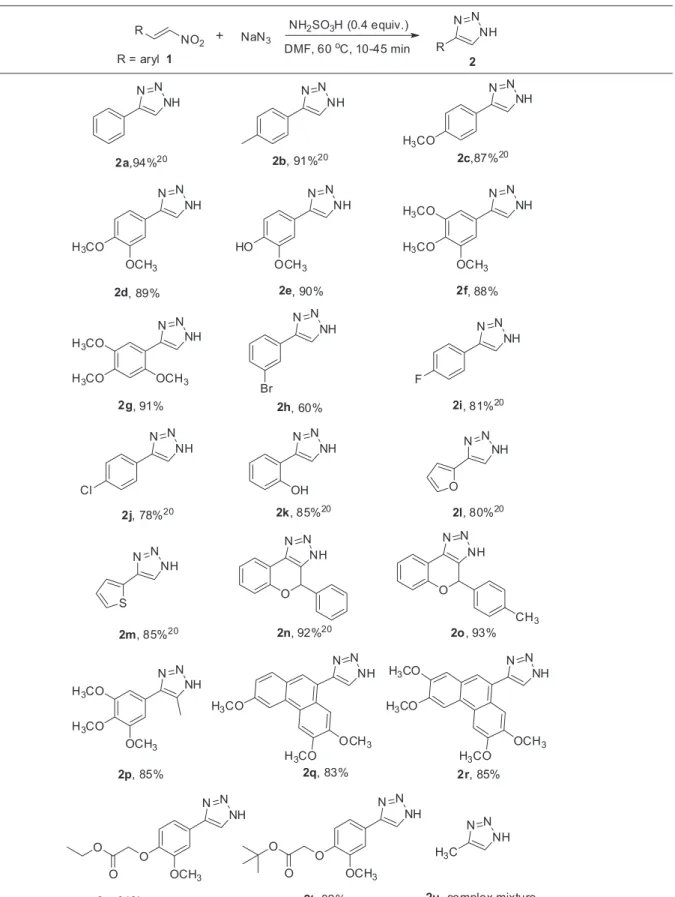
With optimized reaction conditions in our hand, then we explored the substrate scope of the protocol with various decorated nitroolefins to achieve different NH-1,2,3-triazoles (Table 2). Regardless of the substitution pattern, this protocol underwent 1,3-dipolar cycloaddition smoothly and accomplished the corresponding products in moderate to excellent yields (60-94% yields, 2a-u, Table 2). Additionally, this methodology is highly compatible with a variety of functional groups, such as fluoro, chloro, bromo, methoxy, o-protected ethyl ester and o-protected tert-butyl ester, as shown in Table 2. It was our keen observation that all the cycloaddition reactions were completed in less than 1 h (10-45 min, Table 2). It is noteworthy that nitroolefins
having with electron-donating groups viz. methoxy on the
aryl ring resulted in the formation of products in excellent yield (87-91%, 2c-g, Table 2). Much to our satisfaction, the optimized reaction conditions were mild enough to tolerate a range of halogenated (e.g., –F, –Cl, –Br) substrates with moderate to good yields (60-81%, 2h-j, Table 2). In general, it could be easily deduced that the electronic properties of the substituent might have some effect on the formation of
NH-1,2,3-triazoles as electron-releasing groups facilitated
the formation of product in higher yields (87-91%, 2c-g,
Table 2) when compared to electron-withdrawing groups
(60-81%, 2h-j, Table 2). The substitution on aryl group
at ortho-position to nitroolefin furnished the product in
higher time as compared to other substrates (2g and 2k,
Table 2). Encouraged by these results, we turned our interest to heterocyclic substrates like furan and thiophene which are common motifs in medicinal chemistry. To our delight, the heterocyclic substituted nitroolefins proceeded smoothly in the cycloaddition reaction to provide their
corresponding products 2l and 2m in good yields (80 and
85%, respectively, Table 2). Interestingly, the strongly coordinating heteroatoms like sulfur and oxygen have no interference to this reaction. Next, we moved on to explore the scope of this protocol with respect to di-substituted nitroolefins. It was quite interesting to note that the 1,3-dipolar cycloaddition reaction proceeded efficiently with di-substituted nitroolefins with high yield (92, 93 and 85%, respectively, 2n-p, Table 2).
Furthermore, complex substrates like tricyclic nitroolefins were also investigated to explore the scope of this reaction. Gratifyingly, tricyclic substrate like phenanthrene nitroolefins underwent smooth cycloaddition and gave the corresponding products 2q and 2r in good yields (83 and 85%, respectively, Table 2). Similarly, nitroolefins having phenoxy alkyl ester viz. ethyl ester and tert-butyl ester efficiently participated
and gave good yields (84 and 82%, respectively, 2s and
2t, Table 2) even without affecting the sensitive ethyl and
tertiary butyl groups. However, the reaction performed with methyl nitroolefin gave a complex mixture of products under
the same reaction conditions (2u). These results clearly
indicated the scope and generality of sulfamic acid as additive or initiative for the synthesis of different 4-aryl-NH -1,2,3-triazoles by using a wide range of nitroolefins.
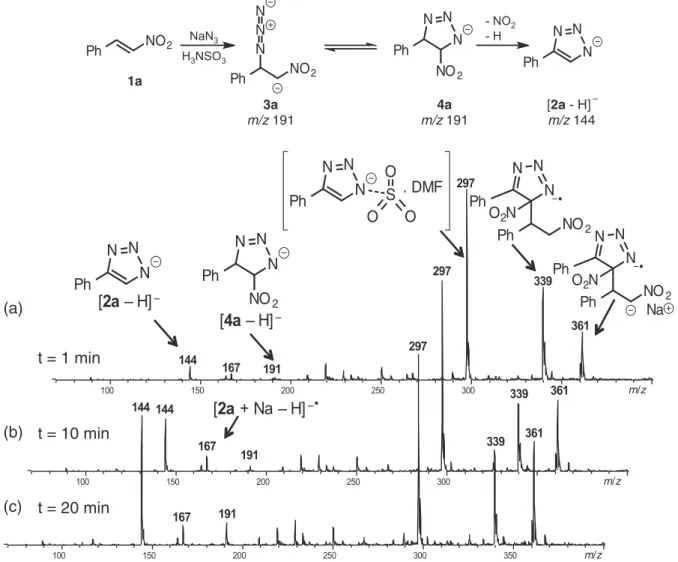
The functional nature of sulfamic acid couldallow to
activate β-nitrostyrene24 through H-bonding (Figure 2)
favoring the attack of azide to the molecule of nitrostyrene
and leading to the formation of intermediate 3a, which
could immediately cyclise to form intermediate 4a followed
by loss of hydrogen and NO2 to give final product 2a.
However, the addition of azide to nitrostyrene followed
by conjugate addition to intermediate 3a led to the
formation of little quantities of nitroolefin dimer and the
sodiated nitroolefin dimer of m/z 339. The formation of
triphenylbenzene is a more complex process and is slower
when compared to the formation of triazole.15 Henceforth,
activation of β-nitrostyrene by sulfamic acid could favor
the immediate formation of triazole 2a and could help in
the reduction of byproduct formation.
Although several mechanistic proposals are proposed for these transformations, we were intrigued by the fact that the action of an azide on nitrostyrenes did not afford the production of dimers/trimers in a great extension when
employed H3NSO3. Thus, it is worthwhile to evaluate this
transformation by on line ESI-MS studies. Electrospray ionization tandem mass spectrometry has been used by our group to study the mechanism of several catalyzed reactions by coupling on line microreactors to ESI-MS, and this combination showed significant advantages over
more conventional parallel screening approaches.25 ESI-MS
experiments afford insight into the ionic reactive species
Table 2. Synthesis of substituted 4-aryl-NH-1,2,3-triazoles using NH2SO3Ha,b
aReaction conditions: nitroolefin (1.3 mmol), NaN
taking a prominent role in organocatalytic reactions26
since ESI can capture such ionic intermediates directly from solution to the gas phase for their unprecedented MS interception, mass identification and MS/MS structural characterization.27 Based on our interest in the mechanistic
study of organic reactions by mass spectrometry (MS),28
which has greatly advanced from the development of electrospray ionization (ESI), we describe the experiments aimed to intercept the species produced from the on line monitoring of the sulfamic acid catalyzed reaction by using reactors coupled to ESI-MS. Although the proposed mechanism undergoes a 1,3-dipolar cycloaddition, the aim was to intercept the anionic species resulting from
the proton-exchange equilibrium with NH2SO3H/DMF
using ESI-MS in the negative ion mode. ESI is known for its ability to transfer ions to the gas phase without inducing undesirable side reactions, and the composition of ESI-generated ions often closely reflects that in solution.25-27
The anionic reaction intermediates are likely to be in equilibrium with their respective neutral forms in solutions,
and even disfavored equilibria could be useful because of the high sensitivity of ESI-MS analysis. Indeed, the ESI-MS spectra collected for such reactions are extraordinarily clean and mechanistically enlightening.
Initially, following our reaction protocol, sulfamic acid
(0.4 mmol) was added to a DMF solution of nitroolefin 1a
(1.3 mmol) and NaN3 (2.0 mmol). The reaction mixture was
allowed to stir at 60 oC under an air atmosphere. Then, the
solution was on line screened by using pressurized sample
infusion (PSI) methodology,29 which allows the monitoring
of the reaction solution in real-time up to 8 h at 60 oC under
stirring. Then, after 20 s to 1 min of reaction, three anionic species can be observed (Figure 3), which are detected
as major ions (Figure 3a), m/z of 297, 339 and 361. The
main ion of m/z 297 was characterized by ESI(–)-MS/MS
and afforded a characteristic fragmentation pathway
that showed main losses of [M–HCOH]– (m/z 267),
[M−HCOH−PhH]– of (m/z 219) and [M–DMF–SO
3]– (m/z
144). This species can be seemed as a stabilized triazole species that is observed in the catalyzed sulfamic acid
reaction. The other two species of m/z 339 and 361 were characterized as the nitroolefin dimer and the so sodiated nitroolefin dimer, respectively, which were produced in the first stages of reactions as depicted in Figure 3a. Furthermore, small amounts of anionic [4a–H]– of m/z 191
and [1a–H]– of m/z 144 were also observed at 1 min reaction
time. Between 10 to 20 min of reaction, the species [1a−H]–
increases (Figures 3b-3c), which is the final product
obtained from the nitration of [4a–H]– in solution. The
characterization of the species [4a–H]– was performed by
ESI-MS/MS experiments, which afforded as expected, one
main fragment pathway producing intermediate [1a–H]– by
losses of H and NO2, respectively.
The experiments were carried out in negative ion mode
(m/z range of 70-600). The samples were on line infused
into the ESI source, via a pressurized reactor, at flow
rates of 10 µL min-1. After mixing the reagents at 60 oC
in a DMF solution and ESI(–)-MS analysis after 1 min, a
small amount of intermediate 4a (m/z 191) was observed
(Figure 3). It is worth to note that between 1-20 min reaction
time, the presence of the species of m/z 297 was observed
being characterized as 2a.SO3-DMF complex. The presence
of this complex might prevent the production of undesired dimers-trimers in the reaction, affording higher yields of 2a, which justified theuse of H3NSO3 in this class of reactions.
In order to show the merit of this methodology, the
synthesis of 4-aryl-NH-1,2,3-triazoles in the presence of
sulfamic acid was compared with some of the previous methods as shown in Table 3. As it is obvious from the results, the reaction in the absence of catalyst led to the
formation of considerable quantities of triarylbenzene,15
however the reaction of phenylacetylene required more
time for completion.20 Furthermore, the reaction of
nitrostyrene 1a with sodium azide in the presence of
sulfamic acid completed in less time as compared to
p-TsOH20 being the advantage of this method compared
to the previous ones.
Conclusions
In conclusion, we have developed a facile and reproducible 1,3-dipolar cycloaddition reaction from
nitroolefins by employing sulfamic acid as additive towards
the synthesis of a valuable substituted 4-aryl-NH
-1,2,3-triazoles. This method proved to be a possible alternative to the classical Huisgen 1,3-dipolar cycloaddition of azides with alkynes. Easily available starting materials, simple process, inexpensive reagents and open to air are the salient features of this protocol. In addition, the key intermediates related to this reaction mechanism were proposed by online monitoring through ESI-MS/MS experiments. This methodology is practically applicable for all kind of nitroolefins and displayed great functional group compatibility. More importantly, this strategy enables rapid validation of library synthesis of 1H-1,2,3-triazoles as new chemical entities in the drug discovery.
Supplementary Information
Spectroscopic data and 1H and 13C NMR spectra for
2a-2t are available free of charge at http://jbcs.sbq.org.br as PDF file.
Acknowledgments
We thank the Department of Pharmaceuticals (Ministry of Chemicals and Fertilizers) for providing funds and National Institute of Pharmaceutical Education and Research (NIPER), Hyderabad, for providing the facilities. F. M. N. and L. S. S. acknowledge InnovaChile CORFO Code FCR-CSB 09CEII-6991 for supporting this research activity. F. M. N. thanks FONDECYT-Iniciacion (11130086). L. S. S. thanks additional support from PIEI (Quimica y Bio-organica en Recursos Naturales), Universidad de Talca.
References
1. Chen, C. Y.; Lee, P. H.; Lin, Y. Y.; Yu, W. T.; Hu, W. P.; Hsu, C. C.; Lin, Y. T.; Chang, L. S.; Hsiao, C. T.; Wang, J. J.; Chung, M. I.; Bioorg. Med. Chem. Lett. 2013, 23, 6854; Zhou, C. H.; Wang, Y.; Curr. Med. Chem. 2012, 19, 239; Hou, J.; Liu, X.; Shen, J.; Zhao, G.; Wang, P. G.; Expert Opin. Drug Discovery
2012, 7, 489; Shankaraiah, N.; Jadala, C.; Nekkanti, S.; Senwar, Table 3. Different reaction for the synthesis of 4-aryl-NH-1,2,3-triazoles
entry Reaction Catalyst Solvent time Temperature / oC Yielda / %
1 1a + NaN3 – DMSO – rt 60 + triarylbenzene15
2 phenylacetylene + TMSN3 (in situ HN3) CuI (20 mol%) MeOH/DMF 11 h 100 8718
3 1a + NaN3 p-TsOH (0.5 equiv) DMF 1 h 60 9320
4b 1a + NaN
3 sulfamic acid (0.4 equiv) DMF 20 min 60 94
K. R.; Nagesh, N.; Shrivastava, S.; Naidu, V. G. M.; Sathish, M.; Kamal, A.; Bioorg. Chem. 2016, 64, 42; Kamal, A.; Shankaraiah, N.; Devaiah, V.; Reddy, K. L.; Juvekar, A.; Sen, S.; Kurian, N.; Zingde, S.; Bioorg. Med. Chem. Lett. 2008, 18, 1468; Kamal, A.; Prabhakar, S.; Ramaiah, M. J.; Reddy, P. V.; Reddy, C. R.; Mallareddy, A.; Shankaraiah, N.; Reddy, T. L. N.; Pushpavalli, S. N. C. V. L.; Bhadra, M. P.; Eur. J. Med. Chem.
2011, 46, 3820.
2. Fan, W. Q.; Katritzky, A. R. In Comprehensive Heterocyclic Chemistry, vol. 2; Katritzky, A. R.; Rees, C. W.; Scriven, E. F. V., eds.; Elsevier Science: Oxford, UK, 1996, p. 1; Morgan, N. H.;
Eur. Pat. Appl. EP 437979 A2 19910742, 1991; Thirumurugan, P.; Matosiuk, D.; Jozwiak, K.; Chem. Rev. 2013, 113, 4905; Wang, K.; Chen, M.; Wang, Q.; Shi, X.; Lee, J. K.; J. Org. Chem.
2013, 78, 7249; Lau, Y.; Rutledge, P. J.; Watkinson, M.; Todd, M. H.; Chem. Soc. Rev. 2011, 40, 2848; Liu, Y. H.; Zhang, L.; Xu, X. N.; Li, Z. M.; Zhang, D. W.; Zhao, X.; Li, Z. T.; Org. Chem. Front. 2014, 1, 494.
3. Huisgen, R.; Szeimies, G.; Moebius, L.; Chem. Ber. 1967,
100, 2494; Huisgen, R.; 1,3-Dipolar Cycloaddition Chemistry; Wiley: New York, USA, 1984, p. 1; Huisgen, R.; Pure Appl. Chem. 1989, 61, 613; Huisgen, R.; Angew. Chem., Int. Ed. Engl.
1963, 2, 656.
4. Rostovtsev, V. V.; Green, L. G.; Fokin,V. V.; Sharpless, K. B.;
Angew. Chem., Int. Ed. 2002, 41, 2596.
5. Tornøe, C. W.; Christensen, C.; Meldal, M.; J. Org. Chem. 2002,
67, 3057.
6. Zhang, L.; Chen, X.; Xue, P.; Sun, H. Y.; Williams, I. D.; Sharpless, K. B.; Fokin,V. V.; Jia, G.; J. Am. Chem. Soc. 2005,
127, 15998; Rasmussen, L. K.; Boren, B. C.; Fokin, V. V.;
Org. Lett. 2007, 9, 5337; Tam, A.; Arnold, U.; Soellner, M. B.; Raines, R. T.; J. Am. Chem. Soc. 2007, 129, 12670.
7. Meldal, M.; Tornøe, C. W.; Chem. Rev. 2008, 108, 2952. 8. Hein, J. E.; Fokin, V. V.; Chem. Soc. Rev. 2010, 39, 1302. 9. Li, W.; Du, Z.; Huang, J.; Jia, Q.; Zhang, K.; Wang, J.; Green
Chem. 2014, 16, 3003; Ramachary, D. B.; Shashank, A. B.;
Chem. Eur. J. 2013, 19, 13175; Wang, L.; Peng, S. Y.; Danence, L. J. T.; Gao, Y.; Wang, J.; Chem. Eur. J. 2012, 18, 6088; Belkheira, M.; Abed, D.; Pons, J. M.; Bressy, C.; Chem. Eur. J. 2011, 17, 12917; Danence, L.; Gao, Y.; Li, M.; Huang, Y.; Wang, J.; Chem. Eur. J. 2011, 17, 3584; Ramachary, D. B.; Ramakumar, K.; Narayana, V. V.; Chem. Eur. J. 2008, 14, 9143. 10. Cai, Z. J.; Lu, X. M.; Zi, Y.; Yang, C.; Shen, L. J.; Li, J.; Wang,
S. Y.; Org. Lett. 2014, 16, 5108.
11. Rasolofonjatovo, E.; Theeramunkong, S.; Bouriaud, A.; Kolodych, S.; Chaumontet, M.; Taran, F.; Org. Lett. 2013, 15, 4698; Ding, S.; Jia, G.; Sun, J.; Angew. Chem., Int. Ed. 2014,
53, 1877.
12. Cheng, G.; Zeng, X.; Shen, J.; Wang, X.; Cui, X.; Angew. Chem., Int. Ed. 2013, 52, 13265; Thomas, J.; John, J.; Parekh, N.; Dehaen, W.; Angew. Chem., Int. Ed. 2014, 53, 10155.
13. Blanch, N. M.; Chabot, G. G.; Quentin, L.; Scherman, D.; Bourg, S.; Dauzonne, D.; Eur. J. Med. Chem. 2012, 54, 22; Kume, M.; Kubota, T.; Kimura, Y.; Nakashimizu, H.; Motokawa, K.; Nakano, M.; J. Antibiot. 1993, 46, 177; Huang, Q.; Zheng, M.; Yang, S.; Kuang, C.; Yu, C.; Yang, Q.; Eur. J. Med. Chem. 2011, 46, 5680; Cristalli, G.; Eleuteri, A.; Volpini, R.; Vittori, S.; Camaioni, E.; Lupidi, G.; J. Med. Chem. 1994,
37, 201; Harrison, T.; Owens, A. P.; Williams, B. J.; Swain, C. J.; Williams, A.; Carlson, E. J.; Rycroft, W.; Tattersall, F. D.; Cascieri, M. A.; Chicchi, G. G.; Sadowski, S.; Rupniak, N. M. J.; Hargreaves, R. J.; J. Med. Chem. 2001, 44, 4296. 14. Lewis, W. G.; Green, L. G.; Grynszpan, F.; Radie, Z.; Carlier,
P. R.; Taylor, P.; Finn, M. G.; Sharpless, K. B.; Angew. Chem.,
Int. Ed. 2002, 41, 1053; Hong, L.; Lin, W.; Zhang, F.; Liu, R.; Zhou, X.; Chem. Commun. 2013, 5589.
15. Zefirov, N. S.; Chapovskaya, N. K.; Kolesnikov, V. V.; Chem. Commun. 1971, 1001; Quiclet-Sire, B.; Zard, S. Z.; Synthesis
2005, 3319; Piet, J. C.; Le, H. G.; Cailleux, P.; Benhaoua, H.;
Carrie, R.; Bull. Soc. Chim. Belg. 1996, 105, 33.
16. Journet, M.; Cai, D.; Kowal, J. J.; Larsen, R. D.; Tetrahedron Lett. 2001, 42, 9117.
17. Amantini, D.; Fringuelli, F.; Piermatti, O.; Pizzo, F.; Zunino, E.; Vaccaro, L.; J. Org. Chem. 2005, 70, 6526.
18. Cohrt, E.; Jensen, J. F.; Nielsen, T. E.; Org. Lett. 2010, 12, 5414; Jin, T.; Kamijo, S.; Yamamoto, Y.; Eur. J. Org. Chem.
2004, 3789; Kalisiak, J.; Sharpless, K. B.; Fokin, V. V.; Org. Lett. 2008, 10, 3171; Wang, X.; Kuang, C.; Yang, Q.; Eur. J. Org. Chem. 2012, 424.
19. Barlunga, J.; Valdes, C.; Beltran, G.; Escribano, M.; Aznar, F.;
Angew. Chem., Int. Ed. 2006, 45, 6893.
20. Quan, X. J.; Ren, Z. H.; Wang, Y. Y.; Guan, Z. H.; Org. Lett.
2014, 16, 5728.
21. Heravi, M. M.; Baghernejad, B.; Oskooie, H. A.; Curr. Org. Chem. 2009, 13, 1002; Sarvaria, M. H.; Sharghi, H.; J. Iran. Chem. Soc. 2008, 5, 384; Jin, T. S.; Sun, G.; Li, Y. W.; Li, T. S.;
Green Chem. 2002, 4, 255; Wang, B.; Yang, L.; Suo, J.; Synth. Commun. 2003, 33, 3929; Wang, B.; Gu, Y. L.; Yang, L. M.; Suo, J. S.; Catal. Lett. 2004, 96, 71; Li, J. T.; Han, J. F.; Yang, J. H.; Li, T. S.; Ultrason. Sonochem. 2003, 10, 119; Wang, B.; Gu, Y. L.; Luo, G. Y.; Yang, T.; Yang, L. M.; Suo, J. S.; Tetrahedron Lett. 2004, 45, 3369; Nagarajan, R.; Magesh, C. J.; Perumal, P. T.; Synthesis 2004, 69; Zeng, H.; Li, H.; Shao, H.; Ultrason. Sonochem. 2009, 6, 758; Foroughifar, N.; Mobinikhaledi, A.; Fard, M. A. B.; Moghanian, H.; Ebrahimi, S.; Synth. Commun.
2009, 39, 161; Li-Tao, A.; Jian-Ping, Z.; Li-Li, Z.; Yong, Z.;
Tetrahedron Lett. 2007, 48, 4297; Sing, P. R.; Singh, D. U.; Samant, S. D.; Synlett 2004, 1909.
Chem. 2015, 102, 413; Sharma, P.; Senwar, K. R.; Jeengar, M. K.; Reddy, T. S.; Naidu, V. G. M.; Kamal, A.; Shankaraiah, N.; Eur. J. Med. Chem. 2015, 104, 11; Kamal, A.; Shankaraiah, N.; Reddy, C. R.; Prabhakar, S.; Markandeya, N.; Srivastava, H. K.; Sastry, G. N.; Tetrahedron 2010, 66, 5498; Kamal, A.; Prabhakar, S.; Shankaraiah, N.; Reddy, C. R.; Reddy, P. V.;
Tetrahedron Lett. 2008, 49, 3620.
23. Wang, P. A.; Zhang, D. X.; Liu, X. Y.; ARKIVOC 2014, 5, 408; Gairaud, C. B.; Lappin, G. R.; J. Org. Chem. 1953, 18, 1. 24. Gavin, D. P.; Stephens, J. C.; ARKIVOC2011, 9, 407. 25. Santos, L. S.; Eur. J. Org. Chem. 2008, 235; Santos, L. S.;
Reactive Intermediates: MS Investigations in Solution; Wiley-VCH: Weinheim, Germany, 2012.
26. Santos, L. S.; Knaack, L.; Metzger, J. O.; Int. J. Mass Spectrom.
2005, 246, 84.
27. Santos, L. S.; Metzger, J. O.; Angew. Chem., Int. Ed. 2006, 45, 977; Da Silveira, B. A.; Santos, L. S.; Nachtigall, F. M.; Eberlin, M. N.; Dupont, J.; Angew. Chem., Int. Ed. 2006, 45, 7251. 28. Nekkanti, S.; Kumar, N. P.; Sharma, P.; Kamal, A.; Nachtigall,
F. M.; Forero-Doria, O.; Santos, L. S.; Shankaraiah, N.;
RSC Adv. 2016, 6, 2671; Shankaraiah, N.; Markandeya, N.; Srinivasulu, V.; Sreekanth, K.; Reddy, C. S.; Santos, L. S.; Kamal, A.; J. Org. Chem. 2011, 76, 7017.
29. Vikse, K. L.; Woods, M. P.; McIndoe, J. S.; Organometallics
2010, 29, 6615.