Application of Delphi method in site selection of desalination plants
M. Sepehr1, S.M.R. Fatemi1,*, A. Danehkar2, A. Mashinchian Moradi1
1Department of Marine Biology, Science and Research Branch, Islamic Azad University, Tehran, Iran 2Department of Environmental Sciences, Faculty of Natural Resources, University of Tehran,
Tehran, Iran
ABSTRACT: Given the reduced freshwater supplies across the world, seawater desalination is one of the appropriate methods available for producing freshwater. Selecting an optimal location is crucial in the installation of these plants owing to the environmental problems they cause. The present study was conducted to identify optimal locations for installing desalination Plants in the coastal areas of southern Iran (Hormozgan Province) with application of Delphi method. To implement this technique and identify, screen and prioritize effective criteria and sub-criteria, ten experts were surveyed through questionnaires and eight criteria and 18 sub-criteria were identiied. All these sub-criteria were evaluated and classiied in ArcGIS into ive classes as input layers. The maps were then integrated based on the modulation importance coeficient and the identiied priorities using a linear Delphi model and the inal map was reclassiied into ive categories. Environmentally sensitive areas and seawater quality were respectively the criterion and sub-criterion that received the highest importance. After combining the layers and obtaining the inal map, 63 locations were identiied for installing desalination plants in the coastal areas on the Persian Gulf and Oman Sea in Hormozgan Province. At the end, 27 locations were high important and had optimal environmental conditions for establishing desalination plants. Of the 27 locations, six were located in the coastal area of the Oman Sea, one in the coastal area of the Strait of Hormuz and 20 others in the coastal area of the Persian Gulf.
KEYWORDS: Delphi method; Desalination; Oman Sea; Persian Gulf ; Site selection
CASE STUDY
Received 18 August 2016; revised 20 September 2016; accepted 17 October 2016; available online 1 December 2016
*Corresponding Author Email: [email protected]
Tel.: +9821 88630939 Fax: +9821 88630939
Note: Discussion period for this manuscript open until March 1, 2017 on GJESM website at the “Show Article”.
INTRODUCTION
Global water shortage is a major challenge with which different countries struggle (Ong et al., 2016). Continuing population growth and economic growth are continually putting pressure on world demand for water (Goh et al., 2016). Installing desalination plants to desalinate seawater is an appropriate solution to the shortage of freshwater. Desalination involves several processes to remove the excess salt and other chemicals dissolved in saltwater (Alshahri, 2016). Although desalination plants have numerous socioeconomic and environmental beneits, they
produce high-temperature brine, which may reduce the quality of coastal waters and endanger the marine environment (Lattemann and Höpner, 2008; Karbassi and Pazoki, 2015). The brine generated causes increases temperature and salinity andcauses oxygen depletion (Cooley et al., 2013) and habitat degradation as well as decline in the population of phytoplankton and invertebrates and ish communities (Roberts et al., 2010) in marine ecosystems (Mezher
M. Sepehr et al.
the site selection. Different site selection methods are used across the world, including TOPSIS method(Yal
and Akgün, 2014), analytical hierarchy process (AHP) (Chaudhary et al., 2016), fuzzy (Alavipoor et al., 2016;
Kharat etal., 2016) and fuzzy-AHP (Wang et al., 2014). Additionally, environment specialists use the Delphi method, which is based on the intuitive opinions of a group of experts who comment on a speciic subject to reach a consensus (Lang, 1995). The Delphi method, is thus based on the literature review, experts’ opinions (Cho and Lee, 2013) and mathematical equations and is used for site selection (Andon Petrosian et al., 2013). The processes of identifying proper locations for installing desalination plants facilities are complicated and include environmental, economic and management criteria and the use of a geographical information system (GIS) (Kallali et al., 2007). GIS is amongst the different useful tools for site selection purposes (Uyan, 2013). Middle East region is well known as an area with water scarcity (Kim et al., 2015). Iran, a middle eastern country with arid and semi-arid climate (Yavari et al., 2015) and an average annual precipitation of 250 mm is therefore considered a low rainfall region of the world (Molavi Arabshahi et al., 2016). The coastal areas of southern Iran in Hormozgan Province are faced with a shortage of freshwater owing to their dry climate with an annual average precipitation of less than 170 mm (Asadpour, 2015), population growth and growth in various industries. Hormozgan Province is regarded as an important marine area of the world owing to its proximity to the Persian Gulf and Oman Sea as well as having communities of mangrove forests (Mai-Gholami
et al., 2015a), coral reefs (Koupaei et al., 2015), sea grass (Erftemeijer and Shuail, 2012), seaweed (Mohammadi
et al., 2013) and also a variety of marine mammals
(Braulik et al., 2010),ish (Daliri et al., 2012)and Sea Turtle (Pilcher et al., 2014). Few studies have been
conducted on the site selection for desalination plants in these areas, in western Hormozgan Province (Basereh et al., 2014)and Qeshm Island (Kor et al., 2012). A review
of studies conducted across the world indicated a lack of deined frameworks for developing and prioritizing the effective factors (contains criteria and sub-criteria) to Identify suitable locations of desalination plants. The identiication of important criteria and sub-criteria, prioritization of the sub-criteria and the detection of optimal locations for installing while minimizing their destructive environmental impacts appear necessary. The aim of this study was to identify optimal locations for installing desalination plants based on different criteria with application of Delphi method. The study has been carried out in Hormozgan Province during 2015- 2016.
MATERIALS AND METHODS Study area
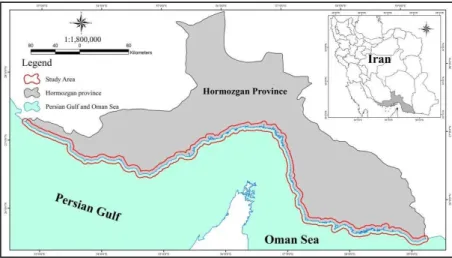
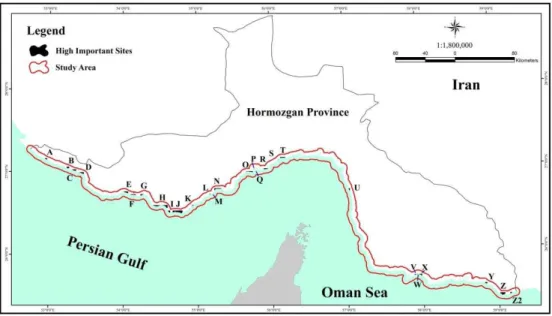
Hormozgan Province is situated in the north of the Persian Gulf and Oman Sea with a 1950.61 km coastline. This province covers an area of 71193.476 km2 and in located southern Iran. This study examined the coastal area of 1950 km length and 10 km width (with a width of 5 km on land and 5km at sea)in order to determine the appropriate location for installing desalination plants. Fig. 1 illustrates the geographical location of the Hormozgan Province as the study area.
91 Methods
The selection of ideal locations for installing desalination plants is carried out in four steps in this study. The irst step is to identify and screen the effective factors containing criteria and sub-criteria. In a second step is to prepare input layers and identify compulsory and preferred sub-criteria. The third step is to prioritize the preferred sub-criteria using the Delphi method. The fourth step is to integrate the layers to identify proper sites. Fig. 2 presents the different steps of site selection for desalination plants based on the Delphi method.
Identifying and screening effective factors containing criteria and sub-criteria
Identifying appropriate effective factors containing criteria and sub-criteria associated with the research subject is the irst step in any management study (Hasanzadeh et al., 2012). Table 1 presents the effective factors identiied through the review of 10 different studies on the site selection for desalination plants.
In this method, effective factors were selected from different references reviewed and each factor was deined as a sub-criterion (Mousavi et al., 2015).
Fig. 2: Flowchart of different steps of site selection for desalination plantsFig. 2: Flowchart of different steps of site selection for desalination plants
Table 1: Identifying effective factors in different studies
Sub-criteria Reference
5), 6), 7), 14), 17), 18), 20), 21) Koret al, 2012 2), 11), 14), 28), 30), 31) Baserehet al, 2014 1), 2), 5), 14), 18), 21), 33) Sanver and May, 2010
14), 17), 21), 22), 33) Waddell, 2005
1), 2), 3), 4), 5), 9), 13), 15), 16), 21), 22), 23), 24), 25),
26), 29), 33) Melbourne Water, 2007
1), 2), 5), 6), 12), 15), 20), 21), 33) Life Res Sea Project, 2008 1), 2), 14), 17), 19), 20), 21), 23), 33) Tsiourtis, 2008
14), 17), 32) Victorian Desalination Project, 2011
1), 2), 20), 24) Borrowman, et al, 2013
5), 6), 7), 8), 10), 19), 27), 29) Kallali,et al, 2007
1) Environmentally sensitive land areas, 2) Environmentally sensitive coastal and marine areas, 3) Life species, 4) Wetland, 5) Slope, 6) Geology, 7) Soil texture, 8) Soil salinity, 9) Flood area, 10) Groundwater level, 11) Quality and quantity of fresh water, 12) Source water temperature (land), 13) Flushing times, 14) Sea water quality, 15) Bathymetry, 16) Sea area, 17) Water supply network, 18) Place of use, 19) City and village area, 20) Road network, 21) Electrical network, 22) Access to the beach, 23) Infrastructure, 24) Land use, 25) Aquaculture area , 26) Boating facilities, 27) Water transfer costs, 28) Creating jobs, 29) Cultural heritage, 30) Emigration, 31) Epidemic diseases, 32) Ability to meet future capacity requirements, 33) Waste water discharge.
Delphi method in site selection
Instead of direct interpretations, the descriptions in these references were taken in some cases and the sub-criteria identiied were ultimately classiied as a subset of the several main criteria. Separate indicators were deined in order to provide a better description for each sub-criterion if necessary. A total of 10 experts completed the expert opinion survey (Delphi survey) to screen and determine the percentage and degree of importance of the criteria and sub-criteria (Hasanzadeh et al., 2013). These questionnaires enable experts to express their opinion about the importance of the criteria and in a next step sub-criteria on a ive-level scale (Mai-Gholami et al., 2015b). An important rule of the Delphi studies is
to select experts based on experience and knowledge (Davidson, 2013). Experienced professionals in the ield of coastal zone management, environment and location of desalination plants were therefore selected. In order to sum up the votes of experts, the weighted values of the criteria and sub-criteria were calculated. These weights ranged between 0 and 10. Each Degrees of importance represent a range of weights for the criteria and sub-criteria, which is presented on a Likert scale in igure 2 (unimportant: value 1 at a range of 0-2, low important: value 3 at a range of 2-4, important: value 5 at a range of 4-6, highly important: value 7 at a range of 6-8 and very highly important: value 9 at a range of 8-10) (Mousavi et al., 2015;Mai-Gholami et al., 2015b). The number of times each degree of importance was selected represented the value that degreeof importance obtained.
For the screening the criteria and sub-criteria with application of Delphi method, the following six mathematical formulas comprising 1) maximum attainable value, 2) Moderated weight coeficient, 3) Moderated weight, 4) Weighted value, 5) percentage of importance, 6) degree of importance were used. In order to determine the percentage of importance (P), the maximum attainable value (A) was irst obtained by multiplying the maximum expected value (N=10 in this study, equivalent to the number of all the respondents) by the maximum moderated weight (W=10) (Eq. 1). The Moderated weight coeficient was then calculated by dividing the maximum Moderated weight (10) by the sum of weights of value criteria (Eq. 2). The Moderated weight (yi) was calculated using the Moderated weight coeficient (Eq. 3). The weighted value (zi) was calculated using this Moderated weight and the value of criteria (ni) (Eq. 4). In the last step, the percentage of importance of each criterion was calculated by dividing
the sum of weighted value of criteria ( by the maximum attainable value of the criterion (A) (Eq. 5). The weighted average of importance of each criterion was then obtained and considered the degree of importance of the criteria (D) by dividing the sum of the product of value in weights (degrees of importance) ( by the total value (the total number of respondents, which equals 10 in this study) (Eq. 6) (Hasanzadeh et al., 2013;
Mai-Gholami et al., 2015b). It is worth mentioning that the main condition for selecting the main criteria and sub-criteria is to have at least half of the numerical value of each vertical and horizontal vector (Hasanzadeh et al.,
2012).A criterion is eliminated from the screening and locating process only if all its sub-criteria are eliminated from the importance chart of sub-criteria.
Criteria= C Primary weight = xi
Number of experts voted a important level value = n Total number of experts = N Maximum moderated weight = W
1) Maximum attainable value (A) =N × W 2) Moderated weight coeficient =
1) Maximum attainable value (A) =N×W ×
2) Moderated weight coefficient =∑
3) Moderated weight (yi) =
∑ ×
4) Weighted value (zi) = yi×
5) Percentage of Importance (PC) =∑ × 100
6) Degree of Importance (DC) =∑( × )
3) Moderated weight (yi) =
1) Maximum attainable value (A) =N×W ×
2) Moderated weight coefficient =
∑
3) Moderated weight (yi) = ∑ ×
4) Weighted value (zi) = yi×
5) Percentage of Importance (PC) =∑ × 100
6) Degree of Importance (DC) =∑( × )
4) Weighted value (zi) = yi ×n
5) Percentage of Importance (PC) =
1) Maximum attainable value (A) =N×W ×
2) Moderated weight coefficient = ∑
3) Moderated weight (yi) =∑ ×
4) Weighted value (zi) = yi×
5) Percentage of Importance (PC) =∑ × 100
6) Degree of Importance (DC) =∑( × )
6) Degree of Importance (DC) =
1) Maximum attainable value (A) =N×W ×
2) Moderated weight coefficient = ∑
3) Moderated weight (yi) =∑ ×
4) Weighted value (zi) = yi×
5) Percentage of Importance (PC) =∑ × 100
6) Degree of Importance (DC) =∑( × )
Preparing input layers and identifying compulsory and preferred sub-criteria
93 layer based on the preferred sub-criteria in Arc-GIS and in accordance with their boundaries.
Prioritizing the preferred sub-criteria using the Delphi method
After screening the criteria and in a next step screening the sub-criteria, the normalized importance coeficients of the criteria and sub-criteria were used to prioritize and calculate the modulation importance coeficient of the sub-criteria. The Importance coeficients (IC) of the criteria by multiplying the degree of importance (DC) by percentage of importance of the criteria (% PC) (Eq. 7). The normalized importance coeficients (NI) of the criteria were calculated by dividing the importance coeficient of each criterion by the sum of importance coeficients of the criterion (Eq. 8). The importance coeficients of the sub-criteria (IS) were calculated by multiplying the degree of importance (DS) by percentage of importance of the sub-criteria (%PS) (Eq. 9). The normalized importance coeficient of each sub-criterion (NI) was also obtained by dividing the importance coeficient of the sub-criterion by the sum of importance coeficients of the sub-criteria (Eq. 10). In order to calculate the normalized importance coeficient of the sub-criteria based on the criterion (CiBSj), the importance coeficient of each sub-criterion (ISi) was divided by the sum of importance coeficients of the sub-criteria associated with the same criterion (Eq. 11). To prioritize the sub-criteria and determine the modulation importance coeficient (MI), the normalized importance coeficient of each sub-criterion based on the criterion (CiBSj) was multiplied by the normalized importance coeficient (NI) associated with the same criterion (Eq. 12) (AndonPetrosian et al., 2013).
7) ICi= DCi × (%P) Ci 8) NICi=
7)
8)NICi= ICi / ∑ �����
9)
10) ∑ ����
�
11) ∑�������
����
12)
9) ISj= DSj× (%P) Sj
10) NISj =
7)
8) ∑ ����
�
9)
10) j =ISj / ∑ �����
11) ∑�������
����
12)
11) CiBSj=
7)
8) ∑ ����
�
9)
10) ∑ ����
�
11) j= ISj / ∑�����������
12)
12) MISj= CiBSj× INi
The process of layer integration and location
After developing the preferred layers in Arc-GIS, a distance map of each layer of the preferred sub-criteria was developed using Euclidean distance toolbar. The
layers created were evaluated using the Reclassify toolbar in Arc-GIS and were classiied into ive classes (Unimportant: value 1, Less important: value 3, Middle important: value 5, Important: value 7 and High important: value 9). A letter code was deined for each sub-criterion for integrating the maps (Andon Petrosian et al., 2013). The layers were ultimately integrated using the linear model of the Delphi method and the Raster calculator toolbar in Arc-GIS based on the modulation importance coeficient of each sub-criterion and the priorities, and the site selection layer was obtained in accordance with the preferred sub-criteria. In order to identify high important locations, the layer obtained was reevaluated and reclassiied in ive classes. After overlaying the layer of compulsory sub-criteria on the evaluated layer of the preferred sub-criteria, the inal layer of site selection for desalination plants was obtained. The locations with the highest spatial values were identiied as high important locations and the most optimal places for installing desalination plants.
RESULTS AND DISCUSSION
Screening the effective factors (Contains criteria and sub-criteria)
M. Sepehr et al.
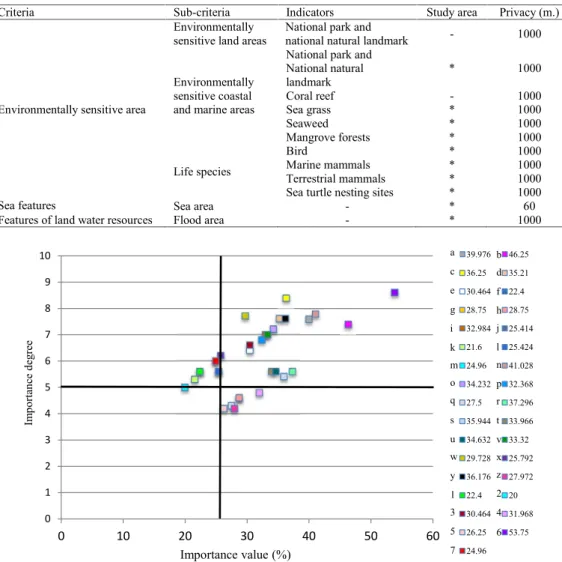
importance of the criteria, environmentally sensitive areas received the highest percentage and degree of importance with a 55% and 8.8 degree of importance, while social signiicance received the lowest percentage of importance (21.63%). The other criteria ranked respectively as follows: Sea features (percentage of importance: 51.25), economic criteria (percentage of importance: 39.96), management criteria (percentage of importance 33.3), access criteria (percentage of importance: 28.882), land water resources’ features (percentage of importance: 27.45) and land Features (percentage of importance: 24.96). A total of 18 top sub-criteria that obtained the required score for locating desalination plants were: 1) Environmentally sensitive land areas, 2) Environmentally sensitive Coastal and marine areas, 3) Life species, 4) Wetland, 5) Slope, 6) Flood area, 7) Sea water quality, 8) Bathymetry, 9) Sea area, 10) Place of use, 11) City and village area, 12) Road network, 13) Electrical network, 14) Access to the beach, 15) Infrastructure, 16) Aquaculture area, 17) Cultural heritage and 18) Waste water discharge. Fig. 3 shows the diagram of the importance of the criteria and Fig. 4 shows the diagram of the importance of the sub-criteria.
Mapping the sub-criteria and identifying the deinite sub-criteria
The map pertaining to each of the sub-criterion was developed in Arc-GIS by preparing the input layers and indices of the criteria identiied. Of 18 sub-criteria identiied, four were identiied as compulsory based on environmental regulations and restrictions. Given the indicators of environmentally sensitive land areas and environmentally sensitive coastal-marine areas, these two were identiied as common sub-criteria. After identifying and separating the compulsory sub-criteria as the compulsory layer, 15 preferred sub-criteria were classiied in a subset of 7 criteria, including:
1) Environmentally sensitive land areas: protected area, wildlife refuge, hunting prohibited area, biosphere reserves, forest reserve
2) Environmentally sensitive coastal and marine areas: protected area, wildlife refuge, hunting prohibited area, biosphere reserves, irth -estuary- river
3) Wetland
4) Sea water quality: temperature, salinity 5) Slope
6) Bathymetry
Fig. 3: Likert range for determination of the important level of criteria
(Mai-Gholami et al., 2015b)
Fig. 3: Likert range for determination of the important level of criteria (Mafi-Gholamiet al., 2015b)
Fig. 4: Importance diagram of the criteria of site selection for desalination plants
1) Environmentally sensitive area 2) Land features 3) Soil features 4) Features of land water resources 5) Sea features 6) Access 7) Economic 8) Social signiicance 9) Management.
Fig. 4: Importance diagram of the criteria of site selection for desalination plants
1) Environmentally sensitive area 2) Land features 3) Soil features 4) Features of land water resources 5) Sea features 6) Access 7) Economic 8) Social significance 9) Management. 0
1 2 3 4 5 6 7 8 9 10
0 10 20 30 40 50 60
55
24.96
27.5
27.456
51.25
28.288
39.96
21.632
33.3
1
2
3
4
5
6
7
8
9
Importancevalue (%)
Im
p
o
rt
an
ce
d
eg
95 7) Place of use
8) City and village area 9) Road Network 10) Electrical Network 11) Access to the beach 12) Infrastructure 13) Aquaculture areas 14) Cultural Heritage 15) Waste water Discharge.
It is worth noting that lood area were the only compulsory sub-criterion of the criterion of land water
resources’ features selected and was thus excluded from the prioritization process. Table 2 presents all the compulsory sub-criteria, and Fig. 5 shows their geographical positions.
Prioritization and modulation importance coeficients of the preferred sub-criteria
After screening and identifying the criteria, the normalized importance coeficient was found to be the component that serves to measure the importance of the criteria. The criteria with a higher normalized Table 2: The compulsory sub-criteria identified
Criteria Sub-criteria Indicators Study area Privacy (m.)
Environmentally sensitive area
Environmentally sensitive land areas
National park and
national natural landmark - 1000
Environmentally sensitive coastal and marine areas
National park and National natural landmark
* 1000
Coral reef - 1000
Sea grass * 1000
Seaweed * 1000
Mangrove forests * 1000
Life species
Bird * 1000
Marine mammals * 1000
Terrestrial mammals * 1000
Sea turtle nesting sites * 1000
Sea features Sea area - * 60
Features of land water resources Flood area - * 1000
Table 2: The compulsory sub-criteria identiied
Fig. 5: Importance diagram of the sub-criteria of site selection for desalination plants
a) Environmentally sensitive land areas, b) Environmentally sensitive Coastal & marine areas, c) Life species, d) Wetland, e) Slope, f) Geology, g) Soil texture, h) Soil salinity, i) Flood Area, j) Groundwater level, k) Quality and quantity of fresh water, l) Source water temperature (land), m) Flushing Times, n) Sea water quality, o) Bathymetry, p) Sea Area, q) Water supply network, r) Place of use, s) City and village area, t) Road Network, u) Electrical Network, v) Access to the beach, w) Infrastructure, x) Land Use, y) Aquaculture area , z) Boating Facilities, 1) Water transfer costs, 2) Creating jobs, 3) Cultural Heritage, 4) Emigration, 5) Epidemic diseases, 6) Ability to meet future capacity requirements, 7) Waste water Discharge
0 1 2 3 4 5 6 7 8 9 10
0 10 20 30 40 50 60
39.976 46.25
36.25 35.21
30.464 22.4
28.75 28.75
32.984 25.414
21.6 25.424
24.96 41.028
34.232 32.368
27.5 37.296
35.944 33.966
34.632 33.32
29.728 25.792
36.176 27.972
22.4 20
30.464 31.968
26.25 53.75
24.96
Importance value (%)
Im
p
o
rt
an
ce
d
eg
ree
a
c
e
g
i
k
m
o
q
s
u
w
y
1
3
5
7 b
d
f
h
j
l
n
p
r
t
v
x
z
2
4
6
Fig. 5: Importance diagram of the sub-criteria of site selection for desalination plants
Delphi method in site selection
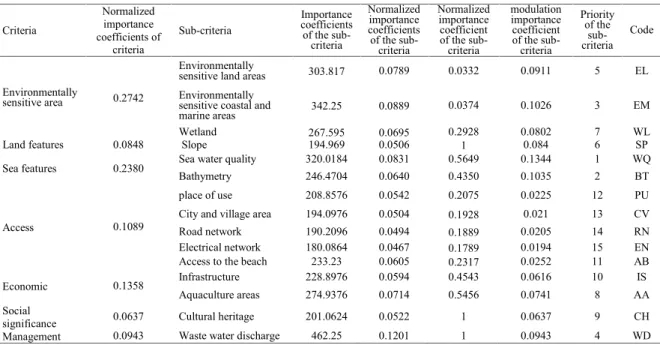
importance coeficient are more important than the other criteria. As shown in Table 5, the normalized importance coeficients of the criteria in descending order is 0.2742 (environmentally sensitive area), 0.2380 (sea features), 0.1358 (economic criterion), 0.1089 (access), 0.0848 (land features) and 0.0637 (social signiicance).The modulation importance coeficient is the most important component for demonstrating the priority and degree of importance of the sub-criteria in the linear model. Of the 15 preferred sub-criteria in the prioritization stage, the modulation importance coeficient of the sub-criteria of seawater quality was the highest (0.1349), followed by bathymetry (0.1035) and environmentally sensitive coastal and marine areas (0.1026), ranking second and third. As seen in Table 3, the sub-criterion of city and village area position, road network and electrical network received the lowest modulation importance coeficient and priorities. In the following items, calculation of the modulation importance coeficient for environmentally sensitive coastal and marine area was shown.
1) Importance coeficients of the criteria (environmentally sensitive area): 55 ×8.8=484
2) Normalized importance coeficients of the criteria (environmentally sensitive area): 484/1765.115= 0.2742
3) Importance coeficients of the sub-criteria
(environmentally sensitive Coastal & marine area): 46.25 × 7.4=342.25
4) Normalized importance coeficients of the sub-criteria (environmentally sensitive Coastal & marine area): 342.25/ 3848.748= 0.0889
5) Normalized importance coeficient of the sub-criteria (environmentally sensitive Coastal & marine area) based on the criterion (environmentally sensitive area): 342.25/ 913.662 = 0.374 6) Modulation importance coeficient of the sub-criteria (environmentally sensitive Coastal & marine area): 0.374 × 0.2742= 0.1026
Identifying proper locations in the study area
The present study used a linear model based on the priorities and modulation importance coeficients to develop the output map in Arc-GIS for site selection desalination plants. According to Table 3, each sub-criterion is involved in the linear model through a letter code. Environmentally sensitive land areas (EL), environmentally sensitive coastal and marine areas (EM), wetland (WL), sea water quality (WQ), slope (SP), bathymetry (BT), place of use (PU), city and village area (CV), road network (RN), electrical network (EN), access to the beach (AB), infrastructure (IS), aquaculture areas (AA), cultural heritage (CH) and waste water discharge (WD). The following, linear model was developed based on the Delphi
Table 3: Calculating normalized importance coefficients of criteria and modulation importance coefficient of sub-criteria
Criteria
Normalized importance coefficients of
criteria
Sub-criteria
Importance coefficients of the sub-criteria
Normalized importance coefficients of the sub-criteria
Normalized importance coefficient of the sub-criteria
modulation importance coefficient of the sub-criteria
Priority of the
sub-criteria
Code
Environmentally
sensitive area 0.2742
Environmentally
sensitive land areas 303.817 0.0789 0.0332 0.0911 5 EL
Environmentally sensitive coastal and
marine areas 342.25 0.0889 0.0374 0.1026 3 EM
Wetland 267.595 0.0695 0.2928 0.0802 7 WL
Land features 0.0848 Slope 194.969 0.0506 1 0.084 6 SP
Sea features 0.2380 Sea water quality 320.0184 0.0831 0.5649 0.1344 1 WQ
Bathymetry 246.4704 0.0640 0.4350 0.1035 2 BT
Access 0.1089
place of use 208.8576 0.0542 0.2075 0.0225 12 PU
City and village area 194.0976 0.0504 0.1928 0.021 13 CV
Road network 190.2096 0.0494 0.1889 0.0205 14 RN
Electrical network 180.0864 0.0467 0.1789 0.0194 15 EN
Access to the beach 233.23 0.0605 0.2317 0.0252 11 AB
Economic 0.1358 Infrastructure 228.8976 0.0594 0.4543 0.0616 10 IS
Aquaculture areas 274.9376 0.0714 0.5456 0.0741 8 AA
Social
significance 0.0637 Cultural heritage 201.0624 0.0522 1 0.0637 9 CH
Management 0.0943 Waste water discharge 462.25 0.1201 1 0.0943 4 WD
97 method to integrate the maps for identifying proper locations for desalination plants.
Site selection for desalination plants = (WQ*0.1344) + (BT*0.1035) + (EM*0.1026) + (WD*0.0943) + (EL*0.0911) + (SP*0. 084) + (WL*0.0802) + (AA*0.0741) + (CH*0.0637) + (IS*0.0616) + (AB*0.0252) + (PU*0.0225) + (CV*0.021) + (RN*0.0205) + (EN*0.0194)
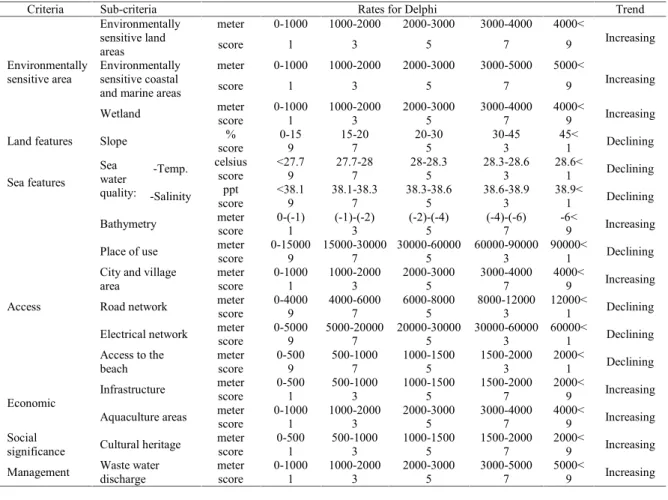
The distance maps of environmentally sensitive land areas, environmentally sensitive coastal and marine areas, are respectively shown in Figs. 7 and 8. According to Table 4, nine sub-criteria show an increasing trend; that is, their location value increases with their numerical value. In other words, the locations with a higher numerical value are more appropriate; for example, the greater is a location’s distance from environmentally sensitive coastal-marine areas, the better is that location. In contrast,
six sub-criteria showed a declining trend; that is, the lower is the numerical value of an identiied location or the closer it is to the range of these sub-criteria, the more appropriate is that location.
The inal map was obtained for site selection desalination plants in Hormozgan Province was developed by combining the layers evaluated based on the linear model and considering the priorities and modulation importance coeficients of the sub-criteria and ultimately by overlaying the layer of compulsory criteria on the inal layer of the preferred sub-criteria. Based on the inal map obtained, 63 locations were found to be appropriate for installing desalination plants on the coast of the Persian Gulf and Oman Sea in Hormozgan Province. By reclassifying and reevaluating the inal map, 27 high important locations were found to have the highest priority, spatial value and score for installing water desalination facilities. As shown in Figs. 9, a total of 28 highly important locations were obtained and all the other locations
Fig. 6: Map of the compulsory sub-criteria and indicators in study area
Fig. 7: Evaluated map of distance to Fig. 8: Evaluated map of distance to environmentally
environmentally sensitive land areas sensitive coastal and marine areas
Fig. 6: Map of the compulsory sub-criteria and indicators in study area
Fig. 7: Evaluated map of distance to environmentally sensitive
land areas
Fig. 8: Evaluated map of distance to environmentally sensitive
M. Sepehr et al.
Table 4: Evaluation of the sub-criteria based on distance
Table 4: Evaluation of the sub-criteria based on distance
Trend Rates for Delphi
Sub-criteria Criteria Increasing 4000< 3000-4000 2000-3000 1000-2000 0-1000 meter Environmentally sensitive land areas Environmentally sensitive area 9 7 5 3 1 score Increasing 5000< 3000-5000 2000-3000 1000-2000 0-1000 meter Environmentally sensitive coastal
and marine areas score 1 3 5 7 9
Increasing 4000< 3000-4000 2000-3000 1000-2000 0-1000 meter Wetland 9 7 5 3 1 score Declining 45< 30-45 20-30 15-20 0-15 % Slope Land features 1 3 5 7 9 score Declining 28.6< 28.3-28.6 28-28.3 27.7-28 <27.7 celsius -Temp. Sea water quality:
Sea features score 9 7 5 3 1
Declining 38.9< 38.6-38.9 38.3-38.6 38.1-38.3 <38.1 ppt
-Salinity score 9 7 5 3 1
Increasing -6< (-4)-(-6) (-2)-(-4) (-1)-(-2) 0-(-1) meter Bathymetry 9 7 5 3 1 score Declining 90000< 60000-90000 30000-60000 15000-30000 0-15000 meter Place of use
Access 1 3 5 7 9 score Increasing 4000< 3000-4000 2000-3000 1000-2000 0-1000 meter City and village
area score 1 3 5 7 9
Declining 12000< 8000-12000 6000-8000 4000-6000 0-4000 meter Road network 1 3 5 7 9 score Declining 60000< 30000-60000 20000-30000 5000-20000 0-5000 meter
Electrical network score 9 7 5 3 1
Declining 2000< 1500-2000 1000-1500 500-1000 0-500 meter Access to the
beach score 9 7 5 3 1
Increasing 2000< 1500-2000 1000-1500 500-1000 0-500 meter Infrastructure
Economic score 1 3 5 7 9
Increasing 4000< 3000-4000 2000-3000 1000-2000 0-1000 meter Aquaculture areas 9 7 5 3 1 score Increasing 2000< 1500-2000 1000-1500 500-1000 0-500 meter Cultural heritage Social
significance score 1 3 5 7 9
Increasing 5000< 3000-5000 2000-3000 1000-2000 0-1000 meter Waste water discharge
Management score 1 3 5 7 9
Fig. 9: Final map of site selection for desalination plants
99
Fig. 10: Areas with a high important spatial value
were identiied as middle important to unimportant locations. As shown in Fig. 10, of the 27 high important locations, six were located in the coastal area of the Oman Sea, one in the coastal area of the Strait of Hormuz and 20 others in the coastal area of the Persian Gulf. Table 5 contains the spatial details of these 27 locations with the best conditions in terms of the identiied criteria for installing desalination plants in Hormozgan Province.
The present indings show that the method of site selection for desalination plants using GIS in Arc-GIS can serve as a useful tool for identifying a set of locations with detailed information (Melbourne Water GHD, 2007). Screening of the criteria, screening and prioritization of the sub-criteria through
various methods such as Delphi were also found to be important steps of site selection studies (Andon Petrosian et al., 2013;Basereh et al., 2014)Seawater quality and coastal environment were found to be the important criteria in site selection for desalination plants in a study on prioritization criteria based on the Delphi method (Basereh et al., 2014), which is consistent with the results of the present study. Studies have proposed proximity to place of use and seawater quality as the most important criteria (Kor
et al., 2012), which is consistent with the presents indings. The present study found that seawater quality, bathymetry, environmentally sensitive coastal and marine areas, waste water Discharge sites and environmentally sensitive land areas have a higher
Table 5: Spatial details, high important locations identiied Fig. 10: Areas with a high important spatial value
Table 5: Spatial details, high important locations identified
N E Location Site N E Location Site 26°59'4" 55°42'37" Persian Gulf O 27° 9'16" 52°57'41" Persian Gulf A 26°59'4" 55°42'37" Persian Gulf P 27° 2'40" 53°15'8" Persian Gulf B 27° 1'45" 55°46'4" Persian Gulf Q 27° 1'25" 53°19'59" Persian Gulf C 27° 0'26" 55°47'28" Persian Gulf R 26°59'4" 53°27'24" Persian Gulf D 27° 1'40" 55°55'57" Persian Gulf S 26°45'30" 54° 1'58" Persian Gulf E 27° 7'47" 56° 5'59" Persian Gulf T 26°43'34" 54° 7'13" Persian Gulf F 27° 9'22" 56° 9'18"
Delphi method in site selection
priority compared to other sub-criteria. The study of the 27 high important locations identiied based on the evaluation table(Table 4) in relation to the sub-criterion of seawater quality showed that, given the declining trend of the water temperature indicator, 20 locations were located at a temperature range below 27.7 °C. Location A was found to have the lowest and location V the highest coastal water temperature compared to the other locations. Given the declining trend of salinity, 15 locations were found to have a seawater salinity range of less than 38.1 ppt. The Coastal waters of location Z2 had the lowest salinity while locations F and G had the highest salinity level compared to other locations identiied. The Coastal waters of 20 locations were found to have a bathymetric range of above 6 meters owing to the increasing trend of bathymetry; of these 20 locations, O had the highest depth while P, Q and Z had the lowest depth compared to other locations. Given the increasing trend observed in the sub-criterion of environmentally sensitive coastal and marine areas, 23 locations were found to be located at a distance above 5000m from protected areas, 25 locations at greater than this distance from biosphere reserves and 10 locations from irth-estuaries-rivers; among these locations, location A had the greatest distance and location X the smallest distance to protected areas. Z2 and A were located at the greatest respective distance and O was at the smallest distance to the biosphere reserves. U and Z2 were found to have the smallest distance from irth-estuaries - rivers. A small area of U and Z2 was found to be located within irth-estuary-river. A total of 23 locations identiied were located at a distance above 5000m from waste water discharge locations, which relects the increasing trend observed in this sub-criterion. Z2 was also located at the greatest distance from wastewater discharge locations and S at the smallest distance. A total of 26 locations were found to be located at a distance above 4000m from environmentally sensitive land areas. According to the results that all the identiied locations are located at the optimal distance from the compulsory areas, which are consistent with some studies (Victorian Government
project, 2011). The optimal locations found in another study (Waddell, 2005), were outside protected areas, which is consistent with the obtained results from this study. In terms of seawater quality, the locations identiied in the Persian Gulf basin were found to have lower temperature and higher salinity compared to the
locations in the Oman Sea basin. Most of the locations identiied in the Persian Gulf and Oman Sea basins were found to have similar bathymetric conditions. In terms of the sub-criterion of environmentally sensitive coastal-marine areas, the locations identiied in the Oman Sea basin were located at a closer distance to protected areas and irth-estuaries-rivers but at a greater distance from biosphere reserves and wastewater discharge locations.
CONCLUSION
Examining of all the effective criteria and sub-criteria with application of Delphi method led to the identiication of 63 proper locations for installing desalination plants on the southern coast of Iran in Hormozgan Province, in the vicinityof the northern Persian Gulf and Oman Sea. A total of 27 high important locations were optimal in terms of the study criteria and sub-criteria and involved the least environmental risks and impacts on the study area. Organizations associated with environmental protection and water resource management, such as the Department of Environment, Ministry of Power, research institutes in the area including Hormozgan Fisheries Organization and the Institute of Oceanography are recommended to more accurately investigate the identiiedlocations and ultimately proceed with establish desalination plants.
ACKNOWLEDGEMENT
The authors gratefully acknowledge the Department of Marine Biology, Science and Research Branch, Islamic Azad University as well as Mr. Raiee for his worthwhile advice.
CONFLICT OF INTEREST
The authors declare that there is no conlict of interests regarding the publication of this manuscript.
REFERENCES
Alavipoor, F.; Karimi, S.; Balist, J.; Khakian, A., (2016). A
geographic information system for gas power plant location using analytical hierarchy process and fuzzy logic. Global J.
Environ. Sci. Manage., 2(2): 197-207 (11 pages).
Alshahri, F., (2016). Radioactivity of 226 Ra, 232 Th, 40 K and 137 Cs in beach sand and sediment near to desalination plant in eastern Saudi Arabia: Assessment of radiological impacts. J.
King Saud. Univ. Sci. (8 pages).
101
on North part of Persian Gulf, Iran). Environ. Dev.J., 4(7): 37-48 (12 pages), (In Persian).
Asadpour, G., (2015). Evaluating the geochemistry of Bam salt
dome in Hormozgan Province, Iran. Pollution, 1(1): 95-101 (7 pages).
Basereh, N.; Mohammadizadeh, M.; Sekhavati, E. ., (2014).
Prioritizing to Choose Proper Regions for Desalination plant
construction in Coastal Regions Located in West of Hormozgan Province using TOPSIS method. 3rd National Conference on Health, Environment and Sustainable Development. Bandar Abbas, Iran 19–20 February (14 pages) (In Persian).
Borrowman, C., (2013).Site selection for seawater desalination treatment plant. Water Department Plant Site Selection Process Draft Technical Memorandum. Santa Cruz County, California, USA. (29 pages).
Braulik, G.T.; Ranjbar, S.; Owi, F.; Aminrad, T.; Dakhteh, S.M.H., (2010). Marine mammal records from Iran. J. Cetac. Res.
Manage., 11(1): 49-64 (15 pages).
Chaudhary, P.; Chhetri, S.K.; Joshi, K.M.; Shrestha, B.M.; Kayastha,
P., (2016). Application of an Analytic Hierarchy Process (AHP) in the GIS interface for suitable ire site selection: A case study from Kathmandu Metropolitan City, Nepal. Socioecon. Plann. Sci., 53: 60-71 (12 pages).
Cho, J.; Lee, J., (2013). Development of a new technology product
evaluation model for assessing commercialization opportunities
using Delphi method and fuzzy AHP approach. Expert Syst. Appl., 40(13): 5314-5330 (16 pages).
Cooley, H.; Ajami, N.; Heberger, M., (2013). Key issues in seawater desalination in California: marine impacts. Paciic Institute Oakland, CA: (32 pages).
Daliri, M.; Eighani, M.; Paighambari, S.Y.; Alizadeh, E., (2012).
Some morphological characteristics of ive marine ish species of Hormozgan coastal waters (Northern Persian Gulf). Caspian
J. Appl. Sci. Res., 1(6): 20-26 (7 pages).
Davidson, P., (2013). The Delphi technique in doctoral research: considerations and rationale. Rev. Higher Educ. Self-Learning, 6(22): 53-65 (13 pages).
Erftemeijer, P.L.; Shuail, D.A., (2012). Seagrass habitats in the Arabian Gulf: distribution, tolerance thresholds and threats. Aquat. Ecosyst. Health Manage., 15(sup1): 73-83 (11 pages).
Goh, P.; Ismail, A.; Hilal, N., (2016). Nano-enabled membranes technology: Sustainable and revolutionary solutions for membrane desalination? Desalination, 380: 100-104 (5 pages).
Hasanzadeh, M.; Danehkar, A.; Pak, A., (2012). Application of Delphi method for criteria selection in site survey of oil jetties in Iran. Environ. Nat. Res., 2(1): 119-128 (10 pages).
Hasanzadeh, M.; Danehkar, A.; Azizi, M., (2013). The application
of analytical network process to environmental prioritizing
criteria for coastal oil jetties site selection in Persian Gulf coasts
of Iran. Ocean Coast Manag., 73: 136-144 (9 pages).
Kallali, H.; Anane, M.; Jellali, S.; Tarhouni, J., (2007). GIS-based
multi-criteria analysis for potential wastewater aquifer recharge sites. Desalination, 215(1): 111-119 (9 pages).
Kharat, M.G.; Kamble, S.J.; Raut, R.D.; Kamble, S.S.; Dhume, S.M., (2016). Modeling landill site selection using an integrated fuzzy MCDM approach. Model Earth Syst. Environ., 2(2): 1-16
(16 pages).
Karbassi, A.R.; Pazoki, M., (2015). Environmental qualitative assessment of rivers sediments. Global J. Environ. Sci. Manage.,
1(2): 109-116 (8 pages).
Kim, H.S.; No, H.C.; Jo, Y.; Wibisono, A.F.; Park, B.H.; Choi, J.; Lee, J.I.; Jeong, Y.H.; Cho, N.Z., (2015). Feasibility study of a dedicated nuclear desalination system: Low-pressure Inherent heat sink nuclear desalination plant (LIND). Nucl. Eng. Tech., 47(3): 293-305 (13 pages).
Kor, Y.; Kashi, H.; Takdastan, A; Mehdinejad, M.H.; Amirkhanlo, B., (2012). Construction positioning and prioritization of the
desalination complexes in Village of Qeshm Island. National
Conference on sea water utilization. Kerman, Iran 3–4 January.
(9 pages), (In Persian).
Koupaei, A.N.; Mostafavi, P.G.; Mehrabadi, J.F.; Fatemi, S.M.R.; Dehghani, H., (2015). Diversity of shallow water zoantharians in Hengam and Larak Islands, in the Persian Gulf. J. Mar. Biol. Assoc. 1-11 (11 pages).
Lang, T., (1995). An overview of four futures methodologies. Manoa J. Fried Half-Fried Ideas.
Lattemann, S.; Höpner, T., (2008). Environmental impact and
impact assessment of seawater desalination. Desalination,
220(1): 1-15 (15 pages).
Life Red Sea Project, (2008). Environmental practices for desalination plants in the South Red Sea Region of Egypt. United States Agency for International Developmen.
Mai-Gholami, D.; Feghhi, J.; Danehkar, A.; Yarali, N., (2015).
Prioritizing stresses and disturbances affecting mangrove forests
using fuzzy analytic hierarchy process. Case study: mangrove forests of Hormozgan Province, Iran. Adv. Environ. Sci., 7(3): 442-459 (18 pages).
Mai-Gholami, D.; Feghhi, J.; Danehkar, A.; Yarali, N., (2015). Classiication and prioritization of negative factors affecting on mangrove forests using Delphi method (Case study: Mangrove Forests of Hormozgan Province of Iran). Adv. Biores., 6(3): 78-92 (15 pages).
Melbourne Water and GHD (2007). Melbourne augmentation program seawater desalination. feasibility study. Melbourne Water and clients people performance.
Mezher, T.; Fath, H.; Abbas, Z.; Khaled, A., (2011).
Techno-economic assessment and environmental impacts of desalination
technologies. Desalination, 266(1): 263-273 (11 pages).
Mohammadi, M.; Tajik, H.; Hajeb, P., (2013). Nutritional
composition of seaweeds from the northern Persian Gulf. Iran J.
Fish Sci., 12(1): 232-240 (9 pages).
Molavi‐Arabshahi, M.; Arpe, K.; Leroy, S., (2016). Precipitation and temperature of the southwest Caspian Sea region during the
last 55 years: Their trends and teleconnections with large‐scale
atmospheric phenomena. Int. J. Climatol., 36(5): 2156-2172 (17 pages).
Mousavi, S.H.; Danehkar, A.; Shokri, M.R.; Poorbagher, H.; Azhdari, D., (2015). Site selection for artiicial reefs using a new combine Multi-Criteria Decision-Making (MCDM) tools for coral reefs in the Kish Island–Persian Gulf. Ocean Coast Manag., 111: 92-102 (11 pages).
Ong, C.; Goh, P.; Lau, W.; Misdan, N.; Ismail, A., (2016). Nanomaterials for biofouling and scaling mitigation of thin ilm composite membrane: A review. Desalination, 393: 2-15 (14 pages).
M. Sepehr et al.
AUTHOR (S) BIOSKETCHES
Sepehr, M., Ph.D. Candidate, Marine Ecology, Department of Marine Biology, Science and Research Branch, Islamic Azad University,
Tehran, Iran. Email: [email protected]
Fatemi, S.M.R., Ph.D., Associate Professor, Department of Marine Biology, Science and Research Branch, Islamic Azad University,
Tehran, Iran. Email: [email protected]
Danehkar, A., Ph.D., Associate Professor, Department of Environmental Sciences, Faculty of Natural Resources, University of Tehran,
Tehran, Iran. Email: [email protected]
Mashinchian-Moradi, A., Ph.D., Assistant Professor, Department of marine biology, Science and Research Campus, Islamic Azad
University, Tehran, Iran. Email: [email protected]
COPYRIGHTS
Copyright for this article is retained by the author(s), with publication rights granted to the GJESM Journal. This is an open-access article distributed under the terms and conditions of the Creative Commons Attribution License (http://creativecommons.org/licenses/by/4.0/).
HOW TO CITE THIS ARTICLE
Sepehr, M., Fatemi, S.M.R., Danehkar, A., Mashinchian- Moradi, A., (2017). Application of Delphi method in site selection of desalination plants. Global J. Environ. Sci. Manage. 3(1): 89-102.
DOI:10.22034/gjesm.2017.03.01.009 url: http://gjesm.net/article_22215.html
important sea turtle areas for hawksbill turtles in the Arabian Region. J. Exp. Mar. Biol. Ecol., 460: 89-99 (11 pages).
Roberts, D.A.; Johnston, E.L.; Knott, N.A., (2010). Impacts of desalination plant discharges on the marine environment: A critical review of published studies. Water Res., 44(18): 5117-5128 (12 pages).
Sanver, A., May, S.C. (2010). The desalination processes site
selection, layout and civil works. The Desalination Site and Civil
Works. Encyclopedia of desalination and water resources, (10 pages).
Tsiourtis, N.X., (2008). Criteria and procedure for selecting a site for a desalination plant. Desalination, 221(1): 114-125 (12 pages).
Uyan, M., (2013). GIS-based solar farms site selection using analytic hierarchy process (AHP) in Karapinar region, Konya/ Turkey. Renewable Sustainable Energy Rev., 28: 11-17 (7 pages).
Waddell, D., (2005). Environmental assessment of the concept plan for Sydney’s Desalination ii: Project Sydney water.
Wang, Y.; Jung, K.-A.; Yeo, G.-T.; Chou, C.-C., (2014). Selecting a cruise port of call location using the fuzzy-AHP method: A case study in East Asia. Tourism Manage., 42: 262-270 (9 pages).
Yal, G.P.; Akgün, H., (2014). Landill site selection utilizing TOPSIS methodology and clay liner geotechnical characterization: a case study for Ankara, Turkey. Bull. Eng. Geol. Environ., 73(2): 369-388 (20 pages).
Yavari, A.R.; Jafari, H.R.; Hashemi, S.M., (2015). Spatial–Temporal Monitoring of Ecotonal Belt Using Landscape Ecological Indices in the Central Elburz Region: Remote sensing and GIS analysis. Pollution., 1(2): 231-246 (16 pages).
Victorian Government project., (2011). Synthesis of environmental effects, Victorian desalination project environmental effects
statement. volume 1. Department of Sustainability and