Research Article
Toxicity and Loss of Mitochondrial Membrane Potential
Induced by Alkyl Gallates in
Trypanosoma cruzi
Rogério Andréo,
1Luís Octávio Regasini,
1Maicon Segalla Petrônio,
1Bruna Galdorfini Chiari-Andréo,
2Aline Tansini,
2Dulce Helena Siqueira Silva,
1and Regina Maria Barretto Cicarelli
21Instituto de Qu´ımica, Universidade Estadual Paulista (UNESP), Rua Professor Franscisco Degni 55, Bairro Quitandinha, CP 355,
14800-900 Araraquara, SP, Brazil
2Faculdade de Ciˆencias Farmacˆeuticas, Universidade Estadual Paulista (UNESP), Rodovia Araraquara-Ja´u, km 1, CP 355,
14801-902 Araraquara, SP, Brazil
Correspondence should be addressed to Regina Maria Barretto Cicarelli; [email protected]
Received 8 September 2014; Revised 18 December 2014; Accepted 22 December 2014
Academic Editor: Tzi Bun Ng
Copyright © 2015 Rog´erio Andr´eo et al. his is an open access article distributed under the Creative Commons Attribution License, which permits unrestricted use, distribution, and reproduction in any medium, provided the original work is properly cited.
American trypanosomiasis or Chagas disease is a debilitating disease representing an important social problem that afects, approximately, 10 million people in the world. he main aggravating factor of this situation is the lack of an efective drug to treat the diferent stages of this disease. In this context, the search for trypanocidal substances isolated from plants, synthetic or semi synthetic molecules, is an important strategy. Here, the trypanocidal potential of gallates was assayed in epimastigotes forms ofT. cruziand also, the interference of these substances on the mitochondrial membrane potential of the parasites was assessed,
allowing the study of the mechanism of action of the gallates in theT. cruziorganisms. Regarding the preliminary structure-activity
relationships, the side chain length of gallates plays crucial role for activity. Nonyl, decyl, undecyl, and dodecyl gallates showed
potent antitrypanosomal efect (IC50from 1.46 to 2.90�M) in contrast with benznidazole (IC50= 34.0�M). Heptyl gallate showed
a strong synergistic activity with benznidazole, reducing by 105-fold the IC50of benznidazole. Loss of mitochondrial membrane
potential induced by these esters was revealed. Tetradecyl gallate induced a loss of 53% of the mitochondrial membrane potential,
at IC50value.
1. Introduction
Chagas disease (or American trypanosomiasis) was recog-nized by World Health Organization as one of thirteen neglected tropical diseases in the world [1]. It was estimated that over 10 million people are infected, and Latin America was considered the area of the highest prevalence [2]. his parasitic disease is caused by Trypanosoma cruzi (family, Trypanosomatidae and order, Kinetoplastida), a hemolag-ellate protozoa [3], which can be found on several strains with diferent mechanisms of pathogenesis, immunogenicity, treatment response, and epidemiology [4]. he development of infection includes an acute phase which lasts up to six months ater infection, an indeterminate phase with no symptoms, and a chronic phase in which approximately 30%
of patients show clinical evidence of heart disease or megavis-ceras [5].
he current chemotherapy uses benznidazole, a nitroimi-dazole derivative, which is orally administered in acute phase and short-term chronic phase [6,7]. he usefulness of this drug is limited by its narrow therapeutic window and due to serious side efects, such as anorexia, nausea, headache, paresthesia, peripheral neuropathies, dermatitis, central ner-vous system (CNS) depression, and maniac symptoms [7, 8]. However, several parasite subpopulations with diferent host tissue’s tropism contribute to the low clinical eicacy of this drug [9]. herefore, there are eforts for the discovery and design of new therapeutic compounds to treat Chagas disease, due to the complexity of this disease.
Gallic acid (3,4,5-trihydroxybenzoic acid) is a precursor of hydrolysable tannins in the biosynthesis that occurs in plants [10] and its natural and semisynthetic derivatives have been associated with a wide variety of biological activi-ties, such as antiproliferative [11–13], chemopreventive [14], antihemolytic [15], antioxidant [16], and anti-inlammatory [17] activities. However, the main interest in gallic acid and in its derivatives has been associated with their antimi-crobial properties. It has been shown that n-octyl gallate possesses fungicidal activity againstSaccharomyces cerevisiae and Zygosaccharomyces bailii in any stage of their growth [18,19]. Leal and coworkers reported the potent fungitoxicity ofn-nonyl gallate against yeasts, dermatophytes, and hialo-hyphomycetes [20]. Lauryl gallate showed antibacterial activ-ity against Gram-positive bacteria, including methicillin-resistantStaphylococcus aureus(MRSA) [21,22].
hus, the aim of this study was to investigate the antit-rypanosomal activity of gallic acid and its esters against epimastigote forms ofTrypanosoma cruzi. Further analysis involving interactions generated by combinations between alkyl gallates and benznidazole was also carried out. In addition, the apoptosis-inducing activity by alkyl gallates was studied through the parasite mitochondrial membrane potential assay.
2. Material and Methods
2.1. Compounds. he compounds tested in this study were synthesized as described previously [14,15].
2.2. Parasites. Epimastigote forms ofTrypanosoma cruziof Y strain, described by Silva and Nussenzweig (1953) [23], which is considered a standard strain of type I, were grown in LIT media (liver infusion tryptose media) at 28∘C [24].
2.3. Cytotoxicity Assay Using MTT. he cytotoxicity assay with epimastigotesT. cruzi was performed using the MTT colorimetric method as described by Muelas-Serrano et al. (2000) [25] with modiications described in Cotinguiba et al. (2009) [26]. he parasites were treated with diferent concentrations of the substances for 72 hours and then, the parasite viability was estimated by measuring the absorbance at 595 nm. he concentration versus response curve was constructed to enable the determination of IC50. An equation that describes the curve was obtained using Origin 7.0 sotware. Means and standard deviations were calculated. ANOVA and Tukey’s tests were carried out when necessary. Diferences in means were treated as signiicant when� < 0.05. Benznidazole was used as positive control (IC50 = 34.0�M).
2.4. Mitochondrial Membrane Potential Assay. he inluence of the treatments with the gallates in the mitochondrial membrane potential was assessed. he parasites were treated with the substances during 72 hours using, as standard concentration, the IC50 previously determined by the MTT assay. he percentage of parasite cells which sufered loss in the mitochondrial membrane potential due to the treatment
with the tested compounds was measured by low cyto-metry using JC-1 dye (5,5�,6,6�-tetrachloro-1,1�,3,3� -tetraeth-ylbenzimidazolcarbocyanine iodide, BD MitoScreen kit) ac-cording to the manufacturer’s instruction [27, 28]. A Fac-sCanto I cytometer was used, and the data were recorded and analyzed on the sotware of the equipment. Pentamidine was used as positive control, at 58.7�M for 24-hour treatment.
3. Results and Discussion
he antitrypanosomal activity of a homologous series of alkyl gallates, gallic acid, and other analogues was evaluated against epimastigote forms ofTrypanosoma cruzi. his study was carried out in order to correlate chemical characteristics of the molecules with the observed activity, including the importance of free hydroxyl groups and side chain length. Table 1summarizes the IC50values of these compounds.
Gallic acid (1) was found to be totally inactive againstT. cruzi(IC50 >100�M) and its derivatives up to hexyl gallate (2–7) exhibited similar IC50values (IC50 >100�M). Heptyl gallate (8, IC50 = 37.3 ± 0.9) showed weak activity which increased in the case of longer carbon chain derivatives up to undecyl gallate (12, IC50=1.46±0.0). However, the increase in the carbon chains, becoming bigger than undecyl gallate, led to lower activity, as shown for compounds13and14(Table 1). Such results indicate that the 3,4,5-trihydroxyphenyl moiety appeared to be necessary but not suicient for antiprotozoal activity. On the other hand, Kubo et al. (2001) [18] veriied that the length of the alkyl chain is not a major contributor but plays an important role in eliciting the activity of the gallates. Among the thirteen tested gallates (2–14) esteriied with linear alcohols from C1 to C14, best results were observed for esters with chain lengths ranging from 9 to 12, which present �log�values of 4.11−5.30, as reported previously by Rosso et al. (2006) [16].
n-Undecyl gallate (12), the most active derivative, with IC50 of 1.46�M (�log� = 4.90), was twenty-three times more potent than benznidazole, used as positive control (IC50= 34.0�M). Such results indicate that esteriication led to appearance of antitrypanosomal activity, suggesting that a free carboxyl group was not crucial for protozoal death. In contrast, esters with�log�values lower than 3.32 or higher than 0.92 exhibited lower potency than the positive control.
Table 1: Antitrypanosomal activity of gallic acid (1) andn-alkyl
gallates (2–14) against epimastigote forms ofTrypanosoma cruzi.
IC50values were expressed in�M.
Compound R �log�a IC50
Gallic acid (1) H 0.89 >100b
Methyl gallate (2) CH3 0.92 >100b
Ethyl gallate (3) CH2CH3 1.27 >100b
Propyl gallate (4) (CH
2)2CH3 1.73 >100
b
Butyl gallate (5) (CH2)3CH3 2.13 >100b
Pentyl gallate (6) (CH2)4CH3 2.53 >100b
Hexyl gallate (7) (CH
2)5CH3 2.92 >100
b
Heptyl gallate (8) (CH2)6CH3 3.32 37.3±0.9
Octyl gallate (9) (CH2)7CH3 3.72 23.0±5.3
Nonyl gallate (10) (CH
2)8CH3 4.11 2.90±0.1
Decyl gallate (11) (CH2)9CH3 4.51 1.50±0.3
Undecyl gallate (12) (CH2)10CH3 4.90 1.46±0.0
Dodecyl gallate (13) (CH
2)11CH3 5.30 2.13±0.2
Tetradecyl gallate (14) (CH2)13CH3 6.09 17.6±1.8
Benznidazolec — — 34.0
aValues described by Rosso and coworkers (2006) [16].
b
Percentage of inhibition at 100�M.
c
Positive control.
features: hydrophilic phenolic hydroxyls and hydrophobic alkyl chain. Fujita and Kubo (2002) [19] reported the anti-fungal activity of gallates, suggesting that these compounds possessed amphiphilic capacity and surfactant properties and they might act disrupting the luidic bilayer membrane, leading to fungal death.
he synergistic efects of the combination using gallic acid and its esters with benznidazole, the antichagasic drug, were also evaluated. he deinitions and mathematical determina-tion of the formula for synergism were used as described by Hellmann et al. (2010) [30]. Briely, the fractional inhibitory concentration (FIC) index was calculated by using the for-mula FIC index =�/� + �/�. In this formula,�, �, and � were IC50 of gallate with benznidazole, IC50 of gallate alone, and IC50of benznidazole alone, respectively. From this calculation, a FIC index≤0.5 was considered evidence of synergistic efect, as this value can be generated only if the concentrations of both compounds in combination do not exceed one-quarter of the IC50 of either drug tested alone. A FIC index>4.0 indicates antagonism. When tested alone, some gallates (2–7) have not led to a signiicant number of epimastigotes toxicity, even at the highest concentration tested (100�M). herefore, to calculated FIC index for these compounds, the IC50was arbitrarily deined as 50�M (Table
2).
he interactions between compounds1–14and benznida-zole were highly variable, indicating dependence on the gallates chain length. Association between gallic acid (1) and short esters (2–4) with benznidazole was indiferent. Additive interaction was observed for inactive short esters (5and6) and most potent long esters, which exhibited FIC index values ranging from 0.560 to 0.765. Interestingly, medium chain length gallates (7–9) and the long chain length ester14with
FIC index values bellow 0.257 exhibited synergism. he most signiicant synergistic efect was observed for heptyl gallate (8, FIC = 0.084), which reduced by 105-fold the concentration of benznidazole necessary to inhibit cell growth in 50% (IC50 of37.3 ± 0.93 �M).
Synergism was observed at�M level, evidencing a strong antitrypanosomal activity and the potential of medium and long chain alkyl gallates as prototypes for further studies and development of novel therapeutic agents. It is also worth mentioning that the signiicant results from the association of benznidazole and alkyl gallates, which enabled the use of smaller doses of benznidazole, extended dosing intervals between consecutive administrations and short-term treat-ment leading to fewer and less intense side efects.
Few reports have been found on the antimicrobial syner-gistic efect against trypanosomatidae protozoa. Urbina and coauthors (1988, 1995, 2002, 2009) [31–34] described system-atic studies involving antifungal drugs and their associations as trypanocidal combined agents for treatment of Chagas disease, such as azoles (ketoconazole and posaconazole) with mevinolin, terbinaine, aspirin, and amiodarone. Recently, the interaction between benznidazole and parthenolide was investigated againstT. cruzi, which evidenced synergistic and additive activities against epimastigotes and trypomastigotes, respectively.
Additionally, trypanocidal gallates (8–14) were investi-gated for their inluence on the mitochondrial membrane potential. Considering that the loss of mitochondrial mem-brane potential is a typical characteristic of apoptotic cells [35], it was used to elucidate a possible mode of parasite death. In living cells, JC-1 dye crosses the plasmatic membrane as monomers, penetrating into the mitochondria. his process is controlled by the membrane potential of this organelle. he membrane of healthy mitochondria is polarized and JC-1 is rapidly internalized, increasing the concentration gradient, which may lead to its aggregation. In the low cytometer, the JC-1 monomers were detected in the FL-1 channel (FITCS), while its aggregates were observed in the red channel FL-2 (PE). On the other hand, injured mitochondria exhibits depolarized membrane and JC-1 remains in the cytoplasm as monomers. hen, we suggest that the cells which loss their mitochondrial membrane potential, which could be apoptotic cells, lose their luorescence and could be captured in Q2 quadrant, whereas normal cells are detected in Q4 quadrant.Figure 1presents the low cytometry graphs.
Figure 1presents the low cytometry analysis ofn-undecyl gallate (12) onT. cruzi.
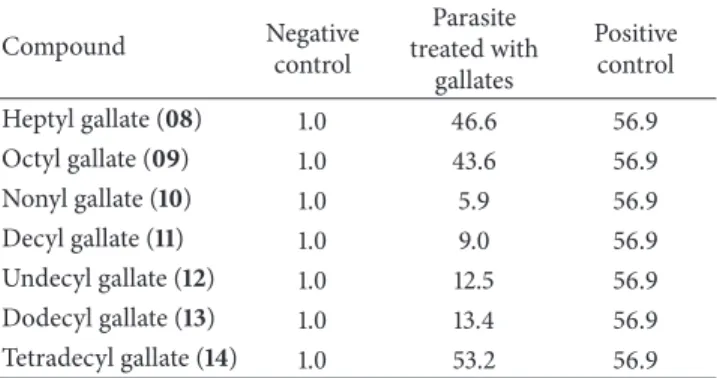
Among the tested gallates, compounds 8, 9, and 14 promoted important loss in the mitochondrial membrane potential, which maybe an apoptosis-inducing activity, with percentage of cells with reduction of mitochondrial mem-brane potential of 46.6, 43.6, and 53.2, respectively. he results are presented onTable 3.
105
104
103
102
105
104
103
102
PE-A
FITC-A
(a) Negative control
105
104
103
102
105
104
103
102
PE-A
FITC-A
(b)n-Undecyl gallate (12)
105
104
103
102
105
104
103
102
PE-A
FITC-A
(c) Pentamidine
Figure 1: Flow cytometry analysis of epimastigotes forms ofT. cruziY strain, without any treatment (a), treated with 1.46�M ofn-Undecyl
gallate (12) for 72 h (b), and treated with 58.7�M of pentamidine for 24 h (c).
of luorescence as shown by the control, suggesting the maintenance of the membrane potential. In contrast, the cells treated with pentamidine (Figure 1(c)) show intense decrease in the luorescence represented by PE, suggesting a loss of mitochondrial membrane potential which may indicate apoptosis of the parasites analyzed. he results of low cytometry forn-undecyl gallate (12) are presented on Table 3.
he results showed that the gallate esters used in this study induced loss of the mitochondrial membrane potential and maybe apoptosis in the parasites. his indicates that one of the mechanisms of cell death induced by the gallates activity could be similar to the apoptosis. his can be visualized by comparing the results with pentamidine, an apoptosis-inducing drug [36], which led to diferent percentages of mitochondrial membrane potential relatively to the control.
he treatment with some gallates, such as the substances 8,9, and14, showed a percentage of loss of mitochondrial membrane potential similar to the pentamidine treatment.
Table 2: Synergism evaluation between hypothetical IC50 values
used for calculation of FIC index.
Compound
IC50
(gallates alone)
IC50
(gallates with benznidazole)
FIC index
Interaction
type∗
Gallic acid (01) 294a 17.4 2.017 I
Methyl gallate
(02) 271
a 15.3 1.786 I
Ethyl gallate
(03) 252
a 10.2 1.193 I
Propyl gallate
(04) 235
a 8.90 1.043 I
Butyl gallate
(05) 221
a 7.47 0.878 A
Pentyl gallate
(06) 208
a 6.02 0.708 A
Hexyl gallate
(07) 196
a 2.28 0.257 S
Heptyl gallate
(08) 37.3 0.64 0.084 S
Octyl gallate
(09) 6.49 0.62 0.165 S
Nonyl gallate
(10) 0.86 0.44 0.560 A
Decyl gallate
(11) 0.46 0.24 0.548 A
Undecyl
gallate (12) 0.47 0.32 0.716 A
Dodecyl
gallate (13) 0.72 0.51 0.765 A
Tetradecyl
gallate (14) 6.44 0.58 0.155 S
Benznidazoleb 8.84 — — —
aHypothetical IC
50value used for calculating of FIC index.
bPositive control.
∗I, A, and S mean indiferent interaction, antagonism, and synergism,
respectively.
caused more signiicant dysfunction in the mitochondrial membrane potential (8,9, and14) are not the same substances that according to the cytotoxicity assay cause higher rates of parasites death (10,11,12, and13). In addition, maintenance of cell viability might be associated with low ainity or steric hindrance of the molecular target due to its physical-chemical properties.
Another possible mechanism of action of the gallic acid esters would be similar to the results found by Abe et al. (2000) [41]. hese authors showed that some gallates are potent inhibitors of the enzyme squalene epoxidase, which is involved in the biosynthesis of ergosterol [42] and, therefore, is essential for the survival of the microorganism.
Ergosterol is essential to the parasite because it is the most abundant sterol found in the membrane of lower eukaryotes and is therefore found in fungi and parasitic protozoa such as LeishmaniaandTrypanosoma[43–46].
he inhibition of sterol biosynthesis is associated with the loss of cell membrane luidity, which might lead to
Table 3: Loss of mitochondrial membrane potential (%) of parasite cells.
Compound Negative
control
Parasite treated with
gallates
Positive control
Heptyl gallate (08) 1.0 46.6 56.9
Octyl gallate (09) 1.0 43.6 56.9
Nonyl gallate (10) 1.0 5.9 56.9
Decyl gallate (11) 1.0 9.0 56.9
Undecyl gallate (12) 1.0 12.5 56.9
Dodecyl gallate (13) 1.0 13.4 56.9
Tetradecyl gallate (14) 1.0 53.2 56.9
the parasite death through the same mechanism of action of commercial drugs, such as terbinaine [42].
Mitochondria are one of the irst organelles to be afected ater treatment ofT. cruziwith ergosterol biosynthesis inhi-bitors, and even stronger efect may occur when an inhibitor of squalene epoxidase is used [36–47].
Due to the results of our experiments that demonstrated that there are changes in the mitochondrial membrane poten-tial of the parasites when treated with gallates, we suggest that these compounds cause the parasite death by more than one pathway, which probably includes loss of mitochondrial membrane potential, correlated with the induction of apop-tosis and, also, interfering in the biosynthesis of ergosterol in the parasites.
he phenol moiety is oten associated with cytotoxic efects due to the possible free radical or reactive oxygen species formation, which might be deleterious to the parasite metabolism.
4. Conclusions
his study demonstrated that gallic acid is not very toxic toT. cruziepimastigotes. However its esteriication yielding gallate esters with diferent side chain lengths aforded compounds with strong trypanocidal potential, which is probably also due to a change in the mitochondrial membrane potential and an interference in the biosynthesis of ergosterol in the parasites [48]. It is important to clarify that previous studies demonstrate a correlation between epimastigote and trypomastigote forms ofT. cruzi,the last one the infective form. hus, this research encourages the development of new research aiming to apply the gallates as an alternative to current therapy against Chagas disease.
Conflict of Interests
he authors declare that there is no conlict of interests regarding the publication of this paper.
Acknowledgments
`a Pesquisa do Estado de S˜ao Paulo (FAPESP)), CNPq, PADC-FCF-UNESP, and Coordination for the Improvement of Higher Education Personnel (Capes, Coordenadoria de Aperfeic¸oamento de Pessoal de N´ıvel Superior) to this re-search.
References
[1] P. J. Hotez, D. H. Molyneux, A. Fenwick et al., “Control
of neglected tropical diseases,” he New England Journal of
Medicine, vol. 357, no. 10, pp. 1018–1027, 2007.
[2] World Health Organization (WHO), 2010,http://www.who.int/
mediacentre/factsheets/fs340/en/.
[3] H. B. Tanowitz, L. V. Kirchhof, D. Simon, S. A. Morris, L. M.
Weiss, and M. Wittner, “Chagas’ disease,”Clinical Microbiology
Reviews, vol. 5, no. 4, pp. 400–419, 1992.
[4] A. Prata, “Clinical and epidemiological aspects of Chagas
disease,”he Lancet Infectious Diseases, vol. 1, no. 2, pp. 92–100,
2001.
[5] S. S. Estani, E. L. Segura, A. M. Ruiz, E. Velazquez, B. M. Porcel, and C. Yampotis, “Eicacy of chemotherapy with benznidazole
in children in the indeterminate phase of Chagas’ disease,”he
American Journal of Tropical Medicine and Hygiene, vol. 59, no. 4, pp. 526–529, 1998.
[6] J. D. Maya, B. K. Cassels, P. Iturriaga-V´asquez et al., “Mode of
action of natural and synthetic drugs againstTrypanosoma cruzi
and their interaction with the mammalian host,”Comparative
Biochemistry and Physiology Part A: Molecular & Integrative Physiology, vol. 146, no. 4, pp. 601–620, 2007.
[7] J. R. Canc¸ado, “Long term evaluation of etiological treatment
of Chagas disease with benznidazole,”Revista do Instituto de
Medicina Tropical de S˜ao Paulo, vol. 44, no. 1, pp. 29–37, 2002. [8] D. A. Sa´ude-Guimar˜aes and A. R. Faria, “Substˆancias da
natureza com atividade anti-Trypanosoma cruzi,” Revista
Brasileira de Farmacognosia, vol. 17, no. 3, pp. 455–465, 2007. [9] S. G. Andrade and J. B. Magalh˜aes, “Biodemes and zymodemes
ofTrypanosoma cruzistrains: correlations with clinical data
and experimental pathology,”Revista da Sociedade Brasileira de
Medicina Tropical, vol. 30, no. 1, pp. 27–35, 1996.
[10] A. Kanaujia, R. Duggar, S. T. Pannakal et al., “Insulinomimetic activity of two new gallotannins from the fruits of Capparis
moonii,”Bioorganic and Medicinal Chemistry, vol. 18, no. 11, pp.
3940–3945, 2010.
[11] K. Dodo, T. Minato, T. Noguchi-Yachide, M. Suganuma, and Y. Hashimoto, “Antiproliferative and apoptosis-inducing activ-ities of alkyl gallate and gallamide derivatives related to
(-)-epigallocatechin gallate,”Bioorganic and Medicinal Chemistry,
vol. 16, no. 17, pp. 7975–7982, 2008.
[12] C. Locatelli, R. Rosso, M. C. Santos-Silva et al., “Ester derivatives of gallic acid with potential toxicity toward L1210 leukemia
cells,”Bioorganic and Medicinal Chemistry, vol. 16, no. 7, pp.
3791–3799, 2008.
[13] C. Locatelli, P. C. Leal, R. A. Yunes, R. J. Nunes, and T. B. Creczynski-Pasa, “Gallic acid ester derivatives induce apoptosis and cell adhesion inhibition in melanoma cells: the relationship between free radical generation, glutathione depletion and cell
death,”Chemico-Biological Interactions, vol. 181, no. 2, pp. 175–
184, 2009.
[14] M. C. C. Morais, S. Luqman, T. P. Kondratyuk et al.,
“Suppres-sion of TNF-�induced NF�B activity by gallic acid and its
semi-synthetic esters: possible role in cancer chemoprevention,”
Natural Product Research, vol. 24, no. 18, pp. 1758–1765, 2010. [15] V. F. Ximenes, M. G. Lopes, M. S. Petrˆonio, L. O. Regasini,
D. H. Siqueira Silva, and L. M. da Fonseca, “Inhibitory
efect of gallic acid and its esters on 2,2�-azobis(2-
amidino-propane)hydrochloride (AAPH)-induced hemolysis and
deple-tion of intracellular glutathione in erythrocytes,” Journal of
Agricultural and Food Chemistry, vol. 58, no. 9, pp. 5355–5362, 2010.
[16] R. Rosso, T. O. Vieira, P. C. Leal, R. J. Nunes, R. A. Yunes, and T. B. Creczynski-Pasa, “Relationship between the lipophilicity of gallic acid n-alquil esters’ derivatives and both
myeloperoxi-dase activity and HOCl scavenging,”Bioorganic and Medicinal
Chemistry, vol. 14, no. 18, pp. 6409–6413, 2006.
[17] L. O. Regasini, D. C. Fernandes, I. Castro-Gamboa et al.,
“Chemical constituents of the lowers of Pterogyne nitens
(Caesalpinioideae),”Quimica Nova, vol. 31, no. 4, pp. 802–806,
2008.
[18] I. Kubo, P. Xiao, and K. Fujita, “Antifungal activity of octyl
gallate: structural criteria and mode of action,”Bioorganic and
Medicinal Chemistry Letters, vol. 11, no. 3, pp. 347–350, 2001. [19] K.-I. Fujita and I. Kubo, “Antifungal activity of octyl gallate,”
International Journal of Food Microbiology, vol. 79, no. 3, pp. 193–201, 2002.
[20] P. C. Leal, A. Mascarello, M. Derita et al., “Relation between lipophilicity of alkyl gallates and antifungal activity against
yeasts and ilamentous fungi,”Bioorganic and Medicinal
Chem-istry Letters, vol. 19, no. 6, pp. 1793–1796, 2009.
[21] I. Kubo, P. Xiao, and K. Fujita, “Anti-MRSA activity of alkyl
gallates,”Bioorganic and Medicinal Chemistry Letters, vol. 12, no.
2, pp. 113–116, 2002.
[22] I. Kubo, K.-I. Fujita, and K.-I. Nihei, “Molecular design of multifunctional antibacterial agents against methicillin resis-tantStaphylococcus aureus(MRSA),”Bioorganic & Medicinal Chemistry, vol. 11, no. 19, pp. 4255–4262, 2003.
[23] L. H. P. Silva and V. Nussenzweig, “Sobre uma cepa de
Trypanosoma cruzialtamente virulenta para o camundongo
branco,”Folia Cl´ınica et Biologica, vol. 20, pp. 191–208, 1953.
[24] J. F. Fernandes and O. Castellani, “Growth characteristics and
chemical composition of Trypanosoma cruzi,” Experimental
Parasitology, vol. 18, no. 2, pp. 195–202, 1966.
[25] S. Muelas-Serrano, J. J. Nogal, R. A. Mart´ınez-D´ıaz, J. A. Escario,
A. R. Mart´ınez-Fern´andez, and A. G´omez-Barrio, “In vitro
screening of American plant extracts onTrypanosoma cruziand
Trichomonas vaginalis,”Journal of Ethnopharmacology, vol. 71, no. 1-2, pp. 101–107, 2000.
[26] F. Cotinguiba, L. O. Regasini, V. S. Bolzani et al., “Piperamides and their derivatives as potential anti-trypanosomal agents,”
Medicinal Chemistry Research, vol. 18, no. 9, pp. 703–711, 2009. [27] A. Cossarizza, M. Baccarani-Contri, G. Kalashnikova, and C.
Franceschi, “A new method for the cytoluorimetric analy-sis of mitochondrial membrane potential using the
J-aggre-gate forming lipophilic cation 5,5�6,6�-tetrachloro-1,1�,3,3�
-tetraethylbenzimidazolcarbocyanine iodide (JC-1),”
Biochemi-cal and BiophysiBiochemi-cal Research Communications, vol. 197, no. 1, pp. 40–45, 1993.
[28] G. V. Kulkarni, W. Lee, A. Seth, and C. A. G. McCulloch, “Role of mitochondrial membrane potential in concanavalin A-induced
apoptosis in human ibroblasts,”Experimental Cell Research, vol.
245, no. 1, pp. 170–178, 1998.
cinnamaldehyde,” Bioresource Technology, vol. 98, no. 4, pp. 734–738, 2007.
[30] J. K. Hellmann, S. M¨unter, M. Wink, and F. Frischknecht, “Synergistic and additive efects of epigallocatechin gallate and
digitonin on Plasmodium sporozoite survival and motility,”
PLoS ONE, vol. 5, no. 1, Article ID e8682, 2010.
[31] J. A. Urbina, K. Lazardi, T. Aguirre, M. M. Piras, and R. Piras, “Antiproliferative synergism of the allylamine SF 86-327 and ketoconazole on epimastigotes and amastigotes of
Trypanosoma (Schizotrypanum) cruzi,” Antimicrobial Agents and Chemotherapy, vol. 32, no. 8, pp. 1237–1242, 1988.
[32] J. A. Urbina, J. Vivas, G. Visbal, and L. M. Contreras,
“Modi-ication of the sterol composition ofTrypanosoma(
Schizotry-panum)cruziepimastigotes by�24(25)-sterol methyl transferase
inhibitors and their combinations with ketoconazole,”
Molecu-lar and Biochemical Parasitology, vol. 73, no. 1-2, pp. 199–210, 1995.
[33] J. A. Urbina, J. L. Concepcion, S. Rangel, G. Visbal, and R. Lira, “Squalene synthase as a chemotherapeutic target in
Trypanosoma cruziandLeishmania mexicana,”Molecular and Biochemical Parasitology, vol. 125, no. 1-2, pp. 35–45, 2002. [34] J. A. Urbina, “Ergosterol biosynthesis and drug development for
Chagas disease,”Mem´orias do Instituto Oswaldo Cruz, vol. 104,
no. 1, pp. 311–318, 2009.
[35] J. D. Ly, D. R. Grubb, and A. Lawen, “he mitochondrial
membrane potential (Δ�m) in apoptosis; an update,”Apoptosis,
vol. 8, no. 2, pp. 115–128, 2003.
[36] W. de Souza, M. Attias, and J. C. F. Rodrigues, “Particularities of mitochondrial structure in parasitic protists (Apicomplexa and
Kinetoplastida),”International Journal of Biochemistry and Cell
Biology, vol. 41, no. 10, pp. 2069–2080, 2009.
[37] M. Sands, M. A. Kron, and R. B. Brown, “Pentamidine: a review,”
Reviews of Infectious Diseases, vol. 7, no. 5, pp. 625–634, 1985.
[38] A. E. Vercesi and R. Docampo, “Ca2+transport by
digitonin-permeabilizedLeishmania donovani. Efects of Ca2+,
pentami-dine and WR-6026 on mitochondrial membrane potentialin
situ,”Biochemical Journal, vol. 284, no. 2, pp. 463–467, 1992. [39] S. L. Crot and R. P. Brazil, “Efect of pentamidine isethionate
on the ultrastructure and morphology ofLeishmania mexicana
amazonensis in vitro,”Annals of Tropical Medicine and
Parasitol-ogy, vol. 76, no. 1, pp. 37–43, 1982.
[40] B. Hentzer and T. Kobayasi, “he ultrastructural changes of
Leishmania tropicaater treatment with pentamidine,”Annals of Tropical Medicine and Parasitology, vol. 71, no. 2, pp. 157–166, 1977.
[41] I. Abe, T. Seki, and H. Noguchi, “Potent and selective inhibition
of squalene epoxidase by synthetic galloyl esters,”Biochemical
and Biophysical Research Communications, vol. 270, no. 1, pp. 137–140, 2000.
[42] W. de Souza and J. C. F. Rodrigues, “Sterol biosynthesis pathway
as target for anti-trypanosomatid drugs,”Interdisciplinary
Per-spectives on Infectious Diseases, vol. 2009, Article ID 642502, 19 pages, 2009.
[43] K. E. Bloch, “Sterol structure and membrane function,”CRC
Critical Reviews in Biochemistry, vol. 14, no. 1, pp. 47–92, 1983. [44] A. Arora, H. Raghuraman, and A. Chattopadhyay,
“Inlu-ence of cholesterol and ergosterol on membrane dynamics: a
luorescence approach,”Biochemical and Biophysical Research
Communications, vol. 318, no. 4, pp. 920–926, 2004.
[45] E. Zinser, C. D. M. Sperka-Gottlieb, E.-V. Fasch, S. D. Kohlwein, F. Paltauf, and G. Daum, “Phospholipid synthesis and lipid com-position of subcellular membranes in the unicellular eukaryote
Saccharomyces cerevisiae,”Journal of Bacteriology, vol. 173, no. 6, pp. 2026–2034, 1991.
[46] N. Mbongo, P. M. Loiseau, M. A. Billion, and M. Robert-Gero,
“Mechanism of amphotericin B resistance inLeishmania
dono-vanipromastigotes,”Antimicrobial Agents and Chemotherapy,
vol. 42, no. 2, pp. 352–357, 1998.
[47] K. Lazardi, J. A. Urbina, and W. de Souza, “Ultrastructural alterations induced by two ergosterol biosynthesis inhibitors, ketoconazole and terbinaine, on epimastigotes and amastigotes ofTrypanosoma (Schizotrypanum) cruzi,”Antimicrobial Agents and Chemotherapy, vol. 34, no. 11, pp. 2097–2105, 1990. [48] Z. J. Molina-Garza, A. F. Bazald´ua-Rodr´ıguez, R.
Quintanilla-Licea, and L. Galaviz-Silva, “Anti-Trypanosoma cruziactivity of
10 medicinal plants used in northeast Mexico,”Acta Tropica, vol.
Submit your manuscripts at
http://www.hindawi.com
Stem Cells
International
Hindawi Publishing Corporation
http://www.hindawi.com Volume 2014
Hindawi Publishing Corporation
http://www.hindawi.com Volume 2014
INFLAMMATION
Hindawi Publishing Corporation
http://www.hindawi.com Volume 2014
Behavioural
Neurology
Endocrinology
International Journal of Hindawi Publishing Corporationhttp://www.hindawi.com Volume 2014 Hindawi Publishing Corporation
http://www.hindawi.com Volume 2014
Disease Markers
Hindawi Publishing Corporation
http://www.hindawi.com Volume 2014
BioMed
Research International
Oncology
Journal ofHindawi Publishing Corporation
http://www.hindawi.com Volume 2014
Hindawi Publishing Corporation
http://www.hindawi.com Volume 2014
Oxidative Medicine and Cellular Longevity
Hindawi Publishing Corporation
http://www.hindawi.com Volume 2014
PPAR Research
The Scientiic
World Journal
Hindawi Publishing Corporationhttp://www.hindawi.com Volume 2014
Immunology Research
Hindawi Publishing Corporation
http://www.hindawi.com Volume 2014
Journal of
Obesity
Journal ofHindawi Publishing Corporation
http://www.hindawi.com Volume 2014
Hindawi Publishing Corporation
http://www.hindawi.com Volume 2014
Computational and Mathematical Methods in Medicine
Ophthalmology
Journal ofHindawi Publishing Corporation
http://www.hindawi.com Volume 2014
Diabetes Research
Journal ofHindawi Publishing Corporation
http://www.hindawi.com Volume 2014
Hindawi Publishing Corporation
http://www.hindawi.com Volume 2014
Research and Treatment
AIDS
Hindawi Publishing Corporation
http://www.hindawi.com Volume 2014
Gastroenterology Research and Practice
Hindawi Publishing Corporation
http://www.hindawi.com Volume 2014
Parkinson’s
Disease
Evidence-Based Complementary and Alternative Medicine
Volume 2014 Hindawi Publishing Corporation