Article
Printed in Brazil - ©2017 Sociedade Brasileira de Química0103 - 5053 $6.00+0.00*e-mail: [email protected] †In memoriam
Anti-Trypanosoma Activity and Synergistic Effects of Natural and Semi-Synthetic
Triterpenes and Predominant Cell Death through Autophagy in Amastigote Forms
Gleison D. P. Bossolani,a Tânia Ueda-Nakamura,a Sueli O. Silva,a Benedito P. Dias Filho,a
Tulio O. G. Costa,b Raúl H. R. Quintanilla,c Sabrina T. Martinez,c Valdir F. Veiga-Junior,b,d
Angelo C. Pinto†,c,d and Celso V. Nakamura*,a
aDepartamento de Ciências Básicas da Saúde, Universidade Estadual de Maringá (UEM),
Av. Colombo, 5790, 87020-900 Maringá-PR, Brazil
bDepartamento de Química, Instituto de Ciências Exatas, Universidade Federal do Amazonas (UFAM),
Av. Rodrigo Octávio, 6200, 69077-000 Manaus-AM, Brazil
cDepartamento de Química Orgânica, Instituto de Química, Universidade Federal do Rio de Janeiro (UFRJ),
Av. Athos da Silveira Ramos, 149, 21941-909 Rio de Janeiro-RJ, Brazil
dInstituto Militar de Engenharia (IME), 22290-270 Rio de Janeiro-RJ, Brazil
Chagas’ disease is a parasitic diseasewith unsatisfactory treatment, mainly in chronic stage. This study aimed to evaluate the trypanocidal activity and action mechanisms of α/β-amyrin and its semi-synthetic derivatives, together with four isolated natural triterpenes, tested against trypomastigote and amastigote forms. The structure-activity relationship was suggested and cytotoxicity was measured. In general, greater polar compounds may have improved the selectivity to the protozoan. Action mechanisms were only performed for the amastigotes of Trypanosoma cruzi by evaluating the ultrastructural alterations, membrane permeability, mitochondrial membrane potential and cell volume, since the majority of compounds displayed promising antiamastigote activities. Triterpenes promoted changes on mitochondrial membrane potential and ultrastructural features that suggest autophagy processes. Both combinations between α/β-amyrin and 3-O-acetyl-11-oxo-α/β-amyrin and 3-O-acetyl-α/β-amyrin with benznidazole displayed synergistic effects against amastigotes and antagonistic effects on LLCMK2 cells. The antiamastigote activities, chemical derivatization, drug
combinations and action mechanisms revealed to be crucial approaches toward this chronic disease.
Keywords: triterpenes, Trypanosoma cruzi, synergistic effects, amastigote, autophagy
Introduction
Chagas’ disease, caused by the lagellate protozoan
Trypanosoma cruzi, is a chronic systemic parasitosis that affects about 8 million people worldwide, mostly in Latin America where it is considered endemic.1 Symptomatic
Chagas’ disease is mainly associated with cardiac and enteric consequences that may lead to increased rates of morbidity and mortality.2 Unfortunately, there is no
satisfactory treatment for the chronic stage of the disease and new anti-T. cruzi drug candidates are needed. The current available drug therapy for Chagas’ disease relies on two nitro derivatives: benznidazole and nifurtimox. Both are
far from the ideal due to their several side effects, the limited eficacy against the genetically heterogeneous parasite, the long-term therapy, and the well-known poor activity in the late chronic phase.2,3 In addition, low investments toward
drug discovery research for Chagas’ disease contribute to the slow advancements in the development of new drugs.4,5
Several studies have been conducted to ind novel active compounds against T. cruzi. The search of natural products is promising source for the discovery of novel drugs, mainly for the neglected diseases. Another approach is that plant-derivative synthetic compounds may have an increased antiparasitic activity and a reduced toxicity through the modifications in their original chemical structure.6,7 Triterpenes are widely distributed in nature
from nature.8 These compounds have shown a wide
spectrum of pharmacologic activities, such as antibacterial, antiviral, antifungal, anti-oxidative, anti-inlammatory, anti-ulcer, anti-hyperlipidemic, hepatoprotective, as well as anti-cancer.9,10
Studies with terpenes revealed promising antileishmanial and trypanocidal activities that leads to different types of cellular death mechanisms induced by these compounds. Furthermore, different classes of terpenes have been demonstrated desirable synergistic effects when combined, since drug combination may improve the parasitic activity with lower dosage of these substances, in addition to reducing their undesirable toxic effects.11-17 The search
for synergic compounds can improve the eficiency of the treatment, reduce their toxicities on mammalian cells and diminish the selection of resistant mutations.12,18-20
Alternative strategies have been designed to identify candidates among the already available drugs in the market that could be used in combination to provide synergic effects and improve the chemotherapy eficacy. Antifungal agents, tricyclic antidepressants and several antipsychotics have been studied in combination with benznidazole in order to search new combination therapy approaches.19-21
After the discovery of several biological activities of ursolic acid and their derivatives, the search for sustainable sources of triterpenes with promising biological activities has increased in order to improve their original biological activities. Amyrins, hydroxylated monounsaturated alcohols obtained from several triterpenic skeletons, mainly from ursane and oleanane, are commonly observed in apolar extracts of plants and abundantly available in oil resins that is produced by Burseraceae species, well-known incense, frankincense or breu.22-25
This study evaluated the antiprotozoal activities of twelve triterpenoid and combinatorial effects, as well as the cytotoxicity against mammalian cells. The structure-activity relationship (SAR) between the chemical structure and biological properties of the compounds was also suggested. Ultrastructural changes, integrity of the mitochondria and cellular membrane and cell volume were also studied to investigate some action mechanisms of the triterpenes.
Experimental
Syntheses
α/β-Amyrin (1)
The binary mixture of triterpenoids α/β-amyrin was isolated from Protium resin.26 The high purity of this
mixture was considered based on the only two peaks in the analyses of gas chromatography (GC) and high
performance liquid chromatography (HPLC). These two analyses, performed and published previously, were used to deine, together with proton nuclear magnetic resonance (1H NMR), the amount of these α- and β-amyrins in this
mixture was 66 and 34%, respectively.
3-O-Fumaryl-α/β-amyrin (2)
A solution of α/β-amyrin (0.30 g, 0.703 mmol) in diclorometane (CH2Cl2), maleic anhydride (0.55 g,
5.6 mmol) and 4-dimethylaminopyridine (DMAP, 0.02 g, 0.164 mmol) was reluxed for 24 h. Then, the mixture was concentrated and subjected to liquid-liquid extraction. Column chromatography (silica gel 60, Merck, hexane:ethyl acetate, 95:5) of the crude residue was performed to give expected pure compound (0.33 g, 0.629 mmol), with yield of 89%, and appearance light yellow; IR (KBr) v / cm-1
3126 (O–H), 1738 (C=O, ester), 1686 (C=O, acid), 1308 (C(=O)–O, ester); 13C NMR (75 MHz, CDCl
3) was
compared with literature data,27d
C (ppm), α isomer, d15.6
(C-25), 15.6 (C-24), 16.8 (C-26), 18.2 (C-6), 23.5 (C-11), 23.7 (C-30), 26 (C-27), 26.1 (C-15), 26.9 (C-2), 26.9 (C-16), 28.1 (C-23), 28.4 (C-28), 31.1 (C-20), 32.5 (C-7), 32.5 (C-17), 33.3 (C-29), 34.7 (C-21), 36.8 (C-10), 37.1 (C-22), 38.1 (C-1), 39.8 (C-8), 39.8 (C-4), 41.7 (C-14), 46.7 (C-19), 47.2 (C-18), 47.5 (C-9), 55.2 (C-5), 85.1 (C-3), 121.4 (C-12), 129.1 (C’2), 137.8 (C’3), 145.3 (C-13), 164.1 (C’4), 168 (C’1); β isomer, 15.7 (C-24), 15.7 (C-25), 16.8 (C-26), 17.5 (C-29), 18.2 (C-6), 21.4 (C-30), 23.2 (C-27), 23.3 (C-11), 26.6 (C-16), 26.6 (C-15), 28.1 (C-2), 28.1 (C-28), 28.7 (C-23), 31.2 (C-21), 32.8 (C-7), 33.8 (C-17), 36.8 (C-10), 38.3 (C-1), 38.3 (C-4), 39.6 (C-19), 39.6 (C-20), 40 (C-8), 41.5 (C-22), 42.1 (C-14), 47.6 (C-9), 55.2 (C-5), 59 (C-18), 85.1 (C-3), 124.1 (C-12), 139.7 (C-13); HRMS (ESI) m/z [M – H]– observed 523.3791; C
34H51O4
requires 523.3787.
3-O-Succinyl-α/β-amyrin (3)
To obtain a solution of 3-O-succinyl-α/β-amyrin (3), succinic anhydride (0.56 g, 5.6 mmol) and DMAP (0.02 g, 0.164 mmol) were added in α/β-amyrin (0.30 g, 0.703 mmol) in CH2Cl2, and reluxed for 24 h. Then,
the mixture was concentrated and subjected to liquid-liquid extraction. It was obtained a white solid (0.35 g, 0.664 mmol) with yield of 94%; IR (KBr) v / cm-1 3443
(O–H), 1732 (C=O, ester), 1713 (C=O, acid), 1308 (C(=O)–O, ester); 13C NMR (75 MHz, CDCl
3) was
compared with literature data,27d
C (ppm), α isomer, d15.7
38.4 (C-1), 39.6 (C-4), 39.6 (C-19), 39.6 (C-20), 40 (C-8), 41.5 (C-22), 42 (C-14), 47.6 (C-9), 55.2 (C-5), 59 (C-18), 81.6 (C-3), 124.3 (C-12), 139.6 (C-13), 171.9 (C’1), 177.2 (C’4); β isomer, 15.5 (C-24), 15.5 (C-25), 16.8 (C-26), 18.2 (C-6), 23.5 (C-11), 23.7 (C-30), 26 (C-16), 26 (C-27), 26.1 (C-15), 26.9 (C-2), 27.9 (C-23), 28.4 (C-28), 29.4 (C’2), 29.4 (C’3), 31.1 (C-20), 32.5 (C-7), 32.5 (C-17), 33.3 (C-29), 34.7 (C-21), 36.8 (C-10), 37.1 (C-22), 38.2 (C-1), 39.8 (C-4), 39.8 (C-8), 41.7 (C-14), 46.8 (C-19), 47.2 (C-18), 47.5 (C-9), 55.2 (C-5), 81.5 (C-3), 121.6 (C-12), 145.2 (C-13), 171.9 (C’1), 177.1 (C’4); HRMS (ESI) m/z
[M – H]– observed 525.3969; C
34H53O4 requires 525.3949.
3-O-Acetyl-α/β-amyrin (4)
A solution of α/β-amyrin (0.5 g, 1.17 mmol), acetic anhydride (3.0 mL) and DMAP (0.01 g, 0.082 mmol) was reluxed for 30 min. Then, the mixture was concentrated and subjected to liquid-liquid extraction with CH2Cl2 in water
(CH2Cl2/H2O). This derivate binary mixture was obtained
as a white solid (0.54 g, 1.15 mmol) with yield of 98%; IR (KBr) v / cm-1 1736 (C=O, ester), 1243 (C(=O)–O, ester); 13C NMR (75 MHz, CDCl
3) was compared with literature
data,28,29 d
C (ppm), α isomer,d 15 (C-25), 16.6 (C-26),
16.8 (C-24), 17.4 (C-29), 18.2 (C-6), 21.3 (C-30), 23.1 (C-11), 23.4 (C-27), 25.9 (C-2), 26.6 (C-16), 28.1 (C-28), 28.2 (C-23), 28.7 (C-15), 31.3 (C-21), 32.8 (C-7), 33.7 (C-17), 36.7 (C-10), 37.7 (C-4), 38.5 (C-1), 39.6 (C-19), 39.6 (C-20), 40 (C-8), 41.5 (C-22), 42 (C-14), 47.7 (C-9), 55.2 (C-5), 59 (C-18), 80.9 (C-3), 124.3 (C-12), 139.6 (C-13); β isomer, 15.7 (C-25), 16.8 (C-24), 16.8 (C-26), 18.2 (C-6), 21.3 (C’2), 23.4 (C-11), 23.6 (C-2), 26.1 (C-27), 26.2 (C-16), 26.6 (C-30), 26.9 (C-28), 28.1 (C-23), 28.4 (C-15), 31 (C-20), 32.5 (C-17), 32.6 (C-7), 33.4 (C-29), 34.8 (C-21), 36.8 (C-10), 37.1 (C-22), 37.7 (C-4), 38.2 (C-1), 39.6 (C-8), 41.5 (C-14), 46.8 (C-19), 47.2 (C-18), 47.5 (C-9), 55.3 (C-5), 80.7 (C-3), 121.6 (C-12), 145.2 (C-13), 170.9 (C’1); GC-MS (EI), m/z 468 [M]+ (4), 218
(100), 203 (22-50).
3-O-Phthaloyl-α/β-amyrin (5)
A solution of α/β-amyrin (0.30 g, 0.703 mmol) in CH2Cl2, phthalic anhydride (0.83 g, 5.6 mmol) and DMAP
(0.02 g, 0.164 mmol) was reluxed for 24 h. Then, the mixture was concentrated and subjected to liquid-liquid extraction on CH2Cl2/H2O. Column chromatography
(silica gel 60, Merck, hexane:ethyl acetate, 95:5) of the crude organic residue was performed to give a white solid (0.37 g, 0.644 mmol), with yield of 92%; IR (KBr) v / cm-1
3460 (O–H), 1713 (C=O, ester), 1641 (C=O, acid), 1300 (C(=O)–O, ester); 13C NMR (75 MHz, CDCl
3) was
compared with literature data,27d
C (ppm), α isomer, d15.7
(C-25), 16.6 (C-26), 16.8 (C-24), 17.5 (C-29), 18.2 (C-6), 21.4 (C-30), 23.2 (C-11), 23.4 (C-27), 26.6 (C-16), 28.1 (C-2), 28.1 (C-28), 28.2 (C-23), 28.7 (C-15), 31.3 (C-21), 32.8 (C-7), 33.7 (C-17), 36.7 (C-10), 38.4 (C-1), 39.6 (C-4), 39.6 (C-19), 39.6 (C-20), 40 (C-8), 41.5 (C-22), 42 (C-14), 47.6 (C-9), 55.3 (C-5), 59 (C-18), 83.1 (C-3), 124.3 (C-12), 129 (C’3), 129.9 (C’6), 131.1 (C’2), 131.4 (C’7), 132.7 (C’4), 133.4 (C’5), 139.6 (C-13), 168 (C’1), 171.4 (C’8); β isomer, 15.7 (C-25), 16.8 (C-24), 16.8 (C-26), 18.2 (C-6), 23.6 (C-30), 23.7 (C-11), 25.9 (C-27), 26.2 (C-16), 28.1 (C-23), 28.4 (C-15), 28.4 (C-28), 28.6 (C-2), 31 (C-20), 31.1 (C-21), 32.7 (C-17), 32.8 (C-7), 33.4 (C-29), 36.8 (C-10), 37.1 (C-22), 38.5 (C-1), 39.6 (C-4), 39.6 (C-8), 41.7 (C-14), 46.8 (C-19), 47.5 (C-9), 47.6 (C-18), 55.4 (C-5), 83.1 (C-3), 121.6 (C-12), 129 (C’3), 129.9 (C’6), 131.1 (C’2), 131.4 (C’7), 132.7 (C’4), 133.4 (C’5), 145.2 (C-13), 168 (C’1), 171.4 (C’8); HRMS (ESI) m/z [M – H]–
observed 573.3930; C38H53O4 requires 573.3943.
3-O-Acetyl-11-oxo-α/β-amyrin (6)
To obtain a solution of 3-O-acetyl-11-oxo- α/β-amyrin (6), acetic anhydride (3 mL), acetic acid and
tert-butyl chromate (3 mL) were added in the solution of 3-O-acetyl-α/β-amyrin (0.20 g, 0.427 mmol), and reluxed for 6 h. Then, the mixture was concentrated and subjected to liquid-liquid extraction with CH2Cl2/H2O and oxalic acid
(5%). The oxidation yield was 97%; 13C NMR (75 MHz,
CDCl3) was compared with literature data,29,30dC (ppm),
α isomer, d16.5 (C-25), 16.7 (C-24), 17.4 (C-26), 17.4 (C-29), 18.5 (C-6), 21.1 (C-30), 21.2 (C’2), 23.5 (C-2), 23.6 (C-27), 27.2 (C-16), 27.4 (C-15), 28 (C-23), 28.8 (C-28), 30.9 (C-21), 32.8 (C-7), 33.9 (C-17), 36.8 (C-10), 38 (C-4), 38.8 (C-1), 39.2 (C-19), 39.3 (C-20), 40.9 (C-8), 43.6 (C-22), 45.1 (C-14), 55 (C-9), 59 (C-5), 61.4 (C-18), 80.6 (C-3), 130.4 (C-12), 165 (C-13), 171 (C’1), 199.6 (C-11); β isomer, 16.4 (C-25), 16.6 (C-24), 17.4 (C-26), 18.6 (C-6), 23.4 (C-2), 23.5 (C-27), 23.5 (C-30), 26.4 (C-15), 26.4 (C-16), 28 (C-23), 28.7 (C-28), 31 (C-20), 32.3 (C-17), 32.6 (C-7), 33 (C-29), 34.4 (C-21), 36.5 (C-22), 36.9 (C-10), 38 (C-4), 38.7 (C-1), 43.3 (C-8), 45 (C-19), 45.4 (C-14), 47.5 (C-18), 55 (C-5), 61.5 (C-9), 80.6 (C-3), 128 (C-12), 170.6 (C-13), 200.1 (C-11); GC-MS (EI), m/z
482 [M]+ (4), 232 (60-100), 273 (80-100).
3-O-Succinyl-11-oxo-α/β-amyrin (7)
A solution of 3-O-succinyl-α/β-amyrin (0.20 g, 0.380 mmol), acetic anhydride (3 mL) and acetic acid
tert-butyl chromate (3 mL) was reluxed for 6 h. The mixture was concentrated and subjected to liquid-liquid extraction with CH2Cl2/H2O and oxalic acid (5%). The oxidation yield
was 97%; 13C NMR (75 MHz, CDCl
literature data,27,30d
C (ppm), α isomer, d16.5 (C-25), 16.7
(C-24), 17.4 (C-26), 17.4 (C-29), 18.5 (C-6), 21.1 (C-30), 23.4 (C-27), 27.2 (C-16), 27.4 (C-15), 28 (C-23), 28 (C-28), 28.8 (C-2), 29 (C’3), 29.3 (C’2), 31 (C-21), 32.4 (C-7), 33.9 (C-17), 36.8 (C-10), 38.1 (C-4), 38.8 (C-1), 39.2 (C-19), 39.3 (C-20), 40.9 (C-8), 43.6 (C-22), 45.1 (C-14), 55 (C-9), 59 (C-5), 61.4 (C-18), 81.2 (C-3), 130.3 (C-12), 165.1 (C-13), 171.8 (C’4), 177.5 (C’1), 199.7 (C-11); β isomer, 16.4 (C-25), 16.6 (C-24), 17.4 (C-26), 18.6 (C-6), 23.4 (C-2), 23.5 (C-27), 23.5 (C-30), 26.4 (C-15), 26.4 (C-16), 28 (C-23), 28.7 (C-28), 29 (C’3), 29.3 (C’2), 30.9 (C-20), 32.3 (C-17), 32.8 (C-7), 33.2 (C-29), 34.4 (C-21), 36.5 (C-22), 36.9 (C-10), 38 (C-4), 38.7 (C-1), 43.3 (C-8), 45.1 (C-19), 45.4 (C-14), 47.6 (C-18), 55 (C-5), 61.5 (C-9), 81.2 (C-3), 128 (C-12), 170.8 (C-13), 171.8 (C’1), 177.5 (C’4), 200.2 (C-11); HRMS (ESI) m/z [M – H]– observed 539.3714;
C34H51O5 requires 539.3742
3-O-Phthaloyl-11-oxo-α/β-amyrin (8)
To obtain the solution of 3-O -phthaloyl-11-oxo-α/β-amyrin (8), acetic anhydride (3 mL) and acetic acid tert-butyl chromate (3 mL) were added in the 3-O-phthaloyl-α/β-amyrin (0.20 g, 0.348 mmol), and reluxed for 6 h. Then, the mixture was concentrated and subjected to liquid-liquid extraction with CH2Cl2/H2O and
oxalic acid (5%). The oxidation yield was 97%; 13C NMR
(75 MHz, CDCl3) was compared with literature data,27,30
dC (ppm), α isomer, d 16.5 (C-25), 16.8 (C-24), 17.5
(C-26), 17.5 (C-29), 18.5 (C-6), 21.1 (C-30), 23 (C-27), 27.2 (C-16), 27.4 (C-15), 28.1 (C-23), 28.1 (C-28), 28.8 (C-2), 32.8 (C-7), 33.9 (C-17), 33.9 (C-21), 36.9 (C-10), 38.4 (C-1), 39.2 (C-20), 39.3 (C-19), 40.9 (C-4), 40.9 (C-8), 43.8 (C-22), 45.2 (C-14), 55.2 (C-9), 59 (C-5), 61.4 (C-18), 82.8 (C-3), 128.9 (C’3), 129.9 (C’6), 130.3 (C-12), 130.8 (C’2), 131.7 (C’7), 133.3 (C’4), 133.3 (C’5), 165.4 (C-13), 171.3 (C’1), 171.3 (C’8), 199.9 (C-11); β isomer, 16.4 (C-25), 16.8 (C-24), 17.5 (C-26), 18.6 (C-6), 23.4 (C-27), 23.4 (C-30), 26.1 (C-16), 26.4 (C-15), 28.1 (C-23), 28.1 (C-28), 28.8 (C-2), 31 (C-20), 32.6 (C-7), 33.8 (C-29), 33.9 (C-17), 33.9 (C-21), 36.9 (C-10), 38.4 (C-1), 40.9 (C-4), 40.9 (C-22), 43.6 (C-8), 45.2 (C-19), 45.4 (C-14), 55.2 (C-5), 59 (C-18), 61.6 (C-9), 82.8 (C-3), 128.9 (C-12), 128.9 (C’3), 129.9 (C’6), 130.8 (C’2), 131.7 (C’7), 133.3 (C’4), 133.3 (C’5), 171.3 (C-13), 171.3 (C’1), 171.3 (C’8), 200.4 (C-11); HRMS (ESI) m/z [M – H]– observed
587.3708; C38H51O5 requires 587.3742.
Lup-20(29)-ene-3β,6β,16β-triol (9)
This natural compound was previously isolated a n d c h a r a c t e r i z e d b y o u r c o l l a b o r a t o r3 1 f r o m Combretum leprosum and provided a sample to this study.
Lup-20(29)-en-3-one (10)
For a solution of Protium resin26 (0.100 g) in acetone
(10 mL), Jones reagent was slowly added until green-blue color. Then, isopropanol (2 mL) was added and, after 10 min, the product was washed with aqueous solution of oxalic acid (10%, 3 × 10 mL) and water (3 × 10 mL), dried with sodium sulfate (Na2SO4) and the solvent
evaporated, under vacuum. The product (85 mg) was subjected to separation by semi-preparative HPLC, thus obtaining a white solid (10 mg), which was characterized as lup-20(29)-en-3-one; 13C NMR (100 MHz, CDCl
3) was
compared with literature data.32,33 d14.6 (C-27), 15.9
(C-26), 16.1 (C-25), 18.2 (C-28), 19.4 (C-30), 19.8 (C-6), 21.2 (C-24), 21.58 (C-11), 25.23 (C-12), 26.8 (C-23), 27.5 (C-15), 29.9 (C-21), 33.7 (C-7), 34.3 (C-2), 35.6 (C-16), 37 (C-10), 38.3 (C-13), 39.7 (C-1), 40.1 (C-22), 40.9 (C-8), 43 (C-17), 43.1 (C-14), 47.5 (C-4), 48.1 (C-19), 48.3 (C-18), 49.9 (C-9), 55 (C-5), 109.5 (C-29), 151 (C-20), 218.5 (C-3); GC-MS (EI) C30H48O m/z (%) 424 (32) [M]+•, 409
(20), 313 (27), 245 (25), 218 (34), 205 (100), 189 (40), 109 (94), 95 (80), 81 (60).
Betulinic acid (11)
This natural compound was previously isolated and characterized by our collaborator from Gustavia augusta L. (Lecythidaceae family) and provided a sample to this study.34
Lanosta-8,24-dien-3-one (12)
Lanosta-8,24-dien-3-ol (50-60%) was purchased from Sigma and puriied as in Kavtaradze et al.35 Subsequently,
the lanosta-8,24-dien-3-ol was oxidized with the Jones reagent in order to obtain the lup-20(29)-en-3-one.
13C NMR (100 MHz, CDCl
3) was compared with literature
data.36,37d 15.8 (C-18), 17.8 (C-26), 19 (C-21), 19.9 (C-6),
20.4 (C-19), 21.2 (C-29), 21.5 (C-11), 24.4 (C-30), 24.9 (C-23), 25.9 (C-27), 26.8 (C-28), 27.6 (C-7), 28.3 (C-16), 29.8 (C-15), 30.9 (C-12), 34.7 (C-2), 35.5 (C-1), 35.7 (C-20), 36 (C-22), 37.2 (C-10), 44.2 (C-13), 47.4 (C-4), 49.8 (C-14), 50.2 (C-17), 51.6 (C-5), 125.3 (C-24), 131.1 (C-25), 132.7 (C-9), 134.8 (C-8), 218.6 (C-3); GC-MS (EI), m/z (%) 424 (25) [M]+•, 409 (100), 257 (55), 245
(25), 109 (39).
Equipments
with 5% phenylpoly (methylsiloxane) (0.25 μm film thickness) was used. The operating temperatures were as follows: injector, 280 °C; ionization chamber, 230 °C; and transfer line, 280 °C. The carrier gas was helium with low 1 mL min-1. NMR spectra (1H and 13C) were recorded on
a Bruker (300 and 400 MHz for 1H; 75 and 100 MHz for 13C) spectrometer, and CDCl
3 was used as solvent and an
internal reference. Analysis by HPLC was performed on an Agilent liquid chromatograph, model HP 1100, equipped with UV detector. Columns used were: Zarbax 300SB-C18 analytical (4.6 × 150 mm, 5 μm) and Zorbax 300SB-C18 semi-preparative (9.4 × 250 mm, 5 μm). As mobile phase was used acetonitrile and acid water (pH 4, with acetic acid) in the proportions: 88:12, 90:10 and 95:5 (% v/v), with low 0.7 mL min-1 (analytical) and 3.0 mL min-1
(semi-preparative). Analysis was monitored at 200 nm. HRESI-MS analysis was performed on a mass spectrometer Waters MIcromass Q-TOF Micro (Milford, MA, USA), equipped with an ESI. The infrared (IR) spectra were recorded on a Fourier transform infrared spectrophotometer (FTIR) model Magna IR 760.
Activity on trypomastigotes
In order to obtain tissue culture-derived trypomastigote forms, LLCMK2 cells (Macaca mulatta epithelial kidney
cells) were cultivated in DMEM (Dulbecco’s Modiied Eagle Medium, pH 7.4, Gibco Invitrogen Co., Grand Island, NY), diluted in 10% SFB (bovine fetal serum) in a 5% CO2 atmosphere at 37 °C. Trypomastigotes were
harvested from the supernatant of infected LLCMK2 and
added to 96-well plates at 1 × 10⁷ parasites mL-1 in the
presence and absence of increasing concentrations of the triterpenoids up to the maximum concentration of 100 μM. This assay was incubated at 37 °C in a 5% CO2 atmosphere.
The trypomastigote motility was determined by using the Pizzi-Brener method.38 Briely, 5 μL aliquots from each
well were removed and deposited on slides, coverslipped, and analyzed immediately. Motility reflected parasite viability. The concentration that killed 50% of the parasites (EC50) was calculated.
Activity on amastigotes
In order to evaluate the activity of triterpenoids against the intracellular forms of the parasite, LLCMK2
cells were deposited on glass coverslips in 24-well microplates at a concentration of 2.5 × 10⁵ cells mL-1.
After the monolayer formation, the trypomastigote forms (10 trypomastigotes/1 LLCMK2 ratio) were added to each
well, and the plates were incubated for 24 h. After that,
the medium that contained the parasites was removed, the cells were washed in phosphate-buffered saline (PBS), and DMEM with or without increasing concentrations of the compounds was added. The cells were maintained for 96 h at 37 °C in a 5% CO2 atmosphere. After the incubation
period, the glass coverslips were ixed with methanol and Giemsa staining and permanently mounted with Entellan (Merck, Darmstadt, Germany). Under a light microscope, a total of 200 mammalian cells were counted and the percentage of the infected cells and number of amastigotes
per cell were determined. The results were expressed as the survival index. The control infected without treatment was considered as 100%, and the results for the treated-groups were comparatively evaluated, and the concentrations that inhibits 50% (IC50) and 90% (IC90) were determined.
Cytotoxicity assay
Cytotoxicity was assessed to determinate the cell viability by using a MTT (3-[4,5-dimethylthiazol-2-yl]-2,5-diphenyltetrazolium bromide) assay.39 This colorimetric
assay is based on the ability of the viable mitochondria to convert MTT, a water-soluble tetrazolium salt, into an insoluble purple-colored formazan precipitate. LLCMK2
cell line was plated and incubated for 24 h at 37 °C with 5% CO2. Afterwards, the medium was removed and the
cells were treated with different concentrations of the compounds and incubated for 96 h at 37 °C with 5% CO2
atmosphere. The cell wells with fresh medium and 10% SFB without treatment were included as controls. After 96 h of incubation, the cells were washed in PBS, and 50 μL of MTT (2 mg mL-1) were added to each well. The formazan
crystals were solubilized in DMSO (dimethyl sulfoxide), and the absorbance was read at 570 nm in a microplate reader (BioTek, Power Wave XS). All the experiments were carried out in duplicate. The means were determined from at least three experiments. The selectivity index (SI) was calculated by CC50 (cytotoxic concentration for 50% of the
cells) of the LLCMK2 divided by IC50 of the amastigote
forms of T. cruzi.
Haemolytic assay
and read at 550 nm in a microplate reader. To calculate the percentage of hemolysis, 1% Triton X-100 was used as a positive control.
Drug combination assay
To verify the combinatory effects between triterpenes and the combination of one of them with benznidazole against the amastigote forms and LLCMK2 cells, three
compounds were randomly chosen (α/β-amyrin, 3-O -acetyl-α/β-amyrin and 3-O-acetyl-11-oxo-α/β-amyrin). Two drug interaction assays between triterpenes were performed by using amastigote forms and combinations between α/β-amyrin with 3-O-acetyl-11-oxo-α/β-amyrin, in different concentrations. The compound 3-O -acetyl-α/β-amyrin was only combined with benznidazole (2.5-40.0 μM) to evaluate the synergy with the standard drug. As described above, the same experimental assay of cytotoxicity against nucleated cells and antiamastigote activity of T. cruzi was carried out. The experimental design consists in combinations of at least four concentrations of each drug arranged in a checkerboard at a 1:2 concentration ratio. To evaluate the combinational effect, the combination index (CI) method proposed by Chou and Talalay40 was
adopted. The data were mathematically calculated with the combination index
CI = [IC50drug A combined/IC50drug A alone] +
[IC50drug B combined/IC50drug B alone] (1)
(based on the sum of division data of the IC50 of the drug A
combined with B divided by IC50 of the drug A when used
separately, plus the division data of the IC50 of the drug B
combined with A by IC50 when used alone) in which CI
values less, equal, and more than 1 indicate combinatorial effects of synergism, additive, and antagonism, respectively. The data were also graphically expressed in an isobologram.
Transmission electron microscopy (TEM)
To evaluate the effect of the compounds on the morphology of intracellular amastigote forms by TEM, the compounds 3-O-phthaloyl-α/β-amyrin, 3-O -succinyl-11-oxo-α/β-amyrin and lup-20(29)-en-3-one, as well as the compounds α/β-amyrin and 3-O-acetyl-11-oxo-α/β-amyrin separately, and in combination, were chosen. Thus, a lask of culture LLCMK2 cells with a well-formed monolayer
and previously infected with 1 × 10⁷ trypomastigotes mL-1
was either treated or not with concentrations of the IC50
and IC90 of triterpenes for 24 h. The cells were collected
and ixed with 2.5% glutaraldehyde prepared in 0.1 M
cacodylate buffer, and the cell monolayer was detached and collected and, then, pos-ixed in 1% osmium tetroxide and 0.8% potassium ferrocyanide, prepared in a cacodylate buffer. The parasites were washed, and then dehydrated in growing concentrations of acetone (50, 70, 80, 90, 95 and 100%), gradually embedded in Epon resin and polymerized at 60 °C. Ultra-thin sections of the samples were obtained with an ultramicrotome cut and stained with uranyl acetate and lead citrate. A JEOL JM1400 transmission electron microscope was used to examine the ultrastructure of the parasites.
Evaluation of the mitochondrial membrane potential and cell membrane integrity
To associate the ultrastructural alterations with the action mechanisms of the triterpenes, both mitochondrial membrane potential (∆Ψm) and cell membrane integrity were evaluated in amastigotes treated with triterpenoids by using flow cytometry. The same five compounds and the higher synergistic combination found between α/β-amyrin and 3-O-acetyl-11-oxo-α/β-amyrin, assessed by electron microscopy were also assessed through the low cytometry. Therefore, T. cruzi parasitic forms (1 × 10⁷ amastigotes mL-1), either treated or not with
the IC50 and IC90 for 24 h with ive different compounds
(α/β-amyrin, 3-O-phthaloyl-α/β-amyrin, 3-O -acetyl-11-oxo-α/β-amyrin, 3-O-succinyl-11-oxo-α/β-amyrin and lup-20(29)-en-3-one) and with the combination between α/β-amyrin and 3-O-acetyl-11-oxo-α/β-amyrin, were assessed with electron microscopy. The cell membrane integrity was evaluated by using PI (propidium iodide), a probe that binds to DNA (deoxyribonucleic acid) in ruptured membrane cells. After treatment, the parasites were washed and incubated with 0.2 mg mL-1 PI for 10 min
to verify the cell membrane integrity. Data acquisition and analysis were performed by using a FACSCaliburTM
flow cytometer (Becton-Dickinson, Rutherford, NJ, USA) equipped with the CellQuest software (Joseph Trotter, The Scripps Research Institute, La Jolla, CA, USA). A total of 10,000 events were acquired in the previously established region that corresponds to the parasites. Alterations in the PI luorescence were quantiied as the increase percentage in the luorescence compared with the control (untreated parasites). To evaluate the mitochondrial membrane potential (∆Ψm), the rhodamine 123 (Rh123) was used as a fluorescent probe, which accumulates within mitochondria. The amastigotes previously treated for 24 h were washed and incubated with 5 mg mL-1 Rh123 for 15 min to verify alterations
cytometer. Changes in Rh123 luorescence were quantiied by using an index variation (IV) obtained by the equation (MT − MC) / MC, where MT is the median luorescence for treated parasites and MC is the median luorescence of control parasites. Negative IV values (−IV) correspond to the depolarization of the mitochondrial membrane and positive IV values (+IV), hypolarization process. The carbonyl cyanide 3-chlorophenylhydrazone (CCCP) with a dosage of 100 μM was used as a positive control for the Rh123 experiments, and digitonin (40 μM) was used as a positive control for the PI experiments.
Cell volume determination
The amastigotes (1 × 10⁷ parasites mL-1) were treated
for 24 h with IC50 and IC90 of α/β-amyrin, 3-O
-phthaloyl-α/β-amyrin, 3-O-acetyl-11-oxo-α/β-amyrin, 3-O -succinyl-11-oxo-α/β-amyrin and lup-20(29)-en-3-one, and the combination between α/β-amyrin and 3-O -acetyl-11-oxo-α/β-amyrin. The parasites were collected with centrifugation, washed twice in PBS, resuspended in PBS, and directly analyzed through luorescence-activated cell sorting by using a BD FACSCalibur low cytometer (Becton-Dickinson, Rutherford, NJ, USA). A total of 10,000 events were acquired in a region previously established for the parasites. The parasites treated with actinomycin D (20.0 mM) were used as a positive control. Histograms were generated and the analyses were performed by using the CellQuest software, in which the FSC (forward scatter) parameters represent the cell volume.
Statistical analysis
The experiments were carried out in different occasions, and the statistical analysis was performed with the GraphPad Prism 5.0 software with one-way analysis of variance (ANOVA) test. Values of p < 0.05 were considered signiicant.
Ethics
For the hemolytic assay, voluntary donations of human blood were obtained according to the Declaration of Helsinki (Ethical principles for medical research involving human beings). The donors were informed about the purpose of the study and provided with the written consent before blood collection. The blood was collected through brachial vein puncture by a trained professional with appropriate material and medical support. All procedures were conducted as described in the speciic protocol approved by the Ethics Committee on Human Beings of the State University of
Maringá (acceptance 293/2006 COPEP-UEM). In order to obtain tissue culture-derived trypomastigote forms, blood was weekly collected through cardiac puncture, the Swiss mice were obtained in the Central Animal Facility of the State University of Maringá (UEM). All the procedures were carried out in accordance with the guidelines established by the Ethics Committee on Animal Experiments of UEM, stating the detailed approved protocol for this experiment (acceptance 074/2011-CONCEA).
Results
Amyrins were obtained from Burseraceae family that produces Brazilian oil resins, such as the breu resin exudate that is obtained from species Protium hebetatum
and P. paniculatum. These triterpenes are promising raw materials for the semi-synthesis of triterpene derivatives, since these compounds are easily puriied and available in high amounts throughout Amazon region.25 However,
the isomers are not easy to separate,26 and have usually
been studied as a binary mixture, especially α-amyrin and β-amyrin, from oleanane and ursane skeletons, respectively.
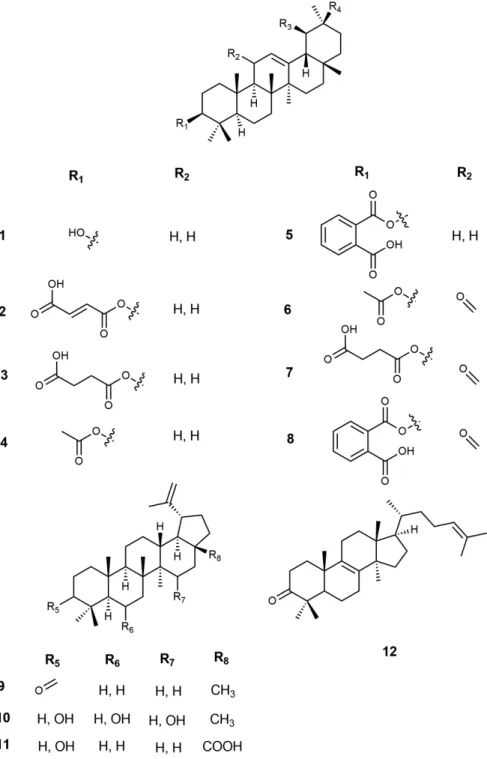
In the present study, seven derivatives were obtained from this binary mixture [(1) α/β-amyrin]: (2) 3-O -fumaryl-α/β-amyrin, (3) 3-O-succinyl-α/β-amyrin, (4) 3-O -acetyl-α/β-amyrin, (5) 3-O-ftaloyl-α/β-amyrin, (6) 3-O -acetyl-11-oxo-α/β-amyrenone, (7) 3-O-acetyl-11-oxo-α/β-amyrin and (8) 3-O-ftaloyl-11-oxo-α/β-amyrin. To improve the discussion on SAR of the triterpenes, four natural triterpenes previously isolated were also studied: three pentacyclic lupane compounds [(9) lup-20(29)-en-3-one, (10) 3β,6β,16β-trihydroxylup-20(29)-ene and (11) betulinic acid], together with a tetracyclic dammarane [(12) lanosta-8,24-dien-3-one]. All compounds were used to determine their trypanocidal activities and action mechanisms against trypomastigote and amastigote forms (Figure 1). The semi-synthesis reactions of triterpenic derivatives obtained by α/β-amyrin are shown in Figure 2.
Activity against trypomastigote forms
the compound (2) 3-O-fumaryl-α/β-amyrin exhibited a good activity, with an IC50 of 25.2 μM (Table 1).
Activity against amastigote forms
Unlike the antitrypomastigote activity, all triterpenoid compounds exhibited an excellent activity, inhibiting the parasite intracellular multiplication. After 96 h, only
compound (6) 3-O-acetyl-11-oxo-α/β-amyrin showed a moderate activity with an IC50 of 55.3 μM, and among
the other eleven triterpenes, the IC50 values varied from
3.2 to 21.8 μM. Based on the CC50 and IC50 values, the
SI was determined to compare toxicity for the parasite when compared to the host cells. The higher selectivity indexes indicate more toxicity to the protozoan than mammalian cells. Compounds (5) 3-O
Figure 2. Semi-synthesis of triterpene derivatives, reagents and conditions: (a) maleic anhydride, DMAP, CH2Cl2, relux, 24 h; (b) succinic anhydride, DMAP, CH2Cl2, relux, 24 h; (c) acetic anhydride, DMAP, relux, 30 min; (d) phthalic anhydride, DMAP, CH2Cl2, relux, 24 h; and (e) acetic anhydride, acetic acid, tert-butyl chromate, relux, 6 h.
Table 1. Trypanocidal activity and cytotoxicity on mammalian cells of twelve triterpenoid compounds (with standard deviation): (1) α/β-amyrin, (2) 3-O-fumaryl-α/β-amyrin, (3) 3-O-succinyl-α/β-amyrin, (4) 3-O-acetyl-α/β-amyrin, (5) 3-O-phthaloyl-α/β-amyrin, (6) 3-O-acetyl-11-oxo-α/β-amyrin, (7) 3-O-succinyl-11-oxo-α/β-amyrin, (8) 3-O-phthaloyl-11-oxo-α/β-amyrin, (9) lup-20(29)-en-3-one, (10) lup-20(29)-ene-3β,6β,15β-triol, (11) betulinic acid and (12) lanosta-8,24-dien-3-one
Compound Trypomastigote Amastigote LLCMK2 Erytrocyte SI
EC50 (24 h) / μM IC50 (96 h) / μM CC50 (96 h) / μM H (3 h) / % CC50/IC50
1 > 100 20.2 ± 2.0 136.3 ± 7.7 8.6 ± 1.1 6.7
2 25.2 ± 0.6 3.2 ± 0.6 16.2 ± 1.1 51.1 ± 0.3 5.1
3 86.3 ± 1.3 10.1 ± 1.8 150.4 ± 4.3 3.4 ± 1.3 14.9
4 > 100 21.2 ± 4.9 135.8 ± 6.2 12.6 ± 1.2 6.4
5 74.6 ± 3.8 6.1 ± 2.9 104.6 ± 2.5 27.5 ± 3.4 17.1
6 > 100 55.3 ± 4.0 103.6 ± 6.7 5.5 ± 3.2 1.9
7 > 100 9.7 ± 1.4 195.5 ± 5.9 23.0 ± 1.4 20.2
8 > 100 9.7 ± 3.0 150.3 ± 5.5 82.4 ± 1.9 15.5
9 > 100 21.8 ± 4.2 556.5 ± 11.3 5.1 ± 1.6 25.5
10 > 100 5.9 ± 0.2 29.6 ± 0.7 24.0 ± 0.4 5.0
11 > 100 9.9 ± 0.1 102.2 ± 3.6 25.7 ± 1.4 10.4
12 > 100 11.0 ± 5.5 137.1 ± 7.2 10.5 ± 2.2 12.5
Bz 5.1 ± 2.1 9.3 ± 0.9 1,235.3 ± 15.1 49.5 ± 3.4 132.8
α/β-amyrin, (7) 3-O-succinyl-11-oxo-α/β-amyrin and (9) lup-20(29)-en-3-one were 17.1 to 25.5-fold more active against amastigotes than the host cells. The compounds (2) 3-O-fumaryl-α/β-amyrin, (6) 3-O -acetyl-11-oxo-α/β-amyrin and (10) lup-20(29)-ene-3β,6β,15β-triol were the least selective, with SIs of 5.1, 1.9, and 5.0 (Table 1). Comparing the triterpenoids’ antiamastigote activity with benznidazole, the standard drug displayed an IC50 of 9.3 μM
to the intracellular parasites of the vertebrate host cells.
Cytotoxicity in mammalian cells
Most the triterpenes displayed a low cytotoxicity against the mammalian host cells (LLCMK2) incubated for
96 h. The most toxic compounds were (2) 3-O-fumaryl- α/β-amyrin and (10) lup-20(29)-ene-3β,6β,15β-triol with CC50 values of 16.2 and 29.6 μM, respectively, and the lowest
toxic compound was (9) lup-20(29)-en-3-one with a CC50 of
556.5 μM. Among the nine remaining triterpenes, the lowest toxic compounds were observed with a CC50, which ranged
from 102.2 to 195.5 μM. The benznidazole demonstrated the lowest toxicity in relation to the triterpenes. The toxicity in erythrocytes was lower than nucleated cells. After 3 h, the hemolysis rate for the lowest hemolytic compounds varied from 3.4 to 27.5% with the highest tested concentration (2.000 μM). However, the compounds (2) 3-O -fumaryl-α/β-amyrin and (8) 3-O-phthaloyl-11-oxo-α/β-amyrin showed the highest hemolytic activity with 51.1 and 82.4% of hemolysis rate (Table 1).
Drug combination assay
Because of the higher antimastigote activity of the triterpenes, the aim of this study was to evaluate the drug combination assay only in intracellular forms. The evaluation of the combinatorial effects with combination of the compounds (1) α/β-amyrin and (6) 3-O -acetyl-11-oxo-α/β-amyrin revealed a synergistic activity with a CI of 0.78.
In addition, the combination of (4) 3-O-acetyl-α/β-amyrin and benznidazole also showed synergistic interaction with a CI of 0.81. The above described combinations were also performed in LLCMK2 cells to verify variation on
cells. Satisfactory results were also obtained because both combinations exhibited antagonistic effects in LLCMK2
cells, with a CI of 1.35 and 1.4, respectively (Figure 3).
Ultrastructural and morphological alterations
TEM images of the intracellular replicative amastigotes treated with triterpenoids revealed morphological alterations due to the lack of uniformity of the plasma membrane (white arrow head, Figures 4 and 5). Furthermore, alterations were observed in the ultrastructure mitochondrion-kinetoplast complex (Figures 4C, E and F, and Figure 5E), including rupture of the mitochondrion (white star, Figure 4E), multiple cytoplasmic vacuolization structures (Figure 5B) that accumulate lipids in these inclusions (white star, Figure 5C) and a formation of the membrane within the kinetoplast (black arrow head, Figure 5E). The most evident feature observed in treated-amastigotes was an induction of the formation of autophagosomes (black arrow, Figures 4 and 5) and autophagosome-like structures such as: well-developed endoplasmic reticulum (white arrow, Figures 4 and 5), which surrounds cytoplasmic structures and organelles, Golgi complex extension (white arrow head, Figure 5C) and concentric myelin-like membrane structures (black arrow head, Figure 4G).
Evaluation of the mitochondrial membrane potential and cell membrane integrity
For the cell membrane integrity assay, alterations were not verified in the membrane permeability in
T. cruzi intracellular forms through the incubation with triterpenoids. The low number of high luorescence events (upper left and upper right quadrants) shows cells with
Figure 3. Combinatorial effects between (1) α/β-amyrin with (6)3-O-acetyl-11-oxo-α/β-amyrin and benznidazole with (4) 3-O-acetyl-α/β-amyrin on amastigotes of T. cruzi and LLCMK2 cells. Isobolograms (a) and (b) show the combinatorial effects of (1) α/β-amyrin with (6)
normal membrane permeability due to blockage of the entrance of PI inside the cells. In the three experiments with amastigote forms, the effects of the treatment with triterpenes with IC50 and IC90 were very similar to those
untreated parasites (Figure 6). The digitonin (positive control) promoted a loss of the cell membrane integrity with 93.9% PI-stained positive cells in the upper left and upper right quadrants.
Differently from the assay above described, some alterations were veriied in ∆Ψm. The histograms showed a decrease in total Rh123 luorescence intensity for all the compounds mainly treated with IC90, thus resulting in a
mitochondrial depolarization. However, (1) α/β-amyrin combined (6) 3-O-acetyl-11-oxo-α/β-amyrin with IC50 that showed an enhancement of the total Rh123
luorescence, which indicates a mitochondrial membrane hyperpolarization (Figure 7). CCCP caused a high Rh123 luorescence intensity reduction in comparison to untreated cells (data not shown). In general, the treated-amastigotes with IC90 dosage of the triterpenoids displayed higher
indexes of IV values than IC50, indicating dose-dependent
effects. According to the higher IV values, treatment with (1) α/β-amyrin and (6) 3-O-acetyl-11-oxo-α/β-amyrin combined with IC90 (Table 2) was the most pronounced
mitochondrial depolarization.
Cell volume determination
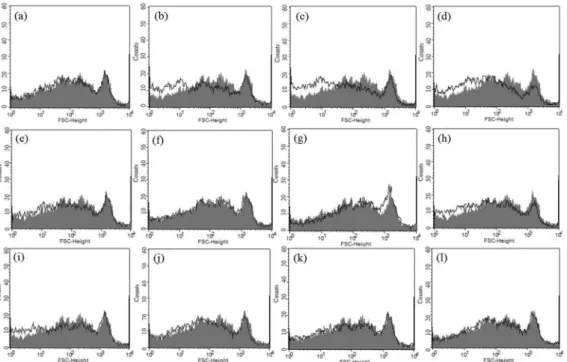
The amastigote forms treated with triterpenes, as previously described, were analyzed for FSC parameters through the low cytometry. The positive control showed a substantial cell volume reduction by a decrease of the luorescence intensity in the FSC parameters (data
Figure 4. Transmission electron images of amastigotes forms of T. cruzi treated with triterpenes for 24 h. (A) Control; (B)-(G) correspond to treated-amastigotes with IC50 of the compounds (1) α/β-amyrin (20.2 μM), (5) 3-O-phthaloyl-α/β-amyrin(6.1 μM), (6) 3-O-acetyl-11-oxo-α/β-amyrin(55.3 μM), (7) 3-O-succinyl-11-oxo-α/β-amyrin (9.7 μM), (9) lup-20(29)-en-3-one(21.8 μM), and drug combination between (1) α/β-amyrin(7.1 μM) with (6) 3-O-acetyl-11-oxo-α/β-amyrin (14.5 μM), respectively; n: nucleus, k, kinetoplast, m, mitochondrion, and f, lagellum. Bar = 1 μm.
Figure 5. Transmission electron images of amastigotes forms of T. cruzi treated with triterpenes for 24 h. (A)-(F) correspond to treated-amastigote with an IC90 of the compounds (1) α/β-amyrin(97.3 μM), (5) 3-O-phthaloyl-α/β-amyrin (86.3 μM), (6)
Figure 6. Cell membrane integrity assay by low cytometry in amastigote forms of T. cruzi treated with triterpenes for 24 h and stained with PI. (a) Untreated amastigotes; (b) positive control; histograms (c), (e), (g), (i) (k) and (m) correspond to treated-amastigotes with IC50, and (d), (f), (g), (h), (j) (l) and (n) treated-amastigotes with IC90 of the compounds (1) α/β-amyrin, (5) 3-O-phthaloyl-α/β-amyrin, (6) 3-O-acetyl-11-oxo-α/β-amyrin, (7) 3-O-succinyl-11-oxo-α/β-amyrin, (9) lup-20(29)-en-3-one and drug combination between (1) α/β-amyrinwith (6) 3-O-acetyl-11-oxo-α/β-amyrin, respectively. Percentage of PI-stained positive cells is shown in the upper right and left quadrants. Typical histograms of at least three independent experiments are shown.
not shown). As illustrated in Figure 8, the cell volume maintenance was observed by two concentrations (IC50
and IC90) tested for mammalian stage T. cruzi parasites
with ive selected compounds and for the (1) α/β-amyrin with (6) 3-O-acetyl-11-oxo-α/β-amyrin in combination. All histograms showed a similar effect compared with the untreated control group for all the compounds and two selected concentrations by maintaining the luorescence intensity in the FSC parameters.
Discussion
Considering modern drug research, natural products and plant-derivative terpenoids may offer good sources designs and discoveries for a new drug. In this study,
the treatment with triterpenoids and benznidazole displayed an excellent anti-T. cruzi activity against the relevant clinically intracellular amastigote forms, which are responsible for the chronic phase infection maintenance through parasite persistence and parasite load in target organs.21,41 These features revealed to
be crucial even at asymptomatic phase, since the host can develop autoimmunity due to the presence of the parasite.42 Thus, the aim of treatment in this stage should
eliminate the amastigotes or reduce the parasite load. The weaker antitrypomastigote activity observed in this study with terpenes is well-reported in several previous researches.11-17,42,43
proliferation. Lozano et al.44,45 reported a more triterpenoid
resistence against trypomastigote forms may be related with their non-multiplying capacity. Despite the low antitrypomastigote activity, these compounds are promising candidates for therapeutic targets in the chronic stage. It is well-known that benznidazole displays a limited effectiveness for the chronic stage; even being the best current available drug in the market.
Aiming to obtain compounds with synergistic properties against chronic illness, great interactions were obtained with synergic activities by combining (1) α/β-amyrin with (6) 3-O-acetyl-11-oxo-α/β-amyrin, as well as (4) 3-O-acetyl-α/β-amyrin combined with the standard
drug benznidazole against intracellular forms. Additionally, these two combinations were performed in LLCMK2,
and antagonism effects were obtained that indicate a satisfactory reduction of toxicity in the mammalian cells. In a recent study, Izumi et al.12 evaluated the combinational
effects against trypomastigotes between copalic acid and β-caryophyllene in which a strong synergism was found with FICI (fractional inhibitory concentration index) values of 0.12. In addition, combination therapies with benznidazole can allow the decrease of the dosage of the standard drug for treating Chagas’ disease and, thus, its side-effects might be alleviated and may extend the period of the treatment with benznidazole.21 The lowest Table 2. Mitochondrial potential assay in parasitic forms of Trypanosoma cruzi treated with following triterpenoids for 24 h and stained with Rh123: (1) α/β-amyrin, (5) 3-O-phthaloyl-α/β-amyrin, (6) 3-O-acetyl-11-oxo-α/β-amyrin, (7) 3-O-succinyl-11-oxo-α/β-amyrin, (9) lup-20(29)-en-3-one and drug combination between (1) α/β-amyrinwith (6) 3-O-acetyl-11-oxo-α/β-amyrin
Compound Median of the luorescence (Rdh 123) IV
a
IC50 / μM IC90 / μM IC50 / μM IC90 / μM
1 165.5 134.5 –0.3 –0.5
5 155.4 135.8 –0.4 –0.5
6 160.2 143.8 –0.4 –0.4
7 116.2 136.2 –0.5 –0.5
9 140.8 120.8 –0.4 –0.5
1 + 6 355.5 77.0 +0.4 –0.7
Control 250.3 250.3 0.0 0.0
aIV = (MT – MC)/MC, where MT corresponds to the median of the luorescence for treated parasites and MC for control parasites; Rh123: rhodamine 123; IC50: inhibitory concentration of 50%; IIV: index variation; –IV: negative IV values; +IV: positive IV values; C90: inhibitory concentration of 90%.
Figure 8. Cell volume determination of amastigotes treated with triterpenoids for 24 h and analyzed by low cytometer. The histograms show the relationship between the number of cells (counts) and FSC considered as a function of cell size. Gray-illed areas represent untreated cells. In each plot, the black line with unilled areas represents treated-parasites. Histograms (a), (c), (e) (g), (i) and (k) correspond to treated-amastigotes with IC50 and (b), (d), (f), (h), (j) and (l) treated-amastigotes with IC90 of the compounds (1) α/β-amyrin, (5) 3-O-phthaloyl-α/β-amyrin, (6) 3-O-acetyl-11-oxo-α/β-amyrin, (7) 3-O-succinyl-11-oxo-α/β-amyrin, (9) lup-20(29)-en-3-one and drug combination between (1) α/β-amyrinwith (6) 3-O-acetyl-11-oxo-α/β-amyrin, respectively.
cytotoxicity of benznidazole in vitro demonstrated in this study does not occur in vivo.
Toxicity data indicated that (9) lup-20(29)-en-3-one is one of the less toxic compounds, and (2) 3-O-fumaryl- α/β-amyrin and (10) lup-20(29)-ene-3β,6β,15β-triol showed the strongest toxicity to LLCMK2 cells. The
other compounds exhibited low and similar toxicities. Additionally, all the compounds tested showed non-toxicity properties in blood erythrocytes at very high concentrations of 2.000 μM, even though the compounds (2) 3-O -fumaryl-α/β-amyrin and (8) 3-O-phthaloyl-11-oxo-α/β-amyrin displayed high hemolysis rates. It has already been reported that ursane, lupane- and oleanane-type triterpenes are considered as relatively non-toxic drugs.46 Furthermore, it
has been reported that some natural pentacyclic triterpenoid derivatives such as oleanolic, ursolic and betulinic acids are a thousand-fold more active than the natural compounds.45
Based on this study, four compounds were the most selective to the protozoan [(5) 3-O-phthaloyl-α/β-amyrin, (6) 3-O-succinyl-11-oxo-α/β-amyrin, (8) 3-O -phthaloyl-11-oxo-α/β-amyrin and (9) lup-20(29)-en-3-one], only (9) lup-20(29)-en-3-one is a natural isolated compound, and other compounds are triterpenic derivative, thereby promising compounds may be obtained by chemical derivatization.
Aiming to establish the SAR, it may be suggested that the more insertion of polar groups in the fundamental
triterpenic core and the position insertion of these radicals is determinant for the activity. For instance, comparing the four ursane and oleanane-type triterpenoid derivatived from triterpenoid mixture of (1) α/β-amyrin, it may be observed that (1) α/β-amyrin was the less effective and (2) 3-O-fumaryl-α/β-amyrin was the highest active from the twelve triterpenoids assessed against two T. cruzi developmental forms in the host and LLCMK2 cells. These data can be explained by an
insertion of a radical 3-O-fumaryl at C-3 position for (2) 3-O-fumaryl-α/β-amyrin in which its radical shows four oxygen atoms, possibly due to the formation of the intramolecular hydrogen that consistently increases its polarity and activity in comparison with (1) α/β-amyrin. Such feature may also suggest the high cytotoxicity of (2) 3-O-fumaryl-α/β-amyrin. The low presence of oxygen atoms in the substituent groups at C-3 may also explain the lower activity of (1) α/β-amyrin, (6) 3-O -acetyl-11-oxo-α/β-amyrin and (9) lup-20(29)-en-3-one.
Previous researches reported that the presence of hydroxyl group at C-3 and carboxyl group at C-17 is important for the parasitic activity.47 For this reason, (11) betulinic
polarity of the compounds, nature and orientation of the substituents at C-3 and C-17 position may affect the activity of the triterpenes, mainly at C-3 position in the majority compounds of this study. Indeed, the positions C-3 and C-17 are considered a target of chemical derivatization for the insertion of the different substituents.47 In addition,
the presence of hydroxyl groups in different positions at C-3, C-6 and C-15 of (10) lup-20(29)-ene-3β,6β,15β-triol as well as spatial coniguration and several other factors may have inluenced to the greater antiamastigote and cytotoxic activity.
The ultrastructural alterations, visualized by TEM of the T. cruzi intracellular parasites, revealed changes in the parasite shape, as well as ultrastructural alterations in the mitochondrion-kinetoplast complex and multiple cytoplasmic vacuolization. No changes were observed in the cell membrane permeability with the low cytometry. These results can be associated with the absence of the rupture plasma membrane not seen by TEM. The plasma membrane rupture is modulated in response to the programmed cell death by necrosis, which is also characterized by the subsequent loss of the intracellular content and an increase in cell volume,19,48 thereby the
present data exclude cell death by necrosis. Furthermore, amastigotes did not undergo any modiication of the cell volume in the present study.
Except for combination of (1) α/β-amyrin with (6) 3-O-acetyl-11-oxo-α/β-amyrin at IC50 concentration,
the flow cytometry analyses of triterpenoid-treated parasites showed a loss of the ∆Ψm with a decrease in Rh123 luorescence intensity, resulting in mitochondrial depolarizing effects, mainly the treatment with IC90. The
most pronounceddepolarization found was obtained with the IC90 dosage with the combination between compounds
(1) α/β-amyrin with (6) 3-O-acetyl-11-oxo-α/β-amyrin. In contrast, IC50 dosage of the combination between
(1) α/β-amyrin with (6) 3-O-acetyl-11-oxo-α/β-amyrin displayed a mitochondrial membrane hyperpolarization that enhanced the total Rh123 luorescence intensity. Part of these results may be correlated with ultrastructural mitochondrial alterations conirmed by TEM analyses, resulting in mitochondrial dysfunctions.The depolarization indicated an enhancement in the proton permeability through the inner mitochondrial membrane, the inhibition of the electron transport, or decrease in mitochondrial substrate transport/oxidation, which would impair proton pumping eflux and adenosine triphosphate synthesis, resulting in the parasite cell death. Speciic mechanisms may be involved in the hyperpolarizing phenomena of the ∆Ψm, such as complex II respiratory chain inhibition in the protozoan.49
The remarkable ultrastructural alterations seen by TEM were the formation of autophagosomes and autophagosome-like structures, such as dilated endoplasmic reticulum profiles and Golgi complex alterations, which surround cytoplasmic structures, and the formation of concentric myelin-like igures. These features are morphologically characterized as signs of the hallmark cell death of autophagy, in which their cellular components, such as the cytoplasm, organelles and protein aggregates, are catabolized for recycling as a pro-survival protection mechanism.50 Not all the
triterpenes induced the formation of autophagosome-like structures, which may suggest an autophagic process [(9) lup-20(29)-en-3-one]. For this reason, cell death by apoptosis can also be involved. Izumi et al.12 reported that
some terpenes found in copaiba oils promoted parasite death by different mechanisms, including oxidative stress and autophagy. Thus, other studies should be carried out to further investigate the possible mechanisms involved in the cell death.
Conclusions
This study showed that triterpenes are promising compounds due to their excellent antiamastigote activities. Most compounds exhibited a low toxicity to the mammalian cells. The SAR of the triterpenes suggested that the insertion of more numbers of polar substituent groups may lead to greater selective compounds to the protozoan, thereby chemical derivatization can optimize the search of biological promising compounds with low toxicity to the host. Our results reinforce the importance of evaluating compounds with synergistic effects against the parasite and antagonistic effects against LLCMK2 cells, being
an important alternative to treat the chronic stage of disease. Finally, the main cell death mechanism induced by triterpenoids against amastigotes suggests autophagy.
Acknowledgments
The authors thank to FAPERJ, FAPEAM, CNPq and CAPES.
References
1. Rassi Jr., A.; Rassi, A.; Marin-Neto, J. A.; Lancet 2010, 375, 1388.
6. Ulla, A.; Baratto, L. C.; Paula, R. C.; Silva, L. H. V.; Soares, M. J.; Oliveira, B. H.; J. Braz. Chem. Soc. 2016, 27, 1245. 7. Silva Júnior, E. N.; Jardim, G. A. M.; Menna-Barreto, R. F. S.;
Castro, S. L.; J. Braz. Chem. Soc. 2014, 25, 1780.
8. Thimmappa, R.; Geisler, K.; Louveau, T.; O’Maille, P.; Osbourn, A.; Annu. Rev. Plant Biol. 2016, 65, 225.
9. Mazumder, K.; Tanaka, K.; Fukase, K.; Molecules 2013, 18, 8929.
10. Laszczyk, M. N.; Planta Med. 2009, 75, 1549.
11. Leite, A. C.; Ambrozin, A. R. P.; Fernandes, J. B.; Vieira, P. C.; Silva, M. F. G. F.; Albuquerque, S.; Planta Med. 2008, 74, 1795. 12. Izumi, E.; Ueda-Nakamura, T.; Veiga-Junior, V. F.; Pinto, A. C.;
Nakamura, C. V.; J. Med. Chem. 2012, 12, 2994.
13. Ramírez-Macías, I.; Marín, C.; Chahboun, R.; Messouri, I.; Olmo, F.; Rosales, M. J.; Gutierrez-Sánchez, R.; Alvarez-Manzaneda, E.; Sánchez-Moreno, M.; Am. Soc. Trop. Med. Hyg. 2012, 87, 481.
14. Santos, A. O.; Ueda-Nakamura, T.; Dias Filho, B. P.; Veiga-Junior, V. F.; Nakamura, C. V.; Evid. Based Complement. Alternat. Med. 2012, DOI: 10.1155/2012/898419.
15. Santos, A. O.; Izumi, E.; Ueda-Nakamura, T.; Dias-Filho, B. P.; Veiga-Junior, V. F.; Nakamura, C. V.; Mem. Inst. Oswaldo Cruz
2013, 108, 59.
16. Santos, V. A. F. F. M.; Leite, K. M.; Siqueira, C. M.; Regasini, L. O.; Martinez, I.; Nogueira, C. T.; Galuppo, M. K.; Stolf, B. S.; Pereira, A. M. S.; Cicarelli, R. M. B.; Furlan, M.; Graminha, M. A. S.; Molecules 2013, 18, 1053.
17. Izumi, E.; Ueda-Nakamura, T.; Veiga-Junior, V. F.; Nakamura, C. V.; Planta Med. 2013, 79, 952.
18. Castro, S. L.; Batista, D. G. J.; Batista, M. M.; Batista, W. D. A.; Souza, E. M.; Menna-Barreto, R. F. S.; Oliveira, G. M.; Salomão, K.; Silva, C. F.; Silva, P. B.; Nazar, M.; Soeiro, C.; Mol. Biol. Int. 2011, DOI: 10.4061/2011/306928.
19. Rodrigues, J. H. S.; Ueda-Nakamura, T.; Corrêa, A. G.; Sangi, D. P.; Nakamura, C. V.; PLoS One 2014, 9, 85706.
20. Martins, T. A. F.; Diniz, L. F.; Nascimento, A. F. S.; Caldas, S.; Caldas, I. V.; Andrade, I. M.; Ribeiro, I.; Bahia, M. T.; PLoS One 2015, 9, 4807.
21. Castro, J. A.; De Mecca, M. M.; Bartel, L. C.; Hum. Exp. Toxicol.
2006, 25, 471.
22. Sonar, V. P.; Corona, A.; Distinto, S.; Maccioni, E.; Meleddu, R.; Fois, B.; Floris, C.; Malpure, N. V.; Alcaro, S.; Tramontano, E.; Cottiglia, F.; Eur. J. Med. Chem. 2017, 130, 248.
23. Silva Júnior, W.; Pinheiro, J.; Moreira, C.; Rüdiger, A.; Barbosa, E.; Lima, E.; Veiga Júnior, V. F.; Silva Júnior, A.; Aragão, C.; Lima, A.; J. Therm. Anal. Calorim. 2017, 127, 1757. 24. de Almeida, P. D. O.; Boleti, A. P. A.; Rüdiger, A. L.; Lourenço,
G. A.; Veiga Junior, V. F.; Lima, E. S.; Yasukawa, K.; Evid. Based Complement. Alternat. Med. 2015,2015, 10.
25. Rüdiger, A. L.; Veiga-Junior, V. F.; Chem. Biodiversity 2013, 10, 1142.
26. Dias, M. O.; Hamerski, L.; Pinto, A. C.; Quim. Nova 2011, 34, 704.
27. Barros, F. W.; Bandeira, P. N.; Lima, D. J.; Meira, A. S.; de Farias, S. S.; Albuquerque, M. R.; dos Santos, H. S.; Lemos, T. L.; de Morais, M. O.; Costa-Lotufo, L. V. Pessoa, C. O.; Bioorg. Med. Chem. 2011, 19, 1268.
28. Okoye, N. N.; Ajaghaku, D. L.; Okeke, H. N.; Ilodigue, E. E.; Nworu, C. S.; Okoye, F. B.; Pharm. Biol. 2014, 52, 1478. 29. Agrawal, P. K.; Jain, D. C.; Prog. NMR Spectr. 1992, 24, 1. 30. Barnes, R. A.; Pereira, A. L.; Scoield, T. C. V.; Brás Filho, R.;
Pinto, A. C.; Chem. Pharm. Bull. 1984, 32, 3674.
31. Facundo, V. A.; Andrade, C. H. S.; Silveira, E. R.; Braz-Filho, R.; Hufford, C. D.; Phytochemistry 1993, 32, 411.
32. Cota, B. B.; Siqueira, E. P.; Oliveira, D. M.; Alves, T. M. A.; Sobral, M. E. G.; Rabello, A.; Zani, C. L.; Braz. J. Pharmacog.
2012, 22, 1253.
33. Carpenter, R. S.; Sotheeswaran, S.; Sultanbawa, M. U. S.; Ternai, B.;Org. Magn. Reson. 2015, 14, 462.
34. Leão De Souza, A. D.; Souza, A. D. L.; Rocha, A. F. I.; Pinheiro, M. L. B.; Andrade, C. H. S.; Queiroz, A. L. A. G.; Santos, M. P. S. S.; Quim. Nova 2001, 24, 439.
35. Kavtaradze, L. K.; Manley-Harris, M.; Nicholson, B. K.; Steroids 2004, 69, 697.
36. Nana, F.; Sandjo, L. P.; Keumedjio, F.; Ambassa, P.; Malik, R.; Kuete, V.; Rincheval, V.; Choudhary, M. I.; Ngadjui, B. T.; J. Braz. Chem. Soc. 2012, 3, 482.
37. Mendes, C. C.; Sandes, L. Q.; Cruz, F. G.; Roque, N. F.; Chem. Biodiversity 2009, 6, 1463.
38. Brener, Z.; Rev. Inst. Med. Trop. São Paulo 1962, 4, 386. 39. Mosmann, T.; J. Immunol. Methods 1983, 16, 55. 40. Chou, T. C.; Talalay, P.; Adv. Enzyme Regul. 1984, 22, 27. 41. Urbina, J. A.; J. Euk. Microbiol. 2015, 62, 149.
42. Leon, J. S.; Engman, D. M.; Int. J. Parasitol. 2001, 31, 555.
43. Ferreira, D. S.; Esperandim, V. R.; Alonso, M. P.; Kuehn, T. C. C.; Júnior, J. C. P.; Cunha, W. R.; Silva, M. L. A.; Albuquerque, S.; Exp. Parasitol. 2013, 134, 455.
44. Lozano, E.; Barrera, P.; Romina, S.; Nieto, I. V.; Tonn, M. C.; Kemmerling, U.; Mortara, R. A.; Sosa, M. A.; Parasitol. Int.
2012, 61, 628.
45. Lozano, E.; Barrera, P.; Tonn, C.; Nieto, M.; Sartor, T.; Sosa, M. A.; Parasitol. Int. 2012, 61, 275.
46. Xia, Q.; Zhang, H.; Sun, X.; Zhao, H.; Zhu, L. W. D.; Yang, G.; Shao, Y.; Zhang, X.; Mao, X.; Zhang, L.; She, G.; Molecules
2014, 19, 17478.
48. Menna-Barreto, R. F.; Salomão, K.; Dantas, A. P.; Santa-Rita, R. M.; Soares, M. J.; Barbosa, H. S.; Castro, S. L.; Micron 2009, 40, 157.
49. Tiuman, T. S.; Ueda-Nakamura, T.; Alonso, A.; Nakamura, C. V.; BMC Microbiol. 2014, 14, 152; Sen, N.; Das, B. B.; Ganguly, A.; Mukherjee, T.; Tripathi, G.; Bandyopadhyay, S.; Rakshit, S.; Sem, T.; Majumder, H. K.; Cell Death Differ. 2004, 11, 924; Mehta, A.; Shaha, C.; J. Biol. Chem. 2004, 279, 11798. 50. Chaabane, W.; User, S. D.; El-Gazzah, M.; Jaksik, R.; Sajjadi,
E.; Rzeszowska-Wolny, J.; Los, M. J.; Arch. Immunol. Ther. Exp.
2013, 61, 43; Queiroz, K. C. S.; Milani, R.; Ruela-de-Sousa,
R. R.; Fuhler, G. M.; Justo, G. Z.; Zambuzzi, W. F.; Duran, N.;
Diks, S. H.; Spek, C. A.; Carmen, V. F.; Peppelenbosch, M. P.; PLoS One 2012, 7, 4536; Schontal, A. A.; Scientifica 2012, DOI: 10.6064/2012/857516; Adade, M. A.; Oliveira, I. R. S.; Pais, J. A. R.; Souto-Padrón, T.; Toxicon 2013, 69, 227; Meira, C. S.; Guimarães, E. T.; Bastos, T. M.; Moreira, D. R.; Tomassini, T. C.; Ribeiro, I. M.; Santos, R. R.; Soares, M. B.; Parasitology
2013, 140, 1811; Veiga-Santos, P.; Reignault, L. C.; Huber, K.;
Bracher, F.; De Souza, W.; De Carvalho, T. M.; Parasitology
2014, 141, 814.