JHEP03(2014)032
Published for SISSA by SpringerReceived: December 19, 2013
Accepted: February 7, 2014
Published: March 5, 2014
Study of double parton scattering using W + 2-jet
events in proton-proton collisions at
√
s
= 7
TeV
The CMS collaboration
E-mail: [email protected]
Abstract: Double parton scattering is investigated in proton-proton collisions at √s=
7 TeV where the final state includes a W boson, which decays into a muon and a neutrino, and two jets. The data sample corresponds to an integrated luminosity of 5 fb−1, collected
with the CMS detector at the LHC. Observables sensitive to double parton scattering are investigated after being corrected for detector effects and selection efficiencies. The fraction of W + 2-jet events due to double parton scattering is measured to be 0.055± 0.002 (stat.)±0.014 (syst.). The effective cross section, σeff, characterizing the effective
transverse area of hard partonic interactions in collisions between protons is measured to be 20.7±0.8 (stat.)±6.6 (syst.) mb.
Keywords: Jet physics, Hadron-Hadron Scattering, QCD
JHEP03(2014)032
Contents1 Introduction 1
2 Effective cross section 2
3 Experimental methods 5
3.1 Simulated samples 5
3.2 Event selection 7
4 Unfolding and comparison with simulations 9
5 Strategy for the extraction of the DPS fraction 13
5.1 DPS signal template 13
5.2 Background template 14
6 The DPS fraction in data 16
7 Determination of the effective cross section 18
7.1 Measurement of R 19
7.2 Measurement of σ′
2j 19
8 Summary 21
The CMS collaboration 27
1 Introduction
In high-energy proton-proton (pp) collisions at the Large Hadron Collider (LHC), semi-hard parton-parton scattering, producing particles with transverse momenta pT of a few
GeV, dominates the inelastic cross section. In such processes longitudinal momentum fractions, given byx∼2pT/√s, of values down to O(10−3) are probed. At these values of
x, the parton densities are large causing a sizable probability for two or more parton-parton scatterings within the same pp interaction [1]. Such multi-parton interactions (MPI) at semi-hard scales of a few GeVs have been observed in high-energy hadronic collisions [2]. Conversely, the evidence for hard double parton scattering (DPS) processes in the same pp collision at scales of a few tens of GeV is still relatively weak. In processes where a W and two jets are produced, the x values are larger,x∼10−2, and the parton densities are
JHEP03(2014)032
qq l(l)
)
ν
(
ν
+(-) W
g
g
g
g
g
q
g g
+(-) W
(l) l
)
ν
(
ν
q
Figure 1. Feynman diagrams for W + 2-jet production from (left) double parton scattering and (right) single parton scattering.
on the multi-parton correlations in the hadronic wave function [4]. DPS also constitutes a background to new physics searches at the LHC [5–7].
Various measurements in pp and pp collisions at √s = 63 GeV [8], 630 GeV [9], and 1.8 TeV [10] are consistent with DPS contributions to multijet final states, as well as toγ + 3-jet events at√s= 1.8 TeV [11] and 1.96 TeV [12]. Additional searches for DPS have been proposed via double Drell-Yan, four jet, and same-sign WW production, as well as in W production associated with jets [13–20]. This paper presents a study of DPS based on W + 2-jet events in pp collisions at 7 TeV. DPS with a W + 2-jet final state occurs when one hard interaction produces a W boson and another produces a dijet in the same pp collision, as sketched in figure1(left). The W + 2-jet process is attractive because the muonic decay of the W provides a clean tag and the large dijet production cross section increases the probability of observing DPS. Events containing a W + 2-jet final state originating from single parton scattering (SPS) constitute an irreducible background (figure 1(right)). The ATLAS collaboration has carried out a similar DPS measurement using W + 2-jet events at√s= 7 TeV [21].
The outline of this paper is as follows. Section 2 describes DPS in terms of effective cross section and defines the relevant observables. Section 3 presents a brief description of the Compact Muon Solenoid (CMS) detector, the data and the simulated samples, as well as the event selection criteria. Section 4 summarizes the unfolding of the DPS-sensitive observables, the systematic effects, and the comparison of data and simulation. The method to extract the DPS fraction is discussed in section 5. Section 6 presents the extraction of the DPS fraction from the data and corresponding systematic uncertainties. The measurement of the effective cross section is described in section 7.
2 Effective cross section
The effective cross section,σeff, is a measure of the transverse distribution of partons inside
JHEP03(2014)032
individual processes. If A and B are two independent processes, whose production cross sections areσAand σB, respectively, σeff can be written as:
σeff=
m 2
σA·σB
σDPS A+B
, (2.1)
where “m” is a symmetry factor for indistinguishable (m= 1) and distinguishable (m= 2) final-states and σA+BDPS is the cross section of the two processes to occur simultaneously.
According to various phenomenological studies [22–24], the above cross sections should be inclusive. This requirement makes the determination of σeff independent of the
spe-cific mechanisms of the first and second interactions, as well as of the parton distribution functions (PDF). Inclusive σDPS
A+B also includes contributions from higher number of
par-ton scatters.
However, in the present analysis an exclusive selection is performed by considering the events with one W boson and exactly two jets withpT >20 GeV/c and pseudorapidity, η,
within ±2. The pseudorapidity is defined as η=−ln[tan(θ/2)], whereθis the polar angle measured with respect to the anti-clockwise beam direction. This sample should have a significant contribution from events where one interaction produces only a W boson and no jet withpT >20 GeV/c within |η|<2.0 and the other interaction produces exactly two
jets with pT >20 GeV/c and |η|<2.0.
Experimentally, the exclusive selection is necessary to identify the jets from the second interaction. In this case, DPS-sensitive observables can be defined based on the back-to-back topology of the two jets. From a sample of simulated events generated with
MadGraph 5 [25, 26] followed by hadronization and parton showering (PS) using the
4C tune [27] of pythia 8 [28], it is found that σeff changes by only 2–3% if an inclusive
selection is applied.
In order to account for missing contributions of a larger number of parton scatterings, corrections [22–24] were proposed to a previous DPS measurement of CDF [11]. However, in the kinematic region of the present study, due to the requirement of having exactly 2 jets, the contribution of triple and higher number of scatters is expected to be small and is estimated, with the same sample of simulated events as mentioned above, to be less than 1% of the DPS contribution. Therefore, for the present analysis no additional correction is required for the exclusive selection.
Assuming independent interactions from DPS, σeff can be rewritten in terms of the
cross sections at the stable particle level (defined as lifetime, cτ > 10 mm) within the detector acceptance. For the case of the W + 2-jet process, σeff becomes:
σeff=
σ′
W+0j
σ′DPS W+2j
·σ′
2j, (2.2)
where the prime indicates that the cross sections are obtained at particle level. Theσ′
W+0j
andσ′
2jare the particle-level cross sections for W-boson production associated with zero-jet
and for dijet events, respectively. The particle-level cross section for DPS events producing a W + 0-jet from the first interaction and exactly two jets from the second interaction is denoted by σ′DPS
JHEP03(2014)032
sample; therefore σeff can be reformulated in terms of the yield of W bosons associated
with zero jets and the yield associated with DPS:
σeff=
N′
W+0j
N′DPS W+2j
·σ2j′ . (2.3)
If we define the DPS fraction as
fDPS =
N′DPS W+2j
N′
W+2j
, (2.4)
σeff can be written as
σeff=
N′
W+0j
fDPS·NW+2j′ ·
σ2j′ , (2.5)
or
σeff=
R fDPS ·
σ′2j, (2.6)
where R = N′
W+0j/NW+2j′ . Thus, the determination of the effective cross section reduces
to a measurement of R,σ′
2j, and fDPS.
For the extraction of the DPS fraction,fDPS, observables that can discriminate between
SPS and DPS are needed. For DPS events, the W and the dijet system are independent of each other, while for SPS events they are highly correlated. It is thus possible to define several observables that discriminate between DPS and SPS events. The present analysis uses the following observables, which were also considered in previous DPS measurements at the LHC and the Tevatron:
• the relativepT-balance between the two jets, ∆rel pT, defined as:
∆rel pT= |
~
pT(j1) +~pT(j2)|
|~pT(j1)|+|~pT(j2)|
. (2.7)
Here ~pT(j1) andp~T(j2) are the transverse momentum vectors of the leading (in pT)
and subleading jets. In DPS events, at leading order (LO), the two jets balance each other and ∆rel p
T is small, which is not the case for SPS events.
• The azimuthal angle between the W-boson and the dijet system, ∆S, defined as:
∆S = arccos
~
pT(µ, E/T)·~pT(j1,j2)
|p~T(µ, E/T)| · |~pT(j1,j2)|
, (2.8)
where p~T(µ, E/T) and p~T(j1,j2) are the combined transverse momentum vectors of
(µ, E/T) and the two jets, respectively, with E/Tas the missing transverse energy in
JHEP03(2014)032
3 Experimental methodsIn the present analysis a sample of W + 2-jet events is selected from a data sample of pp collisions at √s= 7 TeV with the CMS detector. The data sample corresponds to an integrated luminosity of 5 fb−1. The distributions are fully corrected for detector effects and efficiencies. These distributions are used for the extraction of the DPS fraction and the determination of the effective cross section. The dijet production cross section required for the determination of the effective cross section is measured with a pp data sample collected in 2010 also at√s= 7 TeV. This sample corresponds to an integrated luminosity of 35 pb−1.
The central feature of the CMS apparatus is a superconducting solenoid of 6 m internal diameter, providing a magnetic field of 3.8 T. Within the superconducting solenoid volume are a silicon pixel and strip tracker, a lead tungstate crystal electromagnetic calorimeter (ECAL), and a brass/scintillator hadron calorimeter (HCAL). Muons are measured in gas-ionization detectors embedded in the steel flux return yoke outside the solenoid. In addition, CMS has extensive forward calorimetry. The CMS experiment uses a right-handed coordinate system, with the origin at the nominal interaction point, the x axis pointing to the centre of the LHC ring, they axis pointing up (perpendicular to the plane of the LHC ring), and the z axis along the anticlockwise-beam direction. The polar angle θ is measured from the positive z axis and the azimuthal angle φ is measured in the x-y plane. A more detailed description of the CMS apparatus can be found in ref. [29].
3.1 Simulated samples
Samples of W + jets events are generated withMadGraph5 followed by hadronization and
parton showering using the Z2 tune [30] ofpythia6 (version 6.4.25) [31]. TheMadGraph
event generator produces parton-level events with a W boson and up to four partons in the final state on the basis of matrix element (ME) calculations. The ME/PS matching scale µ is taken to be 20 GeV, and the factorization and renormalization scales are set to q2 =M2
Wc2+ (pWT)2, whereMW andpWT are the mass and transverse momentum of the W
boson, respectively.
Samples of Z/γ* + jets and tt events are also simulated with MadGraph 5.
Single-top-quark samples are generated with powheg 2 [32]. Samples of WW and WZ events
are generated with the pythia 6 Monte Carlo (MC) event generator. Contributions of
JHEP03(2014)032
Process Cross section (pb)
W→µν 10500 ±5% (NNLO) [33]
W→τ ν 10500 ±5% (NNLO) [33]
tt 160±7% (NNLL) [34]
Single top quark 85 ±5% (NLO) [35–37]
Drell-Yan 3050±4.3% (NNLO) [33]
Diboson (WW + WZ) 61± 10% (NLO) [38]
Multijet Estimated from data by fitting
E/Tdistribution in control region
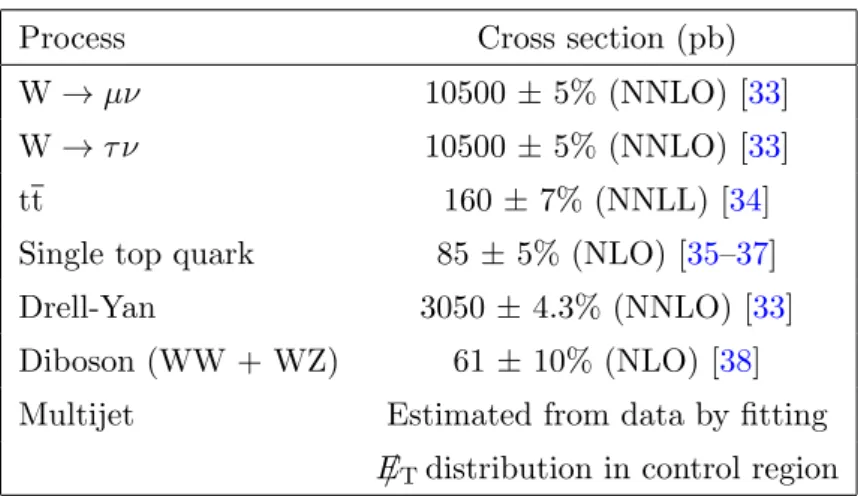
Table 1. Cross sections of the various processes and their uncertainties.
The simulated samples are processed and reconstructed in the same manner as the col-lision data. The detector response is simulated in detail by using theGeant4package [39].
The samples include additional interactions per beam crossing (the so-called pileup), which match the corresponding distribution in data.
In addition to these fully simulated samples, various simulations at particle level are compared with the fully corrected DPS-sensitive observables.
• MadGraph5 +pythia8: W + jets events are generated by means of MadGraph
5 (as discussed before) followed by hadronization and parton showering using the 4C tune of pythia 8. The MPI [1] are simulated with the pythia 8 event
genera-tor. In order to see the effects of MPI, events are also produced without the MPI contribution by pythia 8. For the systematic studies, hadronization and parton
showering of MadGraph5 events are performed with pythia6 tune Z2* [40], with
and without MPI.
• powheg 2 +pythia6 (herwig6): W + 2-jet events are also produced up to NLO
accuracy with the powheg 2 event generator with the “Multi-scale improved NLO”
(MiNLO) method [41]. The W + 2-jet samples simulated with the powheg 2 +
MiNLO describe satisfactorily the inclusive W + jet production data as well [42]. Hadronization and parton showering is carried out with pythia 6, tune Z2*. To
assess the effect of angular-ordered showering, herwig 6 (version 6.520) [43, 44] is
also used for the parton showering.
• pythia8: W + jets events are generated with the 4C tune of thepythia8 event
gen-erator, which produces hard subprocesses with a W boson and either zero or one addi-tional parton in the final state. It also performs hadronization and parton showering.
The MPI model is similar in pythia 6 and pythia 8, with the free parameters tuned to
the underlying event data obtained at the LHC. The key features of the model are:
JHEP03(2014)032
of MPI. A factor with a free parameter,pT0, is introduced to regularize an otherwise divergent partonic cross section,
α2
s(p2T+pT02)
α2
s(p2T)
· p
4 T
(p2
T+pT02)2
, (3.1)
with
pT0(√s) =pT0(√s0)
√
s
√s
0
ǫ
. (3.2)
Here√s0 = 1.8 TeV andǫis a parameter characterizing the energy dependence ofpT0.
• A Poisson distribution for the number of MPI in an event, with a mean that depends on the overlap of the matter distribution of the hadrons in impact parameter space. The impact parameter profile gives a measure of σeff. The present model uses the
convolution of the matter distributions of the two incoming hadrons as an estimate of the impact parameter profile. The overlap function is of the form e−bZ, wherebis the impact parameter and Z is a free parameter.
The MPI model used here [31] includes parton showers for the MPI processes as well as MPI processes interleaved with initial state radiation.
Events simulated with LO event generators, i.e. MadGraph 5, pythia 6, and pythia8, use the CTEQ6L [45] PDF set, whereas in the NLO event generation with powheg 2 the CTEQ6M [45] PDF set is used.
3.2 Event selection
Events were selected online when at least one muon candidate was found. A muon candidate consists of a track with hits in the muon system and a transverse momentum greater than a threshold. The threshold was increased with increasing instantaneous luminosity in order to keep the rate within the allocated trigger bandwidth for muon triggers. The offline selection requires exactly one muon reconstructed in the muon detector and the silicon tracker. Muon candidates are required to satisfy identification criteria based on the number of hits in the muon detector and the tracker, their transverse impact parameter with respect to the beam axis, and the goodness of the global fitχ2/(number of degree of freedom) [46] for the tracks
in the tracking system and the muon chambers. The background from jets misidentified as muons and from semileptonic decays of heavy quarks is suppressed by applying an isolation condition on the muon candidates. The muon candidate is considered to be isolated if the isolation variable [47],I, is smaller than 0.1.
The selected muon is required to have pT > 35 GeV/c and |η| < 2.1. The trigger
JHEP03(2014)032
Jets and E/Tare reconstructed with the particle-flow (PF) algorithm [48], which
com-bines information from several sub-detectors. The jet reconstruction is based on the anti-kT
clustering algorithm [49–51] with a distance parameter of 0.5. Jets are required to have pT > 20 GeV/c and |η| < 2.0 to ensure that they are well reconstructed and fall within
the tracker acceptance. Jets are required to satisfy identification criteria that eliminate jet candidates originating from noisy channels in the hadron calorimeter [52]. Jet energy scale (JES) corrections are applied to account for the non-linear response of the calorimeters to the particle energy and other instrumental effects. These corrections are based on in-situ measurements using dijet, γ + jet, and Z + jet data samples [53]. Pileup and the under-lying event can contribute additional energy to the reconstructed jets. The median energy density due to pileup is evaluated in each event and the corresponding energy is subtracted from each jet [54]. Jets are rejected if they overlap with selected muons within a cone of radius 0.5. In order to reject additional jets from pileup interactions, a pileup mitigating variableβ is utilized, defined as:
β=
Σpsignal vertexT
Σ pall T
, (3.3)
where Σ(psignal vertexT ) is the sum of the pT of all charged constituents in a jet associated
with the signal vertex and Σ(pall
T) is the sum of the pT of all charged constituents in a jet.
Jets are required to haveβ >0.4 .
The W transverse mass (MT) is defined as:
MT =
r
2·pµT·E/T·
1−cos ∆φ[µ, E/T]
. (3.4)
The E/T is defined as the negative vector sum of the transverse momenta of all
re-constructed particle candidates in the event, E/T = −Σi~pT(i). The reconstructed E/T is
corrected for the non-compensating nature of the calorimeters and detector misalignment using the procedure described in ref. [55]. This procedure uses all corrected jets which have pT >10 GeV/cand less than 90% of their energy in the ECAL. TheE/Tis also corrected for
the effect of the azimuthal variation of the tracker acceptance and the calorimeter align-ment. The correction factor is calculated as a function of the number of reconstructed vertices and also as a function of ΣET, where ΣET is the total transverse energy measured
in the calorimeter. The angle ∆φ[µ, E/T] is measured between the muon µ and the E/T
direction in the azimuthal plane.
Events are required to have exactly one muon with pT > 35 GeV/c, |η| < 2.1, and
E/ >T 30 GeV. The transverse mass is required to be greater than 50 GeV/c2. Selected
events are required to have exactly two jets withpT>20 GeV/cand|η|<2.0. The criteria
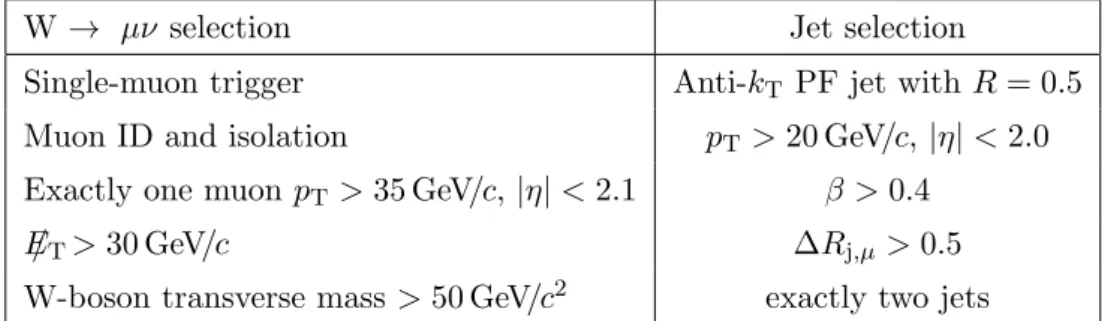
used in the selection are summarized in table2.
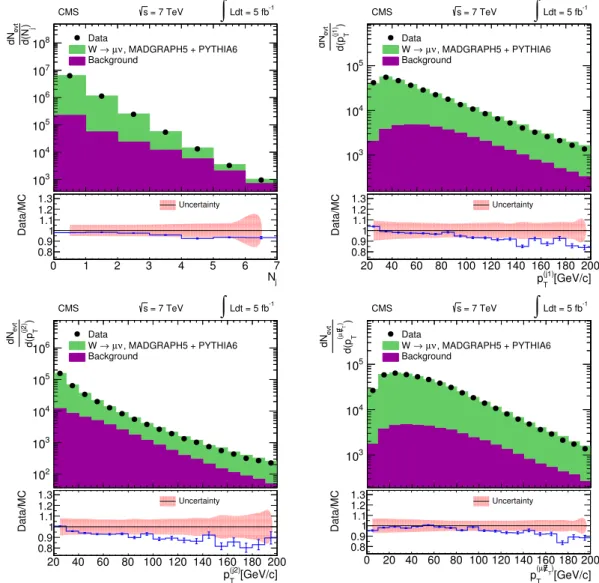
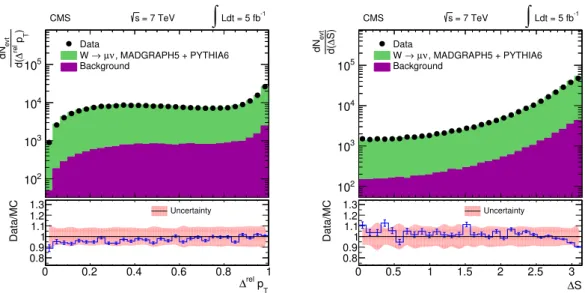
The kinematic distributions of the jets in the selected events are reproduced by the MC simulations as shown in figure 2. Figure 3 shows the comparison of data with MC simulations for ∆relp
T (left) and ∆S (right) at the detector level. Data and MC simulation
JHEP03(2014)032
W → µν selection Jet selection
Single-muon trigger Anti-kT PF jet withR= 0.5
Muon ID and isolation pT >20 GeV/c,|η|<2.0
Exactly one muon pT>35 GeV/c,|η|<2.1 β >0.4
E/ >T 30 GeV/c ∆Rj,µ>0.5
W-boson transverse mass >50 GeV/c2 exactly two jets
Table 2. Summary of the W + 2-jet event selection and reconstruction criteria at the detector level.
Process Number of events
W→µν (2.3 ±0.12) ×105
W→τ ν (3.7 ±0.20) ×103
Top quark (9.4 ±0.69) ×103
Drell-Yan (5.3 ±0.26) ×103
Diboson (2.6 ±0.26) ×103
Multijet (1.1 ±0.34) ×103
Total expected events (2.5 ±0.14) ×105
Data (2.4 ±0.0049)× 105
Table 3. Expected yields for various processes for 5 fb−1
and observed number of events in the data. The top production background is the sum of the single-top-quark and tt processes. The estimated event yields from the simulated samples include uncertainties in the respective cross sections.
a concern for the present analysis because the contribution of events having large pT jet
is very small, e.g., only 3% of the W + 2-jet events have a jet pT larger than 100 GeV/c,
where the description starts to deviate from the data. There is a small level of background contamination in the selected W + 2-jet samples. The dominant background contribution comes from top-quark production (single top-quark and pair production) and Drell-Yan processes. The contribution of the multijet background is less than 0.5%. This contribution is estimated by defining a control region with the requirement of a non-isolated muon, with I > 0.1. A template of the E/Tdistribution for the multijet background is constructed by
using events in this control region. This template is then used to estimate the contribution of the multijet background by fitting theE/Tdistribution in the signal region, withI <0.1.
Table3 summarizes the expected number of events for the processes listed in table 1, for an integrated luminosity of 5 fb−1. The total contribution from the background events is
about 10% but the effect on the shape of the DPS-sensitive observables is less than 1%.
4 Unfolding and comparison with simulations
JHEP03(2014)032
j N
0 1 2 3 4 5 6 7
Data/MC 0.8 0.9 1 1.1 1.2 1.3 Uncertainty
0 1 2 3 4 5 6 7
) j d(N evt dN 3 10 4 10 5 10 6 10 7 10 8
10 DataW →µν, MADGRAPH5 + PYTHIA6 Background
-1
Ldt = 5 fb
∫
= 7 TeV s CMS [GeV/c] (j1) T p20 40 60 80 100 120 140 160 180 200
Data/MC 0.8 0.9 1 1.1 1.2 1.3 Uncertainty
20406080100
120
140
160
180
200
) (j1) T d(p evt dN 3 10 4 10 5 10 Data
, MADGRAPH5 + PYTHIA6 ν µ → W Background -1
Ldt = 5 fb
∫
= 7 TeV s CMS [GeV/c] (j2) T p20 40 60 80 100 120 140 160 180 200
Data/MC 0.8 0.91 1.1 1.2 1.3 Uncertainty
20406080100
120
140
160
180
200
) (j2) T d(p evt dN 2 10 3 10 4 10 5 10 6 10 Data
, MADGRAPH5 + PYTHIA6 ν µ → W Background -1
Ldt = 5 fb
∫
= 7 TeV s CMS [GeV/c] ) T E µ ( T p0 20 40 60 80 100 120 140 160 180 200
Data/MC 0.8 0.91 1.1 1.2 1.3 Uncertainty
0 20406080100
120
140
160
180
200
) )T E µ ( T d(p evt dN 3 10 4 10 5 10 Data
, MADGRAPH5 + PYTHIA6 ν µ → W Background -1
Ldt = 5 fb
∫
= 7 TeV sCMS
Figure 2. Detector-level comparison of data with MC simulations for the multiplicity (top left) of jets (Nj) withpT>20 GeV/c and|η|<2.0. Data and simulations for the sample with exactly two
jets are plotted as a function of thepTof the leading (top right) and subleading (lower left) jets, as
well as of the magnitude of the vector sum of the muonpTandE/T(lower right). The background
distribution represents the sum of the contributions of Drell-Yan, W → τ ν, diboson, multijet, tt, and single-top-quark processes. The bottom panels show the ratio of the data and simulated distributions. The band shows the total uncertainty, with the contributions of the jet energy scale uncertainty and the statistical uncertainties of the MC samples added in quadrature. The error bars on the ratio histogram represent the statistical uncertainty of the data and the simulated samples added in quadrature.
The distributions of the DPS-sensitive observables for the selected events are corrected for selection efficiencies and detector effects. The trigger efficiency does not bias the shape of the DPS-sensitive observables; this was checked by comparing simulated samples with and without the trigger requirement. The selected events are mainly SPS events and the sample contains only a few percent of DPS events. However, in the DPS-sensitive region, at low ∆rel p
JHEP03(2014)032
T p rel
∆
0 0.2 0.4 0.6 0.8 1
Data/MC 0.8 0.9 1 1.1 1.2 1.3 Uncertainty
0 0.2 0.4 0.6 0.8
1
) T p rel∆ d( evt dN 2 10 3 10 4 10 5 10 Data
, MADGRAPH5 + PYTHIA6 ν µ → W Background -1
Ldt = 5 fb
∫
= 7 TeV sCMS
S
∆
0 0.5 1 1.5 2 2.5 3
Data/MC 0.8 0.9 1 1.1 1.2 1.3 Uncertainty
0 0.5 1 1.5 2 2.5 3
S) ∆ d( evt dN 2 10 3 10 4 10 5 10 Data
, MADGRAPH5 + PYTHIA6 ν µ → W Background -1
Ldt = 5 fb
∫
= 7 TeV sCMS
Figure 3. Comparison of data with MC simulations at detector level for the DPS-sensitive ob-servables ∆rel p
T (left), and ∆S (right). The background distribution represents the sum of the
contributions of Drell-Yan, W → τ ν, diboson, multijet, tt, and single-top-quark processes. The bottom panels show the ratio of the data and simulated distributions. The band shows the total uncertainty, with the contributions of the jet energy scale uncertainty and the statistical uncertain-ties of the MC samples added in quadrature. The error bars on the ratio histogram represent the statistical uncertainty of the data and the simulated samples added in quadrature.
1µ : pT>35 GeV/cand |η|<2.1
E/ >T 30 GeV and MT >50 GeV/c2
Exactly 2 jets : pT >20 GeV/c and |η|<2.0
Table 4. Phase space definition for the visible cross section at the particle level.
Thus, the shape of the distribution of ∆rel p
T and ∆S is more important than the absolute
normalization in the extraction of the DPS fraction. Therefore, the unfolding and the systematic studies are carried out for the shapes of the ∆rel p
T and ∆S distributions. The
measured distributions are unfolded to the level of stable particles (lifetime cτ >10 mm) within the phase space given in table4.
Unfolding is performed with an iterative Bayesian method [56] that properly takes into account bin-to-bin migrations. A response matrix is created with simulated events pro-duced with the MadGraph 5 + pythia 6 Monte Carlo event generator. The unfolding
is cross-checked by using the singular value decomposition (SVD) [57] approach. Itera-tive Bayesian and SVD approaches give consistent results within uncertainties. Various systematic effects are considered and are listed below:
• Model dependence: the sensitivity to the model dependence of the simulations used for the unfolding is estimated by comparing the results unfolded with different MCs. The main effect is due to the simulation of MPI, and is estimated by comparing the detector-level distributions of ∆rel p
T and ∆S unfolded by usingMadGraph 5
JHEP03(2014)032
independent of ∆rel p
T and ∆S. This is taken as an estimate of the systematic
uncertainty due to the model dependence of the simulations.
• Background subtraction: the contribution from various backgrounds is estimated with simulated samples that are subtracted from data before applying any corrections. In order to estimate the systematic uncertainties, the cross sections of the background processes are varied within their uncertainties. The shape of the background distri-bution is affected by the jet energy scale andE/Tuncertainties. The total effect of all
these uncertainties on the final distribution is less than 0.5%.
• Jet Energy Scale (JES): the four momentum of each jet is varied by the JES uncer-tainty. This variation gives a systematic bias of 1–3%.
• Jet Energy Resolution (JER): the JER is different between data and simulation by 3–8% for |η|<2.0. A variation of the JER by this amount in the simulation affects the distribution by less than 1%.
• Resolution of E/T: the E/Tresolution differs in data and simulation [55]; this affects
the ∆S distribution by at most 3.7%. The effect on the ∆rel p
T distribution is less
than 1%.
• Pileup: in order to take into account the uncertainty in the luminosity measure-ment [58] and the total inelastic cross section, an uncertainty of 5% is assigned to the mean value of the pileup distribution. This uncertainty affects the ∆S distribution by at most 3.7%, whereas the effect on the ∆rel p
T distribution is less than 1%.
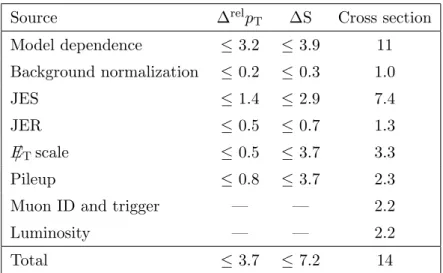
Table 5 summarizes the systematic uncertainties for the ∆rel pT and ∆S distributions.
The absolute cross section of W + 2-jet events is not important for the extraction of the DPS contribution. However, for completeness the W+ 2-jet production cross section is also corrected to the particle level. The total cross section for the W + 2-jet production (including the DPS contribution), within the region defined in table 4, is measured to be 53.4±0.1 (stat.)±7.6 (syst.) pb. This is consistent with the particle-level prediction by
MadGraph 5 + pythia 8, scaled by the ratio of the NNLO and LO cross section for
inclusive W production, yielding 55.6±2.8 pb. Various systematic effects, arising from the sources discussed above, are also evaluated for the total W + 2-jet cross section. In addition to these, the cross section has a systematic uncertainty of 2.2% due to the luminosity measurement [58]. There is a further uncertainty of 1% in the trigger efficiency and 2% in the muon identification and selection efficiencies [46]. A summary of the various systematic uncertainties for the W + 2-jet cross section is given in the last column of table 5.
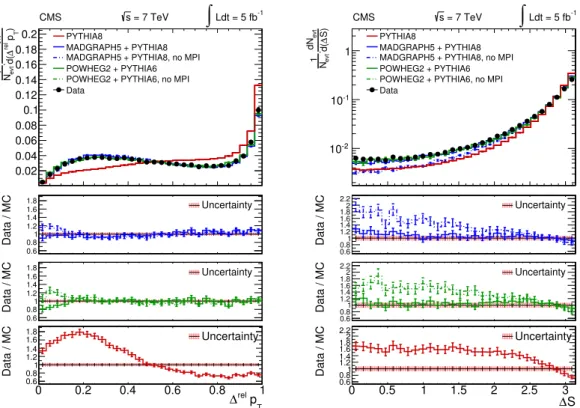
A comparison of various simulations for inclusive W production with the corrected distributions is shown in figure4. The ∆relpTand ∆S distributions are properly described
by MadGraph 5 +pythia 8. MadGraph 5, with hadronization and parton showering
carried out with pythia 6, also describes the measurements well. The NLO predictions
for W + 2-jet production obtained withpowheg2 +pythia6 also satisfactorily describe
the data. Measurements are also well reproduced by powheg 2, with hadronization and
JHEP03(2014)032
Source ∆relp
T ∆S Cross section
Model dependence ≤3.2 ≤3.9 11
Background normalization ≤0.2 ≤0.3 1.0
JES ≤1.4 ≤2.9 7.4
JER ≤0.5 ≤0.7 1.3
E/Tscale ≤0.5 ≤3.7 3.3
Pileup ≤0.8 ≤3.7 2.3
Muon ID and trigger — — 2.2
Luminosity — — 2.2
Total ≤3.7 ≤7.2 14
Table 5. Summary of the systematic uncertainties (in %) for different observables. Uncertainties in integrated luminosity, muon identification (ID), and trigger efficiency only affect the W + 2-jet cross section measurement.
The pythia 8 simulation underestimates the measurements by a factor of 1.5–2.0.
This discrepancy is due to the fact thatpythia8 generates only 2→1 and 2→2 processes
and most of the additional jets are produced during parton showering, and have a softer pT spectrum than that measured in data. The difference is mainly in the DPS-sensitive
region. Therefore, event generators used to define SPS backgrounds must include a proper implementation of additional hard radiation. If it is not included, the effect of missing hard radiation might be interpreted as a DPS contribution. Without MPI, the LO and NLO predictions fromMadGraph 5 + pythia 8 andpowheg 2 + pythia 6 are unable
to describe the data shown in figure 4. The importance of including MPI, for both LO and NLO simulations in the description of W + 2-jet events, is conclusively shown by the comparisons of data with simulations with and without MPI. In the following sections the contribution of hard MPI is extracted.
5 Strategy for the extraction of the DPS fraction
The fraction of W + 2-jet events produced by DPS is extracted by performing a template fit to the fully corrected distributions of ∆rel pTand ∆S using a binned likelihood method.
Here, the strategy to extract the DPS fraction is discussed, including the definition of the signal and background templates and the corresponding systematic uncertainties.
5.1 DPS signal template
In this analysis, DPS events are required to have one W boson with zero jets from the first interaction and two jets from an independent second interaction, where the jets are required to havepT >20 GeV/cand |η|<2.0. In present analysis, the two interactions are assumed
JHEP03(2014)032
T
p
rel
∆
0 0.2 0.4 0.6 0.8 1
Data / MC
0.6 0.81 1.2 1.4 1.6 1.8 Uncertainty
0 0.2 0.4 0.6 0.8 1
Data / MC
0.6 0.8 1 1.2 1.4 1.6 1.8 Uncertainty
0 0.2 0.4 0.6 0.8 1
Data / MC
0.6 0.8 1 1.2 1.4 1.6 1.8 Uncertainty
0 0.2 0.4 0.6 0.8 1
)T p rel ∆ d( evt dN . evt N 1 0.02 0.04 0.06 0.08 0.1 0.12 0.14 0.16 0.18 0.2 -1
Ldt = 5 fb
∫
= 7 TeV sCMS
PYTHIA8
MADGRAPH5 + PYTHIA8 MADGRAPH5 + PYTHIA8, no MPI POWHEG2 + PYTHIA6 POWHEG2 + PYTHIA6, no MPI Data
S
∆
0 0.5 1 1.5 2 2.5 3
Data / MC
0.6 0.81 1.2 1.4 1.6 1.82 2.2 Uncertainty
0 0.5 1 1.5 2 2.5 3
Data / MC
0.6 0.81 1.2 1.4 1.6 1.82 2.2 Uncertainty
0 0.5 1 1.5 2 2.5 3
Data / MC
0.6 0.81 1.2 1.4 1.6 1.82 2.2 Uncertainty
0 0.5 1 1.5 2 2.5 3
S) ∆ d( evt dN . evt N 1 -2 10 -1 10 1 -1
Ldt = 5 fb
∫
= 7 TeV sCMS
PYTHIA8
MADGRAPH5 + PYTHIA8 MADGRAPH5 + PYTHIA8, no MPI POWHEG2 + PYTHIA6 POWHEG2 + PYTHIA6, no MPI Data
Figure 4. Fully corrected data distributions, normalized to unity, for the DPS-sensitive observables ∆rel p
T(left) and ∆S (right). The second panel in both plots shows the ratio of data over
Mad-Graph 5 + pythia8 with and without MPI, whereas in the third panel the ratio with powheg 2 + pythia6 is shown. The ratio of the data andpythia8 is shown in the fourth panel of both plots. The band represents the total uncertainty of the data (cf. table 5).
pythia8 and W + 0-jet events. These W + 0-jet events are selected as a subsample of the
W + jets inclusive sample simulated withMadGraph5 +pythia8. The DPS templates
produced with simulated events are in good agreement with the templates obtained by mixing W + 0-jet and dijet events in the data.
5.2 Background template
In order to construct the background template, inclusive W + jets events are used which are produced with MadGraph 5 followed by hadronization and parton showering with pythia 8. The background template cannot be obtained by simply switching off MPI,
because only the MPI events that satisfy the DPS signal definition as discussed above need to be excluded. This requires the tagging of the MPI partons and is achieved, in the case of parton showering withpythia8, by using the status codes 31–39, which are assigned to
partons produced from MPI. The background template is constructed by taking inclusive W + jets events that contain exactly two jets with pT > 20 GeV/c and |η| <2.0 and by
removing those with two MPI tagged partons with|η|<2.0. It has been argued [21] that the templates for signal and background must be disjoint and that an additional cutoff on the transverse momentum,pcut
T , must be applied to the tagged MPI partons. By applying
the pcut
JHEP03(2014)032
[GeV/c]
cut T
p
0 5 10 15 20 25
DPS fraction [%]
2 3 4 5 6
7 fDPSMC using ∆S observable
observable
T
p
rel
∆ using
DPS MC
f
using simultaneous fit
DPS MC
f
DPS evt
f
= 7 TeV s W + jets,
→
CMS Simulation, pp
Figure 5. The extracted value of the DPS fraction in W + jets events, simulated withMadGraph 5 +pythia8, using different background templates obtained by varying the transverse momentum cutoff (pcut
T ) for the second hard interaction. The DPS fractions obtained by performing both
simultaneous and individual fits to the ∆rel p
Tand ∆S observables are shown. The DPS fraction,
fevt
DPS, for the simulated W + jets events is shown by a dashed black line. The error bars/bands
represent the statistical uncertainty added in quadrature to the systematic uncertainty of the DPS template (as discussed in section6).
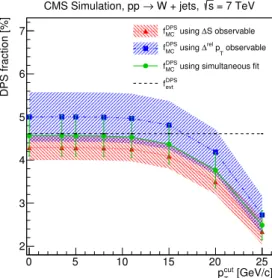
template. The effect of applying such a cutoff is studied by comparing at simulation level the fitted and true DPS fraction in the MadGraph 5 + pythia 8 sample as a function
of pcut
T (figure 5). We observe that, for pcutT < 12 GeV/c, the fitted DPS fraction does not
depend on pcut
T and therefore we do not apply any cut on pT of the MPI partons. The
true DPS fraction inMadGraph5 +pythia8 simulation is obtained by counting events
containing a W boson and exactly two jets within the acceptance at particle level. The two MPI-tagged partons must also be within the acceptance (|η|<2.0) and there must be no parton with|η|<2.0 from the first interaction. This fraction, fevt
DPS, is determined to be
fDPSevt = 0.046±0.001 (stat.). (5.1)
Because of the different sensitivities of ∆rel p
T and ∆S to DPS, the DPS fraction
obtained by fitting only the ∆S observable underestimates fevt
DPS, whereas the fitted result
with ∆rel pT overestimates the fDPSevt . However, the fitted DPS fractions are compatible
with each other within their systematic uncertainties. In these simulation studies, the main source of systematic bias is the model dependence of the signal templates (a detailed discussion is given in section 6) used for the DPS extraction. If a simultaneous fit of the ∆rel p
T and ∆S observables is performed, the fitted fraction is consistent withfDPSevt .
The two observables ∆rel p
T and ∆S are not correlated for signal events; conversely
JHEP03(2014)032
T
p
rel
∆
0 0.2 0.4 0.6 0.8 1
Ratio
0.81
1.2 1.4 1.6
1.8 MC) * Background)
DPS
* Signal + (1-f
MC
DPS
Inclusive/(f Inclusive/Background
0 0.2 0.4 0.6 0.8 1
)T p rel ∆ d( evt dN . evt N 1 0.02 0.04 0.06 0.08 0.1
0.12 Inclusive MADGRAPH5 + PYTHIA8DPS Signal SPS Background
= 7 TeV s W + jets, → CMS Simulation, pp
S
∆
0 0.5 1 1.5 2 2.5 3
Ratio 0.81 1.2 1.4 1.6 1.82
2.2 MC) * Background)
DPS
* Signal + (1-f
MC
DPS
Inclusive/(f Inclusive/Background
0 0.5 1 1.5 2 2.5 3
S) ∆ d( evt dN . evt N 1 -3 10 -2 10 -1 10 1
Inclusive MADGRAPH5 + PYTHIA8 DPS Signal
SPS Background
= 7 TeV s W + jets, → CMS Simulation, pp
Figure 6. Fit results for the DPS-sensitive observables ∆rel p
T (left) and ∆S (right) using signal
and background templates. The distributions of the simulated W + 2-jet events are fitted with signal and background templates. The bottom panels show the ratio of the distributions to the fit results. Here, the term “inclusive” means the simulation also includes the DPS contribution.
to the 2-dimensional distribution of ∆rel p
T and ∆S. The result differs by 4% from that
obtained by simultaneously fitting the two one-dimensional distributions. This effect of the correlation on the DPS fraction is small as compared to the total systematic uncertainty of 26% (as discussed in section6).
Figure 6 shows the results of fitting the ∆rel p
T and ∆S observables for simulated W
+ 2-jet events with signal and background templates. The extracted DPS fraction in the simulated events is
fDPSMC = 0.045±0.002 (stat.), (5.2)
which is consistent with the fevt
DPS value predicted by the default MPI model present
in the MadGraph 5 + pythia 8 simulation. This closure test also works well
when fitting pseudo-data obtained by mixing simulated signal and background events in different proportions.
To summarize, we perform a simultaneous fit of the ∆rel pT and ∆S observables to
utilize their different sensitivities and to reduce the uncertainties. The signal template is obtained by randomly mixing independently produced W and dijet events, whereas the background template is produced from the W + 2-jet sample simulated withMadGraph
5 +pythia8, in which events with MPI-tagged partons within the acceptance (|η|<2.0)
are removed.
6 The DPS fraction in data
The ∆rel pT and ∆S distributions are simultaneously fitted by using the signal and
back-ground templates defined in section5. The fitted value of the DPS fraction (fDPS) is:
JHEP03(2014)032
T
p
rel
∆
0 0.2 0.4 0.6 0.8 1
Ratio 0.8 0.91 1.1 1.2 1.3 1.4
1.5 ) * Background)
DPS
* Signal + (1 - f
DPS
Data/(f Data/Background
0 0.2 0.4 0.6 0.8 1
)T p rel ∆ d( evt dN . evt N 1 0.02 0.04 0.06 0.08 0.1
0.12 DataDPS Signal
SPS Background
-1
Ldt = 5 fb
∫
= 7 TeV sCMS
S
∆
0 0.5 1 1.5 2 2.5 3
Ratio 0.81 1.2 1.4 1.6 1.82
2.2 ) * Background)
DPS
* Signal + (1 - f
DPS
Data/(f Data/Background
0 0.5 1 1.5 2 2.5 3
S) ∆ d( evt dN . evt N 1 -3 10 -2 10 -1 10 1 Data DPS Signal SPS Background -1
Ldt = 5 fb
∫
= 7 TeV sCMS
Figure 7. Fit results for the DPS-sensitive observables ∆rel p
T (left) and ∆S (right). Corrected
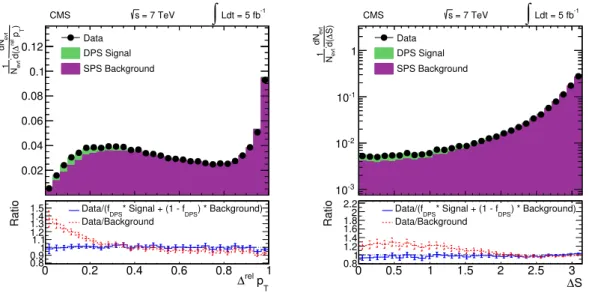
data distributions are fitted with signal and background templates (as discussed in section5).
The MC predictions using the fit results are shown in figure 7and compared to data. The following sources of systematic uncertainties are investigated:
• the signal template is generated by randomly mixing W + 0-jet and dijet events from simulated events. The systematic uncertainty in the signal template is calculated by using different simulations for dijet events, i.e. pythia 8, powheg 2, and her-wig++ [59]. In this signal definition, the first and second interactions are assumed to
be completely independent of each other. In order to study possible effects of colour reconnection and energy conservation between the first and the second interactions, an additional cross-check is performed by using the pythia 8 event generator for
producing W bosons from the first interaction and the dijet from the second interac-tion. From figure 4it has been concluded thatpythia 8 fails to describe W + 2-jet
measurement due to missing contributions from 2→3 and higher order processes. However, the DPS signal definition only includes W + 0-jet from the first interac-tion and exactly two jets from the second interacinterac-tion, which are essentially 2→1 and 2→2 processes, respectively. Therefore, pythia 8 gives a reliable simulation of
the DPS signal events. There is a significant contribution from the combinatorial background at particle level, i.e. at least one of the two jets is not from the sec-ond interaction. For systematic studies, this combinatorial background is removed by performing jet-parton matching. The variation in the signal template introduces a systematic uncertainty of 9% in the extracted DPS fraction. MPI effects are in-cluded in both sets of events used for constructing the signal template; the effect of double counting is studied by switching off MPI in both sets of events, and found to be negligible.
• The background template is generated withMadGraph5 events followed by
JHEP03(2014)032
the corresponding systematic uncertainty, the background template is obtained from various simulations and parton showering models, i.e. MadGraph 5 + pythia 8, MadGraph5 +pythia6 tune Z2*, andpowheg2 +herwig6. The MPI partons
cannot be tagged inpythia6 andherwig6. The background template is therefore
obtained by switching off MPI. The systematic uncertainty is evaluated by comparing the DPS fractions using different background templates with MPI off. In this proce-dure, the systematic uncertainty might be overestimated because of the construction of the background templates with simulations in which MPI are turned off. These variations in the background template introduce a systematic uncertainty of 17% in the DPS fraction.
The systematic uncertainty related to the missing higher order diagrams in Mad-Graph 5 is estimated by varying the QCD renormalization and factorization scales
simultaneously up and down by a factor of two. This variation gives a systematic effect of 10% on the extracted value of the DPS fraction.
The ME/PS matching scale is 20 GeV for theMadGraph5 +pythia8 simulation.
ThispT-threshold controls the matching of partons produced from the matrix element
and that from parton showering. Systematic effects related to the matching scale are estimated by varying the pT-threshold from 15 GeV/c to 25 GeV/c. This variation
gives a systematic uncertainty of 8% in the DPS fraction.
The total systematic uncertainty on the background template is estimated to be 21%.
• The effect of the uncertainty in PDFs used for the simulated sample is studied by using the PDF reweighting method and the prescription given in ref. [60]. The PDF reweighting only affects the hard scatterings and not the MPI and parton showers. The PDF uncertainties have little effect on the signal template but the variations in the background template result in an uncertainty of 5% in the extracted DPS fraction.
• The systematic uncertainty due to the limited number of simulated events for the background template is obtained by varying the template within its statistical un-certainty. This gives a systematic uncertainty of 5% in the extracted DPS fraction.
• The corrected measured distributions have various systematic uncertainties, as dis-cussed in section4. The effect of these systematic biases is evaluated by varying the shape of the measured distributions within uncertainties. This variation affects the DPS fraction by 10%.
Table 6summarizes the various systematic uncertainties in the extracted value of the DPS fraction.
7 Determination of the effective cross section
As discussed in section2, the effective cross section can be written as
σeff=
R fDPS ·
JHEP03(2014)032
Source Uncertainty (%)
Signal template 9
Background template 21
PDFs 5
Limited MC statistics 5
Uncertainty in corrected data 10
Total 26
Table 6. Systematic uncertainties in the DPS fraction determination.
Source Uncertainty (%)
Model dependence 9
JES 7
JER 2
Background 2
Pileup 1
Total 12
Table 7. Systematic uncertainties in the measurement ofR.
To calculate the effective cross section, in addition to fDPS, the measurements of the dijet
cross section and R are also necessary. They are discussed below.
7.1 Measurement of R
The ratio, R, of the yield of events with a W boson in the final state and no jets to the yield of events with a W boson and exactly two jets with pT > 20 GeV/c and |η|<2.0 is
25.9±0.2 (stat.) at detector level. After subtracting the background contributions from the data, this ratio becomes 27.0±0.2 (stat.). The ratioR is unfolded to particle level with a correction factor, (Rgen/Rreco), of 1.03 is calculated with MadGraph5 + pythia6. The
corrected value of R is 27.8 with a statistical uncertainty of 0.7%. The measurement ofR has a total systematic uncertainty of 12% due to various sources, as listed in table 7. The measured value of R is:
R= 27.8±0.2 (stat.)±3.3 (syst.). (7.2)
7.2 Measurement of σ′
2j
The cross section for dijet production withpT>20 GeV/c and |η|<2.0 (σ′2j) is measured
with pp collision data at a centre-of-mass energy of 7 TeV collected during 2010. A combi-nation of minimum bias and single-jet triggers is used, as for the inclusive jet cross section measurement [61]. For each trigger, the offline jet pT threshold is chosen such that the
JHEP03(2014)032
Source Uncertainty (%)
Model dependence 8
JES 13
JER 2
Total 15
Table 8. Uncertainties in the measured value of the dijet cross section.
fDPS 0.055 ±0.002 (stat.)± 0.014 (syst.)
R 27.8± 0.2 (stat.)± 3.3 (syst.)
σ′
2j 0.0409 ±0.0004 (stat.) ±0.0061 (syst.) mb
Effective cross section 20.7 ±0.8 (stat.) ±6.6 (syst.) mb
Table 9. Measured value offDPS, R,σ2j′ , and the effective cross section.
At detector level, the cross section for events with exactly two jets withpT>20 GeV/c
and |η|< 2.0 is measured to be 0.046 mb. This is corrected to particle level with a cor-rection factor of 0.89 calculated from thepythia6 simulation. The 8% uncertainty in the
correction factor is due to the model dependence, estimated by comparing the corrections obtained from the pythia 6 and herwig++ samples. There are further systematic
un-certainties of 13% and 2% due to the JES and JER unun-certainties, respectively. Table 8
summarizes the various sources of systematic uncertainties. The production cross section σ′
2j at particle level is:
σ2j′ = 0.0409±0.0004 (stat.)±0.0061 (syst.) mb. (7.3)
With the values offDPS, R, andσ′2jin eq. (7.1), the effective cross section is determined
to be:
σeff = 20.7±0.8 (stat.)±6.6 (syst.) mb. (7.4)
The results of the measurements of R, the DPS fraction, the dijet cross section, and the effective cross section are summarized in table 9. Figure8 shows a comparison of the effective cross sections obtained using different processes at various centre-of-mass ener-gies. In some theoretical models [22], σeff is expressed as a simple geometrical integral
that is independent of the collision energies. Conversely, pythia predicts an increase of σeff with centre-of-mass energy because of the parameter pT0(√s), which depends on the
collision energy. From the experimental results, a firm conclusion on the energy depen-dence of σeff cannot be drawn because of the large systematic uncertainties. The CMS
measurement is consistent with previous measurements performed at the Tevatron and by the ATLAS Collaboration at the LHC. The CMS measurement is also consistent with pre-dictions from pythia of 20–30 mb, depending on the tune. The measured effective cross
JHEP03(2014)032
[TeV] s 0.04 0.1 0.2 1 2 3 4 5 10
[mb]
eff
σ
5 10 15 20 25 30 35
40 CMS (W + 2 jets)
ATLAS (W + 2 jets) CDF (4 jets)
+ 3 jets)
γ
CDF (
+ 3 jets)
γ
Corrected CDF ( + 3 jets)
γ
D0 (
UA2 (4 jets - lower limit) AFS (4 jets - no errors given)
Figure 8. Centre-of-mass energy dependence of σeff measured by different experiments using
different processes [8–12, 21]. These measurements used different approaches for extraction of the DPS fraction andσeff. The “Corrected CDF” data point indicates theσeff value corrected for the
exclusive event selection [23].
8 Summary
A study of double parton scattering in W + 2-jet events in pp collisions is presented. The data correspond to an integrated luminosity of 5 fb−1 collected in pp collisions at a centre-of-mass energy of 7 TeV. Events with a W boson, reconstructed from the muon and E/T
information, are required to have exactly two jets with pT >20 GeV/cand |η|<2.0. The
DPS-sensitive observables ∆rel pT and ∆S are corrected for detector effects and selection
efficiencies. Simulations of W + jets events withMadGraph 5 +pythia8 (orpythia6)
and NLO predictions of powheg 2 +pythia6 (orherwig6) provide a good description
of the observables and describe the data only if multiple parton interactions are included. The fraction of DPS in W + 2-jet events is extracted with a DPS + SPS template fit to the distribution of the ∆rel p
T and ∆S observables. The obtained value of the DPS
fraction is
fDPS= 0.055±0.002 (stat.)±0.014 (syst.), (8.1)
and the effective cross section, characterizing the effective transverse area of hard partonic interactions in collisions between protons, is calculated to be
σeff = 20.7±0.8 (stat.)±6.6 (syst.) mb. (8.2)
JHEP03(2014)032
AcknowledgmentsTech-JHEP03(2014)032
nology Development Agency of Thailand; the Scientific and Technical Research Council of Turkey, and Turkish Atomic Energy Authority; the Science and Technology Facilities Council, U.K.; the US Department of Energy, and the US National Science Foundation. Individuals have received support from the Marie-Curie programme and the European Re-search Council and EPLANET (European Union); the Leventis Foundation; the A. P. Sloan Foundation; the Alexander von Humboldt Foundation; the Belgian Federal Science Policy Office; the Fonds pour la Formation `a la Recherche dans l’Industrie et dans l’Agriculture (FRIA-Belgium); the Agentschap voor Innovatie door Wetenschap en Technologie (IWT-Belgium); the Ministry of Education, Youth and Sports (MEYS) of Czech Republic; the Council of Science and Industrial Research, India; the Compagnia di San Paolo (Torino); the HOMING PLUS programme of Foundation for Polish Science, cofinanced by EU, Re-gional Development Fund; and the Thalis and Aristeia programmes cofinanced by EU-ESF and the Greek NSRF.
Open Access. This article is distributed under the terms of the Creative Commons
Attribution License (CC-BY 4.0), which permits any use, distribution and reproduction in any medium, provided the original author(s) and source are credited.
References
[1] T. Sj¨ostrand and M. van Zijl,A multiple interaction model for the event structure in hadron
collisions,Phys. Rev.D 36(1987) 2019[INSPIRE].
[2] P. Bartalini and L. Fano,Multiple partonic interactions at the LHC. Proceedings, 1st
International Workshop, MPI’08, Perugia, Italy, October 27–31, 2008,arXiv:1003.4220
[INSPIRE].
[3] M. Diehl, D. Ostermeier and A. Schafer,Elements of a theory for multiparton interactions in QCD,JHEP 03(2012) 089[arXiv:1111.0910] [INSPIRE].
[4] G. Calucci and D. Treleani,Disentangling correlations in multiple parton interactions,Phys. Rev.D 83(2011) 016012[arXiv:1009.5881] [INSPIRE].
[5] A. Del Fabbro and D. Treleani,A double parton scattering background to Higgs boson
production at the LHC,Phys. Rev.D 61(2000) 077502[hep-ph/9911358] [INSPIRE].
[6] M. Hussein,A Double parton scattering background to associate WH and ZH production at
the LHC,Nucl. Phys. Proc. Suppl.174(2007) 55[hep-ph/0610207] [INSPIRE].
[7] D. Bandurin, G. Golovanov and N. Skachkov,Double parton interactions as a background to
associated HW production at the Tevatron,JHEP 04(2011) 054[arXiv:1011.2186]
[INSPIRE].
[8] UA2collaboration, J. Alitti et al.,A study of multi-jet events at the CERNpp¯ collider and a
search for double parton scattering,Phys. Lett.B 268(1991) 145[INSPIRE].
[9] Axial Field Spectrometercollaboration, T. Akesson et al., Double parton scattering in
ppcollisions at√s= 63GeV,Z. Phys.C 34 (1987) 163[INSPIRE].
[10] CDFcollaboration, F. Abe et al.,Study of four jet events and evidence for double parton
JHEP03(2014)032
[11] CDFcollaboration, F. Abe et al.,Double parton scattering in pp¯ collisions at√s= 1.8TeV,Phys. Rev.D 56(1997) 3811 [INSPIRE].
[12] D0collaboration, V. Abazov et al.,Double parton interactions in photon +3 jet events in
pp− bar collisions√s= 1.96 TeV,Phys. Rev.D 81(2010) 052012[arXiv:0912.5104]
[INSPIRE].
[13] C. Goebel, F. Halzen and D.M. Scott,Double Drell-Yan annihilations in hadron collisions:
novel tests of the constituent picture,Phys. Rev.D 22(1980) 2789[INSPIRE].
[14] M. Mekhfi,Multiparton processes: an application to double Drell-Yan,Phys. Rev.D 32
(1985) 2371[INSPIRE].
[15] B. Humpert and R. Odorico,Multiparton scattering and QCD radiation as sources of four jet
events,Phys. Lett.B 154(1985) 211[INSPIRE].
[16] L. Ametller, N. Paver and D. Treleani,Possible signature of multiple parton interactions in
collider four jet events,Phys. Lett.B 169(1986) 289[INSPIRE].
[17] E.L. Berger, C.B. Jackson and G. Shaughnessy,Characteristics and estimates of double
parton scattering at the Large Hadron Collider,Phys. Rev.D 81(2010) 014014
[arXiv:0911.5348] [INSPIRE].
[18] R. Godbole, S. Gupta and J. Lindfors,Double parton scattering contribution to W + jets,Z.
Phys.C 47 (1990) 69[INSPIRE].
[19] E.L. Berger, C.B. Jackson, S. Quackenbush and G. Shaughnessy,Calculation ofW b¯b
production via double parton scattering at the LHC,Phys. Rev.D 84(2011) 074021
[arXiv:1107.3150] [INSPIRE].
[20] J.R. Gaunt, C.-H. Kom, A. Kulesza and W.J. Stirling, Same-signW pair production as a
probe of double parton scattering at the LHC,Eur. Phys. J.C 69(2010) 53
[arXiv:1003.3953] [INSPIRE].
[21] ATLAScollaboration,Measurement of hard double-parton interactions inW(→lν) + 2jet
events at√s= 7TeV with the ATLAS detector,New J. Phys.15(2013) 033038
[arXiv:1301.6872] [INSPIRE].
[22] D. Treleani,Double parton scattering, diffraction and effective cross section,Phys. Rev.D 76(2007) 076006[arXiv:0708.2603] [INSPIRE].
[23] M. Bahr, M. Myska, M.H. Seymour and A. Siodmok, Extractingσeff from the CDFγ+ 3jets
measurement,JHEP 03 (2013) 129[arXiv:1302.4325] [INSPIRE].
[24] M.H. Seymour and A. Siodmok, Extractingσeff from the LHCb double-charm measurement,
arXiv:1308.6749[INSPIRE].
[25] J. Alwall, M. Herquet, F. Maltoni, O. Mattelaer and T. Stelzer,MadGraph 5: going beyond,
JHEP 06 (2011) 128[arXiv:1106.0522] [INSPIRE].
[26] F. Maltoni and T. Stelzer,MadEvent: automatic event generation with MadGraph,JHEP 02
(2003) 027[hep-ph/0208156] [INSPIRE].
[27] R. Corke and T. Sj¨ostrand,Interleaved parton showers and tuning prospects,JHEP 03
(2011) 032[arXiv:1011.1759] [INSPIRE].
[28] T. Sj¨ostrand, S. Mrenna and P.Z. Skands,A brief introduction to PYTHIA 8.1,Comput.
JHEP03(2014)032
[29] CMScollaboration, The CMS experiment at the CERN LHC,2008JINST 3S08004[INSPIRE].
[30] R. Field,Early LHC underlying event data — Findings and surprises, arXiv:1010.3558
[INSPIRE].
[31] T. Sj¨ostrand, S. Mrenna and P.Z. Skands,PYTHIA 6.4 physics and manual,JHEP 05
(2006) 026[hep-ph/0603175] [INSPIRE].
[32] K. Hamilton and P. Nason,Improving NLO-parton shower matched simulations with higher
order matrix elements,JHEP 06(2010) 039[arXiv:1004.1764] [INSPIRE].
[33] K. Melnikov and F. Petriello,Electroweak gauge boson production at hadron colliders through
O(α2
s),Phys. Rev.D 74(2006) 114017[hep-ph/0609070] [INSPIRE].
[34] N. Kidonakis,Next-to-next-to-leading soft-gluon corrections for the top quark cross section
and transverse momentum distribution,Phys. Rev.D 82(2010) 114030[arXiv:1009.4935]
[INSPIRE].
[35] N. Kidonakis,NNLL resummation for s-channel single top quark production, Phys. Rev.D 81(2010) 054028[arXiv:1001.5034] [INSPIRE].
[36] N. Kidonakis,Next-to-next-to-leading-order collinear and soft gluon corrections for t-channel
single top quark production, Phys. Rev.D 83(2011) 091503 [arXiv:1103.2792] [INSPIRE].
[37] N. Kidonakis,Two-loop soft anomalous dimensions for single top quark associated production
with aW− orH−,Phys. Rev.D 82(2010) 054018 [arXiv:1005.4451] [INSPIRE].
[38] J.M. Campbell, R.K. Ellis and C. Williams,Vector boson pair production at the LHC,JHEP
07(2011) 018[arXiv:1105.0020] [INSPIRE].
[39] GEANT4collaboration, S. Agostinelli et al.,GEANT4: a simulation toolkit,Nucl. Instrum.
Meth.A 506 (2003) 250[INSPIRE].
[40] CMScollaboration, Study of the underlying event at forward rapidity inpp collisions at
√
s= 0.9,2.76and7 TeV,JHEP 04(2013) 072[arXiv:1302.2394] [INSPIRE].
[41] K. Hamilton, P. Nason and G. Zanderighi,MINLO: Multi-scale Improved NLO,JHEP 10
(2012) 155[arXiv:1206.3572] [INSPIRE].
[42] J.M. Campbell, R.K. Ellis, P. Nason and G. Zanderighi,W andZ bosons in association with
two jets using the POWHEG method,JHEP 08(2013) 005[arXiv:1303.5447] [INSPIRE].
[43] G. Marchesini et al., HERWIG: A Monte Carlo event generator for simulating hadron
emission reactions with interfering gluons. Version 5.1 — April 1991, Comput. Phys.
Commun.67 (1992) 465[INSPIRE].
[44] G. Corcella et al.,HERWIG 6: an event generator for hadron emission reactions with
interfering gluons (including supersymmetric processes),JHEP 01(2001) 010
[hep-ph/0011363] [INSPIRE].
[45] J. Pumplin et al., New generation of parton distributions with uncertainties from global QCD
analysis,JHEP 07(2002) 012[hep-ph/0201195] [INSPIRE].
[46] CMScollaboration, Measurement of the inclusiveW andZ production cross sections in pp
collisions at√s= 7 TeV,JHEP 10(2011) 132[arXiv:1107.4789] [INSPIRE].
[47] CMScollaboration, Measurement of the underlying event in the Drell-Yan process in
proton-proton collisions at√s= 7 TeV,Eur. Phys. J.C 72(2012) 2080[arXiv:1204.1411]
JHEP03(2014)032
[48] CMS collaboration, Particle-flow event reconstruction in CMS and performance for jets, tausand MET,CMS-PAS-PFT-09-001(Particle-Flow Event Reconstruction in CMS and
Performance for Jets, Taus and MET).
[49] M. Cacciari, G.P. Salam and G. Soyez, The anti-kt jet clustering algorithm,JHEP 04(2008)
063[arXiv:0802.1189] [INSPIRE].
[50] M. Cacciari, G.P. Salam and G. Soyez,FastJet user manual,Eur. Phys. J.C 72 (2012) 1896
[arXiv:1111.6097] [INSPIRE].
[51] M. Cacciari and G.P. Salam, Dispelling theN3 myth for the k
t jet-finder,Phys. Lett. B 641
(2006) 57[hep-ph/0512210] [INSPIRE].
[52] CMScollaboration, Identification and filtering of uncharacteristic noise in the CMS hadron
calorimeter,2010JINST 5T03014[arXiv:0911.4881] [INSPIRE].
[53] CMScollaboration, Determination of jet energy calibration and transverse momentum
resolution in CMS, 2011JINST 6P11002[arXiv:1107.4277] [INSPIRE].
[54] M. Cacciari and G.P. Salam,Pileup subtraction using jet areas,Phys. Lett.B 659(2008) 119
[arXiv:0707.1378] [INSPIRE].
[55] CMScollaboration, Missing transverse energy performance of the CMS detector,2011
JINST 6P09001[arXiv:1106.5048] [INSPIRE].
[56] G. D’Agostini, A multidimensional unfolding method based on Bayes’ theorem, Nucl.
Instrum. Meth.A 362(1995) 487[INSPIRE].
[57] A. Hocker and V. Kartvelishvili,SVD approach to data unfolding,Nucl. Instrum. Meth.A 372(1996) 469[hep-ph/9509307] [INSPIRE].
[58] CMS collaboration, Absolute calibration of the luminosity measurement at CMS: winter 2012
update,CMS-PAS-SMP-12-008(2012).
[59] M. B¨ahr et al.,HERWIG++ physics and manual, Eur. Phys. J.C 58 (2008) 639
[arXiv:0803.0883] [INSPIRE].
[60] S. Alekhin et al.,The PDF4LHC working group interim report, arXiv:1101.0536[INSPIRE].
[61] CMScollaboration, Measurement of the inclusive jet cross section inppcollisions at√s= 7
TeV,Phys. Rev. Lett.107(2011) 132001[arXiv:1106.0208] [INSPIRE].
[62] M.H. Seymour and A. Siodmok, Constraining MPI models usingσeff and recent Tevatron
JHEP03(2014)032
The CMS collaborationYerevan Physics Institute, Yerevan, Armenia
S. Chatrchyan, V. Khachatryan, A.M. Sirunyan, A. Tumasyan
Institut f¨ur Hochenergiephysik der OeAW, Wien, Austria
W. Adam, T. Bergauer, M. Dragicevic, J. Er¨o, C. Fabjan1, M. Friedl, R. Fr¨uhwirth1,
V.M. Ghete, C. Hartl, N. H¨ormann, J. Hrubec, M. Jeitler1, W. Kiesenhofer, V. Kn¨unz,
M. Krammer1, I. Kr¨atschmer, D. Liko, I. Mikulec, D. Rabady2, B. Rahbaran, H. Rohringer,
R. Sch¨ofbeck, J. Strauss, A. Taurok, W. Treberer-Treberspurg, W. Waltenberger, C.-E. Wulz1
National Centre for Particle and High Energy Physics, Minsk, Belarus
V. Mossolov, N. Shumeiko, J. Suarez Gonzalez
Universiteit Antwerpen, Antwerpen, Belgium
S. Alderweireldt, M. Bansal, S. Bansal, T. Cornelis, E.A. De Wolf, X. Janssen, A. Knutsson, S. Luyckx, L. Mucibello, S. Ochesanu, B. Roland, R. Rougny, H. Van Haevermaet, P. Van Mechelen, N. Van Remortel, A. Van Spilbeeck
Vrije Universiteit Brussel, Brussel, Belgium
F. Blekman, S. Blyweert, J. D’Hondt, N. Heracleous, A. Kalogeropoulos, J. Keaveney, T.J. Kim, S. Lowette, M. Maes, A. Olbrechts, D. Strom, S. Tavernier, W. Van Doninck, P. Van Mulders, G.P. Van Onsem, I. Villella
Universit´e Libre de Bruxelles, Bruxelles, Belgium
C. Caillol, B. Clerbaux, G. De Lentdecker, L. Favart, A.P.R. Gay, A. L´eonard, P.E. Marage, A. Mohammadi, L. Perni`e, T. Reis, T. Seva, L. Thomas, C. Vander Velde, P. Vanlaer, J. Wang
Ghent University, Ghent, Belgium
V. Adler, K. Beernaert, L. Benucci, A. Cimmino, S. Costantini, S. Dildick, G. Garcia, B. Klein, J. Lellouch, J. Mccartin, A.A. Ocampo Rios, D. Ryckbosch, S. Salva Diblen, M. Sigamani, N. Strobbe, F. Thyssen, M. Tytgat, S. Walsh, E. Yazgan, N. Zaganidis
Universit´e Catholique de Louvain, Louvain-la-Neuve, Belgium
S. Basegmez, C. Beluffi3, G. Bruno, R. Castello, A. Caudron, L. Ceard, G.G. Da Silveira, C. Delaere, T. du Pree, D. Favart, L. Forthomme, A. Giammanco4, J. Hollar,
P. Jez, M. Komm, V. Lemaitre, J. Liao, O. Militaru, C. Nuttens, D. Pagano, A. Pin, K. Piotrzkowski, A. Popov5, L. Quertenmont, M. Selvaggi, M. Vidal Marono, J.M. Vizan Garcia
Universit´e de Mons, Mons, Belgium
N. Beliy, T. Caebergs, E. Daubie, G.H. Hammad
Centro Brasileiro de Pesquisas Fisicas, Rio de Janeiro, Brazil