The Effect of Attractive Interactions and
Macromolecular Crowding on Crystallins
Association
Jiachen Wei1, Jure Dobnikar2, Tine Curk3, Fan Song1*
1State Key Laboratory of Nonlinear Mechanics (LNM), Institute of Mechanics, Chinese Academy of Sciences, 100190, Beijing, China,2International Research Center for Soft Matter, Beijing University of Chemical Technology (BUCT), 100029, Beijing, China,3The University Chemical Laboratory, University of Cambridge, Lensfield Road, CB2 1EW, Cambridge, United Kingdom
Abstract
In living systems proteins are typically found in crowded environments where their effective interactions strongly depend on the surrounding medium. Yet, their association and dissoci-ation needs to be robustly controlled in order to enable biological function. Uncontrolled pro-tein aggregation often causes disease. For instance, cataract is caused by the clustering of lens proteins, i.e., crystallins, resulting in enhanced light scattering and impaired vision or blindness. To investigate the molecular origins of cataract formation and to design efficient treatments, a better understanding of crystallin association in macromolecular crowded environment is needed. Here we present a theoretical study of simple coarse grained colloi-dal models to characterize the general features of how the association equilibrium of pro-teins depends on the magnitude of intermolecular attraction. By comparing the analytic results to the available experimental data on the osmotic pressure in crystallin solutions, we identify the effective parameters regimes applicable to crystallins. Moreover, the combina-tion of two models allows us to predict that the number of binding sites on crystallin is small, i.e. one to three per protein, which is different from previous estimates. We further observe that the crowding factor is sensitive to the size asymmetry between the reactants and crowding agents, the shape of the protein clusters, and to small variations of intermolecular attraction. Our work may provide general guidelines on how to steer the protein interactions in order to control their association.
Introduction
The fiber cells of eye lens contain no organelles, but almost exclusively a dense suspension of proteins, namely, theα,βandγ-crystallins [1,2]. In the nucleus of human eye lens, the pre-dominant proteins areγ-crystallins [3,4] (for brevity, we will use“crystallins”instead of“γ -crystallins”in the rest of the manuscript). The moderate attractions between crystallins allow their self-assembly into organized patterns [5,6] with short-range spatial order, which plays an
OPEN ACCESS
Citation:Wei J, Dobnikar J, Curk T, Song F (2016) The Effect of Attractive Interactions and
Macromolecular Crowding on Crystallins Association. PLoS ONE 11(3): e0151159. doi:10.1371/journal. pone.0151159
Editor:Yong-Bin Yan, Tsinghua University, CHINA
Received:November 12, 2015
Accepted:February 24, 2016
Published:March 8, 2016
Copyright:© 2016 Wei et al. This is an open access article distributed under the terms of theCreative Commons Attribution License, which permits unrestricted use, distribution, and reproduction in any medium, provided the original author and source are credited.
Data Availability Statement:All relevant data are within the paper and its Supporting Information files.
Funding:This work was supported by the National Natural Science Foundation of China (Grant No. 11232013 and No. 11472285) and the Fundamental Research Funds for the Central Universities of P. R. China. The funders had no role in study design, data collection and analysis, decision to publish, or preparation of the manuscript.
important role in maintaining the transparency of the lens. Recent studies [7–11] have shown that prenatal or age-related genetic mutations associated to cataract can lead to modified inter-molecular interactions, resulting in crystallin association and cross-linked structures with a lower degree of local order producing the blur in the lens [12,13]. Modified crystallins change the osmotic balance of the lens inner cells by agglomerating into larger clusters, thereby reduc-ing the excluded volume that directly leads to the decrease of the osmotic pressure [14–16]. In order to compensate for such pressure loss, the tissue must expel water or increase the concen-tration of the non-aggregated proteins. Furthermore, if the aggregation becomes so extensive that the osmotic pressure cannot be restored, the biochemical equilibrium within the eye lens is destroyed and the cells deform and rupture, leading to cataract. Due to its prevalence and serious impact on the quality of life, cataract has been extensively studied, however its molecu-lar origins [1] are to date not fully understood—hindering efficient disease prevention or treatment.
One of the major open questions is the relation between the microscopic protein-protein interactions and the thermodynamic properties of crowded crystallin solutions. Daset.al. [17,
18] calculated the stability of crystallins by all-atom molecular simulations, showing that crys-tallin attraction can result in protein polymerization. Such detailed simulations are prohibi-tively expensive when addressing the effect of molecular crowding. Coarse grained models of hard spheres with short-range square-well attraction have been applied to study phase separa-tion [19–21] and physical aggregation [6,22] of crystallins, revealing that moderate intermolec-ular attraction is crucial in maintaining the thermodynamic stability of the system. Here we focus on how the association-dissociation equilibrium of a pair of proteins embedded in a crowded environment depends on the magnitude of their attraction. We adopt the scaled parti-cle theory (SPT) [23] approach that has been previously used to study polymerization diseases of proteins, such as sickle cell and Alzheimer’s disease [24,25]. The protein attraction is mod-elled in two ways: by thermodynamic perturbation model (TPM) [26] and by chemical binding model (CBM) [27], both of which separate intermolecular interactions into contributions from steric depletion and chemical attraction. Due to the simplicity of the models, we can address the problem analytically and discuss the generic features of association equilibria in crowded attractive systems.
Methods
The SPT characterizes thermodynamic properties of macromolecular or colloidal solutions by describing them as effective hard-core convex particles [28]. We consider a crowded environ-ment with spherical particles (crowders) of diameterσ0within which there are two spherical crystallins as reactants of diameterσ= 3.6 nm. We denote the ratio of reactant and crowder sizes asB=σ/σ0. We will focus on the ratioB= 1, i.e. the reactants and the crowders are identi-cal crystallins. The effect of size polydispersity is addressed in theOnline SI. The reactants asso-ciate into a product (Fig 1) with volumeπσ3/3 whose shape depends on the microscopic details of the protein-protein interactions. We model the products as spherocylinders with the length
Land the diameter of hemispherical capsσp(seeFig 1). The deviation from the spherical shape can be defined by an asphericity parameterλL/σp. Taking the volume conservation into account, we have
sp¼s
ffiffiffiffiffiffiffiffiffiffiffiffiffiffi
4 3lþ2 3
r
; L¼lsp: ð1Þ
For spherical product (λ= 0) we haveL= 0 ands
p ¼
ffiffiffi
2 3 p
Crowding factor
The crowding factor (or non-ideality factor),Γ, measures the contribution of crowders to the
association equilibria of the two reactants:
G¼ K
K0
; ð2Þ
whereK0andKdenote the equilibrium association constants in dilute and crowded environ-ment, respectively, and are related to the activity coefficientsγrandγpfor reactant and prod-uct:
lnK lnK0 ¼2lngr lngp: ð3Þ
Fig 1. Association of two crystallins in macromolecular crowding.Sketch of two crystallins as reactants polymerising into a dimer as product for (a) thermodynamic perturbation model (TPM), where blue spheres represent crystallins with isotropic intermolecular attraction, and (b) chemical binding model (CBM), where blue spheres and red points respectively represent crystallins with steric repulsion and binding sites with chemical attraction. The general shape of the product is a spherocylinder with asphericityλ.
Combining Eqs2and3, we obtain:
G¼g
2
r
gp: ð4Þ
The activity coefficient,γ(for either reactant or product), is associated to the work of insert-ing another reactant/product particle into the sea of crowders. For system of hard-spheres, according to the SPT, we have:
lngst¼ lnð1 Þ þA 1
1 þA2
1
2
þA3
1
3
; ð5Þ
whereϕis the packing fraction of the system, and [27,29]
A1¼B
3þ3B2þ3Bþ1:5lðB2þ2Bþ1Þ
A2¼3B
3þ4:5B2þ4:5lðB2þBÞ
A3¼3B
3þ4:5lB2:
ð6Þ
For the reactants,B= 1 andλ= 0, thusA
1= 7,A2= 7.5 andA3= 3. For the products,B=σp/σ0. The total activity in the case of associating proteins is a sum of the steric part,γst, due to the hard-sphere part of the interactions and the“chemical”part, i.e. the contribution of the attrac-tive interactions,γch:
lng¼ lngstþ lngch: ð7Þ
Below we describe the two models applied in order to estimateγch: TPM and CBM. The TPM describes the protein-crowder attraction by thermodynamic perturbation theory with orientational average approximation (Fig 1(a)). The CBM treats it as binding between crystal-lins with nonspecific binding sites (Fig 1(b)). Both approaches lead to predictions of association constants compatible with existing experimental data and numerical simulation for various types of globular proteins [26,27,30–33]. We therefore use the SPT in combination with TPM or CBM to determine the activity coefficient, crowding factor and osmotic pressure of dense attractive crystallin suspensions. The osmotic pressurePis evaluated as [34]:
P¼RT rþ
Z r
0
rdlng
dr dr
; ð8Þ
whereRis the molar gas constant,Tthe absolute temperature andρ= 6ϕ/πσ3the number density.
Thermodynamic perturbation model (TPM)
In the TPM [26],γchis approximated using thermodynamic perturbation theory and orienta-tional average as
lngch¼ rS drþ gmax
0 1
y
ð9Þ
where(in unit ofkBT) is the orientationally averaged depth of the attraction minimum, andS
is the surface area of the protein.δris the range of the attraction. The valueδr/σ= 0.2 was found to be the suitable ratio as compared to Monte Carlo simulation results for a range of globular proteins [26], therefore we adopt this ratio here as well. Finally,gmax
Carnanhan-Starling [35] equation of state to derive the relation betweengmax
0 and the volume fractionϕ:
gmax
0 ¼
1 =2
ð1 Þ3 : ð10Þ
Chemical binding model (CBM)
Within the CBM [27],γchis calculated by treating intermolecular attraction as chemical bind-ing between crystallins (Fig 1(c)). Assume that the binding is nonspecific, we have [27]
lngch¼ n
sln 1þK
gst
rg
st
b
gst
r;b
; ð11Þ
wheregst
b andgstr;bdenote the steric repulsive part of activity coefficient for crowder and
reac-tant-crowder complex, respectively. In our case, since both reactants and crowders are crystal-lins, we havegst
b ¼gstr andgstr;b ¼gstp.ns=αSis the number of binding sites, whereαrepresents a
temperature-independent coefficient that reflects the density of the binding sites. The binding constant,K, which is temperature-dependent, reflects the strength of the attraction between two binding sites.
Theγ−ϕandΓ−ϕrelations at different value offor TPM orKfor CBM are respectively
presented inS1andS2Figs. Also we note that, besides these two models, there is still another effective hard-sphere model introduced by Minton [36]. SeeS3–S6Figs for more discussions.
Results and Discussion
Comparison with experimental data
We first focus on the case where the product has a spherical shape (λ= 0). The osmotic
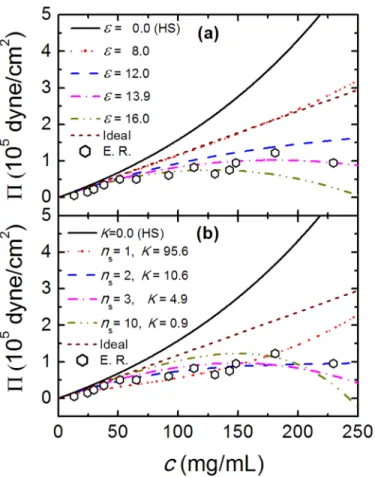
pres-sure for TPM at different average minimum attraction,, is shown inFig 2(a). It is observed that the value ofPsensitively depends on, especially at higher protein concentrationc. For <12, the value ofPincreases monotonically with the increase ofc. Note that when= 0, we obtain the osmotic pressure for hard-spheres based on SPT. For >13, with the increase ofc, the value ofPfirst increases and then decreases, due to the existence of strong intermolecular attraction. The case= 8.0 best describes the osmotic pressure of an ideal solutePi=ρRT.
FromFig 2(a)we also note that the experimental values [15,37] ofPare always smaller thanPi, due to the attractive interactions between crystallins. The optimal parameter value
= 13.9 (where almost quantitative agreement is observed) is obtained by least-square fitting procedure. In order to determine the best fitting parameters (nsandK) for CBM, we first fix
the value ofns, and determine the corresponding value ofKby least square fitting. Several
com-binations (ns,K) of number and strength of the binding sites can qualitatively describe the
experimental data, however, the quantitative agreement for the entire density range is obtained only for the number of binding sites between 2 (ns= 2 andK= 10.6) and 3 (ns= 3 andK= 4.9).
conclude that the number of binding sites for crystallin—crystallin interaction is 2 or 3. This prediction is different from what was earlier anticipated [6,22] and is an important insight into the crystallin structure derived from simple theoretical modeling combined with molecu-lar dynamics simulations and experimental measurements.
Crowding factor
Next, we investigate how crowding factor,Γ, depends on the volume fractionϕfor TPM and
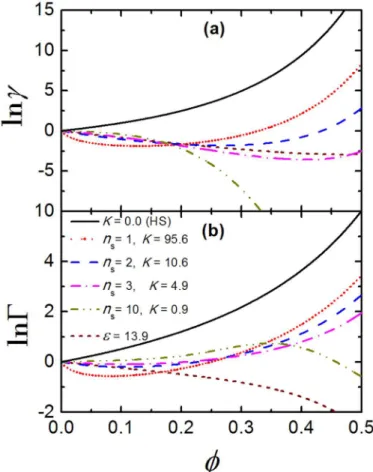
CBM, as illustrated inFig 3(b). For TPM with= 13.9, lnΓis negative and it decreases with
increasingϕ, which indicates that the macromolecular crowding favors the dissociation of the crystallins. Quite on the contrary, we find the sign of lnΓfor CBM depends onϕ. For instance,
lnΓis negative at smallϕwhile positive at higherϕfor CBM withn
s= 1. Whenns= 2 or 3,
which best fits the experimental data for osmotic pressure of crystallins, we observe lnΓ*0.0
for any givenϕless than 0.3. This means that for CBM the crystallins are more or less in equi-libria at dilute and moderate concentrations, which confirms that intermolecular attraction can help maintain the association equilibria of crystallins. In the case of many weak bonds (ns= 10), however, such relation is reversed: lnΓfirst increases and reaches its peak value
aroundϕ= 0.35; whenϕis further increased, lnΓdecreases and becomes negative.
Fig 2. The osmotic pressure,Π, as a function of protein concentration, c.(a) theΠ−crelation for TPM
at different. (b) best fittingΠ−ccurves for CBM with different combinations ofnsandK. Black symbols
denote experimental results derived from the work of Tardieuet.al. [15,37]. In order to compare analytic with experimental results, we setT= 298.15K.
Interestingly, although the activity coefficients for the best fitting parameters of both models (= 13.9 for TPM, andns= 2 andK= 10.6 for CBM) are quite similar, the corresponding
crowding factors are qualitatively very different. The activity coefficients only differ in the chemical part lnγch(see Eqs9and11), thus the different behavior can only originate from dif-ferences in lnγchof the products. Qualitatively similar behavior of the crowding factor seems to be obtained only in the limit of large number of weak bonds, which, however, is not a good description for crystallin suspension. The two models therefore, despite describing well the osmotic pressure data, predict qualitatively different crowding effects for crystallins. It is rea-sonable to expect that CBM is more accurate than TPM for proteins with highly orientational attraction, since the former reflects the competition between the decrease in surface area and the increase in the attractive strength. However, new experiments or atomistic simulations should be performed in order to confirm this claim. It must also be noted that many-body effects are not regarded in any of the model, therefore they are generally applicable at dilute and moderate protein concentrations, i.e.,ϕ≲0.4 [28]. In what follows, we will use the optimal
parameter values for both models, i.e.= 13.9 for TPM, andns= 2,K= 10.6 for CBM and
com-pare their predictions in more detail.
The lnΓ−ϕrelation in weak intermolecular attraction, and the effect of number of binding
sites on crowding factor for CBM are respectively presented inS7andS8Figs. We also note that the magnitude of the binding constantKand the average minimum attractionin TPM
Fig 3. The activity coefficient and crowding factor for crystallins.(a) The activity coefficient,γ, and (b) the crowding factor,Γ, as a function of packing fraction,ϕ, for TPM with= 13.9 and CBM with different combinations ofnsandKthat best fit the experimental data for osmotic pressure of crystallins.
are related quantities. InS9 Figthe relation between both constants, i.e., the values ofKand such that the activity coefficient calculated from both models is the same, is depicted showing an expected linear dependence at low densities and deviations from it in more crowded environment.
The effect of product geometry
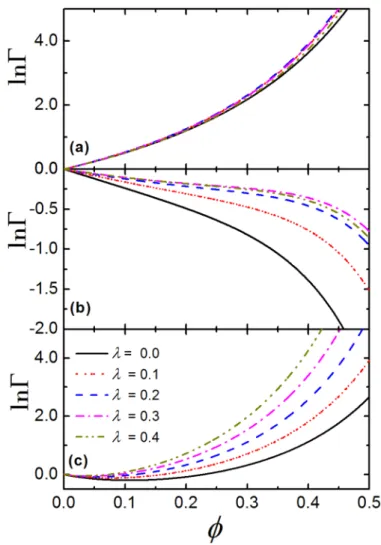
Fig 4presents lnΓas a function ofϕat different value of asphericity parameter,λ. According
to the results of NMR spectroscopy [1], the best fitting value of asphericity parameter for crys-tallin dimers is approximatelyλ= 0.3. We observe that, for system without attraction, whenλ
increases from 0.0 to 0.4 (which is tantamount to increase the length of the cylinder part of product,L, from 0.0 to about 0.43), the lnΓ−ϕrelation is barely changed, seeFig 4(a).
How-ever, for TPM with= 13.9 (Fig 4(b)), lnΓincreases with the increase ofλat fixedϕ, which
indicates that crystallins are more likely to aggregate as the product becomes more nonspheri-cal. This is because the surface area of the product would increase with the increase ofλ, which
directly decreases the activity coefficient of the product. Moreover, we notice that, even at very high packing fraction, lnΓcan hardly increase with the increase ofλwhenλ>0.2, due to the
Fig 4. The influence of product shape on crowding factor of crystallins.The crowding factor,Γ, as a function of packing fraction,ϕ, at different value of asphericity parameter,λ, for (a) hard spheres, (b) TPM with
= 13.9 and (c) CBM withns= 2 andK= 10.6.
cancelation effect of the increase of lnγstand the decrease of lnγchfor product.Fig 4(c)shows the lnΓ−ϕrelation at differentλfor CBM withn
s= 2 andK= 10.6. We can see that, in dilute
environment (ϕ<0.2) lnΓ<0 and it is slightly larger for largerλat the sameϕ. However, at
higher density, lnΓis positive and it becomes more sensitive to the value ofλ, since lnγchfor
product is significantly decreased with the increase of asphericity of the product. For both TPM and CBM, one thing in common is that at dilute and moderate density, the value of lnΓ
only slightly increased by changingλfrom 0.0 to 0.4 at sameϕ, which means that the shape
of the product has a limited impact on the association equilibria of crystallins in crowded environment.
We note that the crowding factor and the activity coefficient depend also on the reactant-crowder size ratio,B. This effect, which is important in order to understand the association in polydisperse systems, is explored in more detail inS10andS11Figs.
Entropy-enthalpy compensation
When lnΓ= 0, steric repulsion and chemical attraction between proteins are canceled out and
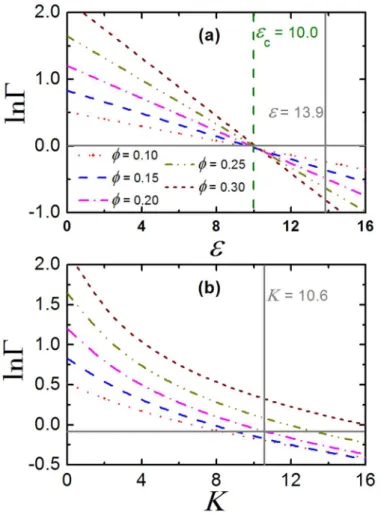
effectively the crowded environment has no impact on the association equilibria of the pro-teins. This effect is called entropy-enthalpy compensation [26]. To determine the critical value of the fitting parameters (cfor TPM andKcfor CBM) at which entropy-enthalpy
compensa-tion is achieved (lnΓ= 0), here we present the crossover behavior of crowding factor inFig 5.
For TPM, we observe lnΓdecreases linearly with the increase ofat fixed packing fraction, see Fig 5(a), which is in accord with former studies on association equilibria of other types of pro-teins [30,31]. The critical average minimum attractionc10.0, which is almost independent
on the value ofϕ. In addition, we find that at= 13.9, lnΓis negative for any givenϕ,
indicat-ing that macromolecular crowdindicat-ing help stabilize the monodispersity of the crystallins. The crossover behavior of crowding factor for CBM is quite different from that for TPM (note that here we still fix number of binding sitesns= 2), seeFig 5(b). First, we find the ln Γ−Krelation is no more linear at fixed packing fractionϕ. Moreover, we find the critical
bind-ing constantKc, at which lnΓ= 0, is of different value for differentϕ. This can also be inferred
from the lnΓ−ϕrelation inS2 Fig, since lnΓfluctuates a lot at moderate and high packing
fraction. ForK= 10.6 (the fitting value for crystallins), the sign of lnΓdepends on theϕ, which
suggests the association equilibrium is sensitive to the concentration of crystallins. Neverthe-less, we find lnΓ*0.0 whenϕ= 0.2, at which entropy-enthalpy compensation is achieved.
Conclusion
the effects of polydispersity will need to be addressed in future studies. Since many-body inter-actions are not taken into account, the SPT becomes less convincing at high packing fraction, where crystallization and other types of phase transitions are expected. However, former stud-ies [36,38,39] have shown that the osmotic pressure calculated by SPT agrees well with experi-mental results for various types of globular proteins, when their concentration is below 400
mg/mL. Our theoretical predictions are thus likely to be relevant for the regime of crystallins in physiological environment, where the concentration is usually 200*400mg/mL[1,28].
Supporting Information
S1 Fig. The activity coefficient,γ, as a function of packing fraction,ϕ.(a) Theγ−ϕrelation
for TPM at different average minimum attraction. (b) theγ−ϕrelation for CBM at different Kandns= 2.
(PDF)
S2 Fig. The crowding factor,Γ, as a function of packing fraction,ϕ.(a) TheΓ−ϕrelation
for TPM at different average minimum attraction. (b) theγ−ϕrelation for CBM at different
Fig 5. Crossover behavior in crowding factor.The crowding factor,Γ, as a function of average minimum attraction,, at different packing fraction,ϕ, for TPM. (b)Γas a function ofat differentϕ, for CBM. The
horizontal solid line denotes lnΓ= 0.0. The vertical solid and dashed line respectively represents the fitting
values ofas well asKfor crystallins, and the critical attraction at which lnΓ= 0.0 is achieved.
Kandns= 2.
(PDF)
S3 Fig. Association of two crystallins in macromolecular crowding for EHM.Sketch of two crystallins as reactants polymerising into a dimer as product for effective hard-sphere model (EHM), where dashed lines and blue spheres respectively represent the actual and effective sizes of crystallins.
(PDF)
S4 Fig. The osmotic pressure,P, as a function of protein concentration, c.TheP−c
rela-tion for EHM at differentB
2. Pink hexagons denote experimental results derived from the work of Tardieuet.al. [15,37]. In order to compare analytic with experimental results, we set
T= 298.15K. (PDF)
S5 Fig. The crowding factor,Γ, as a function of packing fraction,ϕ.The lnΓ−ϕrelation for
EHM at differentB 2. (PDF)
S6 Fig.B2 Krelation at same activity coefficient.The reduced second virial coefficient,B2,
as a function of binding constant,K, at different number density of crystallinsρ. This relation is obtained under the condition that the activity coefficient,γ, derived from EHM equals to that derived from CBM.
(PDF)
S7 Fig. The crowding factor in weak intermolecular attraction for CBM.The crowding fac-tor,Γ, as a function of packing fraction,ϕ, at differentKfor CBM.
(PDF)
S8 Fig. Effect of number of binding sites on crowding factor.The crowding factor,Γ, as a
function of packing fraction,ϕ, at differentαfor CBM withK= 0.6. (PDF)
S9 Fig.−K relation at same activity coefficient.The average minimum attraction,, as a function of binding constant,K, at different number density of crystallinsρ. This relation is obtained under the condition that the activity coefficient,γ, derived from TPM equals to that derived from CBM.
(PDF)
S10 Fig. Size effect on activity coefficient of crystallins.The activity coefficient,γ, as a function of packing fraction,ϕ, at different ratio of the diameter of the reactant to that of background crowders,B, for (a) hard spheres, (b) TPM with= 13.9 and (c) CBM withns= 2 andK= 10.6.
(PDF)
S11 Fig. Size effect on crowding factor of crystallins.The crowding factor,Γ, as a function of
packing fraction,ϕ, at different ratio of the diameter of the reactant to that of background crowders,B, for (a) hard spheres, (b) TPM with= 13.9 and (c) CBM withns= 2 andK= 10.6.
(PDF)
Acknowledgments
Author Contributions
Conceived and designed the experiments: JW JD FS. Performed the experiments: JW. Analyzed the data: JW JD TC. Contributed reagents/materials/analysis tools: FS. Wrote the paper: JW JD FS.
References
1. Bloemendal H, de Jong W, Jaenicke R, Lubsen NH, Slingsby C, Tardieu A. Ageing and vision: struc-ture, stability and function of lens crystallins. Progress in Biophysics and Molecular Biology. 2004; 86 (3):407–485. doi:10.1016/j.pbiomolbio.2003.11.012PMID:15302206
2. Andley UP. Crystallins in the eye: function and pathology. Progress in Retinal and Eye Research. 2007; 26(1):78–98. doi:10.1016/j.preteyeres.2006.10.003PMID:17166758
3. Grey AC, Schey KL. Distribution of bovine and rabbit lensα-crystallin products by MALDI imaging mass spectrometry. Molecular Vision. 2008; 14(1):171–179. PMID:18334935
4. Keenan J, Orr DF, Pierscionek BK. Patterns of crystallin distribution in porcine eye lenses. Molecular Vision. 2008; 14(1):1245–1253. PMID:18615203
5. Delaye M, Tardieu A. Short-range order of crystallin proteins accounts for eye lens transparency. Nature. 1983; 302(5907):415–417. doi:10.1038/302415a0PMID:6835373
6. Stradner A, Foffi G, Dorsaz N, Thurston G, Schurtenberger P. New insight into cataract formation—
enhanced stability through mutual attraction. Physical Review Letters. 2007; 99(19):198103. doi:10. 1103/PhysRevLett.99.198103PMID:18233120
7. McManus JJ, Lomakin A, Ogun O, Pande A, Basan M, Pande J, et al. Altered phase diagram due to a single point mutation in humanγD-crystallin. Proceedings of the National Academy of Sciences. 2007; 104(43):16856–16861. doi:10.1073/pnas.0707412104
8. Sandilands A, Hutcheson AM, Long HA, Prescott AR, Vrensen G, Loster J, et al. Altered aggregation properties of mutantγ-crystallins cause inherited cataract. The EMBO Journal. 2002; 21(22):6605–
6614. doi:10.1093/emboj/cdf609
9. Banerjee PR, Pande A, Patrosz J, Thurston GM, Pande J. Cataract-associated mutantE107Aof humanγD-crystallin shows increased attraction toα-crystallin and enhanced light scattering. Proceed-ings of the National Academy of Sciences. 2010; 108(2):574–579. doi:10.1073/pnas.1014653107
10. Takemoto L, Sorensen CM. Protein-protein interactions and lens transparency. Experimental Eye Research. 2008; 87(6):496–501. PMID:18835387
11. Sharma KK, Santhoshkumar P. Lens aging: effects of crystallins. Biochimica et Biophysica Acta (BBA)
—General Subjects. 2009; 1790(10):1095–1108. doi:10.1016/j.bbagen.2009.05.008
12. Benedek GB. Cataract as a protein condensation disease. Investigative Ophthalmology & Visual Sci-ence. 1997; 38(10):1911–1921.
13. Michael R, Bron AJ. The ageing lens and cataract: a model of normal and pathological ageing. Philo-sophical Transactions of the Royal Society B: Biological Sciences. 2011; 366(1568):1278–1292. doi:
10.1098/rstb.2010.0300
14. Bettelheim FA, Siew EL. Effect of change in concentration upon lens turbidity as predicted by the ran-dom fluctuation theory. Biophysical journal. 1983; 41(1):29–33. doi:10.1016/S0006-3495(83)84402-6
PMID:6824751
15. Veretout F, Tardieu A. The protein concentration gradient within eye lens might originate from constant osmotic pressure coupled to differential interactive properties of crystallins. European Biophysics Jour-nal. 1989; 17(2):61–68. doi:10.1007/BF00257103PMID:2766998
16. Fang H, Hua X, Wang M, Wan W, Yang Q, Sun X, et al. Anti-osmotic and antioxidant activities of gigan-tol from Dendrobium aurantiacum var. denneanum against cataractogenesis in galactosemic rats. Jour-nal of Ethnopharmacology. 2015; 172(1):238–246. doi:10.1016/j.jep.2015.06.034PMID:26119284
17. Das P, King JA, Zhou R.β-strand interactions at the domain interface critical for the stability of human lensγD-crystallin. Protein Science. 2009; 19(1):130–141.
18. Das P, King JA, Zhou R. Aggregation ofγ-crystallins associated with human cataracts via domain swapping at the C-terminalβ-strands. Proceedings of the National Academy of Sciences. 2011; 108 (26):10514–10519. doi:10.1073/pnas.1019152108
20. Pellicane G, Costa D, Caccamo C. Microscopic determination of the phase diagrams of lysozyme andγ crystallin solutions. The Journal of Physical Chemistry B. 2004; 108(23):7538–7541. doi:10.1021/
jp048651v
21. Duda Y. Square-well fluid modelling of protein liquid-vapor coexistence. The Journal of Chemical Phys-ics. 2009; 130(11):116101. doi:10.1063/1.3089702PMID:19317570
22. Dorsaz N, Thurston GM, Stradner A, Schurtenberger P, Foffi G. Phase separation in binary eye lens protein mixtures. Soft Matter. 2011; 7(5):1763–1776. doi:10.1039/C0SM00156B
23. Reiss H, Frisch HL, Lebowitz JL. Statistical mechanics of rigid spheres. The Journal of Chemical Phys-ics. 1959; 31(2):369–380. doi:10.1063/1.1730361
24. Liu Z, Weng W, Bookchin RM, Lew VL, Ferrone FA. Free Energy of Sickle Hemoglobin Polymerization: A Scaled-Particle Treatment for Use with Dextran as a Crowding Agent. Biophysical Journal. 2008; 94 (9):3629–3634. doi:10.1529/biophysj.107.117465PMID:18212015
25. Batra J, Xu K, Zhou HX. Nonadditive effects of mixed crowding on protein stability. Proteins: Structure, Function, and Bioinformatics. 2009; 77(1):133–138. doi:10.1002/prot.22425
26. Kim YC, Mittal J. Crowding Induced Entropy-Enthalpy Compensation in Protein Association Equilibria. Physical Review Letters. 2013; 110(20):208102. doi:10.1103/PhysRevLett.110.208102PMID: 25167454
27. Minton AP. Quantitative assessment of the relative contributions of steric repulsion and chemical inter-actions to macromolecular crowding. Biopolymers. 2013; 99(4):239–244. doi:10.1002/bip.22163
PMID:23348671
28. Zhao H, Magone MT, Schuck P. The role of macromolecular crowding in the evolution of lens crystallins with high molecular refractive index. Physical Biology. 2011; 8(4):046004. doi:10.1088/1478-3975/8/4/ 046004PMID:21566271
29. Kim JS, Yethiraj A. Crowding Effects on Protein Association Effect of Interactions between Crowding Agents. The Journal of Physical Chemistry B. 2011; 115(2):347–353. doi:10.1021/jp107123yPMID:
21166404
30. Rosen J, Kim YC, Mittal J. Modest Protein-Crowder Attractive Interactions Can Counteract Enhance-ment of Protein Association by Intermolecular Excluded Volume Interactions. The Journal of Physical Chemistry B. 2011; 115(11):2683–2689. doi:10.1021/jp200625kPMID:21361356
31. Bhattacharya A, Kim YC, Mittal J. Protein-protein interactions in a crowded environment. Biophysical Reviews. 2013; 5(2):99–108. doi:10.1007/s12551-013-0111-5
32. Kim YC, Best RB, Mittal J. Macromolecular crowding effects on protein-protein binding affinity and specificity. The Journal of Chemical Physics. 2010; 133(20):205101. doi:10.1063/1.3516589PMID: 21133453
33. Kim YC, Bhattacharya A, Mittal J. Macromolecular Crowding Effects on Coupled Folding and Binding. The Journal of Physical Chemistry B. 2014; 118(44):12621–12629. doi:10.1021/jp508046yPMID:
25302571
34. Tanford C. Physical Chemistry of Macromolecules. 2nd ed. New York: Wiley; 1961.
35. Carnahan F, Starling E. Equation of state for nonattracting rigid spheres. The Journal of Chemical Physics. 1969; 51(2):635–636. doi:10.1063/1.1672048
36. Minton AP. Molecular crowding: Analysis of effects of high concentrations of inert cosolutes on bio-chemical equilibria and rates in terms of volume exclusion. Methods in Enzymology. 1998; 295(1):127–
149. doi:10.1016/S0076-6879(98)95038-8PMID:9750217
37. Tardieu A, Veretout F, Krop B, Slingsby C. Protein interactions in the calf eye lens: interactions between βcrystallins are repulsive whereas inγcrystallins they are attractive. European Biophysics Journal. 1992; 21(1):1–12. doi:10.1007/BF00195438PMID:1516556
38. Boublik T. Equations of state of hard body fluids. Molecular Physics. 1986; 59(2):371–380. doi:10.
1080/00268978600102131
39. Guttman HJ, Anderson CF, Record MT Jr. Analyses of thermodynamic data for concentrated hemoglo-bin solutions using scaled particle theory: implications for a simple two-state model of water in thermo-dynamic analyses of crowding in vitro and in vivo. Biophysical Journal. 1995; 68(3):835–846. doi:10.