www.copernicus.org/EGU/hess/hess/9/193/ SRef-ID: 1607-7938/hess/2005-9-193 European Geosciences Union
Earth System
Sciences
Variability in stream discharge and temperature: a preliminary
assessment of the implications for juvenile and spawning Atlantic
salmon
D. Tetzlaff1, C. Soulsby1, A. F. Youngson2, C. Gibbins1, P. J. Bacon2, I. A. Malcolm2, and S. Langan3 1Department of Geography and Environment, University of Aberdeen, Aberdeen AB24 3UF, UK
2FRS Freshwater Laboratory, Faskally, Pitlochry, Perthshire, PH16 5LB, UK 3The Macaulay Institute, Craigiebuckler, Aberdeen, AB15 8QH, UK
Received: 14 March 2005 – Published in Hydrology and Earth System Sciences Discussions: 18 May 2005 Revised: 10 August 2005 – Accepted: 31 August 2005 – Published: 14 September 2005
Abstract.This study focuses on understanding the temporal variability in hydrological and thermal conditions in a small mountain stream and its potential implication for two life stages of Atlantic salmon (Salmo salar) – stream resident ju-veniles and returning adult spawners. Stream discharge and temperature in the Girnock Burn, NE Scotland, were charac-terised over ten hydrological years (1994/1995–2003/2004). Attention was focussed on assessing variations during par-ticular ecologically “sensitive” time periods when selected life-stages of salmon behaviour may be especially influenced by hydrological and thermal conditions.
Empirical discharge data were used to derive hydraulic pa-rameters to predict the Critical Displacement Velocity (CDV) of juvenile salmon. This is the velocity above which fish may no longer be able to hold station in the water column and thus can be used as an index of time periods where feeding behaviour might be constrained. In the Girnock Burn, strong inter- and intra-annual variability in hydrological and ther-mal conditions may have important implications for feeding opportunities for juvenile fish; both during important growth periods in late winter and early spring, and the emergence of fry in the late spring. Time periods when foraging behaviour of juvenile salmon may be constrained by hydraulic condi-tions were assessed as the percentage time when CDV for 0+ and 1+ fish were exceeded by mean daily stream veloc-ities. Clear seasonal patterns of CDV were apparent, with higher summer values driven by higher stream temperatures and fish length. Inter-annual variability in the time when mean stream velocity exceeded CDV for 0+ fish ranged be-tween 29.3% (1997/1998) and 44.7% (2000/2001). For 1+
Correspondence to:D. Tetzlaff ([email protected])
fish mean stream velocity exceeded CDV between 14.5% (1997/1998) and 30.7% (2000/2001) of the time.
The movement of adult spawners into the Girnock Burn in preparation for autumn spawning (late October to mid-November) exhibited a complex relationship with hydro-logical variability with marked inter-annual contrasts. In years when discharge in the period prior to spawning was low, fish movement was increasingly triggered by subopti-mal flow increases as spawning time approached. In con-trast, wet years with numerous events allowed a much more even distribution of fish entry. Elucidating links between discharge/temperature variability and foraging opportunities and upriver migration of adult Atlantic salmon have the potential to contribute to the improvement of conservation strategies in both regulated and unregulated rivers.
1 Introduction
variability simultaneously and explicitly link them to the functioning of aquatic ecosystems (Harris et al., 2000).
In many hydroecological studies, it is often assumed that averaged statistics (e.g. using monthly or weekly means) are sufficient to characterise flow and thermal regimes in ways that allow meaningful correlations with ecological function-ing (Richter et al., 1996; Richter et al., 1998; Clausen and Biggs, 2000; Olden and Poff, 2003). But such analyses for coarser temporal scales are likely to underplay the fact that the biological effects of flow and temperature changes often occur much more rapidly (Stewardson and Gippel, 2003). In extreme cases, responses can occur over the course of indi-vidual hydrological events (Archer and Newson, 2002; Tet-zlaff et al., 2005a), which can cause temporary, but substan-tial, changes in physical habitat and affect ecosystem func-tioning (Schlosser, 1995; Arndt et al., 2002). Our under-standing of such short-term hydroecological interactions is poorly developed.
The Scottish Highlands contain some of the least disturbed rivers in Europe (Gilvear et al., 2002), and the region ex-periences highly variable flow conditions and marked an-nual ranges in stream temperatures, though the effects on ecosystem functioning are poorly understood (Gibbins et al., 2001). Many Highland rivers are internationally important as spawning and rearing habitats for Atlantic salmon (Salmo salar): particularly the early “spring” running fish which are of great economic, cultural and conservation importance. Salmon is often cited as a key higher order species and an indicator of wider ecosystem health, thus it is commonly a target species for instream flow studies aimed at provid-ing an ecological basis for river management (Gibbins et al., 2002; Webb et al., 2002; Gordon et al., 2004; Moir et al., 2005). A number of Scottish salmon rivers are used for hy-dropower production and have regulated flow regimes that are only crudely relevant to the environmental requirements of salmon; and adverse impacts of flow regulation on salmon populations have been reported (Gilvear, 1994).
Understanding the hydrological and thermal requirements of Atlantic salmon at different life-stages is important for river management (Gilvear et al., 2002). Discharge influ-ences in-stream hydraulics is thus one of the basic determi-nants of the amount of habitat space available in river sys-tems for different life stages (Petts, 1980). A number of studies have investigated the influence of stream discharge on different phases of the salmon’s life-cycle (e.g. Økland et al., 2001; Jensen, 2003). For stream resident salmonids, discharge can exert a strong influence on general behaviour including foraging (e.g. Flodmark et al., 2004; Enders et al., 2005). In addition, discharge thresholds have been ob-served to trigger some life-stage specific activities, including upstream migration to spawning areas, spawning activity it-self and the downstream migration of smolts (Youngson et al., 1983; Bunt et al., 1999; Gibbins et al., 2002). Likewise, temperature exerts a major influence on physiology reflected, for example, in the growth rate of stream-dwelling juveniles
(e.g. Elliot, 1991; Arndt et al., 2002; Elliot and Hurley, 2003; Bacon et al., 2005). Temperature may also help trigger life-stage specific behaviours such as juvenile salmonid migra-tion (Swansburg et al., 2004).
In the Girnock Burn, an upland tributary of the River Dee in Scotland, the Atlantic salmon population (adult spawner returns, smolt production, juvenile densities etc) has been routinely monitored since 1966. Therefore, a unique data set of long-term high resolution biological data is available. Alongside this, stream flows and temperatures have also been monitored, providing a rare longer-term hydroecolog-ical data set. Amongst other things, these data indicate two potentially important hydrological and thermal influences on the salmon population. Firstly, recent work using physio-logical and empirical models have suggested that much (ca. 85%) of the inter-annual variability in the growth rates of ju-venile Atlantic salmon can be accounted for by variability in water temperatures (Bacon et al., 2005). It has been hy-pothesised that some of the unexplained variation in growth may be related to temporal differences in discharge regimes which may affect the availability of suitable hydraulic habi-tats when velocities are so high that fish are either unable to feed or when their prey capture success is reduced (Graham et al., 1996; Tetzlaff et al., 2005b). Secondly, the returning numbers of adult spawners has markedly declined over the part 2 decades, leading to concerns that insufficient fish may be returning to maintain a viable salmon population (Webb et al., 2001). Optimal juvenile fish distributions to maximise habitat utilization in spawning streams – and maximise smolt production – are considered to result from even distributions of spawning along approximately 8 km of the river system. However, in the past decade a number of dry autumns have been noted to delay spawning entry to the stream and focus spawning in the lower reaches of the river. In such situations, uneven spawning distributions may result in inadequate use of juvenile habitat and compromise smolt production (Gib-bins et al., 2002).
2 Study site
The Girnock Burn drains a catchment of 30.3 km2 (Fig. 1)
with altitude ranging from 230 m to 862 m. The upper part of the catchment is underlain by granite while the geology in the lower parts is dominated by schists and other metamor-phic rocks (Soulsby et al., 2005b). Land use is dominated by heather (Calluna vulgaris) moorland used for deer stalking and grouse shooting, with smaller areas of abandoned rough grazing and forestry.
Extensive data sets have been compiled to characterise the hydrology, water quality and geomorphology of the Girnock Burn (e.g. Langan et al., 2001; Gibbins et al., 2002; Mal-colm et al., 2003; Moir et al., 2004; Hannah et al., 2004). The stream is characterised by high inter- and intra-annual variability in discharge dynamics and thermal regimes (Moir et al., 1998; Malcolm et al., 2002; Soulsby et al., 2005a); though the effects of these on different salmon life-stages are not well-understood.
Average annual precipitation (1961–1990) is 1100 mm with the summer months (May–August) generally being dri-est. Discharge is calculated from stage measured in a cali-brated section of the river at Littlemill using standard flow velocity cross-section methods (Fig. 1). Mean annual dis-charge is 0.52 m3s−1 (1969–2001), though discharges
be-tween June and August are often below 0.1 m3s−1 (Moir
et al., 1998). However, instantaneous discharges have var-ied between ca. 0.04 m3s−1in summer low flows (Malcolm
et al., 2003) and>50 m3s−1during floods. Most high
dis-charge events occur between late autumn and early spring, though they can also occur in summer.
Mean annual stream temperature over the period 1968– 1997 was ca. 7.0◦
C though Langan et al. (2001) noted that there was considerable inter-annual variation. For the win-ter months, variation of mean daily temperatures was con-strained to 0.5–4.0◦C but during summer mean daily
temper-atures varied between 11–13.5◦C. Over the 30 year period
examined there was no change in mean annual temperature with time, but an increase (ca. 1◦C) in mean daily
tempera-tures during winter and spring was observed (Langan et al., 2001).
The stream provides an important spawning and rearing habitat for Atlantic salmon and has been used as a research and monitoring site by the Scottish Executive’s Freshwater Laboratory since 1966. A fish trap at Littlemill intercepts returning adult fish as they enter the stream close to spawning time. The growth of juveniles in the stream above the traps is monitored by electrofishing, marking and sizing resident fish at regular intervals throughout the year; most juveniles leave the stream at two or three years of age.
Inverness
Dundee Aberdeen
N
Field Site
Fig. 1. The Girnock Burn catchment: location and topography
showing gauging site at Littlemill and fish trap.
3 Methodology
3.1 Hydrology and hydraulic characteristics
Despite a 35 year data record of mean daily flows, qual-ity controlled, high resolution discharge data (15 min) were only available for the ten most recent hydrological years (October–September) between 1994/1995 and 2003/2004. This was because the site was established for fisheries inves-tigations where mean daily flow data were assumed to be ad-equate hydrological measurements. The flow data was used to derive flow duration curves and flow accumulation curves. The latter involved conversion of flow data from m3s−1 to
mm.
Hydrological conditions are only an indirect measure of the hydraulic forces that aquatic organisms experience in the stream channel. To obtain more direct hydraulic data from the discharge measurements, a mean stream velocity (m s−1)time series was derived. This used 89 existing
cal-ibration gaugings (1997–2004) at Littlemill; average veloci-ties were measured across the gauged section from 26 points at the mean column velocity position (0.6×depth). From the gaugings, a total of 89 data points could be used to de-rive a discharge-mean velocity relationship for the gauged section. A power function best described the relation-ship (r2=0.99) and was used to construct a mean veloc-ity time series for each hydrological year (Tetzlaff et al., 2005b). Figure 2 shows the velocity distribution for the cross section at Littlemill for representative discharge; including those for the median (Q50), high (Q10)and low (Q95)
dis-charges. Low flow conditions (e.g. Q95) generated
uni-formly low mean stream velocities but even at higher flows (>Q50=0.52 m3s−1)there remained areas of low stream
Discharge [m3s-1]
0 1 2 3 4
V
e
lo
c
it
y
[
m
s
-1]
0.0 0.2 0.4 0.6 0.8
Qmax=2.7
Q10=1.02
Q50=0.52
Q95=0.05
Fig. 2.Stream velocity for several discharges with median, 5th/95th
percentiles (outlying points), 10th/90th percentiles (whiskers) and 25th/75 percentiles (box boundaries) at the cross-section at gauging site Littlemill (Qmax= maximum gauged flow; Q95,50,10=95%,
50% (Median) and 10% exceedence during time period 1997– 2004.).
Temporal variations in mean stream velocity at the gauged site were assumed to provide a meaningful index of the gen-eral temporal variation in stream velocities throughout the catchment. Obviously, it was recognised that different chan-nel characteristics generate high spatial variability in veloc-ity conditions at equivalent discharges in different stream channel types (Moir et al., 2002). Thus interpretations must be cautious. Nevertheless, in the absence of more spatially distributed long-term data sets, we can reasonably assume that the Littlemill data provide a meaningful indication of the temporal variability in velocity conditions throughout the catchment. In other words, when velocities are high at Lit-tlemill, they are very likely to be high elsewhere in the catch-ment.
3.2 Stream temperature monitoring
Stream temperature data were available from 1968 at hourly resolution from a logging thermistor. Total error of a range of instruments used during this period is estimated at 0.6◦C.
When instruments were replaced – as new technologies be-came available – periods of parallel monitoring were used to check for no systematic errors (Langan et al., 2001). Tem-perature monitoring was carried near the Littlemill fish traps, where the stream is tree-lined. This was assumed to be a rea-sonable location of catchment-wide inferences as previous investigations have shown that stream temperatures exhibit little spatial variability under most conditions (Malcolm et al., 2004).
Data capture was 93%; the strong correlation between stream and air temperatures above 0◦C facilitated the gaps
in stream temperature time series being in filled using lin-ear air-stream temperature relationships on an hourly basis for each month. Air temperature data were obtained on an hourly basis from the Meteorological Office observation sta-tion at Aboyne, about 20 km east of the catchment. A num-ber of studies have discussed the limitations of such approx-imation (e.g. Webb and Nobilis, 1997; Mohseni and Stefan, 1999; Webb et al., 2003). However, this was the most conve-nient way of infilling the data record and high correlation co-efficients for individual months indicated that the approach was reasonable. Degree days are a means of assessing the relationships between cumulative temperature measure sand ecological processes (Allan, 1995) and these values were cal-culated by summing all daily mean temperatures above 0◦C.
3.3 Biological assessment for juvenile and spawning At-lantic salmon
To provide a framework for hydro-thermal analyses in the context of likely implications for Atlantic salmon, the fol-lowing periods were identified on the basis of detailed obser-vations at the site over a 35 year period. The 15 October–14 November (Period 1 in this paper) approximates the main period where Atlantic salmon enter the Girnock Burn for spawning. Spawning activity occurs during a more restricted time period, typically between 1 and 14 November (Webb et al., 2001). The winter period between 15 November–14 March (Period 2) represents a time of low biological activity and low growth for juvenile fish (Bacon et al., 2005). The spring period between 15 March–15 May (Period 3) repre-sents the time of most rapid juvenile growth for fish that are one year of age or older (Bacon et al., 2005). During the final summer period until 31 August (Period 4) juvenile growth slows as a consequence of higher temperatures and higher metabolic costs prior to the end of the hydrological year (Ba-con et al., 2005).
To assess the implication of variations in velocity dynam-ics for juvenile Atlantic salmon, Critical Displacement Ve-locity (CDV, Graham et al., 1996) was calculated. CDV is the maximum velocity against which a fish can hold station over sustained periods. When stream velocity exceeds CDV, it is assumed that fish will be unable to hold station and foraging opportunities are expected to be correspondingly constrained (Gibbins and Acornley, 2000), resulting in decreased growth rates or weight losses (Arndt et al., 1996). CDV is deter-mined using relationships derived from flume experiments (Graham et al., 1996). Stream temperature and length data are input to a regression equation to calculate CDV (m s−1):
CDV=CDVBL∗L/100 withCDVBL=4.14logT+1.74 (1) where CDVBL is expressed in body lengths per second, T=water temperature (◦C) andLis fish body lengths (cm).
For estimating CDV’s in the stream on any given day, the mean length of juveniles was derived from growth curves for the years 2002 and 2003 (described in detail in Tetzlaff et al., 2005b). The curves were derived from fish length data from electro-fishing surveys carried out in the Girnock at ap-proximately monthly intervals. Data were available for 687 salmon fry (i.e.<1 year of age) and 1175 parr (between 1 and 2 years old). Best fit lines were fitted through size data using linear trend series filling so as to allow estimation of daily length increments. In the Girnock Burn, fry reach about 50 mm by the end of their first summer and about 100 mm a year later (Bacon et al., 2005).
To estimate CDV exceedence, and indicate the time peri-ods when foraging may be adversely affected by high flows, the mean stream velocity at Littlemill was compared to the CDV’s estimated for 0+ and 1+ fish. This analysis clearly in-volves several assumptions which need to be justified. First, it is assumed that the mean velocities at Littlemill are rep-resentative of velocity conditions throughout the Girnock. Second, it is assumed that mean velocity data (derived from mean column velocities) characterise the velocities that for-aging salmon will experience. Thirdly, it assumed that CDV’s derived from flume studies are representative for the responses of fish to changing velocities in complex natural channels. Whilst spatial variation in velocities at the catch-ment scale – given the diversity of channel types (Moir et al., 2004) – is likely to be even greater than the variability ob-served at the measured transect shown in Fig. 2, the temporal variation is likely to be indexed at Littlemill as noted above. Moreover, this is also likely to reflect temporal variations in more complex velocity fields in the water column. Thus, it is established that juvenile salmon can use refugia with hy-draulically boundary layers near the stream bed at high flows (Armstrong et al., 2003). Nevertheless, at higher velocities when CDVs are exceeded, it is reasonable to assume that the total habitat available is likely to decline as fish movement will probably become more restricted. Whilst flume stud-ies are unlikely to replicate conditions in the stream, empir-ically establishing the relationships between fish behaviour and flow variability in complex channels and spatially vari-able river systems is a major research undertaking and cer-tainly beyond the scope of this study. Previous work has in-dicated that, although flume based, the CDV approach can have utility in understanding salmon responses to flow vari-ability (Gibbins and Acornley, 2000). Thus, despite of these limitations, analysis of CDV can be a useful preliminary step towards linking velocity, temperatures and fish size. How-ever, it is important to remember that when CDVs are pre-dicted to be exceeded that foraging of fish will necessarily stop, or fish will be unable to survive, but simply show time periods when movement and feeding are most likely to be constrained. Indeed smaller flow increases may actually en-hance drift and food sources (Kemp et al., 2003).
Relationships between hydrological and thermal variables and the numbers of returning spawning adults were
inves-Hydrological year
94/95 95/96 96/97 97/98 98/99 99/00 00/01 01/02 02/03 03/04
N
u
m
b
e
r
re
tu
rn
in
g
a
d
u
lt
s
0 20 40 60 80
Females Males
Fig. 3.Number of returning spawning adults entering the Girnock
Burn during the ten hydrological years investigated.
tigated using data from the fish trap. The number of fish entering the stream is monitored daily during the relevant times of the year. Radio tagging studies have shown that returning adult salmon that spawn in the Girnock gradually move up the Dee throughout the year and in the months prior to spawning are found in holding pools a short dis-tance down stream of the Girnock confluence. Movement into the Girnock represents the start of the final stage of the salmon life cycle. Since 1966 the mean annual number of adult salmon entering the Girnock Burn to spawn has been 125; with a range between 20 (2000) and 293 (1987). In general, females enter the stream ahead of males, at or be-fore ovulation, and are expected to be more clearly respon-sive to abiotic factors than males, which respond additionally to pheromonal signals generated by females in spawning- or near-spawning condition (Moore and Waring, 1996). For the 10 years investigated, the number of returning females varied between 9 (1997/1998) and 71 (1995/1996, Fig. 3).
4 Results
4.1 Characterisation of stream discharge
Marked inter-annual variability of discharge is evident in the range of the flow duration curves, whilst high intra-annual variability of discharge (e.g. in 1994/1995 and 2002/2003) is shown by steep flow duration curves (Fig. 4). For individual years, theQ1(1% exceedence) ranged between 8.63 m3s−1
(1994/1995) and 2.82 m3s−1 (2003/2004). The Q
95 (95%
exceedence) varied between 0.15 m3s−1 (2001/2002) and
0.032 m3s−1 (1998/1999). The long-term mean daily
dis-charge of 0.52 m3s−1 (1966–2003) was exceeded for 27%
% time exceeded
1 10 30 50 70 90
D
is
c
h
a
rg
e
[m
3 s -1 ]
0.01 0.1 1 10
Annual mean 1994/95 1995/96
1996/97 1997/98 1998/99 1999/2000 2000/01 2001/02 2002/03 2003/04
Fig. 4.Flow duration curves for the ten hydrological years
investi-gated.
Fig. 5. Cumulative discharge curves showing ecological sensitive
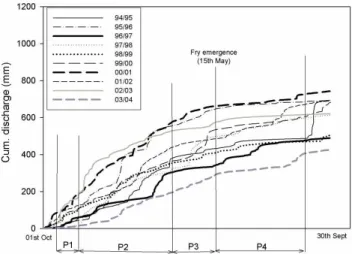
time periods: P1=Period 1, 15 October–14 November, Main time period where spawning salmon enter the Girnock Burn; P2=Period 2, 15 November–14 March, Winter period – low biological activity and low growth for juvenile fish; P3=Period 3, 15 March–15 May, Spring period – most rapid juvenile growth for fish that are one year of age or older; P4=Period 4, 15 May–31 August, Summer period – juvenile growth slows as a result of higher temperatures and higher metabolic costs.
Focussing on the ecologically “sensitive” time periods where Atlantic salmon are potentially most susceptible to flow-related effects, the cumulative discharge curves show the magnitude and nature of flow variability within specific time periods for each year (Fig. 5). The winter period 2 (P2) was generally characterised by the most marked variability. The flattest period of flow accumulation (i.e. the lowest rate of change) was around the start of period 4 (P4), which coin-cides with the time of fry emergence.
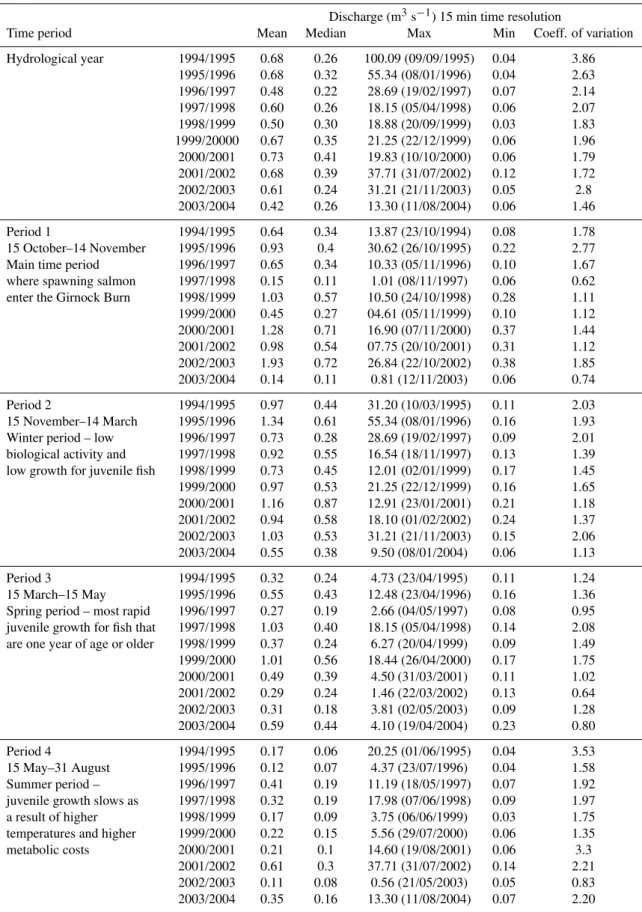
In Table 1, selected discharge statistics are listed for the ten years and for each ecologically “sensitive” time pe-riod. Mean discharge varied between 0.48 (1996/1997) and
% time exceeded
0.1 1 10 30 50 70 90
S
tr
e
a
m
te
m
p
e
ra
tu
re
[
o C
]
0 5 10 15 20
1994/95 1995/96
1996/97 1997/98 1998/99 1999/2000 2000/01 2001/02 2002/03 2003/04
18oC
Fig. 6. Time of exceedence of stream temperatures showing
benchmark temperature (optimum temperature) for Atlantic salmon growth (after Elliot and Hurley, 2003).
0.73 m3s−1 (2000/2001). Principal Component Analysis
(PCA) suggested that flow regimes differed between years principally in relation to their coefficients of variation and maximum flows.
The highest discharge generally occurred outside period 1 (i.e. when fish were moving into the burn), occurring four times during period 2 and three times during period 4. Only in 1997/1998 did the highest discharge occur in period 3. There was no consistent pattern in the timing of maximum discharge for different periods in individual years. This largely reflects the “flashy” hydrological regime of the Girnock Burn that even in summer high flow events can oc-cur immediately after a period of low flow. Inter-annual vari-ability in mean discharge, however, differed more markedly between designated periods. Period 1 had the greatest de-viation between lowest and maximum value (93%), whilst period 2 showed the lowest variability (59%).
4.2 Characterisation of stream temperature
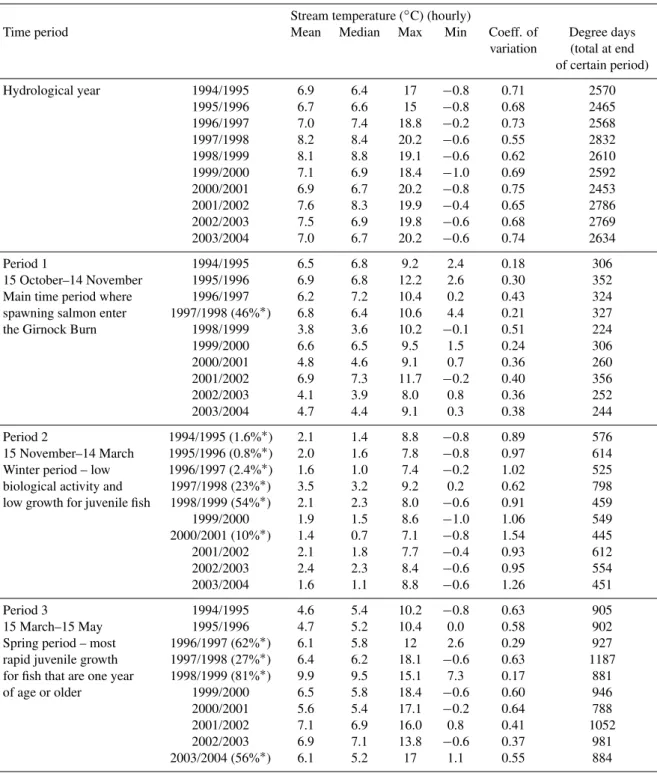
Stream temperatures in the Girnock Burn were characterised by less inter-annual variability than discharge (Fig. 6). Ap-plying PCA to temperatures, inter-annual differences were characterised mainly by mean and median values. Mean temperatures ranged between 6.9◦C (1995/1996) and 8.2◦C
(1997/1998, Table 2). The highest stream temperatures – exceeded for 1% of the time – ranged between 14.2◦C
(1995/1996) and 17.7◦C (2002/2003). Stream
tempera-tures in individual years varied between exceeding−0.6◦C
(2000/2001 and 2002/2003) and 1◦
C (1997/1998) for 95% of the time. Elliot and Hurley (2003) suggested a tem-perature of 18◦C as the mid-point of an optimum
tempera-ture range for growth of Atlantic salmon based on growth model applications, with lower and upper temperatures for growth of 7.8◦C and 24.6◦C, respectively. However,
Table 1.Statistical values of discharge for ecologically sensitive time periods.
Discharge (m3s−1) 15 min time resolution
Time period Mean Median Max Min Coeff. of variation
Hydrological year 1994/1995 0.68 0.26 100.09 (09/09/1995) 0.04 3.86
1995/1996 0.68 0.32 55.34 (08/01/1996) 0.04 2.63
1996/1997 0.48 0.22 28.69 (19/02/1997) 0.07 2.14
1997/1998 0.60 0.26 18.15 (05/04/1998) 0.06 2.07
1998/1999 0.50 0.30 18.88 (20/09/1999) 0.03 1.83
1999/20000 0.67 0.35 21.25 (22/12/1999) 0.06 1.96
2000/2001 0.73 0.41 19.83 (10/10/2000) 0.06 1.79
2001/2002 0.68 0.39 37.71 (31/07/2002) 0.12 1.72
2002/2003 0.61 0.24 31.21 (21/11/2003) 0.05 2.8
2003/2004 0.42 0.26 13.30 (11/08/2004) 0.06 1.46
Period 1 1994/1995 0.64 0.34 13.87 (23/10/1994) 0.08 1.78
15 October–14 November 1995/1996 0.93 0.4 30.62 (26/10/1995) 0.22 2.77
Main time period 1996/1997 0.65 0.34 10.33 (05/11/1996) 0.10 1.67
where spawning salmon 1997/1998 0.15 0.11 1.01 (08/11/1997) 0.06 0.62
enter the Girnock Burn 1998/1999 1.03 0.57 10.50 (24/10/1998) 0.28 1.11
1999/2000 0.45 0.27 04.61 (05/11/1999) 0.10 1.12
2000/2001 1.28 0.71 16.90 (07/11/2000) 0.37 1.44
2001/2002 0.98 0.54 07.75 (20/10/2001) 0.31 1.12
2002/2003 1.93 0.72 26.84 (22/10/2002) 0.38 1.85
2003/2004 0.14 0.11 0.81 (12/11/2003) 0.06 0.74
Period 2 1994/1995 0.97 0.44 31.20 (10/03/1995) 0.11 2.03
15 November–14 March 1995/1996 1.34 0.61 55.34 (08/01/1996) 0.16 1.93
Winter period – low 1996/1997 0.73 0.28 28.69 (19/02/1997) 0.09 2.01
biological activity and 1997/1998 0.92 0.55 16.54 (18/11/1997) 0.13 1.39 low growth for juvenile fish 1998/1999 0.73 0.45 12.01 (02/01/1999) 0.17 1.45
1999/2000 0.97 0.53 21.25 (22/12/1999) 0.16 1.65
2000/2001 1.16 0.87 12.91 (23/01/2001) 0.21 1.18
2001/2002 0.94 0.58 18.10 (01/02/2002) 0.24 1.37
2002/2003 1.03 0.53 31.21 (21/11/2003) 0.15 2.06
2003/2004 0.55 0.38 9.50 (08/01/2004) 0.06 1.13
Period 3 1994/1995 0.32 0.24 4.73 (23/04/1995) 0.11 1.24
15 March–15 May 1995/1996 0.55 0.43 12.48 (23/04/1996) 0.16 1.36
Spring period – most rapid 1996/1997 0.27 0.19 2.66 (04/05/1997) 0.08 0.95 juvenile growth for fish that 1997/1998 1.03 0.40 18.15 (05/04/1998) 0.14 2.08 are one year of age or older 1998/1999 0.37 0.24 6.27 (20/04/1999) 0.09 1.49
1999/2000 1.01 0.56 18.44 (26/04/2000) 0.17 1.75
2000/2001 0.49 0.39 4.50 (31/03/2001) 0.11 1.02
2001/2002 0.29 0.24 1.46 (22/03/2002) 0.13 0.64
2002/2003 0.31 0.18 3.81 (02/05/2003) 0.09 1.28
2003/2004 0.59 0.44 4.10 (19/04/2004) 0.23 0.80
Period 4 1994/1995 0.17 0.06 20.25 (01/06/1995) 0.04 3.53
15 May–31 August 1995/1996 0.12 0.07 4.37 (23/07/1996) 0.04 1.58
Summer period – 1996/1997 0.41 0.19 11.19 (18/05/1997) 0.07 1.92
juvenile growth slows as 1997/1998 0.32 0.19 17.98 (07/06/1998) 0.09 1.97
a result of higher 1998/1999 0.17 0.09 3.75 (06/06/1999) 0.03 1.75
temperatures and higher 1999/2000 0.22 0.15 5.56 (29/07/2000) 0.06 1.35
metabolic costs 2000/2001 0.21 0.1 14.60 (19/08/2001) 0.06 3.3
2001/2002 0.61 0.3 37.71 (31/07/2002) 0.14 2.21
2002/2003 0.11 0.08 0.56 (21/05/2003) 0.05 0.83
Table 2.Statistics of stream temperature (∗Percentage of missing data for given time period %.).
Stream temperature (◦C) (hourly)
Time period Mean Median Max Min Coeff. of Degree days
variation (total at end of certain period)
Hydrological year 1994/1995 6.9 6.4 17 −0.8 0.71 2570
1995/1996 6.7 6.6 15 −0.8 0.68 2465
1996/1997 7.0 7.4 18.8 −0.2 0.73 2568
1997/1998 8.2 8.4 20.2 −0.6 0.55 2832
1998/1999 8.1 8.8 19.1 −0.6 0.62 2610
1999/2000 7.1 6.9 18.4 −1.0 0.69 2592
2000/2001 6.9 6.7 20.2 −0.8 0.75 2453
2001/2002 7.6 8.3 19.9 −0.4 0.65 2786
2002/2003 7.5 6.9 19.8 −0.6 0.68 2769
2003/2004 7.0 6.7 20.2 −0.6 0.74 2634
Period 1 1994/1995 6.5 6.8 9.2 2.4 0.18 306
15 October–14 November 1995/1996 6.9 6.8 12.2 2.6 0.30 352
Main time period where 1996/1997 6.2 7.2 10.4 0.2 0.43 324
spawning salmon enter 1997/1998 (46%∗) 6.8 6.4 10.6 4.4 0.21 327
the Girnock Burn 1998/1999 3.8 3.6 10.2 −0.1 0.51 224
1999/2000 6.6 6.5 9.5 1.5 0.24 306
2000/2001 4.8 4.6 9.1 0.7 0.36 260
2001/2002 6.9 7.3 11.7 −0.2 0.40 356
2002/2003 4.1 3.9 8.0 0.8 0.36 252
2003/2004 4.7 4.4 9.1 0.3 0.38 244
Period 2 1994/1995 (1.6%∗) 2.1 1.4 8.8 −0.8 0.89 576
15 November–14 March 1995/1996 (0.8%∗) 2.0 1.6 7.8 −0.8 0.97 614
Winter period – low 1996/1997 (2.4%∗) 1.6 1.0 7.4 −0.2 1.02 525
biological activity and 1997/1998 (23%∗) 3.5 3.2 9.2 0.2 0.62 798
low growth for juvenile fish 1998/1999 (54%∗) 2.1 2.3 8.0 −0.6 0.91 459
1999/2000 1.9 1.5 8.6 −1.0 1.06 549
2000/2001 (10%∗) 1.4 0.7 7.1 −0.8 1.54 445
2001/2002 2.1 1.8 7.7 −0.4 0.93 612
2002/2003 2.4 2.3 8.4 −0.6 0.95 554
2003/2004 1.6 1.1 8.8 −0.6 1.26 451
Period 3 1994/1995 4.6 5.4 10.2 −0.8 0.63 905
15 March–15 May 1995/1996 4.7 5.2 10.4 0.0 0.58 902
Spring period – most 1996/1997 (62%∗) 6.1 5.8 12 2.6 0.29 927
rapid juvenile growth 1997/1998 (27%∗) 6.4 6.2 18.1 −0.6 0.63 1187
for fish that are one year 1998/1999 (81%∗) 9.9 9.5 15.1 7.3 0.17 881
of age or older 1999/2000 6.5 5.8 18.4 −0.6 0.60 946
2000/2001 5.6 5.4 17.1 −0.2 0.64 788
2001/2002 7.1 6.9 16.0 0.8 0.41 1052
2002/2003 6.9 7.1 13.8 −0.6 0.37 981
2003/2004 (56%∗) 6.1 5.2 17 1.1 0.55 884
temperatures of 18◦C were exceeded for 0.1% of the time
during seven years (1997/1998–2003/2004). A temperature of 24.6◦C was not exceeded at the site, though work on
spa-tial distribution of Girnock temperatures has shown that more extreme temperatures in particularly hot summers occur in the upstream river network where riparian shading is absent (Malcolm et al., 2004).
Table 3. Time of exceedence when mean stream velocity exceeded Critical Displacement Velocity (CDV) (%) (∗For January–April:
as-sumption of a minimum fish length of 20 mm for 0+ fish; with fry emergence in mid May.).
0+ fish
1994–1995 1995–1996 1996–1997 1997–1998 1998–1999 1999–2000 2000–2001 2001–2002 2002–2003 2003–2004
October 3.2 9.7 6.5 0.0 32.3 0.0 22.6 16.1 35.5 0.0
November 6.7 36.7 46.7 23.3 33.3 13.3 56.7 13.3 33.3 3.3
December 32.3 54.8 71.0 22.6 51.6 96.8 77.4 67.7 51.6 45.2
January∗ 100 100 93.5 100 100 100 100 100 100 100
February∗ 100 100 96.4 46.4 100 100 100 100 100 100
March∗ 100 100 71.0 58.1 64.5 41.9 100 87.1 61.3 90.3
April∗ 26.7 96.7 0.0 93.3 30.0 100 76.7 0.0 10.0 80.0
May 6.5 25.8 45.2 3.2 16.1 19.4 0.0 22.6 32.3 29.0
June 3.3 0.0 10.0 6.7 6.7 0.0 0.0 0.0 0.0 0.0
July 0.0 0.0 6.5 0.0 0.0 0.0 0.0 6.5 0.0 0.0
August 0.0 0.0 0.0 0.0 0.0 0.0 6.5 6.5 0.0 12.9
September 26.7 0.0 0.0 0.0 6.7 6.7 0.0 0.0 0.0 0.0
Total time
exceeded 33.4 43.4 37 29.3 36.2 39.6 44.7 34.8 35.1 38.5
1+ fish
October 3.2 6.5 0.0 0.0 9.7 0.0 12.9 9.7 22.6 0.0
November 0.0 23.3 46.7 10.0 20.0 6.7 33.3 6.7 30.0 3.3
December 19.4 45.2 61.3 12.9 41.9 93.5 51.6 58.1 29.0 45.2
January 77.4 64.5 61.3 71.0 77.4 74.2 100 71.0 67.7 80.6
February 82.1 89.7 53.6 10.7 53.6 62.1 100 89.3 75.0 62.1
March 12.9 32.3 12.9 22.6 0.0 16.1 71.0 25.8 3.2 45.2
April 3.3 6.7 0.0 46.7 6.7 46.7 0.0 0.0 0.0 6.7
May 0.0 0.0 3.2 0.0 0.0 0.0 0.0 0.0 0.0 0.0
June 3.3 0.0 3.3 0.0 0.0 0.0 0.0 0.0 0.0 0.0
July 0.0 0.0 3.2 0.0 0.0 0.0 0.0 6.5 0.0 0.0
August 0.0 0.0 0.0 0.0 0.0 0.0 3.2 3.2 0.0 3.2
September 16.7 0.0 0.0 0.0 3.3 3.3 0.0 0.0 0.0 0.0
Total time
exceeded 17.8 22.1 20.3 14.5 17.5 25.1 30.7 22.2 18.6 20.6
4.3 Effects of discharge and stream temperature on forag-ing behaviour of juvenile Atlantic salmon
To assess the times when the foraging behaviour of juveniles Atlantic salmon may be constrained by hydraulic conditions, the percentage of time when CDV was exceeded by mean daily stream velocity was determined for the fish age classes 0+ and 1+ (Table 3). As a result of the interaction between intra-annual changes in fish length and stream temperature, the CDV for each age class varied systematically through-out the year (Fig. 8). Clear seasonal patterns in CDV were apparent. The higher CDV values typical of the summer pe-riod, due to greater fish length and higher temperatures indi-cate that high discharges, are less likely to constrain feeding opportunities during this time. In addition, CDV was more stable (less day-to-day variability) during the summer than the winter. In general, CDV showed greater intra-annual than inter-annual variability due to strong seasonal patterns in stream temperature. However, clear differences were ev-ident in the total percentage of the time for which mean ve-locities exceeded the CDV in the ten years, as a result of high inter-annual variability in discharge conditions (Table 3).
Fig. 7.Cumulative stream temperature curves as degree days
a)
01/95 01/96 01/97 01/98 01/99 01/00 01/01 01/02 01/03 01/04
M
e
a
n
s
tr
e
a
m
v
e
lo
c
it
y
a
n
d
C
ri
ti
c
a
l
D
is
p
la
c
e
m
e
n
t
V
e
lo
c
it
y
(m
s
-1 )
0.0 0.5 1.0 1.5 2.0 2.5 3.0
Mean stream velocity
CDV 0+ fish
b)
01/95 01/96 01/97 01/98 01/99 01/00 01/01 01/02 01/03 01/04
M
e
a
n
s
tr
e
a
m
v
e
lo
c
it
y
a
n
d
C
ri
ti
c
a
l
D
is
p
la
c
e
m
e
n
t
V
e
lo
c
it
y
(m
s
-1)
0.0 0.5 1.0 1.5 2.0 2.5 3.0
Mean stream velocity
CDV 1+ fish
Fig. 8. Daily Critical Displacement Velocity (CDV) and daily mean stream velocity for(a)0+ and(b) 1+ salmon over the ten years
investigated.
The duration of periods when mean stream velocity ex-ceeded CDV for salmon fry (0+) ranged between 29.3% (1997/1998) and 44.7% (2000/2001). CDVs are relatively high during the summer due to warmer stream temperatures and CDV was only occasionally exceeded. Although fry do not emerge from the streambed before ca. mid-May, CDV values were calculated for January to April months in order to examine the potential influence of CDV exceedence on foraging opportunities during this time. The winter months were characterised by an exceedence of CDV by stream ve-locity for fry by almost 100%. The earliest time at which hydraulic conditions are suitable for free swimming and for-aging fry was May, close to the usual time of fry emergence in the Girnock.
For 1+ parr, mean stream velocity exceeded CDV be-tween 14.5% (1997/1998) and 30.7% (2000/2001) of the time. Again, the highest percentages of exceedence time were generally reached in January/February. But because of the larger size of parr relative to fry, 100% exceedence in any month was only predicted in 2002/2003. During years with higher stream temperatures (e.g. 1997/1998, Table 2) and in summer, CDV values were relatively higher and ex-ceedence values lower. This was because the potential
con-straints of high discharge on foraging were compensated for by the greater scope for fish mobility afforded by higher tem-peratures.
4.4 Effects of discharge and stream temperature on return-ing spawners
Simple linear correlation analyses were carried out as a pre-liminary assessment of influences of discharge and stream temperature on returning adult numbers (Table 4). Due to the extremely complex interactions between abiotic influences and biological controls on salmonids movement at spawn-ing, it is unsurprising that the number of returning female spawners was not directly related to discharge for whole hy-drological years (P >0.1323). However, focussing on eco-logically “sensitive” time periods and providing a more bio-logically relevant temporal resolution for analysis improved regression results substantially.
Table 4.Pearson coefficients of correlation (r) andP-values between discharge variables and returning adults.
Discharge value Total fish Total male Total female
r P r P r P
Total hydrological year Mean 0.40 0.2552 0.32 0.1243 0.22 0.5424
Max 0.51 0.1344 0.39 0.2589 0.51 0.1323
Min −0.25 0.4868 −0.29 0.4129 −0.17 0.6455
SD 0.48 0.1637 0.47 0.1723 0.40 0.2584
CV 0.40 0.2550 0.34 0.3417 0.38 0.2837
Period 1 Mean 0.15 0.6713 0.26 0.4667 0.03 0.9272
15th October–14 November Max 0.66 0.0361 0.59 0.0751 0.61 0.0621
Main time period where Min 0.08 0.8192 0.25 0.4824 −0.08 0.8320
spawning salmon enter SD 0.43 0.2096 0.42 0.2275 0.37 0.2976
the Girnock Burn CV 0.82 0.0038 0.61 0.0637 0.85 0.0018
r = 0.61 p-value = 0.0621
Coefficient of variation (discharge, period 1)
0 10 20 30 40
T
o
ta
l
n
u
m
b
e
r
re
tu
rn
in
g
fe
m
a
le
s
0 10 20 30 40 50 60 70 80
02/03 01/02
97/98 98/99 99/00
96/97
94/95
95/96
00/01
Maximum discharge ( period 1)
0.0 0.5 1.0 1.5 2.0 2.5 3.0
T
o
ta
l
n
u
m
b
e
r
re
tu
rn
in
g
fe
m
a
le
0 10 20 30 40 50 60 70 80
02/03 01/02
97/98 98/99 99/00
96/97
94/95
95/96
00/01
03/04 03/04
r = 0.85 p-value = 0.0018
Fig. 9. Scatterplot showing relationships between selected discharge values during period 1 (15 October–14 November; main time period
where spawning salmon enter the Girnock Burn) and returning females.
is unsurprising that there were weaker correlations between hydrological conditions and adult male numbers (Table 4). Correlation plots showing the relationships between maxi-mum discharge and coefficients of variation and returning females are shown in Fig. 9 and indicate that the correlations were strongly influenced by the extreme conditions during 1995/1996 and 1997/1998.
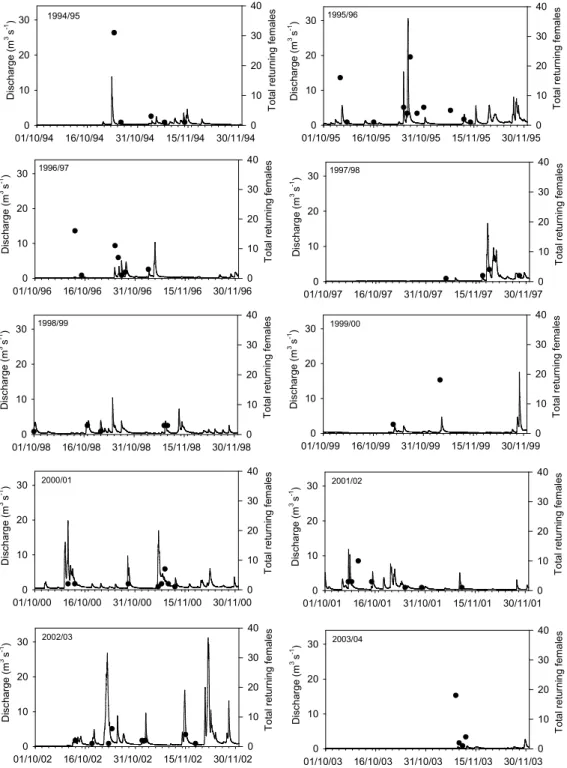
For further understanding of relationships between hydro-logical conditions and returning female spawners, daily re-turning female spawners were plotted against hydrographs during period 1 (Fig. 10). Hydrological conditions dif-fered substantially between the ten years examined and pat-terns of fish entry varied too. The entry of female fish was much more evenly distributed during years with regular flow pulses during the critical period. In most years, spawn-ers could be shown to enter the stream coincident with hy-drological events. For example, in 1994/1995, 1995/1996 and 1997/1998, the highest numbers of returns on one day occurred during the largest hydrological event. However, in other years, such as 1996/1997, 1998/1999, 1999/2000, 2000/2001, 2001/2002 and 2002/2003 fish entry was more
evenly distributed over a range of smaller events. In con-trast, 2003/2004 saw a sustained period of low discharges in the months prior to spawning, which resulted in all spawn-ing females enterspawn-ing the burn in response to two very mi-nor increases in stream discharge. Discharges below about 0.3 m3s−1appeared to inhibit access to the stream.
5 Discussion
1994/95
01/10/94 16/10/94 31/10/94 15/11/94 30/11/94
D is c h a rg e (m 3 s -1 ) 0 10 20 30 T o ta l re tu rn in g fe m a le s 0 10 20 30 40 1995/96
01/10/95 16/10/95 31/10/95 15/11/95 30/11/95
D is c h a rg e (m 3 s -1 ) 0 10 20 30 T o ta l re tu rn in g fe m a le s 0 10 20 30 40 1996/97
01/10/96 16/10/96 31/10/96 15/11/96 30/11/96
D is c h a rg e (m 3 s -1 ) 0 10 20 30 T o ta l re tu rn in g fe m a le s 0 10 20 30 40 1997/98
01/10/97 16/10/97 31/10/97 15/11/97 30/11/97
D is c h a rg e (m 3s -1) 0 10 20 30 T o ta l re tu rn in g fe m a le s 0 10 20 30 40 1998/99
01/10/98 16/10/98 31/10/98 15/11/98 30/11/98
D is c h a rg e (m 3 s -1 ) 0 10 20 30 T o ta l re tu rn in g fe m a le s 0 10 20 30 40 1999/00
01/10/99 16/10/99 31/10/99 15/11/99 30/11/99
D is c h a rg e (m 3s -1) 0 10 20 30 T o ta l re tu rn in g fe m a le s 0 10 20 30 40 2000/01
01/10/00 16/10/00 31/10/00 15/11/00 30/11/00
D is c h a rg e (m 3s -1) 0 10 20 30 T o ta l re tu rn in g fe m a le s 0 10 20 30 40 2001/02
01/10/01 16/10/01 31/10/01 15/11/01 30/11/01
D is c h a rg e (m 3s -1) 0 10 20 30 T o ta l re tu rn in g fe m a le s 0 10 20 30 40 2002/03
01/10/02 16/10/02 31/10/02 15/11/02 30/11/02
D is c h a rg e (m 3s -1) 0 10 20 30 T o ta l re tu rn in g fe m a le s 0 10 20 30 40 2003/04
01/10/03 16/10/03 31/10/03 15/11/03 30/11/03
D is c h a rg e (m 3 s -1 ) 0 10 20 30 T o ta l re tu rn in g fe m a le s 0 10 20 30 40
Fig. 10.Timing and number of returning spawning salmon in relation to hydrological conditions for the ten years investigated.
genetic adaptation may affect the timing of certain activities (Stewart et al., 2002). In the Girnock Burn, it has been shown that local genotype is a direct effect on growth performance (Jordan and Youngson, 1991), but, unsurprisingly, most of the variability in the growth of juvenile salmon (ca. 85%) can be accounted for by variability in stream temperatures (Ba-con et al., 2005). In this (Ba-context, the analysis of CDV applied
in this study highlighted quite marked inter- and intra-annual variability in the potential feeding opportunities for juvenile salmon during critical growth time periods, a factor which may help account for unexplained variability in growth.
response by fish mediated by differences in adult spawning time (Webb and McLay, 1996). Together with incubation temperature, this is likely to determine hatch and emergence dates, i.e. they emerge at a time when discharges are, on av-erage, becoming lower and less variable (Heggberget, 1988). In the first few weeks after emergence, small 0+ fish have relatively low CDVs and consequent low ability to forage in faster flowing sections of the stream. When high dis-charges do occur soon after hatch time (e.g. in 1997/1998 and 1999/2000) there may be marked effects on recruitment, foraging and growth rates (Jensen, 2003).
In the Girnock, 1+ fish grow most markedly in the March-May period, prior to the emergence of 0+ individuals, prob-ably because of the high seasonal prey abundance and low basal metabolic costs associated with lower temperatures (Gibbins et al., 2002; Elliot and Hurley, 2003; Gibbins et al., 2004; Bacon et al., 2005). The later emergence of the 0+ fish relative to this same period may reflect the overall fit-ness benefits of avoiding emergence when growth potential is high but hydraulic conditions are typically unfavourable for foraging.
The second key life stage examined in the present study was the entry of adult fish into the stream for spawning. This was also strongly influenced by event scale variation in dis-charge conditions. The timing of entry of females was more distributed during years with regular flow pulses during the critical period. During years with long periods of low flow the entry of spawners was delayed and minor flow pulses were apparently sufficient to cause fish to enter the stream, perhaps as sexual development and impending ovulation or actual ovulation increasingly demand entry even under sub-optimal conditions. Many of the adults entering the Girnock Burn have been tagged there previously as smolts (Young-son et al., 1994). This suggests that fish originating in the stream are committed to spawning there rather than in other, more accessible locations. Yet, large fish in small streams are extremely vulnerable to predation for the duration of their stay there (Carss et al., 1990). Delaying final migration into the stream until shortly before spawning, and the increasing need to move upstream regardless of discharge magnitude, probably reflect play-offs between the likelihood of reaching preferred target locations for spawning, the energetic costs involved in doing so, and the discounted individual risk of predation before spawning can take place.
The study has also indicated significant positive correla-tions between coefficient of variation for discharge during spawning period 1 and number of returning females. This may emphasise the importance of regular discharge variation for ecological integrity (Fausch et al., 2002). Numerically, full juvenile recruitment to stream populations is dependent on a sufficient number of potential adult spawners reaching their targeted destinations throughout the usable reaches of the stream, so that juveniles are distributed throughout the useable habitat. Thus, qualitatively, effective population size and the maintenance of genetic diversity are critically
depen-dent on spawner number in relatively small spawning popu-lations such as those of the Girnock Burn (Ryman, 1991).
The entire range of variability in discharges and tempera-tures plays a crucial role in the maintenance of river ecosys-tems (e.g. Allan, 1995; Petts, 2000; Archer and Newson, 2002). This study has shown that short-term variability (e.g. at the event scale in relation to spawning or during critical growth period for juvenile fish) in discharge and tempera-tures can have important implications for certain life stages. Although the results represent only a first step in understand-ing such complex interactions, such information can provide insights for the management of fisheries resources (Fausch et al., 2002). For example, setting Ecologically Acceptable Flow regimes (EAFs) on regulated rivers for the benefit of target species such as Atlantic salmon need to incorporate the habitat requirements of different life-stages at a range of temporal scales. If freshet or compensation releases for fisheries benefit are to be made, variable regimes are needed during the period of maximum spring growth rates – to avoid potential CDV exceedence – and during the final phase of the spawning migration to facilitate passage (Jackson et al., 2004). This has implications for using tools such as the “Range of Variability” approach (Richter et al., 1997) in set-ting environmental flow targets in river systems, as they are generally based on timescales (i.e. weekly or monthly) that may not capture such subtle interactions between physical habitat conditions and biological activity (Stewardson and Gippel, 2003).
Moreover, whilst physical environmental effects on salmonids are most marked during extreme hydrological and thermal conditions (as shown in Fig. 9), the thresholds mark-ing the difference between normal system behaviour and dis-turbances are uncertain. Thus it is clear that river systems are climatically-driven and need to be understood in the con-text of climatic variations (Harris et al., 2000). Addition-ally, the recognition that climatic effects on river systems are non-stationary needs to be considered, particularly at a time when the effects of marked climatic change are being predicted for many river systems (Fowler and Kilsby, 2003). Consequently, analysis of longer-term, discharge and tem-perature data, together with biological data, at those few sites where all are available is important in order to understand such mechanisms and controls on biological variables and contribute to the development of a more scientific basis for river management.
values as applied in this study, although useful for illustrat-ing inter-annual variability in hydraulic conditions in rela-tion to CDVs, masks differences in the absolute hydraulic conditions experienced by individual fish. Work by Webb et al. (2001) and Gibbins et al. (2002) has already shown how channel characteristics in different parts of the catchment af-fect the way in which spawning habitat varies with flow. On a finer scale, opportunities for individual fish to avoid loca-tions where CDV is exceeded, by moving just a small dis-tance to a refuge area are likely to exist, even at the gauge site (this is evident from velocity distribution presented in Fig. 2). Thus, more advanced hydraulic characterisation, ei-ther by field measurement and/or 3-D modelling, is needed to allow small spatial-scale variability in velocity to be factored into these types of analysis (Booker et al., 2004). In addition, the complex behavioural responses of juvenile fish to small scale velocity changes in natural channels need to be better understood (Holm et al., 2001).
More generally, studies at the larger spatial scales are needed to contextualise processes in small streams like the Girnock Burn. For example, the numbers of returning adult fish were used in this study to illustrate an ecological re-sponse which was potentially triggered by flow influences. However, the conditioning of the ways in which spawners exploit variable habitat conditions at particular times is prob-ably conditioned over the long period of river life prior to stream entry (>8 months for many Girnock spawners). In ad-dition, the connectivity of riverine habitats, and particularly the main river system – spawning stream continuum needs to be investigated further (Fausch et al., 2002). This might in-clude an assessment of the connections between adult return to freshwaters and spawning in the autumn. It might also include a consideration of how spawners in mainstem river systems respond to differences in discharge and temperature variability that have their origin in different parts of the main-stem river or stream network. Clearly a major research effort is needed to underpin the implementation of policies aimed at more scientific approaches to the management of rivers over coming decades.
Acknowledgements. The authors are grateful to the support of
DFG supporting DT on her research fellowship. The invaluable help of D. Fraser from the Scottish Environment Protection Agency (SEPA) in kindly providing the stage, discharge and velocity data is gratefully acknowledged. Thanks are also due to J. Thorley of the FRS Freshwater Laboratory for useful discussions. Three anony-mous referees are thanked for pointing out numerous shortcomings in an earlier version of the paper.
Edited by: A. Ghadouani
References
Armstrong, J. D., Kemp, P. S., Kennedy, G. J. A., Ladle, M., and Milner, N. J.: Habitat requirements of Atlantic salmon and brown trout in rivers and streams, Fish. Res., 62, 143–170, 2003.
Allan, J. D.: Stream ecology, Chapman and Hall, 45–82, 1995. Archer, D. and Newson, M.: The use of indices of flow variability
in assessing the hydrological and instream habitat impacts of up-land afforestation and drainage, J. Hydrol., 268, 244–258, 2002. Arndt, S. K. A., Benfey, T. F., and Cunjak, R. A.: Effect of tempo-rary reductions in feeding on protein synthesis and energy stor-age of juvenile Atlantic salmon, J. Fish Biol., 49, 257–276, 1996. Arndt, S. K. A., Cunjak, R. A., and Benfey, T. J.: Effect of sum-mer floods and spatio-temporal scale on growth and feeding of juvenile Atlantic salmon in two New Brunswick streams, Trans-actions of the American Fisheries Society, 131, 607–622, 2002. Bacon, P. J., Gurney, W. S. C., Jones, W., McLaren, I. S., and
Youngson, A. F.: Seasonal growth patterns of wild juvenile fish : partitioning variation among explanatory variables, based on in-dividual growth trajectories of Atlantic salmon (Salmo salar) parr, Journal of Animal Ecology, 74, 1–11, 2005.
Booker, D. J., Dunbar, M. J., and Ibbotson, A.: Predicting juvenile salmonid drift-feeding habitat quality using a three-dimensional hydraulic-bioenergetic model, Ecol. Modell., 177, 157–177, 2004.
Bunt, C. M., Cooke, S. J., Katopodis, C., and McKinley, R. S.: Movement and summer habitat of brown trout (Salmo trutta) be-low a pulsed discharge hydroelectric generation station, Regu-lated Rivers Research and Management, 15, 395–403, 1999. Carss, D. N., Kruuk, H., and Conroy, J. W. H.: Predation on adult
Atlantic salmon, Salmo salar L., by otters, Lutra lutra (L.), within the River Dee system, Aberdeenshire, Scotland, J. Fish Biol., 37, 935–944, 1990.
Clausen, B. and Biggs, B. J. F.: Flow variables for ecological studies in temperate streams: groupings based on covariance, J. Hydrol., 237, 184–197, 2000.
Elliot, J. M.: Tolerance and resistance to thermal stress in juvenile Atlantic salmon,Salmo salar, Freshwater Biology, 25, 61–70, 1991.
Elliot, J. M. and Hurley, M. A.: Variation in the temperature prefer-ence and growth rate of individual fish reconciles differprefer-ences be-tween two growth models, Freshwater Biology, 48, 1793–1798, 2003.
Enders, E. C., Buffin-Belanger, T., Boisclair, D., and Roy, A. G.: The feeding behaviour of juvenile Atlantic salmon in relation to turbulent flow, J. Fish Biol., 66, 242–253, 2005.
Fausch, K. D., Torgersen, C. E., Baxter, C. V., and Li, H. W.: Land-scapes to riverLand-scapes: bridging the gap between research and conservation of stream fishes, Bioscience, 52, 483–498, 2002. Flodmark, L. E. W., Vollestad, L. A., and Forseth, T.: Performance
of juvenile brown trout exposed to fluctuating water level and temperature, J. Fish Biol., 65, 460–470, 2004.
Fowler, H. J. and Kilsby, C. G.: A regional frequency analysis of United Kingdom extreme rainfall from 1961 to 2000, Interna-tional Journal of Climatology, 23, 1313–1334, 2003.
Gibbins, C. N., Acornley, R. M.: Salmonid habitat modelling stud-ies and their contribution to the development of an ecologically acceptable release policy for Kielder Reservoir, North-East Eng-land, Regulated Rivers Research and Management, 6, 203–224, 2000.
Gibbins, C. N., Moir, H. J., Webb, J., and Soulsby, C.: Assess-ing discharge use by spawnAssess-ing Atlantic salmon: a comparison of discharge electivity indices and PHABSIM simulations, Riv. Res. Appl., 18, 383–395, 2002.
Gibbins, C. N., Soulsby, C., Campbell, L., Scott, E., McEwan, I., and Malcolm, I.: Influence of channel hydraulics and sediment mobility on stream invertebrate drift. Hydrology: Science and Practice for the 21st Century, Proceedings of the British Hy-drological Society International Symposium, London, 2, 90–98, 2004.
Gilvear, D. J.: River flow regulation, in: The freshwaters of Scot-land: a natural resource of international significance, edited by: Maitland, P. S., Boon, P. J., and McLuskey, D. S., Wiley, Chich-ester, 463–487, 1994.
Gilvear, D. J., Heal, K. V., and Stephen, A.: Hydrology and the ecological quality of Scottish river ecosystems, The Science of the Total Environment, 294, 131–159, 2002.
Gordon, N. D., McMahon, T. A., Finlayson, B. L., Gippel, C. J., and Nathan, R. J.: Stream hydrology – an introduction for ecologists, Wiley, 233–357, 2004.
Graham, D. W., Thorpe, J. E., and Metcalfe, N. B.: Seasonal current holding performance of juvenile Atlantic salmon in relation to temperature and smolting, Can. J. Fish. Aquat. Sci., 53, 80–86, 1996.
Gustard, A., Cole, G., Marshall, D. C. W., and Bayliss, A. C.: A study of compensation flows in the UK, Institute of Hydrology, report No. 99, Wallingford, 1987.
Hannah, D. M., Malcolm, I. A., Soulsby, C., and Youngson, A. F.: Heat exchange and temperature behaviour in a salmon spawning stream in the Cairngorms, Scotland: seasonal and sub-seasonal dynamics, Riv. Res. Appl., 20, 635–652, 2004.
Harris, N. M., Gurnell, A. M., Hannah, D. M., and Petts, G.: Clas-sification of river regimes: a context for hydro-ecology, Hydrol. Processes, 14, 2831–2848, 2000.
Heggberget, T.: Timing of spawning in Norwegian Atlantic salmon
(Salmo salar), Can. J. Fish. Aquat. Sci., 45, 845–849, 1988.
Holm, C. F., Armstrong, J. D., and Gilvear, D. J.: Investigating a major assumption of predictive instream habitat models: is water velocity preference of juvenile Atlantic salmon independent of discharge?, J. Fish Biol., 59, 1653–1666, 2001.
Jackson, H., Gibbins, C. N., Soulsby, C., McMullen, J. A., Casa Mulet, R., Malcolm, I. A., and Youngson, A. F.: Role of freshets in developing ecologically acceptable flow regimes for the river Lyon, Scotland. Proceedings of the 5th International Conference on Ecohydraulics, Madrid, Spain, 1, 723–729, 2004.
Jensen, A.: Atlantic salmon (Salmo salar) in the regulated River Alta: effects of altered water temperature on parr growth, Riv. Res. Appl., 19, 733–747, 2003.
Jordan, W. C. and Youngson, A. F.: Genetic protein variation and natural selection in Atlantic salmon, J. Fish Biol., 39 (Suppl. A), 185–192, 1991.
Kemp, P. S., Gilvear, D. J., and Armstrong, J. D.: Do juvenile At-lantic salmon parr track local changes in water velocity?, Riv. Res. Appls., 19, 569–575, 2003.
Langan, S. J., Johnston, L., Donaghy, M. J., Youngson, A. F., Hay, D. W., and Soulsby, C.: Variation in river water temperatures in an upland stream over a 30 year period, The Science of the Total Environment, 265, 195–207, 2001.
Malcolm, I. A., Soulsby, C., and Youngson, A. F.: Thermal
regimes in the hyporheic zone of two contrasting salmon spawn-ing streams; hydrological and ecological implications, Fisheries Management and Ecology, 9, 1–10, 2002.
Malcolm, I. A., Youngson, A. F., and Soulsby, C.: Survival of salmonid eggs in a degraded gravel bed stream: effects of groundwater – surface water interactions, Riv. Res. Appl., 19, 303–316, 2003.
Malcolm, I. A., Hannah, D., Donaghy, M., Soulsby, C., Youngson, A. F., and Bacon, P.: Influence of riparian woodland on water temperatures in an upland salmon stream, Hydrol. Earth Syst. Sci., 8, 449–459, 2004,
SRef-ID: 1607-7938/hess/2004-8-449.
Moir, H., Soulsby, C., and Youngson, A.F.: Hydraulic and sedi-mentary characteristics of habitat utilized by Atlantic salmon for spawning in the Girnock Burn, Scotland, Fisheries Management and Ecology, 5, 241–254, 1998.
Moir, H., Soulsby, C., and Youngson, A.F.: The hydraulic and sed-imentary controls on the availability of Atlantic salmon spawn-ing habitat in the river system NE Scotland, Geomorphology, 45, 291–308, 2002.
Moir, H., Gibbins, C. N., Soulsby, C., and Webb, J.: Linking chan-nel geomorphic characteristics to spatial patterns of spawning ac-tivity and discharge use by Atlantic salmon (Salmo salar L.), Ge-omorphology, 60, 21–35, 2004.
Moir, H., Gibbins, C., Soulsby, C., and Youngson, A.F.: Valida-tion of PHABSIM predicValida-tions for simulating salmon spawning habitat, Riv. Res. Appl., 21, 1–14, 2005.
Mohseni, O. and Stefan, H. G.: Stream temperature/air temperature relationship: a physical interpretation, J. Hydrol., 218, 128–141, 1999.
Moore, A. and Waring, C.P.: Electrophysiological and endocrino-logical evidence that F-series prostaglandins function as priming pheromones in mature male Atlantic salmon (Salmo salar) parr, J. Expl. Biol., 199, 2307–2316, 1996.
Naiman, R. J., Bunn, S. E., Nilson, C., Petts, G. E., Pinay, G., and Thompson, L. C.: Legitimizing fluvial ecosystems as users of waters, Environ. Manag., 30, 455–467, 2002.
Økland, F., Erkinaro, J., Moen, K., Niemelae, E., Fiske, P., McKin-ley, R. S., and Thorstad, E. B.: Return migration of Atlantic salmon in the River Tana: phases of migratory behaviour, J. Fish Biol., 59, 862–874, 2001.
Olden, J. D. and Poff, N. L.: Redundancy and the choice of hydro-logical indices for characterising streamflow regimes, Riv. Res. Appl., 19, 101–121, 2003.
Petts, G. E.: Long-term consequences of upstream impoundment, Environ. Conserv., 7, 325–332, 1980.
Petts, G. E.: A perspective on the abiotic processes sustaining the ecological integrity of running waters, Hydrobiologia, 422/423, 15–27, 2000.
Poff, N. L.: Why disturbances can be predictable: a perspective on the definition of disturbances in streams, J. North American Benthological Society, 11, 86–92, 1992.
Poff, N. L., Allan, D. J., Bain, M. B., Karr, J. R., Prestegaard, K. L., Richter, B. D., Sparks, R. E., and Stromberg, J. C.: The Natural Flow Regime – A paradigm for river conservation and restora-tion, Bio-Science, 47, 769–784, 1997.
Resh, V. H., Brown, A. V., Covich, A., Gurtz, M. E., Hiram, W. L., Minshall, G. W., Reice, S. R., Sheldon, A. L., Wallace, J. B., and Wissmar, R. C.: The role of disturbance in stream ecology, J. North American Benthological Society, 7, 433–455, 1988. Richter, B. D., Baumgartner, J. V., Powell, J., and Braun, D. P.:
A method for assessing hydrologic alteration within ecosystems, Cons. Biol., 10, 1163–1174. 1996.
Richter, B. D., Baumgartner, J. V., and Braun, D. P.: How much water does a river need?, Freshwat. Biol., 37, 231–249, 1997. Richter, B. D., Baumgartner, J. V., Powell, J., and Braun, D. P.:
A spatial assessment of hydrologic alteration within a river net-work, Regul. Riv. Res. Managemt., 14, 329–340, 1998. Ryman, N.: Conservation genetics considerations in fishery
man-agement, J. Fish Biol., 39 (Suppl. A), 211–224, 1991.
Schlosser, I. J.: Dispersal, boundary processes and trophic-level in-teractions in streams adjacent to beaver ponds, Ecology, 76, 908– 925, 1995.
Soulsby, C. and Boon, P. J.: Freshwater Environments in Scotland: an Earth Science perspective on the natural heritage of Scotlands rivers, in: Earth Science and the Natural Heritage, edited by: Gordon, J. and Leys, K., Stationary Office, London, 82–104, 2001.
Soulsby, C., Malcolm, I. A., Youngson, A. F., Tetzlaff, D., Gibbins, C. N., and Hannah, D. M.: Groundwater – surface water interac-tions in upland Scottish rivers: hydrological, hydrochemical and ecological implications, Scottish Journal of Geology, 41, 39–49, 2005a.
Soulsby, C., Tetzlaff, D., van den Bedem, N., Malcolm, I. A., Ba-con, P. J., and Youngson, A. F.: Inferring groundwater – surface water interactions in montane catchments from hydrochemical surveys of springs and streamwaters, J. Hydrol., in press, 2005b. Stewardson, M. J. and Gippel, C. J.: Incorporating flow variability into environmental flow regimes using the flow event method, Riv. Res. Appl., 19, 459–472, 2003.
Stewart, D. C., Smith, G. W., and Youngson, A. F.: Tributary-specific variation in timing of return adult Atlantic salmon
(Salmo salar) to fresh water has a genetic component, Can. J.
Fish. Aquat. Sci., 59, 276–281, 2002.
Swansburg, E., El-Jabi, N., Caissie, D., and Chaput, G.: Hydrome-teorological trends in the Miramichi River, Canada: Implications for Atlantic Salmon growth, North American Journal of Fisheries Management, 24, 561–576, 2004.
Tetzlaff, D., Uhlenbrook, S., Grottker, M., and Leibundgut, Ch.: Hydrological assessment of flow dynamic changes on an event-scale by storm water pipe outflows and combined sewer over-flows in an urban river, Urban Water, in press, 2005a.
Tetzlaff, D., Soulsby, C., Gibbins, C., Bacon, P. J., and Young-son, A. F.: An approach to assessing hydrological influences on feeding opportunities of juvenile Atlantic salmon (Salmo
salar): a case study of two contrasting years in a small, nursery
stream, Hydrobiologia, 549, 65–77, http://dx.doi.org/10.1007/ s10750-005-4166-6, 2005b.
Townsend, C. R., Hildrew, A. G., and Schofield, K.: Persistence of stream invertebrate communities in relation to environmental variability, J. Animal Ecol., 56, 597–613, 1987.
Webb, B. W. and Nobilis, F.: A long-term perspective on the nature of the air-water temperature relationship: a case study, Hydrol. Processes, 11, 137–147, 1997.
Webb, J. H. and McLay, H. A.: Variation in the time of spawning of Atlantic salmon (Salmo salar) and its relationship to temperature in the Aberdeenshire Dee, Scotland, Can. J. Fish. Aquat. Sci., 53, 2739–2744, 1996.
Webb, J. H., Gibbins, C. N., Moir, H., and Soulsby, C.: Flow re-quirements of spawning Atlantic salmon in an upland stream: implications for water resource management, Journal of the Chartered Institute of Water and Environmental Management, 15, 1–8, 2001.
Webb, B. W., Clack, P. D., and Walling, D. E.: Water-air temper-ature relationships in a Devon river system and the role of flow, Hydrol. Processes, 17, 3069–3084, 2003.
Youngson, A. F., Buck, R. J. G., Simpson, T. H., and Hay, D. W.: The autumn and spring emigrations of juvenile Atlantic salmon,
Salmo salar L. from Girnock Burn, Aberdeenshire, Scotland:
environmental release of migration, J. Fish Biol., 23, 625–639, 1983.