Generating optimal control simulations of
musculoskeletal movement using
OpenSim and MATLAB
Leng-Feng Lee and Brian R. Umberger
Department of Kinesiology, University of Massachusetts Amherst, Amherst, MA, United States
ABSTRACT
Computer modeling, simulation and optimization are powerful tools that have seen increased use in biomechanics research. Dynamic optimizations can be categorized as either data-tracking or predictive problems. The data-tracking approach has been used extensively to address human movement problems of clinical relevance. The predictive approach also holds great promise, but has seen limited use in clinical applications. Enhanced software tools would facilitate the application of predictive musculoskeletal simulations to clinically-relevant research. The open-source software OpenSim provides tools for generating tracking simulations but not predictive simulations. However, OpenSim includes an extensive application programming interface that permits extending its capabilities with scripting languages such as MATLAB. In the work presented here, we combine the computational tools provided by MATLAB with the musculoskeletal modeling capabilities of OpenSim to create a framework for generating predictive simulations of musculoskeletal movement based on direct collocation optimal control techniques. In many cases, the direct collocation approach can be used to solve optimal control problems considerably faster than traditional shooting methods. Cyclical and discrete movement problems were solved using a simple 1 degree of freedom musculoskeletal model and a model of the human lower limb, respectively. The problems could be solved in reasonable amounts of time (several seconds to 1–2 hours) using the open-source IPOPT solver. The problems could also be solved using the fmincon solver that is included with MATLAB, but the computation times were excessively long for all but the smallest of problems. The performance advantage for IPOPT was derived primarily by exploiting sparsity in the constraints Jacobian. The framework presented here provides a powerful and flexible approach for generating optimal control simulations of musculoskeletal movement using OpenSim and MATLAB. This should allow researchers to more readily use predictive simulation as a tool to address clinical conditions that limit human mobility.
Subjects Bioengineering, Anatomy and physiology, Kinesiology
Keywords Predictive simulation, Dynamics, Musculoskeletal model, Optimization
INTRODUCTION
Dynamic models of the musculoskeletal system are powerful tools for studying the biomechanics of human movement. Musculoskeletal models are commonly used in conjunction with numerical optimization techniques to solve data-tracking or predictive Submitted3 November 2015
Accepted7 January 2016 Published26 January 2016
Corresponding author Brian R. Umberger, [email protected] Academic editor Jiajie Diao
Additional Information and Declarations can be found on page 16
DOI10.7717/peerj.1638
Copyright
2016 Lee & Umberger
Distributed under
human movement problems (Pandy, 2001;Umberger & Caldwell, 2014). In the tracking case, the objective is to minimize the difference between the behavior of the model and a target set of experimental data, such as joint kinematics and ground reaction forces (GRFs). In the predictive case, the objective is to perform the task while minimizing or maximizing a performance criterion, such as minimizing energy consumption or maximizing speed. The data-tracking approach has increasingly been used to address clinically-relevant human movement problems (e.g.,Fey, Klute & Neptune, 2012; Goldberg, Ounpuu & Delp, 2003;Higginson et al., 2006). Predictive simulations of musculoskeletal motion likewise have many potential clinical applications, such as optimizing the design of assistive devices, predicting the outcomes of surgeries, and testing theories of movement control. The predictive approach is in many ways more powerful, given the ability to answer “what-if ” types of questions, and the possibility to consider a wide range of conditions not limited to a set of experimental data. Despite these potential strengths, predictive musculoskeletal simulation has only seen limited use in clinical applications (e.g., Mansouri et al., 2016). This is due to many challenges such as the considerable computational demands (Anderson & Pandy, 2001), difficulty in defining relevant performance criteria (Ackermann & van den Bogert, 2010), and the substantial computer programming requirements involved.
Several commercial and open-source software packages are available that greatly facilitate modeling and simulation of the musculoskeletal system including OpenSim (Delp et al., 2007), AnyBody (Damsgaard et al., 2006), MSMS (Davoodi & Loeb, 2011) and SIMM/Dynamics Pipeline (Delp & Loan, 2000). In the present work, we utilized OpenSim because it is open-source and freely available, and it has a robust
scripting interface to the OpenSim API to solve musculoskeletal optimal control problems.
Optimal control is a general framework that has seen frequent use in solving
musculoskeletal movement problems (Hatze, 1976;Davy & Audu, 1987;Pandy, Anderson & Hull, 1992). In the present work, we employed a direct collocation (DC) approach, which has been applied extensively in the aerospace field (Betts, 2010) and has recently seen increased use in biomechanics (e.g.,Kaplan & Heegaard, 2001;Stelzer & von Stryk, 2006; Ackermann & van den Bogert, 2010;Kistemaker, Wong & Gribble, 2014). DC is well-suited for solving both predictive and tracking problems, as well as multi-objective problems that include weighted performance and tracking terms in the objective function (van den Bogert et al., 2012). In some cases, DC may hold a substantial performance advantage over traditional shooting methods.Ackermann & van den Bogert (2010)generated entirely predictive simulation of human walking with a two-dimensional (2-D) musculoskeletal model in about 30 min using DC on routine computer hardware. Our comparable simulations generated using a shooting method with a simulated annealing algorithm required over 48 hr when run on a high-performance computer workstation (Umberger, 2010). Another distinct advantage of the DC approach is that it can easily handle final-time equality constraints, such as the periodicity constraints that arise in simulating cyclical movements such as walking or running (van den Bogert, Blana & Heinrich, 2011).
With the DC approach, the original optimal control problem is converted to a parameter optimization problem by discretizing the states and controls on a temporal grid, and treating both the states and controls as unknowns in a general nonlinear programming (NLP) problem (Betts, 2010;Kaplan & Heegaard, 2001;van den Bogert, Blana & Heinrich, 2011). The MATLAB Optimization Toolbox includes a solver, fmincon, that can solve NLP problems with general equality, inequality and bound constraints. MATLAB can also interface with the open-source solver IPOPT (Wa¨chter & Biegler, 2006) and the commercial solver SNOPT (Gill, Murray & Saunders, 2005) via the MEX-interface. IPOPT and SNOPT have the potential to substantially outperform fmincon by exploiting sparsity in the constraints Jacobian matrix that arises when the system dynamics are converted to a large set of algebraic equality constraints. In this paper, we focus on fmincon and IPOPT because fmincon is included with most installations of MATLAB and IPOPT is freely available. Moreover, we focus on predictive musculoskeletal simulation as OpenSim already provides the mean to generate tracking simulations via the computed muscle control algorithm.
MATERIALS AND METHODS
We begin by outlining the general optimal control problem formulation and then describe the way in which the capabilities of OpenSim and MATLAB were combined to solve these types of problems using the DC approach. Two examples are then presented to demonstrate the utility of the approach on a simple problem and on a larger-scale problem.
Problem formulation
The optimal control problems presented herein can be stated as: find the statesx(t) and controlsu(t) that minimize an objective function
J ¼
Z T
0
LðxðtÞ;uðtÞÞdt (1)
subject to constraints represented by the system dynamical equations
_
xðtÞ ¼fðxðtÞ;uðtÞ;tÞ (2)
bound constraints on the states and controls
xmin xðtÞ xmax (3)
0uðtÞ 1 (4)
and problem-specific task constraints (Ackermann & van den Bogert, 2010;Davy & Audu, 1987;Pandy, Anderson & Hull, 1992). A common use of task constraints is to ensure periodicity of simulated cyclical motions, such as walking or running, by requiring that
xðTÞ ¼xð0Þ (5)
uðTÞ ¼uð0Þ (6)
whereTis the final time. Additional or different task constraints may be specified for other specific movement problems, as will be seen in the examples presented here. The controls referred to above represent muscle excitations that were bounded between 0 (quiescent) and 1 (maximally excited) (Eq. 4). If desired, one can set the lower bound above 0 for part or all of the simulation time to require that a muscle be recruited above some threshold. Likewise, the upper bound can be set below 1 to prevent excitation above a prescribed, submaximal value.
The optimal control problems were converted to parameter optimization problems using the DC approach. The states and controls were discretized in time and the dynamical constraints (Eq. 2) were expressed as a large set of algebraic constraints using an Euler discretization
xiþ1 xi
t fiþ1¼0 (7)
byBetts (2010)and the appendix provided byAckermann & van den Bogert (2010)for further details on the discretization scheme.
OpenSim-MATLAB interface
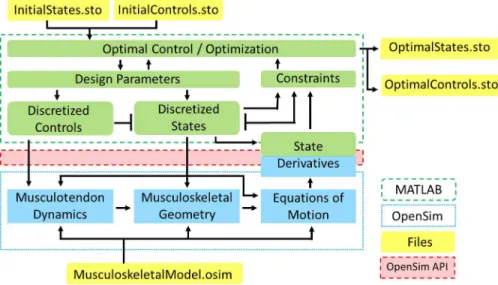
OpenSim was interfaced with MATLAB using the OpenSim API (Seth et al., 2011). MATLAB is used to set-up and solve the optimization problems and OpenSim is used to represent the dynamics of the musculoskeletal system (Fig. 1). OpenSim itself relies on the Simbody dynamics engine (not shown inFig. 1) for multibody dynamics and other numerical operations (Sherman, Seth & Delp, 2011). The key link between OpenSim and MATLAB occurs at the block in Fig. 1labeled “State Derivatives,” which corresponds to the Euler discretization scheme described byEq. (7). The values of the vector termfi+ 1in
Eq. (7)may be obtained from OpenSim for a particular set of discretized states and controls by evaluatingEq. (2). If calculating the value of the objective function requires the magnitudes of any quantities that are implicit functions of the states and controls (e.g., contact forces, muscle powers), these may also be obtained by calling the appropriate OpenSim methods from within MATLAB.
The initial guesses for the optimization parameters are read from two OpenSim storage (.sto) files, labeled InitialStates.sto and InitialControls.sto inFig. 1. The results of an optimization are written to two similar files, labeled OptimalStates.sto and OptimalControls.sto inFig. 1. This allows the initial guesses and final results to be easily visualized in the OpenSim graphical user interface (GUI). Intermediate result files may optionally be written as an optimization progresses to allow the intermediate motion to be viewed in the OpenSim GUI. The storage files containing the final results allow for easy
execution of forward dynamics simulations based on the DC results using the OpenSim ForwardDynamics tool. Forward simulations are generated using the states from the first time point in the OptimalStates.sto file as the initial conditions and the muscle excitations from all time points in the OptimalControls.sto files as the controls.
Simple model
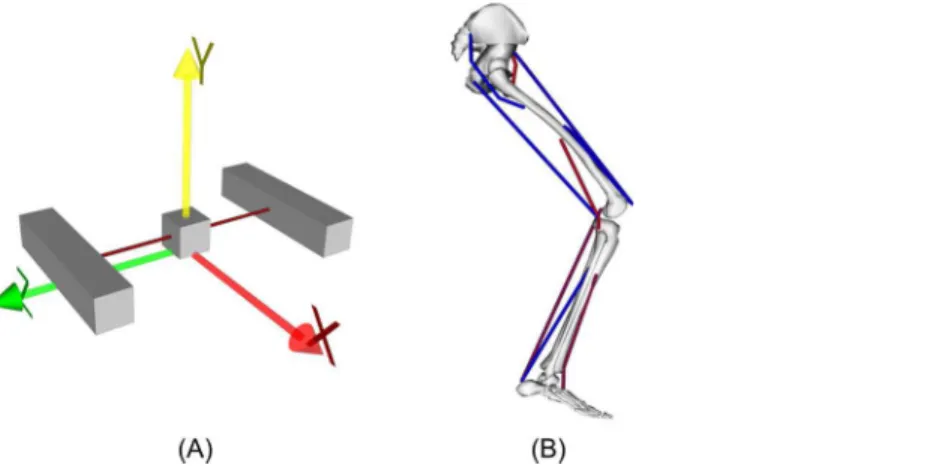
To demonstrate the DC approach using the OpenSim-MATLAB interface, we used a simple 1 degree of freedom (DOF) model consisting of a block acted upon by two muscles, resulting in a model with 6 states and 2 controls (Fig. 2A). The model is able to translate along the mediolateral axis (Z axis inFig. 2A) as it is acted upon by the two muscles, one of which pulls in the positive direction with the other one pulling in the negative direction. The simple model was modified from the “Tug of War” example (Tug_of_War. osim) that is provided with OpenSim. In the original example model, the block has 6 DOF and 5 constraints to produce uniaxial sliding. We replaced the 6 DOF free joint with a 1 DOF slider joint to eliminate the constraints and reduce the size of the state space. We also modified the tendon slack lengths from the example such that the muscles operate closer to the plateau of the force-length curve for the movement task that was simulated. For this study, both muscles had peak isometric forces of 1000 N, optimal fiber lengths of 0.25 m, tendon slack lengths of 0.05 m, and pennation angles of 0.
Predictive simulations were generated where the target motion for the block was to begin at rest from a starting position of−0.08 m along the mediolateral axis, translate to a position of 0.08 m halfway through the movement time, and then return to the original state in a total movement time of 1.0 s. The actual movement was unspecified, other than for these task constraints defined at the initial time, the midpoint, and the final time. Other constraints were enforced such that the states and controls at the final time should
match the states and controls at the initial time (Eqs. 5and6). The objective function was to minimize the sum of squared muscle activation integrals
J ¼ 1 T
Xm i¼1
Z T
0
a2iðtÞdt (8)
whereaiis the instantaneous activation of theith muscle andmis the number of muscles. The NLP problem was solved at a range of grid densities from 25–501 nodes (25, 51, 101, 151, 201, 301, 401 and 501 nodes). Solutions were obtained for IPOPT at all grid densities and for fmincon (interior-point algorithm) up to 201 nodes. The computation time for fmincon on the denser grids was too long (>1 day) to be of practical value for such a small problem.
An initial guess was generated by running a 1.0 s forward simulation where the model began static at an initial position of 0.0 m and did not move because the muscle controls were both set to zero. This will be referred to as the ‘static’ initial guess. For IPOPT, the NLP problem was solved two different ways; once using the static initial guess at all grid densities, and again using a grid refinement approach. For fmincon, the NLP problem was only solved using grid refinement, as convergence was too slow using the static initial guess. In the grid refinement approach, the initial guess at a particular grid density was the solution obtained from the next lower (i.e., coarser) grid density, except for the 25 node grid where there was no lower grid density. For example, the 101 node case was solved using the static initial guess and again using the optimal result obtained for the 51 node grid. For this particular movement task, we always used an odd number of nodes because of the constraint at the middle time point. For the 25 node case there were 200 unknowns and 156 constraints, while for the 501 node case there were 4008 unknowns and 3012 constraints. We evaluated the solutions by comparing the results obtained across the different grid densities, and by comparing the results at each grid density with forward simulations based on the optimal controls and optimal initial conditions obtained from the DC optimizations.
Lower limb model
To evaluate the DC approach using OpenSim-MATLAB on a larger scale and more anatomically realistic model, we generated predictive simulations of lower limb movement using a sagittal plane, 3 DOF model of the human lower limb actuated by 9 muscles (Fig. 2B). The lower limb model had a total of 24 states and 9 controls. This model was modified from another example provided with OpenSim (leg6dof9musc.osim) and is based upon the standard three-dimensional OpenSim gait models (Delp et al., 1990; Anderson & Pandy, 2001) with a reduced set of muscles. The example model provided with OpenSim was modified to fix the pelvis segment in space and passive restraining moments were added to represent the contributions of ligaments and capsular tissues to the net joint moments (Davy & Audu, 1987).
fixed amount of time (0.75 s) while minimizing the sum of squared muscle activations (Eq. 8). At the final target posture, all generalized velocities had to be equal to zero. The desired initial and final states of the system were enforced using an appropriate set of task constraints. The motions and muscle activation patterns were unconstrained between the initial and final times. The initial guess for the lower limb optimizations was derived from a 0.75 s forward simulation where the joints were extended and the muscle controls were all set to an arbitrary, low value (2% of maximum). The lower limb movement problem was only solved using IPOPT, as convergence with fmincon proved too slow even on this modestly sized model. Results were obtained using grid refinement with grid densities of 25, 50, 100 and 200 nodes. The results at 100 and 200 nodes were nearly identical and detailed results are only presented for 200 nodes. For the 25 node case there were 825 unknowns and 615 constraints, while for the 200 node case there were 6600 unknowns and 4815 constraints. For this project, our goal with the lower limb model was to evaluate the feasibility of using the DC approach in OpenSim-MATLAB with a model more complex than the simple 1 DOF model, rather than analyzing the optimal motions and activation patterns and comparing them with actual human behaviors. For both the simple and lower limb models, the objective function gradient and the constraints Jacobian were approximated using forward finite differences. All optimizations were run on the same laptop computer with a 2.30 GHz Intel i5-5300U processor and 8 GB of RAM. The reported results were obtained using OpenSim release 3.3, MATLAB release 8.5, and IPOPT release 3.11.0.
RESULTS
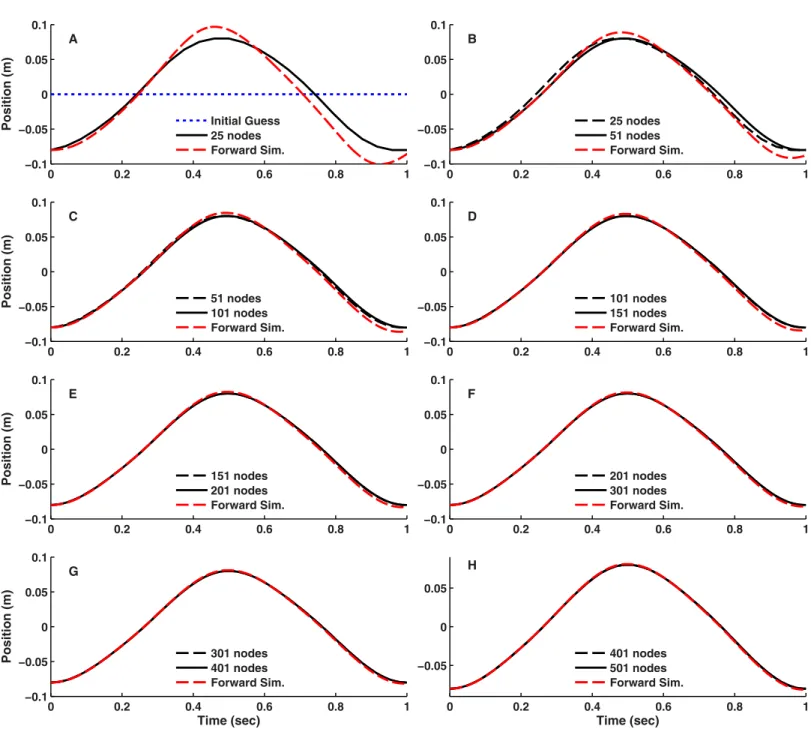
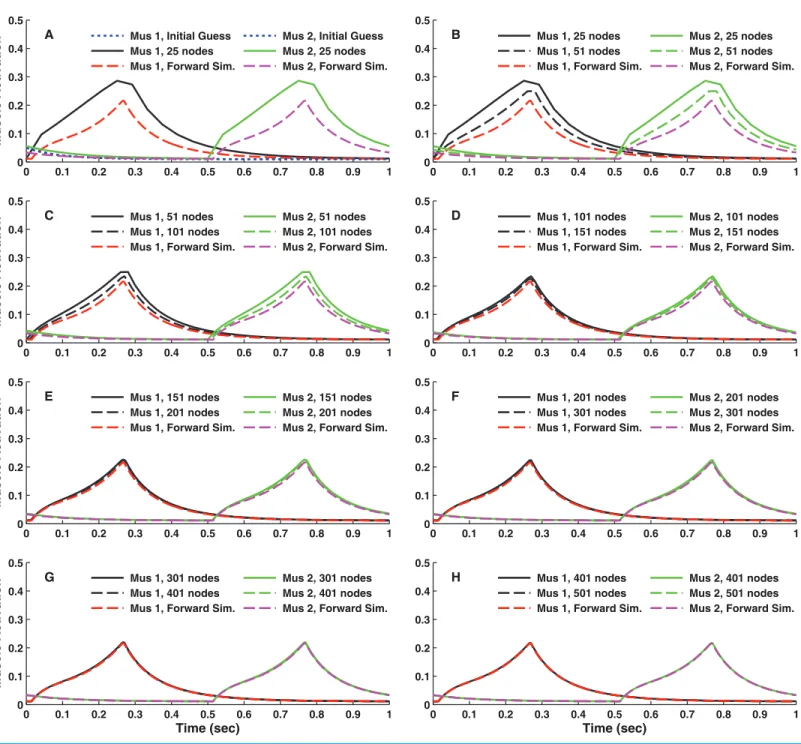
For the simple 1-DOF model, all node densities resulted in approximately sinusoidal motions (Fig. 3) with phasic muscle activity (Fig. 4) that satisfied the endpoint and midpoint constraints. This was true even when the initial guess (blue dotted lines in
Figs. 3Aand4A) was far from the final result. There was little difference in the optimal motions above 101 nodes (Figs. 3D–3H) and little difference in the activations above 151 nodes (Figs. 4E–4H). Forward simulations based on the optimal controls and initial states reproduced the results obtained with DC for grid densities above 101 nodes. The results shown inFigs. 3and4are for IPOPT using the grid refinement approach, where the initial guesses at each grid density were based on the optimal results obtained for the next lower grid density. The results were virtually identical when the static initial guess was used for all grid densities. However, it took on average 4 times longer for the optimizations to converge to the final solutions when starting from the static initial guess (Fig. 5B). The results for fmincon were also nearly identical to the IPOPT results using the grid refinement approach up to 201 nodes, which was the densest grid used with fmincon.
(Figs. 5B and5C). Even at 25 nodes (Figs. 3Aand4A), the optimal results were qualitatively similar to the results obtained with greater numbers of nodes. The two solvers that were used, fmincon and IPOPT, generally converged to the same solutions; however, the execution times were dramatically different. Up to 201 nodes, fmincon took on average 260 times longer to converge that IPOPT (Figs. 5Band5C).
0 0.2 0.4 0.6 0.8 1
−0.1 −0.05 0 0.05 0.1 Position (m) A Initial Guess 25 nodes Forward Sim.
0 0.2 0.4 0.6 0.8 1
−0.1 −0.05 0 0.05 0.1 B 25 nodes 51 nodes Forward Sim.
0 0.2 0.4 0.6 0.8 1
−0.1 −0.05 0 0.05 0.1 Position (m) C 51 nodes 101 nodes Forward Sim.
0 0.2 0.4 0.6 0.8 1
−0.1 −0.05 0 0.05 0.1 D 101 nodes 151 nodes Forward Sim.
0 0.2 0.4 0.6 0.8 1
−0.1 −0.05 0 0.05 0.1 Position (m) E 151 nodes 201 nodes Forward Sim.
0 0.2 0.4 0.6 0.8 1
−0.1 −0.05 0 0.05 0.1 F 201 nodes 301 nodes Forward Sim.
0 0.2 0.4 0.6 0.8 1
−0.1 −0.05 0 0.05 0.1 Time (sec) Position (m) G 301 nodes 401 nodes Forward Sim.
0 0.2 0.4 0.6 0.8 1
−0.05 0 0.05 Time (sec) H 401 nodes 501 nodes Forward Sim.
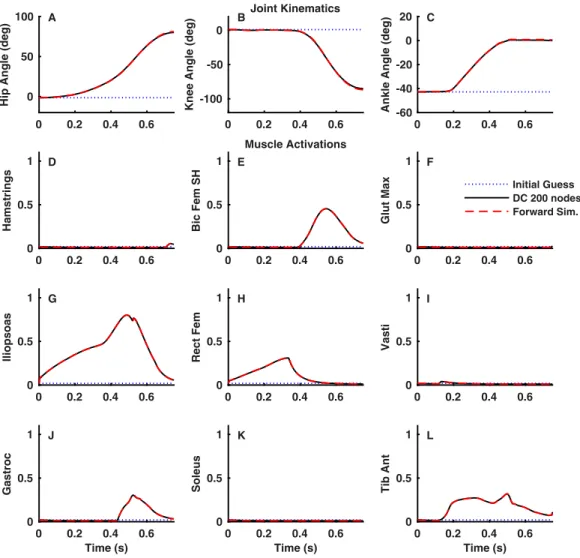
For the discrete, lower limb movement task, the model moved smoothly from the relaxed, initial state to the final, target posture in the specified amount of time (Fig. 6). The results were similar for all node densities and were nearly identical for 100 and 200 nodes (the 200 node results are shown inFig. 6). Computation time was 1164 s at 25
0 0.1 0.2 0.3 0.4 0.5 0.6 0.7 0.8 0.9 1
0 0.1 0.2 0.3 0.4 0.5 Muscle Activation
A Mus 1, Initial Guess
Mus 1, 25 nodes Mus 1, Forward Sim.
Mus 2, Initial Guess Mus 2, 25 nodes Mus 2, Forward Sim.
0 0.1 0.2 0.3 0.4 0.5 0.6 0.7 0.8 0.9 1
0 0.1 0.2 0.3 0.4 0.5
B Mus 1, 25 nodes
Mus 1, 51 nodes Mus 1, Forward Sim.
Mus 2, 25 nodes Mus 2, 51 nodes Mus 2, Forward Sim.
0 0.1 0.2 0.3 0.4 0.5 0.6 0.7 0.8 0.9 1
0 0.1 0.2 0.3 0.4 0.5 Muscle Activation
C Mus 1, 51 nodes
Mus 1, 101 nodes Mus 1, Forward Sim.
Mus 2, 51 nodes Mus 2, 101 nodes Mus 2, Forward Sim.
0 0.1 0.2 0.3 0.4 0.5 0.6 0.7 0.8 0.9 1
0 0.1 0.2 0.3 0.4 0.5
D Mus 1, 101 nodes
Mus 1, 151 nodes Mus 1, Forward Sim.
Mus 2, 101 nodes Mus 2, 151 nodes Mus 2, Forward Sim.
0 0.1 0.2 0.3 0.4 0.5 0.6 0.7 0.8 0.9 1
0 0.1 0.2 0.3 0.4 0.5 Muscle Activation
E Mus 1, 151 nodes
Mus 1, 201 nodes Mus 1, Forward Sim.
Mus 2, 151 nodes Mus 2, 201 nodes Mus 2, Forward Sim.
0 0.1 0.2 0.3 0.4 0.5 0.6 0.7 0.8 0.9 1
0 0.1 0.2 0.3 0.4 0.5
F Mus 1, 201 nodes
Mus 1, 301 nodes Mus 1, Forward Sim.
Mus 2, 201 nodes Mus 2, 301 nodes Mus 2, Forward Sim.
0 0.1 0.2 0.3 0.4 0.5 0.6 0.7 0.8 0.9 1
0 0.1 0.2 0.3 0.4 0.5 Muscle Activation Time (sec)
G Mus 1, 301 nodes
Mus 1, 401 nodes Mus 1, Forward Sim.
Mus 2, 301 nodes Mus 2, 401 nodes Mus 2, Forward Sim.
0 0.1 0.2 0.3 0.4 0.5 0.6 0.7 0.8 0.9 1
0 0.1 0.2 0.3 0.4 0.5 Time (sec)
H Mus 1, 401 nodes
Mus 1, 501 nodes Mus 1, Forward Sim.
Mus 2, 401 nodes Mus 2, 501 nodes Mus 2, Forward Sim.
nodes and 7802 s at 200 nodes. Forward simulations based on the optimal controls and initial states closely matched the DC results at 200 (Fig. 6) and 100 nodes, but did not match as closely at 50 and 25 nodes, consistent with the results obtained for the simple model. The optimal muscle activation patterns were consonant with the requirements of the simulated task and the minimum activation objective function. Activations were uniformly low in muscles that generate exclusively extension moments (Figs. 6F,6Iand6K), while there were distinct bursts of activation in the muscles that generate only flexion moments (Figs. 6E,6Gand6L). The results for biarticular muscles were more variable. The rectus femoris (Fig. 6H), which generates hip flexion and knee extension moments, was active until the knee joint started to flex around the middle of the movement time (Fig. 6B), at which point the gastrocnemius (Fig. 6J), which generates knee flexion and ankle extension moments, became active. When the rectus femoris activity ceased (Fig. 6H), iliopsoas activity increased (Fig. 6G), as it was the only remaining muscle that could generate the necessary hip flexion moment. The activity in the hamstrings (Fig. 6D), which generates hip extension and knee flexion moments, was low throughout the movement. All of the results for the simple and lower limb model optimal control problems are available on the SimTK website (http://simtk.org/home/directcolloc).
DISCUSSION
We used the MATLAB interface to the OpenSim API to develop a new framework for solving musculoskeletal optimal control problems. This approach effectively combines the high-level programming, design and control capabilities of MATLAB with the
musculoskeletal modeling, simulation and analysis tools provided by OpenSim. Within this framework, we used the direct collocation technique to solve two predictive problems; Number of Nodes
0 200 400 600
Objective Function Value
0 1 2 3 4
A
IPOPT
fmincon
Number of Nodes
0 200 400 600
Computation Time (s)
0 500 1000 1500
2000 B IPOPT
static
refine
Number of Nodes
0 200 400 600
Computation Time (s)
0 10000 20000 30000
40000 C fmincon
refine
a periodic motion problem using a simple musculoskeletal model and a discrete motion problem using a more realistic model of the human lower limb. Both problems were solved with reasonable computational demands using the IPOPT solver. The simple model optimal control problem could also be solved using the fmincon solver, but the
computation times were too long to be of general use. Our intent is that this framework will facilitate the application of predictive biomechanical simulation to solving clinically-relevant human movement problems.
The IPOPT solver (Wa¨chter & Biegler, 2006) greatly outperformed the fmincon solver from the MATLAB Optimization Toolbox (Figs. 5Band5C). The performance advantage for IPOPT is primarily derived by exploiting sparsity in the constraints Jacobian matrix. Fewer than 5% of the elements of the constraints Jacobian were non-zero in the cases considered here, creating the opportunity for considerable computational efficiencies.
0 0.2 0.4 0.6
Hip Angle (deg) 0
50 100 A
0 0.2 0.4 0.6
Knee Angle (deg) -100
-50 0
BJoint Kinematics
0 0.2 0.4 0.6
Ankle Angle (deg) -60
-40 -20 0 20 C
0 0.2 0.4 0.6
Hamstrings
0 0.5
1 D
0 0.2 0.4 0.6
Bic Fem SH
0 0.5
1 E
Muscle Activations
0 0.2 0.4 0.6
Glut Max
0 0.5
1 F
Initial Guess DC 200 nodes Forward Sim.
0 0.2 0.4 0.6
Iliopsoas
0 0.5
1 G
0 0.2 0.4 0.6
Rect Fem
0 0.5
1 H
0 0.2 0.4 0.6
Vasti
0 0.5
1 I
Time (s)
0 0.2 0.4 0.6
Gastroc
0 0.5
1 J
Time (s)
0 0.2 0.4 0.6
Soleus
0 0.5
1 K
Time (s)
0 0.2 0.4 0.6
Tib Ant
0 0.5
1 L
However, IPOPT places more demands on the user, which can translate into considerable up-front costs. To use fmincon for the types of problems described here, the user needs to provide functions that return the value of the objective function and the values of the equality constraints. IPOPT has similar requirements, but also obligates the user to provide functions that return the gradient of the objective function with respect to the unknowns, the constraints Jacobian matrix, and the sparsity pattern of the constraints Jacobian. The fmincon algorithm will automatically calculate finite difference
approximations for any derivatives that are not provided by the user; however, that is not the case for IPOPT. When using IPOPT with numerical derivatives, the user is responsible for issues such as choosing the ideal step sizes for the finite differences (Curtis & Reid, 1974) and calculating the non-zero elements of the sparse constraints Jacobian as efficiently as possible (Curtis, Powell & Reid, 1974). The process of determining the sparsity structure of the constraints Jacobian can itself be a time-consuming and error-prone task for problems with thousands of unknowns and constraint. However, that task need only be performed once for a particular model and movement problem, and the benefits can be substantial (compare times inFigs. 5Bwith5C). The performance of both fmincon and IPOPT can benefit from analytical gradients and Jacobians if provided by the user, though IPOPT should still hold a considerable performance advantage due to the use of sparse linear algebra. Unfortunately, it is not always possible to obtain analytical expressions for the required derivatives when interfacing with OpenSim, which is a potential limitation of the approach presented here.
The objective function used in this work was an explicit function of the model states; therefore, it would be possible to derive an analytical expression for the gradient of the objective function with respect to the unknown parameters. However, the same is not true for the constraints Jacobian, which is where most of the time is spent in the optimization algorithms. OpenSim does not provide the full system dynamical equations in symbolic form, as could be obtained with dynamics software such as MotionGenesis (http://www. motiongenesis.com) or MapleSim (http://www.maplesoft.com/products/maplesim). OpenSim, via the Simbody dynamics engine, can return the time derivative of any state variable, or any other quantities of interest such as contact forces or muscle forces, but it does so without forming the relevant equations in full symbolic form (Sherman, Seth & Delp, 2011). An advantage of having the full symbolic equations is that analytical gradient vectors and Jacobian matrices can readily be determined, which should speed up the most time-consuming part of solving the NLP. There is a trade-off though, as the approach used by OpenSim has the advantage of greatly facilitating model development and analysis, while relieving the user from many lower-level details such as deriving symbolic equations of motions.
For the cases studied here, optimal results were obtained using IPOPT in times ranging from 15 s to 2 hr, depending on the node density and model complexity. The 2-D walking simulations generated byAckermann & van den Bogert (2010)using a 50 node
is similar to the 35 min time reported for the 2-D walking simulations (Ackermann & van den Bogert, 2010). This comparison should be made cautiously as the computer used for the present work was likely faster, while Ackermann & van den Bogert (2010)used SNOPT, which has better convergence properties than IPOPT (van den Bogert, Blana & Heinrich, 2011). These two factors should at least partially offset, suggesting that this comparison may be reasonable as a first approximation. While the actual time required to generate walking simulations using IPOPT with the present framework will need to be determined, even if it requires several hours it will be highly competitive with traditional shooting methods (e.g., Anderson & Pandy, 2001;Miller et al., 2012;Neptune, Kautz & Zajac, 2001;Umberger, 2010). However, for tracking problems, the computed muscle control algorithm (Thelen & Anderson, 2006) that is included with OpenSim will likely be much faster than DC. Tracking problems involving large-scale, three-dimensional musculoskeletal models can be solved in a few hours or less using computed muscle control (Saul et al., 2015;Thelen & Anderson, 2006). Despite being slower, DC may still be preferred over computed muscle control for some tracking problems due to the flexibility it affords, such as in defining the cost function, or in placing arbitrary constraints on the solution. However, the actual computational demands of using DC via the OpenSim-MATLAB interface with large-scale musculoskeletal models will need to be evaluated in future research.
Convergence with the fmincon algorithm from the MATLAB Optimization Toolbox was too slow to be of much practical value, even for the simple model optimal control problem. This was due almost entirely to the inability of fmincon to make use of the known sparsity pattern of the constraints Jacobian. We informally compared the impact on performance of requiring IPOPT to use a dense Jacobian and found that it was only marginally faster than fmincon, rather than being over 100 times faster when the sparse Jacobian was used. Some of the other solvers in the MATLAB Optimization Toolbox (e.g., fsolve, lsqnonlin) can use sparsity information in the evaluation of Jacobian matrices, so perhaps future releases of fmincon will include this feature. Given access to a computer cluster, fmincon could also be run in parallel using the MATLAB Parallel Computing Toolbox. Given the large number of independent elements in the constraints Jacobian, performance could be dramatically increased given enough compute nodes. However, even without any performance enhancements, fmincon is still useful for development work as it is easier to use than IPOPT. We found that problems could be more easily tested and debugged using fmincon, before switching to IPOPT to gain the performance advantage.
A key aspect of the DC approach is deciding on the minimally acceptable grid density. For the lower limb discrete movement task, the 100 node solution was nearly
problems, once an initial problem has been solved (e.g., Ackermann & van den Bogert, 2010;van den Bogert et al., 2012). While we used fixed grid spacing in this work, it is possible to optimize the spacing used in the grid refinement process based on estimates of the discretization error at each grid density, which may confer additional performance benefits (Betts, 2010).
In this study, we leveraged the relatively new MATLAB interface to the OpenSim API. This allowed all of the programming to be done in the high-level MATLAB environment, while the musculoskeletal modeling and related numerical calculations were handled by the robust and efficient OpenSim C++ libraries. OpenSim itself relies on the Simbody dynamics engine (Sherman, Seth & Delp, 2011), which is built upon state-of-the-art numerical routines such as LAPACK (Anderson, 1999). Our use of MATLAB to interface with OpenSim is distinct from the approach reported previously where MATLAB was linked with OpenSim via a Simulink S-function (Mansouri & Reinbolt, 2012). In that project, an OpenSim model was wrapped in a Simulink block using the S-function API and then used to run both open-loop and closed-loop forward simulations from MATLAB/Simulink. That approach, and the one presented here, are indeed
complimentary and simply suited to different purposes. While we used MATLAB in the current applications, the OpenSim API is also accessible from Python, as is the IPOPT solver. Python is an open-source high-level programming language with many numerical and scientific computing capabilities (Millman & Aivazis, 2011). Thus, it should be possible for other researchers to replicate the approach presented here using either MATLAB or Python.
In this project, we use DC to solve the optimal control problem (Kaplan & Heegaard, 2001;Ackermann & van den Bogert, 2010), but several other approaches have been used to generate simulations of a variety of human movements. The traditional approach has been to use a low-dimensional (e.g.,Neptune, Kautz & Zajac, 2001;Umberger, 2010) or high-dimensional (e.g.,Anderson & Pandy, 2001;Miller et al., 2012) discretization of the controls only, and then perform forward integrations of the dynamical equations in order to evaluate the objective function and constraints. Other recent approaches include modeling muscle reflexes (Geyer & Herr, 2010) and global parameterization of muscle forces using Fourier series (Shourijeh & McPhee, 2014). These other approaches could likely also be implemented using OpenSim and MATLAB and would be subject to many of the same strengths and weaknesses described herein. The example code provided with this article may prove to be a useful starting point for researchers implementing these other approaches via OpenSim and MATLAB.
CONCLUSIONS
ACKNOWLEDGEMENTS
We thank Russell Johnson for his assistance with this project and Ayman Habib and Ajay Seth for their assistance with the OpenSim API.
ADDITIONAL INFORMATION AND DECLARATIONS
Funding
This project was supported by grants from the National Science Foundation (BCS 0935327, IIS 1526986) and a Pilot grant from the National Center for Simulation in Rehabilitation Research. The funders had no role in study design, data collection and analysis, decision to publish, or preparation of the manuscript.
Grant Disclosures
The following grant information was disclosed by the authors: National Science Foundation: BCS 0935327, IIS 1526986.
National Center for Simulation in Rehabilitation Research: Pilot.
Competing Interests
The authors declare that they have no competing interests.
Author Contributions
Leng-Feng Lee conceived and designed the experiments, performed the experiments, analyzed the data, contributed reagents/materials/analysis tools, wrote the paper, prepared figures and/or tables, reviewed drafts of the paper.
Brian R. Umberger conceived and designed the experiments, performed the
experiments, analyzed the data, contributed reagents/materials/analysis tools, wrote the paper, prepared figures and/or tables, reviewed drafts of the paper.
Data Deposition
The following information was supplied regarding data availability: SimTK repository:http://simtk.org/home/directcolloc.
Supplemental Information
Supplemental information for this article can be found online athttp://dx.doi.org/ 10.7717/peerj.1638#supplemental-information.
REFERENCES
Ackermann M, van den Bogert AJ. 2010.Optimality principles for model-based prediction of
human gait.Journal of Biomechanics43(6):1055–1060DOI 10.1016/j.jbiomech.2009.12.012.
Anderson FC, Pandy MG. 2001.Dynamic optimization of human walking.Journal of
Biomechanical Engineering123(5):381–390DOI 10.1115/1.1392310.
Anderson E. 1999.LAPACK Users’ Guide. Phildelphia: SIAMDOI 10.1137/1.9780898719604.
Betts JT. 2010.Practical Methods for Optimal Control and Estimation Using Nonlinear
Curtis AR, Powell MJD, Reid JK. 1974.On the estimation of sparse Jacobian matrices.Journal of the Institute of Mathematics and its Applications13(1):117–119DOI 10.1093/imamat/13.1.117.
Curtis AR, Reid JK. 1974.The choice of step lengths when using differences to approximate
Jacobian matrices.Journal of the Institute of Mathematics and its Applications13(1):121–126
DOI 10.1093/imamat/13.1.121.
Damsgaard M, Rasmussen J, Christensen ST, Surma E, de Zee M. 2006.Analysis of
musculoskeletal systems in the AnyBody modeling system.Simulation Modelling Practice and Theory14(8):1100–1111DOI 10.1016/j.simpat.2006.09.001.
Davoodi R, Loeb GE. 2011.MSMS software for VR simulations of neural prostheses and patient
training and rehabilitation.Studies in Health Technology and Informatics163:156–162.
Davy DT, Audu ML. 1987.A dynamic optimization technique for predicting muscle forces in the
swing phase of gait.Journal of Biomechanics20(2):187–201DOI 10.1016/0021-9290(87)90310-1.
Delp SL, Loan JP. 2000.A computational framework for simulating and analyzing human and
animal movement.Computing in Science & Engineering2(5):46–55DOI 10.1109/5992.877394.
Delp SL, Loan JP, Hoy MG, Zajac FE, Topp EL, Rosen JM. 1990.An interactive graphics-based
model of the lower extremity to study orthopaedic surgical procedures.IEEE Transactions on Biomedical Engineering37(8):757–767DOI 10.1109/10.102791.
Delp SL, Anderson FC, Arnold AS, Loan P, Habib A, John CT, Guendelman E, Thelen DG. 2007.
OpenSim: open-source software to create and analyze dynamic simulations of movement.IEEE Transactions on Biomedical Engineering54(11):1940–1950DOI 10.1109/TBME.2007.901024.
Dorn TW, Wang JM, Hicks JL, Delp SL. 2015.Predictive simulation generates human adaptations
during loaded and inclined walking.PLoS ONE10(4):e121407DOI 10.1371/journal.pone.0121407.
Fey NP, Klute GK, Neptune RR. 2012.Optimization of prosthetic foot stiffness to reduce
metabolic cost and intact knee loading during below-knee amputee walking: a theoretical study.
Journal of Biomechanical Engineering134(11):111005DOI 10.1115/1.4007824.
Geyer H, Herr H. 2010.A muscle-reflex model that encodes principles of legged mechanics
produces human walking dynamics and muscle activities.IEEE Transactions on Neural Systems and Rehabilitation Engineering18(3):263–273DOI 10.1109/TNSRE.2010.2047592.
Gill PE, Murray W, Saunders MA. 2005.SNOPT: An SQP algorithm for large-scale constrained
optimization.SIAM Review47(1):99–131DOI 10.1137/S0036144504446096.
Goldberg SR, Ounpuu S, Delp SL. 2003.The importance of swing-phase initial conditions in stiff-knee gait.Journal of Biomechanics36(8):1111–1116DOI 10.1016/S0021-9290(03)00106-4.
Hatze H. 1976.The complete optimization of a human motion.Mathematical Biosciences
28(1–2):99–135DOI 10.1016/0025-5564(76)90098-5.
Higginson JS, Zajac FE, Neptune RR, Kautz SA, Delp SL. 2006.Muscle contributions to
support during gait in an individual with post-stroke hemiparesis.Journal of Biomechanics
39(10):1769–1777DOI 10.1016/j.jbiomech.2005.05.032.
Kaplan ML, Heegaard JH. 2001.Predictive algorithms for neuromuscular control of human
locomotion.Journal of Biomechanics34(8):1077–1083DOI 10.1016/S0021-9290(01)00057-4.
Kistemaker DA, Wong JD, Gribble PL. 2014.The cost of moving optimally: kinematic path
selection.Journal of Neurophysiology112(8):1815–1824DOI 10.1152/jn.00291.2014.
Mansouri M, Reinbolt JA. 2012.A platform for dynamic simulation and control of movement
based on OpenSim and MATLAB.Journal of Biomechanics45(8):1517–1521
DOI 10.1016/j.jbiomech.2012.03.016.
Mansouri M, Clark AE, Seth A, Reinbolt JA. 2016.Rectus femoris transfer surgery affects
Miller RH, Umberger BR, Hamill J, Caldwell GE. 2012.Evaluation of the minimum energy hypothesis and other potential optimality criteria for human running.Proceedings of the Royal Society B: Biological Sciences279(1733):1498–1505DOI 10.1098/rspb.2011.2015.
Millman KJ, Aivazis M. 2011.Python for scientists and engineers.Computing in Science & Engineering13(2):9–12DOI 10.1109/MCSE.2011.36.
Neptune RR, Kautz SA, Zajac FE. 2001.Contributions of the individual ankle plantar flexors to
support, forward progression and swing initiation during walking.Journal of Biomechanics
34(11):1387–1398DOI 10.1016/S0021-9290(01)00105-1.
Pandy MG. 2001.Computer modeling and simulation of human movement.Annual Review of
Biomedical Engineering3:245–273DOI 10.1146/annurev.bioeng.3.1.245.
Pandy MG, Anderson FC, Hull DG. 1992.A parameter optimization approach for the optimal
control of large-scale musculoskeletal systems.Journal of Biomechanical Engineering
114(4):450–460DOI 10.1115/1.2894094.
Saul KR, Hu X, Goehler CM, Vidt ME, Daly M, Velisar A, Murray WM. 2015.Benchmarking of
dynamic simulation predictions in two software platforms using an upper limb musculoskeletal model.Computer Methods in Biomechanics and Biomedical Engineering18(13):1445–1458
DOI 10.1080/10255842.2014.916698.
Seth A, Sherman M, Reinbolt JA, Delp SL. 2011.OpenSim: a musculoskeletal modeling and
simulation framework for in silico investigations and exchange.Procedia IUTAM2:212–232
DOI 10.1016/j.piutam.2011.04.021.
Sherman M, Seth A, Delp SL. 2011.Simbody: multibody dynamics for biomedical research.
Procedia IUTAM2:241–261DOI 10.1016/j.piutam.2011.04.023.
Shourijeh MS, McPhee J. 2014.Forward dynamic optimization of human gait simulations:
A global parameterization approach.Journal of Computational and Nonlinear Dynamics
9(3):031018DOI 10.1115/1.4026266.
Stelzer M, von Stryk O. 2006.Efficient forward dynamics simulation and optimization of
human body dynamics.Journal of Applied Mathematics and Mechanics86(10):828–840
DOI 10.1002/zamm.200610290.
Thelen DG, Anderson FC. 2006.Using computed muscle control to generate forward dynamic
simulations of human walking from experimental data.Journal of Biomechanics
39(6):1107–1115DOI 10.1016/j.jbiomech.2005.02.010.
Umberger BR. 2010.Stance and swing phase costs in human walking.Journal of The Royal Society
Interface7(50):1329–1340DOI 10.1098/rsif.2010.0084.
Umberger BR, Caldwell GE. 2014.Musculoskeletal modeling. In: Robertson DGE, Caldwell GE,
Hamill J, Kamen G, Whittlesey SN, eds.Research Methods in Biomechanics. Champaign: Human Kinetics, 247–276.
van den Bogert AJ, Blana D, Heinrich D. 2011.Implicit methods for efficient musculoskeletal
simulation and optimal control.Procedia IUTAM2:297–316
DOI 10.1016/j.piutam.2011.04.027.
van den Bogert AJ, Hupperets M, Schlarb H, Krabbe B. 2012.Predictive musculoskeletal
simulation using optimal control: Effects of added limb mass on energy cost and kinematics of walking and running.Journal of Sports Engineering and Technology226(2):123–133
DOI 10.1177/1754337112440644.
Wa¨chter A, Biegler LT. 2006.On the implementation of an interior-point filter line-search algorithm for large-scale nonlinear programming.Mathematical Programming106(1):25–57