The Activity of Neutral
α
-Glucosidase and
Selected Biochemical Parameters in the
Annual Cycle of Breeding Carp (Cyprinus
carpio
L.)
Julia Kotońska-Feiga1¤*, Wojciech Dobicki1, Przemys
ław Pokorny1, Wojciech Nowacki2
1Department of Hydrobiology and Aquaculture, Institute of Biology, Wrocław University of Environmental and Life Science, Wrocław, Poland,2Department of Immunology, Pathophysiology and Veterinary Preventive Medicine, Wrocxaw University of Environmental and Life Science, Wrocław, Poland
¤ Current address: Department of Internal Medicine and Clinic of Diseases of Horses, Dogs and Cats, Wrocław University of Environmental and Life Science, Wrocław, Poland
Abstract
The aim of the study was to demonstrate seasonal changes in the hydrolytic and transfer-ase activity of neutralα-glucosidase, the level of glucose, cholesterol, triglycerides and total
protein in the annual breeding cycle of the carp. The study was conducted on fish from a fish farm in Lower Silesia (Poland). Blood serum was collected from the heart in: June, Sep-tember and December of two consecutive years. The results of the study show that the hydrolytic and transferase activity of neutralα-glucosidase, as well as the results of basic
biochemical parameters are highest in summer, when the fish seek and intake food inten-sively. The lowest values were observed in spring, when carp have the lowest metabolism after the wintering period.
Introduction
EC 3.2.1.x O-glycoside hydrolases are a widespread sub-subclass, of 178 enzymes [1]. Enzymes from this sub-subclass carry out a variety of functions depending on their subcellular location, as well as the type of organ and organism in which they occur. Among animalα-glucosidases
the following are distinguished: acid and neutralα-glucosidase, microsomalα-glucosidases
and complexes ofα-glucosidase in the intestinal villi.
Neutralα-glucosidase (EC 3.2.1.20) has a hydrolytic and transferase activity. It catalyzes
hydrolysis, releasingαD-glucose and acting on the non-reducing end of the molecule. Because
neutralα-glucosidase belongs to the group of enzymes that preserve the same product
confor-mation as the substrate. Therefore it is capable of catalyzing transferase reaction (transglycosylation).
Neutralα-glucosidase hydrolyzes theα-1,4 glycosidic bonds of maltooligosaccharides and
maltodextrines derived from the hydrolysis of glycogen byα-amylases [2,3]. Neutralα
-gluco-sidase hydrolyzesα-1,2,α-1,3; andα-1,6 glycosidic bonds to a smaller extent [4]. At higher OPEN ACCESS
Citation:Kotońska-Feiga J, Dobicki W, Pokorny P, Nowacki W (2015) The Activity of Neutralα
-Glucosidase and Selected Biochemical Parameters in the Annual Cycle of Breeding Carp (Cyprinus carpioL.). PLoS ONE 10(11): e0142227. doi:10.1371/ journal.pone.0142227
Editor:Nicholas S Foulkes, Karlsruhe Institute of Technology, GERMANY
Received:July 3, 2015
Accepted:October 18, 2015
Published:November 11, 2015
Copyright:© 2015 Kotońska-Feiga et al. This is an open access article distributed under the terms of the
Creative Commons Attribution License, which permits
unrestricted use, distribution, and reproduction in any medium, provided the original author and source are credited.
Data Availability Statement:All relevant data are within the paper and its Supporting Information files.
Funding:Publication was supported by Wrocław Centre of Biotechnology, programme the Leading National Research Centre (KNOW) for years 2014-2018. The funders had no role in study design, data collection and analysis, decision to publish, or preparation of the manuscript.
substrate concentrations the enzyme shows transferase activity, synthesizing oligosaccharides such as maltodextrins. In contrast to the lysosomal (acid)α-glucosidase, which is active at pH
3–6, the neutralα-glucosidase is active at pH 6–7 and is a cytoplasmic enzyme. It is widespread
among microorganisms, plants, and animals. Its presence can be observed in numerous tissues and organs, as well as in the blood serum [5]. In recent years, several studies have focused on the activity of neutralα-glucosidase in human semen and its usefulness in evaluating the
semen quality [6–12].
Hydrolytic activity of neutralα-glucosidase in the blood of mammals was studied by Chiba
[4], who demonstrated significant species-specific differences–from 1.3 mIU cm-3in human serum to 24500 mIU cm-3in pig serum. Other studies involved the transferase activity of neu-tralα-glucosidase [13,14].
Fish differ from warm-blooded animals mainly due to their seasonal metabolic variation. This is particularly evident in, freshwater and farm fish living in ponds with variable water tem-perature owing to changing weather conditions and seasonality. This fact should be taken into account when determining the activity of enzymes in the body fluids, as well as in tissues of the fish. Carp is a fish whose breeding cycle covers all seasons in the European climate zone. When studying the activity of enzymes in the body fluids and tissues of these species, one should take into account the seasonal variability which may considerably affect the results. Few studies are available on the activity of the enzymes in fish blood with special focus on eventual seasonal changes. There are no literature reports of seasonal neutralα-glucosidase changes in fish blood
serum.
The aim of the study was to evaluate the seasonal changes in the hydrolytic and transferase activity of neutralα-glucosidase and to determine the glucose, total protein, cholesterol and
tri-glyceride levels in the serum of carp (Cyprinus carpioL.).
The obtained results may also be applicable to fish of a similar physiology and etiology, such as omnivorous thermophile fish, also exhibiting seasonal variability.
Materials and Methods
The fishes were obtained from a commercial fishing farm–no specific permissions were required. The study also had no impact on endangered or protected species.
The study was approved by the II Local Ethical Committee for Research on Animals in Wrocław (II LKE). The sampling procedure and all experimental manipulations were reviewed and approved prior to obtaining the field permit.
The study was conducted over two consecutive years, during three distinctive seasons in the physiology and metabolism of carp–spring (the last decade of April), summer (September) and winter (December). Each year and each season, the carp were divided into two groups. The first group consisted of carp of lower weight–up to 1100 g (small carp); the second group carp of higher body weight (large carp). The animals were divided into two weight -groups in order to assess whether there is a correlation between the studied parameters and the fish body weight.
The animals were divided into 12 subgroups (5 specimens in each subgroup), depending on the weight of the fish, the season and year of study. Subgroup designations are shown in Table 1.
After harvesting from the pond, the three-year-old carp were measured with the accuracy of 1 mm and weighed on an electronic scale with the accuracy of ±5 g.
No anesthetics were used during the study and a 2–4 ml blood sample was collected from the heart (by cardiac puncture) [15].
The sampled serum was centrifuged (Sigma 3 K 18) for 5 minutes at 4°C and 1000–
Analytical methods
The concentration of glucose, cholesterol and triglycerides was determined through an enzy-matic reaction using the Cormay Liquick Cor–GLUCOSE 60 kit, the Liquick Cor–CHOL 30 kit and the Liquick Cor–TG 30 kit (Poland). Total protein was determined using the Lowry method [16].
The hydrolytic activity of neutralα-glucosidase was determined as follows:
10μl of serum was incubated at 30°C for 10 minutes with 90μl of a 100 mM pH 6.8
phos-phate buffer at containing 1.2 mg of maltose. The reaction was stopped by adding 200μl of a
6% solution of trichloroacetic acid (TCA). The precipitated protein was centrifuged for 5 min-utes at 10,000 × g. 50μl of the supernatant was sampled and assayed for glucose content using
the enzymatic method. To prepare the control sample the serum was added to a substrate solu-tion containing 200μl of TCA. The hydrolytic activity was expressed in IU cm-3of serum.
The transferase activity of neutralα-glucosidase was determined as follows:
10 ml serum was incubated for 20 minutes at 30°C with 90μl of a 100 mM pH 7.0 phosphate
buffer at containing the p-nitrophenyl-N-maltoside (pNGlc2) substrate at a concentration of 40 mM. After thermal (100°C) interruption of the reaction and centrifugation of the sample for 5 minutes at 10,000×g, the supernatant was diluted 500-fold with redistilled water for HPLC and 80μl of the product solution was injected to a HPX 87K column (Bio-Rad, USA). The
amount of the resulting products was identified based on the retention time and was calculated by measuring the surface area of the separated products by dedicated software included in the Waters HPLC unit. Beforehand, a series of standard concentrations of the individual p-nitro-phenyl-N-glycosides eluted through the column was prepared in order to determine the rela-tionship between the surface area of the separation of the products and their concentration. The activity was expressed inμ-moles of maltooligosaccharides produced over a period of 1
minute at 30°C by the enzyme present in 1 ml of serum.
Statistical analysis
Statistical analysis was performed using the Statsoft–Statistica 9.0 software. A three-way analy-sis of variance (ANOVA) and Tukey post hoc test were used to compare equal groups. Statisti-cally significant differences were written in lower-case letters at p0.05 and with capital letters at p0.01.
Furthermore, an arithmetic mean (x) and standard deviation (SD) was calculated for each parameter.
Results
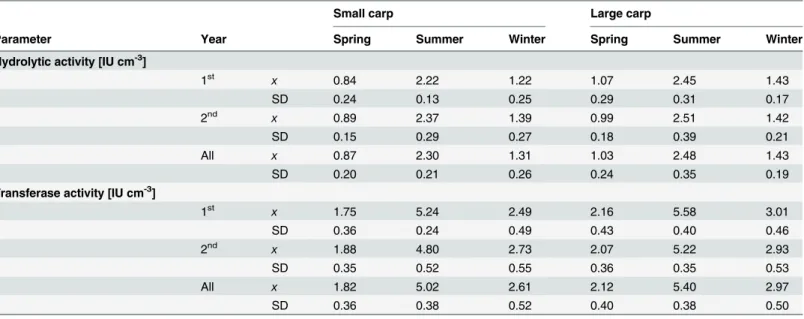
The lowest hydrolytic activity occurred in the spring in both small and large carp (Table 2). This activity was roughly 1.5- fold higher in the winter and 2.5- fold higher in the summer.
Very similar results were observed for seasonal differences in transferase activity of the neu-tralα-glucosidase under investigation. Transferase activity on pNGlc2 is higher than hydrolytic
activity on maltose in all the six subgroups. In terms of seasons, identical pattern for transferase
Table 1. Designation of experimental groups.
1styear 2ndyear
Fish weight Spring Summer Winter Spring Summer Winter
Small (<1100 g) I II III IV V VI
Large (>1100 g) VII VIII IX X XI XII
activity was observed. The lowest activity within the individual weight groups of the fish was demonstrated in the spring. In summer, as in the case of hydrolytic activity, an over 2.5-fold increase in transglycosylation occurred. In the winter, there was a significant decrease in trans-ferase activity in small and large carp respectively (Table 2).
The study of the enzyme activity was carried out in two annual cycles, during which the aver-age temperatures and amounts of sunlight were similar. No statistically significant differences were observed between the values of the studied parameters in the same seasons in the two conse-cutive years (Table 2); therefore, the quantitative data regarding the studied activities–both the mean (x) and the standard deviation (SD)–apply to measurements performed in both years.
Variations in both the hydrolytic activity and the transferase activity of neutralα
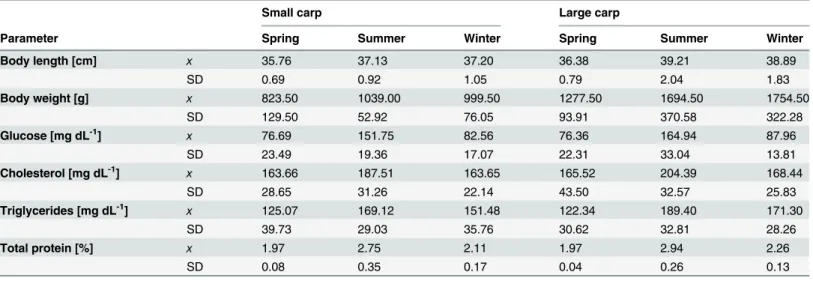
-glucosi-dase occurring between seasons in the serum of carp are highly statistically significant p0.01. Table 3show the mean values of the levels of the glucose, total cholesterol, triglycerides and total protein in the blood serum of carp in all the experimental groups.
The activity ofα-glucosidase in individual subgroups and groups with statistically
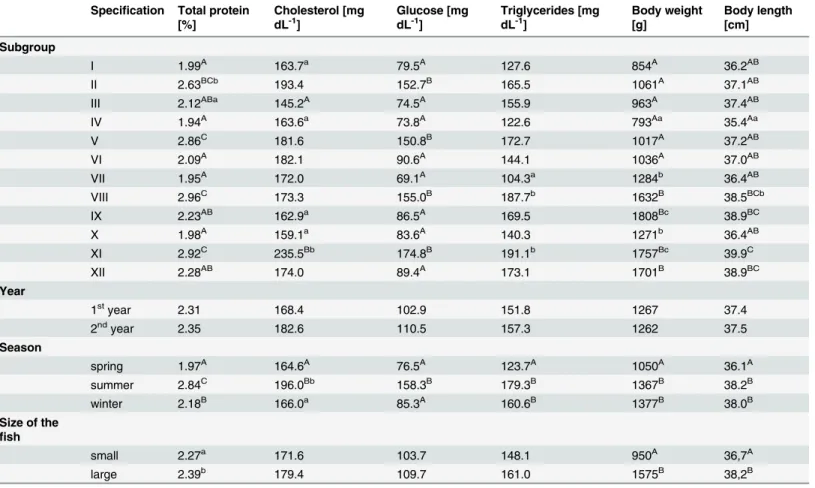
signifi-cant differences are summarized inTable 4. The mean fish size as well as mean concentrations of total protein, cholesterol, glucose and triglycerides in the experimental subgroups and groups are presented inTable 5.
SEM, p-values and interactions between factors have been attached inS1andS2Tables in the Supporting Information.
Discussion
Both the hydrolytic and transferase activity of neutralα-glucosidase in the blood serum of carp
vary significantly depending on the season of the annual breeding cycle.
A highly statistically significant increase in the level of glucose was found in the summer. This was associated with intensive food intake by the fish during this period. The increase in other parameters was also statistically significant in the summer with a tendency to persist dur-ing the winter. In sprdur-ing, all the examined parameters remained at the lowest levels.
Table 2. Seasonal activity of neutralα-glucosidase.
Small carp Large carp
Parameter Year Spring Summer Winter Spring Summer Winter
Hydrolytic activity [IU cm-3]
1st x 0.84 2.22 1.22 1.07 2.45 1.43
SD 0.24 0.13 0.25 0.29 0.31 0.17
2nd x 0.89 2.37 1.39 0.99 2.51 1.42
SD 0.15 0.29 0.27 0.18 0.39 0.21
All x 0.87 2.30 1.31 1.03 2.48 1.43
SD 0.20 0.21 0.26 0.24 0.35 0.19
Transferase activity [IU cm-3]
1st x 1.75 5.24 2.49 2.16 5.58 3.01
SD 0.36 0.24 0.49 0.43 0.40 0.46
2nd x 1.88 4.80 2.73 2.07 5.22 2.93
SD 0.35 0.52 0.55 0.36 0.35 0.53
All x 1.82 5.02 2.61 2.12 5.40 2.97
SD 0.36 0.38 0.52 0.40 0.38 0.50
x—arithmetic mean, SD–standard deviation
Table 3. Seasonal changes in fish size, glucose, cholesterol, triglycerides, and total protein concentrations.
Small carp Large carp
Parameter Spring Summer Winter Spring Summer Winter
Body length [cm] x 35.76 37.13 37.20 36.38 39.21 38.89
SD 0.69 0.92 1.05 0.79 2.04 1.83
Body weight [g] x 823.50 1039.00 999.50 1277.50 1694.50 1754.50
SD 129.50 52.92 76.05 93.91 370.58 322.28
Glucose [mg dL-1] x 76.69 151.75 82.56 76.36 164.94 87.96
SD 23.49 19.36 17.07 22.31 33.04 13.81
Cholesterol [mg dL-1] x 163.66 187.51 163.65 165.52 204.39 168.44
SD 28.65 31.26 22.14 43.50 32.57 25.83
Triglycerides [mg dL-1] x 125.07 169.12 151.48 122.34 189.40 171.30
SD 39.73 29.03 35.76 30.62 32.81 28.26
Total protein [%] x 1.97 2.75 2.11 1.97 2.94 2.26
SD 0.08 0.35 0.17 0.04 0.26 0.13
x—arithmetic mean, SD–standard deviation
doi:10.1371/journal.pone.0142227.t003
Table 4. Activity of neutralα-glucosidase in experimental subgroups and groups.
Activity of neutralα-glucosidase
Specification Hydrolytic[IU cm-3] Transferase[IU cm-3]
Subgroup
I 0.84A 1.75Aa
II 2.22Bb 5.24C
III 1.22A 2.49AB
IV 0.89A 1.88Aa
V 2.37B 4.80C
VI 1.39Aa 2.73ABb
VII 1.07A 2.16AB
VIII 2.45B 5.58C
IX 1.43Aa 3.01Bb
X 0.99A 2.07ABa
XI 2.51B 5.22C
XII 1.42Aa 2.93Bb
Year
1styear 1.54 3.37
2ndyear 1.59 3.27
Season
spring 0.95A 1.96A
summer 2.39C 5.21C
winter 1.36B 2.79B
Size of thefish
small 1.49a 3.15A
large 1.65b 3.49B
Statistically significant differences: Different letters indicates differences AB—p0.01; ab—p0.05
The low levels of glucose in the blood serum of carp harvested in the spring were caused by a low physiological activity of these fish in low water temperatures. At this time, the carp were beginning to intake food and increase their physical activity. The remaining studied biochemi-cal parameters also reached their lowest concentrations during that period. It was not until an increase in water and air temperature to about 16–18°C that the carp began to seek and intake food intensively. Their physical condition and the intensity of metabolism increased. In sum-mer, the concentration of serum glucose increased due to higher food intake and glycogen metabolism. In winter, when the fish ceased to feed, glucose levels decreased. In India, Jan et al. [15] found the lowest glucose levels in the blood of carp during winter and the highest serum glucose levels during autumn. However, climate differences between Poland and India should be taken into account.
The levels of cholesterol, triglycerides and total proteins in the blood serum of fish may serve as nutritional condition indices. As opposed to glucose, these parameters are not subject to rapid quantitative changes caused by short-term stress during blood collection. The increases in the concentrations of these three parameters observed during late summer were most likely the result of intense food intake and high activity of the fish at that time. This inter-pretation was confirmed by studies assessing the effects of different doses of food on the levels of triglycerides and cholesterol in the blood serum of carp [17]. Patriche et al. [18] studied cho-sen biochemical parameters in carp blood in two age groups and indicated higher values of
Table 5. Levels of total protein, cholesterol, glucose, triglycerides as well as fish size in experimental subgroups and groups.
Specification Total protein [%]
Cholesterol [mg dL-1]
Glucose [mg dL-1]
Triglycerides [mg dL-1]
Body weight [g]
Body length [cm]
Subgroup
I 1.99A 163.7a 79.5A 127.6 854A 36.2AB
II 2.63BCb 193.4 152.7B 165.5 1061A 37.1AB
III 2.12ABa 145.2A 74.5A 155.9 963A 37.4AB
IV 1.94A 163.6a 73.8A 122.6 793Aa 35.4Aa
V 2.86C 181.6 150.8B 172.7 1017A 37.2AB
VI 2.09A 182.1 90.6A 144.1 1036A 37.0AB
VII 1.95A 172.0 69.1A 104.3a 1284b 36.4AB
VIII 2.96C 173.3 155.0B 187.7b 1632B 38.5BCb
IX 2.23AB 162.9a 86.5A 169.5 1808Bc 38.9BC
X 1.98A 159.1a 83.6A 140.3 1271b 36.4AB
XI 2.92C 235.5Bb 174.8B 191.1b 1757Bc 39.9C
XII 2.28AB 174.0 89.4A 173.1 1701B 38.9BC
Year
1styear 2.31 168.4 102.9 151.8 1267 37.4
2ndyear 2.35 182.6 110.5 157.3 1262 37.5
Season
spring 1.97A 164.6A 76.5A 123.7A 1050A 36.1A
summer 2.84C 196.0Bb 158.3B 179.3B 1367B 38.2B
winter 2.18B 166.0a 85.3A 160.6B 1377B 38.0B
Size of the
fish
small 2.27a 171.6 103.7 148.1 950A 36,7A
large 2.39b 179.4 109.7 161.0 1575B 38,2B
Statistically significant differences: Different letters indicates differences AB—p0.01; ab—p0.05
glucose, protein, cholesterol and triglycerides in two-year-old carp compared to one-year-old carp.
Seasonal variations in the serum concentration of total protein in carp demonstrated in the presented results were also related to the intensity of metabolism. During winter and spring, when water temperatures are low and the fish case to intake food, the intensity of their metabo-lism, including that of the hepatopancreas which is a major source of serum proteins, is decreased. The renewal of serum proteins is slower when the metabolism is low. In the sum-mer, there is increased protein synthesis within the body. The fish grow and gain weight. Thus, the total amount of protein in the serum significantly increased in this period.
Distinctive differences in the activity of lactate dehydrogenase (LDH) were found in Cypry-nidae during different seasons. It was low during winter and spring and when compared to the cold seasons, it was almost three times higher during summer and twice as high during autumn [19].
By comparing the activity of aldolase and lactate dehydrogenase in muscles and blood serum of carp during summer and autumn (November), Melotti et al. [20] found that the serum activity of these enzymes was higher during autumn. However, they found the concen-trations of these enzymes to decrease in autumn signifing reduced muscle metabolism. On the other hand, Kotoński and Sobiech [14] found a lower amylomaltase activity in the red and white muscles of carp during winter, when compared to that in summer.
Few studies on transferase activity of neutralα-glucosidase, with the objective of
determin-ing whether the measurement of this activity could have diagnostic significance in the future, have been conducted so far [21–23]. To date, the enzyme does not have clinical diagnostic value, which may be due to its very low activity in human blood. Since the demonstration of its activity in human semen and the location of the activity in the secretion of epididymis, the enzyme is used as an indicative parameter in the evaluation of semen [7,9,11,24,25]. Since 1999, neutralα-glucosidase is classified as a diagnostic enzyme, especially in the evaluation of
semen parameters. To date this parameter has not been studied in the semen of fish. It may prove to be helpful in the evaluation of the quality of the semen with practical implications for aquaculture and fisheries. In addition, future research of neutralα-glucosidase in species that
exhibit its high activity, especially in the blood, could prove that it is an important indicator for diagnostic purposes. Neutralα-glucosidase, which is active in the blood serum, shows very
dis-tinct species-specific quantitative variation [4]. This variation also concerns different species of fish (own unpublished observations).
The authors’own research into the activity of neutralα-glucosidase in the blood serum of
carp, as well as literature reports, imply that a number of factors must be considered in the interpretation of results when studying the activity of enzymes in fish. The most important ones include the species, season (especially in freshwater fish), stressors (that fish are exposed to and respond to accordingly), age, type of food and periods of feeding.
Most of the statistically significant differences of the concentrations of the studied parameters were demonstrated between individual subgroups and between seasons of the year (Table 4).
There were no statistically significant differences between the successive years of the study. It can therefore be assumed that the relationship between the studied parameters was not affected by small climate differences that undoubtedly occurred during the study period. In contrast, when comparing large carp with small carp, there were statistically significant differ-ences in hydrolytic and transferase activity, as well as in the total protein concentration. This relationship proves that carp with higher weight (those growing faster and fed better) have higher enzyme activity. However, the level of total cholesterol, glucose and triglycerides in both size groups remained similar.
The effect of the following interactions was not confirmed statistically: year season, year size, season size, year season size.
Conclusions
High hydrolytic and transferase activities ofα-glucosidase, with distinct seasonal variations
were found in the blood serum of carp.
The level of glucose, cholesterol, triglycerides and total protein in the blood serum of carp undergoes seasonal variations and peaks during summer. In spring and winter, the levels of these parameters were statistically significantly lower. This is associated with the water temper-ature, intensity of feeding of the carp and the condition of the fish. Weight may significantly affect the value of biochemical parameters in carp.
Lack of differences between successive years confirms the characteristic seasonal variation of the enzyme, irrespective of the weather within a single study year.
Supporting Information
S1 Table. Statistical informations for activity of neutralα-glucosidase in experimental sub-groups and sub-groups.
(DOCX)
S2 Table. Statistical informations for levels of total protein, cholesterol, glucose, triglycer-ides as well as fish size in experimental subgroups and groups.
(DOCX)
Author Contributions
Conceived and designed the experiments: JKF WD WN. Performed the experiments: JKF. Ana-lyzed the data: JKF PP. Contributed reagents/materials/analysis tools: JKF. Wrote the paper: JKF PP.
References
1. Nomenclature Committee of the International Union of Biochemistry and Molecular Biology (NC-IUBMB). Enzyme Nomenclature, Recommendations of the Nomenclature Committee of the Interna-tional Union of Biochemistry and Molecular Biology on the Nomenclature and Classification of Enzymes by the Reactions they Catalyse. Available:http://www.chem.qmul.ac.uk/iubmb/enzyme/.
2. Karpiak S, Ziarko D,Żółtowska K, Gwara K. Relations between glycogen phosphorylase activity and activities of amylolytic enzymes in rabbit skeletal muscle. Arch. Immunol. Ther. Exp. 1977: 25: 199–
212.
3. Martiniuk F, Hirscchorn R. Characterization of neutral isozymes of human alpha-glucosidase: differ-ences in substrate specificity, molecular weight and electrophoretic mobility. Biochim. Biophys. Acta 1981; 658, 248–261. PMID:7018580
4. Chiba S. Molecular mechanism inα-glucosidase and glucoamylase. Biosci. Biotech. Biochem. 1997;
5. Chiba S.α-Glucosidases. In: Amylase Research Society of Japan (Ed.) Handbook of amylases and
related enzymes. Oxford, New York, Tokyo. Pergamon Press. 1988. pp. 104–116.
6. Elzanaty S, Richthoff J, Malm J, Giwercman A. The impact of epididymal and accessory sex gland func-tion on sperm motility. Hum. Reprod. 2002, 17, 2904–2911. PMID:12407047
7. Henkel R, Maaß G, Schuppe HC, Jung A, Schubert J, Schill WB. Seasonal changes of neutral alpha-glucosidase activity in human semen. J. Androl. 2006; 27: 34–39. PMID:16400075
8. Levrant S, Watanabe M, Land S, Sauer R, Jeyendran RS. The relevance of neutralα-glucosidase
activ-ity in andrology. Sys. biol. reprod. med. 2009; 55, 116–119.
9. Peña P, Risopatrón J, Villegas J, Miska W, Schill WB, Sànchez R. Alpha-glucosidase in the human
epi-didymis: topographic distribution and clinical application. Andrology. 2004; 36, 315–320.
10. Watanabe M, Roussev R, Ahlering P, Sauer R, Coulam C, Jeyendran RS. Correlation between neutral alpha-glucosidase activity and sperm DNA fragmenation. Andrology. 2009, 41, 316–318.
11. Vivas-Acevedo G, Lozano-Hernández R, Camejo MI. Varicocele decreases epididymal neutralα
-glu-cosidase and is associated with alteration of nuclear DNA and plasma membrane in spermatozoa. BJU Int. 2014; 113: 642–649. doi:10.1111/bju.12523PMID:24148354
12. Zöpfgen A, Priem F, Sudhoff F, Jung K, Lenk S, Loening SA, Sinha P. Relationship between semen quality and the seminal plasma components carnitine, alpha-glucosidase, fructose, citrate and granulo-cyte elastase in infertile men compared with a normal population. Hum. Reprod. 2000, 15, 840–845.
PMID:10739829
13. Kotoński B. [Purification of alpha-1,4 glucosyltransferase from horse blood serum]. Pol. Arch. Wet. 1982, 23, 65–72. Polish
14. Kotoński B, Sobiech KA. [Non-phosphorylative transglycosylation in extracts from white and red mus-cles of carp (Cyprinus carpio L.)]. Pol. Arch. Wet. 1984; 24: 79–87. Polish
15. Jan U, Shah GM, Bhat AA. Haemato–biochemical parameters of cammon Carp. Rep Opinion. 2012; 4:
1–3.
16. Lowry OH, Rosebrough NJ, Farr AL, Randal NJ. Protein measurement with the Folin phenol reagent. J. Biol. Chem. 1951; 193: 165–275.
17. Shimeno S, Shikata T, Hosokawa H, Masumto T, Kheyyali D. Metabolic response to feeding rates in common carp,Cyprinus carpio. Aquaculture 1997; 151, 371–377.
18. Patriche T, Patriche N, Bocioc E, Coada MT. Serum biochemical parameters of farmed carp (Cyprinus carpio). AACL Bioflux. 2011; 4, 137–140.
19. Bayir A, Necdet Sirkecioğlu A, Polat H, Aras M. Biochemical profile of blood serum of sirazCapoeta capoeta umbla. Comp. Clin. Pathol. 2007; 16: 119–126.
20. Melotti P, Meluzzi A, Zucchi P, Giordani G, Cataudella S. Seasonal effect on some serum and muscule enzymes of catfish (Ictalurus melas) and common carp (Cyprinus carpio). J. App. Ichthyol. 1989; 5, 74–79.
21. Kotoński B, Madej JA, Sobiech KA, Kaszubkiewicz C. Non-phosphorylative transglucosylation in the serum and liver of mice with transplantable leukaemias. Folia Histochem. Cytobiol. 1986; 24: 15–20.
PMID:2941319
22. Sobiech KA, Madej JA, Kotoński B. [Non-phosphorylative transglycosylation in the serum and liver of mice with transplantable leukemia P388 and L1210]. Pol. Arch. Wet. 1986; 26: 49–58. Polish 23. Madej JA, Kotoński B, Sobiech KA, Madej P. Non–phosphorylative transglukosylation and other
bio-chemical indices in serum and uterine myoma in women. Arch. Immunol. Ther. Exp. 1991; 39: 309–
315.
24. Mahmoud AM, Gleslevich J, Kint J, Depuydt Ch, Huysse L, Zalata A, Comhaire FH. Seminal plasmaα
-glucosidase activity and male infertility. Hum. Reprod. 1998; 13: 591–595. PMID:9572418
25. Yeung CH, Cooper TG, Senge T. Histochemical localization and quantification ofα-glucosidase in the