AACL BIOFLUX
Aquaculture, Aquarium, Conservation & Legislation
International Journal of the Bioflux Society
Fish abundance differences and relations to
plankton primary production in two variants of
pond stocking with common carp (
Cyprinus carpio
L.), grass carp (
Ctenopharyngodon idella
Val.)
and bighead carp (
Aristichthys nobilis
Rich.)
larvae
1
Doychin I. Terziyski,
2Roumen K. Kalchev,
1Penka L. Vasileva,
1Ivaylo A. Piskov, and
1Ivan Z. Iliev
1Institute of Fisheries and Aquaculture, Plovdiv, Bulgaria; 2Institute of Zoology, Bulgarian Academy of Sciences Sofia, Bulgaria.
Corresponding author: D. I. Terziyski
,
[email protected]Abstract. A fish pond experiment was conducted in two ponds which were stocked with 0 aged common carp and bighead carp larvae in numeric abundance ratio 3:1 (variant 1) while in other two ponds the ratio was 1:3 in favor of bighead carp (variant 2). To each of the two stocking variants we added one and the same number of 0 aged grass carps and 1+ or 2+ common carps. The experiment lasted 4 months (May to September) and was repeated in two consecutive years (2007, 2008). The second year variant 2 was conducted in three ponds. The fish ponds belonged to the experimental facilities of the Institute for Fishery and Aquaculture, Bulgaria. The plankton primary production and other related variables were measured approximately fortnightly and continuously throughout the experiment duration. At the end of experiment number and yield of fishes were measured and survival rates were calculated. Survival rate of bighead carp and yield of common carp and bighead carp of variant 1 were significantly higher than those of variant 2. The yield of bighead carp larvae did not, while that of common carp, grass carp and total fish yield correlated significantly and positively with plankton primary production. The yield of accidentally fallen into ponds of crucian carps (Carassius carassius Lin.) correlated strongly negatively with 1+/2+ common carps, which was indication for the strong food completion between them.
Key Words: primary production, fish ponds, larvae.
Aбcтрaкт. Проведен е експеримент в рибовъдни басейни, в които два басейна са зарибени с 0 годишни личинки на шаран и пъстър толстолоб в числено съотношение 3:1 (вариант 1), докато в други два басейна отношението е 1:3 в полза на толстолоба (вариант 2). Към всеки от двата варианта е добавена и една и съща численост 0 и 1+/2+ годишни екземпляри съответно на бял амур и шаран. Експериментът продължи четири месеца (от май до септември) и е повторен през две последователни години (2007 и 2008). Втората година вариант 2 се реализира в три басейна. Рибовъдните басейни принадлежат на института по рибарство и аквакултури в България. Първичната продуктивност на планктона и други родствени променливи са измервани през двуседмичен интервал по време на експеримента. В края на експеримента е установен добива, числеността и оцеляемостта на рибата. Процентът на оцеляемост на толстолоба и добива от шаран и толстолоб от вариант 1 са достоверно по-добри от тези на вариант 2. Добива от личинките на толстолоба не корелира, докато тези от шаран, амур и общия добив на риба корелират достоверно и положително с първичната продуктивност на планктона. Добива от случайно попадналата в рибовъдните басейни каракуда корелира силно отрицателно с 1+/2+ годишния шаран, което показва силна трофична конкуренция между тях.
Kлючови думи: първична продуктивност, рибовъдни басейни, личинки.
alte variabile corelate cu aceasta. La finalul experimentului s-au calculat numărul şi cantitatea de peşti, precum şi rata supravieţuirii. Aceasta, în cazul novacilor, ca şi producţia de crap comun în varianta 1 au fost semnificativ mai mari decât cele din varianta 2. Cantitatea de larve de crap comun, cosaş şi cantitatea totală de peşte s-au corelat semnificativ şi pozitiv cu producţia primară de plancton, pe când cantitatea de larve de novac nu a corelat astfel. Cantitatea de caracudă pătrunsă accidental în iazuri s-a corels-at puternic negs-ativ cu crs-apii comuni în vârstă de 1+ şi 2+, cees-a ce indică o concurenţă s-acerbă ls-a hrană între cele două specii.
Cuvinte cheie: producţie primară, iazuri piscicole, larve.
Introduction. The polyculture is a very widely spread form for fish rearing. By composing stocks of fishes with different feeding niches and habitats one tries to utilize the pond natural and artificial food resources in the most effective way. By manipulating fish densities in wide ranges a more or less strong completion or top-down effect on lower elements of the foodchain is achieved, directed to better efficiency of fish rearing (Mattson 1999; Lu et al 2002; Rahman et al 2006; Yong-Sulem et al 2006; Kadir et al 2007). Moreover, effects like bottom stirring by carp, that do not act by means of the foodchain seem to improve the feeding conditions for obligate plankton consuming fishes (Milstein et al 2006; Kadir et al 2007). The optimization of different fish interactions was attempted by variations in densities of different fish species and age groups (Mattson 1999; Lu et al 2002) by showing that definite ratios between species densities are favorable for fish growth. This might influence decisively the utilization of primary production, however, fish growth also depends to different extend on availability of additional food (Yi 1999).
Therefore we tried to test the ability of two density ratios of the most often reared fish species (common carp and bighead carp) in order to achieve better growth by utilizing plankton primary production and artificial food in an effective way.
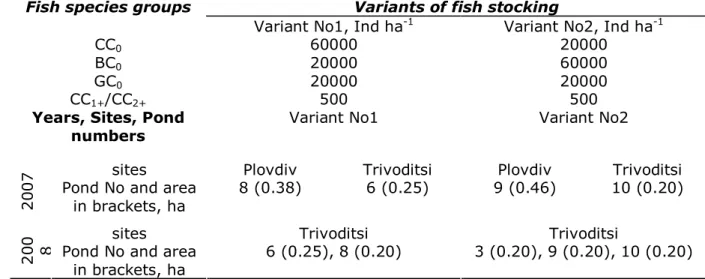
Material and Method.Breeding variants of common carp (CC) and bighead carp (BC) 0 larvae in two different proportions and their relations to plankton primary productivity were tested. The experiment includes two fish ponds stocked with CC and BC larvae by numeric ratio 3:1 and further two fish ponds whose ratio amounts to 1:3 in favor of BC. To each of the two stocking variants we added one and the same number of 0 aged grass carps and 1+/2+ common carps. The Table 1 summarizes the number of individuals from each fish species group, ponds and sites applied in the experiment.
Table 1 Stocking variants with 0 larvae of common carp (CC0), bighead carp (BC0), grass carp
(GC0) and 1 or 2 year old common carp (CC1+/CC2+ with 250g average body weight)
reared in years 2007 and 2008 in fish ponds at two sites (Plovdiv and Trivoditsi)
Variants of fish stocking Fish species groups
Variant No1, Ind ha-1 Variant No2, Ind ha-1
CC0 60000 20000
BC0 20000 60000
GC0 20000 20000
CC1+/CC2+ 500 500
Years, Sites, Pond
numbers Variant No1 Variant No2
sites Plovdiv Trivoditsi Plovdiv Trivoditsi
20
07 Pond No and area
in brackets, ha 8 (0.38) 6 (0.25) 9 (0.46) 10 (0.20)
sites Trivoditsi Trivoditsi
20
0 8 Pond No and area
As shown on the table in the first year (2007) the experiment took place at two different sites (Plovdiv town and Trivoditsi village) whose fish ponds belonged to the experimental facilities of the Institute for Fishery and Aquaculture. In the second year (2008) all experimental ponds were localized in Trivoditsi village. For technical reasons in the year 2008 we carried out variant 2 with three ponds (beside pond No 10 already applied in the previous year exceptionally we used pond No 3 and later included the pond No 9 also). Another difference from the first year was the application of CC2+ instead of CC1+ applied
previously, which was not more available in the second year.
The applied earthen fish ponds were drained and dried in autumn. Then in the spring of the next year they were limed with 2000 kg.ha-1 of alkaline lime and manured
with decomposed organic dung of cattle origin (3000 kg.ha-1) before the filling with
water. The manure is introduced in proximity of the pond banks with depth varying between 0.30-0.50 m.
The experiments lasted about 4 months (from the beginning of June till the end of September). The fishes were introduced in the intervals 7-22 June and 5 June -18 July during the years 2007 and 2008 correspondingly.
The larvae and older carps were fed with grounded sunflower groats during the whole experiment.
The plankton primary production was measured at three depth levels (0.1, 0.3 and 0.5 m) by means of light and dark bottle technique. Laboratory glass bottles of about 250 ml volume with wide neck were used in order to ensure the oxygen measurement with an oxy-meter electrode (WTW Oxi 315i/SET). Sometimes oxygen bubbles appeared in the light bottles and escaped the measurement. However we introduced an approximate correction by estimating the bubble dimensions, calculation and transformation of its volume to normal conditions and obtaining the quantity escaping the oxygen measurements. The exposure took between 1 and 2 hours time during the first half of the day. The 24 hours rates of gross primary production were calculated after the method of Moutin et al (1999). The respiration was obtained by multiplying the measured hourly rate by 24 hours and the difference between gross primary production and respiration delivered the net primary production. Finally the 24 hour rates were integrated for the experiment duration and the total production for the period of experiment (about four months) obtained.
The chlorophyll-a was measured by filtration of an appropriate volume through GFA Millipore glass fibber filters of 0.7 m pore size, ethanol extraction, spectrophotometer readings and calculation, all operations carried out after the ISO-1/1980 and ISO 5667-2/1991.
The total sun radiation was measured by a pyranometer M 80 M type with black and white squares, fixed about 2 m above the earth surface. The pyranometer readings were recorded every hour during the interval between 9oo am and 16oo pm local time.
At the end of the experiment the ponds were fished completely and fish yield was measured, then the number and the survival rate of different fish species and age groups were calculated.
Unfortunately during the experiments in both years crucian carp was brought into the fish ponds with water supply and its abundance also recorded at the experiment end. Thus we were able to account for possible influences by crucian carp on the final results.
Results and Discussion. The only statistically significant difference concerning percentage of fish survival between the two variants of fish stocking is observed for bighead carp in favor of the variant No 1 (Figure 1). Taking into consideration the statements of Milstein et al (2006), Rahman et al (2006), and Kadir et al (2007) we have to assume that the variant 1 offers better survival conditions for bighead carp larvae than variant 2. There are two reasons for this. First, the 3 times larger number of 0 aged common carps than in variant 2 caused more intensive nutrient mobilization from sediment by stirring it (Milstein et al 2006; Kadir et al 2007) and second, the initial socking density of bighead carp in variant 1 is closer to the optimum (0.5 Ind. m-2)
survival rates between two stocking variants and the highest survival percentage is reported for oldest fish group that of 1+/2+ old carp because as default natural fish mortality of older age classes is supposed to be lower than of the younger.
Mean; Whisker: Mean-SD, Mean+SD
V1 V2 Variant s of fish stocking 0
5 10 15 20 25 30 35 40 45
Pe
rc
en
ta
ge
o
f f
is
h
su
rv
iv
al
,
C
C0
, G
C0
, BC
0
%
55 60 65 70 75 80 85 90 95 100
Pe
rc
en
ta
ge
o
f f
is
h
su
rv
iv
al
,
C
C1+
/2
+
%
CC0(L)
BC0(L)
GC0(L)
CC1+/2+(R)
Figure 1. Percentage of survived fishes from two variants stocked with of 0 old common carp (CC0), grass carp (GC0), bighead carp (BC0) and 1+/2+ old carp (CC1+/2+).
The fish number means of the two variants showed no statistically significant differences at the end of experiment, despite the starting ratios between CC0:BC0 for variant 1 of 3:1
and 1:3 for variant 2.
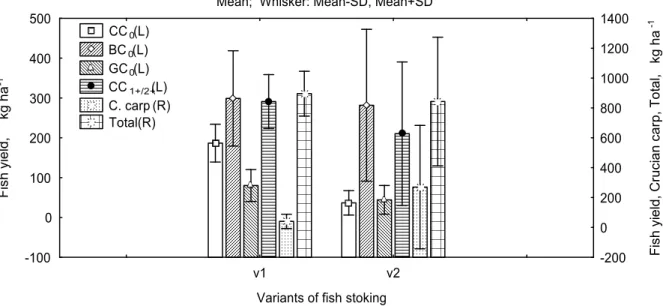
The fish yield of two stocking variants showed statistically significant differences in favor of the mean of variant 1 for CC0 only (P=0.00164, Figure 2). As previously
indicated in the text above the final number of CC0 group does not differ for the two
Mean; Whisker: Mean-SD, Mean+SD
v1 v2 Variants of fish stoking -100
0 100 200 300 400 500
Fi
sh
y
ie
ld
,
kg
h
a
-1
-200 0 200 400 600 800 1000 1200 1400
Fi
sh
y
ie
ld
, C
ru
ci
an
c
ar
p,
T
ot
al
,
k
g
ha
-1
CC0(L)
BC0(L)
GC0(L)
CC1+/2+(L)
C. carp (R) Total(R)
Figure 2. Fish yield means of 0 old common carp (CC0), grass carp (GC0) bighead carp
(BC0), 1+/2+ old common carp (CC1+/2+), crucian carp (C. carp) and total fish yield from
two variants of fish stocking at the end of experiment.
The feed for bighead carp larvae under variants 1 seem also to be better than in variant 2 because the yields of two variants at the end of the experiment did not differ despite the starting ratio of 1:3 in favor of variant 2. The other two fish components of experiment set in equal numbers at the beginning as expected did not show significant differences at the experiment finish. The same is valid for final total fish biomass, which included also the crucian carp which accidentally got into the experiment ponds with water supply.
Mean; Whisker: Mean-SD, Mean+SD
v1 v2 Variant s of fish stocking during year 2007 -20
0 20 40 60 80 100 120 140 160 180 200
PP
gr
os
s
, R
, PP
ne
t
,
g
O
m
-2 2
4h
-1
, C
hl
, m
g
m
-3
-2 -1 0 1 2 3 4
PEU
,
%
, PP
gr
os
s
/C
hl
,
m
gO
24
h
-1 m
g
-1
PPgross(L)
R(L) PPnet(L)
Chl (L) PEU(R) PPgross/Chl(R)
Figure 3. Plankton primary production and derivative variables of fish stocking experiment, measured during the year 2007: gross primary production (PPgross), respiration (R), net primary production (PPnet), concentration of chlorophyll-a (Chl), percentage of solar energy utilization by PPgross (PEU), ratio between PPgross and Chl.
Besides the regularly provided artificial feed and preference to benthic or pelagic food resources the yield and number of most reared fish groups showed significant correlations with net plankton primary production.
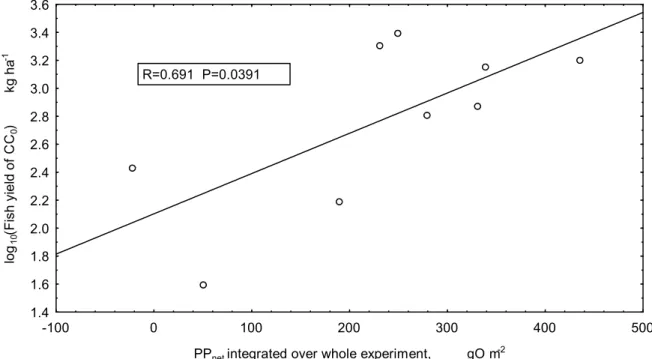
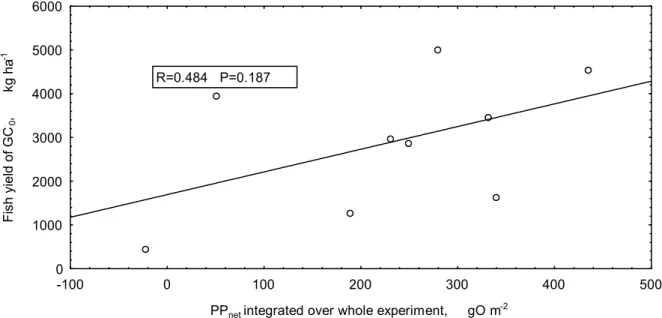
As shown on Figure 4 and 5 both yields of CC0 and GC0 correlated significantly
with plankton PPnet despite the CC0 being omnivorous in presence of plankton feeder
might prefer benthic organisms and GC0 – high plant vegetation. Probably the GC0 has
taken more plankton algae in its diet due to its low age and because the high plants were rare in the ponds. As obligatory plant feeder GC0 correlates stronger with PPnet than the
CC0 whose feeding spectrum includes both benthic and plankton animals and has indirect
-100 0 100 200 300 400 500 PPnet integrated over whole experiment, gO m-2
1.4 1.6 1.8 2.0 2.2 2.4 2.6 2.8 3.0 3.2 3.4 3.6
lo
g10
(F
is
h
yi
el
d
of
C
C0
)
k
g
ha
-1
R=0.691 P=0.0391
Figure 4. Relationship between net plankton primary production (PPnet) integrated for the whole experiment duration and the obtained fish yield share of common carp larvae
in the age of 0 (CC0) at the experiment end.
-100 0 100 200 300 400 500 PPnet integrated over whole experiment gO m-2
1.8 2.0 2.2 2.4 2.6 2.8 3.0 3.2
lo
g10
(Yi
el
d
of
G
C0
)
kg
h
a
-1
R=0.786 P=0.012
Figure 5. Relationship between net plankton primary production (PPnet) integrated for the whole experiment duration and the obtained fish yield share of grass carp larvae in
age of 0 (GC0) at the experiment end.
On contrary, the BC0 as a typical plankton feeder did not show significant correlation with
Ppnet (Figure 6). This was in accordance with our preliminary microscopic investigations of gut content. They showed that beside phyto and zooplankton, detritus formed a great share of bighead carp gut content.
carp inclusive) also showed a significant correlation with plankton net productivity (R=0.700, P=0.0356).
-100 0 100 200 300 400 500 PPnet integrated over whole experiment, gO m-2
0 1000 2000 3000 4000 5000 6000
Fi
sh
y
ie
ld
o
f G
C0
,
k
g
ha
-1
R=0.484 P=0.187
Figure 6. Relationship between net plankton primary production (PPnet) integrated for the whole experiment duration and the obtained fish yield share of bighead carp larvae in
age of 0 (BC0) at the experiment end.
-2000 0 2000 4000 6000 8000 10000 12000 Yield of Crucian carp, kg ha-1
0.0 0.2 0.4 0.6 0.8 1.0 1.2 1.4 1.6 1.8
lo
g10
(Yi
el
d
of
C
C1+
),
kg
h
a
-1 R=-0.926 P=0.0003
Figure 7. Relationship between measured yield of crucian carp contaminating the experiment and the obtained fish yield share of common carp in age of 1+/2+ (CC1+/2+)
at the experiment end.
Conclusions. The variant 1 with stocking density ratio 3:1 of common carp to bighead carp in age 0 showed better survival rate of BC0 and better yield of CC0 and BC0 than of
variant 2 with stocking ratio CC0 : BC0 = 1:3. Obviously this density ratio of CC0 and BC0
was more favorable for the realization of mutual benefits for both fish species.
Despite the regular feeding with artificial food the yield of larvae of CC0 and grass
carps (GC0) correlated significantly with net plankton primary production, while yield of
BC0 did not due to its feeding on detritus particles. Most probably either the added food
was not directly utilized by the larvae (except BC0), or big deal of it was eaten by older
CC1+/2+ and crucian carps.
The common carp 1+/2+ competed strongly with experiment invader crucian carp for the same food resources, while common carp 0 aged did not.
Acknowledgements. We would like to thank the bulgarian Ministry of Education and Science for the financial support of this study.
References
Kadir A., Wahab M. A., Milstein A., Hossain M. A., Seraji M. T. I., 2007 Effects of silver carp and the small indigenous fish mola Amblypharyngodon mola and punti Puntius sophore on fish polyculture production. Aquaculture 273:520–531.
Lu M., Xie P., Tang H., Shao Zh., Xie L., 2002 Experimental study of trophic cascade effect of silver carp (Hypophthalmichthys molitrixon) in a subtropical lake, Lake Donghu: on plankton community and underlying mechanisms of changes of crustacean community. Hydrobiologia 487:19–31.
Mattson N. S. 1999 Trophic interactions between two tropical omnivorous fishes,
Oreochromis shiranus and Barbus paludinosus: feeding selectivities and food web responses. Hydrobiologia 380:195–207.
Milstein A., Ahmed A. F., Masud O. A., Kadir A., Wahab M. A., 2006 Effects of the filter feeder silver carp and the bottom feeders mrigal and common carp on small indigenous fish species (SIS) and pond ecology. Aquaculture 258:439–451.
Moutin T., Raimbault P., Poggiale J.-C., 1999 Production primaire dans les eaux de surface de la Mediterranee occidentale. Calcul de la production journaliere. C.R. Acad. Sci. Paris, Sciences de la vie/Life Sciences 322:651-659.
Rahman M. M., Verdegem M. C. J., Nagelkerke L. A. J., Wahab M. A., Milstein A., Verreth J. A. J., 2006 Growth, production and food preference of rohu Labeo rohita (H.) in monoculture and in polyculture with common carp Cyprinus carpio (L.) under fed and non-fed ponds. Aquaculture 257:359–372.
Yi Y., 1999 Modeling growth of Nile tilapia (Oreochromis niloticus) in a cage-cum-pond integrated culture system. Aquacultural Engineering 21:113–133.
Yong-Sulem S., Tomedi E. T., Mounchili S., Tekeng S., Brummett R. E., 2006 Survival of
Received: 27 April 2009. Accepted: 19 July 2009. Published 20 July 2009. Authors:
Doychin Ivanov Terziyski,Institute of Fisheries and Aquaculture, 248 V. Levski str., 4003 Plovdiv, Bulgaria, e-mail: [email protected]
Roumen Kirilov Kalchev, Institute of Zoology, Bulgarian Academy of Sciences, 1, Tsar Osvoboditel Blvd., 1000 Sofia, Bulgaria, e-mail:[email protected]
Penka Lazarova Vasileva, Institute of Fisheries and Aquaculture, 248 V. Levski str., 4003 Plovdiv, Bulgaria, e-mail: [email protected]
Ivaylo Atanasov Piskov, Institute of Fisheries and Aquaculture, 248 V. Levski str., 4003 Plovdiv, Bulgaria, e-mail: [email protected]
Ivan Zlatkov Iliev, Institute of Fisheries and Aquaculture, 248 V. Levski str., 4003 Plovdiv, Bulgaria, e-mail: [email protected]
How to cite this article:
Terziyski D. I., Kalchev R. K., Vasileva P. L., Piskov I. A., Iliev I. Z., 2009 Fish abundance differences and relations to plankton primary production in two variants of pond stocking with common carp (Cyprinus carpio
L.), grass carp (Ctenopharyngodon idella Val.) and bighead carp (Aristichthys nobilis Rich.) larvae. AACL Bioflux 2(3):251-260.
Printed version: ISSN 1844-8143