Elsevier Editorial System(tm) for Social Networks Manuscript Draft
Manuscript Number: SON-D-14-00014
Title: The Consumer Litigation Industry: Chasing Dragon Kings in Lawyer-Client Networks Article Type: Full Length Article
Keywords: Power-law; Litigation; Preferential Attachment; Scale-Free network ; ambulance chasers
Corresponding Author: Prof. Flavio Codeco Coelho, Ph.D. Corresponding Author's Institution: Fundação Getulio Vargas First Author: Angelo M Calvão, PhD
Order of Authors: Angelo M Calvão, PhD; Crysttian A Paixão, PhD; Flavio Codeco Coelho, Ph.D.; Renato R Souza, PhD
Abstract: The community of lawyers and their clients form a scale-free bipartite network that develops naturally as the outcome of the recommendation process through
which lawyers form
their client base. This process is an example of preferential
attachment where lawyers with more clients are more likely to be recommended to new clients. Consumer litigation is an important market for lawyers. In
large consumer societies, there always a significant amount of consumption
disputes that escalate to court. In this paper we analyze a dataset of
thousands of lawsuits, reconstructing the lawyer-client network embedded in the data. Analyzing the degree distribution of this network we noticed that it
follows that of a scale-free network built by preferential attachment, but for a few lawyers with much larger client base than could be
expected by
preferential attachment. Incidentally, most of these also figured on a list put together by the judiciary of Lawyers which openly advertised the benefits of consumer litigation. According to the code of ethics of their
profession, lawyers should not stimulate clients into litigation, but it is not strictly illegal. From a network formation point of view, this stimulation can be seen as a separate growth mechanism than
The Consumer Litigation Industry: Chasing Dragon
Kings in Lawyer-Client Networks
Angelo Mondaini Calvãoa,b, Crysttian Arantes Paixãoa , Flávio Codeço Coelhoa,*, Renato Rocha Souzaa
a - School of Applied Mathematics, Getulio Vargas Foundation, Rio de Janeiro, RJ, Brazil b - Physics Institute, Universidade Federal Fluminense, Niterói, RJ, Brazil
* - corresponding author ([email protected]).
The Consumer Litigation Industry: Chasing Dragon
Kings in Lawyer-Client Networks
Abstract
The community of lawyers and their clients form a scale-free bipartite
net-work that develops naturally as the outcome of the recommendation process
through which lawyers form their client base. This process is an example of
preferential attachment where lawyers with more clients are more likely to
be recommended to new clients. Consumer litigation is an important market
for lawyers. In large consumer societies, there always a significant amount
of consumption disputes that escalate to court. In this paper we analyze
a dataset of thousands of lawsuits, reconstructing the lawyer-client network
embedded in the data. Analyzing the degree distribution of this network
we noticed that it follows that of a scale-free network built by preferential
attachment, but for a few lawyers with much larger client base than could be
expected by preferential attachment. Incidentally, most of these also figured
on a list put together by the judiciary of Lawyers which openly advertised
the benefits of consumer litigation. According to the code of ethics of their
profession, lawyers should not stimulate clients into litigation, but it is not
strictly illegal. From a network formation point of view, this stimulation
can be seen as a separate growth mechanism than preferential attachment
alone. In this paper we find that this composite growth can be detected by
a simple statistical test, as simulations show that lawyers which use both
mechanisms quickly become the “Dragon-Kings” of the distribution of the
number of clients per lawyer.
Keywords: Power-law, Litigation, Preferential Attachment, Scale-Free
network, ambulance chasers
1. Introduction
The existence of accessible legal mechanisms for settling disputes in
con-sumer relations is key to the maintenance of a “healthy” market. When the
consumer relation in focus involves essential services, such as power, health,
communications, etc., the consumer may give an important contribution to
the regulation of the system, by demanding the maintenance of minimal
stan-dards of quality in the services provided. A key channel for such demands is
that of legal litigation.
Legal litigation may have the side-effect of generating great increase in
judicial courts caseload, if used in violation of the basic assumptions about
the legal practice. According to code of ethics for the legal practice in Brazil,
as promulgated by the Brazilian Bar Association (Ordem dos Advogados
do Brasil, 1995), it is unethical for lawyers to stimulate clients to litigate.
Lawyers may advertise their services, but the demand for litigation must arise
from clients. This is also a known phenomenon on other countries (Luther,
1958), where legal ethics may not be as restrictive. Even tough in Brazil the
violation of this ethical code does not constitute a crime but it is frowned
upon by the legal community.
In recent years, the recourse to litigation to settle consumer relations
has become very popular in Brazil. The creation of the JEC (Civil Special
Courts), in which the assistance of a lawyer is not required and no legal
fees are charged, allied to the overall decrease in the times to reach a judicial
for legal settlement of their consumer conflicts.
These changes in judiciary, when taken together with the poor quality of
services of brazilian companies, especially in the utilities sector, has spiked
the interest of a number of law firms to stimulate litigation, through
mar-keting campaigns or even by fraudulent litigation, in which the parts are
not even aware of the lawsuit. This behavior is in blatant violation of the
Brazilian Bar Association’s code of ethics, but has largely gone unchecked
and has become an important source of business for many law firms.
In the company examines in this study, approximately 1% of its clients
litigate every year. Although this number may look small, it is responsible for
a substantial financial burden to the company, and for a great work overload
to the judiciary system as well. It can be estimated from official statistics1
published by the Rio de Janeiro State Court (TJRJ) that roughly one fifth
of new lawsuits filed each year, are consumer-related and come in through
JEC.
A considerable fraction of these lawsuits originates from law firms which
stimulate such litigation. Not all stimulated litigation are done in bad-faith,
but may be uncalled for and constitute a waste of important resource which
is the free access to justice as provided by the JEC.
Since the only way to identify firms which deviate from professional ethics
in this matter, is through careful investigation - advertisement identification,
fieldwork, interviews - which can be costly and time-consuming, in this paper
we show statistical properties of lawyer-client networks can help to
nate between law firms which recruit their clients ethically from those which
unethically stimulate litigation. From now on, those will be referred to as
unethical recruiters (UR).
The analysis is based on statistical properties of the lawyer-client
net-works, namely on the distribution of the number of clients per
lawyer/law-firm, which fits nicely to a power-law model. Based on observations that
confirmed URs appear to be outliers of this distribution. We design a
sta-tistical test to identify potential URs. In the stasta-tistical literature (Sornette,
2009), outliers to power-law distributions are called Dragon-kings.
We postulate that unethical recruitment act as an amplifying mechanism
turning URs into the Dragon-kings of the distribution, in the sense of
Sor-nette (2009). Dragon-kings are defined by this author as “extreme events
that do not belong to the same population as the other events, in a precise
quantitative and mechanistic sense”.
The paper is organized as follows: in section 2, the data which motivates
the analysis is presented and the implications for the Judiciary system and
the consumer are discussed. Section 3, contains the proposed models for
client acquisition and their assumptions. In section 4,we present the results
and discuss their relevance.
2. The Evidence
The Brazilian judicial system has seen a pronounced growth in
consumer-related litigation in recent years. This growth is in part derived from the
economical expansion experienced by the country in the recent past. This
dynamics taking place within the same population, such as unethical
stim-ulation of litigatory behavior on the part of law firms and/or individual
Lawyers.
The analysis shall focus on the electricity distribution sector in a large
brazilian city, namely, the municipality of Rio de Janeiro and some adjacent
regions. This sector alone display considerable volume of lawsuits (Table 1),
causing the electricity company and the judiciary system important financial
burden and work overload.
Legal disputes concerning electricity distribution services are estimated
to cost annually around R$ 10 million to a utility company with roughly
4×10⁶
clients2
, and more than 10 million reais to the judiciary system in
operating costs, according to a study commissioned by the National Council
of Justice(IPEA, 2011). The fraction of this cost which is related to
stim-ulated litigation is not certain, but may add up to more than 20% of the
total cost, according to our estimates, based on statistics from the Rio de
Janeiro Court of Justice (TJRJ). These costs reinforce the importance of
having mechanisms to detect potential abuses of the judicial system.
Table 1: TJRJ Lawsuits related to Electricity services
Years 2005 2006 2007 2008 2009 2010 2011-04
Lawsuits 32523 53342 45651 38404 51265 38108 12481
Source: TJRJ
2Estimated from settlement values in a sample of lawsuits and the percentage of
The data used in this study are public in nature and were obtained from
the query page on TJRJ’s website. The raw data consists of the full lawsuits
records. The actual table with number of clients per lawyer used, obtained
from the full records, is available as a csv file in the supplementary materials.
3. Methods
In order to study the system, we propose a generative model to
approx-imate the observed social network of Lawyers and their clients. In such a
model we can chose to include unethical recruitment. In this section, we
begin by modeling the distribution of clients per lawyer in the actual data
and then we present the generative models (with and without unethical
re-cruitment) and the methodology used to parameterize them from the data.
Finally, we generated simulated datasets from the proposed model and
com-pare them to actual data.
3.1. Distribution of clients per Lawyer
After analyzing the available lawsuit dataset, we had to exclude a number
of lawsuits where we couldn’t determine accurately the identity of the lawyer
or law firm, due to typographical errors. We have also only retained lawsuits
against the main electrical utility company in Rio de Janeiro. This reduced
dataset contains 43,973 lawsuits, with 9,155 unique lawyers, comprising at
least 86% of the cases. In the dataset, we knew from advertising materials
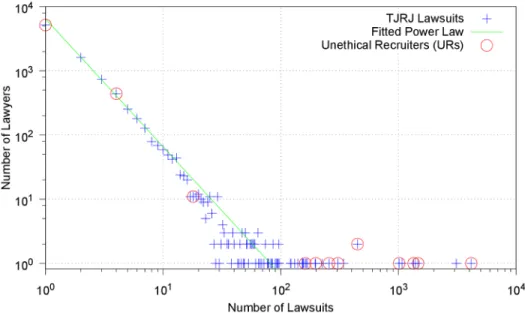
posted on the Internet and other media, that 12 of the lawyers (marked in
red on figure 1) were stimulating litigation and therefore fitted the definition
Upon a first inspection of the data, we noticed that the number of clients
(lawsuits) per lawyer or law firm, is distributed according to a power-law (see
Figure 1).
Figure 1 clearly suggests a power law behavior for the most part of the
values. However, there are some points at the distribution’s tail, that do not
seems to belong to the same distribution as the majority. Having the number
of clients per lawyer follow a power law amounts to say that probability of a
lawyer having L lawsuits(clients) is given by:
P(L) = CL−α (1)
whereCis a normalization constant. According to Clauset et al. (2009) there
must be a lower bound to the power law behavior. To accurately determine
that the underlying distribution of our data is indeed a power-law, we need
to estimate this lower bound (Lmin) and the value of α. Expressing the
normalizing constant in terms of Lmin and α, we get
p(L) = α−1
Lmin L Lmin −α (2)
To estimate both parameters we used the methodology described by
Clauset et al. (2009). The estimates obtained are shown in table 2. This
method is based on goodness of fit tests between the the data and the
pro-posed model. If the p-value of the goodness-of-fit test is greater then 0.1,
the power law is a plausible representation for the data. As shown in
ta-ble 2, running the estimates without the points corresponding to the known
unethical recruiters, yields stronger support for a power law distribution.
This fact suggests that UR can be considered outliers of the general lawyer
Table 2: Parameters estimated from data.
Data sets α Lmin p-value
With URs 2.26 4.00 0.12
Without URs 2.30 4.00 0.44
3.2. Detecting Unethical Lawyers
The position of a lawyer/law firm in the distribution of clients per lawyer,
is determined, according to the proposed generative model described below
(section 3.3.2), by its recruitment methodology, and their time in business.
After a short while of litigation stimulation, simulations show that they
in-variably end up as outliers of the power-law degree distribution estimated
for the rest of the network.
Detecting outliers in power-law distributions is not an easy task, but
there are statistical tests in the literature which claim to consistently identify
such outliers, which are called Dragon Kings (Pisarenko and Sornette, 2011;
Janczura and Weron, 2012).
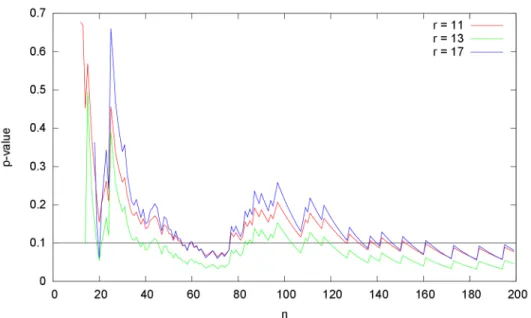
The method by Pisarenko and Sornette (2011) is based on ranking the
observations and testing whether ther top values are outliers. Applying this
method to our dataset, we found support for the existence of 11-17 outliers
in the data-set with 13 being the most likely value (Figure 2).
It produces ap-value which is interpreted as explained in table 3.
The second method Janczura and Weron (2012) proposes using the
cu-mulative probability distribution of lawsuits/lawyer to detect outliers. First,
cal-Table 3: Interpretation ofp-value in Pisarenko and Sornette’s Dragon king test.
p < 0.10 0.10< p <0.90 p > 0.90
r or less
Dragon-King(s)
No significant
deviation from a
power law
r or less
“neg-ative
Dragon-King(s)”
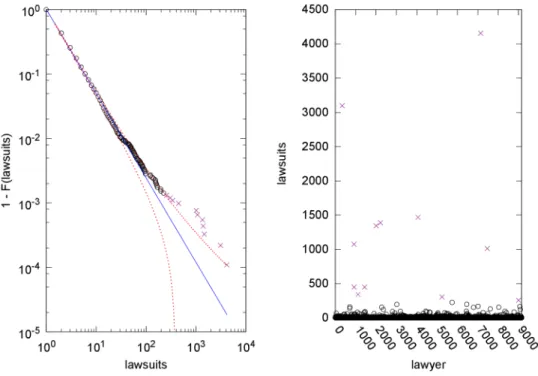
culated from the observed data. Then the complement of the cumulative
function, 1−F(L), can be fitted by a power-law: 1−F(L)≈1.01976x−1.31
(figure 3). Finally, we calculated confidence intervals for the fitted function.
The confidence interval for 1−F(x)(Equation 3) is defined from its power
law A0x−A1, for a confidence band of 95% and n observations. Note that
Z ∼N(0,1).
Figure 3 shows the power-law fitted to 1− F(L) with the confidence
intervals. This method found 11 outliers marked with × symbols in the
figure. Note that they fall outside the confidence interval.
(A0x−A1 + r
A0x−A1(1−A0x−A1)
n Z0.025, (3)
A0x−A1 + r
A0x−A1(1−A0x−A1)
n Z0.975)
Removing these 11 outliers and using Clauset et al.’s method for testing
whether a power law is the appropriate hypothesis, we obtainp= 0.21, which
is better than the value obtained on Section 3.1 for the data including the
3.3. Models of Client Acquisition
Having determined that the distribution of clients follows a power-law
with the parameters shown on table 2, we propose two models of client
ac-quisition to explain the observed data: One for the ethical client recruitment
methods and another for unethical recruitment.
We model the formation of Lawyer-client networks as a random process
in which clients find lawyers according to their needs and social contacts.
According to the Brazilian Bar Association (OAB, 1995), the only
ethi-cal way for lawyers to acquire clients is through recommendation or through
ethical advertisement of their services which does not induce litigation.
Suc-cessful lawyers are more likely to be recommended to new clients and may
have, on average, more resources to advertise their practice. These
charac-teristics lead to a “rich-get-richer” type of network dynamics.
An important class of networks which display this pattern of connectivity
are scale-free networks as proposed by Barab´asi and Albert (1999). It is
defined by the following building rules:
Nodes Growth: Starting with M0 ≥2 nodes, new nodes are added, one at
a time to the network.
Preferential Attachment: a node will tend to link to the higher degree
nodes. Formally, new nodes will attach to nodei with a probabilitypi:
pi = ki P
jkj
(4)
Barabsi and Albert have shown that the combination of this two rules,
leads to a network that has a power-law degree distribution Barab´asi and
Albert (1999), i.e., P(k) ∼ k−α. This property led to this type of network
be know as a scale-free network, since its degree distribution is independent
of the size of the network.
Many real-world networks have similar topology, e.g., the World Wide
Web (Barab´asi et al., 2000), social networks (Kossinets and Watts, 2006),
the Internet (Faloutsos et al., 1999) and metabolic networks (Jeong et al.,
2000). However the standard Barab´asi-Albert network does not describe
adequately the system as the one we are studying because in this particular
case, we have to add more than one attachment at each iteration.
3.3.1. Ethical Recruitment
The ethical recruiting behavior of a lawyer or law-firm can also be modeled
as a scale-free network, with the difference that our lawyer-client network is
a bi-partite one. This means that although the growth rule described for the
Barab´asi-Albert network remains the same, only edges between lawyers and
clients are ever formed, since the edges represents lawsuits.
To simulate such a network, we start with a small population of clients
and their lawyers, to even out the initial distribution of clients. Then we
added Lawyers and clients, according to the following algorithm:
1. Choose a maximum number of lawsuits lmax, that is, the maximum
number of edges on the network.
2. Start the system with m0 lawyers and m0 clients, with one client per
lawyer. Them0 must be chosen with care, to avoid much advantage to
3. Add a new lawyer, connecting it to a client
4. Add nc new clients.
5. Connect the new clients to lawyers with probability given by Equation
(4).
Steps 3-5 above is repeated until the network reaches the desired size
(lmax). See the figure 4, for an illustration of network growth. Motivated by
the data, without URs, these parameters were chosen: m0 = 80,lmax = 36600
and nc = 3.
The bi-partite network thus constructed is a scale-free network withα=
2.12 and shows an excellent fit to the observed data (see figures 5).
By visual inspection, is not possible to detect any outliers on the figure 5.
However, it is wise to check if the model does generates Dragon-kings. The
figure 6 shows the result for the previously used tests to detect outliers applied
on this model. As it should be, there are no dragon-kings (points beyond the
confidence bands).
The results obtained from the model of Ethical recruitment seem to
sup-port our hypothesized mechanism for ethical client recruitment. But we still
need a mechanism to explain the outliers observed in the dataset, which we
attribute to unethical recruitment.
3.3.2. Unethical Recruitment of clients
Assuming unethical recruiters as defined in this paper display an
addi-tional recruitment mechanism, namely the stimulation of litigation, we now
proceed to propose a model for their client recruitment.
We have seen that the word-of-mouth recommendation dynamics, implied
distribution satisfactorily. Therefore, we need to propose an extension to the
preferential attachment, to represent their client acquisition tactics.
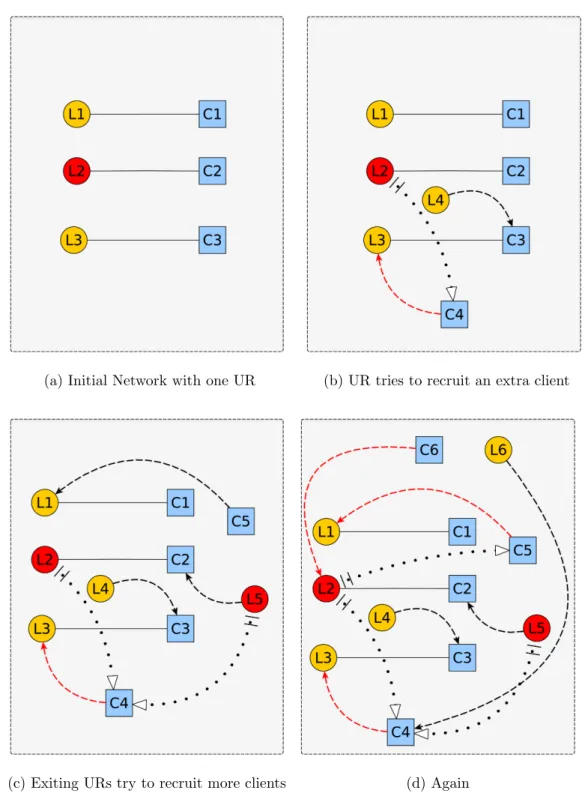
The network with unethical lawyers is built according to the following
algorithm:
1. Chose a maximum number of lawsuitslmax, that is, the maximum
num-ber of edges on the network.
2. Start the system with m0 lawyers and m0 clients, with one client per
lawyer. Them0 must be chosen with care, to avoid much advantage to
those initial lawyers and then preventing outliers.
3. Add a new lawyer, connecting it to a client
4. Whit probabilitypur this lawyer is marked as unethical.
5. Add nc new clients.
6. Connect the new clients to lawyers with probability given by eq.(4).
7. with probability pc, all unethical lawyers capture a client (stimulated
litigation).
Steps 3-7 above is repeated until the network reaches the desired size
(lmax). The step 4 is because even though we known which ones are URs, we
cannot precisely determine when they started their client recruitment work.
See the figure 4, for an illustration of network growth. Motivated by
the data, these parameters were chosen: m0 = 80, lmax = 44000, nc = 2,
pur = 0.0014 and pc = 0.2.
On fig.8, we can see a comparison of the simulated client distribution from
the unethical recruitment model with the observed data, and appreciate how
Tuning the parameters pur and pc, one can give more advantage to the
URs, thus generating more outliers. Also by starting the network with a
smaller community of lawyers, one gives more advantage to some lawyers to
amass a larger client base and position itself more towards the right end of
the distribution.
Applying the previously described methods to detect dragon-kings to
sim-ulated dataset with unethical recruitment, we can see some outliers (see
fig-ure 9)
4. Discussion and Conclusion
In this paper we have managed to demonstrate the distribution of clients
per lawyer in a large metropolitan area is compatible with a scale-free
bi-partite network of lawyers and clients. By proposing an extremely simple
model for unethical recruitment based observed behavior of real unethical
lawyers, we showed that unethical lawyers can be detected by means of a
simple statistical test. We also confirm Sornette’s observation that
dragon-kings are generated by an amplification mechanism (Sornette, 2009) which
unethical recruitment of clients is a good example of.
Being able to determine the probability of lawyer or law-firm being an
unethical recruiter, based only on their number of clients is an important tool
regulatory agencies can use to forestall the growth of an industry of moral
damages.
Despite the fact that approximately 1% of the clients sue their electricity
provider, less then 0.5% of these made previous complaints to the regulatory
This indicates an abuse of the judiciary system, since many of the issues
could be resolved extra-judicially.
In these analyses we have assumed that the lawyers have no influence on
other lawyers abilities to develop their client base. This is not strictly true as
lawyer may recommend other lawyers or form associations to better compete
for clients. However, the fact that the data fits very nicely to a power-law,
seem to support that the influences among lawyers do not play an important
role in the larger picture.
5. Bibliography
Barab´asi, A.-L., Albert, R., Oct. 1999. Emergence of Scaling in Random
Networks. Science 286, 509–512.
Barab´asi, A.-L., Albert, R., Jeong, H., 2000. Scale-free characteristics
of random networks: the topology of the world-wide web. Physica A:
Statistical Mechanics and its Applications 281, 69 – 77.
URL http://www.sciencedirect.com/science/article/pii/
S0378437100000182
Clauset, A., Shalizi, C., Newman, M., 2009. Power-law distributions in
em-pirical data. SIAM Review 51 (4), 661–703.
URL http://epubs.siam.org/doi/abs/10.1137/070710111
dos Advogados do Brasil, O. O., 1995. C´odigo de ´Etica e Disciplina da OAB.
Di´ario de Justi¸ca, Ch. 1.
Faloutsos, M., Faloutsos, P., Faloutsos, C., Aug. 1999. On power-law
29 (4), 251–262.
URL http://doi.acm.org/10.1145/316194.316229
IPEA, 2011. Custo unit´ario do processo de execu¸c˜ao fiscal na justi¸ca federal.
URL http://www.egov.ufsc.br/portal/sites/default/files/
custo\_unitario\_do\_processo\_de\_execucao\_fiscal\_na\
_justi\_ca\_federal\_2.pdf
Janczura, J., Weron, R., 2012. Black swans or dragon-kings? a simple test
for deviations from the power law. The European Physical Journal Special
Topics 205 (1), 79–93.
Jeong, H., Tombor, B., Albert, R., Oltvai, Z. N., Barab´asi, A.-L., 2000. The
large-scale organization of metabolic networks. Nature 407 (6804), 651–
654.
Kossinets, G., Watts, D. J., 2006. Empirical analysis of an evolving social
network. Science 311 (5757), 88–90.
URL http://www.sciencemag.org/content/311/5757/88.abstract
Luther, M. J. I., 1958. Legal ethics: The problem of solicitation. A.B.A. J.
44, 554.
Pisarenko, V. F., Sornette, D., Apr. 2011. Robust statistical tests of
dragon-kings beyond power law distributions. arXiv:1104.5156.
URL http://arxiv.org/abs/1104.5156
Figure 1: This log-logplot depicts the distribution of clients per Lawyer. The points
marked in red are the confirmed URs. It is also evident the power law behavior of the
distribution, which has exponent of 2.26. Even though there are some URs along the
Figure 2: In Pisarenko and Sornette’s method to detect Dragon-King(s) (2011), one should
choose a value for rand plot thep-values for different values ofn, that is the number of
observations of the ranked dataset against which the candidates to Dragon Kings are
compared. The existence of Dragon-King(s) is likely if the p-values stay under 0.1 for
most values ofn. Here we can see that 13 Dragon-kings is the most likely possibility, since
Figure 3: Confidence intervals for the complement of the cumulative distribution of the
number of lawsuits per lawyer (left panel) and the raw data (right panel). Outliers are
(a) Initial Network (b) New client and lawyer are added
(c) Again (d) Again
Figure 4: Diagrams showing the mechanism of network growth according to the proposed
(a) Degree distribution for the data and the model (b) Pareto Q-Q Plot for the ethical recruitment
Figure 5: Agreement between the ethical recruitment model and the data, the TJRJ
Lawsuits.
(a) Confidence Intervals (b) Dragon-King(s) Test
Figure 6: Tests for outliers as described in section 3.2. Note that here we are only interested
(a) Initial Network with one UR (b) UR tries to recruit an extra client
(c) Exiting URs try to recruit more clients (d) Again
Figure 7: Diagrams showing the mechanism of network growth, according to the proposed
(a) Degree distribution for the data and the model (b) Pareto Q-Q Plot for the URs
Figure 8: Agreement between the unethical recruitment model and the data, the TJRJ
Lawsuits
(a) Confidence Intervals (b) Dragon-King(s) Test
Figure 9: This model, besides showing a good fit to the data, also generates dragon-kings
Acknowledgments
This work was funded by a grant from Funda\c{c}\~ao Getulio Vargas. The authors would like to thank Didier Sornette for helpful comments on how to properly implement the tests to detect dragon-king(s). We are also grateful to Dayanne Fernandes Amaral for her help with part of the data collection and Carlos Eduardo Galhardo for some useful discussions.