January, 2009 PROGRESS IN PHYSICS Volume 1
LETTERS TO PROGRESS IN PHYSICS
Israel L. Bershtein (1908 –2000) — the Founder of the Theory
of Fluctuations in Self-Oscillating Systems
(In Commemorating the 100th Birthday Anniversary)
Gregory B. Malykin
Inst. of Applied Physics, Russian Acad. of Sciences, Ulianova Str. 46, Nizhni Novgorod 603600, Russia
E-mail: [email protected]
Israel L. Bershtein (1908–2000) was one of the famous radio physicists in the world. He had constructed the theory of amplitude and frequency fluctuations for the electromag-netic wave generators working in the radio and optical scales. He also had developed numerous methods for precise measurement of the fluctuations, which also can be ap-plied to ultimate small mechanical displacements. Besides these he was the first person among the scientists, who had registered the Sagnac effect at radiowaves.
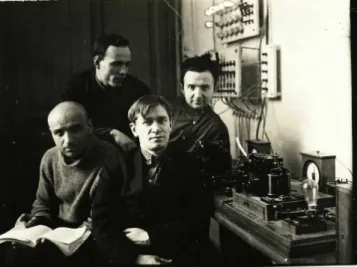
Fig. 1: I. L. Bershtein in 1930 (the left corner in the picture), being a 5th grade university student at the Low Current Lab (a common name for a radio laboratory in those years). This photo is interesting from the historical viewpoint, because the background of a radio laboratory of the 1930’s.
In November, 2008 we celebrate the 100th Birthday Anniver-sary of Israel Lazarevich Bershtein, Doctor of Science in Physics and Mathematics, a distinguished radio physicist, the author of theoretical and experimental research methods for fluctuations of radio and optical electromagnetic oscilla-tors. The paper deals with I. L. Bershtein’s basic scientific achievements.
I. L. Bershtein started his scientific activities when radio-physics originated and broke new ground, so he took a part in its development. I. L. Bershtein was born on November 22, 1908 in the Mogilyov city of the Russian Empire (nowa-days the Republic of Belarus). After graduating from school he studied physics at the Electromechanical Faculty of the Leningrad Polytechnical Institute (1926–1930). A. F. Ioffe,
V. F. Mitkevich, D. D. Rozhansky, A. A. Chernyshev, and M. A. Shatelen were among his teachers. A well-known de-bate concerning the nature of electric current, electric and magnetic fields and also the long-range action problem be-tween V. F. Mitkevich, the full member of the USSR Acade-my of Sciences, and Ya. I. Frenkel, the corresponding mem-ber of the Academy, took a place in 1929–1930 at the Poly-technical Institute. P. Ehrenfest was invited by A. F. Ioffe to participate in two sessions of the debate. I. L. Bershtein took a part in all three sessions of these.
After graduating from the Polytechnical Institute in 1931 I. L. Bershtein was employed at the Central Military Research Radio Laboratory (later — the Frunze Factory). He how-ever preferred scientific activities. In 1930 N. D. Papaleksi, the corresponding member of the Academy, paid attention to the talented student. On his advice I. L. Bershtein addressed Prof. A. A. Andronov who agreed to become his scientific su-pervisor. In 1933 I. L. Bershtein was enrolled for A. A. And-ronov’s in-service training postgraduate course. His task was to obtain expressions for amplitude and frequency fluctua-tions of a self-oscillating system (by the example of valve os-cillator) close to its periodic motion. I. L. Bershtein managed to show that frequency fluctuations of the generator “blurred” the infinitely narrow radiation line of an ideal oscillator and it acquired width, while amplitude fluctuations created a rather wide but low “pedestal” of the generation line. Results of this work were recommended to publishing by L. I. Mandelstam, the full member of the Academy, and they were published inSoviet Physics — Doklady[1]. Paper [1] considerably
ex-ceeded the maximum permissible volume and A. A. Andro-nov reached an agreement with the Editor-in-Chief S. I. Va-vilov, the full member of the Academy, on publishing [1] in total. In 1939 I. L. Bershtein under supervision of A. A. And-ronov defended a Ph.D. thesis. The official opponents were M. A. Leontovich and G. S. Gorelik. In 1941 I. L. Bershtein
Volume 1 PROGRESS IN PHYSICS January, 2009
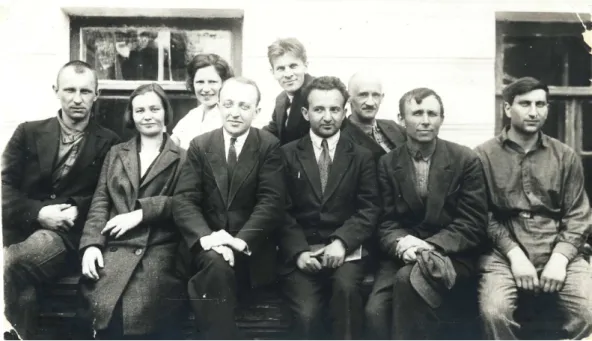
Fig. 2: I. L. Bershtein in 1938, among the research scientists and professors of the Gorky Physics and Technical Institute (GPTI). In the 1st row (from left to right): unknown person; unknown person; Prof. S. M. Rytov; I. L. Bershtein; Prof. Jakov N. Nikolaev; Kholodenko. In the 2nd row (from left to right): Prof. Alexandra G. Lyubina; Prof. Victor I. Gaponov (the husband of Prof. Maria T. Grekhova, the Director of GPTI, and the father of A. V. Gaponov-Grekhov, the full member of the Academy); unknown person.
published a more detailed statement of the theory of fluc-tuations in valve oscillator [2]. The original theoretical re-sults he had obtained required experimental validation, how-ever the Fascist Germany aggression upon the USSR forced I. L. Bershtein to postpone his fundamental research.
During the World War II I. L. Bershtein developed radio receiving equipment for the Soviet army and aviation needs. In 1946 I. L. Bershtein stopped his industrial activity and was employed at the Gorky Physics and Technical Institute (GPTI) in G. S. Gorelik’s department, and held a post of As-sistant Professor and Full Professor of radioengineering at the newly organized Radiophysical Faculty of the Gorky State University. Nevertheless, until 1952 he continued to super-vise the development and production of radio equipment at a factory. At that time I. L. Bershtein starts to develop ex-perimental methods for measuring amplitude and frequency fluctuations of valve oscillator. In particular, he was the first person who suggested to process measurement of small phase fluctuations by the so-called method of triangle, based on the interference of the measured and reference signals having an insignificant constant phase shift relative to each other and close amplitude values. The experimental measurement car-ried out by I. L. Bershtein in [3, 4] completely verified his earlier theoretical results [1, 2]. His paper [4] was awarded the Mandelstam Prize presented to L. I. Bershtein at a session of the USSR Academy of Sciences by N. I. Vavilov, the Pres-ident of the Academy.
In papers [3, 4] I. L. Bershtein managed to measure the lowest level of periodic phase modulation of the order 10 8
rad in the frequency band 1 Hz. This permitted to carry out a very interesting physical experiment, i.e., to measure the Sagnac effect at radio waves employing a cable of the 244 m length coiled round a barrel [5]. The radio wavelength was 10 m and the angular velocity of the barrel’s rotation was 1–1.3 revolutions per second. Since the phase difference of counter-running waves caused by the rotation is inversely proportional to the wavelength, it is evident that the Sagnac interferometer sensitivity at radio waves is 107lower than the sensitivity un-der the other equal conditions expected in the optical range.
I. L. Bershtein’s papers on fluctuations and the Sagnac ef-fect [3–5] brought him world-wide popularity. He became a leading Soviet scientist on fluctuation measurement. In 1954 he measured extremely small mechanical displacements em-ploying the interference method, and recorded a displacement of the order 10 3Å (see [6]). (It should be noted that, in 1998, one of I. L. Bershtein’s disciples, namely — V. M. Geli-konov, managed to increase the measurement accuracy of me-chanical displacements by 4 orders to it. See [7] for detail.) That year I. L. Bershtein defended a Dr.Sci. thesis (his op-ponents were G. S. Landsberg, Yu. B. Kobzarev, S. M. Rytov, and G. S. Gorelik) and after G. S. Gorelik’s departure for Moscow he headed a scientific department in GPTI. In the same time he became a Full Professor at the Radioengineer-ing Faculty of the Gorky State University.
In 1957 I. L. Bershtein and his department were transfer-red to the Radiophysical Research Institute (RRI), where he studied klystron oscillators and matched their frequencies to the frequencies of a quartz oscillator and an ammonia maser,
January, 2009 PROGRESS IN PHYSICS Volume 1
Fig. 3: I. L. Bershtein in 1948. This is the time of the upper point of his scientific achievements.
then investigated the oscillator fluctuations in AFC system operation. In the mid-60’s I. L. Bershtein’s department started developing a subject related to the pioneering experimental and theoretical studies in the field of fluctuation processes in gas lasers with Fabry-P´erot and ring resonators, including gas lasers with an absorbing cell used for elaboration of the op-tical frequency standards. At that time I. L. Bershtein devel-oped a heterodyne method for frequency fluctuation measure-ment, enabling his disciples Yu. I. Zaitsev and D. P. Stepanov to be first persons in the world who measured frequency fluc-tuations of a gas laser at the wavelength 0.63[8]. In 1969 I. L. Bershtein was invited to held a lecture on his depart-ment’s activities at P. L. Kapitsa’s workshop in Kapitza’s In-stitute for Physical Problems in Moscow.
In 1970 the so-called polarization resonances in coun-terrunning waves in an amplifying laser tube at the wave-length 3:39 [9] were discovered with the participation of L. I. Bershtein. He also studied the influence of the light back-scattering on laser operation and reciprocal capture of the counterrunning wave frequencies in a ring gas laser. The AFC systems for laser generation developed by I. L. Bershtein permitted his disciples to discover new effects in gas lasers with an absorbing cell. The new effects they have discov-ered were the dynamic self-stabilization of the generation fre-quency which occurs not only at the centre of the transition line of the absorbing gas, but also at the boundaries of the entire non-uniformly broadened absorption line, the depen-dence of the self-stabilization coefficient on the modulation frequency [10], and the so-called dispersion resonances they have recorded.
I. L. Bershtein was a member of the Editorial Board of the journalSoviet Radiophysics published in RRI for about
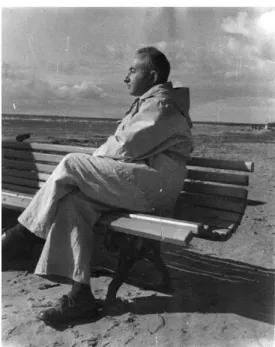
Fig. 4: The mid-60’s. I. L. Bershtein being taking relax at the coast of the Black Sea.
twenty years (1958–1976).
From 1977 to 1986 I. L. Bershtein headed a research lab-oratory at the Institute of Applied Physics dealing with fiber-optic interferometers. From 1987 to 1999, being a leading consulting scientist, he continued his studies in the field of fiber-optic gyroscopy and semiconductor radiation sources for fiber optics. I. L. Bershtein died on August 16, 2000.
The life and scientific activity of I. L. Bershtein is a wor-thy example of service to science. His work in the field of self-oscillating system fluctuations and micro phase meter-ing are the classics of science, and are extremely valuable for radiophysics. He is the author of more than 60 scientific pub-lications and many inventions certified by patents. He was also awarded several prizes provided by the USSR Govern-ment [11].
Under careful leading of I. L. Bershtein three persons have got a Ph.D. degree. Those were I. A. Andronova, Yu. I. Zai-tsev, and L. I. Fedoseev (the last person was led by I. L. Ber-shtein commonly with V. S. Troitsky, the corresponding mem-ber of the Academy). Many other research scientists were also I. L. Bershtein’s disciples: Yu. A. Dryagin, D. P. Stepa-nov, V. A. Markelov, V. V. Lubyako, V. A. Rogachev. The next generations of research scientists were also I. L. Bershtein’s disciples. Those are I. A. Andronova’s disciples, namely — I. V. Volkov, Yu. K. Kazarin, E. A. Kuvatova, Yu. A. Mamaev, A. A. Turkin, G. V. Gelikonov, and Yu. I. Zaitsev’s disciples — V. M. Gelikonov, V. I. Leonov, G. B. Malykin, and also D. V. Shabanov who was V. M. Gelikonov’s disciple, and also L. M. Kukin, who was Yu. A. Dryagin’s disciple. I. L. Bersh-tein patiently transferred all his scientific experience to the aforementioned persons, who are actually his disiples and fol-lowers in science.
Volume 1 PROGRESS IN PHYSICS January, 2009
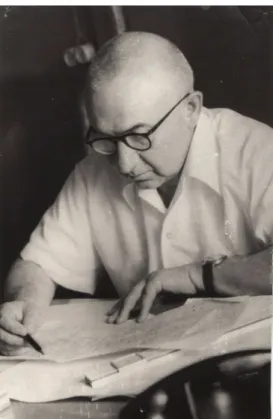
Fig. 5: I. L. Bershtein at the working desk in his cabinet. This photo, pictured in 1967, is very specific to his nativity of a man who spent his life in science.
The author of this paper would like to thank V. M. Ge-likonov, E. G. Malykin, V. I. Pozdnyakova, and N. V. Roudik for their assistance in this paper. This work was partly sup-ported by the Council on President’s Grants of the Russian Federation for Leading Scientific Schools (project no. NSh. 1931.2008.2).
Submitted on October 30, 2008/Accepted on November 14, 2008
References
1. Bershtein I. L. Fluctuations close to periodic motion of self-oscillating systems.Dokl. Acad. Nauk SSSR(Sov. Phys.-Dokl.),
1938, v. 20, 11–16 (in Russian).
2. Bershtein I. L. Fluctuations in a self-oscillating system and determination of natural spread of valve oscillator frequency.
Zh. Tekh. Fiz.(Sov. Phys.-Tech. Phys.), 1941, v. 11, 305–316
(in Russian).
3. Bershtein I. L. On valve oscillator fluctuations. Dokl. Acad. Nauk SSSR(Sov. Phys.-Dokl.), 1949, v. 68, 469–472 (in Rus-sian).
4. Bershtein I. L. Amplitude and phase fluctuations in a valve os-cillator.Izv. Acad. Nauk SSSR,Ser. Fiz.(Bull. Acad. Sci. USSR, Phys. Ser.), 1950, v. 14, 145–173 (in Russian).
5. Bershtein I.L. Sagnac experience at radio waves.Dokl. Acad. Nauk SSSR(Sov. Phys.-Dokl.), 1950, v. 75, 635–638 (in Rus-sian).
6. Bershtein I. L. On measurement of extremely small mechanical path difference of two light oscillations.Dokl. Acad. Nauk SSSR
(Sov. Phys.-Doklady), 1954. v. 94, 655–658 (in Russian). 7. Gelikonov V.M. Measurment of nanoangstr¨om oscillatory
dis-placements by a gas laser with a small natural linewidth. Ra-diophysics and Quantum Electronics, 1998, v. 41, 998–1006. 8. Zaitsev Yu.I. and Stepanov D.P. On frequency fluctuations of a
gas laser.Pis’ma Zh. Exp. Teor. Fiz.(JEPT Letters), 1967, v. 6,
733–737 (in Russian).
9. Bershtein I.L. and Rogachev V.A. Faraday rotation due to the interaction of oppositely directed waves in the3:39 . Radio-physics and Quantum Electronics, 1970, v. 13, 23–26. 10. Gelikonov V.M., Zaitsev Yu.I., Malykin G.B. On one
manifes-tation of nonsmanifes-tationary saturation of absorbing gas in a standing frequency-modulated wave.Pis’ma Zh. Tekh. Fiz.(Sov. Tech. Phys. Lett.), 1979, v. 5, 1468–1471 (in Russian).
11. Malykin G.B. I. L. Bershtein, his scientific activity. To the 90th birthday anniversary. Institute of Applied Physics Publishers, Nizhny Novgorod, 1998, 20 p.