http://jppres.com/jppres
Original Article | Artículo Original
Microbial and physicochemical assays of paracetamol in different
brands of analgesic syrups sold in Sana'a City-Yemen
[Ensayos microbiológicos y físico-químicos de paracetamol en diferentes marcas de jarabes analgésicos vendidos en la ciudad de Sana’a, Yemen]
Ali G. Al−Kaf1*, Saeed M. Alghalibi2, Wadhah H. Edrees2
1
Medicinal Chemistry Department, Faculty of Pharmacy; 2Biology Department, Faculty of Science, Sana'a University, Sana’a, Yemen. *
E-mail: [email protected]
Abstract Resumen
Context: Contamination of pharmaceuticals with microorganisms irrespective whether they are harmful or nonpathogenic can bring about changes in physicochemical characteristics of the drugs.
Aims: To assay the microbial and physicochemical characteristics of paracetamol of two hundreds samples of different brands of analgesic syrups sold in Sana'a City, Yemen.
Methods: Total viable aerobic count, type of isolated microorganisms, physical properties, and content of active ingredients were identified and evaluated by standard methods and techniques. The SPSS program was used to statistical analysis of variance for results obtained.
Results: The total bacterial count of <10 CFU/mL and <100 CFU/mL in 179 (89.5%) and 21 (10.5%) samples, respectively was recorded, while the total fungal count was ≤10 CFU/mL in all analyzed syrup samples. The isolated bacteria were Bacillus subtilis, Micrococcus fulvum, and Staphylococcus epidermidis while isolated fungi were Aspergillus niger, Aspergillus fumigatus, and Penicillium notatum. Bacillus subtilis and Aspergillus niger were the predominant bacteria and fungi isolated. The color results had a light red liquid with a sweet taste in the analyzed analgesic syrups. The pH values were ranged from 4.44–5.88. However, the density fluctuated from 1.149–1.184 g/mL. The paracetamol concentration as an active ingredient in the analgesic syrup was recorded from 98.19% – 106.53%.
Conclusions: This finding showed that all analgesic syrups sold in Sana'a City followed Pharmacopeia specifications on microbial and physicochemical qualities.
Contexto: La contaminación de los productos farmacéuticos con microorganismos, independientemente si son perjudiciales o no puede provocar cambios en las características fisicoquímicas de los fármacos.
Objetivos: Analizar las características microbianas y físico-químicas del paracetamol de doscientas muestras de diferentes marcas de jarabes analgésicos vendidos en la ciudad de Sana'a, Yemen.
Métodos: Fueron medidos el recuento total viable aeróbico, el tipo de microorganismos aislados, las propiedades físicas y el contenido de ingredientes activos mediante métodos y técnicas estándares. El programa SPSS se utilizó para el análisis estadístico de la varianza de los resultados. Resultados: Fue registrado el conteo total de bacterias de <10 CFU/mL y <100 CFU/mL en 179 (89.5%) y 21 (10.5%) muestras, respectivamente, mientras que el conteo total de hongos fue ≤10 CFU/mL en todas las muestras de jarabe analizadas. Las bacterias aisladas fueron Bacillus subtilis, Micrococcus fulvum y Staphylococcus epidermidis, mientras que los hongos aislados fueron Aspergillus niger, Aspergillus fumigatus y Penicillium notatum. Bacilus subtilis y Aspergillus niger fueron los microorganismos aislados predominantes. Los jarabes analgésicos tuvieron una apariencia líquida de color rojo claro con un sabor dulce. Los valores de pH estuvieron en el rango de 4,44 – 5,88. La densidad varió de 1,149 – 1,184 g/mL. La concentración de paracetamol, como un ingrediente activo dentro del jarabe analgésico, fue registrada desde 98,19 – 106,53%.
Conclusiones: Este hallazgo mostró que todos los jarabes analgésicos, vendidos en la ciudad de Sana'a, siguieron las especificaciones de calidad microbianas y físico-químicas de la farmacopea.
Keywords: Content; evaluation; microbiological; physical; oral liquid. Palabras Clave: Contenido; evaluación; microbiológica; física; oral líquida.
ARTICLE INFO
Received | Recibido: June 28, 2014.
Received in revised form | Recibido en forma corregida: November 27, 2014. Accepted | Aceptado: February 24, 2015.
Available Online | Publicado en Línea: February28, 2015.
INTRODUCTION
In the earlier of the the 21st century, microbial contamination of non-sterile drugs is one of the main problems for product recalls and production slowdowns (Jimenez, 2004).
The presence of microbial contaminants was not only found to cause physicochemical changes that led to the spoilage of numerous products but was also proved to be a potential health hazard to the consumer. Non-sterile dosage forms are not required to be sterile, as recommended by most pharmacopeias, but are required to pass microbial bioburden tests for the absence of certain specified indicator pathogens(Escherichia coli, Salmonella sp., Pseudomonas aeruginosa, Staphylococcus aureus and Candida albicans) to ensure their efficacy and safety (El-Housseiny et al., 2013).
Not only the presence of pathogenic microorganisms but the presence of relatively high number non-pathogenic microorganisms is also objectionable in pharmaceutical products. The presence of the large number of non-pathogenic microorganisms in pharmaceuticals is objectionable for two reasons: firstly, these microorganisms can deteriorate active ingredients and can interfere with the desired activity of the product; and secondly, they can produce some metabolites that may be toxic to the consumer (Gad et al., 2011; Kabir and Hossain, 2013).
Some oral pharmaceutical drugs, if stored in a favorable environment, can serve as nutrients source for microorganisms. Humidity and high amount of sugar in the oral- liquid drugs -in particular can support the microbial growth. Oral liquid drug formulations such as aqueous solutions, suspensions, emulsions and syrups used in pediatrics are at a more risk of microbial contamination during use due to sweetening agents, reconstitution methods, unsuitable storage and handling defects. Microbial contaminations may ultimately contribute to secondary bacterial infections in pediatric patients (Mugoyela and Mwambete, 2010; Khanom et al., 2013).
Microbial infections are not only the result of the physical presence of microorganisms, but also
their metabolites/toxins that become harmful even if they are found in minimal quantities. Some of these toxin-related illnesses include acute gastroenteritis, abdominal discomfort, and diarrhea (Nester et al., 2002; Mugoyela and Mwambete, 2010).
The nature of the active ingredients, the quality of the vehicle and the attention and attitude of workers involved in their handling influence the incidence of microflora in
non-sterile products (Parker, 2000). The nutrients
availability, presence of microorganisms, and oxygen consider the some factors for extent of microbial contamination in non-sterile products
(Denyer and Baird, 2007).
The microbiological quality of pharmaceutical products mainly depends on the quality of raw materials, manufacture process and environment, hygiene of the personnel involved in the
manufacture and the storage conditions (Baird,
2004).
The present study was designed to determine the percentage content of paracetamol, physical properties and the microbial contaminants found in some brands of analgesic syrups marketed in Sana'a City, Yemen.
MATERIAL AND METHODS
Samples collection
Two hundred samples of analgesic syrups of four companies having different manufacturing date were collected from various retail pharmacies in Sana'a City, Yemen and labeled with the code A, B, C, and D.
Microbiological examination
Total viable aerobic count
Ten mL of the sample was diluted to bottle contained 90 mL of nutrient broth (Himedia, India) and mixed well. A quantity of 0.1 mL of the diluted sample was spread on the surface of Casein soya bean digest agar (Himedia) and Sabouraud dextrose agar (Himedia) plates. The casein soya bean digest agar plates were incubated at 35°C for three days while the
Sabouraud dextrose agar plates were incubated at 25°C for five days with daily observation. All experiments were done in duplicates and controls set up in each round. Colonies were counted, and the mean number of colony forming units per mL of each syrup was calculated and recorded (Clontz, 2009).
Identification of isolated microorganisms
The sample of the syrups was placed on various selective media such as MacConkey agar, Sabouraud dextrose agar, Baird Parker agar and xylose lysine deoxycholate (Himedia, India) and then incubated. The biochemical tests used were oxidase, catalase, methyl red (MR), Voges-Proskauer (VP), motility indole ornithine decarboxylase (MIO), triple sugar iron (TSI) citrate utilization, urea and mannitol fermentation (Himedia, India). Gram staining and Lactophenol cotton blue stain technique
(Moubasher, 1993; Don et al., 2004; Leboffe and Pierce, 2011).
Physical examinations
The color was assessed in each sample by visual examination, whereas the taste was evaluated by using the appropriate, relevant sense organs. The pH value was measured once by a Metrohm pH meter instrument (Switzerland) model (827pH Lab). The density measured by density instrument (Mettler Toledo, Japan) model (DA-100M) (USP, 2007).
Chemical examinations
Determination of paracetamol (PCM) content
Preparation of working standard solution: The standard procedures were repeated for different weights of PCM working standard solution from 120, 160, 240, and 250 mg for syrup containing 120 mg/5 mL, 160 mg/5 mL, 240 mg/5 mL, and 250 mg/5 mL, respectively. In each PCM standard weight was diluted with 50 mL of 0.1 M sodium hydroxide (NaOH) (Himedia) into a volumetric flask (200 mL) and completed by distilled water (DW) to the volume. One mL of the diluted
solution was transferred into a volumetric flask (100 mL) contained 10 mL of 0.1 M (NaOH) and completed with DW to a volume (USP, 2007).
Preparation of sample solution: Five mL from each paracetamol syrup sample was transferred into a volumetric flask (200 mL) contained 50 mL of 0.1 M (NaOH) and completed with DW to a volume. One mL of the diluted solution was moved into a volumetric flask (100 mL) contained 10 mL of 0.1 M (NaOH) and completed with DW to a volume (USP, 2007).
Sample assayed by UV/visible spectrophotometer
The absorbance of the prepared PCM solutions (working standard and sample) were measured in a UV/visible spectrophotometer (Jasco) model (V-550) with bandwidth (1 nm), connected to a HP Compaq computer loaded with software, at a wavelength of 257 nm using a mixture of 10 mL of 0.1 M (NaOH) and 90 mL of DW as a blank. Quartz cell was used to measure absorbance of all the PCM solutions (USP, 2007).
The analysis of results was made as follow:
Percentage (%) = (Absorbance of sample/absorbance of standard) × (concentration of standard/concentration of test) × 100 (USP, 2007).
Statistical analysis
The obtained data was subjected to statistical analysis of variance (ANOVA) using IBM SPSS statistics software (version 20.0, 2011). Differences in microbial count, isolated microbial, physical and chemical characters were compared ANOVA test. Values of p < 0.01 was considered statistically significant.
RESULTS
Table 1 shows the total viable aerobic count of microorganisms present in the analyzed analgesic syrup samples.
Table 1. Total viable aerobic count in the tested analgesic syrup samples.
Brand code Total bacteria (CFU/mL)
Total fungi (CFU/mL)
Acceptable limit (CFU/mL)
(USP, 2007) P value
Bacteria Fungi A <10 (88%)
≤10 (100%)
<102 101 0.01* <100 (12%)
B <10 (86%) ≤10 (100%)
<100 (14%)
C <10 (90%)
≤10 (100%) <100 (10%)
D <10 (94%)
≤10 (100%) <100 (6%)
* The P value is not statistically significant at the 0.01 level. Sample size: 50
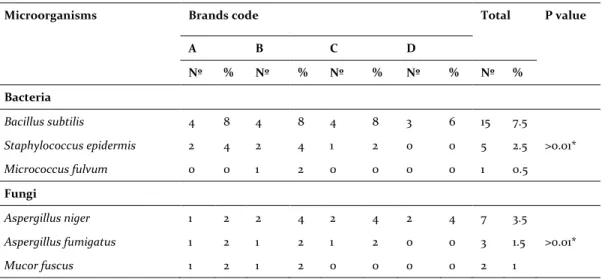
Table 2. Number (Nº) and percentage (%) of bacteria and fungi isolated from tested analgesic syrup samples.
Microorganisms Brands code Total P value
A B C D
Nº % Nº % Nº % Nº % Nº %
Bacteria
Bacillus subtilis 4 8 4 8 4 8 3 6 15 7.5
Staphylococcus epidermis 2 4 2 4 1 2 0 0 5 2.5 >0.01*
Micrococcus fulvum 0 0 1 2 0 0 0 0 1 0.5
Fungi
Aspergillus niger 1 2 2 4 2 4 2 4 7 3.5
Aspergillus fumigatus 1 2 1 2 1 2 0 0 3 1.5 >0.01*
Mucor fuscus 1 2 1 2 0 0 0 0 2 1
*The P value is not statistically significant at the 0.01 level.
Physical parameters results
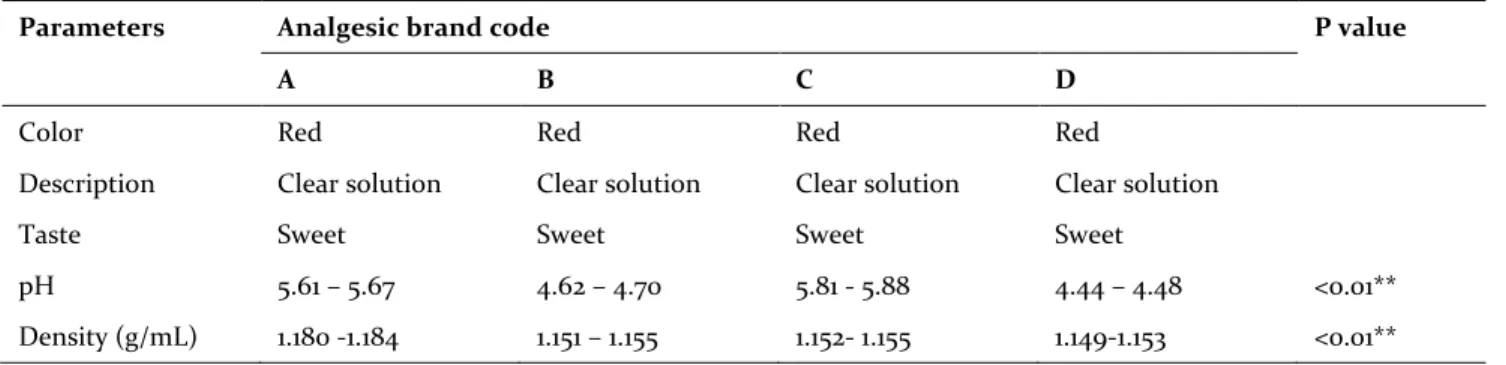
The results of physical parameters include the color, description, taste, pH, and density (g/mL) that obtained from analyzed analgesic syrup samples are listed in the Table 3.
Chemical results
Fig. 1 shows the PCM in the analyzed anal-gesic syrups samples. The ANOVA test showed that there was a significant differen-ce in the paradifferen-cetamol content results when compared between analgesic syrup samples with an individual confidence level of 99%.
Table 3. Physical parameters of the different brands of the analgesic syrups.
Parameters Analgesic brand code P value
A B C D
Color Red Red Red Red
Description Clear solution Clear solution Clear solution Clear solution
Taste Sweet Sweet Sweet Sweet
pH 5.61 – 5.67 4.62 – 4.70 5.81 - 5.88 4.44 – 4.48 <0.01**
Density (g/mL) 1.180 -1.184 1.151 – 1.155 1.152- 1.155 1.149-1.153 <0.01** **The P value is statistically significant at the 0.01 level.
98,19
99,03
100,05 100,13
103,42
105,03
106,12 106,53
94 96 98 100 102 104 106 108
A B C D
P
C
M
c
o
n
te
n
t
(%
)
Products code
Min. Max.
Figure 1. The paracetamol (PCM) content results of analyzed analgesic syrup samples.
DISCUSSION
Results obtained from this work have revealed that all the syrups complied with the official requirement for microbiological quality of syrups in the total viable aerobic count levels, according
to the USP (2007) specification. This is in
agreement with the work of other investigators
(Sudeshika et al., 2010; El-Housseiny et al., 2013).
From the findings made in this study, it could be inferred that very small levels of microbial contamination of the syrups in this investigation
were observed. The low levels of microbial contamination in tested syrup samples could be due to the adoption of Current Good Manufacturing Practice (CGMP), effective preservative agents and adequate quality control program (Ogbulie et al., 2009).
The USP (2007) recommends that Salmonella
sp., Pseudomonas aeruginosa, Escherichia coli, Staphylococcus aureus, and Candida albicans as indicators of pathogenic microorganism contamination of syrups. All the samples of analyzed analgesic syrups were found to be free from the pathogenic microorganisms and passed the USP (2007) specifications. Similar observation was reported by Shaikh et al. (1988).
Absence of coliform and pathogenic bacteria indicated that fecal contamination of water might not occur. Unhygienic environmental condition and improper handling of raw materials, ingredients, and products might be the cause of contamination (Khanom et al., 2013).
Low water activity values usually inhibit the growth of bacteria such as members of the Enterobacteriaceae family, as well as aerobic and anaerobic spore formers, but allow the growth of certain vegetative microorganisms, such as
Staphylococci and Micrococci, especially S.
aureus, also the fungi such as A. niger, and A. fumigatus which grow below a water activity of 0.86 (Bloomfield, 1988).
The results of the present work showed that the most important isolated bacteria from non-sterile pharmaceutical syrups were B. subtilis, M. fulvum, and S. epidermidis, while the most important fungi were A. niger, A. fumigatus, and
P. notatum.
Staphylococcus sp. and Bacillus sp. might transmit from soil and hands of handler during the preparation of drugs. Their incidence does not always mean that the consumption of medicines are potentially being hazardous to users as not all the strain of Staphylococcus sp. can necessarily produce enterotoxin and higher infectious dose (105-106 CFU/mL) of Bacillus sp. is required (Gad et al., 2011).
Bacillus subtilis reported to be the most frequent in syrups and are widely distributed in the soil, dust, air, and water and because they are resistant to environmentally destructive factors.
S. epidermidis was the most frequently isolated species from oral and topical medicaments.
Micrococcus sp. was also isolated from liquid and solid drugs (Rosa et al., 1993; Prescott et al., 2008).
Some of the fungi isolated include species of
Aspergillus, Penicillium and Mucor are possible
allergic and toxin producers. Aspergillus sp.
causes Aspergillosis while Aspergillus flavus
produces aflatoxin that is carcinogenic (Prescott et al., 2008).
The types of microorganisms isolated in this study suggest contamination from air, processing unit, during handling, and packaging materials.
In our study, the observation that the syrups were not cloudy is indicative of the absence of undesirable chemical and physical changes as well as the lack of visible microbial growth in the syrups.
In this study, the results showed that the analgesic syrup samples appearance were light red with a sweet taste, and this agreement with Ofonaike et al. (2007).
Liquid preparations for oral use may contain suitable excipients such as stabilizing, flavoring and sweetening agents and coloring matter, authorized by the competent authority (USP, 2007).
The USP (2007)stipulates the pH values in the
analgesic syrup contained paracetamol from 3.8– 6.1. From the results of Table 3, the pH value results were within the acceptable range according to USP (2007) standards.
The density results in the analgesic syrup samples were 1.149–1.184 g/mL. The density of a substance is the ratio of its mass to its volume at 20°C. No pharmacopeia stipulates specification or limit for density value but leaves that to competent authority to authorize the density value.
The USP (2007) specifications for percentage
content of paracetamol in analgesic oral solution ranges are from 90.0%–110.0% of the labeled amount in paracetamol syrups. Table 4 and Fig. 1 indicate that products A, B, C, D showed values within the USP (2007)specifications for a product
to be passed. This is similar observation was reported by Oluseun et al. (2012).
CONCLUSIONS
It can be concluded that the analgesic syrup have passed the official requirement for microbiological quality of syrups. Also, the pH value and paracetamol content showed within
the USP (2007) specifications for a product to be passed. It is therefore suggested that Good Manufacturing and Packaging Practice, proper treatment of water and air; personal hygiene improvement of the production personnel and pretreatment of natural raw materials be enforced and maintained.
CONFLICT OF INTEREST
The authors declare no conflict of interest.
ACKNOWLEDGEMENT
Authors thank to the Yemen Drug Company for
Industrial and Commerce (YEDCO) for the facilities
provided for the use of UV/vis Spectrophotometer.
REFERENCES
Baird RM (2004) Microbial spoilage, infection risk and contamination control. In: Denyer SP, Hodges NA, Gorman SP, Hugo W, and Russell’s A (eds), Pharmaceutical Microbiology. 17th edn. Blackwell Scientific Publications: London, U.K, pp. 262-284.
Bloomfield SF (1988) Control of microbial contamination in non-sterile pharmaceuticals, cosmetics and toiletries. In: Microbial quality assurance in pharmaceuticals, cosmetics, and toiletries. 1st edn. Chichester, Ellis Horwood Limited and Halsted Press, pp150.
Clontz L (2009) Microbial limit and bioburden tests: Validation approaches and global requirements. 2nd edn. Taylor and Francis Group, LLC: New York, pp. 1-91, 203-204.
Denyer SP, Baird RM (2007) Guide to microbiological control in pharmaceuticals and medical devices. 2nd edn., Ellis Horwood Chichester: U.K. pp. 504.
Don J, Noel R, James T, George MG (2004) Bergey’s manual of systematic bacteriology. 2nd edn. Michigan State University: East Lansing, USA.
El-Housseiny R, Aboulwafa MM, Aboulwafa, Elkhatib W, HassounaN (2013) Recovery and detection of microbial contaminants in some non-sterile pharmaceutical products. J Clin Microbiol4: 736-742.
Gad GF, Aly RAI, Ashour MSE (2011) Microbial evaluation of some non-sterile pharmaceutical preparations commonly used in the Egyptian market.Trop J Pharm Res 10: 437-445.
Jimenez L (2004) Microbial limits. In: Jimenez L (ed), Microbial contamination control in the pharmaceutical industry. Drugs and the Pharmaceutical Sciences. 142: 15-44. Marcel Dekker Inc.: New York.
Kabir S, Hossain MD (2013) Microbiological quality assessment of vitamin B syrups and antibiotic susceptibility profile of the isolated Escherichia coli. J Pharm Biol Sci 8: 61-64.
Khanom S, Das KK, Banik S, Noor R (2013) Microbiological analysis of liquid oral drugs available in Bangladesh. Intern J Pharm Pharm Sci 5: 479-482.
Leboffe MJ, Pierce BE (2011) A photographic atlas for the microbiology laboratory. 4th edn. Morton Publishing. Englewood, Colorado, United States of America.
Moubasher AH (1993) Soil fungi of Qatar and other Arab countries. The Scientific and Applied Research Centre. The University of Qatar, Doha, Qatar.
Mugoyela V, Mwambete KD (2010) Microbial contamination of non-sterile pharmaceuticals in the public hospital settings. Ther Clin Risk Manag 6: 443-448.
Nester MT, Anderson G, Roberts C, Pearsall N (2002) Microbiology–a human perspective. Genitourinary infections and antimicrobial medications. 3rd edn., Mac Graw Hill Publisher, Madrid, Spain.
Ofonaike JO, Entato EO, Okhama AO (2007) A study of the pharmaceutical quality of chloroquine and paracetamol products sold in a major Nigerian market. Afr J Health Sci 14: 3-4.
Ogbulie N, Ibe J, Nguma C (2009) The microbial associates of unexpired and expired pediatric syrups. Nig J Microbiol 23: 1817-1822.
Oluseun PE, Abiodun A, Oyelola T, Babatunde I, Ologundudu T (2012) Paracetamol content in tablets and syrups of some common brands in Nigeria. An Inter J Sci Manag 1: 1-3.
Parker MS (2000) Microbiological contamination and preservation of pharmaceutical preparations. In: Pharmaceutics: The science of dosage from design. 2nd ., Churchill Livingstone: China, p. 220.
Prescott LM, Harley JP, Klein DA (2008) Microbiology. 17th edn. Mc Craw-Hill Publisher: New York.
Rosa MC, Mosso A, Garcia L, Plaza C (1993) Resistance to the antimicrobial agents of bacteria isolated from non-sterile pharmaceuticals. J Appl Microbiol 74: 570-577.
Shaikh D, Jamshed TA, Shaikh R (1988) Microbial contamination of pharmaceutical preparations. Pak J Pharm Sci 1: 61-66.
Sudeshika ST, Panagoda GJ, Tennakoon IK (2010) A preliminary study to evaluate the microbiological quality of paediatric oral liquid drug formulations during consumption. Available online at:
www.pdn.ac.lk/ahs/dept_and_unit/Pharmacy/Research/
preliminary.pdf [Consulted April 16, 2014].
Tukur MA, Muazu J, Mohammed GT (2012) Microbial analysis of brands of multivitamin syrups marketed in Maiduguri, northeast Nigeria. Adv Appl Sci Res 3:3124-3128.
United States Pharmacopoeia (USP), 30-NF/25, (2007) Monograph: Paracetamol oral solution. Antimicrobial effectiveness testing, microbiological examination of non-sterile products, acceptance criteria for pharmaceutical preparations and substances for pharmaceutical use, and spectrophotometry and light-scattering. The United States Pharmacopeial Convention: Rockville. 229, 30(2,5):172, 391, 1466.