ELECTRIC DOUBLE LAYER AND ELECTROKINETIC POTENTIAL OF PECTIC MACROMOLECULES IN SUGAR BEET
Tatjana A. Kuljanin, Ljubinko B. Lević, Nevena M. Mišljenović and Gordana B. Koprivica
Electrokinetic potential is an important property of colloidal particles and, regarding the fact that it is a well defined and easily measurable property, it is considered to be a permanent characteristic of a particular colloidal system. In fact, it is a measure of electrokinetic charge that surrounds the colloidal particle in a solution and is in direct proportion with the mobility of particles in an electric field.
Gouy-Chapman-Stern-Graham's model of electric double layer was adopted and it was proven experimentally that the addition of Cu++ ions to sugar beet pectin caused a reduction in the negative electrokinetic potential proportional to the increase of Cu++ concentration. Higher Cu++ concentrations increased the proportion of cation specific adsorption (Cu++ and H+) with regard to electrostatic Coulombic forces. Consequently, there is a shift in the shear plane between the fixed and diffuse layers directed towards the diffuse layer, i.e. towards its compression and decrease in the electrokinetic potential or even charge inversion of pectin macromolecules.
KEYWORDS: lectrokinetic potential, electric double layer, sugar beet pectins
INTRODUCTION
On the adjacent surface of a colloidal particle of pectin macromolecule in aqueous solution, besides dissociated carboxyl groups as main charge carriers, various ions and solvent molecules are also present. These electrically charged groups and solvent molecules are closely adsorbed onto the colloidal particle, forming a fixed layer known as adsorbed layer (1-4).
Alongside the adsorbed layer, the electrical effect of the colloidal particle is the strongest and weakens proportionally to the increase in distance. There is a boundary where the electrical effect of charged colloidal particle stops to exist. The layer of liquid between the boundary and the adsorbed layers is denoted as diffuse layer. Although it is mobile, it is considered to be part of the colloidal particle.
Original scientific paper
The adsorbed and diffuse layers form a covering over the colloidal particle designated as electric double layer (EDL). The difference in potential between the adsorbed and diffuse layer is called electrokinetic or zeta potential. The following factors significantly affect the magnitude of electrokinetic potential: pH of the colloidal solution, temperature, dilution, presence of various electrolytes, etc. The electrokinetic potential is in direct proportion with the mobility of colloidal particle in the electrical field (1—4).
Zeta potential of sugar beet pectin is negative and it is strong enough to impair the coagulation and agglomeration of the macromolecules in aqueous solutions. However, the addition of oppositely charged ions, in this case polyvalent cations, can decrease the electrokinetic potential to near zero, causing the colloidal particles to discharge. Conse-quently, the system’s stability is lost, which leads to the coagulation and precipitation of agglomerated colloidal particles (4-6). The most frequently used coagulants are various salts of Ca, Pb, Cu and Al.
The overall ability of pectin macromolecules to form complexes with polyvalent cations depends on the degree of esterification of pectin with methyl alcohol, degree of polymerization and composition of the glycosyl residue (7, 8). The affinity of divalent cations to form complexes with pectin macromolecules follows the order (8, 9):
Cu++ ~ Pb++ > Zn++ > Cd++ ~ Ni++ > Ca++ > Mg++
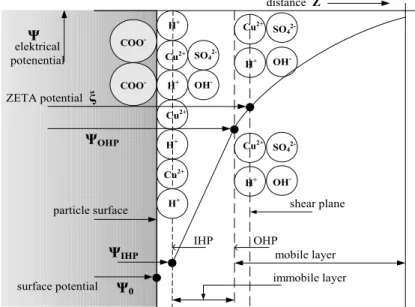
Figure 1 illustrates the widely accepted model for the EDL according to the Gouy-Chapman-Stern-Graham (GCSG) model in the presence of divalent salt (CuSO4) in an aqueous solution (4, 10, 11).
distance Z
H+
Cu2+
COO
-COO
-Cu2+
H+
SO42-
OH-
Cu2+
H+
immobile layer mobile layer ZETA potential
shear plane
IHP OHP
particle surface
surface potential Ψ0
ΨIHP
ΨOHP
ξ
elektrical potenential
Ψ SO4
2-SO4
2-OH
-OH
-Cu2+
H+
H+ H+
Cu2+
This model is characterized by the localization of ions (Cu2+; H+; SO42-; OH-) both in the fixed (Stern) layer and in a diffuse layer (subjected to thermal agitation) of the solid-liquid interface.
According to the GCSG model, the fixed layer is assumed to be bounded by two planes: the Inner Helmholtz plane (IHP) and Outer Helmholtz plane (OHP), which are characterized by the potentials ψIHP and ψOHP.
The aim of the paper was to investigate the effect of Cu++ ions on the EDL and the change of the electrokinetic potential of sugar beet pectin macromolecules in an aqueous solution of CuSO4.
EXPERIMENTAL
Methods of analysis
Pectin was isolated from sugar beet pulp. Extraction of pectin was conducted at pH 3.5 and 85°C during 2.5 h. The pectin preparation was precipitated from the extract with 70% ethanol solution. Basic parameters of the pectin preparation were determined according to standard methods of AOAC (12).
The mean molar mass of the pectin preparation was determined refractometrically and spectrophotometrically (4, 13). The degree of polymerization (DP) was calculated by dividing the mean molar mass of the pectin preparation with the molar mass of dehydrated galactouronic residue.
Tests for the determination of composition of the pectin preparation were conducted in duplicate. If the variation in the results of two measurements were larger than 5%, more measurements were taken.
The electrokinetic potential was evaluated by means of electrophoresis using a Zeta Meter ZM-77 (14). The instrument consists of an electrophoretic cell with platinum elec-trodes connected to direct current and a stereoscopic microscope equipped with a special ocular micrometer. After adjusting the voltage, an electric recording device was used to measure time needed for a colloidal particle to pass a distance of a standard micrometer division.
The electrokinetic potential of pectin macromolecules was determined as the mean value of 20 measurements for randomly selected particles. Temperature correction of the results was also performed.
In this experiments, aqueous solutions of pectin with the concentrations ranging from 0.1; 0.5 to 1.0% (w/w) where prepared by dissolving 1, 5, and 10 g of the pectin prepara-tion in 1000 cm3 of distilled water. The pH of the solutions was measured on a pH Meter MA 5740 in one hour intervals, counting from the moment of their preparation.
dis-Original scientific paper
aggregation of the already formed floccules. The solution was then allowed to stay for 5 min. An aliquot taken from the supernatant was used to measure the zeta potential. Mea-surements were performed at room temperature for seven different solution concentra-tions.
RESULTS AND DISCUSSION
By analyzing the proposed GCSG model of EDL (Fig. 1) on pectin macromolecules in the presence of Cu2+ and SO4
ions, the following can be observed:
The Inner Helmohltz plane (IHP) is passing through the centers of Cu2+ ions that may adsorb specifically and H+ ions adsorbing from the solution on the negatively charged glycosyl-residues on the surface of macromolecules of pectins. The Outer Helmohltz plane (OHP) is passing through the centers of Cu2+ and H+ ions that are attracted only by the electrostatic forces (Coulombic attraction). Here are also present SO42- and OH- ions from the solution, attracted by the electrostatic forces as oppositely charged ions.
The shear plane (disconnected line in Fig. 1) according to the CGSG model is localized immediately behind the fixed layer and corresponds to the electrokinetic or zeta potential of the pectin macromolecule. The shear plane is that plane where hydrodynamic motion becomes possible.
According to the GCSG model, the potential change ψ between the IHP and OHP is linear, depending on the number, size and hydration of Cu2+ ions. In the diffuse layer, an exponential potential drop is observed in accordance with the Boltzmann distribution (15-17).
At a low concentration in the water solution, the Cu2+ ions in a free, non-hydrohylated form. The increase of the concentration of Cu2+ ion, leads to hydrolytic reaction, so the Cu2+ ion can form hydroxy complexes (such as Cu(OH)+; Cu(OH)2; Cu(OH)3-; Cu(OH)42-), and at much lower concentrations, dihydroxy complexes (18, 19).
Table 1. Plan of the experiment and coagulant quantities
Coagulant: 100 % CuSO4 50 cm3 Erlenmeyer flask with 0.1 % (w/w) pectin Number of measurement 1 2 3 4 5 6 7 Volume CuSO4 (cm3) 0.47 0.94 1.41 1.88 2.35 2.82 3.29 Concentration CuSO4 (mg/dm3) 30 60 90 120 150 180 210
Table 2. Basic physico-chemical composition of pectin preparation
Parameter Solid content, %
Purity (% gal. acid)
Degree of esterification
(DE)
Mean molar mass Mwsr (kg/kmol)
Degree of polymerization
(DP)
Table 3. Results of measuring the electrophoretic mobility (usr) of particles and electrokinetic potential (ZP) of pectin solution for three different solution concentrations
Concentration % (mas) 0.1 0.5 1.0
usr(s) 2.3 2.4 2.5
ZP (mV) -48 -46 -45
Table 4. Results of measuring the electrophoretic mobility (usr) of particles and electrokinetic potential (ZP) of pectin solution at various quantites of CuSO4 added
CuSO4 (mg/dm 3
) 0 30 60 90 120 150 180 210
usr (s) 2.3 5.8 8.3 27.5 12.0 7.5 6.4 5.4
ZP (mV) -48 -18 -13 -4 9 14 17 19
-50 -40 -30 -20 -10 0 10 20 30
0 30 60 90 120 150 180 210
concentration CuSO4 (mg/dm3)
Z
e
ta
p
o
te
n
ti
a
l (
m
V
)
Figure 2. Dependence of the electrokinetic potential of pectin solution on the CuSO4 concentration
The isolated preparation belonged to the group of highly esterified pectins (DE>50). The change of the pectin solution concentrations did not significantly affect the electro-phoretic mobility of particles (usr), i.e. the electrokinetic potential. Therefore, in further measurements the effect of solid phase was considered to be irrelevant, and only the 0.1% (w/w) pectin solution was examined (Table 3).
In Table 4 and Figure 2 is presented the effect of Cu++ ions on the changes in the electrokinetic potential of pectin macromolecules. The increase in the concentration of Cu++ ions results in a decrease of the negative potential, suggesting that by controlled dosing of CuSO4 coagulant, the electrokinetic potential may be kept at the values close to 0 mV, which is the main prerequisite for the beginning of coagulation. The negative elec-trokinetic potential decreased proportionally to the quantity of added coagulant until the moment when charge inversion was reached.
Original scientific paper
that the increase in Cu++ ions increases the proportion of specific adsorption of cations as compared to the proportion of electrostatic Coulombic attractions. As a result, the shear plane moves towards the diffuse layer, causing its compression and an increase in the proportion of the fixed (Stern) layer of the EDL. This occurs when the zeta potential of pectin macromolecules drops or even reverts its charge.
The charge inversion of the electrokinetic potential from negative to positive for the investigated concentrations of CuSO4 infers that besides ionic exchange and decrease in the plane potential Ψ(0) caused by charge neutralization, marked specific adsorption of Cu++ ions occurs at active sites of pectin macromolecules (COO-). Total charge due to Cu++ ions (as well as H+ ions from the solution) increased in magnitude as compared to the magnitude of negative charge on the surface of pectin macromolecule due to the presence of dissociated carboxyl groups.
Also, due to the high density of Cu++ ions (the density of Cu++ ions is 8.93 g/cm3, whereas of Ca++ and Mg++ is 1.54 i.e. 1.74 g/cm3, respectively), their electrophoretic mobility is higher, which enables easier location in the Stern layer and neutralization of the negative charge on the surface of pectin macromolecules.
CONCLUSION
The concentration of aqueous pectin solutions was not found to influence the electrokinetic potential of pectin.
Electrokinetic potential of pectic macromolecules changes proportionally to the quan-tity of Cu++ ions added in the form of aqueous CuSO4 solution.
The Gouy-Chapman-Stern-Graham's model of electric double layer was experimen-tally proven in sugar beet pectins. The increased concentrations of coagulant CuSO4 reduced the negative potential, whereas concentrations over 100 mg/dm3 caused charge inversion of pectin macromolecules.
REFERENCES
1. Werner, C., Korber H., Zimermann R., Dukhin S. and Jacobasch: Extended Electroki-netic Characterization of Flat Solid Surfaces, J. of Colloid and Interface Science 208 (1998) 329-346.
2. Kirby B.J., Hasselbrink E.F.: Zeta potential of microfluidic substrates: 1. Theory, experimental techniques and effects on separations, Electrophoresis 25 (2004) 187-202.
3. Lević Lj.: Ispitivanje uticaja elektrokinetičkog potencijala na efekat izdvajanja pektina i belančevina iz soka šećerne repe, magistarski rad. Tehnološki fakultet, Novi Sad (1981) pp. 19-24.
5. Lević Lj., Tekić M., Djurić M., Kuljanin T.: CaCl2, CuSO4 and AlCl3 & NaHCO3 as possible pectin precipitants in sugar juice clarification, International Journal of Food Science and Technology 42 (2007) 609-614.
6. Lević Lj., Gyura J., Djurić M., Kuljanin T.: Optimization of pH value and aluminium sulphate quantity in the chemical treatment of molasses, European Food Research and Technology 220 (2005) 70-73.
7. Pellerin, P. and O΄Neill, M., A.: The interaction of pectin polysaccharide Rhamno-galacturonan II with heavy metals and lanthanides in wines and fruit juices, Analysis Magazine 26 (1998) M32-M39.
8. Dronnet V. M., Renard C. M. G., Axelos M. A. V., Thibault J. F.: Characterisation and selectivity of divalent ions binding by citrus and sugar-beet pectins, Carbohydrate Polymers 30 (1996) 253-263.
9. Wiedemer S. K., Cassely A., Hong M., Novotny M. V., Riekkola M.: Electrophoretic studies of polygalacturonate oligomers and their interactions with metal ions, Electro-phoresis 21 (2000) 3212-3219.
10.Alkan, M., Demirbas, O. and Dogan, M.: Elektrokinetic properties of sepiolite suspension in different electrolyte media, J. of Colloid and Interface Science 281 (2005) 240-248.
11.Kleinschek, K. S., Ribitsch, V. R.: Electrokinetic properties of processed cellulose fibers, Colloids and Surfaces A: Physichochemical and Engineering Aspects 140 (1998) 127-138.
12.AOAC - Methods of Analysis of Afficial Analytical Chemists, Washington (2000). 13.Kar F., Arslan N.: Effect of temperature and concentration on viscosity of orange peel
pectin solutions and intrinsic viscosity-molecular weight relationship, Carbohydrate Polymers 40 (1999) 277-284
14.Riddick M. T.: Zeta-Meter Manual (third. ed.), New York (1975).
15.Lyklema J.: Electrokinetics after Smoluchowski, Colloids and Surfaces A: Physico-chem. Eng. Aspects 222 (2003) 5-14.
16.Grigorov O.N.: Э я я, ,
(1973).
17.Dukhin S. S., Zimmermann R., Werner C.: A concept for the generalization of the standard elektrokinetic model, Colloids and Surfaces A: Physicochem. Eng. Aspects 195 (2001) 103-112.
18.Larson I. and Pugh R. J.: Coagulation of quartz particles in aqueous solutions of copper (II), J. of Colloid and Interface Science 208 (1998) 399-404.
Original scientific paper
. , . , .
.
, ,
-ђ . , ,
.
-. ђ , Cu++
-,
ђ .
Gouy-Chapman-Stern-Graham-
je ђ Cu++
-,
Cu++ . Cu++ ,
(Cu++ H+)
. ,
-ђ , .
,
.