ACPD
4, 3089–3126, 2004Implementing growth and sedimentation of
NAT particles
M .M. P. van den Broek et al.
Title Page
Abstract Introduction
Conclusions References
Tables Figures
◭ ◮
◭ ◮
Back Close
Full Screen / Esc
Print Version
Interactive Discussion
©EGU 2004
Atmos. Chem. Phys. Discuss., 4, 3089–3126, 2004 www.atmos-chem-phys.org/acpd/4/3089/
SRef-ID: 1680-7375/acpd/2004-4-3089 © European Geosciences Union 2004
Atmospheric Chemistry and Physics Discussions
Implementing growth and sedimentation
of NAT particles in a global Eulerian
model
M. M. P. van den Broek1, J. E. Williams2, and A. Bregman3
1
Space Research Organization of the Netherlands (SRON), Utrecht, The Netherlands
2
Eindhoven University, Eindhoven, The Netherlands
3
ACPD
4, 3089–3126, 2004Implementing growth and sedimentation of
NAT particles
M .M. P. van den Broek et al.
Title Page
Abstract Introduction
Conclusions References
Tables Figures
◭ ◮
◭ ◮
Back Close
Full Screen / Esc
Print Version
Interactive Discussion
©EGU 2004
Abstract
Here we present a concise and efficient algorithm to mimic the growth and
sedimen-tation of Nitric Acid Trihydate (NAT) particles in the polar vortex in a state-of-the-art 3D chemistry transport model. The particle growth and sedimentation are calculated using the microphysical formulation of Carslaw et al. (2002). Once formed, NAT parti-5
cles are transported in the model as tracers in the form of size-segregated quantities.
Two different approaches were adopted for this purpose: one assuming a fixed
par-ticle number density (“FixedDens”) and the other assuming a discrete set of parpar-ticle diameter values (“FixedRad”). Simulations were performed for three separate 10-day periods during the 1999–2000 Arctic winter and compared to the results of an existing 10
Lagrangian model study, which uses similar microphysics in a computationally more expensive method for the simulation of NAT particle growth. The resulting maximum particle sizes for both our approaches compare favourably at 96 hPa with those ob-tained from this previous model study, and also in-situ observations related to the size of large NAT particles. Comparisons were made with a standard equilibrium approach 15
and the differences in the redistribution of HNO3were found to be substantial. For both
approaches the performance of the algorithm is rather insensitive to both the number
of size bins and the shape of the size distribution. However, the percentage of HNO3
sequestered into NAT is critically dependent on the total number density of particles prescribed for each size bin.
20
1. Introduction
Shortly after the discovery of the ozone hole in the mid 1980’s, it was recognized that
denitrification (i.e. the uptake and subsequent sedimentation of HNO3 within Polar
Stratospheric Clouds, PSC’s) both increases and prolongs stratospheric ozone loss (Crutzen and Arnold, 1986; Fahey et al., 1989; Fahey et al., 1990). Although this 25
ACPD
4, 3089–3126, 2004Implementing growth and sedimentation of
NAT particles
M .M. P. van den Broek et al.
Title Page
Abstract Introduction
Conclusions References
Tables Figures
◭ ◮
◭ ◮
Back Close
Full Screen / Esc
Print Version
Interactive Discussion
©EGU 2004
a consequence of lower temperatures, Shindell et al. (1998) have postulated that any possible future stratospheric cooling could result in an increase in the importance of denitrification in the Arctic winter stratosphere. Moreover, during the last decade,
ob-servational evidence of this vertical redistribution of HNO3 in the Arctic stratosphere
has also been found (e.g. Fahey et al., 1990; Sugita et al., 1998; Waibel et al., 1999), 5
where it has been shown that such a redistribution can lead to an increase in Arctic ozone loss (Rex et al., 1997; Waibel et al., 1999).
More recently, during the Arctic winter of 1999/2000, which is one of the coldest cur-rently on record (Manney and Sabutis, 2000), both extensive nitrification (Koike et al., 2002) and denitrification (Popp et al., 2001; Santee et al., 2000; Kleinb ¨ohl et al., 2003) 10
were observed. Again, large ozone loss was also derived for this winter using both model experiments (Sinnhuber et al., 2000) and in-situ observations of ozone (Richard et al., 2001). Model results attributed 21–30% of ozone loss at the 460 K potential
temperature level to denitrification (Davies et al., 2003). The presence of large HNO3
-containing particles was recorded directly by means of NOy measurements on board
15
the NASA ER-2 aircraft (Northway et al., 2002a) and aerosol extinction measurements by the SAGE III satellite (Poole et al., 2003). The Multiangle Aerosol Spectrometer Probe (MASP) instrument took in-situ samples of large PSC particles (Fahey et al.,
2001; Brooks et al., 2003). These particles ranged from 2–22µm in diameter, with a
bi-model distribution. Since the sedimentation of large particles (>5µm radius) is
sig-20
nificantly faster than that of small particles, the presence of large particles increases
the rate at which HNO3is redistributed.
To date, atmospheric models have typically described denitrification using a rather simplified approach. For instance, most chemistry transport models (CTM’s) neglect to include PSC particles as transported species. Instead, a constant or equilibrium 25
There-ACPD
4, 3089–3126, 2004Implementing growth and sedimentation of
NAT particles
M .M. P. van den Broek et al.
Title Page
Abstract Introduction
Conclusions References
Tables Figures
◭ ◮
◭ ◮
Back Close
Full Screen / Esc
Print Version
Interactive Discussion
©EGU 2004
fore, agreement between model results and observations may simply be fortuitous.
For instance, Koike et al. (2002) were able to represent NOymeasurements during the
1999/2000 winter with a CTM using an average NAT particle radius of 5µm and fixed
particle number density of 5×10⁻³cm−3. Although this radius falls within the range of
observed radii for large particles, the particle number density was overestimated by a 5
factor of∼20 (c.f. Fahey et al., 2001). Thus, the finding that large NAT particles exist
with correspondingly low particle number densities has introduced a strong constraint regarding the description of NAT particles in atmospheric models. A proper description of NAT particles is essential to modelled ozone loss in a cooling stratospheric climate. It has been demonstrated that current CTM’s significantly underestimate the temper-10
ature sensitivity of ozone loss during the last two decades (Rex et al., 2004). This partly reflects shortcomings in NAT representation in global chemistry climate or trans-port models.Certain non-equilibrium model studies have been carried out for the same winter. For example, Jensen et al. (2002) used 1-D model simulations of NAT growth and transport. They tested the sensitivity of the model results towards a number of 15
input parameters, of which the lifetime of the NAT cloud was found to be the most im-portant. The first 3-D model study to include non-equilibrium growth and simultaneous sedimentation of NAT particles was that of Carslaw et al. (2002), where a Lagrangian microphysical algorithm was coupled to the SLIMCAT CTM for particle transport. This study was unique in that the authors were able to represent the radii of the large parti-20
cles measured by Fahey et al. (2001). This algorithm was also used in combination with the CTM to simulate the entire 1999/2000 winter and yielded results for denitrification that were consistent with observations (Mann et al., 2003). One disadvantage of using a Lagrangian method for simulating NAT particles is that the algorithm is prohibitively expensive for multiple year or long-term climate runs when using complex atmospheric 25
models. Therefore, the development of a concise, computationally efficient method,
ACPD
4, 3089–3126, 2004Implementing growth and sedimentation of
NAT particles
M .M. P. van den Broek et al.
Title Page
Abstract Introduction
Conclusions References
Tables Figures
◭ ◮
◭ ◮
Back Close
Full Screen / Esc
Print Version
Interactive Discussion
©EGU 2004
of NAT particles and subsequent transport of the size-segregated particles as chemi-cal tracers, following the parameterization developed by Carslaw et al. (2002). We will
show consistent results from two different approaches describing growth and transport
of NAT, which both yield realistic HNO3 redistribution, NAT particle sizes and particle
number densities. In Sect. 2, the CTM and the algorithms for both approaches are 5
described. Sect. 3 shows the results in comparison to observations and other model studies. Several sensitivity studies are carried out and described in Sect. 4 and, finally, the discussion and conclusions are presented in Sect. 5.
2. Model description
2.1. The TM5 model
10
For our purpose we use the recently developed global three-dimensional transport model, version 5 (TM5). This model has been used previously for several studies
of both the troposphere (e.g. Krol et al., 20041; Krol et al., 2003) and stratosphere
(van den Broek et al., 2003). It has been developed by modification of the existing TM3 model, which has also been used for a number of stratospheric chemistry and 15
transport studies (van den Broek et al., 2000; Bregman et al., 2000; Bregman et al., 2001). The main improvement is the inclusion of a zooming algorithm and the ver-tical extension of the model domain up to 0.2 hPa, with a higher verver-tical resolution.
In this study we apply a 2◦ latitude by 3◦ longitude horizontal resolution for all model
runs. The transport of tracers in TM5 is driven by six-hourly forecast fields for tem-20
perature, surface pressure, wind, humidity and convective mass flux taken from the European Centre for Medium-Range Weather Forecasts (ECMWF) operational data. The method to calculate mass fluxes from ECMWF winds has recently been improved
1
ACPD
4, 3089–3126, 2004Implementing growth and sedimentation of
NAT particles
M .M. P. van den Broek et al.
Title Page
Abstract Introduction
Conclusions References
Tables Figures
◭ ◮
◭ ◮
Back Close
Full Screen / Esc
Print Version
Interactive Discussion
©EGU 2004
(Bregman et al., 2003). We used a 33-layer subset of the 60 layer fields that are taken into account in the ECMWF model, with a reduced number of levels in the tropospheric boundary layer and above 70 hPa. Near the surface the model levels are defined as terrain following sigma coordinates whereas the layers above 100 hPa are defined at pressure surfaces. A hybrid of the two is used between the lower troposphere and the 5
lower stratosphere. The mass flux advection scheme contains first order slopes (Rus-sell and Lerner, 1981) or second-order moments (Prather, 1986). A model time step of 1800 s is applied, resulting in dynamical and chemical time steps of 900 s. In contrast to previous model configurations of TM3 and TM5 no reduced grid is applied in the polar region. Instead, the time step in the advection scheme is decreased iteratively to 10
prevent violation of the Courant Friedrichs-Lewy (CFL) condition (Bregman et al.2). To
focus solely on the redistribution of HNO3and performance of the NAT algorithm in this
theoretical study no gas phase chemistry was active for any of the runs. This allows us to compare the results with those of Carslaw et al. (2002). Nitric Acid Dihydrate
(NAD) is not accounted for as it is thought to result in a small effect in terms of NOy
15
redistribution when temperatures fluctuate around 190 K due to the associated higher
HNO3 equilibrium pressure (Jensen et al., 2002). For the Arctic vortex, the coldest
temperatures typically only fall to the values needed for NAD formation for a few days, therefore NAD particles never grow to appreciable sizes and thus do not sediment. No supercooled ternary solution (STS) is included as to avoid the transport of additional 20
tracers (i.e. H2SO4and liquid aerosol). The initial profiles used for HNO3and H2O were
set at 8 ppbv and 5 ppmv, respectively, for the entire column in all runs, similar to those
used for the Lagrangian study by Carslaw et al., 2002. This [HNO3] in the stratosphere
is based on extensive measurements (Kleinb ¨ohl et al., 2003) and considered to be a
lower limit for the average stratospheric [HNO3] available.
25
2
ACPD
4, 3089–3126, 2004Implementing growth and sedimentation of
NAT particles
M .M. P. van den Broek et al.
Title Page
Abstract Introduction
Conclusions References
Tables Figures
◭ ◮
◭ ◮
Back Close
Full Screen / Esc
Print Version
Interactive Discussion
©EGU 2004
2.2. The algorithm for NAT growth and sedimentation
The key aspect of our algorithm is the calculation of NAT particle growth in combination with the transport of NAT as tracers that are segregated by size. This is done by dis-tributing the NAT particles between a number of size bins. The particle number density
per size bin (nbin, cm
−3
) and particle radius (r, m) define the NAT mass according to
5
Eqs. (1) and (2):
mp=
[NAT]
nbin , (1)
where [NAT] is the concentration of NAT (g cm−3), andmpis the mass (g particle
−1
)
r3= mp ρNAT
· 3
4π, (2)
whereρNAT is the density of NAT=1.626×10
6
g m−3(Drdla et al., 1993).
10
To implement the exact calculation of the NAT properties within a Eulerian model, the advection of another model property, besides mass, would be required, e.g. the NAT number density. This would however result in a double amount of tracers, thereby
dramatically decreasing the model efficiency. Furthermore, the separate transport of
two quantities that are linked to each other, but are allowed to have different model
15
gradients, will give severe numerical problems during advection. For example, a num-ber density of NAT could exist in a model grid box while no mass of NAT is present. Therefore, we have only included the transport of NAT mass while assumptions are
made regarding the particle number density per size bin (nbin) or the radius (r). Firstly,
we introduce an approach that assumes a fixednbinper size bin (hereafter referred to
20
as “FixedDens”). Secondly, we introduce an approach that assumes that each particle that resides in a specific size bin has the average radius for that size bin (hereafter re-ferred to as “FixedRad”). In contrast to these two nonequilibrium approaches, we also discuss the equilibrium approach, which is adopted by most previous model studies (e.g. Koike et al., 2002).
ACPD
4, 3089–3126, 2004Implementing growth and sedimentation of
NAT particles
M .M. P. van den Broek et al.
Title Page
Abstract Introduction
Conclusions References
Tables Figures
◭ ◮
◭ ◮
Back Close
Full Screen / Esc
Print Version
Interactive Discussion
©EGU 2004
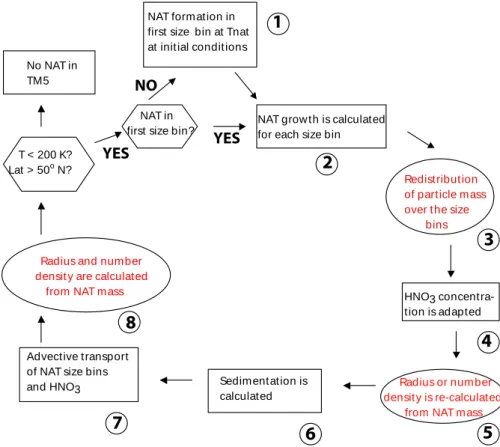
The process of NAT particle growth and sedimentation within TM5 is clarified in the
schematic given in Fig. 1. Any differences that occur between “FixedDens” and
“Fixe-dRad” are denoted in red. These differences are described in more detail in Sects. 2.3
and 2.4. The schedule is valid for each model grid box in which temperature is low enough for the presence of NAT. Both approaches describe the formation of NAT, par-5
ticle growth/evaporation, particle sedimentation and the particle size spectrum in an identical manner. NAT particles are allowed to exist in the model only when
tempera-ture≤200 K and latitude>50◦N. After initialization of the model, fresh formation of NAT
particles only occurs if the first size bin is empty.
In most CTM’s, NAT formation is assumed to occur either on ice particles (e.g. 10
Kleinb ¨ohl et al., 2003) or at supersaturation of the surrounding HNO3-containing air
with respect to NAT, usually by a factor of 10 (e.g. Koike et al., 2002). The exact formation mechanism of NAT has still not yet been fully elucidated from the detailed microphysical studies that have been performed, meaning there is still some debate regarding NAT formation (Drdla, 2003; Knopf et al., 2002; Tabazadeh et al., 2003). For 15
this reason we adopt a simple approach where, in the base run of our model, particles
initially form in the first size bin with a radius of 0.1µm and a particle number density of
5.75×10⁻⁵cm−3(process 1 in Fig. 1) when the temperature is below the NAT
equilib-rium temperatureTNAT(Hanson and Mauersberger, 1988). Both a doubling of the initial
radius and enlarging the threshold for NAT formation by assuming a super saturation 20
by a factor of 10, made no significant change to our results (not shown).
The growth and evaporation of NAT is calculated using the algorithm adopted from Carslaw et al. (2002) (process 2 in Fig. 1). Before implementation of this algorithm into a 3D model run, we first tested the formulation using a box model and successfully re-produced the particle sizes and sedimentation rates for NAT as those shown in Carslaw 25
et al. (2002). An assumption we make is that the calculation of growth across all size bins starts with the smallest size bin. After growth, the NAT particles are re-binned across the size spectrum, meaning that the mass distribution also changes
ACPD
4, 3089–3126, 2004Implementing growth and sedimentation of
NAT particles
M .M. P. van den Broek et al.
Title Page
Abstract Introduction
Conclusions References
Tables Figures
◭ ◮
◭ ◮
Back Close
Full Screen / Esc
Print Version
Interactive Discussion
©EGU 2004
nbin from the NAT mass are different in both methods and are explained in more detail
in Sects. 2.3 and 2.4, below. After the re-binning step, a stoichiometric∆[HNO3]g is
calculated according to the increase or decrease of NAT in each grid box (process 4 in
Fig. 1). Since bothr andnbin are needed for the calculation of the sedimentation rate,
differences occur between both approaches (process 5 in Fig. 1), before
sedimenta-5
tion is described (process 6 in Fig. 1). Numerical diffusion due to vertical layering is
limited by applying first-order slopes (Russell and Lerner, 1981) to the sedimentation calculation. The calculation of NAT growth and sedimentation is followed by the
ad-vective transport of all tracers, i.e. HNO3and the NAT mass per size bin (process 7 in
Fig. 1). After this advective transport of the modelled species the NAT growth subrou-10
tine starts again with the calculation of eitherr (“FixedDens”) ornbin(“FixedRad”) from
the transported NAT mass (process 8 in Fig. 1).
2.3. The “FixedDens” approach
In this approachr is calculated for each respective size bin from the transported particle
mass and the constantnbinvalue, by using Eqs. (1) and (2). This means that we need to
15
assume thatnbinremains constant for each size bin across the entire size bin spectrum
after the initial formation of NAT particles. All particles within the same size bin are assumed to grow or evaporate by the same amount. After NAT growth, re-binning of
the particles occurs if∆r is large enough for the size bin limit to be exceeded. During
this process, the mass of NAT is conserved. 20
A drawback of this method is that a constant size distribution is applied, whereas in reality the size distribution will change during the growth and evaporation of the NAT
particles. Since the radiusr is related tonbinthrough the particle mass (Eqs. 1 and 2),
an underestimatednbin may lead to an overestimation ofr, or the reverse. To diminish
this effect, we chose nbin so that the total number density is in close agreement with
25
observed values of large particles (Fahey et al., 2001) after a 10-day simulation. The
ACPD
4, 3089–3126, 2004Implementing growth and sedimentation of
NAT particles
M .M. P. van den Broek et al.
Title Page
Abstract Introduction
Conclusions References
Tables Figures
◭ ◮
◭ ◮
Back Close
Full Screen / Esc
Print Version
Interactive Discussion
©EGU 2004
the findings are discussed in Sect. 4.
2.4. The “FixedRad” approach
In this second approach thenbin of each size bin is calculated using the transported
particle mass together with Eqs. (1) and (2). Here, we assume that the NAT particle
radius (r) equals the average radius of each respective size bin. To allow the transfer
5
of particles between size bins an nbin threshold is required, otherwise an explosion
of small particles occurs as a consequence of resetting r equal to the average bin
radius at each time step. The required time step would be unrealistically small to solve this numerical problem. Particle growth and sedimentation are calculated in an
identical manner as for the “FixedDens” approach. After growth, any∆r is immediately
10
converted into an increase in nbin using the associated increase in NAT mass (see
Eqn. 2). If the re-calculated nbin exceeds the nbin threshold for any particular size
bin then the excess nbin is transferred (as mass) to the next size bin. During this
step mass is conserved, leading to an instantaneous reduction in the transferrednbin
as a consequence of the instantaneous increase in r, which is set equal to the bin
15
average. This continues until the NAT particulate mass resides across the entire size
bin spectrum. An advantage of this approach is that a realistic size distribution, withnbin
changing per size bin, may be introduced into the scheme. In the “FixedDens” scheme this would introduce a fluctuation in the number of particles during transfer across the size bins, either introducing a mass inconsistency or an artificial change of the radius. 20
Moreover, not all particles within one size bin need to move to the next size bin after particle growth. However, an associated disadvantage is that the growth or evaporation
of particles is actually calculated as a change in nbin instead of r, in first instance,
introducing some diffusivity in the size spectrum. Whereas thenbinthresholds move the
particles upward to the next size bin during a period of growth, continual evaporation 25
would result in a very small nbin value, which essentially indicates the emptying of
the size bin. Combined with the advective transport of particles, the result of thenbin
ACPD
4, 3089–3126, 2004Implementing growth and sedimentation of
NAT particles
M .M. P. van den Broek et al.
Title Page
Abstract Introduction
Conclusions References
Tables Figures
◭ ◮
◭ ◮
Back Close
Full Screen / Esc
Print Version
Interactive Discussion
©EGU 2004
which is more realistic than the assumption of constantnbinin the “FixedDens” method.
The assumption that the radius of resident NAT particles in any size bin equals the average radius of that size bin has some influence on the particle growth. Depending
on whethernbinrepresents a NAT mass above or below the averager, a small over- or
underestimation of growth may occur. Several sensitivity studies to assess the impact 5
of these assumptions are discussed in Sect. 3.
2.5. Equilibrium approach
To date, CTM models have adopted a simplified way to parameterize denitrification.
Typically, a constantr andnbinof NAT are prescribed (Chipperfield et al., 1999; Koike et
al., 2001), or alternatively, calculated assuming an equilibrium particle size (Sinnhuber 10
et al., 2000; Davies et al., 2003). In all these studies, NAT mass is not transported and it is determined at each time step whether NAT formation is possible. This is in strong contrast to the nonequilibrium methods introduced above, which allow the NAT particles to grow and be transported within a fixed number of size bins.
To allow a direct comparison to be made between all the methods discussed here, 15
we performed two model runs using such a simplified approach, which we refer to as the equilibrium approach.
3. Description of the model runs
3.1. Simulation period
Model runs were carried for three separate 10-day time intervals during the 1999/2000 20
winter period, these being 10–20 January, 24 January–3 February and 16–26 February, respectively. The end dates of these periods coincide with the NAT particle
observa-tions made by the NOAANOyand MASP instruments (Fahey et al., 2001; Brooks et al.,
ACPD
4, 3089–3126, 2004Implementing growth and sedimentation of
NAT particles
M .M. P. van den Broek et al.
Title Page
Abstract Introduction
Conclusions References
Tables Figures
◭ ◮
◭ ◮
Back Close
Full Screen / Esc
Print Version
Interactive Discussion
©EGU 2004
modelling study of NAT formation for identical periods (Carslaw et al., 2002). Figure 2 depicts the minimum temperatures from the ECMWF 6-h forecast fields at two potential temperature levels, 380 K and 475 K, during this winter. From there it can be seen that the minimum temperature at 475 K is continuously below 193 K, which approximately
equals TNAT, during the first two simulation periods. The first period, 10–20 January,
5
experienced the coldest stratospheric temperatures of all the three chosen intervals withT <191 K throughout the period at 47 K.
3.2. The base run
A base run was defined to allow a direct comparison to be made between the two methods introduced in Sects. 2.3 and 2.4. During this run NAT was formed at the 10
NAT equilibrium temperature (Hanson and Mauersberger, 1988) with an initial radius of
0.1µm and an initialnbinof 5.75×10
−5
cm−3i.e. equal tonbinof the first size bin. In total
5 size bins were defined, with the thresholds fornbin being set equal to those shown
in Table 1. The minimum, maximum and average r values, along with the average
number concentrations assumed for each bin, are also given for both methods. The 15
nbinvalues were chosen so that the sum of the particle number concentrations equalled
2.3×10⁻⁴cm−3, based on the number density of large particles observed by Fahey et
al. (2001) during the same Arctic winter. Since the particles which reside in the last
size bin, number 5 (i.e.r>10µm), lie outside the particle sizes observed during these
measurements, this total number concentration was distributed over all size bins where 20
r<10µm so as not to underestimate particle number concentrations between 0–20µm diameter. Figure 3a shows the resulting size distribution (black line).
3.3. Sensitivity studies
To investigate the stability, performance and constraints of both approaches, a series of sensitivity tests were performed and the resulting denitrification was examined. All 25
ACPD
4, 3089–3126, 2004Implementing growth and sedimentation of
NAT particles
M .M. P. van den Broek et al.
Title Page
Abstract Introduction
Conclusions References
Tables Figures
◭ ◮
◭ ◮
Back Close
Full Screen / Esc
Print Version
Interactive Discussion
©EGU 2004
where the unusually cold temperatures ensured the existence of NAT particles in the model for the entire simulation period. The sensitivity studies can be grouped into four main categories: (i) comparison against an equilibrium model which neglects NAT
growth and transport, (ii) the influence of thenbin limit, (iii) the influence of the number
of size bins (and thus tracers) and (iv) the influence of differently shaped size
spec-5
tra. Details regarding the constraints of the sensitivity runs are given in Table 2 below, while the related size distributions are shown in Fig. 3. Figure 3a shows the size distri-bution of the standard run (black line) plus the size distridistri-butions used for the sensitivity tests with higher (blue) and lower (red) total number density, which are discussed in Sect. 4.2.2. The size distributions for the runs with 7, 10 and 18 bins are shown in 10
Figs. 3b–3d, respectively, and their results are discussed in Sect. 4.2.3. Figures 3e–f
show the differently shaped size distributions consisting of 7 bins, whose results are
discussed in Sect. 4.2.4.
4. Results
4.1. The standard run
15
4.1.1. Particle sizes
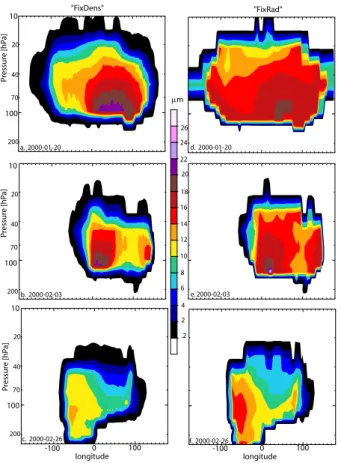
Figures 4a–4c show the average diameter per grid box on the 96 hPa pressure level after a 10-day model run using the “FixedDens” approach for 20 January, 3 February and 26 February, respectively. We have chosen this format for comparison reasons, since similar figures are shown by Carslaw et al. (2002) for the same periods. Here, the 20
average diameter ( ¯d) is obtained by weighting the diameter of particles that reside in
each respective size bin with the fraction of total NAT (hereafter referred to as [NAT]tot)
present in each size bin according to Eq. (3):
¯
d =Xnn=ntot
=1 d¯n·
[NAT]n
ACPD
4, 3089–3126, 2004Implementing growth and sedimentation of
NAT particles
M .M. P. van den Broek et al.
Title Page
Abstract Introduction
Conclusions References
Tables Figures
◭ ◮
◭ ◮
Back Close
Full Screen / Esc
Print Version
Interactive Discussion
©EGU 2004
wheren=the size bin number.
The largest particles form during the first period, where the minimum vortex
temper-ature is continuously below 191 K at θ=475 K (see Fig. 2). The maximum ¯d values
obtained for the first period in the “FixedDens” run range from 22–24µm, which is
comparable to, but slightly higher than, the maximum particle diameter measured by 5
the MASP instrument (∼20µm) on the same day at approximately the same altitude
(Fahey et al., 2001). The model results of Carslaw et al. (2002), which were obtained by applying the same growth/sedimentation algorithm in a Lagrangian model, also show
somewhat smaller particle sizes, with a maximum diameter of 16–18µm at between
θ=420–440 K (c.f. Fig. 2 in Carslaw et al., 2002). It should be noted that the
parti-10
cle number concentrations at thisθlevel are lower than those obtained by Carslaw et
al. (2002) by ≥50% across the entire size spectrum as a consequence of fixing the
particle number density for each size bin in the “FixedDens” approach (c.f. Fig. 3 in Carslaw et al., 2002). This has consequences regarding the growth rate of the NAT particles (see Sect. 4.2.2.). For the other simulation periods, which experienced higher 15
temperatures and less NAT formation, the maximum ¯d values are smaller than those
obtained in the first period by≥3µm. This results in a similar absolute difference with
Carslaw et al. (2002) when comparing particle diameter sizes for the respective end
dates, 3 and 26 February. These differences in maximum ¯d using the “FixedDens”
approach and those obtained by Carslaw et al. (2002) we feel are acceptable, consid-20
ering the difference in the treatment of particle transport and the large uncertainties
associated with both the particle number density and size distribution.
Figures 4d–4f show the corresponding plots of the ¯d values when using the
“Fixe-dRad” approach for identical dates. Here, ¯d is somewhat smaller than that for the
“FixedDens” run, with the maximum ¯d being∼20µm for the first interval, with the
dif-25
ferences in maximum ¯ddecreasing between the two methods for the second simulation
period (c.f. Figs. 4b with 4e). Remarkably, in the third period ¯d is larger for the
“Fixe-dRad” approach. The differences between both approaches are more clearly illustrated
ACPD
4, 3089–3126, 2004Implementing growth and sedimentation of
NAT particles
M .M. P. van den Broek et al.
Title Page
Abstract Introduction
Conclusions References
Tables Figures
◭ ◮
◭ ◮
Back Close
Full Screen / Esc
Print Version
Interactive Discussion
©EGU 2004
The integrated area over which large NAT particles are present is larger for the “Fixe-dRad” runs compared to the “FixedDens” runs. However, even though larger particles exist over a wider area for “FixedRad”, the actual number of such particles can be rather small (e.g. the mass of the second largest particles, NAT tracer number 4, is between
0–100 pptv at pressures<30 hPa). In fact during the analysis of the data a filter was
5
applied to Eq. (3) to avoid including extremely small (NAT) concentrations. When the
NAT total number density was less than 5×10⁻⁹cm−3the data were effectively ignored.
A major cause for these differences between the two approaches is the way in which
atmospheric mixing processes affect ¯d. In the “FixedRad” approach, mixing will
de-crease nbin, while the particle size remains the same. In the “FixedDens” approach,
10
mixing will decrease the particle radius. In fact, at the end of the winter mixing pro-cesses become so apparent that the “FixedRad” radii are slightly larger. An additional
effect originates from the particle size discretization in the “FixedRad” approach. In
cold periods, during strong particle growth, the radius is artificially reduced towards the average bin radius, and vice versa during slow particle growth (warmer periods). In the 15
“FixedDens” approach the radius increase is not limited.
It is interesting to note that in Fig. 5 the base level at which NAT occurs drops with respect to the simulation date due to descent of air within the vortex. These figures clearly show that the largest particles reside at the bottom of the vortex for both ap-proaches as a consequence of the sedimentation.
20
4.1.2. Denitrification
Figure 6 shows a direct comparison of the percentage change in HNO3 calculated
by each of our methods against equivalent latitude for the three chosen simulation periods. Here, two potential temperature levels are shown which correspond to the
alti-tude domains where the maximum amount of nitrification (θ=380 K) and denitrification
25
(θ=475 K) occur in the first simulation period.
As foreseen, the 10–20 January model run gives the greatest ∆HNO3 of all three
ACPD
4, 3089–3126, 2004Implementing growth and sedimentation of
NAT particles
M .M. P. van den Broek et al.
Title Page
Abstract Introduction
Conclusions References
Tables Figures
◭ ◮
◭ ◮
Back Close
Full Screen / Esc
Print Version
Interactive Discussion
©EGU 2004
20 January there is more denitrification in “FixedDens” (∼25%) than in “FixedRad”
(∼10%). This is because “FixedRad” has a smaller number density per size bin, which
is related to the differences in mass transport across the edges of the size bins between
both approaches. In the “FixedDens” approach, the full size bin mass is transported to the next size bin when the radius limit is reached. In the “FixedRad” approach, only the 5
fraction above the size bin number density threshold is transported to the next size bin.
For the second period, between 24 January–3 February, ∼5 and ∼12%
denitrifica-tion is calculated for the “FixedRad” and “FixedDens” approaches, respectively. For the final period, on 26 February 2000, practically no (de)nitrification is predicted by
the “FixedDens” approach, despite the maximum ¯d of∼17µm that was calculated (c.f.
10
Fig. 4c). The “FixedRad” approach on 26 February still yields a small amount of
deni-trification (∼5%) at theθ=475 K. Note that the higher temperatures in periods 2 and 3
reduce the sedimentation velocity and the maximum amount of nitrification occurs at a higher altitude.
Due to the smaller amount of denitrification calculated for this period, the maximum 15
(de)nitrification occurs at different altitudes (not shown). This is a consequence of the
smaller maximum ¯d and the shorter lifetime of the NAT particles.
4.2. Sensitivity studies
As discussed in Sect. 3.2, a number of prescribed model parameters were used for the base run simulation, where the choice of such parameters could influence perfor-20
mance of the algorithms to describe NAT growth and transport. For this reason we have tested the model sensitivity towards such parameters to quantify the robustness of our approaches. The simulation period of 10–20 January was used exclusively for this purpose due to the occurrence of large NAT particles as described earlier. The pro-longed period of cold temperatures also ensures that NAT was present throughout the 25
entire period, making differences between the sensitivity runs more easily discernible.
ACPD
4, 3089–3126, 2004Implementing growth and sedimentation of
NAT particles
M .M. P. van den Broek et al.
Title Page
Abstract Introduction
Conclusions References
Tables Figures
◭ ◮
◭ ◮
Back Close
Full Screen / Esc
Print Version
Interactive Discussion
©EGU 2004
differences in NOy re-distribution for both methods, these being: the number of
ver-tical layers used in the model; the type of advection scheme employed (first order or second moments); doubling the radius of the initial size bin, i.e. the nucleation rate;
and increasing the supersaturation of HNO3needed for NAT formation to 10. It should
be noted that these results pertain to a chemically passive version of TM5 and the 5
sensitivity should be re-tested when adding chemical tracers.
4.2.1. Comparison with the equilibrium approach
To allow a direct comparison of the equilibrium method with the base runs, the to-tal particle number densities and radii for all NAT particles were set constant in
two different runs. For the first sensitivity run, the number density and radius were
10
2.3×10⁻⁴cm−3 and 7.25µm, respectively, which equals the average values found by
Fahey et al. (2001). These sizes were observed on 20 January after a persistent cold period. Since the equilibrium approach assumes a constant radius, using the observed radius throughout the integration period may overestimate denitrification. Therefore,
smaller radii were assumed in the second sensitivity run, i.e. 4µm. Again, NAT
for-15
mation was calculated using TNAT based on the Hanson and Mauersberger criterium
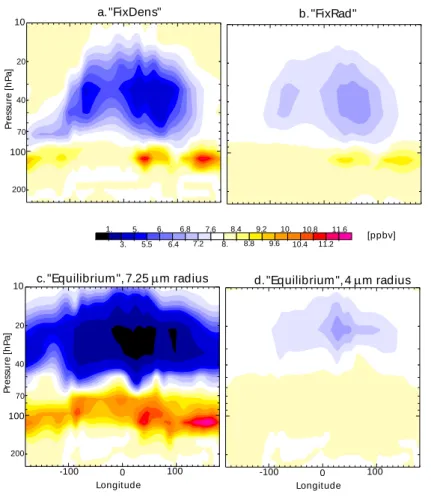
(1988) at each model time step (900 s). Figures 7a-d show the vertical
redistribu-tion of HNO3 at 80◦N across all longitudes for the “FixedDens”, “FixedRad” and both
equilibrium runs, respectively. From Fig. 7c it becomes apparent that after a 10-day simulation nearly 100% denitrification is simulated using the equilibrium approach with 20
large particles. This is an exaggerated repartitioning, given that an estimated 20–60% is thought to occur in the Arctic over the entire winter (Santee et al., 2000; Popp et al., 2001; Kleinb ¨ohl et al., 2003). However, the magnitude of the calculated denitrification is critically dependent on the values assumed for the prescribed radius and particle number density. By comparing Figs. 7c and 7d it can be seen that a smaller radius 25
dramatically reduces denitrification. Tuning these parameters may thus lead to
fortu-itous agreement between modelled NOy profiles and observations (Kleinb ¨ohl et al.,
ACPD
4, 3089–3126, 2004Implementing growth and sedimentation of
NAT particles
M .M. P. van den Broek et al.
Title Page
Abstract Introduction
Conclusions References
Tables Figures
◭ ◮
◭ ◮
Back Close
Full Screen / Esc
Print Version
Interactive Discussion
©EGU 2004
constrain the assumptions that can be made regarding these constant parameters.
Another difference between the equilibrium and nonequilibrium approaches
con-cerns the vertical distribution of HNO3. A maximum of denitrification is found at a
higher level (∼25 hPa instead of ∼50 hPa) in the equilibrium model runs, even with
a short integration time of 10 days. Similar differences between an equilibrium and
5
nonequilibrium approach were also found by Mann et al. (2002) for the same winter.
4.2.2. Total number density
The total number density of large particles (>5µm diameter) as observed by Fahey et
al. (2001) was∼2.3×10⁻⁴cm−3on 20 January. The estimated uncertainty of this
mea-surement is±30% and may vary with the location inside the vortex. To test the model’s
10
sensitivity to this parameter, the maximum allowable total number density was varied
from 0.5 to 5×10⁻⁴cm−3, resulting in an nbin between 0.1 and 1×10⁻⁴cm−3,
respec-tively. The resulting size distributions in terms of number concentration are depicted in Fig. 3a, with the blue, black and red line denoting the high, standard and low total number density, respectively.
15
Figure 8 shows the (de)nitrification at 80◦N equivalent latitude against the total
num-ber density for these model runs onθlevels 380 K and 475 K, respectively. Even though
the number density is variable within the “FixedRad” approach (i.e.nbinis merely used
to define a threshold instead of a fixed number of particles) the algorithm is still sensi-tive to this parameter, although less so than the “FixedDens” approach. (De)nitrification 20
increases with increasing nbin due to an associated increase in the fraction of HNO3
partitioned into NAT. However, the maximum ¯d value becomes lower (decreasing from
24.9µm for 1×10⁻⁵cm−3to 21.8µm for 1×10⁻⁴cm−3at 96 hPa using the “FixedDens”
approach (not shown)) indicating that the growth of NAT particles is somewhat
moder-ated by the choice ofnbin. This is due to a related increase in particle mass (∆mp) in
25
Eq. (2). This change is non-linear with respect tonbin due to the increase in [NAT]tot.
In all cases, the [NAT]tot for the “FixedDens” method exceeded that of the “FixedRad”
ACPD
4, 3089–3126, 2004Implementing growth and sedimentation of
NAT particles
M .M. P. van den Broek et al.
Title Page
Abstract Introduction
Conclusions References
Tables Figures
◭ ◮
◭ ◮
Back Close
Full Screen / Esc
Print Version
Interactive Discussion
©EGU 2004
a maximal value due to the associated reduction in the available [HNO3(g)] within the
vortex. The latter would result in a limitation to particle growth, especially when a
non-uniform HNO3(g) profile is considered. However, this situation would only be reached
when prescribing high number densities or during longer model runs. Moreover, tem-perature fluctuations would also limit the extent of the (de)nitrification by introducing 5
periods where the evaporation of particles would hinder the sedimentation. Varying
nbin from 0.25 to 1×10⁻⁴cm−3, which is equivalent to halving or doubling the total
number density, leads to an increase in denitrification from 12 to 34% at an
equiva-lent latitude of 80◦N andθ=475 K for the “FixedDens” run, and from 5 to 15% for the
“FixedRad” run (see Fig. 8). 10
4.2.3. The number of size bins
To make the algorithm as efficient as possible, it is important to know how many tracers
are required to model denitrification. Figure 9 shows the (de)nitrification at 80◦N
equiv-alent latitude calculated using an increasing number of size bins on identicalθlevels as
those shown in Fig. 8 for both model approaches. Due to the substantial increase in the 15
redistribution of HNO3 with increasing particle number density (see Sect. 4.2.2.), the
total number density was kept constant throughout at 2.3×10⁻⁴cm−3, as prescribed in
the base run. Since the size bin limits were not identical for each sensitivity run, the shape of the resulting size distributions varies depending on the number of bins used (c.f. Figs. 3a–3d). However, it can be seen that the size spectrum essentially becomes 20
flat once 7 or more bins are prescribed.
A pronounced result is that the methods are quite robust in calculated
denitrifica-tion, since only small differences occur when the amount of tracers is doubled. The
“FixedDens” approach results in more (de)nitrification than the “FixedRad” approach
regardless of the number of size bins used. But, remarkably, the differences in the
25
denitrifica-ACPD
4, 3089–3126, 2004Implementing growth and sedimentation of
NAT particles
M .M. P. van den Broek et al.
Title Page
Abstract Introduction
Conclusions References
Tables Figures
◭ ◮
◭ ◮
Back Close
Full Screen / Esc
Print Version
Interactive Discussion
©EGU 2004
tion clearly decreases with an increasing number of size bins, from 25% in the 5 bin simulation to 15% in the 18 bin run. This is due to the fact that the “FixedDens” particle growth is more sensitive to the resolution of the size spectrum (i.e. number of bins). The full content of the size bin is moved up or down at growth or evaporation, while
in the “FixedRad” approach the mass transport occurs only once the thresholdnbinis
5
exceeded. The use of more size bins, with each of them a lower number density than the size bins in the standard run, results in a more concise and variable distribution of the mass over the size bins.
4.2.4. The shape of the size distribution
The particle size distributions measured by Fahey et al. (2001) suggest that constrain-10
ing the model with a flat size distribution across the entire size spectrum maybe an over-simplification (as performed for the 7, 10, 15 and 18 bin sensitivity runs, c.f. Figs. 3b– 3d). To provide further insight into the extent to which the prescribed size spectrum has on the calculation of denitrification, we chose to alter the shape of the permitted size spectrum in a number of ways. For this purpose, we have performed runs with 7 bins 15
using three distinctively different size distributions: one with decreasing and one with
increasingnbin values from bin 2 to bin 7 (creating a negative and a positive “slope”,
respectively) and one based on the distribution observed by Fahey et al. (2001). The shapes of these size distributions are shown in Figs. 3e–3f and defined as the stan-dard flat (black line), negative (blue), positive (green) and observed (red) distribution, 20
respectively.
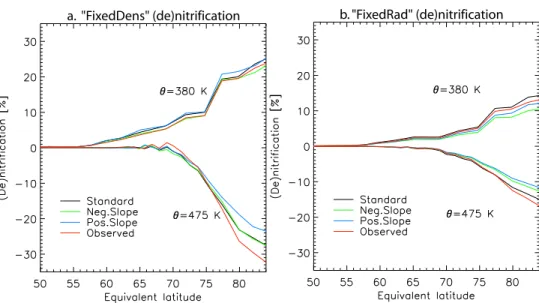
Figures 10a and 10b show comparisons of the resulting (de)nitrification at θ
lev-els 380 and 475 K versus equivalent latitude for the “FixedDens” and “FixedRad” ap-proaches, respectively. In summary it can be seen that the (de)nitrification changes
by<5% for both approaches indicating that they are relatively robust with respect to
25
ACPD
4, 3089–3126, 2004Implementing growth and sedimentation of
NAT particles
M .M. P. van den Broek et al.
Title Page
Abstract Introduction
Conclusions References
Tables Figures
◭ ◮
◭ ◮
Back Close
Full Screen / Esc
Print Version
Interactive Discussion
©EGU 2004
(>2 ppbv) in small regions of the vortex (not shown) meaning that no further
discus-sion of this run is warranted. Prescribing an observed size distribution has the inherent weakness that the size distribution must remain similar during the entire winter period. Unfortunately the size distributions shown in Northway et al. (2002b) indicate that the both the total number density and size distribution change between 20 January and 3 5
February in the Arctic vortex for this winter. Therefore constraining the model with an observed size distribution would only be possible if many more measurements were available, during the whole winter, which is not feasible.
5. Discussion and conclusions
In this study we present an efficient and concise algorithm for the formation and
sedi-10
mentation of NAT particles, which has been implemented in a global Eulerian 3D chem-istry transport model using a non-equilibrium approach. For this purpose the transport of such particles is achieved by segregating the particles into distinct size bins, each of which is treated as an advected tracer. Two separate approaches were tested, one which prescribes a fixed particle number density (“FixedDens”) and the other prescrib-15
ing a fixed particle radius for each respective size bin (“FixedRad”). This algorithm has been applied in simulations over three selected 10-day periods during the Arctic win-ter 1999/2000, and the resulting particle sizes and number concentrations were found to agree favourably with those observed “in-situ” (Fahey et al., 2001; Brooks et al., 2003). Comparisons made with the results of a Lagrangian model study (Carslaw et 20
al., 2002), from which the microphysical component of our algorithm was taken, reveals
differences of between 0–4µm for the diameters of the largest NAT particle formed,
de-pending on the adopted approach (with the Eulerian model producing the larger sizes).
Considering the differences in the performance and underlying concepts of both
mod-els we feel that agreement within±20% is a satisfactory result. Moreover, the resulting
25
ACPD
4, 3089–3126, 2004Implementing growth and sedimentation of
NAT particles
M .M. P. van den Broek et al.
Title Page
Abstract Introduction
Conclusions References
Tables Figures
◭ ◮
◭ ◮
Back Close
Full Screen / Esc
Print Version
Interactive Discussion
©EGU 2004
Santee et al., 2000), although for a more realistic comparison model runs need to be
extended over the entire winter using realistic HNO3 profiles, with a full stratospheric
chemistry scheme.
Substantial differences were found in both the extent of denitrification and vertical
redistribution of HNO3, when compared against the results obtained using a simple
5
equilibrium approach. Applying the equilibrium approach resulted in an unrealistically
high removal of HNO3when using an observed particle radius. Decreasing the particle
radius to 4µm significantly reduced the HNO3removal, indicating the potential danger
of using such an approach. This large effect justifies the use of the computationally
more expensive, but more realistic, treatment, of NAT particle growth and sedimenta-10
tion. The results of the “FixedDens” and the “FixedRad” method differ somewhat, but
these differences are small compared to other uncertainties introduced in the model.
The results from the sensitivity studies suggest that the model is rather robust and relatively insensitive to the number of size bins used, as long as the total particle num-ber density remains constant. The “FixedRad” approach shows the smallest variation 15
in denitrification when changing the number of size bins. The differences between both
approaches become≤10% for 10 tracers or more. This has advantages in that just a
limited number of extra tracers are needed to account for nonequilibrium treatment of NAT and denitrification in a full chemistry run. Another important finding is that both ap-proaches are also quite insensitive to the shape of the size distribution. However, they 20
are sensitive to the total particle number density (∼17% difference in 10-day
denitrifica-tion upon changing the total number density from 1×10⁻⁴to 4×10⁻⁴cm−3), although
the “FixedRad” approach proved to be more robust also in this parameter. Consid-ering the observed variability during 1999/2000, similar observations of the NAT total number density would be beneficial for future Arctic winters, as well as a continued 25
effort in clarifying the details of the formation mechanisms of NAT. Our approaches do
not require detailed knowledge on the shape of the size distribution, at least for the 1999/2000 winter.
sim-ACPD
4, 3089–3126, 2004Implementing growth and sedimentation of
NAT particles
M .M. P. van den Broek et al.
Title Page
Abstract Introduction
Conclusions References
Tables Figures
◭ ◮
◭ ◮
Back Close
Full Screen / Esc
Print Version
Interactive Discussion
©EGU 2004
ulations over the entire Arctic winter period of 1999/2000 with comprehensive chem-istry active, as well as for more moderate Arctic winters. It was already shown with a Lagrangian model that the nonequilibrium treatment of NAT calculates significant den-itrification in other, more moderate winters (Mann et al., 2003). Using the Eulerian
approaches, we are now able to test the effect of denitrification during such a more
5
moderate winter period to try and assess whether these differences lead to surplus
ozone depletion that warrants the increase in computational costs.
Acknowledgements. We would like to thank K. Carslaw, S. Davies, G. Mann from the School
of the Environment at the University of Leeds for their introduction to their nonequilibrium NAT algorithm and fruitful discussions. J. Buchholz, S. Meilinger and J. Lelieveld are also thanked
10
kindly for their help and advice.
References
Bregman, A., Lelieveld, J., van den Broek, M., Fischer, H., Siegmund, P., and Bujok, O.: The N2O and O2 relationship for mixing processes as represented by a three-dimensional chemistry-transport model, J. Geophys. Res., 105, 17 279–17 290, 2000.
15
Bregman, A., Krol, M. C., Teyssedre, H., Norton, W. A., Iwi, A., Chipperfield, M., Pitari, G., Sun-det, J. K., and Lelieveld, J.: Chemistry-Transport model comparison with ozone observations in the midlatitude lowermost stratosphere, J. Geophys. Res., 106, 17 479–17 496, 2001. Bregman, A., Segers, A., Krol, M., Meijer, E., and van Velthoven, P.: On the use of
mass-conserving wind fields in chemistry-transport models, Atm. Chem. Phys., 3, 447–457, 2003.
20
Brooks, S. D., Baumgardner, D., Gandrud, B., Dye, J. E., Northway, M. J., Fahey, D. W., Paul Bui, T., Toon, O. B., and Tolbert, M. A., Measurements of large stratospheric particles in the Arctic polar vortex, J. Geophys. Res., 108, D20, 4652, doi:10.1029/2002JD003278, 2003. Carslaw, K. S., Kettleborough, J. A., Northway, M. J., Davies, S., Gao, R. S., Fahey, D. W.,
Baumgardner, D. G., Chipperfield, M. P., and Kleinb ¨ohl: A vortex-scale simulation of the
25
growth and sedimentation of large nitric acid hydrate particles, J. Geophys. Res., 107, D20, 8300, doi:10.1029/2001JD000467, 2002.
ACPD
4, 3089–3126, 2004Implementing growth and sedimentation of
NAT particles
M .M. P. van den Broek et al.
Title Page
Abstract Introduction
Conclusions References
Tables Figures
◭ ◮
◭ ◮
Back Close
Full Screen / Esc
Print Version
Interactive Discussion
©EGU 2004
Crutzen, P. and Arnold, F.: Nitric acid cloud formation in the cold Arctic stratosphere, a major cause for the springtime “‘ozone hole”, Nature, 324, 651–655, 1986.
Davies, S., Chipperfield, M. P., Carslaw, K. S., Sinnhuber, B.-M., Anderson, J. G., Stimpfle, R. M., Wilmouth, D. M., Fahey, D. W., Popp, P. J., Richard, E. C., von der Gathen, P., Jost, H., and Webster, C. R.: Modeling the effect of denitrification on Arctic ozone depletion during
5
winter 1999/2000, J. Geophys. Res., 108, D5, 8322, doi:10.1029/2001JD000445, 2003. Drdla, K., Schoeberl, M. R., and Browell, E. V.: Microphysical modelling of the 1999-2000 Arctic
winter: 1. Polar stratospheric clouds, denitrification, and dehydration, J. Geophys. Res., 108, D5, 8312, doi:10.1029/2001JD000782, 2003.
Drdla, K., Turco, R. P., and Elliott, S.: Heterogeneous chemistry on Antarctic polar stratospheric
10
clouds – a microphysical estimate of the extent of chemical processing, J. Geophys. Res., 98, D5, 8965–8981, 1993.
Fahey, D. W., Gao, R. S., Carslaw, K. S. et al.: The detection of large HNO3-containing particles in the winter Arctic Stratosphere, Science, 1026–1031, 2001.
Fahey, D. W., Kelly, K. K., Kawa, S. R., Tuck, A. F., Loewenstein, M., Chan, K. R., and Heidt, L.
15
E.: Observations of denitrification and dehydration in the winter polar stratospheres, Nature, 344, 321–324, 1990.
Fahey, D. W., Kelly, K. K., Ferry, G. V., Poole, L. R., Wilson, J. C., Murphy, D. M., Loewenstein, M., and Chan, K. R.: In situ measurements of total reactive nitrogen, total water and aerosol in a polar stratospheric cloud in the Antarctic, J. Geophys. Res., 94, 11 299–11 315, 1989.
20
Hanson, D. and Mauersberger, K.: Laboratory studies of the nitric acid trihydrate: Implications for the South polar stratosphere, Geophys. Res. Lett., 15, 855–858, 1988.
Jensen, E. J., Toon, O. B., Tabazadeh, A., and Drdla, K.: Impact of polar stratospheric cloud particle composition, number density, and lifetime on denitrification, J. Geophys. Res., 107, D20, 8284, doi:10.1029/2001JD000440, 2002.
25
Kleinb ¨ohl, A., Bremer, H., von K ¨onig, M. et al.: Vortexwide denitrification of the Arctic polar stratosphere in winter 1999/2000 determined by remote observations, J. Geophys. Res., 108, D5, 8305, doi :10.1029/2001JD001042, 2003.
Knopf, D. A., Koop, T., Luo, B. P., Weers, U. G., and Peter, T.: Homogeneous nucleation of NAD and NAT in liquid stratospheric aerosols: insufficient to explain denitrification, Atmos. Chem.
30
Phys., 2, 207–214, 2002.
ACPD
4, 3089–3126, 2004Implementing growth and sedimentation of
NAT particles
M .M. P. van den Broek et al.
Title Page
Abstract Introduction
Conclusions References
Tables Figures
◭ ◮
◭ ◮
Back Close
Full Screen / Esc
Print Version
Interactive Discussion
©EGU 2004
doi :10.1029/2001JD001089, 2002.
Krol, M. C., Lelieveld, J., Oram, D. E., Sturrock, G. A., Penkett, S. A., Brenninkmeier, C. A. M., Gros, V., Williams, J., and Scheeren, H. A.: Continuing emissions of methyl chloroform from Europe, Nature, 421, 131–135, 2003.
Mann, G. W., Davies, S., Carslaw, K. S., and Chipperfield, M. P.: Factors controlling Arctic
5
denitrification in cold winters of the 1990s, Atmos. Chem. Phys., 3, 403–416, 2003.
Mann, G. W., Davies, S., Carslaw, K. S., and Chipperfield, M. P.: Polar vortex concen-tricity as a controlling factor in Arctic denitrification, J. Geophys. Res. 107, D22, 4663, doi:10.1029/20002JD002102, 2002.
Manney, G. L. and Sabutis, J. L.: Development of the polar vortex in the 1999-2000 Arctic winter
10
stratosphere, Geophys. Res. Lett., 27, 2589–2592, 2000.
Northway, M. J., Gao, R. S., Popp, P. J., Holecek, J. C., Fahey, D. W., Carslaw, K. S., Tolbert, M. A., Lait, L. R., Dhaniyala, S., Flagan, R. C., Wennberg, P. O., Mahoney, M. J., Herman, R. L., Toon, G. C., and Bui, T. B.: An analysis of large HNO3-containing particles sampled in the Arctic stratosphere during the winter of 1999/2000, J. Geophys. Res., 107, D20, 8298,
15
doi:10.1029/2001JD001079, 2002a.
Northway, M. J., Popp, P. J., Gao, R. S., Fahey, D. W., Toon, G. C., and Bui, T. P.: Relating inferred HNO3 flux values to the dinitrification of the 1999–2000 Arctic Vortex, Geophys. Res. Lett., 29, D16, 1816, doi: 10.1029/2002GL015000, 2002b.
Poole, L. R., Trepte, C. R., Harvey, V. L., Toon, G. C., and VanValkenburg, R. L.: SAGE III
20
observations of Arctic polar stratospheric clouds – December 2002, Geophys. Res. Lett., 30, 23, 2216, doi :10.1029/2003GL018496, 2003.
Popp, P. J., Northway, M. J., Holecek, J. C. et al.: Lait, Severe and extensive denitrification in the 1999/2000 Arctic winter stratosphere, Geophys. Res. Lett., 28, 2875–2878, 2001. Prather, M. J.: Numerical advection by conservation of second-order moments, J. Geophys.
25
Res., 91, 6671–6681, 1986.
Rex, M., Salawitch, R. J., von der Gathen, P., Harris, N. R. P., Chipperfield, M. P., and Naujokat, B.: Arctic ozone loss and climate change, Geophys. Res. Lett., 31, L04116, doi:10.1029/2003GL018844, 2004.
Rex, M., Harris, N. R. P., von der Gathen, P. et al.: Prolonged stratospheric ozone loss in the
30
1995–1996 winter, Nature, 389, 835–838, 1997.
ACPD
4, 3089–3126, 2004Implementing growth and sedimentation of
NAT particles
M .M. P. van den Broek et al.
Title Page
Abstract Introduction
Conclusions References
Tables Figures
◭ ◮
◭ ◮
Back Close
Full Screen / Esc
Print Version
Interactive Discussion
©EGU 2004
Res. Lett., 28, 2197–2200, 2001.
Russell, G. L. and Lerner, J. A.: A new finite-differencing scheme for the tracer transport equa-tion, J. Appl. Meteorol., 20, 1483–1498, 1981.
Santee, M. L., Manney, G. L., Livesey, N. J., and Waters, J. W.: UARS Microwave Limb Sounder observations of denitrification and ozone loss in the 2000 Arctic late winter, Geophys. Res.
5
Lett., 27, no. 19, 3213–3216, 2000.
Shindell, D. T., Rind, D., and Lonergan, P.: Increased polar stratospheric ozone loss and de-layed eventual recovery due to increasing greenhouse gas concentrations, Nature, 392, 582– 592, 1998.
Sinnhuber, B.-M., Chipperfield, M. P., Davies, S., Burrows, J. P., Eichmann, K.-U., Weber, M.,
10
von der Gathen, P., Guirlet, M., Cahill, G. A., Lee, A. M., and Pyle, J. A.: Large loss of total ozone during the Arctic winter of 1999/2000, Geophys. Res. Lett., 27, 21, 3473–3476, 2000. Sugita, T., Kondo, Y., Nakajima, H., Schmidt, U., Engel, A., Oelhaf, H., Wetzel, G., Koike, M., and Newman, P. A.: Denitrification observed inside the Arctic vortex in February 1995, J. Geophys. Res., 103, 16 221–16 233, 1998.
15
Tabazadeh, A.: Commentary on “Homogeneous nucleation of NAD and NAT in liquid strato-spheric aerosols : insufficient to explain denitrification” by Knopf et al., Atmos. Chem. Phys., 3, 863–865, 2003.
Van den Broek, M. M. P., v. Aalst, M., Bregman, A., Krol, M., Lelieveld, J., Toon, G. C., Garcelon, S., Hansford, G. M., Jones, R. L., and Gardiner, T. D.: The impact of model grid zooming on
20
tracer transport in the 1999/2000 Arctic polar vortex, Atmos. Phys. Chem., 3, 1833–1847, 2003.
Van den Broek, M. M. P., Bregman, A., and Lelieveld, J.: Model study of stratospheric chlo-rine activation and ozone loss during the 1996/1997 winter, J. Geophys. Res., 105, 28 961– 28 977, 2000.
25
ACPD
4, 3089–3126, 2004Implementing growth and sedimentation of
NAT particles
M .M. P. van den Broek et al.
Title Page
Abstract Introduction
Conclusions References
Tables Figures
◭ ◮
◭ ◮
Back Close
Full Screen / Esc
Print Version
Interactive Discussion
©EGU 2004
Table 1.Prescribed radii size limits, average radius, size bin particle density (nbin) and number concentrations used for the base run. Values are given for each respective bin. Within the “FixedDens” approach,nbinis fixed, whereas the “FixedRad” approach uses them to set mass thresholds for each bin (see Sect. 2.4). Simulations were performed for all chosen time intervals (see Sect. 3.1) using each approach.
Size bin number 1 2 3 4 5
Minimumr(µm) 0 0.2 2 6 12
Maximumr(µm) 0.2 2 6 12 25
Averager(µm) 0.1 1.1 4 9 18.5
Number density per size bin (10−5
cm−3
) 5.75 5.75 5.75 5.75 5.75
Number concentration (10−5
cm−3
µm−1
ACPD
4, 3089–3126, 2004Implementing growth and sedimentation of
NAT particles
M .M. P. van den Broek et al.
Title Page
Abstract Introduction
Conclusions References
Tables Figures
◭ ◮
◭ ◮
Back Close
Full Screen / Esc
Print Version
Interactive Discussion
©EGU 2004
Table 2.Definition of the sensitivity runs conducted regarding the number of size bins, the total particle number density at the end of the simulation, the particle number concentrations in each bin (nbin), and the initial diameter.
Definition of No. size Total particle Number density Initial the model run bins number density per size binnbin diameter (µm)
(1×10⁻⁴cm−3) (1×10⁻⁵parts cm−3)
I Base 5 2.3 5.75 0.2
II Equilibrium a. 0 2.3 N/A 14.5
b. 0 2.3 N/A 8.0
III Number density 5 0.4–4 1–10 0.2
IV Number of bins 5–18 2.3 1.60–5.75 0.2
(see Figs. 3a–3d)
V Size spectrum 7 2.3 Varying 0.2
ACPD
4, 3089–3126, 2004Implementing growth and sedimentation of
NAT particles
M .M. P. van den Broek et al.
Title Page
Abstract Introduction
Conclusions References
Tables Figures
◭ ◮
◭ ◮
Back Close
Full Screen / Esc
Print Version
Interactive Discussion
©EGU 2004
NAT form ation in first size bin at Tnat at initial conditions
NAT grow th is calculated for each size bin NAT in
first size bin? No NAT in
TM5
T < 200 K? Lat > 50o N?
Radius and num ber densit y are calculated from NAT m ass
HNO3 concentra-tion is adapted
Sedim entation is calculated
Redistribution of particle m ass over the size bins
Radius or num ber densit y is re-calculated from NAT m ass Advective transport
of NAT size bins and HNO3
1
2
3
4
5
6
7
8
YES
YES NO
ACPD
4, 3089–3126, 2004Implementing growth and sedimentation of
NAT particles
M .M. P. van den Broek et al.
Title Page
Abstract Introduction
Conclusions References
Tables Figures
◭ ◮
◭ ◮
Back Close
Full Screen / Esc
Print Version
Interactive Discussion
©EGU 2004
ACPD
4, 3089–3126, 2004Implementing growth and sedimentation of
NAT particles
M .M. P. van den Broek et al.
Title Page
Abstract Introduction
Conclusions References
Tables Figures
◭ ◮
◭ ◮
Back Close
Full Screen / Esc
Print Version
Interactive Discussion
©EGU 2004
Fig. 3. Plots of particle number concentration (cm−3µm−1) versus particle diameter (µm) for all sensitivity runs performed for the “FixedDens” and “FixedRad” approaches: (a) base run (black), with the higher (blue, 4×10⁻⁴cm−3) and lower (red, 4×10⁻⁵cm−3) total number density
ACPD
4, 3089–3126, 2004Implementing growth and sedimentation of
NAT particles
M .M. P. van den Broek et al.
Title Page
Abstract Introduction
Conclusions References
Tables Figures
◭ ◮
◭ ◮
Back Close
Full Screen / Esc
Print Version
Interactive Discussion
©EGU 2004
a. "FixDens", 2000-01-20
b. "FixDens", 2000-02-03
d. "FixRad", 2000-01-20
e. "FixRad", 2000-02-03
c. "FixDens", 2000-02-26 f. "FixRad", 2000-02-26
NAT particle diameters