BODY COMPOSITION OF YOUNG PEOPLE AGED 17–18 YEARS, PRACTICING AND NOT PRACTICING SWIMMING, WITH THE USE OF THE BIOELECTRICAL IMPEDANCE METHOD.
Jendrysek Marek 1, Nowosielska-Swadźba Danuta 1, Zwolińska Danuta 1, Podstawski Robert 2 1 The Institute of Physical Culture, State Higher Vocational School in Racibórz, Poland
2 Department of Physical Education and Sport, University of Warmia & Mazury in Olsztyn, Poland
Abstract. Purpose:Body composition evaluation of youth aged 17–18 of a different physical activity with the help of bioelectric impedance method. Material and Methods:18 boys practicing swimming and 19 boys not practicing it took part in the study, making up a control group. Height, weight, BMI, lean body mass, the content of fat and water, Rohr factor were evaluated. Non-parametric Mann-Whitney test has been used to evaluate the differences in the range of the tissue components between the two groups. Results: Statistically significant differences were found on the p<0,05 level in % fat content. Mean body weight in experimental group was 71.5 kg, while in control group it was 69.4 kg. Minimum and maximum weight in group of swimming-practicing persons was: 56.6–92.2 kg.Increased body weight in the group of swimmers can result from greater amount of active tissue in this group compared with persons of low physical activity.Proportionally, it amounted to 64.3 kg and 61.3 kg. In the tested groups, minimal and maximal values of amount of active tissue proportionately amounted to: 54.1–78 and 49.5–72,3 kg. Conclusions: Physical activity modifies body composition. Active lifestyle is one of the methods for prevention of overweight and obesity. Key words: body composition, physical activity, obesity, bioelectric impedance.
Introduction1
Recent years, in Poland and in many other countries studies have been conducted on problem of overweight and obesity. Obesity is perceived as a health problem and treated as “Epidemic of XXI century”. In medical concept, obesity is treated as a systemic chronic metabolic disease resulting from a disorder of the balance between energy collecting and spending [1]. Obesity is connected with an excessive fat body growth. The period of puberty is a critical period for general fatness development and in terms of body for fat location in the organism [13].
Hirschler V. et al. [8], Anoop M. et al. [1] suggest that there is a correlation between abdominal obesity and late appearance of the metabolic syndrome (ZM). De Ferranti A. et al. [5] state that obesity is a clinical concept of related metabolic disorders, to which belong the following among others: abdominal obesity, hypertension, increased glucose concentration, insulin resistance, lipid economy. In case of children obesity should be treated as a multi-systemic disease [7].
According to Sikorska-Wiśniewska G. [18], main obesity causes are: inappropriate eating habits, low physical activity, emotional problems, pregnant women’s inappropriate nutrition, genetic factors. The author says that during childhood, environmental impact is very crucial, due to formation of eating habits. Besides, parents have also a significant influence on the children’s way of their free time spending. They can offer different forms of physical activity to the child. Significance of a physical activity increases, especially in the prevention of civilizational diseases. Physical activity positively affects our health, emotional and social development. Systematic, long-lasting physical exercises induce changes in organs, systems, cells. These changes affect body composition (lean body mass participation, fat body) [17]. Chabros E. and Chrzanowska J. [4] state that obesity and overweight are frequently the result of an inappropriate diet and low physical activity. It has been found that following an appropriate diet together with a regular physical activity constitutes an effective method in the fight against obesity. Regular participation in sports reduces amount of fat body and increases lean body mass. Physical activity leads to reduction of fat body mass size, and also improves its sensitivity to insulin effect. An adequate level of physical activity leads also to regulation of metabolic disorders, which occur with obesity. Białkowska M. [2] claims that physical activity is effective for secondary and primary obesity prevention, while reduced physical fitness can lead to increased risk of premature death.
Body mass and composition measurements are good tools to evaluate metabolism disorders, in diagnostics of malnutrition, overweight and obesity.
Anthropometric methods evaluating overweight and obesity include: bioelectric impedance method, percentile grid, waist-hip rate (WHR), waist circuit (WC), BMI rate (body mass index). Bioelectric impedance method
is a non-invasive, simple method. Besides, thanks to this method, evaluation of body composition mass can be made. Woodrow G. [20],Birch K., et al. [3] state that bioelectric impedance is connected with electrical conductivity of lean, hydrated and anhydrous body fat. The most frequently used weight-height factor is BMI factor.
Material and methods Ethics
The study was conducted in accordance with the Helsinki Charter of Human Rights and was approved by Ethics Committee of State Higher Vocational School in Raciborz. Each participant was willing to participate in the study voluntarily and confirmed that with a written agreement.
Participants and controls
Tests were conducted in 2013 on a group of young people at age of 17–18 in the morning hours (8.00 – 10.00). The participants were divided into two groups differing by level of physical activity. One group consisted of persons with high level of physical activity, training swimming (18 boys). The second tested group – were the persons not training (19 people), attending only PE lessons (3 times a week).
The subjects were instructed to avoid physical activity, maintain current food intake, with no alcohol and caffeine 48 hours before testing. On test day, the athletes were with empty stomach. The subjects stayed in standard study conditions (temperature 20–22o C – thermo neutral conditions), following the basic procedures of sports metrology.
As a research tool, analyzer of body composition TANITA TBF-300 type has been used, measuring participation of particular body components (Bioelectric analysis of the impedance – BIA). This method uses resistance measurement of electric current in human body. As a result of such research, the following values have been obtained: body mass [kg], BMI – Body Mass Index (weight – height factor of body mass), FAT % – percentage of body fat, FAT MASS –content of body fat in [kg], FFM –content of lean body mass [kg], TBW – total water content in organism [kg].
The results were processed and subjected to the statistical calculations (mean, standard deviation (SD, ±), min., max.) in Microsoft Open Office Excel 2007 software. Significance level of differences between tested groups was calculated with Statistica 10 program. Calculations were made with the use of non-parametric U Mann-Whitney test to compare two independent groups. The level of significance was p<0,05.
Results
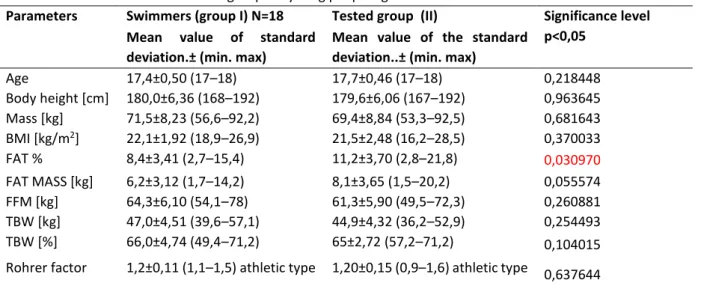
Table 1. Somatic evaluation of tested groups of young people aged 17–18.
Parameters Swimmers (group I) N=18 Tested group (II) Significance level p<0,05
Mean value of standard deviatio .± i . ax
Mean value of the standard deviatio ..± i . ax
Age 17,4± , ( –18) 17,7± , ( –18) 0,218448
Body height [cm] 180,0± , ( –192) 179,6± , 6 (167–192) 0,963645 Mass [kg] 71,5± , (56,6–92,2) , ± , ( , –92,5) 0,681643 BMI [kg/m2] 22,1± , ( , –26,9) , ± , ( , –28,5) 0,370033
FAT % 8,4± , ( , –15,4) , ± , ( , –21,8) 0,030970
FAT MASS [kg] , ± , ( , –14,2) , ± , ( , –20,2) 0,055574
FFM [kg] 64,3± , ( , –78) , ± , ( , –72,3) 0,260881
TBW [kg] 47,0± , ( , –57,1) , ± , ( , –52,9) 0,254493
TBW [%] 66,0± , ( , –71,2) ± , ( , –71,2) 0,104015
Rohrer factor 1,2± , ( , –1,5) athletic type , ± , ( , –1,6) athletic type 0,637644
*significance level p<0,05
Mean body weight in experimental group was 71.5 kg (± 8.23), while in control group it was 69.4 kg (± 8.84). Minimum and maximum weight in group of swimming-practicing persons was: 56.6–92.2 kg.Increased body weight in the group of swimmers can result from greater amount of active tissue in this group compared with persons of low physical activity.Proportionally, it amounted to 64.3 kg (± 6.10) and 61.3 kg (± 5.90). In the tested groups, minimal and maximal values of amount of active tissue proportionately amounted to: 54.1–78 and 49.5–72,3 kg. Greater volume of active tissue in group with high physical activity has also an effect on BMI. This indicator respectively took values: 22.1 (± 1.92) [kg / m2] and 21.5 (2.48) [kg / m2]. Minimum and maximum valueswere: 18.9–26.9 [kg/m2] and 16.2–28.5 [kg/m2]. Amount of active tissue, body weight, BMI in group of young people practicing swimming, were not significantly statistically higher, compared with control group.Water content [TBW] expressed in percents and in kilograms, in group practicing swimming, was not significantly higher, compared with control group. These indicators respectively took values: in experimental group: 66.0 (± 4.74), maximum and minimum values: 49.4–71.2 [%], whereas in control group: 65 (± 2.72), minimum and maximum values: 57.2–71.2 [%].
The study and analysis of the results have shown that there were significant statistical differences in body fat expressed in percents. In the group of people practicing swimming, these values amounted to 8.4 (± 3.41), minimum and maximum values were: (2.7–15.4) [%]. Accordingly, in control group, body fat, expressed in [%], took values of 11.2 (± 3.70) 2.8–21.8 [%]. Body fat percentage, expressed in kilograms, was 6.2 (± 3.12) in experimental group, minimum and maximum values were: 1.7–14.2 [kg], while in reference group they were: 8.1 (± 3.65), minimum and maximum values: 1.5–20.2 [kg]. Body fat percentage expressed in kilograms, approached level of significance 0 <0.05.
Discussion
Łaska-Mierzejewska T. [11] states that in non-training population, BMI shows rather high correlation with different measures of fatness. People, who train sports, have different composition of body tissues. BMI of contestants may be considered as an active tissue measurement. Jaskólski A. [10] writes that BMI factor is not the best obesity factor for trained people. People with of high physical activity and having mass musculature can have higher BMI value, which may indicate overweight or obesity. In the swimming-training group, high BMI factor can result from a large amount of muscles. Based on the presented opinions, BMI factor should not be compared when people, who differ in the level of physical activity, are examined. In group of the individuals, who practice swimming, in comparison with group II, BMI factor has shown insignificantly higher value. Nazar K. and Kaciuba-Uściłko H. [14] write that BMI factor can increase under the influence of increased physical activity. In group of contestants, body mass was insignificantly higher in comparison with the tested group. Beneficial effects of sports training are visible along with the evaluation of changes in proportions of active tissue and body fat. It can be observed in our studies, where body fat percentage was significantly lower in the contestants’ group. It is confirmed by the opinion of Dietz W. H. [6] who claims that long-lasting physical activity promotes fat body reduction. Besides, in the author’s opinion, systematic physical activity raises body efficiency and affects psyche positively. A similar conclusion was drawn by Janiszewska R. [9] who investigated students differing in the level of the physical activity. Based on the conducted studies, it can be assumed that intensive sports training affects body composition. In tested group I, amount of lean body tissue was insignificantly higher relative to group II. Our results are consistent with previous results, obtained by Stanula A., et al. [19]. Having investigated 12-year old swimmers with a 3-year training experience, the authors have shown that physical training significantly affects body composition. Janiszewska R. [9] states that systematic, increased physical activity leads to protein body mass increase, LBM increase, reduction of the subcutaneous body fat and visceral, and maintenance of BMI factor within normal range. On the basis of the studies, Orkwiszewska A. et al. [15], while assessing the degree of fatness and tissue composition in the training and non-training boys, suggest, that appropriately dosed physical exercises affect the process of physical development in a modifying way, leading to changes in somatic construction and tissue system.
According to Nazar K. and Kaciuba-Uściłko H. [14], the changes in body composition, connected with physical activity, are important argument in obesity therapy. Besides, the authors state that there are differences in sensitivity of cells, located in various parts of body, to the physical exercises. Moreover, according to Dietz W. H. [6], systematic physical activity not only raises body’s efficiency, but also affects psyche positively. Radochońska A. and Perenc L. [16] state that studies on fatness play important role in the obesity treatment and prevention.
Conclusions
2. In group of contestants there were no statistically significant tendencies for lean tissue growth [kg] compared with the control group.
3. In tested groups, BMI was normal. Based on these results, it can be concluded that non-significantly higher rate in group with increased physical activity was associated with content of lean tissues.
4. In group of swimmers, water content was not significantly higher, compared with control group. Conflict of interests
The authors declare that they have no competing interests.
References
1. Anoop M, Lokesh Khurana. Obesity and the Metabolic Syndrome in Developing Countries. Journal of Clinical Endocrinology. 2008;93:9–30.
2. Białkowska M. Przyczyny epidemii otyłości [The causes of the obesity]. Dietetyka [Dietetics]. 2008;2(1):10– 12 (in Polish).
3. Birch K, MacLaren D, George K. Skład ciała [Body composition]. Fizjologia sportu. Krótkie wykłady [Physiology of sport. Short lectures]. Warsaw: PWN; 2008. p. 262 (in Polish).
4. Chabros E, Chrzanowska J. Charakterystyka poziomu aktywności ruchowej dzieci i młodzieży [Characteristics of the level of physical activity of children and adolescents]. In: Jarosz M, editors Zasady prawidłowego żywienia dzieci i młodzieży oraz wskazówki dotyczące zdrowego stylu życia [The rules of proper nutrition of children and adolescents and tips for a healthy lifestyle]. Warsaw; 2008. p. 292 (in Polish). 5. De Ferranti A, Gauvreau K, Ludwig D. Prevalence of metabolic syndrome in American adolescents. Findings
from the third National Health and Nutrition Examination Survey. Circulation. 2004;110:2494–2497. 6. Dietz W. H. Childhood weight affects adult morbidity and moralities. Journal of Nutrition. 1998;128(2):411–
414.
7. Gawlik A, Zachurzok-Buczyńska A, Małecka-Tendera E. Powikłania otyłości u dzieci i młodzieży [Obesity disorders in children and adolescents]. Klinika Pediatrii, Endokrynologii i Diabetologii Dziecięcej Śląskiego Uniwersytetu Medycznego w Katowicach [Medical University of Silesia in Katowice, Department of Pediatrics, Pediatric Endocrinology and Diabetes, Endocrinology, Obesity and Metabolic Disorders]. 2009;5(1):19–27 (in Polish).
8. Hirschler V, Aranda C, Calgano M. Can waist circumference identify children with the metabolic syndrome? Archives of Pediatrics and Adolescent Medicine 2005;159(8):740–744.
9. Janiszewska R. Ocena składu ciała metodą bioelektrycznej impedancji u studentów o różnym stopniu aktywności fizycznej [Assessment of body composition with the use of bioelectrical impedance method in students with varying degrees of physical activity]. Medycyna Ogólna i Nauki o Zdrowiu [General Medicine and Health Sciences]. 2013;19(2):173–176 (in Polish).
10. Jaskólski A, Jaskólska A, Adach Z. Aktywność ruchowa czynnikiem podtrzymującym zdrowie [Physical activity as a factor supporting health]. Podstawy fizjologii wysiłku fizycznego z zarysem fizjologii człowieka [Fundamentals of exercise physiology with the outline of human physiology]. Wrocław: AWF; 2002. p. 417 (in Polish).
11. Łaska-Mierzejewska T. Budowa somatyczna człowieka i jej rola w sporcie [Somatic construction of man and its role in sport]. Antropologia w sporcie i wychowaniu fizycznym [Anthropology in sport and physical education]. Warsaw: COS; 1999. p. 248 (in Polish).
12. Mikoś M, Mikoś M, Obra-Moszyńska M, Niedziela M. Nadwaga i otyłość u dzieci i młodzieży [Overweight and obesity in children and adolescents]. Nowiny Lekarskie [Medical News]. 2010;79(5):397–402 (in Polish). 13. Nawarycz T, Ostrowska-Nawarycz L. Otyłość brzuszna u dzieci i młodzieży – doświadczenia Łódzkie [Abdominal obesity in children and adolescents – the experience from Lodz]. Endokrynologia, Otyłość, Zaburzenia Przemiany Materii [Endocrinology, Obesity, Metabolic Disorders]. 2007;3(1):1–8. (in Polish). 14. Nazar K, Kaciuba-Uściłko H. Znaczenie aktywności ruchowej w zapobieganiu chorobom cywilizacyjnym
[The importance of physical activity in the prevention of lifestyle diseases]. In: Górski J, editors Fizjologiczne podstawy wysiłku fizycznego [Physiological basis of exercise]. Warsaw: PZWL; 2001. p. 553 (in Polish). 15. Orkwiszewska A, Iwanek B, Rogowska E, Jerzemowski J. Stopień otłuszczenia i skład tkankowy chłopców
16. Radochońska A, Perenc L. Tendencje przemian w otłuszczeniu ciała u dzieci i młodzieży Rzeszowa [Trends of change in body fatness in children and adolescents from Rzeszow]. Przegląd Medyczny Uniwersytetu Rzeszowskiego [Overview of the Medical University of Rzeszow]. 2006;2:113–121 (in Polish).
17. Reilly JJ, Methven E, McDowell Z C, Hacking B, Alexander D, Stewart L, Kelnar C J H. Health consequences of obesity. Archives of Disease in Childhood. 2003; 88 (9): p. 748–752.
18. Sikorska – Wiśniewska G. Nadwaga i otyłość u dzieci i młodzieży [Overweight and obesity in children and adolescents]. Żywność. Nauka. Technologia. Jakość [Food. Science. Technology. quality]. 2007; 6 (55): p. 71–80 (in Polish).
19. Stanula A, Cholewa J, Zając A. Skład ciała oraz wybrane parametry antropometryczne młodych pływaków [Body composition and selected anthropometric parameters in young swimmers]. Annales Universitatis Mariae Curie –Skłodowska Lublin – Polonia. 2005;60(16):503–509 (in Polish).
20. Woodrow G. Body composition analysis techniques in adult and pediatric patients: how reliable are they? How useful are they clinically? Peritoneal Dialysis International. 2007;27(2):245–249.
Information about the authors:
Jendrysek Marek: http://orcid.org/0000-0003-3460-1181; [email protected]; State Higer Vocational School in Raciborz; Słowackiego 55, 47-400 Racibórz Poland.
Nowosielska-Swadźba Danuta: http://orcid.org/0000-0002-9476-3089; [email protected]; State Higher Vocational School in Raciborz; Słowackiego 55, 47-400 Raciborz, Poland.
Zwolińska Danuta: http://orcid.org/0000-0002-3353-27-97; [email protected]; State Higher Vocational School in Racibórz, Słowackiego 55, 47-400 Racibórz, Poland.
Podstawski Robert: http://orcid.org/0000-0002-1492-252X; [email protected]: Yniversity of Warmia&Mazury in Olsztyn: Prawocheńskiego7, 10-720 Olsztyn, Poland.
Cite this article as: Jendrysek Marek, Nowosielska-Swadźba Danuta, Zwolińska Danuta, Podstawski Robert. Body composition of young people aged 17–18 years, practicing and not practicing swimming, with the use of the bioelectrical impedance method. Pedagogics, psychology, medical-biological problems of physical training and sports, 2015;11:67–71.
http://dx.doi.org/10.15561/18189172.2015.1110
The electronic version of this article is the complete one and can be found online at: http://www.sportpedagogy.org.ua/html/arhive-e.html
This is an Open Access article distributed under the terms of the Creative Commons Attribution License, which permits unrestricted use, distribution, and reproduction in any medium, provided the
original work is properly cited
(http://creativecommons.org/licenses/by/4.0/deed.en).
Received: 18.08.2015