A Work Project, presented as part of the requirements for the Award of a Masters Degree in Management from the Faculdade de Economia da Universidade Nova de
Lisboa.
Which characteristics, behaviours and
perceptions influence the consumption of
Nestum private label brands?
Cátia Susana Januário da Silva
N
er408
A Project carried out on the Children Consumer Behaviour Field Lab, with the supervision of:
Luísa Agante
Page | I
Index
Abstract ... II
Introduction ... 1
Literature Review and Hypothesis ... 2
Children Consumer Behaviour ... 3
Manufacture Brand versus Private Label Brand... 3
Hypothesis ... 5
Methodology ... 7
Children ... 7
Parents ... 9
Findings and Results ... 10
Children ... 10 Parents ... 12 Conclusion ... III Limitations ... IV Bibliography ... V Annexes ... VIII
Page | II
Abstract
The aim of this research about cereal flakes category is to understand through the consumer characteristics, purchasing behaviour and perceptions about the product category, why some of consumers switch from Nestum to private label brands.
Through focus group with the young consumers and questionnaires to their parents, it was found that household income and family size are not the features that impact on private label purchasing intention and the price is not the key buying decision factor. Additionally, young consumers do not see each brand as unique, but their parents notice Nestum as being the best brand. It was demonstrated that the main myths about private label brands consumption are not applied in this product category.
Page | 1
Introduction
Nestum, a Nestlé brand, which belongs to the cereals and milk category; is a strong brand, very well recognized by the customers, it has built strong brand equity through the years by delivering a consistent quality and communication (Nestlé, 2009). The cereal flakes category specifically was developed for Nestum due to differences between the product and other products within the closest categories. Therefore, Nestum is not porridge nor a breakfast cereal but rather cereal flakes by this we mean it is not in powder form nor a cereal that we can individually eaten like Chocapic or Estrelitas, for example (Nestlé, 2009).
Nestum has a diversify range of flavours. Nestum Honey sells about 84% of the total Nestum’s range; consequently my research will focus on this flavour. Nestlé offers alternative flavours such as Nestum Chocolate and Apple & Cinnamon, in order to cater different consumers’ taste needs. Nestum Rice is the only one that is not flakes but rice flower. It is recommended for treating stomach flu’s. More recently, Nestlé launched the wholegrain range, which includes three different flavours: Honey, 5 Cereals and Multifruits; this range is directed mainly to the young adults and adults who seek additional benefits.
Nestum as a brand is an “all family brand” due to the fact that consumption is made from young children to the grandparents, as mentioned by Nestum’s brand manager. Considering the data given by Nestlé, children until five years old are the major consumers, with about 43% of the total volume sold. In spite of this evidence, the strategic target is children aged between 6 and 10 years old, who are in primary school; this age group represents around 27% of the total volume sold. The option of using the before mentioned age group is made based on marketing reasons combined with scientific reasons. Regarding the marketing reasons, mothers pay special attention
Page | 2
to the child’s energy needs, whether during classes or even during break time; so Nestum’s consumption gives the right energy intake regarding their daily challenges. On the other hand, scientifically Nestum is a product that is sweet besides the low level of sugars but also the digestive process of the product allows for the energy to be spread more evenly than other products since the sugar is being gradually assimilated, not allowing for such a elevated pick and fall this also gives the sensation of being full during a large period of time.
In Portugal, the private label brands are growing, in the supermarkets and hypermarkets during the first semester of 2009 33% of the total sales were private labels, against 30,8% during the same semester of 2008 (Sol, 2009).
Nowadays, private label brands are more conscious about the quality and health factors of its brands, and they are working hard to gain the consumers’ trust.
Concerning the category where Nestum is, it is the only cereals flakes´ national brand in the Portuguese market, being the private label brands the threat to Nestum growth. All the biggest retailers in the Portuguese market have their own private label in this category; so as competitors Nestum has the brands Continente, Pingo Doce, Auchan, Goody (exclusive brand by Lidl) and Dia (exclusive brand by Minipreço). In spite of the competition, Nestum is the market leader, but in the last few years, Nestum has been losing market share to the private label brands (Néstle, 2009).
My research proposal is to understand through the consumer characteristics,
purchasing behaviour and perceptions about the product category, why some of
consumers switch from Nestum to their competitors. All of those are important to obtain a solution to properly fight private label brands.
Page | 3
Literature Review and Hypothesis
Children Consumer Behaviour
According to McNeal (2007), at the primary school age, between 6 and 10 years, the consumer behaviour of the children is influenced by their family and with a higher preponderance by their peers - their schoolmates.
At this stage, children want to copy the behaviour of older people (parents, celebrities and older schoolmates), who are their references. To avoid the inferiority feeling, children work hard to develop skills and attitudes, as they want to belong to the same group and be one of them. (McNeal, 2007)
During this age, children do their first independent purchases, by this we do not mean supermarket purchases alone but some low value items as candies when they walk from their home to school, where they find small stores that know the children personally having a more personal relationship with them making it easier for children to make purchases.
As the above mention behaviour is not yet engrained children at this age are not independent buyers with parents playing an important role in their decisions and for that reason in this research.
Manufacture Brand versus Private Label Brand
Taking in to account the definition by Kotler, manufacturer brand is “created and owned by the producer”, while private label brand is “created and owned by a retailer” (Kotler et al, 2008).
However this is not the only difference; through customers’ heterogeneity these two kinds of brands could be seen as two distinctive sub segments: there is customers, which are “quality seekers” and others “economy seekers” (Baltas et al., 1997). Those
Page | 4
authors found a decreasing substitution between manufacture brands and private label brands. For example, when the manufacture brand’ price increases, there is a similar proportional switch to other manufacture brands rather than to private label brands. Myres (1967) argues that the price and the promotion are the main differences between them, with private brands tending to have a lower price and their promotion is mainly local while manufacture brands are more likely that have a higher price and their promotion is made in a bigger scale.
Additionally customers perceive differences in terms of quality (Baltas and Doyle, 1998). For example, even when we have two products with equal quality but priced differently, the private label brand, the one with lowest price, is seen as being lower quality (Myres, 1967).
In Western Europe, the grocery chains dominate the grocery retailing. This means a huge retailer’s power over the manufacturers (Quelch and Harding, 1996). As the retailers have their own brand, and also sell the manufacture brands, in their store, they can control the shelf space according with their needs, gaining advantage over the national brands (Rao, 1969), which have to negotiate and consequently to pay a fee to obtain a good position in the shelves.
Nowadays, retailers do not consider about private label brands as low-price product with simple packaging and no advertising. They are changing the image of the private label brands, giving a new value for the own brands in order to avoid the low quality association. Retailers are focused now on creating demand offering quality, as well as healthy conscious products (Know et al., 2008). Following the Quelch and Harding (1996) idea, private label brands have more quality, more readily will the customers choose those brands over the manufacture and high-priced brands.
Page | 5 Hypothesis
Research about manufacturer brands versus private label brands is plentiful. However, these studies were made across different product different categories, to verify if all the hypotheses were applicable in all categories studied. In my research, some of the variables are applied to a specific product category, the cereal flakes.
Considering the literature review, the best predictors to differentiate who buys private label brands from the manufacture brands is through the behavioural variables (Burger and Schott, 1972). Other authors had already studied demographic and socio-economic characteristics, which have a small significance and they are not relevant at all (Frank, R. E. and Boyd, H. W., 1965, Myres, 1967 and Livesey and Lennon, 1978), but Richardson, P. et al (1996) noticed that socio-economic variables such as income and family size have an impact on propensity to consume private label brands. Furthermore education and age were found to have no impact of such variables as purchase intention. Hence the first’s hypotheses are:
H1: Household annual income has negative impact on private label brands’
purchase intention.
H2: The greater is the family size, the greater is the purchase intention of
Nestum private label brands.
The protection of brand image becomes even more important nowadays because it is a strong weapon to remain competitive without forcing the price too much (Baltas et al., 1997). Brand image is “the set of beliefs about where each brand stands on each attribute” (Kotler et al., 2008) that include purchase experiences, which influences the customer behaviour through the policies adopted by the stores and the response to the marketing programs, but the impact depends on each product (Myers, 1967). One could add up to marketing programs, the product related attributes such as the brand name,
Page | 6
packaging and label, the combination of all those elements contributes to brand image and consequently will influence the brand preference (Richardson et al, 1996).
H3: The greater the brand image of the private label brands, greater is the brand
preference for such brands over Nestum brand.
According to Lichtenstein et al. (1988) definition, price consciousness is the degree to which the consumers use the price as a decision-making criterion. Being price conscious is one of the attitudes already studied previously and it is a feature of the private label customers, since private label brands practice lower prices than manufacture brands (Glyn and Chen, 2009). Other authors found that the consumers who tend to pay low prices are more favourable to buy private label brands (Burton et al, 1998 and Ailawadi
et al, 2001).
H4: If customers are price conscious, the purchase intention of private labels
brands is higher.
Considering Richardson et al (1996), quality should be seen as the perceived value of money rather than quality in absolute terms; given the same price of two brands in the same category, the brand that the customer, considering the different attributes and features, perceives as having the most quality, this is, the one that presents greater benefits will induce greater private brand purchase intention. Hence the fifth hypothesis:
H5: If the customers perceive value of money, then the purchasing intention of
Page | 7
Methodology
The research is divided in two parts. The first part is dedicated to the children as the
consumers, while the second part will focus on the parents as the buyers. The
children’s perceptions and attitudes are important due to the fact that parents take in to consideration their child’s preferences when purchasing products in stores.
Children
The method used in the first part was to conduct focus group with the target age group mentioned above (between 6 and 10 years old), in their schools, within Greater Lisbon. Moreover, the children had to consume at least one of the brands in the cereal flakes category.
While doing research with children, one has to take into account their development, because there are some techniques and methods, which are not suitable. UNICEF (2002) built an article about the ethics and responsibilities one should take in consideration. The main points in this document regard the parents’ agreement in the children participation in the research, as well as, the children rights.
The initial goal was to conduct the research in private and public schools to get information from different social classes. In order to do the research in public schools an authorization from the Education Ministry is needed. This authorization was denied because the study was understood as a market research; therefore, the research was limited to private schools.
The research was conducted in two private schools; authorization and a questionnaire (both documents are available in Annexe 1 and 2) were sent to the parents, with the former used to complement the information given by the children.
The questionnaire was applied in second year classes, 30 parents answered it. The focus group had six students. In the other school 44 authorizations and questionnaires were
Page | 8
sent but only 10 of them were valid; consequently, 2 focus groups of 5 children each were performed.
The focus groups were composed by three distinct parts. In the first one, the goal was to “break the ice”, mainly. Children present themselves by writing in a card their names as well as what they eat for breakfast. After that a small discussion was had about their preferences and habits at this meal.
In the second part, the goal was to get information about children’s preferences and was composed by two steps. First, a blind test with the six different honey cereal flakes brands was performed; warm skimmed milk was used, as information given by Nestlé (2009) showed this was the way that the majority of consumers used to eat such brands. In order to measure how much the children liked the different brands, a 5 points smile likert scale (Neelankavil, O’Brien and Tashijian, 1985) was used. After that, the six brands packages were shown to the children for them to rank the three most preferred brands. The objective of this second part was to analyze if there were differences between the ranks of brands’ tastes and the ranks of the brand images of the several brands.
In the last part, the goal was to measure the brand image of the different brands. Given the participants age, visual methods were more effective. I offered them a diverse range of magazines, as Visão, Sábado, Visão Júnior, National Geography, Futebolistas, Auto Hoje, Pais e Filhos, Bébes, MotorSport, etc.) and children had to cut images from the several magazines which they associated to each brand and then posted them in the paper with the correspondent brand. At the end, small interviews were made to understand the pictures’ choices when related to each brand.
Page | 9 Parents
To gather information from the parents, a questionnaire was built since it is the best method to collect information from buyers of cereal flake category (Questionnaire in detail in Annexe 2).
The questionnaire was built according to the research hypothesis, excepting the first part, which intended to filter the cereal flakes’ buyer; to understand which brands were bought, brand packaging pictures were shown to the parents to point out which ones they knew. After that, they had to point out which brands their children consumed. If the parent did not choose any brand, their participation finished.
The second part was made to obtain information about brand preference. The scale applied can be found in Bruner and Hensel (1998); this scale compares the known brands under several statements by using a five point likert scale, where each extreme corresponds to a brand. The statements used were “Good brand”, “I like the brand” and “brand more likely to purchased”.
Furthermore, the third part was focused in two topics: price consciousness and perceived value of money. Both topics were measures through scales from a book by Bearden and Netemeyer (1999). Those scales contain different statements measured in a seven item likert-scale, from the 1, strongly disagree to 7, strongly agree.
The following part was dedicated to the social-economical variables. The income levels used to measure the household annual income is from the Instituto Nacional de
Estatística (2002), as are parts 6 to 11. Each part corresponds to one brand. This
organization allowed for an easy identification of the brand, as parents had to answer only the brands they knew.
The three first questions were about purchase intention of that specific brand. Those questions were also measured in 7 item likert-scale. The fourth question measured the
brand items The the p hype study they in Li child obtai days whic
Find
All th A foc was samp then descr The have abou categ d image. It s likert-scal questionnai parents in ermarkets a ying all bra knew some isbon area, dren consum ined in thre in both Co ch was biasedings and
he frequenc Children cus group w conducted; ple is too sm the analys riptive. data collec the childr ut the cereal gory. t was made le, collected ires were re the schools and superm and images; eone. The qu next to the me at least e of the fiv ontinente an ed as 55 qued Results
cies are deta
n with 16 chil ; therefore, mall to be v is conducte ted is usefu ren perspec l flakes pro through si d from Brun ebuilt, being s. The que markets (Qu only two b uestionnaire Nestum an one of the e grocery c nd Pingo Do estionnaires ailed in Ann dren the valid, ed is ul to ctive oduct ixteen adjec ner and Hen
g a slightly estionnaire uestionnaire brands were e was filled nd private l e brands. U hains; so tw oce. This fa s were from nexe, from 4 ctives that c nsel (1998) b different fr was too lo e in detail e chosen: N d in the hype abels shelv Unfortunate wo days wer act has an im m the hyperm 4 to 22. characterize book. om the one ong to be a in Annexe Nestum and ermarkets a ves to get th ely, authoriz re spent in mpact on th markets and Pag ed brands i that first se answered in e 3). Instea d a competit and superma he parents w zation was Jumbo and he data obta supermarke e | 10 n a 5 ent to n the ad of tor, if arkets whose only three ained, ets.
The in th main them label perce In ge cerea None prefe Whe brand by C Bran amon Child chos children, w he focus gr nly Nestum m also con l brands, entage is sm eneral, child al flak etheless Co erred, when n, asked to ds. As expe Continente (F nd image wa ng brands. dren, howev
en, they are
who particip roups cons brand. Som nsume pri , but mall (Figure
dren like all kes bra ontinente w the differen o rank the b ected, the m Figure 3). as another s ver, still do e common to pated sume me of ivate this e 1). l the ands. as the bran nt brands w brands, one manufacture studied topi
on´t see each o all brands
nd most pre were tested/ta
e surprise ar brand, Nes
ic, with the
h brand as s. eferred and asted (Figur rose: Good stum was th intention o unique. Mo Goody wa re 2). dy was one he favourite of perceiving ost of the pi Pag as the brand of the pref brand, foll g the differ ictures that e | 11 d less ferred lowed ences were
The other tuna For t child than Addi assoc pack One expe As s sun, Nestu From the there from time not a samp are n be. common pi r products f for kids. the private dren though the product itionally, wa ciated with kaging due t of the chi ctations, thi aid previou which is p um. Parents m the parent grocery ch e was low m the schoo constrain, allow to o ple therefo not accurat In spite ictures that for children label brand ht about tho t category o arm colours them. Rega to the fact is ldren wrote is child was usly, there w present in D ts a conveni hains, but response ols and fin
which it obtain a hig ore the res
te as it sho of all th appeared w n were poin ds there wa se brands w or the brand s like yellow arding thos s white, in o e over the s an Auchan were few u Dia packagi ience samp also rate nally did gher sults ould hese were babies nted out, as s a strong a what came t
for that spe w and brow e associatio opposition t Auchan br n consumer. unique asso
ing and oth
le was gotte s and some s Cerelac (b association to mind wer ecific produ n together w ons, they se to the yellow rand picture . ciations. On her have lin
en, due to t dishes use baby porrid with the bu re the groce uct.
with the hon eem do not w in the com e “crap”, h ne of child nked the Po he limitatio Pag d by them. dge), cheese uying act. W ery chains r ney colours like the Au mpetitors br however, ag d pointed ou ortuguese fl ons in visitin e | 12 Also e and When rather were uchan rands. gainst ut the lag to ng all
limit paren more the becau Initia varia unde throu earn avail Grea repre incom The o varia famil that equa categ of th by tw (Figu Altho quest tations sam nts was eover for s sample is use of selec ally, the so ables are erstand, whi
ugh the ann the highest lable by IN at Lisbon ar esentative o me levels. other social able studie ly size. W the freq ally distrib gories. Surp he families a wo element ure 5). ough brand tionnaire, to mple of s obtai ome questi s even low ct cases. cio-econom described ich buyers’ nual househo t income le NE (2002), a ea and 25% of the Great l - economic ed was t We could s quencies a buted in t prisingly, 16 are compos s. In this sa d recognition o ask to peo 76 ned; ions, wer, mical to characteris old income evel (Figure around 35% % earn the sm Lisbon area cal the say are the 6% sed ample the f n was not r ople the rig
stics fit in t . In sample e 4). Contra % of househ mallest inco a in terms o families wit required for ght question the sample. e of the 76 r asting the d holds earn t ome level. T of income, b th three elem r the hypoth ns. Given my The sampl respondents data collect the highest Therefore, o being biased ments are m heses, it was y sample, N Pag le was desc s, more than ed with the income lev our sample d towards h more repres s included i Nestum has e | 13 cribed n half e data vel in is not higher sented in the huge
brand abou After As e mark custo each Impo prefe manu with It w diffe the brand purch In respo Nestu knew likert scale done comp d recognitio ut 45% of br rwards, the expected, th ket share c omers buy one (Figure ortant to kno erence co ufacturer b each priva was decomp rent questi best bran d is more hased. this q ondents ha um with th w, through t scale. In e transfor e, in order t prehension
on: all the r rand recogn parents we he result wa comparing the Nestum e 7). ow is the br omparing brand, Nes ate label bra
posed in ions: which d and wh likely to question d to comp he brand t a five ite n addition rmation w to get a be of the resul respondents nition (Figur ere asked ab as accordin to the com m brand, wh rand the tum and. two h is hich be the pare they ems , a was etter lts. s know the re 6). bout in whic ng to the m mpetitors. I hile the com
brand. Th ch cereal fla arket share In the sam mpetitors’ b e best priva akes brands . Nestum h mple, aroun brands hav Pag
ate label jus
s they really has an enor nd 88%, o e less than e | 14 st got y buy. rmous of the 20%
Cons comp brand Unde the p of th that t label For the o comp colum highe Nestu prefe on w comp perce Cont Ping as go the b that t sidering the petitors. Alt d. A small p er the previ private label he responde they know. l brands (Fig a better un outcome, th puted (Figu mn means er purchase um brand erred, it do which bran pare. Nestu eived as bet tinente and o Doce is p ood as Nest best brand, they buy the
e Figure 8, though, the percentage s iously struc l brands, to ents said tha However, gure 9). nderstanding he average ure 10). A h Nestum ha e intention. d is alw oes not dep
nd is used um is clea tter brand t Auchan, wh perceived to tum. Nestum taking into e manufactu , customers re is a sign see Nestum cture, the re know whic at they buy there is a s g of was high as a The ways end d to arly than hile o be m is considerati ure brand. s think Ne nificant perc m is the wors espondents ch brand the y more Nest significant p
ion this sam
stum brand centage, wh st brand. were asked ey are more tum than th percentage, mple; howev d as good ho thinks Ne d to compar e likely to b he other pri who buys m
ver this fac
Pag as private estum is the red Nestum buy. About ivate label b more the pr ct does not e | 15 label e best m with t 40% brand rivate mean
Purch impo quest brand the s resul Then label comp the h Anal see purch priva not d more distri Rega majo consi at pr perce 4, Addi buye hase intent ortant varia tions was ds, but som sample too s lt not sign n, the freque l brands we pare with N highest purc lyzing deep Nestum hasing like ate label bra dominant an e or ibuted. arding Fig ority of iderer to bu rice shown, entage of an the m itionally, a ers who kno
tion is also able. The se asked for me brands small, being nificant at encies of pr ere added u Nestum in o chasing inten ly each que with elihood. In ands there w nswer; they less equ gure 13, responde uy each bra , since a s nswers is be middle p around 35% ows Contine o an et of r all have g the all. rivate up to order to obta ntion (Figur estion, we h high the were y are ually the ents’ ands mall elow oint. % of ente, ain an over re 11). have a more all conclusi accurate pe ion. In gene erspective. Pag eral, Nestum In Figure 1 e | 16 m has 2, we
are n when Acco respo a hig categ expre the midd abou are w To an nega In th as m becau not able to p n it is comp ording to F onds are no gh price fo gory. This essed by th options is dle point. O ut 10% of t willing to pa nalyze the p ative form. T his product c main factor
use that sea
pay for the ared with o Figure 14,
t willing to for the pro s outcome he majority centre in Only in Nest the respond ay a so high price consc They are ma category, th to choose arch does no brand, give ther brands the o pay oduct e is y of the tum, dents h price. iousness, w arked by a ( he buyers ar a brand du ot worth tim en the price . we need to b (*). re low price ue to the fa me and the e e shown. Th be aware tha e conscious act they do ffort (Figur his percenta at some que s. They do n o not search re 15). Pag age is signif estions are i
not use the h for low p e | 17 ficant in the price prices
The conc on th Final brand conc customers a erned abou he price, wh lly, we hav ds were a lusions are also perceiv ut the quality
hen they are
ve the bran aggregated, not signific
ved the cate y and price buying the nd image. A because t cant at all. egory as go e. However, category pr As happene they have ood value of , they do no roducts (Fig ed in previo a small s f the money ot pay some gure 16). ously quest sample and Pag y. They are e much atte tions, here d their pos e | 18 e both ention some ssible
Page | 19
In all the adjectives used in the brand image description, Nestum has higher score than its competitors, excepted in “cheap”; Nestum is seen as being the most expensive brand. The brand Continente is the brand with the lowest brand image (Figure 17).
To see detailed the analysis of each adjective, check the Annexe 22.
After a quickly summary about the data found, it is essential to see if the initial hypothesis are verified. Due to the type of scales used, all the tests used were non- parametrical.
The hypotheses were tested through chi-square test, at 5% significance level with the null hypothesis of this test being a no association between the variables; to measure the strength of the association, we used the Cramer’s V statistic, which is applied in tables larger than 2 x 2. This statistic only indicates the degree of association and it does not indicate how the variables are associated. Furthermore, to see how variables are associated, the Spearman’ rank correlation coefficient is used (Malhotra and Birks, 2007). In Annexe 23 is available the tests for variables with significance.
When, significance tests were computed, the data from Auchan, Dia and Goody were not used because their samples are too small to have a significant conclusion.
H1: Household annual income has negative impact on private label brands’
purchase intention.
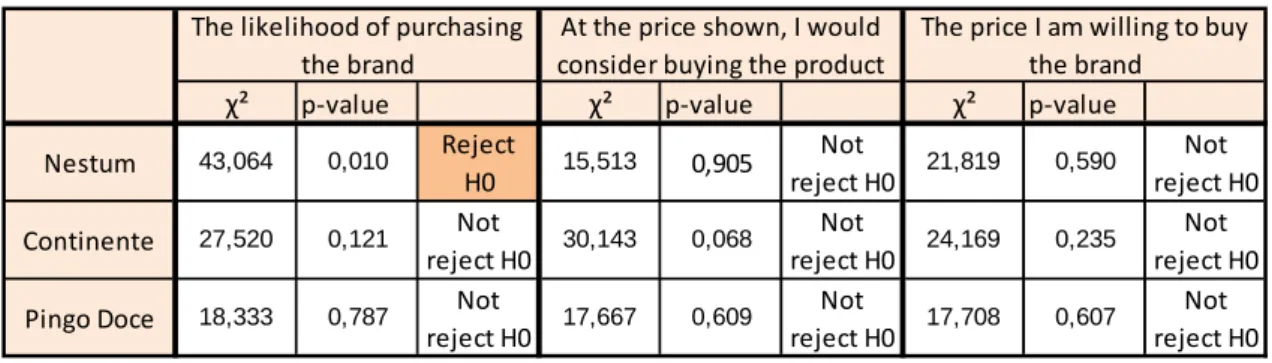
Table 1 ‐ Chi‐Square Test between Household Income and Purchase Intention
χ² p‐value χ² p‐value χ² p‐value
Nestum 43,064 0,010 Reject H0 15,513 0,905 Not reject H0 21,819 0,590 Not reject H0 Continente 27,520 0,121 Not reject H0 30,143 0,068 Not reject H0 24,169 0,235 Not reject H0 Pingo Doce 18,333 0,787 Not reject H0 17,667 0,609 Not reject H0 17,708 0,607 Not reject H0 At the price shown, I would consider buying the product The price I am willing to buy the brand The likelihood of purchasing the brand
Page | 20
In the Table 1 are presented the values of chi-square tests, the p-value and an indication if the hypothesis is rejected or not rejected.
The hypothesis which associates “the likelihood of purchasing Nestum” with the different incomes level was rejected. This means there is association between these two variables. Therefore, the Cramer’s V statistic is equal to 0,376, meaning that this association is not strong and this outcome is confirmed by -0,045 Spearman Rho test. Between the private labels brands and the purchase intention there is any association. It means, for the cereals flakes category, the household income is not a characteristic that distinguish the customers, and then, the null hypothesis is rejected.
H2: Greater is the family size, the greater is the purchase intention of Nestum
private label brands.
The Table 2 shows that there is no association between the different family’s sizes and both Nestum and private label brands purchase intention. So, the initial hypothesis is rejected. A greater family size does not induce more private labels’ purchasing intention.
In conclusion, the socio-economic variables do not have impact on the private label brand purchase intention, in the cereal flakes category.
H3: The greater the brand image of the private label brands, greater is the brand
preference for such brands over Nestum brand.
χ² p‐value χ² p‐value χ² p‐value
Nestum 17,071 0,972 Not reject H0 35,009 0,242 Not reject H0 25,764 0,687 Not reject H0 Continente 9,095 0,523 Not reject H0 6,287 0,791 Not reject H0 13,608 0,192 Not reject H0 Pingo Doce 22,500 0,549 Not reject H0 24,250 0,232 Not reject H0 15,938 0,720 Not reject H0 The likelihood of purchasing the brand At the price shown, I would consider buying the product The price I am willing to buy the brand Table 2 ‐ Chi‐Square Test between Family Size and Purchase Intention
Page | 21
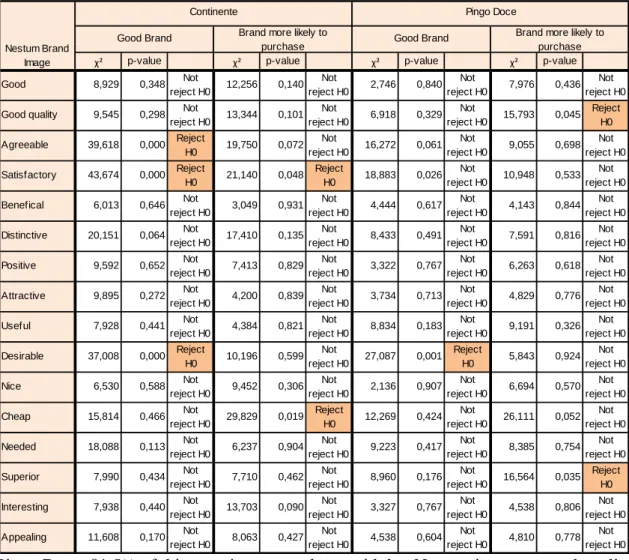
Using the chi-square test, the association between each adjective and brand preference was measured. A test for each brand was done, and in general, there is no association between the majority of adjectives and the brand preference.
For Nestum brand, there was needed to compare with Continente and Pingo Doce, due to the fact that the brand preference question was built using a comparative scale, where Nestum was always one of the possible answers (see Table 3 for summary of all hypotheses tested).
There is a strong association (Cramer’s V is equal to 0,541) between “good quality” and “the brand more likely to purchase”, when the respondents had to compare Nestum with
Pingo Doce. 81.5% of this question respondents said that Nestum is a very good quality brand and 51.9% said that it is more likely to buy Nestum in relation to Pingo Doce.
Table 3 ‐ Chi‐Square Tests between Nestum Brand Image and Continente and Pingo Doce
Brand Preference
χ² p-value χ² p-value χ² p-value χ² p-value
Good 8,929 0,348 Not reject H0 12,256 0,140 Not reject H0 2,746 0,840 Not reject H0 7,976 0,436 Not reject H0 Good quality 9,545 0,298 Not
reject H0 13,344 0,101 Not reject H0 6,918 0,329 Not reject H0 15,793 0,045 Reject H0 Agreeable 39,618 0,000 Reject H0 19,750 0,072 Not reject H0 16,272 0,061 Not reject H0 9,055 0,698 Not reject H0 Satisfactory 43,674 0,000 Reject H0 21,140 0,048 Reject H0 18,883 0,026 Not reject H0 10,948 0,533 Not reject H0 Benefical 6,013 0,646 Not reject H0 3,049 0,931 Not reject H0 4,444 0,617 Not reject H0 4,143 0,844 Not reject H0 Distinctive 20,151 0,064 Not reject H0 17,410 0,135 Not reject H0 8,433 0,491 Not reject H0 7,591 0,816 Not reject H0 Positive 9,592 0,652 Not reject H0 7,413 0,829 Not reject H0 3,322 0,767 Not reject H0 6,263 0,618 Not reject H0 Attractive 9,895 0,272 Not reject H0 4,200 0,839 Not reject H0 3,734 0,713 Not reject H0 4,829 0,776 Not reject H0 Useful 7,928 0,441 Not reject H0 4,384 0,821 Not reject H0 8,834 0,183 Not reject H0 9,191 0,326 Not reject H0 Desirable 37,008 0,000 Reject H0 10,196 0,599 Not reject H0 27,087 0,001 Reject H0 5,843 0,924 Not reject H0 Nice 6,530 0,588 Not reject H0 9,452 0,306 Not reject H0 2,136 0,907 Not reject H0 6,694 0,570 Not reject H0 Cheap 15,814 0,466 Not reject H0 29,829 0,019 Reject H0 12,269 0,424 Not reject H0 26,111 0,052 Not reject H0 Needed 18,088 0,113 Not reject H0 6,237 0,904 Not reject H0 9,223 0,417 Not reject H0 8,385 0,754 Not reject H0 Superior 7,990 0,434 Not reject H0 7,710 0,462 Not reject H0 8,960 0,176 Not reject H0 16,564 0,035 Reject H0 Interesting 7,938 0,440 Not reject H0 13,703 0,090 Not reject H0 3,327 0,767 Not reject H0 4,538 0,806 Not reject H0 Appealing 11,608 0,170 Not reject H0 8,063 0,427 Not reject H0 4,538 0,604 Not reject H0 4,810 0,778 Not reject H0 Nestum Brand Image
Good Brand Brand more likely to
purchase Good Brand
Continente
Brand more likely to purchase Pingo Doce
Page | 22
69.7% of 33 respondents though that Nestum is agreeable brand and Nestum is seen as better brand than Continente (54,5%). This association between “agreeable” and “good brand” is strong: The Cramers’ V statistic is 0,633.
There is strong association between “satisfactory” and “good brand” (Cramers’ V is 0,664) and “satisfactory” and “brand more likely to purchase” (Cramers’ V is 0,462), when it was compare Nestum with Continente. 69.7% of the respondents said Nestum is a very satisfactory brand.
Nestum is also a desirable brand. When it was compared with Continente, 54.5% of the respondents said Nestum is the best brand and 87.9% of 33 said that Nestum is a desirable brand. The association between them is strong, because Cramers’ V is equal to 0.611. However, when we compare Nestum with Pingo Doce, a significant number of the respondents (48.8%) though that Nestum is as good as Pingo Doce and Nestum is desirable brand by 88.9% of the respondents, who know both Nestum and Pingo Doce. In this case, the association is also strong; Cramers’ V is equal to 0,578.
Through chi-square test, association between “cheap” and “brand more likely to purchase” was also found. There is a higher probability of buying Nestum rather than Continente (66.7%) and respondents thought that Nestum was neither expensive nor cheap (42.4%). The association is not too strong (Cramers’ V is 0,475).
There is a strong association between “superior” and “brand more likely to purchase” (Cramers’V is 0,554). Nestum is seen as a superior brand (88.9%).
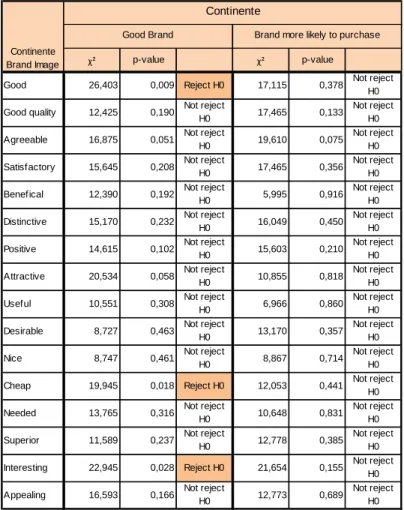
In general, there is no relationship between the Continente brand image and its brand preference (Table 4). However, there are three adjectives that are strong associated with “good brand”. As it was said previously, in order to measure the brand preference, a comparative scale was used, between Nestum and Continente. Nestum is seen as a better brand than Continente, 60,9% of the respondents said that.
Page | 23
Regarding the chi-square test, there is a strong association (Cramers’ V is 0,619) between the adjective “good” and “good brand”. A contradiction was establish because when the respondents were asked about which brand they prefer between two, the majority preferred Nestum, but when it was asked, if Continente is a good brand, without any comparative term, they answer positively.
The customers recognized that Continente is a cheaper brand (73,4% of respondents), in spite of this, they preferred Nestum. This association is strong (Cramers’V is 0,538).
Table 4 ‐ Chi‐Square Test between Continente Brand
Image and Continente Brand Preference
χ² p-value χ² p-value
Good 26,403 0,009 Reject H0 17,115 0,378 Not reject H0 Good quality 12,425 0,190 Not reject
H0 17,465 0,133
Not reject H0 Agreeable 16,875 0,051 Not reject
H0 19,610 0,075
Not reject H0 Satisfactory 15,645 0,208 Not reject
H0 17,465 0,356
Not reject H0 Benefical 12,390 0,192 Not reject
H0 5,995 0,916
Not reject H0 Distinctive 15,170 0,232 Not reject
H0 16,049 0,450
Not reject H0 Positive 14,615 0,102 Not reject
H0 15,603 0,210
Not reject H0 Attractive 20,534 0,058 Not reject
H0 10,855 0,818
Not reject H0 Useful 10,551 0,308 Not reject
H0 6,966 0,860
Not reject H0 Desirable 8,727 0,463 Not reject
H0 13,170 0,357
Not reject H0
Nice 8,747 0,461 Not reject
H0 8,867 0,714
Not reject H0 Cheap 19,945 0,018 Reject H0 12,053 0,441 Not reject
H0 Needed 13,765 0,316 Not reject
H0 10,648 0,831
Not reject H0 Superior 11,589 0,237 Not reject
H0 12,778 0,385
Not reject H0 Interesting 22,945 0,028 Reject H0 21,654 0,155 Not reject
H0 Appealing 16,593 0,166 Not reject
H0 12,773 0,689 Not reject H0 Continente Brand Image Continente
Page | 24
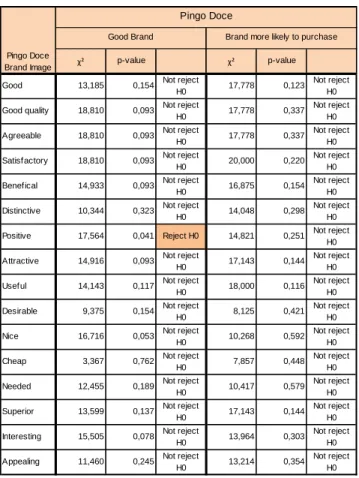
There is a strong association between “interesting” and “good brand” (Cramers’V is equal to 0,577). However, the respondents who know Continente brand did not give an explicit answer about how interesting Continente is. Some found it neither interesting, nor uninteresting brand (34,8%), and others said that it is a little bit interesting (30,4%). There is only one association between one adjective of Pingo Doce brand image and it brand preference (Table 5). The respondents said that Nestum is as good as Pingo Doce (46,7%). However, they considered Pingo Doce as a positive brand (86,7%). This relationship is strong due to the fact Cramers’ V statistic is equal to 0,550.
Although, the Nestum brand image, on average, is higher than the brand image of its competitors and also it is the most preferred brand, on average, when we compute the appropriate statistics, there are few brand image items associated to brand preference. In conclusion, brand image do not have impact on brand preference, in general.
Table 5 ‐ Chi‐Square Test between Pingo Doce
Brand Image and Pingo Doce Brand Preference
χ² p-value χ² p-value Good 13,185 0,154 Not reject
H0 17,778 0,123 Not reject
H0 Good quality 18,810 0,093 Not reject
H0 17,778 0,337 Not reject
H0 Agreeable 18,810 0,093 Not reject
H0 17,778 0,337 Not reject
H0 Satisfactory 18,810 0,093 Not reject
H0 20,000 0,220 Not reject
H0 Benefical 14,933 0,093 Not reject
H0 16,875 0,154 Not reject
H0 Distinctive 10,344 0,323 Not reject
H0 14,048 0,298 Not reject
H0 Positive 17,564 0,041 Reject H0 14,821 0,251 Not reject
H0 Attractive 14,916 0,093 Not reject
H0 17,143 0,144 Not reject
H0 Useful 14,143 0,117 Not reject
H0 18,000 0,116 Not reject
H0 Desirable 9,375 0,154 Not reject
H0 8,125 0,421 Not reject
H0 Nice 16,716 0,053 Not reject
H0 10,268 0,592 Not reject
H0 Cheap 3,367 0,762 Not reject
H0 7,857 0,448 Not reject
H0 Needed 12,455 0,189 Not reject
H0 10,417 0,579 Not reject
H0 Superior 13,599 0,137 Not reject
H0 17,143 0,144 Not reject
H0 Interesting 15,505 0,078 Not reject
H0 13,964 0,303 Not reject
H0 Appealing 11,460 0,245 Not reject
H0 13,214 0,354 Not reject H0 Pingo Doce Brand Image Pingo Doce
Page | 25 H4: If the customers are price conscious, so there is higher purchase intention of
private labels brands.
In this hypothesis, both variables were measure through an interval scale, due to this fact, a table for each brand was done.
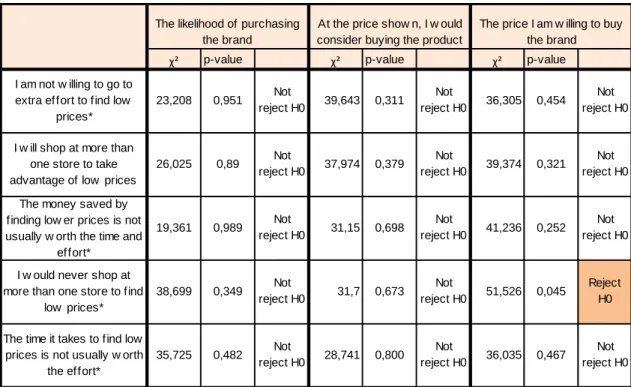
Firstly, the association between price consciousness and Nestum purchasing intention was checked (Table 6). In the majority of the situations, the null hypothesis of the chi-square test was not rejected. However, there is a set of variables with association between them, but this association is not strong (Cramer’s V = 0,336). Therefore, we could say that there is association between “the price I am willing to buy Nestum” and “I would never shop at more than one store to find low prices”, but it is not strong enough.
There is no association between price conscious and Continente’s purchase intention. In the all combinations made there is no evidence to reject null hypothesis (Table 7).
Table 6 ‐ Chi‐Square Test between Price Conscious and Nestum Purchase Intention
χ² p-value χ² p-value χ² p-value
I am not w illing to go to extra effort to find low
prices* 23,208 0,951 Not reject H0 39,643 0,311 Not reject H0 36,305 0,454 Not reject H0
I w ill shop at more than one store to take advantage of low prices
26,025 0,89 Not reject H0 37,974 0,379 Not reject H0 39,374 0,321 Not reject H0 The money saved by
finding low er prices is not usually w orth the time and
effort* 19,361 0,989 Not reject H0 31,15 0,698 Not reject H0 41,236 0,252 Not reject H0
I w ould never shop at more than one store to find
low prices* 38,699 0,349 Not reject H0 31,7 0,673 Not reject H0 51,526 0,045 Reject H0
The time it takes to find low prices is not usually w orth
the effort* 35,725 0,482 Not reject H0 28,741 0,800 Not reject H0 36,035 0,467 Not reject H0 The likelihood of purchasing
the brand
At the price show n, I w ould consider buying the product
The price I am w illing to buy the brand
Page | 26
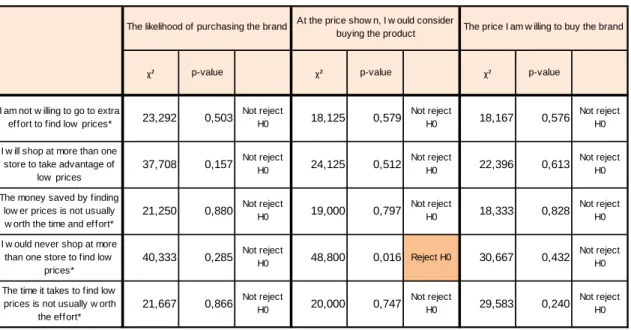
The relation between price conscious and Pingo Doce purchase intention did not exist at all (Table 8). There is only one combination with a strong association between them (Cramers’ V is equal to 0,807). The association exists between “I would never shop at more than one store to find low prices” and “at price shown, I would consider buying the product”. 53,3% of the respondents said that do not shop at more than one store to find low prices and 80% said that consider to buy Pingo Doce.
In general, the cereal flakes customers are not price conscious; it does not have impact
on the purchase of private label brands. Therefore, H4 null hypothesis was rejected.
Table 7 ‐ Chi‐Square Test between Price Conscious and Continente Purchase Intention
χ² p-value χ² p-value χ² p-value
I am not w illing to go to extra
effort to find low prices* 34,743 0,252
Not reject H0 21,052 0,886 Not reject H0 26,025 0,890 Not reject H0
I w ill shop at more than one store to take advantage of
low prices 27,594 0,592 Not reject H0 32,061 0,365 Not reject H0 19,361 0,989 Not reject H0
The money saved by finding low er prices is not usually w orth the time and effort*
24,62 0,743 Not reject H0 28,65 0,536 Not reject H0 23,299 0,803 Not reject H0
I w ould never shop at more than one store to find low
prices* 22,86 0,586 Not reject H0 21,984 0,637 Not reject H0 28,332 0,293 Not reject H0
The time it takes to find low prices is not usually w orth
the effort* 21,754 0,863 Not reject H0 33,481 0,119 Not reject H0 21,307 0,675 Not reject H0 The likelihood of purchasing the brand At the price show n, I w ould consider
buying the product The price I am w illing to buy the brand
Table 8 ‐ Chi‐Square Test between Price Conscious and Pingo Doce Purchase Intention
χ² p-value χ² p-value χ² p-value
I am not w illing to go to extra
effort to find low prices* 23,292 0,503
Not reject H0 18,125 0,579 Not reject H0 18,167 0,576 Not reject H0
I w ill shop at more than one store to take advantage of
low prices
37,708 0,157 Not reject H0 24,125 0,512 Not reject H0 22,396 0,613 Not reject H0
The money saved by finding low er prices is not usually w orth the time and effort*
21,250 0,880 Not reject H0 19,000 0,797 Not reject H0 18,333 0,828 Not reject H0
I w ould never shop at more than one store to find low
prices*
40,333 0,285 Not reject H0 48,800 0,016 Reject H0 30,667 0,432 Not reject H0
The time it takes to find low prices is not usually w orth
the effort*
21,667 0,866 Not reject H0 20,000 0,747 Not reject H0 29,583 0,240 Not reject H0
The likelihood of purchasing the brand At the price show n, I w ould consider
Page | 27 H5: If the customers perceive value of money, then there is purchasing intention
of the private label brands.
As in the previous hypothesis, the data was analysed separately for each brand.
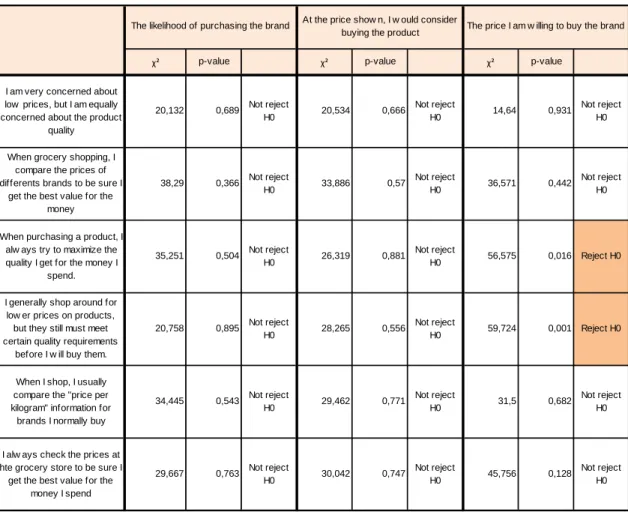
Regarding Nestum brand, in general, there is no association between the perceived value of money and the Nestum purchase intention (Table 9). However, there are two variables that are associated. “The price I am willing to buy the brand” and “When purchasing a product, I always try to maximize the quality I get for the money I spend” are associated, but it is not too strong (Cramers’ V is 0,352). 64,5% of the respondents are really looking for quality, in spite of they are not willing to pay too much for Nestum brand, only 14,5% are able to do it. Also “the price I am willing to buy the brand” and “I generally shop around for lower prices on products, but they still must meet certain quality requirements before I will buy them” are not strong associated,
Table 9 ‐ Chi‐Square Test between Perceived Value of Money and Nestum Purchase
Intention
χ² p-value χ² p-value χ² p-value
I am very concerned about low prices, but I am equally concerned about the product
quality 20,132 0,689 Not reject H0 20,534 0,666 Not reject H0 14,64 0,931 Not reject H0
When grocery shopping, I compare the prices of differents brands to be sure I
get the best value for the money 38,29 0,366 Not reject H0 33,886 0,57 Not reject H0 36,571 0,442 Not reject H0
When purchasing a product, I alw ays try to maximize the quality I get for the money I
spend.
35,251 0,504 Not reject
H0 26,319 0,881
Not reject
H0 56,575 0,016 Reject H0
I generally shop around for low er prices on products, but they still must meet certain quality requirements
before I w ill buy them.
20,758 0,895 Not reject
H0 28,265 0,556
Not reject
H0 59,724 0,001 Reject H0
When I shop, I usually compare the "price per kilogram" information for brands I normally buy
34,445 0,543 Not reject H0 29,462 0,771 Not reject H0 31,5 0,682 Not reject H0
I alw ays check the prices at hte grocery store to be sure I get the best value for the
money I spend 29,667 0,763 Not reject H0 30,042 0,747 Not reject H0 45,756 0,128 Not reject H0 The likelihood of purchasing the brand At the price show n, I w ould consider
Page | 28
because Cramers’ V is 0,396. The customers use to see the low prices, but they only buy them if they have quality (69,7%).
For the brand Continente, there are no association between the perceived value of money and the Continente´s purchase intention (Table 10). In all significance tests, the null hypotheses were not rejected.
Regarding the brand Pingo Doce, there is only one association (Table 11). It happened between “I always check the prices at the grocery stores to be use I get the best value for the money I spend” and “the price I am willing to buy the brand”. These two variables are very strong associated with a Cramers’ V statistic of 0,741. The customers are not willing to pay a huge price for Pingo Doce brand but most of them verified the prices at store to get the best value for the money spent (46,6%).
Table 10 ‐ Chi‐Square Test between Perceived Value of Money and Continente Purchase
Intention
χ² p-value χ² p-value χ² p-value
I am very concerned about low prices, but I am equally concerned about the product
quality 2,173 0,825 Not reject H0 7,173 0,208 Not reject H0 1,025 0,961 Not reject H0
When grocery shopping, I compare the prices of dif ferents brands to be sure I
get the best value for the money 22,527 0,834 Not reject H0 29,895 0,471 Not reject H0 21,387 0,875 Not reject H0
When purchasing a product, I alw ays try to maximize the quality I get f or the money I
spend. 20,250 0,442 Not reject H0 16,889 0,660 Not reject H0 19,164 0,511 Not reject H0
I generally shop around for low er prices on products, but
they still must meet certain quality requirements before I
w ill buy them.
13,832 0,538 Not reject H0 12,689 0,626 Not reject H0 10,088 0,814 Not reject H0
When I shop, I usually compare the "price per kilogram" information for
brands I normally buy
20,400 0,906 Not reject H0 28,273 0,556 Not reject H0 26,751 0,636 Not reject H0
I alw ays check the prices at hte grocery store to be sure I get the best value for the
money I spend 21,840 0,645 Not reject H0 20,948 0,400 Not reject H0 22,280 0,326 Not reject H0 The likelihood of purchasing the brand At the price show n, I w ould consider
Page | 29
Taking into consideration this sample, the customers did not find differences among the brands regarding their perceived value of money. In general, the perceived value of money is not associated to the private labels purchasing behaviour, in the cereal flakes product category and the initial null hypothesis is not verified.
Table 11 ‐ Chi‐Square Test between Perceived Value of Money and Pingo Doce Purchase
Intention
χ² p-value χ² p-value χ² p-value
I am very concerned about low prices, but I am equally concerned about the product
quality 8,958 0,706 Not reject H0 10,5 0,398 Not reject H0 7,604 0,667 Not reject H0
When grocery shopping, I compare the prices of differents brands to be sure I
get the best value for the money 26,667 0,32 Not reject H0 15,25 0,762 Not reject H0 25,417 0,186 Not reject H0
When purchasing a product, I alw ays try to maximize the quality I get for the money I
spend. 21,944 0,583 Not reject H0 28,083 0,107 Not reject H0 15,139 0,768 Not reject H0
I generally shop around for low er prices on products, but
they still must meet certain quality requirements before I
w ill buy them.
9,792 0,634 Not reject H0 14,875 0,137 Not reject H0 7,604 0,667 Not reject H0
When I shop, I usually compare the "price per kilogram" information for brands I normally buy
24,018 0,461 Not reject H0 18,911 0,528 Not reject H0 25,134 0,196 Not reject H0
I alw ays check the prices at hte grocery store to be sure I get the best value for the
money I spend
21,071 0,635 Not reject
H0 23,036 0,287
Not reject
H0 32,946 0,034 Reject H0 The likelihood of purchasing the brand At the price show n, I w ould consider
Page | III
Conclusion
Before general conclusions presentation, it is essential to reinforce that this study was made through a convenience sample and results were based on that.
In the cereal flakes category, the differences in income level do not have different purchasing behaviours among the brands. The same happens with the family size. There is a strong idea that low income families and also the big families are more prone to purchase private label brands. However, those facts are not verified in this category.
Furthermore, price is not the main factor to choose among a brand in the cereal flake category. The customers are not price conscious at all, due to the fact they do not use to spend time and effort in the search of low prices. Even with the quality improvements of private label brands, the price is still the main distinguish factor from the manufacturer brand. However, the customers do not use to look for it and then the private labels brands could not take advantage from the low prices.
The perceived quality is one of the important factors to choose a brand, even more
than the price in this category. In spite of all these considerations, any of these factors are not strongly associated to the purchase intention.
Nestum is the brand with the best brand image, even for the children. It is the most
consumed brand since generations in opposition to private labels brands, which are relatively new in the market. They still have not so positive image, related to the low price and initial low quality, when private label brands entered in the distribution market. Children did not see the different brands in the category as unique. For them, they have the same associations to Nestum. When they have thought about the private label brands images, they have associated them to the grocery chains image,
Page | IV
mainly. The target consumers, from the 6 to 9 years old, have seen the brands consumed for children younger people than them.
The market share lost by Nestum to private label brands should be explained through others factors, which were not present in this study.
Limitations
The main limitation of this study was the sample size, which is too small to have a significant and generalized conclusion about cereal flakes category in Portuguese market. It was used a convenience sample, with geographic limitations, because research was made is Lisbon Great Area whether in schools whether in supermarkets, it does not represent the national behaviour.
Also the fact that this research was not applied in public schools biased the sample, not allowing to have access to children from other social environments.
The time constrain was another factor that had impact in the final outcome, because it was not possible to use more deeply characteristics, methods and analyses that could help explain better the problem between Nestum and private label brands.
Page | V
Bibliography
Baltas, G., (1997), “A Model of Consumer Choice for National vs Private Label Brands”, The Journal of the Operational Research Society, Vol. 48 No 10, pp 988-995.
Baltas, G. and Doyle, P., (1998), “An Empirical Analysis of Private Brand Demand Recognising Heterogeneous Preferences and Choice Dynamics”, The Journal of the
Operational Research Society, Vol.49 No.8, pp.790-798.
Batra, R. and Sinha, I., (2000), “Consumer-Level Factors Moderating the Success of Private Label Brands”, Journal of Retailing, Vol.76, pp. 175-191.
Bearden, W. O. and Netemeyer, R. G., (1999); “Handbook of marketing scales: Multi-item measures for marketing and consumer behaviour research”; Sage Publications; 2nd edition, pp. 271-275.
Bruner, G. C. and Hensel P. J.; (1998); “Marketing Scales Handbook: a compilation of multi-item measures”; American Marketing Association, Vol 2, pp. 81-100, 136-137, 505-506 and 534-536
Burger, P. C. and Schott, B. (1972), “Can Private Brand Buyers be Identified?”, Journal
of Marketing Research, Vol.9, pp. 219-222.
Demsetz, H., (1962), “The Effect of Consumer Experience on Brand Loyalty and the Structure of Market Demand”, Econometrica, Vol.30, pp. 22-33.
Frank, R. E. and Boyd, H. W., (1965), “Are Private-Brand-Prone Grocery Customers Really Different?”, Journal of Advertising Research, Vol.5, pp. 27-35
Glyn M. S. and Chen S., (2009) “Consumer-factors moderating private label brand success: further empirical results”, International Journal of Retail & Distribution
Page | VI
Instituto Nacional de Estatística, (2002), “Destaque do INE – Inquérito aos Orçamentos Familiares 2000 – Áreas Metropolitanas de Lisboa e Porto”, INE
Know, K. N., Lee, M. H., Know, Y. J., (2008), “The effect of perceived product characteristics on private brand purchases”, Journal of Consumer Marketing, Vol. 25, pp. 105-114.
Kotler, P., Amstrong, G., Wong, V. and Saunders, J., (2008),”Principles of Marketing”,
5th European Edition, Prentice Hall, pp 528.
Lichtenstein, D. R., Bloch, P. H. and Black, W. C., (1988), “Correlates of Price Acceptability”, Journal of Consumer Research, Vol. 15, pp. 243-252
Livesey, F. and Lennon, P., (1978), “Factors Affecting Consumers' Choice between Manufacturer Brands and Retailer Own Labels”, European Journal of Marketing, Vol.12, pp.158-170.
Malhotra, N. K. and Birks, D. F., (2007), “Marketing Research: an applied approach”,
Financial Time/Prentice Hall, 3rd Edition
McNeal, J. U., (2007), “On Becoming a Consumer – Development of Consumer
Behaviour Patterns in Childhood”, Butterworth-Heinemann, 1st Edition, pp.277-280,
332-333
Myres, J. G. (1967), “Determinants of the Private Brand Attitude”, Journal of
Marketing Research, Vol. 4, pp.73-81
Narasimhan, C. and Wilcox, R. T., (1998), “Private-Labels and the Channel Relationship: A Cross-Category Analysis”, Journal of Business, Vol. 71, pp 573-600. Neelankavilm J. P., O’Brien, J. V., Tashjian, R., (1985), “Techniques to Obtain
Market-related Information from Very Young Children”, Journal of Advertising Research, Vol. 25, pp. 41-47
Page | VII
Quelch, J. A. and Harding R., (1996), “Brands versus Private Labels: Fighting to Win”
Harvard Business Review”, pp. 99-109
Rao, T. R., (1969), “Are Some Consumers More Prone to Purchase Private Brands?”,
Journal of Marketing Research, Vol. 6, pp. 447-450
Richardson, P. S., Jain, A. K. and Dick, A., (1996), “Household Store Brand Proneness: A Framework”, Journal of Retailing, Vol. 72, pp. 159-185
Sol, (2009), “Marcas brancas já valem mais um terço das vendas em hipermercados”,
Jornal Sol
UNICEF, (2002), “Children Participating in Research, Monitoring and Evaluation (M&E) – Ethics and Your Responsibilities as a Manager”, UNICEF