WOMEN IN LEADERSHIP POSITIONS
How do female leaders address challenges associated with their
role in a male-dominated organizational environment?
Sophie Sabine Brunner
152117167
Dissertation written under the supervision of Tommaso Ramus
Dissertation submitted in partial fulfilment of requirements for the International MSc
in Management with major in Entrepreneurship & Innovation
at the Universidade Católica Portuguesa
December 26, 2018.
DECLARATION OF AUTHORSHIP
“I hereby declare that the thesis submitted is my own unaided work. All direct or indirect sources used are acknowledged as references.
I am aware that the thesis in digital form can be examined for the use of unauthorized aid and in order to determine whether the thesis as a whole or parts incorporated in it may be deemed as plagiarism. For the comparison of my work with existing sources I agree that it shall be entered in a database where it shall also remain after examination, to enable com-parison with future theses submitted. Further rights of reproduction and usage, however, are not granted here. This paper was not previously presented to another examination board and has not been published.”
ABSTRACT ENGLISH
Title: Women in leadership positions
Keywords: Leadership, female leadership, change agent, institutional change agent Author: Sophie Brunner
In today’s fast moving business environment outstanding leaders are needed. However, women have a significant under-representation in executive positions in many European countries. The aim of this dissertation is to identify the challenges that female leaders have to address in a male-dominated environment and the strategies they can perform to overcome them. For this purpose, the literature dedicated to female leadership was analyzed and a qualitative research was conducted, which comprised of ten interviews with female executives. The findings show that female leaders follow different strategies that play at individual, group and network level in order to overcome emerging challenges when ascending in their business environment. As a result, these strategies enable women in leadership positions to act as institutional change agents. This research might be of relevance for women which are currently addressing challenges and also for young females who aim to achieve an executive position. Consequently, this master thesis contributes to the academic literature by offering strategic responses to emerging challenges while simultaneously providing a new perspective on women in leadership positions.
ABSTRACT PORTUGUESE
Title: Mulheres em posições de liderança
Keywords: Liderança, liderança feminina, agente de mudança, agentes de mudança institucional Author: Sophie Brunner
O atual ambiente empresarial encontra-se em rápida evolução e, como tal, são necessários líderes extraordinários. Contudo, em diversos países Europeus, as mulheres estão sub-representadas em posições executivas. O objetivo desta dissertação passa por identificar as estratégias que as líderes femininas têm de adotar para ultrapassar os desafios que lhes são lançados num ambiente dominado por homens. Para tal, foi analisada literatura sobre liderança feminina e foi realizada uma análise qualitativa, onde dez mulheres executivas foram entrevistadas. Os resultados indicam que as líderes femininas seguem diferentes estratégias a nível individual, de grupo e de network para superar os desafios emergentes quando ascendem de posição no ambiente empresarial. Como tal, estas estratégias possibilitam que mulheres em posições de liderança atuem como agentes de mudança institucional. Este estudo pode ser relevante para mulheres que se encontrem perante estes desafios e, também, para mulheres jovens que ambicionam alcançar uma posição executiva. Consequentemente, esta tese de mestrado contribui para a literatura académica, uma vez que revela soluções estratégias para desafios emergentes, ao mesmo tempo que proporciona uma nova perspetiva sobre mulheres em posições de liderança.
ACKNOLEDGEMENTS
While writing this master thesis, many people were included and helped me to finish my aca-demic career and especially my last acaaca-demic paper. For them, I convey my special thanks. First of all, I would like to express my sincere acknowledgement to my supervisor Tommaso Ramus. He was an outstanding professor, who supported me not only academically, he also pushed me and always knew a way out in times of stress and “thesis-crisis”. His useful re-marks, comments and engagement throughout the learning process constantly leaded me in the right direction and he was always available, whenever I needed help. I could not have wished for a better professor and I am very thankful that he guided me throughout the last three months.
Second, I would like to thank my interview partners, who were involved in this research pro-ject. The interviewed women were open and willing to share their precious time and to answer my questions. They provided me with interesting insights but also with personal tips and mo-tivation. I am very happy and grateful that I had the opportunity to meet every single woman and to discuss this exciting topic with top female leaders.
Third, sincere gratitude is expressed to my friends, who pushed me to my personal limits and who always supported me throughout my whole academic career. I want to give my special thanks to my closest friends Anna and Dani who beyond all others not only accompanied my five years of universal education but also always motivated and inspired me. You made my sometimes tough student life to a very special and incredible chapter of my life. Thank you both for everything.
Additionally, I want to express my very profound gratitude to my parents for their endless support and love not only during my study but also throughout my whole life. Thank you for providing me this unique opportunity to study in Vienna, Bordeaux and Lisbon and to give me everything, a daughter could wish for. This accomplishment would not have been possible without you!
And last but not least, I want to thank my boyfriend Marcus, who always believes in me, who was my strong shoulder to lean on when the thesis became too stressful and nerve-racking and who always pushes to get out the best of me. Thank you for your tireless support, without
TABLE OF CONTENT
DECLARATION OF AUTHORSHIP ... I ABSTRACT ENGLISH ... II ABSTRACT PORTUGUESE ...III ACKNOLEDGEMENTS ... IV TABLE OF CONTENT ... V LIST OF FIGURES... VII
1. INTRODUCTION ... 1
2. LITERATURE REVIEW ... 3
2.1 STEREOTYPES & IDEOLOGICAL BARRIERS ... 3
2.1.1 GLASS CEILING AND GLASS WALL... 4
2.2 DIFFERENCES BETWEEN MALE AND FEMALE LEADERSHIP STYLES ... 5
2.2.1 THE FEMININE LEADERSHIP STYLE ... 5
2.2.2 COMPARING THE FEMININE AND MASCULINE APPROACH ... 7
2.3 CHALLENGES IN A MALE-DOMINATED ENVIRONMENT ... 8
3. EMPIRICAL STUDY ... 11
3.1 METHODOLOGY ... 11
3.2 DATA COLLECTION ... 12
3.3 DATA ANALYSIS ... 12
4. RESULTS ... 14
4.1CHARACTERISTICS AND LEADERSHIP STYLE ... 14
4.2CHALLENGES ... 17
4.2.1ADDRESSING STEREOTYPES AS A FEMALE NEWCOMER ... 17
4.2.2GROUP GENDER DISCRIMINATION IN THE WORKPLACE ... 18
4.2.3INDIVIDUAL GENDER DISCRIMINATION ... 19
4.2.4WORK-FAMILY-BALANCE ... 19
4.3STRATEGIES TO OVERCOME THE CHALLENGES ... 20
4.3.1BUILD DIVERSE TEAMS ... 20
4.3.2BUILD EXTERNAL NETWORKS ... 21
4.3.3BALANCE BETWEEN STRAIGHTFORWARDNESS AND ADJUSTMENT ... 22
4.5WOMEN BEING A CHANGE AGENT ... 27
5. CONTRIBUTION AND MANAGERIAL IMPLICATIONS ... 30
6. CONCLUSION AND LIMITATIONS ... 33
REFERENCES LIST ... 32
APPENDIX ... 39
APPENDIX A: INTERVIEW GUIDE ... 40
APPENDIX B: CHARACTERISTICS ... 43
APPENDIX C: CHALLENGES ... 45
APPENDIX D: STRATEGIES ... 49
APPENDIX E: BE A CHANGE AGENT ... 54
LIST OF FIGURES
TABLE 1: INTERVIEW ANALYSIS PROCESS ………..12 TABLE 2: SPECIFIC LINKAGE BETWEEN CHALLENGES AND STRATEGIES.. 22
INTRODUCTION
1.
INTRODUCTION
In many European countries, a great gender imbalance in leadership positions can be observed in several areas: politics, economics, science and research. However, this gender difference is most evident at corporate management levels (Ernst & Young, 2017). Nearly 7.3 million peo-ple hold a leadership position in companies with at least 10 employees in the European Union: 4.7 million men (65% of all executives) and 2.6 million women (35%) (Eurostat, 2017). In other words, women, although they make up about half of all employed people in the EU, continue to be underrepresented in management positions (Eurostat, 2017). The proportion of female managers in companies in Austria is only 23%, ranking it forth to last among the 28 EU countries. Only Germany, Italy and Cyprus (each 22%) rank even lower (Eurostat, 2017). Moreover, the women's quota on executive levels has stagnated for two years, hardly anything has happened regarding the proportion of women. In 40% of the companies, not a single woman is employed on the executive level (Ernst&Young, 2017). However, a positive aspect of this finding is that increasingly more companies see a positive connection between a higher proportion of female executives and the company's performance (Ernst&Young, 2017), for example increased dynamics among the leadership, a strengthened governance and a driven change in the corporate culture (Liswood, 2015).
In connection with this result, undoubtedly several natural barriers exist for women in the work environment, which lead to the low percentage of female executives. The division of labor within the family and the associated compatibility problem between family and carrier is more often an obstacle for women. Thus, women are more likely confronted with deciding between "child or career" than men (Annies, 2008).
However, instead of only looking at the barriers for women in executive positions, a growing number of researchers is already focusing on what transpires when women achieve leadership roles, recognizing the danger of stereotypes, and whether women and men have different management styles (Haslam & Ryan, 2008). But, this ongoing research in gender and leader-ship shifts the attention towards the individual abilities of female leaders rather than on the situational and contextual factors that affect the organization. Thus, the link between the gen-der-based leadership styles and challenges, women must face, has not been fully established.
INTRODUCTION
search question: how do women in executive positions address challenges associated with
their role in a male-dominated organizational environment?
The main goal of this paper is to consider the individual strengths of the female leadership styles that derive from the feminine culture and how to use them purposefully in order to ad-dress various challenges. This includes different ways of communicating, assuming authority and defining morality (Fondas, 1997). In order to fully exploit these competencies, it is essen-tial to support and promote female role models in executive positions and to legitimate and normalize the strengths of female culture(Carroll, 1993). One main problem for many organi-zations is that women are often more isolated from the dominant traditional male culture and cut off from the required network and encouragement, which they could give other women in similar organizational levels and roles (Carroll, 1993). In other words, having a role model for other female colleagues or driving a change in the male-dominated culture is a major chal-lenge.
The outcome of the study provided a methodological and empirical explanation from ten top level female leaders, who told about their career and development, the challenges they had to face and their strategic responses in order to overcome these barriers. Finally, the interviewed women gave examples, how they were and are unconsciously able to drive a change in their organization and how other women can follow their example.
The dissertation contributes to recognizing and increasing the knowledge of the affecting characteristics of female executives, within the scarce literature on women in leading posi-tions, and especially conduct empirical study on a woman’s capability to overcome challenges resulting from being a female leader and finally, resulting from the research question, how their strategies effect being a change agent in their work environment and how they will be able to influence and possibly change the institution.
LITERATURE REVIEW
2.
LITERATURE REVIEW
2.1 Stereotypes & ideological barriers
Due to the circumstance that women are underrepresented in management positions, it can be stated that female leaders have to face various additional barriers on their carrier path, espe-cially in order to access executive positions. As previously mentioned, several structural bar-riers exist because of her double role as mother and manager. But, several ideological barbar-riers and stereotypes of women in leadership positions exist, which females have identified as a significant difficulty on their way to the top (Catalyst, 2002).
Stereotypes are generalized observations about the qualities that distinguish categories or groups of people (Schneider, 2004). People make use of stereotypes as an energy-saving de-vice and as cognitive short-cuts in anticipating the abilities, behaviors, and motives of others (Allport, 1954). Stereotypes about women in leadership roles are based on familiar female roles such as mothers, nurses, wives, etc.; and the characteristics of these roles are often in-consistent with people’s perception of traditional competences of a good business manager (Lee & James, 2007). Women are regularly characterized with communal traits such as being selfless, friendly, sympathetic, gentle and warm, whereas men are characterized with agentic traits such as being instrumental, assertive, self-reliant and emotionally stable, what people perceive as attributes of a successful leader (Catalyst, 2007; Paris et al., 2009). These attitudes and prejudice hinder females from being assigned to leadership positions, where instrumental-ity and assertiveness are required to succeed (Eagly & Carli, 2003; Rhode, 2016). Moreover, through the long history of the male-dominated top levels, action-oriented characteristics, social status, and power are associated with gender and seen as important, so that a judgment has already been made for a female leader, before she can even begin to act as one (Yoder, 2001).
Women have to behave like men in order to be successful, but on the one hand, if they adapt to male characteristics they are considered too harsh and too masculine, on the other hand, if women maintain their female characteristics they are considered too feminine: too nice and thus not capable or competent enough for a leading position (Catalyst, 2007, Fiske & Stevens, 1993). This shows that the line of an accepted behavior of women in an executive position is
LITERATURE REVIEW
Several researchers provide theoretical support for the perception of women in leadership roles and Schein (1996) even wrote about the think manager- think male paradigm, which studied the fact that the characteristics ascribed to leaders yielded a considerably higher corre-lation with the description of a typical man than with the description of a typical woman (Schein 1996, 1975). A woman might be rejected just because of her lack of agentic charac-teristics, which people associate with an effective leadership style (Fiske & Stevens, 1993). Through all these stereotypes another phenomenon arises that women have to face. The “ste-reotype threat” (Steele, 1997) occurs when a positive or negative ste“ste-reotype appears about a certain group and which members might perform in a manner that simply approves this stere-otype. The “stereotype threat” results in the impression that women are less capable of hold-ing a leadership position and it has been proven that this negatively impacts females in their professional aspiration (Roberson & Kulik, 2007).
As a result, these stereotypes undermine motivation and potentially lower performance, lead-ing to a lack of identification of females as potential managers, which is seen as the male ter-ritory and as a male-dominated environment (Roberson & Kulik, 2007). It reduces the effec-tiveness of females who could occupy leadership roles and who could be an asset to the or-ganization. Taking the female potential into account when filling senior positions ensures a gender-balanced leadership team, which creates opportunities for institutions, companies, and for the economy. It provides access to a larger workforce, diversified experiences, different mindsets and to a broad set of leadership characteristics, which is important in a fast-changing economy (Sedlmayr, 2017).
2.1.1 Glass ceiling and glass wall
Noting the phenomenon of a significantly decreasing proportion of women the higher one looks up the hierarchy level in large companies, a new term was integrated into the language usage in the 1980s by Marylin Loden (1987) who quoted that it seemed to her that “there was
an invisible barrier to advancement that people didn’t recognize” and called the theory “glass
ceiling”. It describes seemingly invisible horizontal and vertical boundaries, which are not directly recognizable, in organizations that prevent women from reaching the highest leader-ship positions (Pasero, 2013). The theory refers to organizational processes of ascension, however, the described barriers can also be applied across organizations (Pasero, 2013). "Glass ceilings" are horizontal barriers that make it harder for women to enter areas where they can move up to senior management positions (Haslam & Ryan, 2007). Ohlendieck
LITERATURE REVIEW
(2003) describes several glass ceilings in organizations, which separate the management lev-els and are increasingly difficult for women to overcome as they ascend. Some of these obsta-cles are an assumed desire of childbearing, part-time employment (Ohlendiek, 2003), but also prejudiced beliefs, such as women are not able or not willing to work long, they do not want to travel and they are less committed to the corporation and their career (Carr-Ruffino, 2005). Another phenomenon called "glass wall" explains barriers that mainly exist within the vertical corporate structure and limit women in their career opportunities. “Glass walls” represent gender segmentation within organizations between departments as obstacles that are difficult to break (Ohlendieck, 2003). It denotes the invisible barrier for women to areas that make a significant contribution to career advancement, as they are strategically central to the organi-zation. Anyone who breaks through the "glass ceiling” and “glass walls” can expect another difficulty behind it (Haslam & Ryan, 2007). The two psychologists (Haslam & Ryan, 2007) describe the phenomenon as “glass cliff”, which means that once a woman achieved a leader-ship position, it is even harder to hold it. Especially in times of crisis or when the company is in a downtrend, women are appointed to the top. If the company struggles, the executive chair is shaky and the risk of failure is particularly high (Tolk, 2009). However, assigning women to leadership positions in unstable and risky circumstances shifts the focus to their charismatic leadership style and so their abilities in stress management (Geller & Dunahoo, 1997). This will be discussed more precisely in the following chapter.
To sum up, on the carrier ladder to a leadership position, women have to face various stereo-types and barriers, due to their natural feminine role and characteristics. They need stamina, hard work and a strength of will to reach their goals and achieve a top position (Eagly & Car-li, 2007). However, once they reached a top level of the company, their competence and abil-ity to manage the organizations, especially in times of crisis, are highly demanded and appre-ciated. Schein’s paradigm “think manager-think male” was transformed by Ryan & Haslam (2007) in “think crisis-think female”.
2.2 Differences between male and female leadership styles
2.2.1 The feminine leadership style
LITERATURE REVIEW
chances to develop leadership skills (Sedlmayr, 2017). However, as stated previously, even though stereotypes and other factors are perceived as barriers for women’s career progression, it is clear that the female role within the society has developed over years. Due to the hinder-ing factors, women who try to reach a senior position have started durhinder-ing the 1960s to peruse higher education opportunities and invest more in knowledge and skills, work harder, and are performing strongly within their leadership styles (Moran, 1992; Chemers, 1997). To define the perfect leadership style, it is important to understand the characteristics of a successful leader (Eagly & Carli, 2003), because behaviors that are effective for men are not always suf-ficient for women and vice versa. It depends on contextual variables, supportive strategies, and the nature of the task (Miner, 1993). Furthermore, researchers underline that there is no uniform leadership style across all situations (Haslam & Turner, 2014). Nonetheless, the Globe Study (House et al., 2004) discovered six effective leadership characteristics, which are universal worldwide, such as being charismatic, team-oriented, participative, and humane-oriented; but, also being autonomous (individualistic, independent) and self-protective, com-petitive, self-centered, and status conscious. Within this study they found out, that women are more likely to contribute the charismatic, team-oriented, and participative leadership, while men are more likely to provide self-protective and autonomous leadership (House et al., 2004:388). In recent years many researchers (Helgesen, 1990; Rosener, 1990; Adler, 1993) have focused on the female management style with their entry into the earlier male-dominated environment; Rosener (1995) for example, defined women’s leadership as involving collabo-ration, interaction, and empowering of employees. Konrad et al. (2000) valued that females attach particular importance to job qualities such as challenge, leadership, freedom, prestige, and power; Haque et al. (2017) studied that women in management positions have a higher people-orientation. Taking these findings into account, Bass (1985) presented new leadership styles named transformational and transactional leadership. He proposed that leaders who cause a change in individuals and social systems, and who enhance the morale, performance, and motivation of followers interact through a transformational leadership approach. Given these aspects, researchers argued that for women especially the transformational leadership may be advantageous (Eagly et. al 2003; Yoder, 2001), because it covers many behaviors that are consistent with the feminine gender role and their charismatic, interpersonally-oriented leadership (Yoder, 2001). Moreover, the feminine, transformational oriented managerial style focuses on teamwork and a decentralized structure (Bartunek et al., 2000). It shapes decision making based on diversity and consensus of ideas that result in an increased cooperation es-pecially during times of crisis (Bartunek et al., 2000). Powell et al. (2008) mentioned that
LITERATURE REVIEW
women’s leadership traits such as empathy, care, and her people- rather than task orientation characterize an advantageous crisis preparation. Females tend to be more attentive and pre-pared than their male counterparts in balancing all organizational responsibilities in order to achieve sustainability (Powell, 2008). Lastly and importantly, a woman’s higher sensibility to welfare and social justice issues empowers her to serve as a real change agent (Alonso-Almeida, 2013; Karam & Jamali 2013).
2.2.2 Comparing the feminine and masculine approach
In the previous chapter, the feminine leadership style was studied and clarified, but in order to understand the characteristics of a male-dominated environment, it is necessary to have knowledge of the masculine approach to leadership. In any case, it is important to identify the differences between the gender’s leadership styles especially in light of the general tendencies towards team-based management, flatter hierarchies, and increased globalization (Adler, 1993; Rosener, 1995). Various researchers consistently verified the masculinized behavior such as being autocratic or directive (Eagly et al., 1992; Jago & Vroom, 1982), commanding-and-controlling (Rosener, 1995), self-promoting (Rudman, 1998), and constructing a structure to guide group interaction (Petty & Lee, 1975); the researchers proved the effectiveness of these characteristics of men in leadership positions rather than of women. Furthermore, as previously mentioned, women tend to pursue the transformational leadership style, whereas men are more likely to act through the transactional style, which is management by expecta-tion, clarifying responsibilities to subordinates, and task oriented (Bass, 1985). Transactional leadership is based on an exchange relationship between management and employees and a rather factual exchange (transaction) between performance (of the employee) and reaction of the supervisor (payment, praise and blame) is practiced (De Cenzo et al., 2011). A manager who acts through the transactional style pays attention to time constraints and productivity, maintains control and is especially effective in mechanistic organizations, where the manager has many institutionalized substitutes (Bass, 1985). For example, men and the transactional leadership style are more effective in traditional masculine environments such as the military, whereas women are more effective in social service organizations and educational or govern-mental institution, where the transformational leadership style motivates to a performance beyond expectations (Eagly, 2007; Lowe et al., 1996). However, even though, or even
be-LITERATURE REVIEW
members (Kramer et al., 2006). Women breaking into the earlier all-male territory often scares their male counterparts (Kramer et al., 2006) and additionally, in masculine environ-ments, prejudicial and predetermined beliefs about women, not only limit their access to sen-ior positions, but can also reduce the effectiveness of females who have achieved these roles (Eagly & Karau, 2002). In sum, besides all the barriers, biases and stereotypes women have to face when ascending to the top, once they reached a senior position, the male domain and their leadership style becomes another major challenge, where women again have to prove themselves, that they have the high ability required to being a leader (Oakley, 2000).
2.3 Challenges in a male-dominated environment
Not only do women face several difficulties in male-dominated environments, due to views of the traditional female role and the prejudgments and biases of their performance as decision makers (Eagly & Karau, 2002; Martell, 1999), it is also because higher wages and higher lev-els of authority are concentrated in these settings and are mostly primarily controlled by men (Eagly & Carli, 2003). Manly characteristics are bundled in higher levels, thus it is often dif-ficult for females to feel comfortable and to gain acceptance and authority at these levels (Al-vesson & Billing, 1992). Research and experiments, such as a meta-analysis of the Goldberg paradigm, confirmed the generalization that in male-dominated leadership roles women re-ceived less favorable evaluations than the equivalently ranked male managers (Eagly et al., 1992). Other research demonstrated that women expressing disagreement, showing domi-nance, or being highly self-promoting in senior positions, have to face more rejection and dislike than men (Carli, 1999; Rudman, 1998). Due to these findings, a double-standard re-quirement arises: on the one side, women have to behave competently as a leader, while simi-larly meeting the expectations concerning suitable female behavior; on the other hand, female leaders often need extra competences and higher credentials to get into this senior role (Weyer, 2007), as previously demonstrated. Women in top positions are more likely to hold not only a Master of Business Administration or a doctorate degree, but also women in execu-tive positions are more likely to have career experience in philanthropic, nonprofit, and com-munity organizations (Eagly & Carli, 2007). Thus, it is especially challenging and exhausting for females to gain the same recognition for great ability and outstanding accomplishments, as their male counterparts (Biernat & Kobrynowicz, 1997; Foschi, 2000).
Another challenge women executives often report is that their male collaborators feel uncom-fortable or sometimes even threatened by females in top positions; this feeling is connected to
LITERATURE REVIEW
the failure of men as managers to maintain their traditional values about sex roles (Gutek, 1985). Furthermore, this discomfort might result from a fear of being beaten by a woman, threatening their masculinity. This results in a sense of embarrassment some male leaders feel when loosing in competition to female executives (Oakley, 2000). Moreover, some men fear a loss in payment, when women enter and penetrate the formerly “all-male domain”, since fe-male managers are still significantly paid less than men in almost all organizational levels (Oakley, 2000).
Another theory for why women in leadership positions are sometimes seen as a threat by their male colleagues is the “break through” into their “old-boy network”. It is an informal male social system, which originally comes from a male network, where men, who went to the same university or school, benefit from each other in finding a good job or other advantages (Cambridge Dictionary, 2018). In the entrepreneurial world it stands for an informal male system, where men from a lower level and especially women are excluded from membership. A critical mass of females in executive positions would be a danger to this well functioning network and it would be a challenge in keeping and promoting the rewards for male managers at the top (Gordon, 1992). Nevertheless, many researchers studied that it is frequently difficult for women in male-dominated environments to gain acceptance in significant networks or to build advantageous relationships (Timberlake, 2005). If women ascend to the top in large numbers, it is plausible that they may challenge the dominant masculine cultural norms with their feminine culture (Oakley, 2000). However, paradoxically, some females have already shown and proven better performance and leadership efficacy on masculine executive tasks, when reacting against the gender leadership stereotypes (Bergeron et al., 2006). The discrimi-natory disadvantage that females face in male-dominated environments sometimes offer a competence advantage for women. Females in high-level leadership positions are typically the survivors of these discriminatory and biased procedures and thus tend to be highly competent, skillful and persistent (Eagly et. al., 2003; Sharpe, 2000). They avoided the threats to her self-confidence, which other people’s criticism and doubts might have provoked (Eagly, 2007). Moreover, over time traditional leadership roles have changed and thus, more and more cor-porations offer an environment that welcomes women’s managerial competencies (Eagly & Carli, 2003). In general, it is more difficult to gradually change society’s attitude towards tra-ditional characterizations of leadership roles than emphasizing qualities which harmonize more the feminine gender role in leadership positions (Eagly & Carli, 2003).
LITERATURE REVIEW
Even though women are still underrepresented in management positions, more and more manage to overcome obstacles and barriers during their carrier and occupy top leadership po-sitions. As a result, diversity increases and the female characteristics get a higher importance and value. The certain male-dominated executive level is undergoing a transformation. The empirical study of this paper aims to encourage the need of women in leadership positions and to use the collected information as a basis to gather new knowledge, in order to answer the research question: how do women address challenges associated to their role in a male-dominated organizational environment? And how are women (as a result) capable of trans-forming and changing organizational structures and culture?
EMPIRICAL STUDY
3.
EMPIRICAL STUDY
3.1 Methodology
The foundation of this thesis is a qualitative research design. To answer the research question and analyze how women in leadership positions address challenges resulting from their role in their organization, I adopted an inductive research approach. I have collected data through personal interviews, which have provided deeper insights into the capacity of women in high positions addressing challenges in organizations in the male-dominated Austrian labor market. For this dissertation, Austria reflects a good example, as it replicates the low percentage of women in leadership positions very well, as already shown in the introduction (Ernst & Young, 2017). Hence, the data and information collected only captures one labor market, in order to narrow and limit the dissertation focus and also to specialize in a geographical area to minimize sample variation because of environmental factors (Zott & Huy, 2007). The purpose of this study was to interview ten different women in the business sector in order to gain qual-itative data and understanding of the underlying issue and to give a reasonable example and significance for this research. In accordance with the sampling strategy, all interviewees se-lected for this study have a solid background in leadership and have been working in top posi-tions for several years. Studying such a diverse set of women will offer a grounding of the theory. The interview sample selection was based on three criteria: The (1) level of their man-agement position, top manman-agement or middle manman-agement, in order to obtain a functional and hierarchical variety, (2) the sector, in which the women were working, whether the public or the private sector, which allows a deep understanding of the Austrian organizational culture and (3) the business branch, in order to obtain a variety of perspectives. 30% of the partici-pants come from the public sector, 20% founded their own company, 20% are middle manag-er and head of an organizational department and 30% are Managing Director and CEO of their company. The names of the interviewed women are listed in Appendix A. With this sample selection, different backgrounds and sectors are very well covered and represented by these carefully selected women, which can best help to understand the phenomenon.
EMPIRICAL STUDY
3.2 Data Collection
Creswell noted, that in qualitative research “the intent is not to generalize to a population, but to develop an in-depth exploration of a central phenomenon” (Creswell, 2002). Whereas the sampling strategy for this study required a deep knowledge in the topic of leadership, numer-ous women in management positions were taken as experts and were contacted through my extended personal network in August. For the purpose of this study, a set of guiding questions was compiled in September to ensure the discussion of the research questions and to provide a certain frame for the interview process. After consultation with the supervising professor, the final interview guide was ready in the beginning of October. The interviews were gathered through a guided conversation and a semi-structured format. This method is commonly used to gain data from professionals about complex topics, as it takes into account the overall pic-ture, opinions and beliefs of industry experts (Barriball, 1994). Moreover, the advantage here is that through this adaptable structure, the interviewer has the flexibility to react to the given information and adjust the interview according to the answers provided (Alshenqeeti, 2014). The interview protocol was divided into four parts; (1) introduction, to identify the woman’s work environment, (2) characteristics, to categorize the woman’s personal strengths and char-acteristics, and also, which traits she can contribute to her current position (3) challenges, she had to face during her career and particular as a female leader, and (4) strategies, how she overcame these specific challenges, which resulted from the questions before, and also, how she possible was and is influencing her organizational environment. The interview questions are listed in the interview guide in Appendix A. Overall, a total of ten face-to-face interviews with an average duration of 40 minutes were conducted in October, which resulted in a total amount of material of about six hours. All interviews were audio-recorded for later transcrip-tion and data analysis. The material was reviewed in November, and themes and general pat-terns were developed and interpreted. The combination of the literature review and the inter-view data enabled a rich and relatively accurate understanding of the phenomenon of women transforming their organizations by establishing strategies in order to overcome arising chal-lenges.
3.3 Data Analysis
The data evaluation process was separated into two parts. First, the raw data and interview answers were summarized in the table and segmented into interview one to ten (Appendix B-E). The goal was to identify similarities, longitudinal patterns within each interview and
rela-EMPIRICAL STUDY
tionships between different answers with respect to the research question. The ten interviews helped to reach an acceptable level of theoretical saturation and provided evidence for the four categories I had compiled. Second, when analyzing the outcome of the interview, I de-veloped four aggregate dimensions: (1) similar characteristics and strengths of female leaders, (2) challenges most women in executive positions were facing, independent of their industry, (3) the strategies, various women had established in order to overcome these challenges. For that, I asked open ended questions and requested the participants to provide concrete exam-ples or to describe specific situations, where they had faced a challenge and how they man-aged to overcome it. And (4) how women transformed into change agents while working on and fighting against various barriers. The last finding became evident in the course of the in-terviews and resulted during the evaluation of the data. It was interesting to see, that while aiming to achieve clarification of the research question, another research gap in this field could be filled: the influence female executives have on their organization and how they re-sulted in being a change agent.
RESULTS
4.
RESULTS
This section will summarize the findings yielded in the interviews. It is divided into four areas of analysis, resulting from the answers to the interview questions: (1) characteristics and lead-ership style, (2) challenges faced, (3) strategies to overcome these challenges and (4) women becoming change agents. The interview protocol was designed to obtain data on situational, individual, and institutional factors affecting women on their way to a leadership position, as well as each interviewee’s subjective sense of being a change agent.
The following data structure (Table 1) illustrates an accumulated overview of the interview results.
Illustration of women in leadership positions
Category Interviewee Data Example
Subcategory Woman 1- 10 Raw Data, Interview Quote
Table 1 – Interview analysis process
4.1 Characteristics and Leadership Style
The table in Appendix B illustrates the characteristics and leadership styles the sampled wom-en mwom-entioned in the interviews. Interestingly, some womwom-en talked about their childhood and personal experiences, and how they influenced their personal leadership style as it is today. Some women specifically gave credit to their parents who pushed them or who have been role models for them, some others also stated the value of growing up with siblings. These inter-views also showed how much the women valued the contribution of those people who had supported and helped them. This humility and appreciation of others explains some of the following selected competencies. The most frequently mentioned characteristics, which at least three women talked about, are listed in the table and are divided into the following sub-sections: (1) curiosity, (2) persistence, (3) straightforwardness, (4) empathy, (5) diversity, (6) team orientation, (7) being networked, and (8) foresightedness. Some characteristics are con-sistent with those stated in the literature, some are very specific for female leaders and some are mentioned due to their frequency, even though they might not be typical for women only. For example, curiosity and persistence are two qualities, which a significant number of inter-viewees mentioned, but which are not seen as uniquely female characteristics.
in-RESULTS
terviewed women were hired away by a headhunter from another company and were asked through direct approach, if they wanted to be the new manager or managing director of the (new) company. The women said that the appeal of a new challenge made them curious. Woman 1 said: "You have to be curious, what else is there, what could I try? I always liked to
investigate new areas." Woman 3 said: "I am curious and I love to try something new. There is nothing I do not want to try at least." And woman 4 stated: "You have to be curious and have the courage to try something new and to go out of your comfort zone." The other half
promoted or established their own company, which can be also connected to curiosity and the eagerness to take on with unfamiliar situations.
Persistence was one characteristic, which can be connected to the statement from the
litera-ture, that women in leadership positions are the “survivors” and managed to overcome all the barriers and stereotypes when ascending. "I am persistent and I do not give up at the first
"No". I am able to convince the men with my charm, persuasion and persistence", said
wom-an 7, who rose in her current orgwom-anization to the very top, wom-and womwom-an 8 mentioned: "I have a
lot of energy and consistency to run the extra mile too. I also have the toughness, do not give up."
Straightforwardness can also be connected to the exhausting way to the top. It was
men-tioned by three women: "My personal strengths are definitely being straightforward,
empath-ic, sustainable and being convinced of what you do.", said woman 2. Woman 1 mentioned; "You have to know, what you really want! Then you will manage to do it!" And woman 6
simply said: “I am straightforward”, when the interviewer asked about her personal strengths.
The following characteristics are consistent with the academic scholarship on female leader-ship styles, which are described in chapter 2.2.1. Several researchers underline that women often have a higher team orientation, that they are more charismatic within their transforma-tional leadership style and regularly base their decision making on diversity and increased cooperation. The outcome of the conducted interviews supported these assumptions:
“Being empathic” was mentioned by four women as one of their personal strengths and lead-ership style. "I learned to see people as individuals and to recognize and empathize with their
differences. With my different employees, I have to work differently. And they really appreci-ate it", said woman 1. Woman 3 shared this strength: “I am in the communication sector. It is important to listen to your clients and to have the necessary human and emphatic sensitivity."
RESULTS
“Being diverse” was how four women described themselves, like woman 2: "As a leader, it
is important to be diverse, rather than simple minded. Woman 4 confirmed this opinion with:
"Be various and not single minded!" and woman 7 described her personal strength: "I am able
to bring together numerous requirements. You have to be diverse and have the ability for mul-titasking."
Another typical female trait three women talked about was the strength and leadership style of
team orientation which can be seen as by the high value they place on the contribution of
others. "I have a strong team orientation", said woman 6 and woman 9 mentioned: "I do not
feel better just because I am the manager. I have a really strong team orientation and I think that the only way to success is cooperation.” Woman 7 connected this personal trait to her
childhood and said: "I think that women have a greater team orientation. I grew up with three
brothers, I was born with this orientation."
One of the most important characteristics that women mentioned was “to be networked” and the importance of building strategic networks in a senior position. Four women described it as one of their main strength, some others talked about it as a strategy to overcome challenges, which will be described in the next chapter. "One of my strengths is to be networked", said woman 3. "I am very well networked and very cooperative", said woman 5 and woman 9 an-swered: "I am networked and also able to think networked." Woman 10 explained: “My huge
network is definitely something I could always benefit from!"
Foresightedness was a characteristic more than half of the interviewed women mentioned.
Several studies have written about this female characteristic, which constitute an advanta-geous preparation and is especially needed in times of crisis. Woman 10 quoted: "It is
ex-tremely important to think about the future, about coming trends, what will the next 5-10 years bring? It is important to be foresighted!" Woman 3 answered: “I think that women have more foresightedness than men." Woman 6 and woman 9 said: "I have a foresightedness with problem-solving", and "One of my strengths is my foresightedness." Woman 4 mentioned
foresightedness in a different way: "At first, women need an all-round view and they are
fore-sighted. They think first about their partner, their family, their children. Am I an uncaring mother, when I am pursuing my career?"
Other personality strengths like creativity, communication, internationality, honesty and am-bition were also mentioned by individual women, but not with the frequency or detail of the other characteristics.
RESULTS
4.2 Challenges
The table in Appendix C summarizes the diverse challenges the sampled women faced during their career as a manager or on their way to this position. Although the women were from a diverse range of backgrounds and organizational cultures, they faced very similar challenges. It is important to mention that all interviewed women were the first female manager in their company, in the executive board or the first female manager after a long period of only male managers. In general, the majority were exceptionally motivated to take risk, to establish something new, to deliver results and to drive a change. As a result, all interviewed women were confronted with several common difficulties during their careers. This section was fur-ther divided into four sub-sections: (1) addressing stereotypes as a female “newcomer”, (2.1) group gender discrimination in the workplace, (2.2) individual gender discrimination, and (3) work-family-balance.
4.2.1 Addressing stereotypes as a female newcomer
The first sub-section demonstrates the challenges new managers are facing in the beginning. The interviewees mentioned that, especially as a female leader, addressing and facing stereo-types was a major difficulty at the start. Woman 1, who was the first woman on the executive board of an international company, for example, said: "I was the first woman in the executive
board. Everybody else had more experience than I had. It was a challenge to stay calm and not trying to eliminate things, I was just not able to eliminate. For all the men in the board it was new, having a woman on the board." Similar said woman 2: "I used to be my team’s col-league and then suddenly from one day to the next I was their boss. The employees came into the office and suddenly there was a woman instead of a man sitting in the boss' chair. I was very concerned how my team was going to deal with this change." Woman 10 said something
comparable: "Of course, one challenge was that employees, who yesterday were your
col-leagues, today are your subordinates. You are eyed more critically, but this is part of the pro-cess." Woman 8, managing director of her company, also experienced a challenge with her
different female leadership style: "At the beginning many employees had problems, because
they were used to a different leadership style. It would have been easier, if I had changed sev-eral things a little bit slower, but that is not my style." Furthermore, some women talked about
RESULTS
herself." Woman 7 also had to deal with the work-family balance: "At the beginning, of course, everybody thought "how is the new boss?" I had to prove myself, especially because I became a leader and had two small children at home. I could deal with that and the adrena-line pushed me." Lastly, two women talked about the barrier many women are facing on their
way to a leadership position, the glass ceiling. Woman 1 faced this challenge and said; "In one
company, I knew that there existed a glass ceiling. I also knew that there was nothing I could do about it. It made it easier for me to change to a new company." Contrarily to this statement
was woman 9, who said: "In this company, a glass ceiling exists but everybody is aware of it.
The world is as it is..."
4.2.2
Group gender discrimination in the workplace
The sub-category “gender discrimination” was subdivided into two parts: group gender dis-crimination, which stands for gender discrimination within their own team, by colleagues or in this thesis by a group of men. The individual gender discrimination stands for discrimina-tion by a single person. Several women mendiscrimina-tioned one or both types of gender discriminadiscrimina-tion. For example, three women quoted in their interview that they sometimes had problems ob-taining the necessary respect for themselves as a female manager. Woman 2 said: “Sometimes
I ask myself; "Am I too nice to my team? Do I have the necessary respect as a woman? How would it be, if I were a man?” but she also described a situation, where women in her
compa-ny were not given the proper respect by her previous boss: “In this work environment, women
are sometimes depreciated and devalued. They are sometimes seen as their secretaries, who have to work for the manly bosses. Women are called "girls" instead of "women" or "ladies". This was something, that really bothered me and made me angry. I once talked to my boss and told him, that this was not okay, but he just denied it. I was too shy and did not have the confidence to discuss it with him..." Differently to this participant was woman 9, the first
managing director in her company, who handled this kind of challenge in another way: "I do
not want to be heard even though I am a woman, I want to be heard because I am a human and I have personality. I do not want to waste my energy for some gender fights." She also
mentioned a specific situation, where she faced the challenge of a pure men group: “Once I
could not overcome the challenge, I wanted to conduct a study and had the core ideas, but the team of only male researchers did not accept it. […] The team was not used to be led by a woman." Similar to this situation, woman 4, who founded a professional academy for women
RESULTS
care about it, said it was meaningless, and wanted to finance something else. They did not want to support my project at first. [...]”
4.2.3 Individual gender discrimination
The individual gender discrimination in this paper is seen as discriminatory statements by a single person. Four women demonstrated situations, where they had to deal with discriminato-ry statements, often said by men, but also by other women. Woman 2 said: "Once there was a
client who was sitting in the waiting room and saw the pictures of my team, which are only women. He asked me if it were cheaper, because there were only women working in the of-fice." She also mentioned in the interview; “I grew up in this town, where I am now working. There might be some people who thought; "Will she be able to make it? Can she deal with this responsibility?" Woman 5, who built the first personnel department in her organization and is
now managing it, supports the other woman’s story when she heard a male team colleague say: "You look nice but you are not." Unlike the others, woman 5 also had to deal with a harsh statement by another woman: “Other women have accused me too! She said to me: ‘You are
too soft and too ready to compromise.’”
4.2.4 Work-Family-Balance
The last sub-section demonstrates the challenge of balancing the time-consuming job as a top manager in a leadership position, while simultaneously managing the role as a mother, wife or friend. All sampled participants were hard working women and gave up several things for their career. However, most of the interviewees also talked about their desire for work-family balance, since the majority has children at home. Woman 1 mentioned that "as a leading
woman you have to be ready to give up certain things. You have less time for friends and fam-ily!" and so did woman 7, who had two little children at the time she was assigned as the
managing director of her organization. She quoted; “For a leader, it is a prerequisite to show
commitment and more effort. That also means to be present at different events, and most of them are in the evening..." Similar to this woman was woman 6, who confirmed the challenge
of the work-family-balance and was confronted by a discrimination by her supervisor; "Once
I wanted to leave earlier on a Friday so I could go back early enough to pick up my son. I was told by my male chef that, if it gets too much for me, there have been other changes, I could
RESULTS
balance and how it was easier for them to reconcile, for example having a 35-hours work-week.
4.3 Strategies to overcome the challenges
In general, this chapter summarizes the strategic behaviors and responses to the previous men-tioned challenges and how the sampled women managed to dismiss or overcome them. Given the frequency of the answers, this category was divided into three types of strategic responses, which is shown in Appendix D: (1) build diverse teams, (2) build external networks, and (3) balance between straightforwardness and adjustment.
4.3.1 Build diverse teams
The first strategy, which 9 of 10 women mentioned in any manner, was to leverage and main-tain diverse teams. Seven women emphasized the importance of a mixed team, which sup-ports the existing literature from Kramer et al. (2006) about having a critical mass of women on corporate boards. He published in his study that having more women on the board, a dis-cussion is more collaborative, more open to include various perspectives and more likely to involve multiple stakeholder. Woman 1, 9 and 10 were all managers of a big company or a department within the company said: "It is important to have a mixed team in the executive
board. The atmosphere is different and more topics are discussed", Woman 1. "Sometimes men had a power struggle among each other, I believe that I was a good balance, as a wom-an. However, more women would have been better here," stated woman 9 and woman 10
mentioned: "It is important to have young and old employees, to have newcomer and "old
hands" and thus, it is important to have men and women on board! Diversity is essential!"
Woman 6 and 7, both from the public sector agreed with the other women: "It needs men and
women on an executive board! A mixed team is good!" said woman 6 and woman 7 confirmed
this: "A mixed team is more productive. The atmosphere is more positive." In addition to this team thinking, which is proven as a strong female characteristic in leadership positions, two women talked about strengthening the own team through teambuilding. Women 2 answered:
"I used to be their colleague and from one day to the other I was their boss. I organized a teambuilding seminar with external coaches and an adult trainer who helped us become a real team. It was important for them to realize a new beginning emotionally.” Woman 3, who
founded her own company fostered this too: "I always pictured my company as a team. I
RESULTS
we go to the theater together and so on..." Lastly, within this subcategory of maintaining
di-verse teams, four women talked about the importance of the communication style. Woman 1, first woman on the executive board of her current company said: "You have to know what to
say at which time. You have to say the right word at the right time. You have to listen to your collaborators and to always have open doors for them."
4.3.2 Build external networks
More than half of the interviewed women mentioned the strategy of building and maintaining external networks, about getting help from externals and about the stakeholder management, which can be connected to the often mentioned female crisis management and also about how important it is to participate in networks, e.g. women’s promotion programs, which several women already stated when talking about their personal characteristics. Some interviewees told, once women “survived” the barriers and stereotypes and reached a management position, they had the erroneous belief that they are alone and have to handle everything by themselves. Woman 1 said: "If I did not know something or if I could not do anything, I just sought for
help and support from somebody else. I was new and I needed help to form my opinion and to be able to make decisions." Woman 4 emphasized this: "Women do not have to do everything by themselves! Ask men for help! Do not ask for it, claim it. Say ‘I need your help and you are good at it. Please help me out!’” Woman 5 had a similar experience: "Sometimes, difficulties arise, which you are not able to solve alone. I get support through external help such as coaches or consultations." Woman 7 managed her double role as manager and mother by
get-ting help: "When you want to balance your job and family it is important to trust others and to
rely on other team colleagues. Get some help if necessary."
Different to this approach, three women talked about the weight of the stakeholder manage-ment. Woman 7, managing director of her political organization said: "You also have to think
about the external stakeholders! It is important to harmonize the various expectations."
Woman 9 confirmed this: "It is important to weigh damages and to have a good crisis
man-agement with all stakeholders." Woman 5 had a specific strategy to overcome her challenges:
"Care about all stakeholders, especially about them who are against you. Get your enemies
on board." Finally, the importance of being in networks and the need of creating strategic
RESULTS
repeatedly too shy to approach someone with an offensive attitude and to show their full com-petence and strengths. "The most important thing is to be in networks, to socialize, to
main-tain business contacts, to be a member of various working groups and networks and to use them!" said woman 5. Woman 7 agreed with this: "Being in networks is especially important. Sometimes distant acquaintances are more helpful than family members." And also: "Young women should be in women networks. It pushes their self-confidence and they can help each other." Women 10 also talked about special women’s networks: "One thing women always forget is to be in networks. Use women's networks and women's promotion programs." On the
other side, woman 4 underlined the importance of diverse networks: "Be in networks! Men
often have a natural advantage and hold the upper hand. Build diverse and many networks and use them."
4.3.3 Balance between straightforwardness and adjustment
This chapter aims to describe the balance women have to find between their own straightfor-wardness and strong female traits and the adjustment to the organization and the male leader-ship style. More specifically, finding balance is the institutional approach to achieve parity among different interests and expectations. This subchapter demonstrates, how the interview-ees attached value on being true to themselves and remaining authentic. Because once all of the challenges are vanquished, the phenomenon of the glass cliff arose and the new challenge was to stay in the leadership position and to retain the established reputation and standing. A strong sensitivity for the combination of the particular female characteristics and the male-dominated environment is needed and explained by the interviewed women. First, women talked about intentions, their ambition and the importance of a strong self-awareness: Woman 2 said: "You have to be convinced about your own ideas and to believe in you. It is possible to
realize your dreams, that is what I did!" Women 6 agreed: "Do not think too long about whether you really can, but rather rely on your own skills." And woman 10 talked about her
self-confidence: "Do not think too much about ‘what will the men think about me, because I
am a woman?’ because in some way you show your fear. It is not an issue for me because I do not make an issue out of it." Many women talked about the challenges of addressing
stereo-types and having the impression to prove oneself because of their gender. Again, their own straightforwardness and authority was their strategy. Moreover, establishing credibility and building reputation was an important tactic in the beginning of the career: "Trust and dare to
RESULTS
position for a reason", said woman 6, a high political personality. Some women stated, that
even though they were very open for differences, they could not give 100 percent for some-thing, they did not believe in or could not identify themselves with. Woman 1 mentioned: "I
tried to stay "myself". It is important not to represent or to play somebody else. I have to ad-mit, that was not easy in the beginning!" Woman 8 confirmed this: "Be yourself as an origi-nal! Do not change, that does not help. Do not try to be somebody else." Also, woman 10
quoted: "It is okay to say no and to reject offers. I also rejected job offers just because I could
not arrange it with myself. I thought ‘This is not me!’" Several interviewees added to this
thought that a lot of women lack self-awareness and self confidence. The majority of female managers are scared at the beginning and start explaining why they achieved this high posi-tion. The participant’s strategic response was to have courage: “You must have the courage to
step out of your comfort zone, to do something, even though not everybody likes it", said
woman 4, who founded her own company. Woman 6, who occupies a completely different role said something similar: "If asked - say yes! Do not question forever. Grow with
challeng-es and do not stay in fear! Believe in your own abilitichalleng-es!" and woman 7 stated: "Sometimchalleng-es you just have to try it. I was surprised how much is possible, if you put effort into it." Another
challenge women had to overcome was the lack of respect in the beginning and also handling some discriminatory comments. As a strategic response, four women emphasized the im-portance of the separation between facts and relations and a specific way of avoidance: “I
learned to not take everything personally. Some things are said and I do not even perceive it",
said woman 1 and woman 5 confirmed this, when she was confronted with several discrimi-nating statements: "You have to have a thick skin. Focus on a topic-oriented collaboration." Half of the participants added, that as a leading woman, you do not have to put up with every-thing. Woman 5 said: "You cannot please everybody. Sometimes you lose, but this is part of
the game. And if something gets too much, you are always free to go." Woman 7 emphasized
this: "Sometimes you must have the courage to say no. Nobody expects you to work 60 hours
a week." Woman 3 stated: "Sometimes it does not matter, what other people say. You have to listen to yourself and do not become dependent on anybody else." Avoiding the gender issue
is also a way and strategy of addressing this topic. A clear evidence of the participants did not mention specific challenges or something about being excluded or hindered by being a wom-an. They adjusted to the company and found the balance between the “gender importance” and the “company’s and position standing”. "I just do not care too much about being a
wom-RESULTS
sponse to the male-dominated environment, she is currently working in. Finally, a strong fe-male quality led to a strategy, four women quoted: being empathic and adjust to your employ-ees: "I ask my employee: "Do you really want this?" because if I realize, that she or he is not
really ready for it, I do not force him or her to do it", said woman 1 and underlined the
im-portance of not trying to push too hard in the beginning. Woman 8 experienced something similar, adapting to her employees: "Some steps I would have liked to make bigger and faster,
but I realized that it was not possible. I never tried to whip something through and tried to force something or someone." Finally, woman 7 highlighted the adjustment-strategy of
com-promising: "Women sometimes have an urge to perfection. It is never 100% perfect... You
have to be ready to compromise."
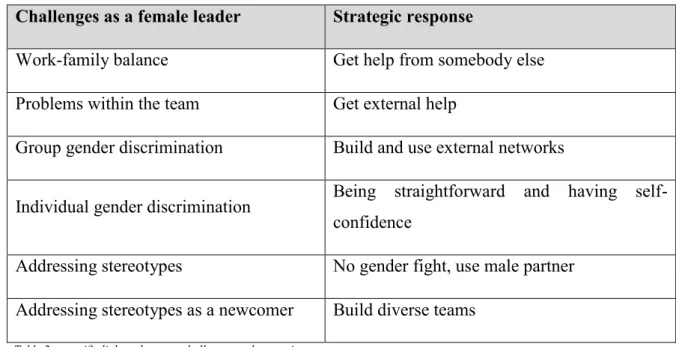
4.4 Specific linkage of strategic responses to emerging challenges
The two chapters above summarize the various challenges and conflicts women were con-fronted with during their career and the different strategies they were using to overcome these barriers and obstacles. This chapter aims to describe and align specific strategic responses to emerging challenges in an attempt to connect the given answers to the research question. Var-ious strategic behaviors in the short term lead to an active change in the long term and disrupt the “taken-for-granted” institutional rules, values, beliefs, myths and culture. Almost all strat-egies had one purpose which was to create a more positive working culture. Nobody spoiled for a fight, aimed to break existing structures or tried to stir up the organization.
Woman 7 mentioned: "I had one year as a probation period. I think that this is
comprehensi-ble because they wanted to be sure that they can trust me and so did I", and she also said: "I think that it is helpful for women in leadership positions to show more commitment in the be-ginning." Woman 5 could rely on her good reputation when she established a new department
in her organization: "[…] My boss trusted me and I already had a good reputation because I
have technical competence and expertise. But the beginning was tough because I had no idea." Two women had the strategy of doing a teambuilding, to earn or re-earn the respect of
their own team before aiming to drive a change. Woman 1 added to this: “If you are changing
some things, you have to have the courage to accept the consequences. Sometimes it is hard and difficult to get new team members, if some do not want to go along with you. It takes time to adapt to changes and it is very important that your employees understand the changes."