307
Metallurgy and materials
Metalurgia e materiais
Abstract
The aim of this study is the risk analysis evaluation about argon release from the GERDA experiment in the Gran Sasso underground National Laboratories (LNGS) of the Italian National Institute for Nuclear Physics (INFN).
The GERDA apparatus, located in Hall A of the LNGS, is a facility with germa-nium detectors located in a wide tank illed with about 70 m3 of cold liqueied argon.
This cryo-tank sits in another water-illed tank (700 m3) at atmospheric pressure.
In such cryogenic processes, the main cause of an accidental scenario is lacking insulation of the cryo-tank.
A preliminary HazOp analysis has been carried out on the whole system. The risk assessment identiied two possible top-events: explosion due to a Rapid Phase Transition - RPT and argon runaway evaporation.
Risk analysis highlighted a higher probability of occurrence of the latter top event. To avoid emission in Hall A, the HazOp, Fault Tree and Event tree analyses of the cryogenic gas extraction and ventilation plant have been made. The failures related to the ventilation system are the main cause responsible for the occurrence. To improve the system reliability some corrective actions were proposed: the use of UPS and the upgrade of damper opening devices. Furthermore, the Human Reliability Analysis identiied some operating and management improvements: action procedure optimiza-tion, alert warnings and staff training.
The proposed model integrates the existing analysis techniques by applying the results to an atypical work environment and there are useful suggestions for improving the system reliability.
Keywords: argon release, cryogenic luid, HazOp, human reliability analysis, qualita-tive and quantitaqualita-tive risk analysis.
Mara Lombardi PhD, Researcher
Universita degli Studi di Roma La Sapienza-Engineering Roma – Italy
Fabio Garzia PhD, professor
Security Systems Universita degli Studi di Roma La Sapienza - Engineering
Roma – Italy
Massimo Guarascio PhD, professor
Safety and Risk Analysis Universita degli Studi di Roma La Sapienza - Engineering
Roma – Italy
Enzo Paolo Giovannone
Safety engineer CNVVF-Corpo Nazionale Vigili del Fuoco L'Aquila – Italy
Antonio Giampaoli Safety engineer
Istituto Nazionale - Laboratori del Gran Sasso L'Aquila – Abruzzo – Italy
Mafalda Musti Safety engineer
Istituto Nazionale di Fisica Nucleare, Laboratori del gran Sasso L'Aquila – Abruzzo – Italy [email protected]
Maria Teresa Ranalli Safety engineer
Istituto Nazionale di Fisica Nucleare - Laboratori del Gran Sasso
L'Aquila – Abruzzo – Italy [email protected]
Risk analysis and reliability of the
GERDA Experiment extraction and
ventilation plant at Gran Sasso mountain
underground laboratory of Italian
308
Roberto Perruzza
Safety engineer of Istituto Nazionale di Fisica Nucleare - laboratori del Gran Sasso
L'Aquila – Abruzzo – Italy [email protected]
Roberto Tartaglia
Safety engineer of Istituto Nazionale di Fisica Nucleare - Laboratori del Gran sasso
L'Aquila – Abruzzo – Italy [email protected]
1. Introduction
According to many authors, to im-prove safety one has to know where the risks are (Pasman et al., 2009). This is certainly true when it is necessary to de-sign the safety of complex systems, where the predictive analysis of failure modes requires identiication of the hazardous conditions, to quantify their probability of occurrence and to deine representative ac-cident scenarios. The representativeness of these scenarios is subject to the knowledge of production processes and system parts and the quantitative risk analysis requires that all failure events be considered (Zhao et al., 2016).
The proposed methodologies have been separated into three different phases: identiication, evaluation and hierarchiza-tion (Tixier et al., 2002).
From the accidental risk analysis, during the identiication phase, a pressure rise in the cryostat over the design value (a) and exceeding of the containment and
insulation conditions (b) of the cryogenic liquid was identiied and it was possible to identify a dominating critical scenario due to a mixing of the shielding water of the Water Tank with the cryogenic liquid (LAr), which leads to an explosive effect due to Rapid Phase Transition (RTP). This mode can be considered as a critical sub system of containment loss (mixture of LAr and Water)
A second scenario is a relevant rise of cryogenic liquid evaporation higher than the functional values. There is a risk of hypo-oxygenation and hypothermia, depending on the modalities with which the release itself is managed. This scenario has a draining low limit as the critical sub system.
Based on the Safety Management System procedures currently in use at the Laboratories, the risk analysis for all the apparatus is a step-by-step complex procedure that must be completed and
agreed upon before the installation of the experiment.
According to the known whole documentation, the proposed analysis has been focused on the critical factors (evaluation phase) related both to the cryogenic liquid evaporation and to the functionality of the extraction/ventilation system, in order to identify, as hierarchiza-tion phase, possible failure causes of the system and evaluate the device reliability of the system.
The "core" of the research consists of the application of industrial risk as-sessment techniques and methodology in a high technology context and in a "prototype scale", as each experiment is really unique in the world. More-over, the attention to the safety issues has to take into account the boundary condition of the underground labs, the conined area and the proximity to a public motorway tunnel.
2. Material and method
2.1 Gran Sasso National Laboratory (INFN)
INFN Gran Sasso National Labora-tory (LNGS) is the largest underground laboratory in the world devoted to neu-trino and astro-particle physics and it offers the most advanced underground infrastructures in terms of dimensions, complexity and completeness.
LNGS is funded by the National Institute for Nuclear Physics (INFN), the Italian Institution which coordinates and supports research in the ield of elementary particles, nuclear and sub nuclear physics.
The laboratory is on one side of the 10-km long highway tunnel which crosses the Gran Sasso massif. It consists of three huge experimental halls (Hall A, Hall B and Hall C, each 100-m long, 20-m wide and 18-m high) and the con-nection among the halls is achieved by other smaller galleries: car tunnel, truck
tunnel, connecting tunnels.
Halls are equipped with all technical and safety equipment and plants neces-sary for the experimental activities and to ensure proper working conditions for underground users.
The 1400 m rock layer above the Laboratory represents a natural coverage that provides a cosmic ray lux reduction by one million times; moreover, the lux of neutrons in the underground halls is about a thousand times less than on the surface, due to the very small amount of uranium and thorium of the calcareous rock of the mountain.
The permeability of cosmic ra-diation provided by the rock coverage together with the huge dimensions and the impressive basic infrastructure, make the Laboratory unmatched in the
detec-tion of weak or rare signals, which are relevant for astro-particle, sub nuclear and nuclear physics.
The research areas are:
- study of rare nuclear phenomena; - study of the most penetrating com-ponents of cosmic rays;
- neutrino physics; - dark matter.
309
Collaborations must realize a Safety Risk Analysis in order to evaluate the
probabil-ity of occurrence of possible events and to guarantee the highest safety standards in a
complex system such as the one in which LNGS are involved.
2.2 The GERDA Experiment
2.3 The GERDA experiment cryogenic gas extraction
The GERDA experiment has been proposed in 2004 as a new 76Ge
double-beta decay experiment at LNGS. The GERDA installation is a facility with ger-manium detectors made out of isotopically enriched material. The detectors are oper-ated inside a liquid argon shield: GERDA experiment has been designed for the clean handling and the stable long-term opera-tion of the Germanium Detector Array in a shield of liqueied gas, copper and water that suppresses the environmental radioactivity by a factor of ~1/108.
The Ge detectors are lowered from the lock in the clean room into the center of a double-walled vacuum iso-lated cryostat (Ø 4.2m, H=9m), which is illed with 6.5*104 liters of liquid argon
(T = -175 ºC). The cryostat (see Figure 1) is manufactured from 30 tons of selected
stainless steel of low radioactivity; its vertical walls are covered with 16 tons of ultrapure copper. The cryostat adheres to the principle of "leak before break", has no penetration below the ill level and is certiied for 1.5 bar overpressure being actually operated at 1.2 bar.
The shield is completed by a tank (Ø=10m, H=9m) illed with ultrapure water; the water level rests at 8.4 m. It contains 580 m3 of puriied water.
It suppresses not only the external gamma radiation but also moderates and absorbs neutrons very eficiently. The water serves also as a radiator for a Cherenkov detector which al-lows to identify and veto the few muons, ~60 per hour, which penetrate through the Gran Sasso massif into the GERDA setup.
The water tank can be completely drained within less than 2 hours.
The water tank has been built around the cryostat from top to bottom: roof and topmost cylindrical ring have been built irst and have then been lifted by the hall crane for the assembly of the next ring underneath.
All vertical surfaces within the water tank including those of the cryo-stat have been covered with a relec-tive and wave-length shifting foil for improved detection of the Cherenkov light. The purple layer on the cryostat’s wall consists of 6 mm thick extruded poly-styrene foam serving as a thermal impedance which limits the evaporation in case of a leak in the inner container. A similar barrier is mounted on the inner wall.
The final section of the own GERDA extraction and ventilation system is connected to the main general exhaust of the Underground
Laboratories, that refers to two pump-ing air stations: the Assergi (AQ) sta-tion and the Casale San Nicola (TE) station. The Underground
Labora-tories ventilation system ensures the ejection of smoke and gases out of the laboratories up to a low rate of ≈6*104 m3/h.
Figure 1
labeled view of the GERDA installation.
The LNGS ejection system of cryo-genic gases for GERDA is designed to ensure a maximum low rate of 104 m3/h:
the ejection point is close to the clean room at 7.30 meters high, into which all the cryogenic gases are directed and where the heat exchanger is installed. The under-ground laboratories ventilation system is managed by a "slow-control software".
Two motorized dampers are in-stalled close to the connection between the ejection system and the underground laboratories ventilation system; further-more, another damper is installed on the new ejection system to provide air ejection from the heat exchanger release point.
The system is equipped with AISI 304 tubes with thickness in compliance
with regulations, and is structured with a support and anchoring system, manual air dampers and extraction grills, motorized air dampers, control and detection devices.
The GERDA extraction system has to guarantee a constant ejection with a 2.5*103 m3/h low rate, up to 103 m3/h in
case of "sudden" cryogenic gas release.
3. Results and discussion
3.1 Hazard identification
The main cause of an accidental scenario is the lack of insulation of the cryo-tank.
A preliminary HazOp analysis has
been carried out on the whole system and in particular, the risk assessment identiied two top-events more critical:
- TOP EVENT 1: explosion due to
a Rapid Phase Transition - RPT; - TOP EVENT 2: argon run-away evaporation.
310
contact between the liquid argon and the water, with the production of a great amount of gaseous argon and shock wave.
In this case, the lack of insulation of the cryostat could be due to an over-pressure or to a crack in the vessel (i.e. human error in the welding phase, wet corrosion, etc.).
The use of a cryostat “intrinsically safe” allowed to reduce the estimated
probability of occurrence of RPT to 10-8
event/year (Guarascio et al., 2013). The GERDA cryostat, in fact, is realized with suitable materials (leak before break), with double wall and double containment.
The argon runaway evaporation beyond functional values leads to asphyxi-ation and hypothermia risks.
The estimated thermal power of the Argon is 5 kW/m2 with initial evaporation
rate of 104 m3/h. A double polycarbonate
layer, the LEXAN, is inserted in the inner and outer walls of the cryostat, in order to reduce the thermal transmission coef-icient and to achieve a greater insulation of the cryostat.
The hazard analysis conducted before the approval and the installation of the GERDA experiment shows the fol-lowing results:
TOP EVENT PROBABILITY OF OCCURENCE [event/year] TOP EVENT 1 - Rapid Phase Transition P(E1) = 10-8 -10-9
TOP EVENT 2 - Argon runaway evaporation P(E2) = 10-4 Table 1
Hazard analysis results.
According to Italian Legislative De-cree 334/99, all the events with a probabil-ity of occurrence greater than 10-6 event/
year have been considered (Guarascio et al., 2013).
Among the different events iden-tiied in the Risk Assessment, the Top Event 2 has certainly the higher prob-ability of occurrence. In fact, during the whole design process and analysis, several structural measures have been put into practice:
- the original single copper wall cryostat has been replaced by a double wall stainless steel one;
- there is a mutual independence between the two stainless steel walls, guaranteeing a "double containment wall all over";
- the vacuum gap between the walls is under monitoring;
- the cryostat has been "coated" with a lexan layer both on the inner and on the outer side, and with a mylar layer
on the outer side, completely "wrapping" the whole cryostat;
- a thermo-mechanical analysis shows that the leak from a wall as con-sequence of a single break on the other one is drastically reduced.
For the above cited reasons, the RPT Event resulted as being extremely unlikely (< 10-8ev/y) and attention has been fo-cused on the TOP EVENT 2 (Marcoulaki et al., 2016) deepening the analysis and proposing technical improvements.
3.2 HAZOP Analysis of the extraction and ventilation plant
Hazards related to the extraction and ventilation plant have been identiied: this plant has been divided into nodes; for each node process parameters and guide words have been applied (Groth et al., 2012).
The primary objective of the plant
is to ensure, in an emergency situation, the gaseous argon extraction up to a low rate of 104 m3/h.
Considering the scope of the plant, the HazOp Analysis (Stefana et al., 2015) highlighted that a lack of low in the piping could be due to the fan seizing or to an
incomplete opening of the shut-off damp-ers, caused by human error or component breakdown. According to the human reliability analysis, the critical events and the corresponding causes leading to the unsuccessful operation of the plant are reported in Table 2.
Event Causes
Incomplete opening of the shut-off dampers
Malfunctioning of the control device Lack of power
Fireproof damper closing High Temperature in the piping system
Lack of power to the electric motor of the extractor
Shut-down of the electric system Malfunction of the power supply system
Non-ordinary maintenance Table 2
Synthesis of the HazOp Analysis.
3.3 Fault Tree Analysis-FTA
In this section is conducted the Fault Tree Analysis (Guarascio et al., 2007) of the Top Event identiied by the previous HazOp: gaseous Argon release in Hall A.
For the event occurrence (Brighton et al., 1994), both the incomplete opening of the air dampers and the failure of the extraction system have to occur, and for
311
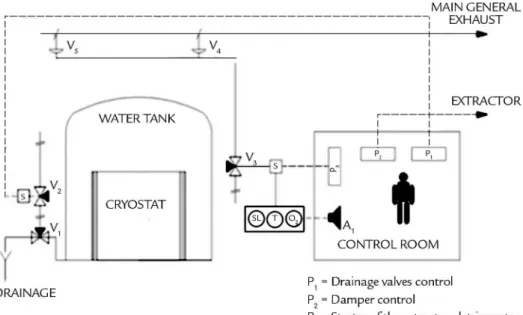
Figure 2 The GERDA extraction plant layout.
The system is equipped with leak of liquid, temperature variation and oxygen deiciency detectors (Crowl et
Louvar, 1990), connected to the cor-responding optical and /or acoustic alarms (see Figure 2). In case of failure
of the mechanized extraction system, the operator activates the P2 command and then the P3 one.
Top Event Actual Event Non-considered Event State of the system
Gaseous Argon release in Hall A
Failure of the extraction and ventilation plant
Concurrence of critical events
Incomplete opening of the Air Dampers Button breakage Failure of the
extraction system Sabotage
Table 3 Characteristics of the system and Conditions for the FTA development.
The output of Fault tree analysis is summarized below according to
Figure 3. The failure modes aim to evaluate the probability of occurrence
according to the top events (Khan et al., 2001).
312
First branch: incomplete opening of the dampers
The main causes of the incomplete opening of the dampers represented by the logic gate “OR” are:
- Damage of mechanical device. - Failure of the damper activation system.
The damage of mechanical device is a “basic event”, representing a inal cause without sub-events.
The failure of the damper ac-tivation system could be due to two main causes, represented by the logic gate “OR”:
- Facilities failure.
- No signal for the damper opening.
The facilities failure is a “basic event” representing a inal cause without sub-events.
The absence of signal for the damper opening could be due to two main causes, represented by the logic gate “OR”:
- Sensor warning failure.
- Failure on the activation of the opening command.
The sensor warning failure could be due to three main causes, represented by the logic gate “OR”:
- PLC-Programmable Logic Con-trol Damage
- Sensor Damage
- Wiring Damage.
These three events are “basic events” representing a inal cause with-out sub-events.
The failure on the activation of the opening command could be due to two main causes, represented by the logic gate “OR”:
- Alarm system Damage.
- Human Error: wrong reaction to the alarm warning.
B ot h t he events a re “basic events” and the human error has been analyzed by the Human Reliability Analysis – HRA.
Second branch: failure of the extraction system
The main causes of the failure of the extraction system, represented by the logic gate “OR”, are:
- Ventilation system failure. - Absence of electric power supply. The failure of the ventilation sys-tem could be due to two main causes, represented by the logic gate “OR”:
- Fan jam.
- Electric Motor Failure.
Both these events are “basic event” representing a inal cause with-out sub-events.
The absence of electric power sup-ply could be due to two main causes, represented by the logic gate “OR”:
- Error on the start command activation
- Lack of energy power.
The error on the start command activation could be due to two main causes, represented by the logic gate “OR”:
- Human Error.
- Alarm system Damage.
Both the events are “basic events” and the human error has been analyzed in the Human Reliability Analysis - HRA.
The lack of energy power could be due to two main causes, represented by the logic gate “OR”:
- Wiring Damage. - Energy shut-down.
Both the events are “basic events” for the TOP EVENT and complete the structure of the FTA.
Basic Events: Fan jam, Wiring Damage, Energy shut-down, Electric Motor Failure, Human Error and Alarm system Damage have a greater inluence on the probability of occurrence of the top event, therefore:
- a little improvement of the electric line reliability involves a great improvement of the entire system reli-ability;
- once the top event occurs, the lack of energy power has a probability of occurrence equal to 1.
The FTA results suggest the use of UPS, the improvement of the opening damper system maintenance and the optimization of the intervention and training procedures.
3.4 Event Tree Analysis (ETA)
The Event Tree proceeds with an-other two branch points, in order to verify
the effectiveness of the control and regula-tion valve systems, and of the extracregula-tion
system activated both automatically and by the operator.
Once the argon is released from the cryostat, the main cause of the ar-gon emission in Hall A is the failure of the extraction system.
Safety measures related to the dampers opening consist of the au-tomatic activation of the control and regulation valves and of the system for the extraction of cryogenic gases.
Furthermore, the operator can directly adopt these safety measures, in redundancy with the system.
The experiment is equipped with liquid leak detectors, temperature and oxygen sensors.
In the ETA construction (Guaras-cio et al., 2013), two branch points have been considered in order to deine the
effectiveness of the irst safety measure: the reliability of the safety measure itself is guaranteed by the correct op-eration, both of the detector and the alarm systems. In the branch related to the correct operation of the alarm system, another branch point concern-ing the correct reaction of the operator is present.
Branch point related to the correct operation of the detector system
The Event Tree proceeds with a branch point in order to verify the suc-cess or not of the systems power-up. In this case, the reaction of the operator it is not considered.
The ETA leads to the
implementa-tion of safety measures to prevent the main event (Gaseous Argon release):
- alerts for the operator by means of optical and acoustic alarms in the control room, done by sensors;
- full opening of the dampers in
the main general exhaust duct, done by the operator;
- starting the extraction electric motor at operating speed in order to conduct the vaporized argon, done by the operator.
313
3.5 Human Reliability Analysis (HRA)
HRA (Lombardi et al., 2014) has been carried out in order to deepen the evaluation of the actions performed by the operator in the control room. The task analysis performed ensures the following steps: recognition and identiication of the alarm warning, call to the suitable opera-tive action, identiication of the extraction system activation button.
The HRA (Sun et al., 2012) has identiied the main operational condi-tions inluencing the operator work and predisposing him to mistakes, as the fol-lowing ones:
- excess of noise outside the operat-ing room could impede the hearoperat-ing of the alarm system;
- wrong location of the optical alarm warning could impede its own identiication;
- absence of a feedback device for the information of the operator about the activation of the extraction system;
- incongruity between procedures and operational activities;
- incomplete layout of the instru-mentation;
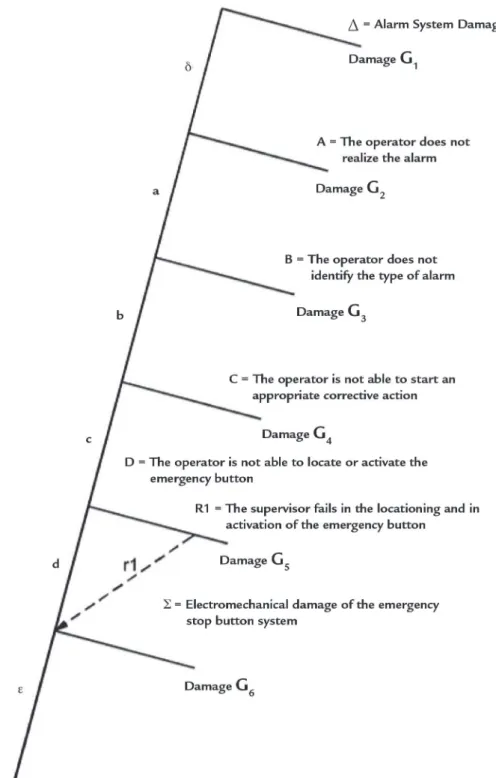
- monotony of the surveillance. The event tree related to the Human
Reliability (Ying at al., 2010) regarding the reaction in case of alarm warning is (see Figure 4):
- Small letters represent success of the operation;
- Capital letters represent the human behavior;
- Greek letters represent the opera-tion of the protecopera-tion systems.
Considering the failure prob-abilities and the operator’s mistakes probabilities (Holmes et al., 1998), the overall human failure (Gtotal) is equal to 0.092 (see table 4).
314
Damage Sequence of events G1= ∆ 5.242E-03 G2= δ A 5.969E-03 G3 = δ aB 2.966E-03 G4 = δ abC 2.957E-02 G5 = δ abcDr1 9.562E-05 G6 = δ abc(d+Dr1)Σ 4.781E-02
Gtotal 9.200E-02
Table 4
Damage list and
sequence of event corresponding.
4. Conclusion
T he risk analysis procedure (Stamatelatos and Dezfuli, 2011) has been performed on the plants of the GERDA Experiment, located in the Hall A of the Underground Gran Sasso National Laboratory. According to different and complementary methodologies, the Risk Assessment has ensured a better analysis of the system and related hazards, by analyz-ing also the effect of human behavior into possible failure modes.
In particular, the event “Argon run-away evaporation” has been analyzed: its probability of occurrence is equal to 10-4 event/year and the Top Event “Gaseous Argon Release in Hall A ” is the most critical one.
Based on the analysis (Pasman et al., 2009), three main corrective actions
have been adopted in order to increase the reliability of the system. The actions comprehend both technical and manage-rial measures reported as follows:
1. Structural Intervention - addition of UPS (Unit Power Supply) in the extrac-tor electricity supply system: this measure guarantees relevant reduction of the prob-ability of occurrence of the Top Event [value of probability between 6.26x10⁻²
and 1.23x10⁻² event/year].
2. Preventive maintenance approach for the control, regulation and activation device of the opening of the dampers: it is an electromechanical device subject to failure in its lifetime; periodic inspections and maintenance can lead to a reduction of the Top Events probability.
3. Periodical information and
train-ing of the operattrain-ing staff in charge of con-trols: the continuous training is crucial in order to reduce the probability of mistakes and to ensure an higher level of attention in the operations of the staff itself.
According to the evidences of avail-able statistical reports, the effect of non compliant human behavior is the most relevant element about the causal analysis of the system failure (Duijm et al., 2006). Based on the result of this back analysis a lot of control procedures are necessary in order to decrease failure oc-currences (Sun et al., 2011).
The following step of this research will be the evaluation of the human error according to the integrated techniques of fault tree analysis and Ishikawa’s model tested on the procedures usually employed.
References
BRIGHTON, P. W. M., BYRNE, A. J., CLEAVER, A. P., COURTIADE, P., CRABOL, B., FITZPATRICK, R. D. et al. Comparison of heavy gas dis-persion models for instantaneous releases. Journal of Hazardous Materials, v. 36, p. 193–208, 1994.
CROWL, D.A., LOUVAR, J.F. Chemical process safety: fundamentals with applica-tions. (3rd. Ed.). New Jersey: Prentice Hall, 1990.
DUIJM, N. J., CARISSIMO, B., MERCER, A., BARTHOLOME, C., GIESBRE-CHT, H. Development & test of evaluation protocol for heavy gas dispersion mo-dels. Journal of Hazardous Materials, v. 56, p. 273–285, 1997.
DUIJM, N. J., GOOSSENS, L. Quantifying the inluence of safety management on the reliability of safety barriers. Journal of Hazardous Materials, v. 130, p. 284–292, 2006.
GROTH, K.M., SHEN, S.-H., OXSTRAND, J., MOSLEH, A., KELLY, D. A mo-del-based approach to HRA: example application and quantitative analysis. In: INTERNATIONAL PROBABILISTIC SAFETY ASSESSMENT AND MANA-GEMENT CONFERENCE, 11; ANNUAL EUROPEAN SAFETY AND RE-LIABILITY CONFERENCE. PSAM11 ESREL, p. 1009-1018, 2012.
GUARASCIO, M., LOMBARDI, M., MASSI, F. Risk analysis in handling and storage of petroleum products. American Journal of Applied Sciences, v. 10, n. 9, p. 965-978, 2013.
315
Received: 10 October 2016 - Accepted: 30 March 2017. p. 131-138, 2007.
HOLMES, N., GIFFORD, S.M., TRIGGS, T.J. Meanings of risk control in oc-cupational health and safety among employers and employees. Safety Science, v. 28, n. 3, p. 14 I - 154, 1998.
KHAN, F. I., ABBASI, S. A. An assessment of the likelihood of occurrence, and the damage potential of domino effect (chain of accidents) in a typical cluster of industries. Journal of Loss Prevention in the Process Industries, v. 14, n.4, p. 283–306, 2001.
LOMBARDI, M., GUARASCIO, M., ROSSI, G. The management of uncertainty: model for evaluation of human error probability in railway system. American Jour-nal of Applied Sciences, v. 11, n. 3, p. 381-390, 2014.
MARCOULAKI, E.C., VENETSANOS, A.G., PAPAZOGLOU, I.A. Quantita-tive safety assessment of pressure control failure in a deep underground large scale cryogenic installation. Reliability Engineering & System Safety, v. 151, p. 60-75, 2016.
PASMAN, H.J., JUNG, S., PREM, K., ROGERS, W.J., YANG, X. Is risk analysis a useful tool for improving process safety? Journal of Loss Prevention in the Process Industries, v. 22, n. 6, p. 769-777, 2009.
STAMATELATOS, M., DEZFULI, H. Probabilistic risk assessment. Procedure Gui-de for NASA Managers and Practitioners. (2nd. Ed.). NASA/SP-2011-3421, 2011. STEFANA, E., MARCIANO, F., et al., Predictive models to assess Oxygen Deiciency
Hazard (ODH): a systematic review. Safety Science, v. 75, p. 1-14, 2015.
SUN, Z., LI, Z., GONG, E., XIE, H. Estimating human error probability using a modiied CREAM. Reliability Engineering and System Safety, v. 100, p. 28-32, 2012.
SUN, R., CHEN, Y., LIU, X., PENG, T., LIU, L. A method of analysis integrating HCR and ETA modeling for determining risk associated with inadequate light separation events. Journal of Aviation Technology and Engineering, v. 1, issue 1, p. 19-27, 2011.
TIXIER, J., DUSSERRE, G., SALVI, O., GASTON, D. Review of 62 risk analysis methodologies of industrial plants. Journal of Loss Prevention in the process in-dustries, v. 15, n.4, p. 291-303, 2002.
YING-JIE, J., ZHI-QIANG, S., HONG-WEI, X., ER-LING, G. A human error pro-bability quantiication method based on CREAM+Bayes. In: INTERNATIONAL CONFERENCE ON ADVANCED COMPUTER THEORY AND ENGINEE-RING, 3. Proceedings... Chengdu: IEEE Xplore Press, August 20-22, 2010. ZHAO, JIN-LONG et al. The quantitative risk assessment of the storage tank areas