ISSN 1517-7076 artigo e-11893, 2017
Autor Responsável: Luis Vanderlei Torres Data de envio: 21/10/2016 Data de aceite: 03/03/2017
10.1590/S1517-707620170004.0227
Microstructural characterization of the A356
alloy in different processing routes used in
the thixoforming process
Luis Vanderlei Torres 1, 2, Luis Fernando Torres 2, Eugênio José Zoqui 2
1
Federal Institute of Education, Science and Technology of São Paulo – IFSP PC: 12929-600, Bragança Paulista, SP e-mail: [email protected]
2
Materials and Manufacturing Engineering Department of Faculty of Mechanical Engineering of University of Campinas
– UNICAMP PC: 13083-860, Campinas, SP
e-mail: [email protected]; [email protected]; [email protected]
ABSTRACT
This work aims to evaluate different routes of raw material production to be used in thixoforming process. The semisolid materials exhibit particular structural characteristics, such the characteristic non dendritic structure. The studies for the production of near-net-shape parts have progressed together with the studies of material weight reduction on the automobile industries production lines. In general the advantages are energy saving, manufacturing steps reduction, productivity and quality increasing. Five processing routes have been investigated (conventional casting, electromagnetic stirring, grain refinement technique and different cooling rates) through microstructural characterizations, conventional metallographic and colour metallography. The material used in this study was the A356 alloy (commercial) having a hypoeutectic structure and grain size of about 750 m and primary dendrite arm spacing size of around 80 m, the combination of electromagnetic stirring + grain refining + high cooling rate provided the best route processing to obtain a refined structure, with grain sizes of around 240 m, being feasible at the thixoforming process. Note also that using conven-tional metallography (black and white) all routes tested showed almost the same primary dendrite arm spac-ing size values ie had identical characteristics.Importantly, only with the characterization via polarized col-our metallography is that was achieved in fact the best processing route definition.
Keywords: A356 alloy, casting, electromagnetic stirring, grain refinement, thixoforming.
1. NTRODUCTION
Thixoforming is a technological process that involves the metal alloys forming in the semisolid state (SSM). Interest in this process is justified by the numerous advantages that can be obtained compared to the conven-tional manufacturing methods: smaller turbulence during filling matrices, smaller shrinkage during solidifica-tion, longer dies and tooling lifetime, smaller loads involved, among others. The semisolid processing of metals has been widely accepted by the industry as a feasible route to the of near net-shape components of aluminum and magnesium alloy production [1,2]. The electronics, aerospace and especially the automobile industries already use components manufactured by such processing. In Europe, it highlights parts such as suspension parts, brackets for motors and pipes to fuel injection for industries such as Alfa Romeo, Fiat, Peugeot and Renault and already in the USA, the production includes bikes and snowmobiles mechanical components, while in Asia, there is a concentration in the production of electronic components and power supply, particularly using magnesium alloys [3,4].
produced using different approaches: chemical agents (appropriate choice of alloying elements or grain refiners) and physical or thermal agents (mechanical/electromagnetic stirring, vibration, low pouring temperature, high cooling rate, etc) [2,7,8,9]. The use of the electromagnetic stirring technique has been widely used in the last years for the thixoforming processes raw material production due to its numerous ad-vantages, among them we can mention the absence of contact between the liquid metal and the stirring envi-ronment, fact that doesn´t happen in the mechanical agitation, allows the continuous and direct casting of billets with varied forms, has low electric energy consumption, among others. Electromagnetic stirring is promoted in the solidifying liquid by the action of strong electromagnetic fields. The field-induced electric currents promote a strong agitation, breaking the structure in formation and stimulating the crystalline multi-plication; achieving low values of primary globules sizes and grains that are important factors for the thixoforming process. [10,11,12,13]. In order to, this work aims to evaluate different processing routes, using A356 alloy as base material the in terms of microstructural characterization by optical microscopy, using conventional metallographic (black and white) and polarized metallography (colour).
2. MATERIALS AND METHODS
The material used in this work was the commercial A356 alloy whose chemical composition can be seen in Table 1. To the alloy chemical composition analysis via optical emission spectrometry equipment, the sam-ples were abraded with water sandpaper grain size of 220, 320, 400 and 600 mesh and were finished for about 30 seconds in ultrasound to remove any impurities. The material was acquired in the market in cast condition (gravity casting).
Table 1: A356 alloy chemical composition (in wt %): *obtained in the literature; **chemical analysis performed by this foundry industry commercial ; ***and obtained by optical emission spectrometry;.
Si Mg Fe Cu Zn Mn Ti Al
*A356 Min - Max [14] 6,50 - 7,50 0,25 - 0,45 0 - 0,20 0 - 0,20 0 - 0,10 0 - 0,10 0 - 0,20 Bal. **A356 (by industry) 6,72 0,38 0,20 0,09 0,02 <0,01 <0,01 Bal. ***A356 6,96 0,38 0,19 0,08 0,02 <0,01 <0,01 Bal.
Figure 1: Mass fraction of liquid versus temperature for A356 alloy predicted by software Thermo-Calc® showing the present transformations (database: TTAl5).
The alloy was melt and poured at 660 °C in a Cu mould as shows the Figure 2, producing up ingots with approximately 250 mm in length and 30 mm in diameter. The first processing technique was used as comparison parameter, since it is a conventional casting, without electromagnetic stirring and without grain refiner use. The use of electromagnetic stirring [10,11,12,13] has great benefits to obtain refined structures, because promotes the breakdown of structure formation, stimulating like this crystalline multiplication and its consequent globularization. In the whole tests which utilized electromagnetic agitation was used the higher power provided by the system, 8kW that is enough to produce a magnetic field of 13 Gauss [12]. The used water flow rate for cooling the metal mould was given using the two extremes provided by the system, a min-imum flow rate of 1 l/min and a maxmin-imum flow rate of 10 l/min.
Figure 2: Schematic representation of the casting assembly to produce ingots under different conditions: 1) Cu mould, 2) electromagnetic coils - 13 Gauss, 3) electric motor, 4) water drain and 5) water inlet [18].
Table 2: Summary of the different processing routes investigated.
CONDITIONS DESCRIPTIONS
Casting casting in Cu mould + high water cooling (10 l/min) EMS + HWC electromagnetic stirring + high water cooling (10 l/min) EMS + LWC electromagnetic stirring + low water cooling (1 l/min)
EMS + GR + HWC electromagnetic stirring + grain refiner + high water cooling (10 l/min) EMS + GR + LWC electromagnetic stirring + grain refiner + low water cooling (1 l/min)
The samples produced were characterized by optical microscopy to evaluate the morphological changes resulting from several investigated conditions, all the samples were submitted to conventional metal-lography (black and white) and polarized metalmetal-lography (colour). Samples were cut longitudinally in the middle of the ingot, whose size was 300 mm, in sequence the samples were sanded with sandpaper in a parti-cle size of 220, 320, 400, 600, 800, 1200 and 1500 mesh and polished with diamond paste of 1m. After pol-ishing, the samples were attacked with hydrofluoric acid (1 ml HF and 99ml H2O), the attack was performed with total immersion of the sample in the reagent during 10s. To the microstructural characterization by col-our metallography, the same samples used in previous characterization passed through an electrolytic attack with deposition of HBF4 (hydrofluoric acid) in 2,0% solution and 25V voltage for about 6 minutes under moderate and constant stirring. To the image acquisition we used a optical microscope Leica DM ILM. Polar-izing filters have been used to obtain the samples grains colour images, doing the grains that have the same crystal orientation exhibit similar colour, which makes it much easier its identification and characterization thereof. To the primary dendrite arm spacing size measurements (1) in conventional metallography and grain size in colour metallography we used Heyn intercepts method. The count of the primary dendrite arm spacing was made by building up a triad of length equal to a multiple of full scale used in the image, counting the number of intersections covered by each straight line forming the triad. After the first count the triad was moved to the other four different positions, thus five different count fields were analyzed in each micrograph, four images being used in different regions of the sample for a total of 20 fields analyzed for each condition. With the obtained data was generated an average primary dendrite spacing of the four counting micrographs obtained. With such value was hand picked the size of the line forming the triad, and its length compared to the micrograph scale line length, through a three-rule, it was calculated the triad line micrometers size. Final-ly, dividing the length in micrometers of a triad line the average primary dendrite spacing count, an average size of primary dendrite spacing was obtained.
3. RESULTS AND DISCUSSION
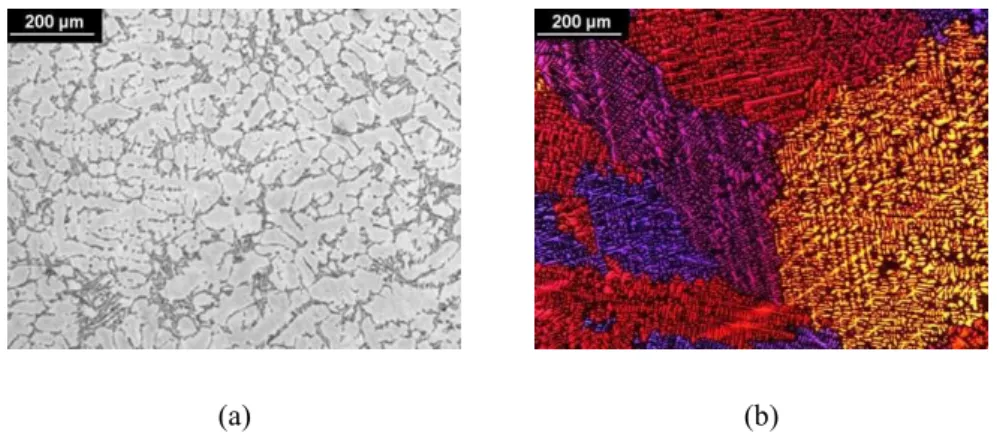
Figure 3 shows the micrographs of the A356 alloy (commercial), it is observed that the alloy has primary dendrite arm spacing size much higher as compared to the investigated conditions; as well as a microstructure in the form of gross dendrite, typical commercial foundry. When using images got by polarized light, we have that the same showed efficient to determine the grain sizes. Thus, the colour metallography wich can be seen is a quite high grain size, of about 750 m and a dendritic microstructure, showing that the use of such material to the thixoforming process is not feasible.
(a) (b)
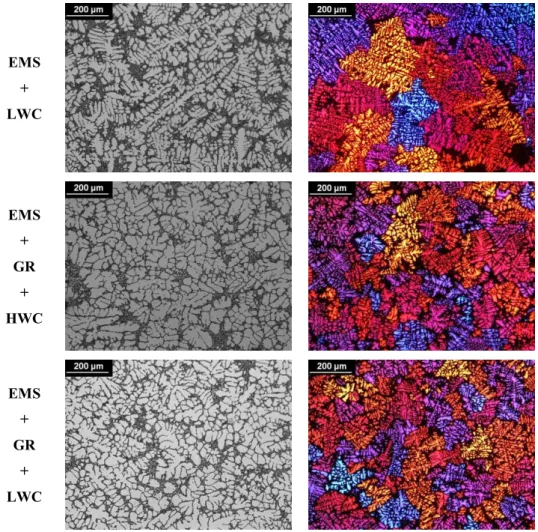
Figure 4 shows the micrographs of different processing routes investigated by conventional B&W metallography and polarized colour metallography. In the conventional B&W metallography notice a typical hypoeutectic structure as a result of solidification, there is dendrite of the primary phase (α-Al) and a network of the interdendritic constituted for the Al-Si eutectic. The dendritic growth is evident, however, due to the high solidification rate imposed by the used metal mould (cooling) as well as the electromagnetic stirring, the primary dendrite arm spacing is relatively small, in order of 30 µm, there was a large reduction when com-pared with the material (commercial) it is known that the grain refining technique for Al-Si-Cu alloys with low silicon percentages (1wt% Si, 2wt% Si and 4wt% Si) is effective, but for high silicon percentages, in the case of 7wt% Si (similar to the A356 alloy, but with the addition of 2.5 wt% of Cu), it doesn’t have a satis-factory result, presenting a totally dendritic structure [15]. Knowing that the grain refining technique for al-loys with high silicon percentages is not effective, the electromagnetic stirring technique was added to the material's production, in according to EMS + GR + HWC and EMS + GR + LWC conditions. Studies that report only the use of electromagnetic agitation show the benefits of obtaining refined structures, providing primary globules and grains considerably inferior when compared to non-agitated structures [16,17]. When used grain refiner (Al-5wt%Ti-1wt%B) notices a change in its shape, namely, the material passes from a typ-ically dendritic structure to a structure trending to the rosette shape, with a substantial gross on the dendritic branches (EMS + GR + HWC and EMS + GR + LWC).
The micrographs with polarized colour metallography revealed relatively gross equiaxed grains, with an average size of 400 m, however when using the combination electromagnetic stirring and grain refining technique (EMS + GR + HWC/LWC), the average size falls substantially, namely, 240 m in other words, the combination of these two production techniques is the one that presents the best results in relation to grain size, an important factor when dealing with semi-solid materials processes [18,19,20]. Therefore, the use of the grain refining technique interferes with nucleation, causing an increase in the initial nucleation rate, that is the number of nuclei as a function of time and volume of the liquid, thus restricting its growth and result-ing in a solid structure of fine grains. It is therefore important to encourage extensive nucleation throughout the liquid volume when associated with high cooling rates [21].Importantly, only with the characterization via polarized colour metallography is that can be obtained in fact the best condition.
Casting
EMS
+
EMS
+
LWC
EMS
+
GR
+
HWC
EMS
+
GR
+
LWC
Figure 4: Micrographs of the different processing routes investigated by conventional B&W metallography and polarized colour metallography (samples were cut longitudinally in the middle of the ingot).
On the Table 3 the average size of primary dendrite arm spacing and average grain sizes to all pro-cessing routes investigated are presented. Note the combination of electromagnetic stirring + grain refining technique + high flow rate (EMS + GR + HWC) provides the best values on the average grain size, since: the grain refining acts as a catalyst nucleation; the agitation promoted on the liquid in solidification generates strong electromagnetic fields, contributing to the breakdown of the structure in formation and stimulating the crystalline multiplication, preventing dendritic growth. Which can be noted a gradual average grain size de-crease in relation to the different investigated processing routes, especially when the use of electromagnetic stirring + grain refining technique + high water cooling, providing a grain size about 3 times smaller when compared to commercial alloy; it also notes that the primary dendrite arm spacing of different routes investi-gated remains almost the same and that only with the use of characterization via colorful metallography to the result be found [18].
Table 3: Primary dendrite arm spacing size and grain size for each investigated condition.
CONDITIONS PRIMARY DENDRITE ARM SPACING SIZE [m] GRAIN SIZE [m]
Commercial alloy 85 10 743 258
Casting 31 3 457 125
EMS + HWC 31 3 367 106
EMS + LWC 31 3 393 155
EMS + GR + HWC 34 3 244 53
4. CONCLUSION
Some conclusions about the different processing routes investigated in this work are:
i. The A356 alloy processed through the combination of electromagnetic agitation + grain refining + high water cooling (EMS + GR + HWC) showed the best results for the grain size, demonstrating that this processing route is effective in thixoforming process, once from this process is expected homogeneous structures and with small grain sizes. Being that both techniques, electromagnetic stir-ring and ultra-refining technique provide the breakdown of the structures in solidification and pre-vent the raw material dendritic growth.
ii. The microstructural characterization via colour metallography is quite efficient, doing with the grains with the same crystal orientation present similar colour, making it much easier identification and characterization thereof.
5. ACKNOWLEDGEMENTS
The authors acknowledge the Brazilian research funding agencies FAPESP (São Paulo Research Foundation
– Project 2009/08478-1), CNPq (National Council for Scientific and Technological Development) and CAPES (Federal Agency for the Support and Evaluation of Postgraduate Education) for their financial sup-port of this research. The authors are also indebted to FEM/UNICAMP – Faculty of Mechanical Engineering, State University of Campinas and IFSP – Federal Institute of Education, Science and Technology of São Pau-lo campus Bragança Paulista for its practical support.
6. BIBLIOGRAPHY
[1] HIRT, G., KOPP, R., Thixoforming: semi-solid metal processing, 1 ed., Aachen, WILEY-VCH, 2009. [2] KIRKWOOD, D.H., SUÉRY, M., KAPRANOS, P., et al., “Semi-solid processing of alloys”, In: Springer Series in Material Science, v. 124, Berlin, Springer-Verlag, pp. 172, 2010.
[3] GARAT, M., MAENNER, L., SZTUR, C., “State of the art of thixocasting”, In: Proceedings of the 6th
International Conference on the Semisolid Processing of Alloys and Composites, pp. 187-194, Turin, 2000.
[4] YOUNG, K., EISEN, P., “SSM (semi-solid metal) technological alternatives for different applications”, In: Proceedings of the 6th International Conference on the Semisolid Processing of Alloys and Composites, pp. 97-102, Turin, 2000.
[5] PERES, M.D., SIQUEIRA, C.A., GARCIA, A., “Macrostructural and microstructural development in Al-
Si alloys directionally solidified under unsteady-state conditions”, Journal of Alloys and Compounds, v. 381, pp. 168-181, 2004.
[6] COSTA T.A., MOREIRA, A.L., MOUTINHO, D.J., et al., “Growth direction and Si alloying affecting directionally solidified structures of Al-Cu-Si alloys”, Materials Science and Technology. v. 31, pp. 1103 -1112, 2015.
[7] FLEMINGS, M.C., “Behavior of metals in the semisolid state”, Metallurgical Transactions A, v. 22, pp. 957-981, 1991.
[8] SALLEH, M.S., OMAR, M.Z., SYARIF, J., et al., “An overview of semisolid processing of aluminium alloys”, ISRN Materials Science, pp. 1-9, 2013.
[9] HAGA, T., NAKAMURA, R., KUMAI, S., et al., “Clad Strip Casting by a Twin Roll Caster”, Archives of Materials Science and Engineering, v. 37/2, pp. 117-124, 2009.
[10] ZOQUI, E.J., PAES, M., ES-SADIQI, E., “Macro and microstructure analysis of the SSM A356 pro-duced by electromagnetic stirring”, Journal of Materials Processing Technology, v. 120, pp. 365-373, 2002. [11] TORRES, L.V., ZOQUI, E.J., “Characterization of the microstructure and rheological behavior of Al- 4wt%Si-2.5wt%Cu alloy produced by direct chill casting and electromagnetic stirring”, Solid State Phenom-ena, v. 192-193, pp. 142-148, 2013.
[12] ZOQUI, E.J., CAMPO, K.N., PRONI, C.T.W., “Influence of the processing route on the microstructure of aluminum alloy A356”, Materials Characterization, v. 85, pp. 26-37, 2013.
[15] BENATI, D.M., Avaliação da tixoconformabilidade de ligas Al–Xwt%Si–2,5wt%Cu–0,5wt%Mg, Dis-sertação de M.Sc., FEM/UNICAMP, Campinas, SP, Brasil, 2008.
[16] PAES, M., Otimização de processo de obtenção de reofundidos da liga A356 por agitação eletromagné-tica, Dissertação de M.Sc., FEM/UNICAMP, Campinas, SP, Brasil, 2000.
[17] KANG, C.G., BAE, J.W., KIM, B.M. “The grain size control of A356 aluminum alloy by horizontal electromagnetic stirring for rheology forging”, Journal of Materials Processing Technology, v. 187, pp. 344-348, 2007.
[18] TORRES, L.V., Tixoconformação de novas ligas Al-Si-Cu, Tese de D.Sc., FEM/UNICAMP, Campinas, SP, Brasil, 2013.
[19] VILAS BÔAS, B., Avaliação do comportamento mecânico de ligas Al-Xwt%Si-5wt%Zn tixoconforma-das, Dissertação de M.Sc., FEM/UNICAMP, Campinas, SP, Brasil, 2012.
[20] PERES, G., Avaliação da tixoconformabilidade de ligas Al-Xwt%Si-5wt%Zn, Dissertação de M.Sc., FEM/UNICAMP, Campinas, SP, Brasil, 2012.