Abstract— A comparative analysis of two cylindrical
complex-frequency-shifted perfectly matched layers (CFS-PML) absorbing boundary condition (ABC) for bi-dimensional (2-D) finite-volume (FV) simulations in the frequency domain is presented. The impact of CFS-PML parameters on the wave absorption, as well as on the condition number of the associated system matrix is investigated by comparing the performance of two PML loss profiles, viz., polynomial and geometric grading. FV-CFS-PML results are validated against analytical solution. Numerical results show that inclusion of a CFS-PML within the FV computational domain increases the condition number of the system matrix and therefore the use of CFS-PML 3-D FV simulations is limited.
Index Terms— Coaxial waveguides, condition number, finite volume
methods, perfectly matched layers.
I. INTRODUCTION
One of the biggest challenges in the computational electromagnetics modeling is the efficient and
accurate solution of electromagnetic fields in unbounded problems. In the analysis of large scale
problems, it is essential to employ iterative solvers for the resulting associated sparse linear system. In
general, the convergence of these solvers becomes poorer as the condition number of the system
matrix increases and, it may not be achieved in many cases. Furthermore, in order to simulate
unbounded problems in both lossless and low-loss media, an absorbing boundary condition (ABC)
must be constructed to eliminate spurious reflections from computational boundaries. The perfectly
matched layers (PML) ABC has been shown to be very effective for discrete methods [1]-[5].
However, some papers in the literature report that the use of PML in frequency domain methods, such
as the finite-volume and finite-element, increases the condition number and consequently, the solution
can be plagued by convergence problems [6]–[8]. It should be note that the problem associated with
the condition number is not really predicated on frequency domain methods but rather whether the
method produces require the solution of a large system matrix or not. Time domain methods such as
finite-volume time-domain (FVTD) and finite-element time-domain (FETD) do require such step and
A comparative Analysis of Cylindrical
CFS
-
PML ABC for Finite Volume Simulations
in the Frequency Domain
Ana Paula M. Lima and Marcela S. Novo
A three-dimensional (3-D) finite volume (FV) algorithm has been developed and successfully
applied to simulate electromagnetic (EM) well-logging tool response in high-loss geophysical
formations [11]–[14]. In low-loss media, however, its application implies increasing the
computational domain. To save memory requirements and CPU time, a PML must be incorporated in
the outermost cells of the grid in order to absorb outgoing waves.
The degradation of the condition number of FV system matrices after the implementation of the
PMLs in the computational domain was first investigated in [15], where coaxial waveguides
terminated by PMLs in the longitudinal direction were analyzed in terms of its loss parameters and
number of layers. In [16], a similar study was done but with coaxial waveguides terminated by
longitudinal complex-frequency-shifted (CFS) PMLs [17].
In this paper, a 2-D FV algorithm is applied to a coaxial waveguide backed by a cylindrical
CFS-PML in both longitudinal and radial directions. This geometry mimics a FV computational domain
with a metallic mandrel around the z axis, which is common in EM well-logging tools simulations.
Here, the main objective is to analyze the effect of the CFS-PML parameters on the condition number
of the FV system matrix taking also into account the numerical discretization error. We assess this by
comparing the performance of two PML loss profiles, viz., polynomial and geometric grading.
Furthermore, the numerical reflection coefficient is also investigated. The FV-CFS-PML technique is
validated against analytical solution showing very good agreement. Numerical results show that the
inclusion of a CFS-PML within the FV computational domain increases substantially the condition
number of the system matrix. Therefore, unless a well-conditioned CFS-PML is developed, the use of
CFS-PML 3-D FV simulations is limited since it requires the use of a direct method for solving the
FV system matrix.
II. FORMULATION
A. Finite Volume Technique
In the FV technique, the physical space is decomposed into small volumes and the partial
differential equations (PDE) are integrated over each volume. The present FV technique is based on a
staggered-grid scheme developed in cylindrical coordinates to better conform to the majority of
well-logging tool geometries and to avoid staircasing errors [18]. The computational grid is uniform in
both the longitudinal z-direction and the radial -direction. Ampere's law is integrated over faces of
the dual grid ~. For any surface S~~ with boundary S~, this gives ( i t
e convention):
S~Hdl
S~ i Eds
S~Jsds
where and are the conductivity, and permittivity of the medium, respectively. Js is the electric current density (impressed source). The electric and magnetic fields are the unknowns to be determined. Dirichlet boundary conditions are assumed at the computational boundaries. Discrete equations are obtained by evaluating the above over each face of the dual grid. By using integration dual faces S~ perpendicular to the - direction (Fig. 1a), we arrive at:
z k i I k i E k i k i H k i H z k i H k iH z z
, , , ˆ , , , , 0 2 1 2 1 2 1 2 1
(2)
where i, k, refer to a primal grid nodal indexing, and z are the cylindrical grid spatial increments in the - and z-directions, respectively; I0 is the current source amplitude, and ˆ
i
. Themagnetic field can be eliminated from (2) using Faraday's law:
SEdl
Si Hds0
(3)
where is the permeability of the medium.
By using integration primary faces S perpendicular to the - and z-directions (Fig. 1b and Fig. 1c), we arrive at:
, 12
1
,
, 1
E ik E ik
z i k i
H
(4a)
E
i k
E
i k
ik i
Hz i 1, i ,
2 , 1 2 1
(4b)
Substituting (4a) and (4b) into (2), a discrete linear system [A][X]=[B] is obtained, where [A] is a
complex non-Hermitian matrix, [X] is the vector of (electric field) degrees of freedom (DoFs), and
[B] is the discrete source representation.
B. Cylindrical Perfectly Matched Layers
A cylindrical PML is incorporated in the outermost cells of the grid in order to absorb outgoing
waves. This is done by modifying the constitutive parameters inside the PML region, and hence it
does not require any modification on Maxwell's equation themselves. In cylindrical coordinates, the
PML constitutive tensors that are matched to a homogeneous nondispersive medium characterized by
constitutive parameters and, are given by
PML ,,z ,z;
;
PML,,z
,z;
(5)
with [19]
zs s s s s s z z z z z ˆ ~ ˆ ~ ˆ ~ ; , , ,
(a)
(b)
(c)
Fig. 1. Unit cell of the staggered grid scheme for spatial discretization of electromagnetic fields on the cylindrical grid. (a) Dual faces perpendicular to the �- direction. (b) Primary faces perpendicular to the �- direction. (c) Primary faces
In the above, ~ is the analytic continuation of the radial coordinate to a complex variable domain,
and s and sz are frequency-dependent complex stretching variables. Here, two types of PML are
implemented for comparison purposes, viz., the standard PML and the CFS-PML. The stretching
variables s and szare defined as:
i K s ;
i z z K z s z z zz
(7)
and
' ' ~ 0
s d(8)
where K
,
, Kz
z and z
z are functions of position only [11]. Note that in the standardPML the parameters and z are set equal to zero.
Inside the CFS-PML region, ordinary longitudinal outgoing eigenmodes are transformed to
i i e e
, where and stands for or z ; and similarly for radial eigenfunctions in terms of Hankel functions. Hence, the transformed eigenmodes exhibit exponential decay inside the
CFS-PML so as to reduce spurious reflections from the grid terminations. However, in the
low-frequency limit 0, the behavior does not exhibit induced attenuation. To circumvent this, is
scaled to be maximum at the inner CFS-PML interface, and minimum at the grid termination. Here,
the following scaling is adopted:
m d max 1
(9)
where d is the CFS-PML thickness and m is a taper profile for both real and imaginary parts of the
stretching variables.
Once, the design of an effective CFS-PML requires balancing the theoretical reflection error, and
the numerical discretization error; several profiles have been suggested for grading in the context
of CFS-PML. The most successful use a polynomial or geometric variation of the CFS-PML loss.
Here, the following polynomial and geometric grading are adopted [1].
1) Polynomial:
max
m
d
(10a)
d R m 2 0 ln 1max (10b)
max
is the CFS-PML conductivity at the outer boundary, is the incidence angle over CFS-PML, and R
is the theoretical reflection error given by d d e R 0 ) ( ) cos( 2 ) (
(a)
(b)
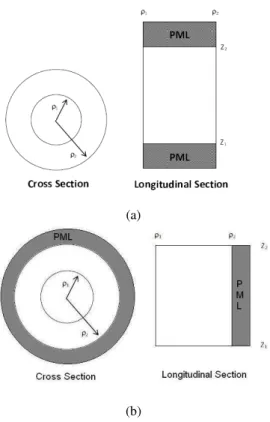
Fig. 2. Illustration of the geometry problem. (a) Longitudinal PML - (b) Radial PML
2) Geometric:
01
g (11a)
1 2
ln 0 ln
0
d
g g
R (11b)
where 0
is the CFS-PML conductivity at its surface, g is the scaling factor, and is the FV space
increment.
III. NUMERICAL RESULTS
A. Validation
In order to validate the present FV-CFS-PML method, the algorithm is applied to a lossless coaxial
waveguide backed by a cylindrical CFS-PML in both the longitudinal and radial directions, as illustrated
(a) (b)
Fig. 3. Electric field distribution of a lossless coaxial waveguide backed by a cylindrical CFS-PML. (a) Longitudinal PML - (b) Radial PML
following input data are used: the operating frequency is 2 MHz; both the relative electric
permittivity and magnetic permeability are set equal to 1; the inner cylinder has radius equal to r =
0.1016 m; the CFS-PML are set up using eight cells; max 4
10
and the scaling factors are m=2 and
g=3.2. For the longitudinal PML case, the computational domain is discretized using a
N,Nz
(50,300) grid.The discretization cell size is uniform in both directions with 2.2m and z 5.0m. The source
is set at
N,Nz
(10,150) and the field is sampled at 85.1m. For the radial PML case, a
N,Nz
(100,80) grid is used. The discretization cell size is uniform in both directions with 5.0m andm
z 1.5
. The source is set at
N,Nz
(51,35)and the field is sampled at 60.0m.In fig. 3, the electric field distribution from the FV-PML simulation is compared against an
analytical solution. Very good agreement is observed between the FV-PML and analytical results.
This occurs because max
is selected within the range defined by max 0
. Outside this range, the
CFS-PML does not exhibit induced attenuation.
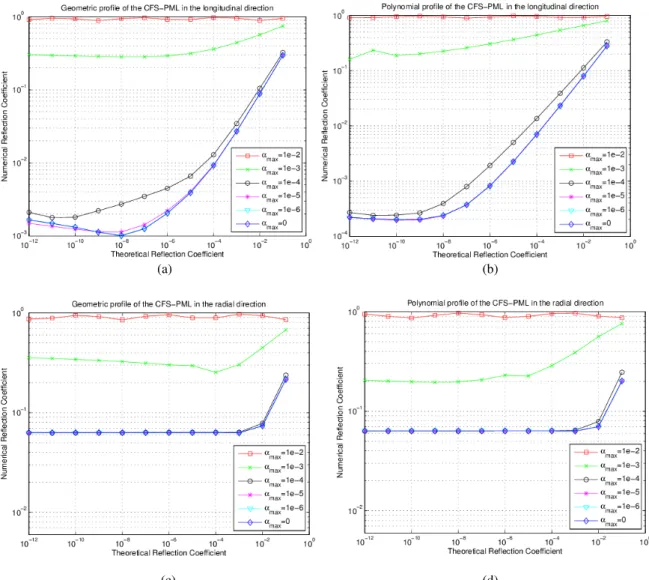
To better analyze the performance of the polynomial and geometric CFS-PML loss profiles, the
numerical (actual) coefficient reflection (COEFN) as a function of the theoretical coefficient
reflection (COEF) is plotted in Fig. 4,
for different values of
max
.
For the longitudinal CFS-PMLcase, it can be noted that the polynomial-graded profile provides smaller reflection levels, showing an
advantage over the geometric-graded profile. However, max
z
does not have strong influence on the
reflection level in both profiles. On the other hand, the COEFN does not vary with max
in both
profiles for radial CFS-PML. Moreover, polynomial and geometric profiles provide similar reflection
levels. As expected, it can also be noted that for max 0
(a) (b)
(c) (d)
Fig. 4. Numerical Reflection Coefficient X Theoretical reflection coefficient for different values of max
. In bothprofiles, NPML=6 and KPML=1.
attenuation. It should be noted that the design of an effective CFS-PML requires balancing the
theoretical reflection error and the numerical discretization error. Normally, the CFS-PML
conductivity profile is chosen as large as possible to minimize the theoretical reflection error.
Unfortunately, if the CFS-PML conductivity profile is too large, the discretization error due to the FV
approximation dominates, and the numerical (actual) reflection error is potentially orders of
magnitude higher than what equation (10c) predicts. This problem is more pronounced in our case
because the cell size is too small.
Fig. 5 shows the COEFN as a function of max
for different values of KPML (the real part of the
stretching variable s). For the longitudinal CFS-PML case, it is observed that both profiles show
similar behavior, and the polynomial CFS-PML outperforms the geometric one. Note that for
4 max
10
z
, COEFN has considerably increased in both profiles and for max 4
10
z
, a slight variation is
observed in the geometric profile. However, for the radial CFS-PML case, it can be noted that
(a) (b)
(c) (d)
Fig. 5. Numerical Reflection Coefficient X max
for different values of KPML. In both profiles, NPML=6.
To investigate the impact of CFS-PML parameters on the condition number (CN) of the FV system
matrix, some of the input data have their values modified. In this study, the computational domain is
discretized using a
N,Nz
(50,50) grid and the source is set at
N,Nz
(25,25). The discretization cell size is uniform in both directions. For the longitudinal PML case, the domain was discretized byusing 2.2m and z 7.5m; and for the radial PML case, 2.2m and z 7.5m was used. Fig. 6
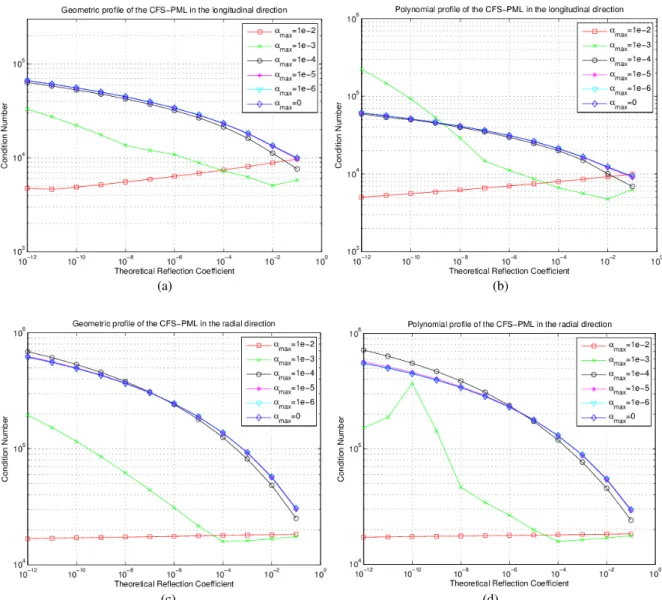
shows the CN as a function of COEF for different
values of
max
.
For both the longitudinal and theradial CFS-PML case, it is observed that for max 4
10
the CN decays as the COEF increases.
Moreover, it can be noted that both profiles (polynomial and geometric) show similar behavior. Fig. 7
shows the CN as a function of max
for different values of KPML. Note that for max 4
10
, the KPML
(a) (b)
(c) (d)
Fig. 6. Condition Number X Theoretical Reflection Coefficientfor different values of max
. In both profiles, NPML=6 and KPML=1.
IV. CONCLUSION
We have compared the performance of two cylindrical CFS-PML, viz., polynomial-graded CFS-PML
and geometric-graded CFS-PML for being used as an absorbing boundary condition (ABC) in the
bi-dimensional (2-D) finite-volume technique in the frequency domain. Simulations in both the
longitudinal and radial coaxial waveguide terminated by a cylindrical CFS-PML have been carried
out. For the longitudinal CFS-PML case, the polynomial-graded CFS-PML has outperformed
geometric-graded PML in terms of wave absorption. However, the condition number of the associated
matrix system in both profiles are similar. For the radial CFS-PML case, both types of CFS-PML
have shown similar performance in terms of absorption of the wave, as well as the condition number
of the matrix system. Even though the CFS-PML has achieved great success in time-domain analysis,
(a) (b)
(c) (d)
Fig. 7. Condition Number X max
for different values of KPML. In both profiles, NPML=6.
computational domain significantly increases the condition number of the system matrix and
consequently the convergence of iterative methods deteriorates.
REFERENCES
[1] A. Taflove and S. Hagness, Computational Eletrodynamics: The Finite-Difference Time-Domain Method, Boston MS: Artech House, 2005.
[2] U. Pekel and R. Mittra, A finite element method frequency-domain application of the perfectly matched layer (PML)
concept, Microwave Opt. Technol. Lett., vol. 9, pp.117 -122, 1995.
[3] Y. Y. Botros and J. L. Volakis, Preconditioned generalized minimal residual iterative scheme for perfectly matched
layer terminated applications, IEEE Micro. and Guide Wave Lett., vol. 9, no.2, Feb. 1999.
[4] D. Pardo, L. Demkowicz, C. Torres-Verdin, and C. Michler, PML Enhanced With A Self-Adaptive Goal-Oriented
pp-Finite Element Method: Simulation Of Through-Casing Borehole Resistivity Measurements, Siam Journal on Scientific
Computing, vol 30, no. 6, pp. 2948-2964, 2008.
[5] H. O. Lee, F. L. Teixeira, L. E. San Martin, and M. S. Bittar, Numerical modeling of eccentered LWD borehole sensors
in dipping and fully anisotropic Earth formations, IEEE Trans. Geosci. Remote Sens., vol. 50, no. 3, pp. 727-735, 2012.
[6] J. M. Jin and W.C. Chew, Combining PML and ABC for Finite Element Analysis of Scattering Problems, Micro. and Opt. Tech. Lett., vol. 12, no. 4, pp. 192-197, Jul. 1996.
[7] Y. Y. Botros and J. L. Volakis, Perfectly Matched Layer Termination for Finite-Element Meshes: Implementation and
Anisotropic Media With Multiple Horizontal Beds, IEEE Trans. Geoscience Remote Sens., vol.45, no.8, pp.2451-2462, 2007.
[11]M. S. Novo, L. C. da Silva and F. L. Teixeira, Finite Volume Modeling of Borehole Electromagnetic Logging in 3-D
Anisotropic Formations Using Coupled Scalar-Vector potentials, IEEE Antennas Wireless Propag. Lett., vol. 6, pp.
549-552, 2007.
[12]M. S. Novo, L. C. da Silva and F. L. Teixeira, Comparison of Coupledpotentials and Field-Based Finite-Volume
Techniques for Modeling of Borehole EM Tools, IEEE Geosci. Remote Sens. Lett., vol. 5, pp. 209-211, 2008.
[13]M. S. Novo, L. C. da Silva and F. L. Teixeira, Three-Dimensional Finite-Volume Analysis of Directional Resistivity
Logging Tools, IEEE Trans. Geosci. Remote Sens., vol. 48, pp. 1151-1158, Mar. 2010.
[14]M. S. Novo, L. C. da Silva and F. L. Teixeira, A Comparative Analysis of Krylov Solvers for Three-Dimensional Simulations of Borehole Sensors, IEEE Geosci. Remote Sens. Lett., vol. 8, no. 1, pp. 98-102, Jan. 2011.
[15]L. F. Ribeiro and M. S. Novo, Analysis of the Cylindrical PML ABC for 2-D Finite Volume Simulations in the
Frequency Domain, Proceedings of 2011 SBMO/IEEE MTT-S International Microwave and Optoelectronics
Conference, 2011, Natal.
[16]A. P. M. Lima and M. S. Novo, Analysis of Cylindrical CFS-PML ABC for 2-D Finite Volume Simulations in the
Frequency Domain, Proceedings of of 2013 SBMO/IEEE MTT-S International Microwave and Optoelectronics
Conference, 2013, Rio de Janeiro.
[17]M. Kuzuoglu and R. Mittra, “Frequency dependence of the constitutive parameters of causal perfectly matched
absorbers,” IEEE Microwave Guided Wave Lett., vol. 6, pp. 447–449, Dec. 1996.
[18]M. S. Novo, Análise numérica de sensores eletromagnéticos de prospecção petrolífera utilizando o método dos
volumes finitos, Pontifícia Universidade Católica do Rio de Janeiro, Departamento de Engenharia Elétrica, Tese de
Doutorado, Agosto 2007.
[19]F. L. Teixeira and W. C. Chew, Sistematic Derivation of Anisotropic PML Absorbing Media in Cylindrical and