(Recebido em 05/05/2009; Texto Final em 29/07/2009).
Bricks
(Uso de Escória de Fluxo de Soldagem a Arco Submerso como Matéria-Prima para a Fabricação de Argamassas de Múltiplo Uso e Tijolos)
Caroline Espinosa Viana1, Dylmar Penteado Dias1, José Nilson França de Holanda2,Ronaldo Pinheiro da Rocha Paranhos2 1UENF/LECIV/CCT, Campos dos Goytacaze-RJ, Brasil,[email protected]; [email protected]
2UENF/LAMAV/CCT, Campos dos Goytacazes-RJ, Brasil, [email protected]; [email protected]
Abstract
This work has as objective to analyze the recycling possible uses of the slag of welding flux (SWF) in the civil construction. It was searched the liability of SWF as substitute of sand in the production of multiple-use mortars and clay for the production of ceramic bricks. SWF has origin in the submerged-arc welding (SAW), and have been used slags of the acid, neutral and basic types, according to its neutrality. Mortars have been made containing the three types of SWF and in addition a reference mortar made with sand. Physical and mineralogical characteristics of each SWF were studied, and the physical properties (consistency and density) and mechanical properties (compressive and tensile strengths) of the mortars were analyzed.Ceramic pieces have been made containing kaolinitic sedimentary clay up to 10 wt. % of SWF. The pieces were prepared by uniaxialpressing and fired at 950ºC. The following properties after firing were determined: linear shrinkage, water absorption, apparent porosity, apparent density, and flexural strength. The results show that for multiple-use mortars, SWF reached excellent results, being an overall substitute for sand as fine aggregate. For ceramic bricks, SWF can also be used as partial substitute for red clay. Both applications of SWF significantly contributes for the reduction of the ambient impact: on one hand, reducing the extraction of natural sand and clay, on other hand, contributing for the reduction of the risk of ground water contamination due to the inadequate disposal of the SWF.
Keywords: Civil construction; Industrial residue; Multiple-use mortars; Recycling; Slag of welding flux.
Resumo: Este trabalho tem como objetivo avaliar possíveis usos para a reciclagem da escória de fluxo de soldagem (EFS) na construção civil. Foi pesquisada a possibilidade do uso da EFS como substituto da areia na produção de argamassas de múltiplo-uso e substituição da argila na produção de tijolos. A EFS tem origem na soldagem a arco submerso (SAS), e foram usadas escórias dos tipos ácida, neutra e básica, conforme sua neutralidade. As argamassas foram preparadas usando os três tipos de EFS e ainda uma argamassa de referência feita com areia. As características físicas e mineralógicas de cada EFS foram estudadas, e as propriedades físicas (consistência e densidade) e propriedades mecânicas (resistência à compressão e à tração) das argamassas foram analisadas. Corpos de prova cerâmicos foram preparados contendo argila caulinítica sedimentar com até 10% em peso de EFS. Estes foram confeccionados por pressão uniaxial e calcinados a 950ºC. As seguintes propriedades após a queima foram determinadas: deformação linear, absorção de água, densidade aparente e resistência à flexão. Os resultados mostraram que para as argamassas de múltiplo-uso, a EFS atingiu resultados excelentes, podendo substituir totalmente a areia como agregado miúdo. Para os tijolos cerâmicos, a EFS também pode ser usada como substituto parcial da argila vermelha. Ambas as aplicações da EFS contribuem significativamente para a redução de impacto ambiental: por um lado, reduzindo a extração de areia natural e da argila e, por outro lado, contribuindo para a redução do risco de contaminação do subsolo devido ao despejo inadequado da EFS.
Palavras-chave: Construção civil; Resíduo industrial; Argamassas de múltiplo-uso; reciclagem; Escória de fluxo de soldagem.
1. Introduction
Thesubmerged-arcweldingprocess(SAW)iswidelyused
in the metal-mechanic industry due to its operational facility and productivity. In Brazil, this process is used for the manufacturing of tubes, pressure vessels, boilers, heat exchanges, iron-making
equipments, ships, automotive parts and all sort of heavy equipments. In SAW, the heat source is supplied by an electric
arcformedbetweenthesolidortubularwireelectrodeandthe workpiece.Theelectricarcandthemeltedmetalarecompletely
covered and protected by the lux from the atmospheric contamination. The granulated lux is partially melted and
generates a liquid protective slag layer, which is solidiied in thesequence.Thissolidmaterialisconsideredasbeingawaste material,andreferredhereafterasslagofweldinglux(SWF)
to its neutrality as acid, neutral or basic types [2]. In Brazil, it
isestimatedthatthesubmerged-arcweldingprocessgenerates
about 500 tonnes per month of SWF [3].
Nowadays, the SWF waste has been mainly disposed in
landill sites, which cost money. Thus, there is interest of the
industrial sector in search technological alternatives for the use
ofthisabundantwaste.
The ceramic industry, particularly the sector devoted for the
manufacturingofcivilconstructionmaterials,hasbeenwidely used as an alternative to the recycling of industrial wastes [4-6]. Some reasons in favor of recycling of industrial wastes
as civil construction materials are: i) the ceramic industry uses
largeamountsofnaturalrawmaterials;ii)themainproduction processes are not greatly modiied; iii) traditional ceramic products allows a large range of their chemical-mineralogical
compositions and iv) some heavy metals or toxic substances can be encapsulated in the ceramic matrix.
Themainobjectiveofthisworkistostudytherecyclingof
SWFwasteasanalternativerawmaterialinthemanufacturing
of ceramic products for civil construction such as
multiple-use mortars and clay bricks. Emphasis is given to the waste
characteristics and its effects on the technological properties of the ceramic products.
2. Materials and methods
2.1 Materials
Therawmaterialsusedinthisworkweretheconventional
components for the manufacturing of multiple-use mortars
(cement,naturalsandandwater)andbricks(plasticsedimentary clay),besidestheSWFwaste. Portlandcementcompoundwithblast-furnaceslag(CPIIE-32type)wasused.Thiscementhasbeenordinaryusedinthe civilconstructionelements.Rivernaturalsandusedwaswashed, driedfor24handsievedwiththeobjectiveofitsuseasnormal
sand according to the ABNT NBR 7214 standard [7].
Plastic sedimentary clay from Campos-RJ (Brazil) region for
makingbrickswasused(<40mesh),whichispredominantly
kaolinitic [8], rich in SiO2, Al2O3 and Fe2O3.
ThreesamplesofSWFwastecollectedinthemetal-mechanic
industryfromsouth-easternBrazilwereusedinthepreparation
ofthemortars.ThesampleswereclassiiedasacidSWF,neutral
SWF and basic SWF, according to its neutrality. Waste samples
werecrushedandsieved,resultinginineaggregate.Figure1 shows the SWF waste before and after the crushing process. The particle size distribution of the SWF waste sample was determined.ThemineralogyoftheSWFsampleswasdetermined
by X-ray diffraction (D5000 diffractometer, Siemens) using Cu-K radiation. The unitary mass of the aggregates in the loose
condition was determined according to ABNT NBR 7251
standard [9] and real speciic mass determined according to ABNT NBR 9776 standard [10].
2.2 Methodology
Multiple-use mortars were prepared with the objective
to characterize the use of SWF waste as ine aggregate. Four mortars samples were formulated: 1) reference mortar made with conventional ine aggregate (natural sand); 2) acid SWF mortar;3)neutralSWFmortarand4)basicSWFmortar.For the last three cases, natural sand was totally replaced by the correspondingSWFwaste.
Themortarswerepreparedusingaconventionalmixerwith
capacityof5liters.Theblendedusedwasof1:3(cementtoine aggregate ratio, in weight). The cement to water relation was determined according with the standard consistency test [11]. The multiple-use mortars were characterized in terms of their
consistency, fresh state density [12] and incorporated air content [12].
Mortarcylindricalspecimensofsize50mmx100mmwere
prepared to ind out the compressive strength for 1, 3, 7, 28, 90
and120agingdays.Thecompressivestrengthwasdetermined
according to ABNT NBR 13279 [13] using a hydraulic press (Versa Tester) at a loading of 0.5 MPa·s-1. The tensile strength of themortarcylindricalspecimensofsize50mmx100mmwas
determined according to ABNT NBR 7215 [14] for 3, 7, 28, 90 and 120 aging days.
AseriesofclayandacidSWFwastemixtureswereprepared.
The bricks were made with up to 10 wt. % waste added as
partial replacement of clay: sample S0 (reference sample,
0 wt. % waste), sample S5 (5 wt. % waste) and sample S10 (10wt.%waste).Theceramicformulationsweredrymixedand
homogenized using a cylindrical mixer, then uniaxially pressed
at24MPainto115mmx254mmbars,driedat110ºCfor24h, andiredat950ºCforasoakingtimeof2hinanelectricfurnace. Thefollowingtechnologicalpropertiesweredetermined:linear shrinkage,waterabsorption,apparentporosity,apparentdensity
and lexural strength according to standardized procedures.
3. Results and discussion
3.1 Waste characteristics
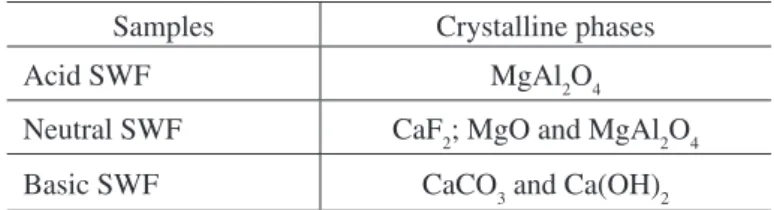
TheresultsofX-raydiffractionoftheSWFwastesamplesare
giveninTable1.Thefollowingmainmineralogicalphaseswere identiied: acid SWF waste (spinel - MgAl2O4), neutral SWF
waste(luorite-CaF2;periclase-MgO;spinel-MgAl2O4) and
basicSWFwaste(calcite-CaCO3;calciumhydroxide-Ca(OH)2).
Theseresultsareinaccordancewiththeluxcompositionsthat
originated the SWF samples [2]. As can be observed, the acid lux contains high content of magnesium and aluminum oxides, the neutral lux is rich in luorite and magnesium and aluminum
oxides,whilethebasicluxisrichincalciumcompounds.
Table1.MineralogicalcharacterizationoftheSWFwaste.
Samples Crystalline phases
Acid SWF MgAl2O4
Neutral SWF CaF2;MgOandMgAl2O4 Basic SWF CaCO3 and Ca(OH)2
The results of unitary speciic mass and bulk density, as
showninTable2,presentedonlyslightdifferences.Ascompared withnaturalsand,however,theSWFwastesamplesareabout 20%moredense.TheSWFwastewascrushedinordertoobtain a ine aggregate material. It was determined that 98% of the SWFparticlesare<4.8mm,whichcharacterizetheeficiency ofthegranulationprocessused.ItwasusedSWFwithBrazilian
Normal Sand distribution [7] in the manufacture of the mortars (ineness module equal to 2.50).
Table 2. Unitary speciic mass, bulk density and ineness module of the ine aggregates.
Samples Unitary speciic mass(g·cm-3) Bulk density(g·cm-3)
Acid SWF 2.65 3.38
Neutral SWF 2.74 3.38
Basic SWF 2.67 3.26
Natural sand 1.39 2.62
3.2 Properties of the mortars
Theresultsofconsistencyandwatercontentoftheprepared
mortarsareshowninTable3.Thecementtoineaggregateratio ofthemortarswaskeptat1:3.Thewater-cementratiowaskept
at 0.56 for the sand and neutral SWF samples, 0.52 for the acid SWF sample and 0.48 for the basic SWF sample.
The consistency index is an important property of the multiple-use mortars. The range of the consistency index speciied in the
ABNT NBR 13276 standard [11] is 255 ± 10 mm.As shown in Table 3, the consistency speciication was achieved for all
studied mortars. It can also be observed that the natural sand and
neutralSWFsamplespresentedequalvaluesofwatercontent,
and approximate values of consistency index. These results are very important because indicate that the consistency of the
mortars remained practically constant with the substitution of thenaturalineaggregate.Thus,themortarworkabilitywasnot affectedwhenSWFwastereplacednaturalsand.
The mortars made with SWF waste, as shown in Table 4,
presented higher fresh state density. This can be attributed to the higher density of the SWF than the natural sand and the minor
amountofincorporatedairobtained.Itwasalsoveriiedthatthe mortarswithlargerwatercontentpresentlessincorporatedair.
The multiple-use mortars are classiied according to the ABNT NBR 13281 standard [15] as: i) type a(incorporatedair<8%);
ii) type b (incorporated air between 8 to 18%) and iii) typec
(incorporated air > 18%).
The results show clearly that the mortar mixtures made withSWFwastepresentedaclassiicationequalorsuperiorthe traditionalmortarpreparedwithnaturalsand.
Table3.Consistencyindexandwatercontentofthemortars.
Mortars / Mix proportions Water content (%) Consistency (mm)
Acid SWF / 1:3:0.52 13 260
Neutral SWF / 1:3:0.56 14 250
Basic SWF / 1:3:0.48 12 257
Natural sand / 1:3:0.56 14 245
Table 4. Fresh state density and incorporated air of the mortars.
Mortars / Mix proportions
Fresh state density Incorporated air ABNT NBR 13281 standard [15] (g.cm-3) (%)
Acid SWF / 1:3:0.52 2.41 8 Type b
Neutral SWF / 1:3:0.56 2.51 2 Type a
Basic SWF / 1:3:0.48 2.34 10 Type b
Natural sand / 1:3:0.56 2.02 10 Type b
The compressive strength is another important property used to verify the production uniformity and control of cements
and mortars [16]. Figure 2 shows the compressive strength of the mortars. The results showed that all mortars presented
mechanical strength above the values speciied (≥ 8 MPa - Class III) according to ABNT NBR 13281 [15].
Figure2alsoshowsthatthecompressivestrengthincreases
themortarsmadewithSWFwastepresentedhighercompressive strength,forallagingtimes,thantheordinarymortarmadewith
natural sand. The basic SWF mortar (1:3:0.48) presented the best mechanical strength, reaching 39 MPa after 28 days and 49
MPaafter120daysaging,becausethelesswater/cementratio
used.
Thus, mortars using SWF waste of any type (acid, neutral orbasic)asineaggregatecanbemadewithfullreplacementof
natural sand.
Figure3showstheresultsoftensilestrengthofthemortar
specimens. It can be observed that the mortar with acid SWF (1:3:0.52)andwithneutralSWF(1:3:0.56)presentedveryclose
tensile strengths, and the basic SWF (1:3:0.48), as a result of the
lowestwater-cementratio,presentedthehighertensilestrength
than the other ones.
TheresultsalsoshowthatallmortarsmadewithSWFwaste
presented higher tensile strength than the mortar made with
natural sand.
Figure 2. Compressive strength of the mortars.
Figure 3. Tensile strength of the mortars.
It is important to emphasizes that the transformation of periclase (MgO) into brucite, Mg(OH)2 (expansive and
deleterious product), due to slow hydration process, was not presentedbythemortarwithneutralSWF,evenafter120days
of age.
3.3 Properties of the clay bricks
ThequalityoftheclaybricksincorporatedwithacidSWF
waste,iredat950ºC,wasevaluatedbymeasuringthefollowing physical-mechanical properties: linear shrinkage, water
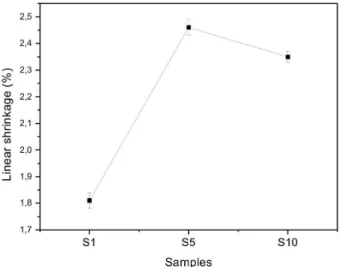
absorption, apparent porosity, apparent density, and lexural strength (Figures 4 to 8). The linear shrinkage of the specimens,
asshowninFigure4,increasedwithwasteaddition.Thiswas
attributed to the chemical-mineralogical composition of the
waste,whichcontributestoincreasethesinteringdegreeofthe
specimens. In addition, the values of linear shrinkage (1.81 to
2.46%)arewithintheacceptablerangeforindustrialproduction
of clay bricks.
Figure 4. Linear shrinkage of the ceramic bricks.
The water absorption of the prepared bricks is shown in Figure 5. The results show that there are not restrictions for incorporationofSWFwasteinclaybricks(waterabsorption< 25%).The apparent porosity, as shown in Figure 6, presented similarbehaviortowaterabsorption.
Figure 6. Apparent porosity of the ceramic bricks.
Figure 7. Apparent density of the ceramic bricks.
Figure 8. Flexural strength of the ceramic bricks.
TheapparentdensityofthebricksisshowninFigure7.As
expected, the apparent density increases with waste addition.
This is caused mainly by open-pore closure, resulting in better densiication of the bricks.
ThelexuralstrengthofthebricksisshowninFigure8.The
effectoftheincorporationoftheSWFwastewastoincreasethe
mechanical strength of the bricks. This is related to the higher densiication of the bricks.
4. Conclusions
Basedontheexperimentalresults,thefollowingconclusions
canbedrawn:
the three SWF waste samples (acid, neutral, and basic)
•
presented all requirements for use as ine aggregate in multiple-use mortars according to the ABNT NBR 13281
standard[15];
the mortars made with SWF waste, when compared to the
•
ordinary mortar made with natural sand, presented equal
or better behavior, measured by means of technological properties as consistency, fresh state density, incorporated air
contentandmechanicalstrengths;
theSWFwastecanbeusedasanalternativerawmaterialfor
•
manufacturing of clay bricks. It was demonstrated that the technologicalpropertiesofthebricksincorporatedwithupto 10wt.%ofSWFwastereplacingclayarecompatiblewith
those speciied for ceramic bricks.
5. Acknowledgements
The authors acknowledge the CNPq and Tecnorte/Fenorte
for inancial support, and to the Machado Viana Comércio e Indústria Ltda - Caldeiraria, Usinagem e Fundição, and Alborg
Industriesbythesupplyoftheweldingluxslags.
6. References
[1] MODENESI, P. J. Técnica operatória da soldagem SAW, UFMG/DEMM, http://www.infosolda.com.br/artigos/prosol04.
pdf. Acessado em janeiro de 2005.
[2] PARANHOS, R. P. R.; SOUZA A. C. Soldagem a arco
submerso. Rio de Janeiro: SENAI/RJ-CETEC de Solda, 1999. 77 p.
[3]MORETE,G.F.;PARANHOS,R.P.R.;HOLANDA J. N. F.
Aproveitamento de resíduo de escória de soldagem em materiais cerâmicos para construção civil, Soldagem & Inspeção, v.11, n. 3, p. 141-146, 2006.
[4] DONDI, M.; MARSIGLI, M.; FABBRI, B. Recycling of industrialandurbanwastesinbrickproduction-areview,Tile
& Brick International, v. 13, p. 218-225, 1997.
[5] MIRANDA, L. F. R.; SELMO, S. M. S.Desempenho de
revestimentos de argamassa com entulho reciclado. Boletim Técnico da Escola Politécnica da USP/DECC - BT/PCC/277, São Paulo, 2001. 12 p.
[6] MENEZES, R. R.; NEVES, G.A.; FERREIRA, H. C. O
cerâmicas alternativas, Revista Brasileira de Engenharia Agrícola e Ambiental, v. 11, n. 2, p. 303-313, 2002.
[7] ASSOCIAÇÃO BRASILEIRA DE NORMAS TÉCNICAS. NBR 7214: Areia normal para ensaio de cimento - especiicação. Rio de Janeiro, 1982.
[8] SOUZA, G. P.; SOUSA, S. J. G.; TERRONES, L. A. H.; HOLANDA, J. N. F. Mineralogical analysis of ceramic
sedimentary clays used in red ceramic, v. 51, n. 320, p. 180-186, 2005.
[9] ASSOCIAÇÃO BRASILEIRA DE NORMAS TÉCNICAS. NBR 7251: Agregado em estado solto - determinação da massa unitária. Rio de Janeiro, 1982.
[10] ASSOCIAÇÃO BRASILEIRA DE NORMAS TÉCNICAS. NBR 9776: Agregados: determinação da massa especíica de agregados miúdos por meio de frasco de Chapman. Rio de Janeiro, 1987.
[11] ASSOCIAÇÃO BRASILEIRA DE NORMAS TÉCNICAS. NBR 13276: Argamassa para assentamento de paredes e revestimento de paredes e tetos - determinação do teor de água para obtenção do índice de consistência-padrão. Rio de Janeiro, 1985.
[12] ASSOCIAÇÃO BRASILEIRA DE NORMAS TÉCNICAS. NBR 13278: Argamassa para assentamento de paredes e revestimento de paredes e tetos - determinação da densidade de massa e do teor de ar incorporado. Rio de Janeiro. 1995. [13] ASSOCIAÇÃO BRASILEIRA DE NORMAS TÉCNICAS. NBR 13279: Argamassa para assentamento de paredes e revestimento de paredes e tetos - determinação da resistência à compressão. Rio de Janeiro. 1995.
[14] ASSOCIAÇÃO BRASILEIRA DE NORMAS TÉCNICAS. NBR 7215: Cimento Portland - determinação da resistência à compressão. Rio de Janeiro. 1996.
[15] ASSOCIAÇÃO BRASILEIRA DE NORMAS TÉCNICAS. NBR 13281: Argamassa industrializada para assentamento de paredes e revestimento de paredes e tetos - especiicação. Rio de Janeiro, 2001.
[16] NAKAKURA, E. H.; CINCOTTO, M. A. Análise dos