ISSN 0104-6632 Printed in Brazil
www.abeq.org.br/bjche
Vol. 23, No. 04, pp. 525 - 530, October - December, 2006
Brazilian Journal
of Chemical
Engineering
SELECTIVITY IN THE EXTRACTION OF
2-QUINOLONE ALKALOIDS WITH
SUPERCRITICAL CO
2
L. L. B. Santana
1, L. A. Cardoso
2, J. I. Druzian
3, V. F. Souza
2, T. A. C. Costa
2,
D. A. Nóbrega
2, S. V. A. Hohlemwerger
1and E. S. Velozo
1*1
Departamento do Medicamento, Laboratório de Pesquisa em Matéria Médica (LAPEMM), Faculdade de Farmácia , Universidade Federal da Bahia, UFBA, Phone, Fax: +(55) (71) 3332-1580, R. Barão de Jeremoabo s/n, Campus Universitário de Ondina, CEP 40.170-290 Salvador - Bahia, Brazil.
E-mail: [email protected] 2
Departamentode Química Orgânica,Instituto de Química, GESNAT (AGRONEX),UFBA, CEP 40.170-290 Salvador - Bahia, Brazil.
3
Departamento de Análises Bromatológicas, Laboratório de Cromatografia, Faculdade de Farmácia, UFBA, CEP 40.170-290 Salvador - Bahia, Brazil.
(Received: October 20, 2004 ; Accepted: May 10, 2006)
Abstract- This work describes the conditions for selective extraction of the alkaloids in Andreadoxa flava (Kallunki). The experiments were performed in a pilot plant SFE 500, in the following conditions. Extractor pressures 206.8 x 10⁵, 241.3 x 10⁵, 275.8 x 10⁵ and 310.3 x 10⁵ Pascal and pressures of 137.9 x 10⁵, 69.0 x 10⁵ and 55.2 x 10⁵ Pascal for separators 6, 7 and 8 respectively. The temperatures were 40 °C in the extractor and 20 oC in the separators. The samples, extracted from A. flava leaves, were analysed by 1H NMR and GC/FID as well as by comparison with standards. This procedure allowed the identification for the first time of the 2-quinolone alkaloid 8-methoxy-N-methyl-flindersine in A. flava leaves of the. In addition, zanthophylline, 5-methoxyalmene and 8-methoxyflindersine were identified as the main alkaloids in leaves. Under the best conditions for zanthophylline extraction it was possible to obtain a purity of 79.4% while with other phytochemical technique 55.5% was obtained.
Keywords: Supercritical CO2 extraction; Alkaloids; 2-quinolone; Andreadoxa flava.
INTRODUCTION
Superior plants have a large variety of micromolecules. These metabolites are used in perfumes, personal hygiene products and in the pharmaceutical and food industries. These substances can be classified in accordance with its biosynthetic origin. Alkaloids are among the most diversified classes of natural products. These substances are generally, bitter taste and have different biological properties, and some of them have a therapeutical effect on human beings when administered in appropriate doses [Simões et al.,
1999]. The literature describes important therapeutical activities for 2-quinolone alkaloids such as antineoplasics, sedatives and antiarrhythmics. A previous study demonstrated that Andreadoxa flava, belonging to the Rutaceae family, is a rich source of this class alkaloid [Hohlemwerger et al., 2004].
elimination of the solvents, it is difficult to remove all residual solvent and the variation in pH can produce chemical alterations and possible toxic effects in the final product [Maul et al., 1998; Ndiomu and Simpson, 1998 ].
Extraction by supercritical fluid is an alternative to the conventional processes that allows to obtain high-quality products using a clean technology combined with the high efficiency of processing [Freitas et al., 2001]. Substances like caffeine, theobromine, quinine, morphine, theophilline and nicotine vary basicity and polarity and have been obtained by supercritical fluid extraction both with and without the aid of a co-solvent [Johannsen and Bruner, 1994; Lim and Hartland, 1996].
The objective of this study was to establish some parameters for the selective extraction of 2-quinolone alkaloids from Andreadoxa flava leaves
using supercritical CO2.
MATERIALS AND METHODS
Andreadoxa flava (Kallunki) leaves, collected in
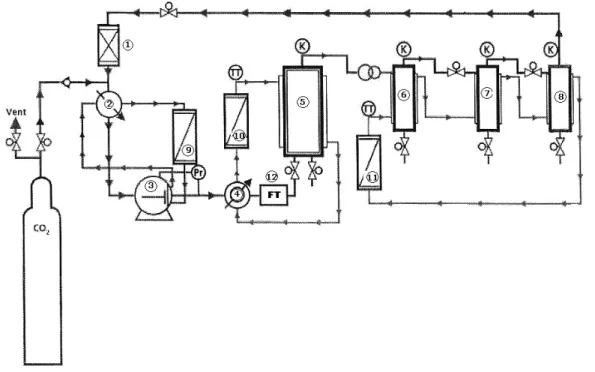
the city of Ilhéus (BA), were dried at room temperature, triturated and later submitted to supercritical extraction CO2 in a SFE 500 pilot plant,
which is illustrated in Figure 1. This unit is composed of a cylinder contends CO2; a condenser
(2); a pump (3) for the transport of CO2 to the 400
mL extractor (5); after passing through a heater (4) and an outflow measurer (12); three separators (6, 7, 8) 16 mL each; a filter containing activated charcoal (1) to hold back the material that passes through the separators when the CO2 is recycled; a cooling bath
(9); and two hea baths (10 and 11).
Figure 1: Scheme of the SFE-500 pilot plant for supercritical fluid extraction.
The samples collected after extraction with supercritical CO2 were analyzed using thin-layer
chromatography (TLC) where after elution the plates of the TLC were developed with ultraviolet light at 240 nm and 360 nm, iodine and Dragendorff reagent for alkaloid detection. Some samples were analyzed by proton nuclear magnetic resonance (PNMR) in a spectrometer operating at 300 MHz in CDCl3 and
having tetramethylsilane as internal standard. The components of each collected fraction were identified and quantified using a Perkin Elmer gas
Table 1:Conditions for extraction from A. flava leaves. The temperature of the extractor (E) was 40ºC and of the separators (S) it was 20ºC. Pressure of the separators decreased from 137.9 X 10⁵
to 69.0 X 10⁵ and then to 55.2 X 10⁵ Pascal. The flow of the gas (V) is in Kg/h, the time of contact (TC) in minutes, and the pressure of the extractor (E) in Pascal.
Condition V TC E Extracts
1* 3,6 30 275.8 × 10⁵ A1-A10
2 3,6 45 206.8 × 10⁵ B1-B4
3 3,6 45 241.3 × 10⁵ C1-C4
4 4,2 30 310.3 × 10⁵ D1-D4
*Under the first condition of extraction, three samples were collected in the separators (6, 7 and 8) at intervals of 30 minutes and after 90 minutes a sample was collected in the extractor.
RESULTS AND DISCUSSION
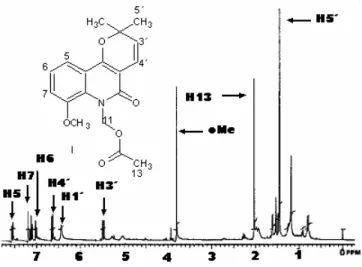
All the TLC of the fractions collected under the different conditions indicated the presence of alkaloids. The samples with high alkaloids contents were selected for analysis by PNMR. The spectra of the A-3 fraction (Figure 2), obtained in the third separator the first condition of extraction, had signals identical to the ones described in the literature for the 2- quinolone alkaloid zanthophylline (I) [Hohlemwerger at al., 2004].
The TLC still made possible the detection of other alkaloids in the fractions. For identification, the fractions obtained in the supercritical fluid extraction and previously isolated alkaloid standards for A.
flava were analyzed by GC/FID. The criteria of
choice of the samples for analysis by GC were yield and indication of the presence of alkaloids. These were mainly the samples collected in the extractor and the third separator under each condition. A comparison of the retention times (tR) of substances
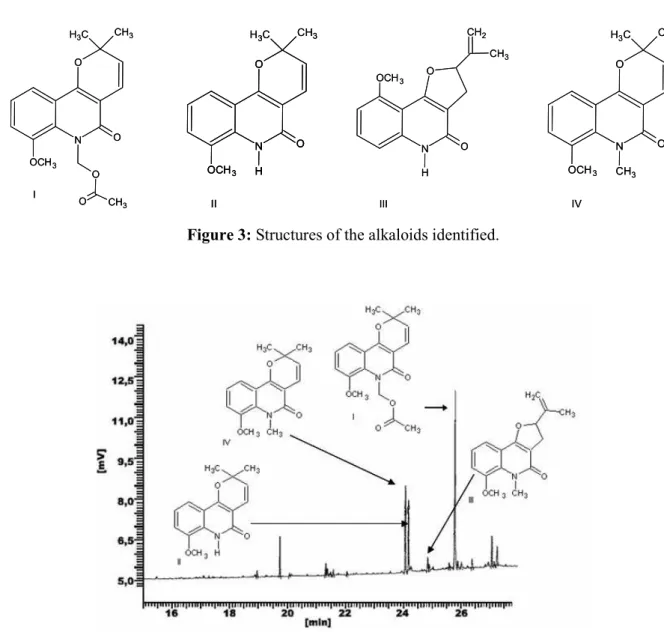
in the chromatographs of the samples obtained with the times of retention of the 2-quinolone alkaloid standards made it possible to identify (I)
zanthophylline, tR = 25,86 min; (II)
8-methoxyflindersine, tR = 25,25 min; (III)
5-methoxyalmene, tR = 24,86 min and (IV)
8-methoxy-N-methyl-flindersine, tR = 24,19 min, with the last
one being identified for the first time in A. flava
leaves. In Figures 3 and 4 the structures of these substances and the chromatograph of the A-9 fraction, respectively, are shown.
Figure 2: PNMR spectra (300 MHz in CDCl3) of the A-3 fraction, collected in
N O CH3 C H3 O O CH 3 O OCH 3 I N O CH3 C H3 O O CH 3 O OCH 3 I CH C H N O 3 3 O H OCH3 II CH C H N O 3 3 O H OCH3 II N O 3 3 O H OCH3 II N O H OCH3 O CH3 CH2 III N O H OCH3 O CH3 CH2 III N O CH3 C H3 O CH3 OCH3 IV N O CH3 C H3 O CH3 OCH3 IV
Figure 3: Structures of the alkaloids identified.
Figure 4: GC/FID of the A-9 fraction, the third fraction collected in the third separator under the first condition of extraction after 90 min of contact.
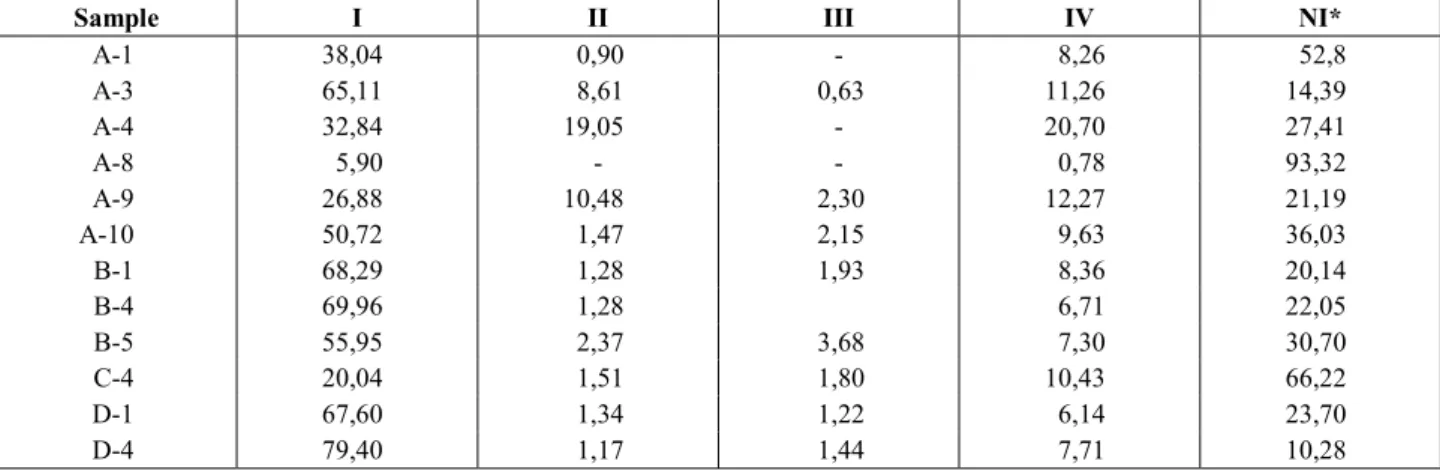
Besides identification of the alkaloids, it was also possible to calculate the percentage of each component in the selected samples, using the normalization method. These values are presented in Table 2.
A comparison of the compositions of samples obtained under the conditions tested allowed verification that the zanthophylline alkaloid, because of its high solubility in CO2, is present in the
majority of the samples. Fractions A-3, A-9, B-4, C-4 and D-C-4, collected in the third separator, showed the largest amounts of this substance. The fraction collected in the third separator at the highest extraction pressure (310.3 X 10⁵ Pa) had the largest
amount of zanthophylline. The results indicate that the density of CO2 is an important factor in the
selectivity of the extraction for this alkaloids. The present work also compared SCFE with the conventional phytochemical techniques for attainment of these alkaloids. The chromatograph presented in Figures 5 and 6 provide evidence of the selectivity of SCFE compared to extraction using conventional phytochemical methods.
Table 2: Percent (%) of alkaloids: zanthophylline (I) 8-methoxyflindersine (II), 5-methoxyalmene (III) and 8-methoxy-N-methyl-flindersine (IV)
Sample I II III IV NI*
A-1 38,04 0,90 - 8,26 52,8 A-3 65,11 8,61 0,63 11,26 14,39
A-4 32,84 19,05 - 20,70 27,41
A-8 5,90 - - 0,78 93,32
A-9 26,88 10,48 2,30 12,27 21,19
A-10 50,72 1,47 2,15 9,63 36,03
B-1 68,29 1,28 1,93 8,36 20,14
B-4 69,96 1,28 6,71 22,05
B-5 55,95 2,37 3,68 7,30 30,70
C-4 20,04 1,51 1,80 10,43 66,22
D-1 67,60 1,34 1,22 6,14 23,70
D-4 79,40 1,17 1,44 7,71 10,28
*NI- not identified
Figure 5: GC/FID of the D-4 fraction, collected in the third separator under the fourth condition of extraction
Figure 6: GC/FID of the fraction of zanthophylline a obtained by conventional phytochemical methods.
CONCLUSIONS
This study enabled the identification of 8-methoxy-N-methyl-flindersine alkaloid in A. flava
leaves, not detected by traditional phytochemical methods. It also established a method for the selective extraction of 2-quinolone alkaloids, mainly the zanthophylline alkaloid from A. flava leaves,
proving that selectivity of extraction with supercritical CO2 is greater than that with the
REFERENCES
Freitas, C.M.J., Guedes, M.L.S. and Velozo, E.S., Extração com Solvente e Fluido Supercrítico dos Constituintes do Caule Subterrâneo de
Spiranthera odoratissimaA. ST. Hill (Rutaceae).
Revista Brasileira de Farmacognosia, vol.12 sup., pp.19-21 (2002)
Hohlemwerger, S.V.A., Tavares W., Carvalho, A.M., Vieira, P.C. and Velozo, E.S., 2-Quinolones Alkaloids from the Rare Specie of Rutaceae -
Andreadoxa flava Kallunki. Biochemical
Systematics and Ecology, vol.32, pp.627-629 (2004).
Johannsen, M.A. and Bruner, G., Solubility of the Xanthines Caffeine, Theophylline and Theobromine
in Supercritical Carbon Dioxide. Fluid Phase Equilibria, vol.95, pp.215-226 (1994).
Lim, S. and Hartland, S.A., New Industrial Process for Extracting Cocoa Butter and Xanthines with Supercritical Carbon Dioxide. Journal American Chemical Society, vo.73, pp.423-429 (1996). Maul, A.A., Wasicky, R. and Bacchi, E.M., Extração
por Fluido Supercrítico, Revista Brasileira de Farmacognosia, vol.5, no.2, pp.185-200 (1998). Ndiomu, D.P. and Simpson, C.F., Some Applications
of Supercritical Fluid Extraction. Analytica Chimica Acta, vol. 213, pp.237-243 (1998).
Simões, C.M., Shenkel, E. P., Gosmann, G. and Mello, J.C.P., Farmacognósia da Planta ao Medicamento. Ed. Universidade Federal do Rio Grande do Sul, Porto Alegre, Brazil (1999).