Performance of rubella
suspect case definition:
implications for surveillance
Acurácia da definição de caso
suspeito de rubéola: implicações
para vigilância
ABSTRACT
OBJECTIVE: To assess the performance of the rubella suspect case definition
among patients with rash diseases seen at primary care units.
METHODS: From January 1994 to December 2002, patients with acute rash, with
or without fever, were seen at two large primary health care units and at a public general hospital in the municipality of Niterói, metropolitan area of Rio de Janeiro, Brazil. Data from clinical and serologic assessment were used to estimate the positive predictive values of the definition of rubella suspect case from the Brazilian Ministry of Health and other combination of signs/symptoms taking serologic status as the reference. Serum samples were tested for anti-rubella virus IgM using commercially available enzyme immunoassays. Positive predictive values and respective 95% confidence intervals were calculated.
RESULTS: A total of 1,186 patients with an illness characterized by variable
combinations of rash with fever, arthropathy and lymphadenopathy were studied. Patients with rash, regardless of other signs and symptoms, had 8.8% likelihood of being IgM-positive for rubella. The Brazilian suspect case definition (fever and lymphadenopathy in addition to rash) had low predictive value (13.5%). This case definition would correctly identify 42.3% of the IgM-positive cases, and misclassify 26.1% of the IgM-negative cases.
CONCLUSIONS: These results support the recommendation to investigate and
collect clinical specimens for laboratory diagnosis of all cases of rash, for surveillance purposes. Although this strategy may increase costs, the benefits of interrupting the circulation of rubella virus and preventing the occurrence of congenital rubella syndrome should pay off.
KEYW O RD S: Rubella, epidemiology. Rubella, diagnosis. Predictive value. Epidemiologic surveillance. Case definition.
RESU M O
OBJETIVO: Avaliar a acurácia da definição de caso suspeito de rubéola entre pacientes
com doenças exantemáticas atendidos em unidades de saúde pública.
MÉTODOS: A população de estudo foi constituída de pacientes com doença
exantemática, com ou sem febre, atendidos em serviços de saúde pública, de janeiro de 1994 a dezembro de 2002 no município de Niterói, RJ. Dados clínicos e sorológicos foram utilizados para estimar os valores preditivos positivos da definição de caso
Solange Artimos de O liveiraI
Luiz Antonio Bastos CamachoII
Antonio Carlos de M edeiros PereiraI
M arília M attos BulhõesIII
Angélica Fortes AguasIV
M arilda M endonça SiqueiraV
I Disciplina de Doenças Infecciosas e
Parasitárias. H ospital U niversitário Antonio Pedro. Niterói, RJ, Brasil
I I Escola Nacional de Saúde Pública.
Fundação Oswaldo Cruz. Rio de Janeiro, RJ, Brasil
I I IMinistério da Saúde e Fundação Municipal
de Saúde de Niterói. Niterói, RJ, Brasil
I V Policlínica Comunitária Santa Rosa.
Fundação Municipal de Saúde de Niterói. Niterói, RJ, Brasil
V Departamento de Virologia. Instituto
Oswaldo Cruz. Fiocruz. Rio de Janeiro, RJ, Brasil
Correspondence:
Solange Artimos de Oliveira Disciplina de Doenças Infecciosas e Parasitárias
Hospital Universitário Antonio Pedro Rua Marquês do Paraná, 303 2o andar
24030-210 Niterói, RJ, Brasil E-mail: [email protected]
suspeito de rubéola do Ministério da Saúde do Brasil e outras combinações de sinais e sintomas, considerando o resultado da sorologia como referência. A detecção de IgM específ ica para rubéola em amostras sangüíneas foi realizada por ensaio imunoenzimático. Foram calculados os valores preditivos positivos e respectivos intervalos de confiança de 95%.
RESULTADOS: Foram estudados 1.186 pacientes com uma doença caracterizada
por uma variada combinação de rash com ou sem febre, artropatia e linfoadenopatia. Pacientes com exantema, independentemente da presença de outros sinais e sintomas, apresentaram uma probabilidade de 8,8% de serem IgM positivos para rubéola. A definição de caso suspeito de rubéola utilizada no Brasil apresentou baixo valor preditivo positivo (13,5%). Esta definição de caso identificou corretamente 42,3% dos casos IgM positivos, e classificou de forma incorreta 26,1% dos IgM negativos.
CONCLUSÕES: Os resultados indicam que as doenças exantemáticas devem ser
investigadas em conjunto para fins de vigilância epidemiológica e coleta de espécimens clínicos para o diagnóstico laboratorial. Esta estratégia aumenta os custos, mas gera benefícios na interrupção da circulação do vírus e na prevenção da síndrome da rubéola congênita.
D ESCRITO RES: Rubéola, epidemiologia. Rubéola, diagnóstico. Valor preditivo. Vigilância epidemiológica. D efinição de caso.
INTRODUCTION
Rubella is a common cause of childhood rash (ex-anthema) and fever in non-immunized populations, and its public health importance relates to tera-togenic effects of primary rubella infection in
preg-nant women.5 The infection caused by rubella virus
is usually mild, with most cases presenting as
sub-clinical or unrecognized events.7,18 Besides, the most
common symptoms of rubella (maculopapular rash, low-grade fever, posterior cervical and suboccipital adenopathy, and arthralgia/arthritis, especially in adult females) can easily be mistaken for other rash
diseases.1,8,14,16 Therefore, a definitive diagnosis of
rubella can be made only by specific laboratory
methods.18
Mass immunization against rubella was gradually implemented by Brazilian states in primary care units between 1992 and 2000, in campaigns targeting chil-dren aged 1-11 years. By 2000, all Brazilian states had initiated routine use of combined measles, mumps, and rubella (MMR) vaccine, with one dose scheduled for 15 months of age. In 2003, the age of vaccination was changed to 12 months with a booster
dose at 4-6 years of age.12
Although rubella surveillance in Brazil had begun in
1996 when case reporting became mandatory,12 its
effectiveness varied across the country. As part of the regional goal for measles elimination in the Ameri-cas by the year 2000, rubella surveillance was
inten-sified in 1999 and integrated into measles surveil-lance. With the improvement of epidemiological sur-veillance of rubella and congenital rubella syndrome (CRS) outbreaks among young adults were reported
during 1999-2000.15 To prevent the occurrence of
CRS, a rubella vaccination campaign targeting 12-30-year-old females nationwide was conducted in two
phases during 2001-2002.12
Case investigation and identification of contacts are now recommended for all suspected cases of
rubella.3 Case definition is a fundamental
compo-nent of disease surveillance. The current defini-tion of rubella suspect case from the Brazilian Min-istry of Health relies on the presence of maculopa-pular rash of acute onset, fever and retroauricular,
occipital and cervical lymphadenopathy12 to
prompt further investigation and laboratory or epi-demiologic conf irmation.
Thus, the objective of this study was to assess the performance of the rubella suspect case definition from the Brazilian Ministry of Health among patients with rash diseases. Data gathered along nine years, in a research project of surveillance of rash diseases, provided a unique opportunity to verify the effec-tiveness of the set of clinical criteria to select pa-tients thought to include rubella cases.
M ETH O D S
clinical and serologic assessment conducted on cases of rash were used to estimate the positive predictive values of the definition of suspect case from the
Bra-zilian Ministry of Health12 and of other combination
of signs/symptoms taking the serologic status as a reference. Sensitivity and specificity could not be estimated since serologic tests for rubella were not available in cases without rash.
From January 1994 to December 2002, 1,186 pa-tients with acute rash, with or without fever, were seen at two large primary health care units and at a public general hospital in the municipality of Niterói, State of Rio de Janeiro, Southern Brazil. The study population comprised patients attending the two largest primary health care units and a gen-eral hospital from the public network with a catch-ment area of approximately 50% of the population of the municipality of Niterói (459,451 inhabitants in 2000*). The clientele of those health units has predominantly middle and low socioeconomic sta-tus. Individuals of any age presenting spontaneously to those health units with maculopapular rash were considered eligible for the study regardless of ac-companying symptoms. Cases were excluded from the study if the rash was vesiculopapular or urticariform, or if more than 30 days had elapsed after the start of rash. A standard clinical examina-tion was performed and a clotted blood sample for serology was collected in a sterile glass tube at the time the patient was enrolled in the study.
Symptoms and signs (measured or reported fever, myalgia, malaise, headache, runny nose, conjuncti-vitis, arthropathy, lymphadenopathy and other symp-toms) were assessed as in usual care by medical doc-tors at the time of enrollment. Signs, symptoms and their duration, and sociodemographic data were re-corded on a form designed for the study.
All serum samples were tested for anti-rubella virus IgM using commercially available enzyme immu-noassays (EIA): Rubenostika II IgM, Organon Teknika
(Boxtel, Holland) (1994-1999) and Enzygnost
anti-rubella-virus/IgM, Dade Behing (Marburg, Germany) (2000-2002). Sera were also tested for measles virus IgM using an antibody capture EIA developed at the
Centers for Disease Control (Atlanta, USA)9
(1994-1998) and a commercially available EIA: Enzygnost anti-measles virus/IgM, Dade Behring (Marburg, Germany) (1999-2002), and for dengue virus IgM by
an in-house EIA.10,13 Specimens negative for rubella,
measles and dengue virus IgM were also tested for anti-human parvovirus B19 IgM using an antibody
capture EIA (MACEIA).4 An indirect
immunofluores-cence test for human herpes virus type 6 (HHV-6) IgG17
was also used to detect low avidity HHV-6 IgG (indi-cating recent primary infection) in children less than 4 years of age without an alternative diagnosis.
The positive predictive values of the suspect case
definition from the Brazilian Ministry of Health12
and of other specified combinations of signs/symp-toms were estimated by the proportion of those pa-tients who were found to be seropositive for ru-bella. Confirmed rubella cases taken as reference had at least one serum sample testing positive for rubella IgM, regardless of the clinical picture and the time of disease. Data analysis was stratified by age to account for differences in clinical presenta-tion of rubella in children and adults, and by time period, acknowledging the two distinct phases of surveillance and control of rash diseases in Brazil. Ninety-f ive percent confidence intervals for the estimates were constructed. Data were analyzed using Epi Info 6.04d.
Informed consent was obtained for all participants and from the parents or guardians of patients younger than 18 years of age. The study was approved by the hospital’s Institutional Review Board.
RESU LTS
A total of 1,186 patients presenting exanthematous disease with variable combinations of rash with fe-ver, arthropathy and lymphadenopathy were stud-ied from January 1994 to December 2002. There were few losses due to failure in venopuncture or inad-equate blood samples, but no refusals. Laboratory confirmed diagnosis was achieved in 673 (56.7%) cases investigated: dengue fever (354 cases, 52.6%), human parvovirus B19 (120 cases, 17.8%), rubella (104 cases, 15.5%), HHV-6 (63 cases, 9.4%), and measles (32 cases, 4.7%). No diagnosis was estab-lished in 513 (43.3%) cases that were seronegative for rubella, measles, dengue, parvovirus and HHV-6. That proportion was lower among individuals with one day of rash (22%). In fact, for cases without labo-ratory confirmation, the proportion of cases with one day of rash was lower (7%) compared to those with serological confirmation (18%). Altogether, 47% of the participants had blood samples drawn within two to five days of rash. Among patients with-out laboratory diagnosis 53.4% were less than 15 years old and 59.2% were female subjects, whereas those with serologic confirmation had 49.5% below 15 years and 58.4% of female subjects. Patients were
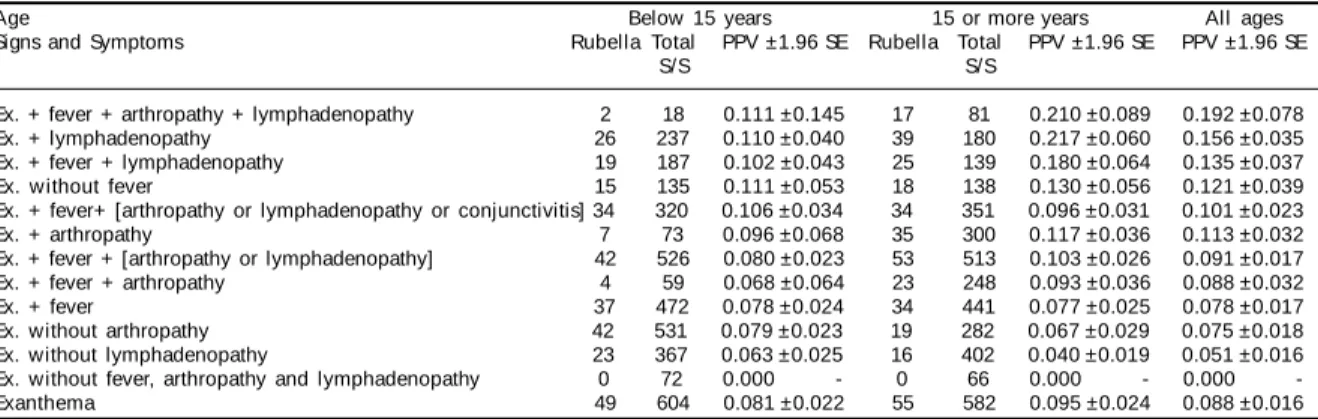
divided in rubella (104 cases) and non rubella (1,082 cases) to assess the performance of the rubella sus-pect case definition (Table 1).
Patients of all ages presenting with rash, regardless of other signs and symptoms, had 8.8% probability of being IgM positive for rubella (Table 1). The combi-nation with at least one of the symptoms fever, lym-phadenopathy or arthropathy did not increase sub-stantially the positive predictive value (PPV). Indi-viduals aged 15 years or more with lymphadenopa-thy in addition to rash were the most likely to have rubella IgM antibodies (21.7%).
The suspect case definition from the Brazilian Min-istry of Health (fever and lymphadenopathy in addi-tion to rash) had low predictive values for both age groups studied: 10.2% in patients below 15 years and 18% in those with 15 or more years. Overall, this suspect case def inition would correctly identify 42.3% of the IgM-positive cases of rash, and mis-classify 26.1% of the IgM-negative cases of rash. However, assuming a 50% sensitivity of rash for ru-bella, most cases both in children and in adults would
not be detected by this combination of signs and symptoms.
The combination fever and arthropathy or lymphad-enopathy, which combined with rash is the case defi-nition recommended by the World Health
Organiza-tion,18 also achieved low PPV (9.1%) in both age
groups. Besides, 944 (87.2%) of the 1,082 IgM-nega-tive cases with rash also presented those symptoms (false positives).
Rash with fever (regardless of other signs/symptoms) was found in 67.3% of rubella IgM-positive cases, but also in 77.8% of the other rash diseases. The latter would constitute false positives if rash with fever was used to indicate putative rubella cases in this setting.
The performance of the rubella suspect case defini-tion recommended by the Centers of Disease Con-trol and Prevention (rash, fever and one of the fol-lowing: lymphadenopathy, arthropathy or
conjunc-tivitis)3 was also assessed. The overall PPV found
(10.1%) was not much better than the results
ob-Table 1 - Positive predictive value (PPV) and 95% confidence interval of different combinations of exanthema with other signs and symptoms. Niterói, Brazil, 1994-2002.
Age Below 15 years 15 or more years All ages
Signs and Symptoms Rubella Total PPV ±1.96 SE Rubella Total PPV ±1.96 SE PPV ±1.96 SE
S/S S/S
Ex. + fever + arthropathy + lymphadenopathy 2 18 0.111 ±0.145 17 81 0.210 ±0.089 0.192 ±0.078 Ex. + lymphadenopathy 26 237 0.110 ±0.040 39 180 0.217 ±0.060 0.156 ±0.035 Ex. + fever + lymphadenopathy 19 187 0.102 ±0.043 25 139 0.180 ±0.064 0.135 ±0.037 Ex. without fever 15 135 0.111 ±0.053 18 138 0.130 ±0.056 0.121 ±0.039 Ex. + fever+ [arthropathy or lymphadenopathy or conjunctivitis] 34 320 0.106 ±0.034 34 351 0.096 ±0.031 0.101 ±0.023 Ex. + arthropathy 7 73 0.096 ±0.068 35 300 0.117 ±0.036 0.113 ±0.032 Ex. + fever + [arthropathy or lymphadenopathy] 42 526 0.080 ±0.023 53 513 0.103 ±0.026 0.091 ±0.017 Ex. + fever + arthropathy 4 59 0.068 ±0.064 23 248 0.093 ±0.036 0.088 ±0.032
Ex. + fever 37 472 0.078 ±0.024 34 441 0.077 ±0.025 0.078 ±0.017
Ex. without arthropathy 42 531 0.079 ±0.023 19 282 0.067 ±0.029 0.075 ±0.018 Ex. without lymphadenopathy 23 367 0.063 ±0.025 16 402 0.040 ±0.019 0.051 ±0.016 Ex. without fever, arthropathy and lymphadenopathy 0 72 0.000 - 0 66 0.000 - 0.000
-Exanthema 49 604 0.081 ±0.022 55 582 0.095 ±0.024 0.088 ±0.016
Ex.: Exanthema; S/S: Signs and symptoms; SE: Standard error
Table 2 - Positive predictive value (PPV) of different combinations of exanthema with other signs and symptoms, according to the study period. Niterói, Brazil, 1994-2002.
Study period 1994-1997 1998-2002
Age Below 15 years 15 or more years All ages*
Signs and Symptoms RubellaTotal PPV ±1.96 SE RubellaTotal PPV ±1.96 SE RubellaTotal PPV ±1.96 SE
S/S S/S S/S
Ex. + fever + arthropathy + lymphadenopathy 2 6 0.333±0.377 13 40 0.325±0.145 4 53 0.075±0.071 Ex. + lymphadenopathy 25 77 0.325±0.105 31 90 0.344±0.098 8 247 0.032±0.022 Ex. + fever + lymphadenopathy 18 59 0.305±0.117 20 66 0.303±0.111 5 199 0.025±0.022 Ex. without fever 15 43 0.349±0.142 13 45 0.289±0.132 5 184 0.027±0.023 Ex. + fever + [arthropathy or lymphadenopathy or conjunctivitis 33 110 0.300±0.086 26 132 0.245±0.073 9 425 0.021±0.014 Ex. + arthropathy 7 24 0.292±0.182 26 104 0.250±0.083 9 243 0.037±0.024 Ex. + fever + [arthropathy or lymphadenopathy] 40 158 0.253±0.068 31 179 0.173±0.055 10 688 0.015±0.009 Ex. + fever + arthropathy 4 18 0.222±0.192 17 82 0.207±0.088 6 206 0.029±0.023
Ex. + fever 33 139 0.237±0.071 27 159 0.170±0.058 10 611 0.016±0.010
Ex. without arthropathy 42 159 0.264±0.069 19 105 0.181±0.074 - 548 - ±0.000 Ex. without lymphadenopathy 23 105 0.219±0.079 9 114 0.079±0.050 7 550 0.013±0.009 Ex. without fever, arthropathy and lymphadenopathy - 72 - - - 66 - - - 1
-Exanthema 48 182 0.264±0.064 40 204 0.196±0.054 16 795 0.020±0.010
Ex.: Exanthema; S/S: Signs and symptoms; SE: Standard error
tained with other combinations of signs and symp-toms studied (Table 1). In rubella epidemic years (1994–1997) the PPV was also low (Table 2), al-though substantially higher than those obtained in periods of lower incidence of the disease (1998– 2002). In addition, no combinations of signs and symptoms assessed were able to detect all rubella cases that occurred in both periods.
D ISCU SSIO N
In a scenario of high incidence, the sensitivity of sus-pect case definition may not be relevant for control purposes, which are not much affected if a proportion of cases are not detected. On the other hand, in very low incidence settings, a sensitive definition is em-phasized to ensure that all possible cases are cap-tured, even if many false positive are included. The latter scenario seems to apply to the current situation in most parts of Brazil, in which the reduction in the number of confirmed cases of rubella shown in Table 2 has also followed the consolidation of the immuni-zation activities against rubella.
Since rash was a selection criterion for investiga-tion of suspect cases referred for serology, the sus-pect case definition for surveillance is analogous to a serial combination of “tests” (criteria), namely, rash and other signs/symptoms in multiple asso-ciations. The sensitivity of serial combinations is
the product of the sensitivity of its components.6
Data did not allow the estimation of the sensitivity of rash. Assuming that approximately half of those
individuals infected with rubella have symptoms,3
a 50% sensitivity of rash would be a plausible esti-mate. Therefore, the serial combination of rash with other signs and symptoms could only result in very low levels of sensitivity and reduced negative pre-dictive values. Although rash in itself is thought to def ine a group with higher probability of ru-bella, the results of the present study pointed out that there was no optimum combination of signs and symptoms with satisfactory predictive value in subjects presenting with rash, even in periods of higher incidence of rubella. Considering an 8.8% (104/1,186) prevalence of rubella in the study rash cases, PPVs obtained in this study indicated low sensitivity and specificity. These results are con-sistent with the recommendation that all suspect rubella cases, particularly those isolated cases that do not occur as part of an outbreak, should be
con-firmed by laboratory testing.2 This issue of case
definition become more complicated by the fact that partially immune persons may have mild ill-nesses, which make detection of a suspected case
still more difficult.11 Inaccurate diagnosis of rash
illness may result in disease spread, as well as inef-ficient use of limited resources.
Considering the results obtained by the combina-tions of signs and symptoms studied, it did not seem that serial combinations could enhance case detec-tion. Also, because a sizable proportion of infec-tions may not present rash, major signs and symp-toms such as fever and arthropathy or lymphaden-opathy without rash might be added to the case defi-nition in small areas of suboptimal vaccine cover-age, or in the field investigation of a confirmed case. Low levels of specificity of those criteria could be overcome with additional epidemiological data, such as contact with another rash disease confirmed by laboratory, written documentation of prior ru-bella vaccine or laboratory evidence of ruru-bella im-munity, used to help the investigation of a suspected
case.2 In any event, the role of the rubella suspect
case definition is to ensure surveillance based on laboratory diagnosis and to monitor the occurrence of other suspected cases in the same region. The se-lection of individuals with higher probability of rubella ensures that the high accuracy of the sero-logic test maximizes the predictive value of posi-tive IgM sera.
The sensitivity and specificity of the EIA are gen-erally considered very high and the results of se-rology are taken as the ultimate diagnostic crite-rion. However, as in many laboratory tests which measure antibody response, accuracy of the EIA for rubella is expected to vary as the disease progresses, being lower in the early course of in-fection. The study group was still heterogeneous in terms of timing of clinical and laboratory as-sessment, and of disease severity, despite the fact that asymptomatic infections and cases without rash were not eligible. Timing of blood collection did not seem to justify the observed proportion of in-conclusive serological test results. Several other causes of rash, such as, mononucleosis, enterovi-rus, echovienterovi-rus, coxsackievirus and streptococcal infections might have accounted for the large pro-portion of “inconclusive” cases.
The results of the present study suggest that current suspect case definitions, which include signs and symptoms other than rash such as that of the Brazil-ian Ministry of Health may limit case finding and delay detection of outbreaks. Because of the syn-dromic character of surveillance, rash, regardless of additional signs and symptoms, should continue to prompt laboratory tests in the approach to patients suspected of infections. Rash diseases should be in-vestigated as a whole for surveillance purposes and collection of clinical specimens for laboratory di-agnosis, except for epidemic periods, in which the disease causing the epidemic should prevail. Al-though this strategy may result in high costs, the
benefits of interrupting the widespread circulation of rubella virus and preventing the occurrence of CRS should pay off.
ACKN O W LED GEM EN TS
To Dr. Jussara P. Nascimento and Dr. Rita M. Nogueira from Fundação Oswaldo Cruz, Rio de Janeiro, RJ, Brazil for, respectively, providing human parvovirus B19 and dengue tests; to the general practitioners from the Department of Infectious Diseases/Hospital Universitário Antonio Pedro and the Policlínica Comunitária Santa Rosa, Niterói, Rio de Janeiro, Bra-zil, for clinical support.
REFEREN CES
1. Bligard CA, Millikan LE. Acute exanthems in children. Postgrad Med. 1986;79(5):150-67.
2. Centers for Disease Control and Prevention. Measles, mumps, and rubella: vaccine use and strategies for elimination of measles, rubella, and congenital rubella syndrome and control mumps:
recommendations of the advisory Committee on Immunization Practices (ACIP). MMWR Recomm Rep. 1998;47(RR-8):1-57.
3. Centers of Disease Control and Prevention. Control and prevention of rubella: evaluation and management of suspected outbreaks, rubella in pregnant women, and surveillance for congenital rubella syndrome: recommendations and reports. MMW R Recomm Rep. 2001;50(RR-12):1-23. 4. Cubel RCN, Alferes ACR, Cohen BJ, Nascimento JP.
Application to immunoglobulin M capture
hemadherence assays of hemagglutination of monkey erythrocytes by native and recombinant human parvovirus B19 antigens. J Clin Microbiol. 1994;32(8):1997-9.
5. Cutts FT, Robertson SE, Diaz-Ortega JL, Samuel R. Control of rubella and congenital rubella syndrome (CRS) in developing countries, part 1: burden of disease from CRS. Bull World Health Organ. 1997;75:55-68.
6. Fletcher RH , Fletcher SW, Wagner EH . Epidemiolo-gia clínica: elementos essenciais. 3ª ed. Duncan BB, Schmidt MI, tradutores. Porto Alegre: Artes Médicas; 1996. p. 52-83.
7. Green RH, Balsamo MR, Giles JP, Krugman S, Mirick GS. Studies of the natural history and prevention of rubella. Am J Dis Child. 1965;110(4):348-65. 8. Guy RJ, Andrews RM, Kelly HA, Leydon JA, Riddell
MA, Lambert SB, et al. Mumps and rubella: a year of enhanced surveillance and laboratory testing. Epidemiol Infect. 2004;132(3):391-8.
9. Hummel KB, Erdman DD, Heath J, Bellini WJ. Baculovirus expression of the nucleoprotein gene of measles virus and utility of the recombinant protein in diagnosis enzyme immunoassays. J Clin Microbiol. 1992;30(11):2874-80.
10. Kuno G, Gomez I, Gubler DJ. Detecting artificial anti-dengue IgM immune complexes using an enzyme-linked immunosorbent assay. Am J Trop Med Hyg. 1987;36(1):153-9.
11. M arks JS, Hayden GF, Orenstein WA. M ethodologic issues in the evaluation of vaccine effectiveness. Am J Epidemiol. 1982;116:510-23.
12. M inistério da Saúde, Secretaria de Vigilância em Saúde. M anual de vigilância epidemiológica das doenças exantemáticas. Brasília (DF); 2003. 13. N ogueira RM R, M iagostovich M P, Cavalcanti SM B,
Financed by the Conselho Nacional de Desenvolvimento Científico e Tecnológico (CNPq - Proccess n. 302430/2002-4 and n. 471155/03-9).
Presented at the 2o Congresso de Infectologia do Cone Sul, São Paulo, SP, December 4, 2004. 14. Oliveira SA, Siqueira M M , Camacho LAB, Nogueira
RM, Spinetti CCJ, Cubel Garcia RCN, et al. The aetiology of maculopapular rash diseases in Niterói, state of Rio de Janeiro, Brazil: implications for measles surveillance. Epidemiol Infect. 2001;127(3):509-16.
15. Pan American Health Organization – PAHO. Brazil accelerates control of rubella and prevention of congenital rubella syndrome. EPI Newsl. 2002;24(2):1-3.
16. Reunión del Grupo Especial de Expertos en Rubéola y Sarampión. Bol Inf PAI. 2004;26(2):1-3.
17. Ward KN, Gray JJ, Efstathiou S. Brief report: primary human herpesvirus-6 infection in a patient following liver transplantation from a seropositive donor. J Med Virol. 1989;28(2):69-72.
18. Wolinsky JS. Rubella. In: Fields BN, Knipe DM, Howley PM, editors. Fields virology. 3rd ed.