ECOLOGICAL ASPECTS OF AMERICAN CUTANEOUS LEISHMANIASIS
4. OBSERVATIONS ON THE ENDOPHILIC BEHAVIOR OF THE SANDFLY AND THE VECTORIAL ROLE OF PSYCHODOPYGUS INTERMEDIUS IN THE RIBEIRA VALLEY REGION OF THE S.PAULO STATE, BRAZIL.
Almério de Castro Gomes * Jair Lício Ferreira Santos * Eunice Aparecida Bianchi Galati *
GOMES, A. de C. et al. Ecological aspects of American cutaneous leishmaniasis. 4. Observations on the endophilic behavior of the sandfly and the vectorial role of Psychodopygus intermedius in the Ribeira Valley region of the S.Paulo State, Brazil. Rev. Saúde públ., S. Paulo, 20: 2807, 1986. ABSTRACT: The invasive tendency of Psychodopygus intermedius in the home environment, observed initially by Forattini et al. (1976), has now been confirmed by the demonstration of its high en dophilic ability and by the use of human residences for shelter. Populations such as Lutzomyia migonei and Pintomyia fischeri were also present in that environment, though their low densities registered during this investigation could be an indication of their poor ability to overcome the barriers raised by the artifi cial environment. An objective epidemiological analysis based on the variables here given showed that human infection takes place in the extraforest environment, and the principal vectorial function falls, without doubt, on P. intermedius.
UNITERMS: Leishmaniasis, mucocutaneous, transmission. Leishmaniasis, mucocutaneous, occur rence. Ecology. Psychodopygus intermedius. Insect vectors.
* Of the "Departamento de Epidemiologia Faculdade de Saúde Pública da Universidade de São Paulo" Av. Dr. Ar naldo, 715 01255 São Paulo, SP Brasil.
INTRODUCTION It has been generally observed that ecological
knowledge of the American Phlebotominae is rela ted to a primary forest environment. Information about the activity of these populations in environ ments that have undergone intensive human activity is still rudimentary. In Brazil, Lutzomyia longipalpis and Psychodopygus intermedius have received greater attention because of their high frequency in extraforest environments (Deane and Deane2, 1957; Forattini4,6, 1960, 1973; Forattini et al.7, 1976; Gomes et al.12, 1980; and Souza et al.23, 1981). Endemic cutaneous leishmaniasis in the Ribeira Valley region increased practically to epidemic proportions in the seventies, though absent before. So the time of human primary colonization, carried out over extensive areas of plain and scarp, does not permit the establishment of a direct relationship as between process of devastation and cutaneous leishmaniasis. Thus the immediate contact between man and forest is not an essential condition for the occurrence of the disease. This means then that this parasitosis in the region does not manifest itself under the classic epidemiological aspect, imposed on South America. On the contrary, it leads to the admission that the risk of man's contracting it when he enters the primeval forest seems nil. This is the
same as saying that conditions of local transmissi bility are related to the extraforest environment. Forattini et al.9 (1976), when investigating the mode of leishmaniasis transmission in the Ribeira Valley , observed that P. intermedius presented a strong tendency to invade the local human habita tions. Consequently, he suggested the hypothesis that this sandfly was a vector in the area under study. The preference of this species for artificial ex perimental environments was demonstrated by Gomes et al.12,13 (1980, 1982) which, added, further, to other information on their considerable presence in rural zones (Araújo Filho1, 1978; Leo poldo e Silva et al.16, 1984; Lima et al.17, 1981; Mattos1 8, 1981; NeryGuimarães19, 1955; and Souza et al.23, 1981), justifies the quantification of their frequency, specially in the domiciliary environment.
MATERIAL AND METHODS
The region known as the Ribeira River Valley has been described in detail in previous publications (Forattini et al.10, 1978 and Gomes11, 1985).
As for the locality chosen: the "PariqueraAçú" county, covering the districts of "Caieira" and "Vila Maria" of the town of "PariqueraAçú" (Fig. 1), was selected. The former suburb lies on the right side of the SP 476/230 highway which links this town to "Jacupiranga", at km 11.4. Although this locality
lies outside the urban zone, it is only 3.0 km from the town center. The mesological conditions here are of predominantly rural character, with habita tions in a precarious state of conservation and with domestic fowls in the peridomiciliary area; there is also an abandoned orchard and a narrow strip of residual forest. Human excreta are left in the open and electric light had still not yet been installed in
the neighborhood. On the other hand, the district called "Vila Maria" possesses utilities such as public illumination, water supply and municipal rubbish collection. However, basic sanitary conditions were deficient and many residences were interspersed with empty plots of land.
The methods of capture used corresponded to the CDC miniature trap (Sundia and Chamberlain24, 1962) of general use in entomological research, though adapted for the purpose of this investigation (Gomes et al.15, 1985), and traps of the luminous New Jersey type, appropriate for the capture of the hematophagous Diptera of the urban zone, par ticularly of mosquitoes (Forattini5, 1962).
In the "Caieira" district only the miniature CDC was used, concomitantly in indoor and outdoor environments, while in the "Vila Maria" district only the New Jersey trap was used.
The catches were made weekly, in the period between 18.00 and 06.00 hours. There was some variation, though never such as to affect the previ ously established twelvehour time interval.
The period of investigation in the "Caieira" district extended from August 1979 to July 1982. That in the "Vila Maria" district lasted from Ja nuary 1979 to July 1982.
The calculation of the densities of the sandflies was based on Williams' geometrical average ([]w).
For the application of the values in graphical form, the device of transforming them into percentages was used.
Once the densities had thus been calculated it became possible to establish a comparative analysis with the human cases registered.
The human data on cutaneous leishmaniasis for the period from 1973 to 1984 were obtained from the Regional Health Department of the Ribeira Valley (DEVALE), an organ belonging to the Health Department of the S.Paulo State.
For the purpose of presenting the relationship between sandfly density and human cases, the respective periods from 1979 to 1982 and 1977 to 1984 were used. However, to explain the fact that investigation was begun with a high density of
P. intermedius, recourse is had to the results
obtained by Gomes et al.13, 1982, after applying the calculations of Williams' average to them.
RESULTS
in the domiciliary environment of the two districts studied. Of a total of 18,002 specimens, 14,715 (81.7%) were collected in the "Caieira" district and 3,287 (18.3%) in "Vila Maria".
Among the species present the most numerous were P. intermedius (94.6%), Lutzomyia migonei (3.6%) and Pintomyia fischeri (1.5%). Lutzomyia
edwardsi, Psychodopygus ayrozai and
Psycho-dopygus pascalei appeared but sporadically, the total
numbers being, respectively, 17.9 and 11.
The result of the indoor captures was much greater than, the outdoor, using the same metho dology for the "Caieira" district. In this latter place, the CDC miniature trap captured ten times more in the domiciliary than in the peridomiciliary environ ment. Besides, the numerical superiority of males over females was remarkable. With the New Jersey
trap there was a collection of 3,287 specimens and the results of this trap, on the other hand, showed a greater proportion of females.
The calculation of the Williams' averages ([]w)
for the years 1978 and 1979 from the publication of Gomes et al.13 (1982) corresponded to 198.8 and 583.8 respectively. This confirmed that, for this study, collection of sandflies was begun in a period of high P. intermedius density. Table 1 also shows the almost total predominance, in terms of averages, of this species.
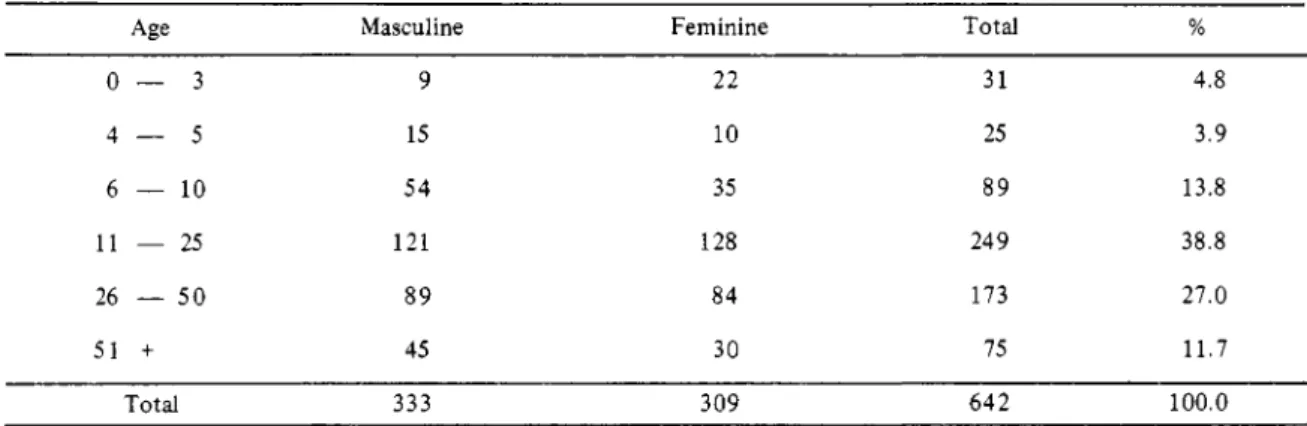
Table 3 shows the age distribution of the 642 human cases of cutaneous leshmaniasis reported between 1973 and 1984 inclusive, for the entire Ribeira Valley region. Such cases are grouped according to age and sex. This classification shows that the sum of the proportions for the 010 age group corresponded to 24.5% of the registered total. Though annual results have not been grouped
separately in this Table, it is reported that in 1978 and 1979 there was a considerable rise in the number of human infections, which makes it possible to suppose the occurrence of a regional epidemic (Gomes11, 1985). To complete this picture it should be added that during the period 19771984, 556 human cases were registered, within the total number for 19731984.
DISCUSSION
Starting from the landscape aspect, it is to be noted that, since the first reports of human cases of cutaneous leishmaniasis in the Ribeira Valley region, a relationship between the disease and the modified or degraded environment has been obser ved. This fact, together with the knowledge that the manmade process of devastation always has its effect on the fauna, decimating a large part of its component populations and at the same time creating new niches, has guaranteed the survival of the populations gifted with greater ecological adaptability. As far as this is concerned, with regard to the American Phlebotominae, there seems to be no doubt that in the southeast of Brazil P.
interme-dius is benefited by anthropic alterations (Table 1).
To a lesser extent this behavior is shared by L.
migo-nei and P. fischeri. However, the same thing does
not happen in the "Vila Maria" district, the domi nant characteristics of which are urban. Here the tendency of P. intermedius to persist is evident, while other species did not have the same success. Therefore this demonstrates the existence of natural and artificial barriers unfavorable to L.
mi-gonei and P. fischeri.
It is worth pointing out that P. intermedius once more demonstrates its ability to adapt to an artifi cial environment. Its behavior, illustrated by the
density of 270.1 for females and 315.8 for males, indoors ("Caieira" district), and 605.8 and 85.8 res pectively outdoors ("Vila Maria" district) is solid proof for the identification of anthropic factors responsible for their dominance in the domiciliary environment (Table 1). On the other hand, it must be remembered that the activity of the sandfly to disperse is limited, that is, they have little tendency to move away from the places of natural shelter (Forattini6, 1973). When they are found beyond an average limit of 200 meters, with the simulta neous presence of both sexes and, further, with considerable density, and a predominance of male over female, they certainly have their breeding ground in this same environment. According to Table 1 we appear to have a genuine phenomenon, at least for P. intermedius. As for L. migonei and
P. fischeri, apart from an interspecific competitive
aspect, their dispersion could be limited to those environments which are characteristically rural, as were exemplified.
relation to extraforest biotopes, including the domiciliary one, as has already been suspected by Forattini et al.9 (1976).
With regard to endophily, it is observed that
P. intermedius, L. migonei and P. fischeri were the
only species which showed some activity in the residence researched in the "Caieira" district. For this reason it was thought opportune to determine the endophilic ability of each of them separately. In Figure 2 it is seen that P. intermedius is demonstra ted to be markedly endophilic, seeing that the density of the female population found indoors was
ten times greater than outdoors. L. migonei and
P. fischeri behaved similarly, though their lower
densities make it difficult to comment further.
When the results of the study of repletion and digestion of blood on the part of the female spe cimens captured indoors with the miniature CDC are analysed, it is found that, in general, there is a clearer tendency to the collection of fasting insects (phase I), which may bespeak a preference for the practice of endophagy. The fact that a proportional decline occurred from phase I to V makes it possible that this is due to the abandonment by the females after meeting the needs of feeding and indoorrest following feeding (Table 2). Thus, taking into account the greater representativity of P.
interme-dius, it is reasonable to concede that this picture is
compatible with the endophilic character of the spe cies and to suggest, further, that despite its eclectic habits the use of man as a host is viable seeing that its tendency is endophagic. On the other hand, despite the presence of a small percentage of preg nant females (phase V) the possible colonization of the artificial biotopes cannot be excluded, principally because the occurrence of this colonization has already been detected in a pigstye (Forattini3,
1953).
From the methodological point of view it should be added that the miniature CDC trap was efficient for the capture of sandflies, and the results obtained in human habitations were compatible with those from the experimental henhouse (Gomes et al.13, 1982) for the same county. It is concluded that the experimental model in practice serves for ecological studies of the sandfly.
drought in the region in 19781979, during which there were indications of intensive migrations of forest rodents (Rocha e Silva et al.22, 1980). Whe ther it be coincidence or not, the only epidemic in the region occurred during that same period. When the annual density of P. intermedius and the annual number of human cases in Figure 3 are compared it is discovered that the epidemic peak of disease coincides with that of the density of this species. Therefore these observations lead to the hypothesis that the Leishmania may spread beyond the frontiers of the natural foci and thus trigger off ephemeral secondary biological cycles, in which man becomes a passive victim, thanks to the ecolo gical success of P. intermedius. The high proportion of 24.5% of the individuals suffering from the disease in the age group between 0 and 10 years of age and the equality of the occurrences as between the two sexes corroborate this (Table 3). One other isolated event could have the same cause. That event was the some few human cases in the city of S.Paulo (Proença and Müller2 0, 1979). This occurred because, during smallscale devastation carried out in the "Cantareira" hill range, the disease manifes ted itself not among the workmen, but in people who lived close to the devastated area. Thus the possibility of natural reservoirs having migrated to the residences in search of shelter or food cannot be ruled out.
One important aspect has to do with the demons tration of there being a proportionate annual corre lation between the decline of the number of human cases and the density of P. intermedius (Figure 3). It must be made clear, however, that the reduction in the density of the vector was spontaneous, be cause the area studied had not been submitted to any kind of control. With regard to this detail, it seems clear that if measures for the control of this parasite were assessed systematically by means of vectorial density, possibly success would be achieved with smaller resources and at less cost to the envi ronment:
CONCLUSIONS
By the analysis of this study it is to be consi dered that:
1 The anthropic alterations evidenced by the high density of P. intermedius represent important factors in the evolution of the species towards synanthropy.
2 The process of urbanization in the area under study seems to involve natural and artificial factors unfavorable to L. migonei and P. fischeri. 3 The confirmation of the endophagic cha racter of P. intermedius proves that invasive tendency with regard to human habitations already suspected by Foratini et al.9 (1976).
4 The larger proportion of the P. intermedius indoors, still in a state of fasting, clearly shows the high endophilic ability of the species.
5 The epidemiological analysis of the relation between the behavior of P. intermedius and the human cases registered allows no room for doubt as to the leading vectorial role of this species.
6 If P. intermedius plays a vectorial role in the region and its density only showed itself to be high in the extraforest environment, this means that human infections are acquired outside the forests and, particularly, in the domiciliary environment.
ACKNOWLEDGMENT
GOMES, A. de C. et al. Aspectos ecológicos da leishmaniose tegumentar americana. 4. Observações sobre o comportamento endófilo de flebotomíneos e papel vetorial de Psychodopygus intermedius na região do Vale do Ribeira, Estado de São Paulo, Brasil. Rev.Saúde públ., S.Paulo, 20: 2807, 1986.
RESUMO: A tendência invasiva de Psychodopygus intermedius ao ambiente domiciliar, observada inicialmente por Forattini e col. (1976), foi agora confirmada através de comprovação da sua elevada capacidade endófila e uso da habitação humana como abrigo. Populações como Lutzomyia migonei e Pintomyia fischeri também estiveram presentes naquele ambiente, porém suas baixas densidades assina ladas nesta investigação poderão indicar pouca capacidade para vencerem as barreiras impostas pelo am biente artificial. Uma análise epidemiológica objetiva, baseada nas variáveis incluídas, demonstrou que a infecção humana ocorre em ambiente extraflorestal, cuja função vetorial principal recaiu sobre P. inter-medius.
UNITERMOS: Leishmaniose tegumentar, transmissão. Leishmaniose tegumentar, ocorrência. Eco logia. Psychodopygus intermedius. Insetos vetores.
REFERENCES
1. ARAÚJO FILHO, N.A. Epidemiologia da leishmaniose tegumentar americana na ilha Grande. Rio de Ja neiro, 1978. [Dissertação de Mestrado Departa mento de Doenças Infecciosas e Parasitárias da UFRJ].
2. DEANE, L.M. & DEANE, M.P. Observações sobre abrigos e criadouros de flebótomos no nordeste do Estado do Ceará. Rev.bras. Malar., 9 : 22546, 1957. 3. FORATTINI, O.P. Nota sobre criadouros naturais de flebótomos em dependências peridomiciliares, no Estado de São Paulo. Arq. Fac. Hig. S. Paulo, 7: 15768, 1953.
4. FORATTINI, O.P. Novas observações sobre a biolo gia de flebótomos em condições naturais (Diptera, Psychodidae). Arq.Hig., S. Paulo, 25 : 20915, 1960. 5. FORATTINI, O.P. Entomologia médica. São Paulo,
Faculdade de Saúde Pública da USP, 1962. v. 1. 6. • FORATTINI, O.P. Entomologia médica. São Paulo,
Ed. Edgard Blücher, 1973. v. 4.
7. FORATTINI, O.P. Novos encontros de flebotomíneos no Estado de São Paulo, Brasil. Rev. Saúde públ., S.Paulo, 10:1258, 1976.
8. FORATTINI, O.P. et al. Infecção natural de fleboto míneos em foco enzoótico de leishmaniose tegumen tar no Estado de São Paulo, Brasil. Rev. Saúde públ., S. Paulo, 6:4313, 1972.
9. FORATTINI, O.P. et al. Observações sobre a transmis são de leishmaniose tegumentar no Estado de São Paulo, Brasil. Rev. Saúde públ., S. Paulo, 10 : 3143, 1976.
10. FORATTINI, O.P. et al. Observações sobre mosquito Culicidae no Sistema da Serra do Mar, Brasil, 1 Observações no ambiente extradomiciliar. Rev. Saúde públ., S. Paulo, 12 : 297325, 1978.
11. GOMES, A. de C. Aspectos epidemiológicos sobre a transmissão da leishmaniose tegumentar na região do Vale do Ribeira, Estado de São Paulo, Brasil. São Paulo, 1985. [Tese de LivreDocência Faculdade de Saúde Pública da USP ] .
12. GOMES, A. de C. et al. Aspectos ecológicos da leish maniose tegumentar americana, 1 Estudo experi mental da freqüência de flebotomíneos em ecótopos artificiais, com referência especial a Psychodopygus intermedius. Rev. Saúde públ., S. Paulo, 14 :54056,
1980.
13. GOMES, A. de C. et al. Aspectos ecológicos da leish maniose tegumentar americana. 2 Ecótopo como abrigo de Psychodopygus intermedius e observações sobre alimentação e reprodução sob a influência de condições naturais. Rev. Saúde públ., S. Paulo, 16 : 14959, 1982.
14. GOMES, A. de C. et al. Aspectos ecológicos da leish maniose tegumentar americana. 3 Observações na turais sobre o ritmo diário de atividade de Psychodo-pygus intermedius em ambiente florestal e extraflo restal. Rev. Saúde públ., S. Paulo, 1 7 : 2330, 1983. 15. GOMES, A. de C. et al. Uma nova câmara coletora para armadilha CDC miniatura. Rev. Saúde públ., S. Paulo, 19:1901, 1985.
16. LEOPOLDO e SILVA, R. et al. Investigação epidemio lógica sobre leishmaniose tegumentar no município de Conchas, Estado de São Paulo, Brasil. Rev. Ciênc. bioméd., S. Paulo, 5 :4955, 1984.
17. LIMA, L.C.R. et al. Flebotomíneos em área de ocor rência de leishmaniose tegumentar no bairro de Campo Grande, Rio de Janeiro. Rev. bras. Malar., 33:6474, 1981.
18. MATTOS, E.A. Bionomia dos flebotomíneos de Pe robas, município de Viana (ES), área endêmica de leishmaniose tegumentar americana. Belo Horizonte, 1981. [Dissertação de Mestrado Instituto de Cien cias Biológicas da UFMG ].
20. PROENÇA, N.G. & MULLER, H. Nota sobre a ocor rência de leishmaniose tegumentar na Serra da Can tareira, São Paulo, Brasil. Rev. Saúde públ, S. Paulo, 1 3 : 6 0 2 , 1979.
21. RANGEL, E.F. et al. Infecção natural de Lutzomyia intermedia Lutz & Neiva, 1912, em área de leishma niose tegumentar no Estado do Rio de Janeiro. Mem. Inst. Oswaldo Cruz, 79: 3956, 1984.
22. ROCHA e SILVA, E.O. et al. A leishmaniose tegumen tar americana no litoral sul do Estado de São Paulo. Rev. bras. Malar., 32 : 925, 1980.
23. SOUZA, M.A. et al. Leishmaniose visceral no Rio de Janeiro, 1 Flebotomíneos da área de procedência de casos humanos autóctones. Mem. Inst. Oswaldo Cruz, 76:1618, 1981.
24. SUDIA, W.D. & CHAMBERLAIN, R.W. Battery ope rated light trap, an improved model. Mosq. News, 22:1269,1962.