Major Article
Corresponding author: Dr. César Carranza Tamayo. e-mail: [email protected]
Received 26 October 2016 Accepted 7 February 2017
Eicacy and safety of amphotericin B deoxycholate
versus N-methylglucamine antimoniate in pediatric visceral
leishmaniasis: an open-label, randomized, and
controlled pilot trial in Brazil
Myrlena Mescouto Borges
[1],[2], Maria Cristina da Silva Pranchevicius
[1], Elza Ferreira
Noronha
[2], Gustavo Adolfo Sierra Romero
[2]and César Omar Carranza-Tamayo
[2][1]. Faculdade de Medicina, Universidade Federal do Tocantins. Palmas, TO, Brasil. [2]. Núcleo de Medicina Tropical, Universidade de Brasília. Brasília, DF, Brasil.
Abstract
Introduction: Despite their high toxicity, antimonials and amphotericin B deoxycholate are commonly used for treating visceral
leishmaniasis (VL). Few studies showing conlictive data about their eficacy and adverse events in pediatric population are available. This study aimed to evaluate eficacy and safety of amphotericin B deoxycholate vs. that of N-methylglucamine antimoniate in
treating pediatric VL in Brazil. Methods: This was a randomized, open-label, 2-arm and controlled pilot clinical trial. Treatment naïve children and adolescents with VL without signs of severe illness were treated with N-methylglucamine antimoniate (20mg/ kg/day for 20 days) or amphotericin B deoxycholate (1mg/kg/day for 14 days). All patients were diagnosed with positive direct examination and/or positive PCR for Leishmania spp. performed in bone marrow samples. The primary eficacy end-point was
VL cure determined after 180 days of completion of treatment. The analysis was performed using intention-to-treat (ITT) and per
protocol (PP) analyses. Results: In total, 101 volunteers were assessed. Eficacy was similar for both groups. The antimonial (n=51) and amphotericin B groups (n=50) had a cure rate of 94.1% and 100%, and 94% and 97.9% according to ITT and PP analyses, respectively. All patients reported adverse events (AE). Serious AE incidence was similar in both groups. Five individuals were
excluded from the study because of severe adverse events. Conclusions: N-methylglucamine antimoniate and amphotericin B deoxycholate have similar eficacy and adverse events rate in pediatric patients with VL.
Keywords: Visceral leishmaniasis. Children. Clinical trial. Brazil.
INTRODUCTION
Visceral leishmaniasis (VL) is a neglected infectious disease
prevalent in children. In recent decades, its epidemiological features have changed in Brazil. In the past, VL was prevalent
predominantly in rural environments; however, in recent years, it has been transmitted predominantly in urban and
peri-urban areas1. Over the last decade, studies have increased
the knowledge of diagnostic tools and eficacy of available
leishmanicidal drugs. Nevertheless, clinical trials are scarce, especially among children2,3.
According to Brazilian Ministry of Health, 3,453 individuals were diagnosed with VL in 2014, of which 52% were children and teenagers aged <19 years. Although 58.6% of VL cases
occurred in Northeastern states, the state with the highest
prevalence was Tocantins (10.8/100,000 population, more than 6 times the prevalence in Brazil in 2014, 1.7/100,000)4.
Clinical features of VL mainly depend on the parasite-host relationship. Immunocompetent patients can resist parasitic
infection, while parasite development is possible in anergic patients, resulting in typical systemic manifestations of the disease5. Splenomegaly and fever are the most important and
common VL manifestations. Spleen size was found to be
proportional with disease duration6.
Drugs for VL have complex pharmacological properties.
American VL needs parenteral administration of drugs
with high toxicity levels7. Brazilian Ministry of Health
suggested antimonials as irst-line VL treatment and liposomal
amphotericin B for patients at high mortality risk (infants, adults
aged >50 years, immunosuppressed patients, patients with renal,
hepatic or cardiac failure, etc.)8. Although drugs indicated for
VL therapy in Brazil have been used for decades, few studies
comparing their eficacy and safety in the pediatric population are available. Additionally, antimonial use in outpatient settings
precludes detailed laboratory investigation of possible toxic
aim of this study was to estimate the eficacy and safety of amphotericin B deoxycholate (ABD) through a randomized and
controlled clinical trial compared to meglumine antimoniate
(MA) in children with VL treated in reference centers of Palmas (Tocantins’ State Capital) and Araguaína, the two most populated cities in the State of Tocantins, Brazil.
METHODS
Study design and participants
This was an open-label, randomized, and controlled trial with masking laboratory outcomes. It was performed in Dona Regina Hospital in Palmas and Tropical Diseases Hospital in Araguaína city. Since analyzed drugs are marketed in Brazil, the survey was registered as a Phase IV study; however, it presented methodological characteristics of a phase III pilot clinical trial. Eligible patients were children aged 6 months-12 years who
met the inclusion criteria for VL diagnosis (presence of fever for at least two weeks associated with splenomegaly). The diagnosis
of VL was conirmed by visualization of Leishmania spp. amastigotes in direct bone marrow microscopic examination or
parasitic deoxyribonucleic acid (DNA) detection by polymerase chain reaction (PCR). Participation in this study was voluntary
upon the signature of the informed consent form by the patients'
parents or legal guardians. Exclusion criteria were the following:
patients who underwent previous treatment with leishmanicidal
drugs, clinically evident jaundice (total bilirubin > 2.5mg/dL),
hemorrhages with coagulation disorders, generalized edema, signs of toxemia, severe malnutrition according to Gómez criteria9, presence of comorbidities or immunosuppressive conditions, and lack of informed consent. Finally, 101 patients were included and underwent the randomization process
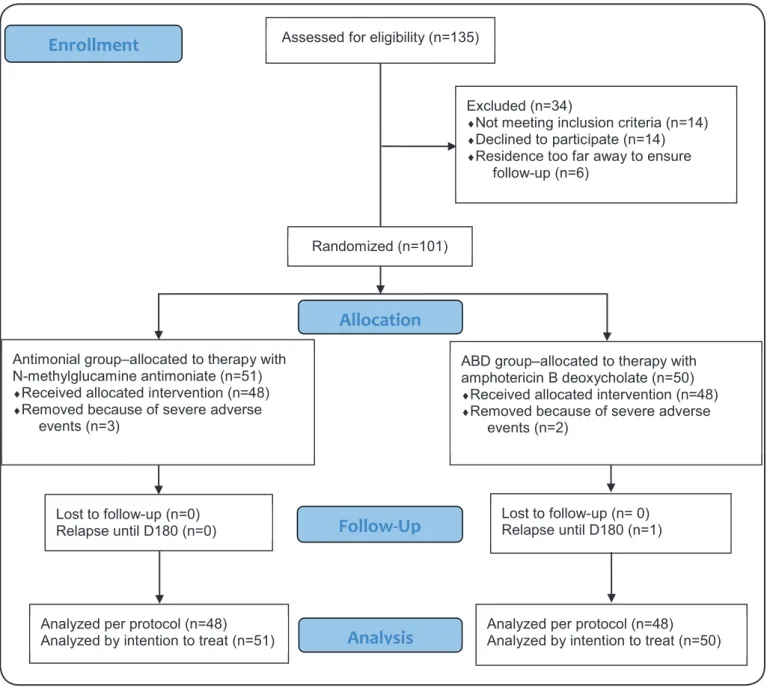
between January 2007 and July 2009 (Figure 1). Ethical consideration
This study attempted to continuously balance both individual
and collective risks and beneits of the evaluated drugs used, always seeking maximum beneits and minimum risk or harm,
and to avoid any damage, such as drug toxicity. The study was
conducted strictly in accordance to the 196/96 Resolution of Brazilian Health Council. The parents or legal guardians of eligible
patients received detailed explanation of the study protocol and provided written consent. The study protocol was approved by the
Ethics Research Committee of the Federal University of Tocantins and complied with the tenets of the Declaration of Helisnki. All interventions were performed at no charge to the patients.
Interventions
Eligible patients underwent complete medical history and laboratory assessments. Samples were collected for complete blood count, human immunodeiciency virus (HIV) serology,
prothrombin activity, bilirubin, aminotransferases, albumin, and globulin levels, and urinalysis. Blood and bone marrow samples
were collected for VL diagnosis. Indirect immunoluorescence test (IFAT), rapid immunoassay (Kala-azar Detect®; InBios International, Seattle, WA), and standard polymerase chain reaction (PCR) for Leishmania spp. detection in the blood were
performed. Bone marrow samples were obtained for direct microscopic examination to detect amastigotes of Leishmania spp., culture of Leishmania spp. in a biphasic medium, and PCR to amplify the conserved target region of 120bp of Leishmania kinetoplast deoxyribonucleic acid (kDNA)10. All patients
underwent clinical and laboratory evaluation on days 0, 3, 7,
14, 21, 28, 60, 90, 120, 150, and 180.
Based on the randomization list, patients were administered either antimonial (antimonial group) or amphotericin B
(ABD group). The treatment was administered using MA (Glucantime®, Aventis Pharma Ltda., Brazil) 20mg/kg/day IV for 20 days (antimonial group) and ABD 1mg/kg/day IV administered diluted in 5% glucose (concentration of 0.1mg/ ml) infused for 6h for 14 days (ABD group).
All 4,500 ampoules of MA belonged to a single batch (603090, expiration date: Jun/2011). The 2,100 vials of ABD (Laboratório Cristália, Brazil) also belonged to the same batch
(06085604, expiration date: Aug/2009). All drugs were provided by the Brazilian Ministry of Health.
Objectives
The primary objective was to evaluate the eficacy and safety of ABD compared to MA in children with visceral leishmaniasis. Secondary objective was to compare the time until clinical and
hematological recovery between the groups.
Outcomes
Primary outcomes were clinical cure evaluated at day 180
of follow-up (D180) and prevalence of serious adverse events
among patients, which required medication discontinuation and were excluded from the study.
Cure was deined as follows: complete remission of clinical
signs and symptoms up to three months after treatment completion, normalization of hematological changes, and no recurrence of
VL until the sixth month of follow-up. Recurrence was deined
as the resurgence or reappearance of VL signs or symptoms after
an improvement period or after clinical cure during the 6-month follow-up. Therapeutic failure was deined as any outcome different from cure. We included the interruption due to severe toxicity or drug intolerance, in the deinition of therapeutic failure. In these cases, MA or ABD were replaced by liposomal amphotericin B.
Secondary outcomes included the following: time elapsed until fever resolution, time to 50% reduction of splenomegaly, time elapsed until normalization of RBC indices (hemoglobin
and hematocrit), lethality rate, time elapsed until normalization of other laboratory parameters, and the overall rate of adverse events associated with drug use. The primarily analyzed adverse events were heart failure, kidney failure, liver failure, pancreatitis,
and cardiac arrhythmias. Adverse events were deined and graded in accordance with the Division of AIDS Table for grading the
severity of adult and pediatric adverse events11.
Sample size
The original sample size was determined on the basis of
the primary outcome endpoint of eficacy. To calculate sample
-
-Assessed for eligibility (n=135)
Excluded (n=34)
♦Not meeting inclusion criteria (n=14) ♦Declined to participate (n=14)
♦Residence too far away to ensure
follow-up (n=6)
Analyzed per protocol (n=48) Analyzed by intention to treat (n=51)
Lost to follow-up (n=0) Relapse until D180 (n=0)
Antimonial group–allocated to therapy with N-methylglucamine antimoniate (n=51)
♦Received allocated intervention (n=48)
♦Removed because of severe adverse
events (n=3)
Lost to follow-up (n= 0) Relapse until D180 (n=1) ABD group–allocated to therapy with amphotericin B deoxycholate (n=50)
♦Received allocated intervention (n=48)
♦Removed because of severe adverse
events (n=2)
Analyzed per protocol (n=48) Analyzed by intention to treat (n=50) Randomized (n=101)
Allocation
Analysis
Follow-Up
Enrollment
FIGURE 1 - Amphotericin B deoxycholate versus N-methylglucamine antimoniate: CONSORT (Consolidated Standards of Reporting Trials) low diagram.
simulated and the formula suggested by Pocock was applied12.
The required sample size was 283 subjects in each group. As a pilot trial, this study was projected with 50 individuals in each
arm to evaluate the protocol.
Randomization
Randomization procedure was performed in blocks of
20, using Graphpad Quickcalcs free software (GraphPad
Software Inc., San Diego, CA). This procedure was under
the responsibility of an independent researcher from Tropical Medicine Center at Universidade de Brasília, who was not directly involved in any other operational aspect of the study. The names of compared drugs were typed on a sheet and placed in dark envelopes, which were sealed, stamped, and signed by
those responsible for the randomization. The envelopes were opened immediately after the consent of the participants.
Blinding
This was an open-label trial. It was possible to mask
the assessment of the hematological and biochemical tests. Laboratory technicians did not have access to patient’s data, they had no direct contact with the investigators, and no information regarding the drug administered to the patients. No blinding was applied for the evaluation of clinical outcomes.
Statistical analysis
and laboratory information. Data were analyzed with the same
software. The two randomized groups were irst compared with
respect to baseline clinical and laboratory data. Proportions were
compared through Yates’ chi-square test. T-test for independent
groups was used for continuous variables. Mann-Whitney U
test was used for variables showing abnormal distributions.
Differences were considered statistically signiicant at p-value < 0.05. The analysis of primary outcome was planned on an intention-to-treat basis (ITT) considering all subjects as
originally assigned to the two arms. Patients who needed therapy change due to adverse effects and those lost during treatment or
follow-up were considered as treatment failures. No subgroup
analysis was initially planned.
RESULTS
The study was conducted between January 2006 and January
2009. A total of 135 children who met the suspect VL case deinition as described above were screened and subsequently diagnosed with VL through laboratorial tests. Thirty-four
children were initially excluded because of parents or legal
guardians decline to participate (n=14), living far away from the study center (n=6), or not complying with the inclusion criteria (n=14). Of the recruited patients, 51 were randomly assigned to MA arm and 50 to ABD arm. Follow-up was completed by
all participants in both arms (Figure 1).
Baseline data
The main baseline characteristics of the included children (101 patients) are reported in Table 1.
The median age was 38 months [range 6-143 months; 56 (55%) male] while children aged <5 and <2 years constituted 64.4% and 33.7% of the sample, respectively. Most patients were from the State of Tocantins, but 2 patients lived in the State of Pará.
The baseline characteristics of both arms were similar, with the exception of liver size measured below the right costal
margin (median 4cm for antimonial group vs 5cm for ABD group; U=989, p=0.04) and spleen size measured below the
left costal margin (median 6cm for antimonial group vs. 8cm
for ABD group; U=878, p=0.02).
All patients included in the study had clinical features
of VL. The main clinical signs on admission were fever in
100 (99%) patients, mucocutaneous pallor in 98 (97%), tachycardia in 76 (75.2%), hepatomegaly in 98 (97%), and splenomegaly in 101 (100%). Other signs and symptoms were vomiting in 48 (47.5%) patients, lethargy in 9 (8.9%), and localized edema in 3 (2.9%). Anemia (hemoglobin < 11g/ dL), leucopenia (white blood cells - WBC < 5,000 cells/mm3),
or thrombocytopenia (platelets < 150,000/mm3) were present in
89 (88.6%) patients. No patient had renal failure or hematuria at admission. Jaundice was observed in 4 children, but the aminotransferases and bilirubin levels 50% above the upper limit of normal occurred in 57% of patients. Twenty-two patients had serum albumin levels below 2g/dL.
The VL diagnosis was confirmed in all participants.
Bone marrow direct examination was positive for 97 (96%)
individuals. Four patients were diagnosed using PCR (one with positive indirect immunoluorescence test - IFI - and rapid test, and another with positive IFI).
Eficacy
Based on ITT analysis, cure was observed in 94.1% (48/51) of patients in antimonial group and in 94% (47/50) of patients in ABD group (p=0.62). Therefore, the observed difference in cure rate was 0.1% [95% conidence interval (CI) = -8.99-9.39] in the ITT analysis. The between-group difference in deinitive cure rates in the ITT analysis was 0.1%, with 95% CI = -10.67-11.04. Most failures considered in the ITT analysis (5/6) were children who
had to discontinue the therapy owing to serious adverse reactions and the remaining failure was due to relapse that occurred in one
patient from ABD group in the sixth month of follow-up. According to per protocol analysis, all (except one child from ABD group) patients who completed treatment were cured. In this analysis, 48 children treated with MA and 48 treated with ABD were included. The observed difference in cure rate was 2.1% with 95% CI= -5.52-10.9 (Table 2).
Secondary outcomes
The time elapsed until fever resolution was signiicantly
shorter in antimonial group (22 children had complete remission
in 48 hours), whereas eight patients in ABD group showed the same outcome (χ2 = 8.91, p < 0.01). Differences in reduction of
spleen size were found between the groups: median spleen size
at hospital discharge was 3 cm (50% reduction from admission spleen size) in antimonial group and 3.75cm (53% reduction from admission size) in ABD group (U=796.5, p < 0.01). The
time elapsed until normalization of hemoglobin was evaluated at
D60 and D90, and no difference was found between groups. In D60, 17 (34%) patients from antimonial group still had anemia (hemoglobin < 11g/dL), while 22 (43%) from ABD group remained with anemia. In D90, anemia was found in 8 (16%) children from antimonial group and in 10 (20%) patients from the ABD group (χ2 = 0.09, p = 0.76). No patient died during the
study period. Time elapsed for normalization of other laboratory
tests was evaluated at D90, and no differences were found between groups. Most patients (80%) showed normalization of hematological and biochemical indices in D90. The remainder
persisted just with anemia.
Adverse events
All patients (in both groups) experienced at least one adverse
event. Three serious adverse events occurred in antimonial
group and 2 in ABD group, but no signiicant difference was found between the groups (χ2 = 0.19, p = 0.98). The main serious
adverse events noted during hospitalization were abnormal liver enzymes, anemia, and hypomagnesemia (Table 3).
Patients in antimonial group had a higher frequency of serious adverse events requiring the withdrawal of research subjects. Most often adverse events observed in antimonial
Antimonial group
N-methylglucamine antimoniate (N= 51)
ABD group
Amphotericin B deoxycholate (N= 50) Outcomes
Early failure because of drug toxicity 3 2
Completed treatment 48 48
Relapse* 0 1
Lost to follow-up 0 0
Deinitive cure at 6 months
Intention-to-treat approach
number of cured patients
percent (95% CI) 94.1 (84.1-97.9)48 94.0 (83.8-97.9)47
Per-protocol approach
number of cured patients
percent (95% CI) 100 (92.5-100)48 97.9 (89.1-99.6)47
TABLE 2
Amphotericin B deoxycholate versus N-methylglucamine antimoniate for pediatric visceral leishmaniasis treatment: eficacy data.
* Relapse was diagnosed in one boy at the inal of follow-up (D180).
ABD: amphotericin B deoxycholate; 95% CI: 95%conidence interval; D180: day 180.
Variable Antimonial group
N-methylglucamine antimoniate (N= 51)
ABD group
Amphotericin B deoxycholate (N= 50)
Age (months) 52.65 52.37
Male (%) 49 62.0
Weight (kg) 14.1 13.3
Fever (%) 94 88.0
Pallor (%) 96 100.0
Hepatomegaly (%) 96 100.0
Splenomegaly (%) 96 100.0
Associated bacterial infection (%)* 65 76.0
Spleen size: median of cm below the left costal margin 6 8
Liver size: median of cm below the right costal margin 4 5
Hemoglobin (g/dl) 7.81 7.67
White-cell count (per mm3) 3,754 3.139
Platelet count (per mm3) 142.780 117.509
Total bilirubin (mg/dl) 0.58 0.64
AST (IU/ml) 101.18 88.57
ALT (IU/ml) 69.4 69.31
Albumin (g/dl) 2.3 2.2
Globulin (g/dl) 3.7 3,8
Creatinine (mg/dl)** 0.495 0.493
Blood urea nitrogen (mg/dl) *** 21.44 17.22
TABLE 1
Baseline clinical and laboratory data of patients with visceral leishmaniasis.
* Bacterial infection was diagnosed on the basis of clinical suspect and/or positive cultures. ** To convert the values for creatinine to micromoles per liter, multiply
mild, but moderate hypocalcemia and severe hypocalcemia were observed in 8 and 2 children, respectively. Moderate
hypomagnesaemia was observed in 15 patients, and 24 had
very low magnesium levels. Gastrointestinal disorders such as nausea, vomiting, and abdominal pain were also reported.
Cardiac arrhythmia was observed in 4 children from antimonial group, with no reported cases in ABD group (p = 0.13). Electrocardiographic changes associated with antimonial use
were sinus arrhythmia associated with septal repolarization changes observed in 3 children and right branch conduction disturbance in one male child.
In the ABD group, increased frequency of anemia and hypomagnesaemia was found. Severe anemia was observed in 37 (74%) patients and 7 patients had moderate (n=5) or severe thrombocytopenia (n=2). Adverse events related to electrolytes
were moderate hyponatremia, hypokalemia, and hypocalcemia,
but magnesium levels dropped in 39 (78%) patients, with
severe drop (below the minimum acceptable level) in 20 (40%) children. Ten children in ABD group reported shivers, and
2 maintained this complaint in D7. None of the patients had abnormal amylase, creatin kinase, creatinine, or urea levels. Other reported adverse events were changes in liver enzymes, gastrointestinal disorders (nausea, vomiting, abdominal pain,
and constipation), myalgia, and arthralgia. Analysis showed that
frequency of adverse events was similar between groups, except for abnormal aminotransferases levels (prevalent on antimonial
group) and shivers (prevalent in ABD group).
DISCUSSION
Approximately two-thirds of the drugs used in pediatric
clinical practice do not have enough evidence about dosages,
safety, and eficacy for each phase of development13. Children
compose a substantial proportion of the population of patients with VL, particularly in New World VL. They seemed to Event
Antimonial group
N-methylglucamine antimoniate N= 51 (%)
ABD group
Amphotericin B deoxycholate N= 50 (%) P-value*
moderate severe moderate severe
Abdominal pain (N/%) 2 (3.9) - 5 (10.0) - 0.42
Constipation (N/%) 1 (1.9) - - - 0.99
Diarrhea (N/%) 2 (3.9) - 2 (4.0) - 0.62
Myalgia/arthralgia (N/%) 37 (72.5) - 35 (70.0) - 0.78
Nausea/vomiting (N/%) 29 (56.9) - 35 (70.0) - 0.24
Phlebitis (N/%) 1 (1.9) - 3 (6.0) - 0.61
Shivers (N/%) 1 (1.9) - 10 (20.0) - 0.01
Worsening anemia (N/%) 13 (21.5) 37 (72.5) 10 (20.0) 37 (74.0) 0.59
Worsening
thrombocytopenia (N/%) 24 (47.1) 2 (3.9) 23 (46.0) 2 (4.0) 0.92
Abnormal alkaline
phosphatase (N/%) 2 (3.9) - 3 (6.0) - 0.98
Abnormal ALT (N/%) 14 (27.5) 16 (31.3) 8 (16.0) 10 (20.0) 0.04
Abnormal AST (N/%) 20 (39.2) 8 (15.6) 10 (20.0) 6 (12.0) 0.03
Abnormal γ-glutamyl
transpeptidase (N/%) 8 (15.6) 3 (5.8) 2 (4.0) 2 (4.0) 0.09
Abnormal total bilirubin
(N/%) 1 (1.9) - 1 (2.0) - 0.48
Hypocalcemia (N/%) 8 (15.6) 2 (3.9) 6 (12.0) 2 (4.0) 0.79
Hypokalemia (N/%) 11 (21.6) 1 (1.9) 11 (22.0) - 0.85
Hypomagnesemia (N/%) 15 (24.0) 24 (47.0) 19 (38.0) 20 (40.0) 0.85
Hyponatremia (N/%) 25 (49.0) - 25 (50.0) - 0.92
TABLE 3
Safety data of Amphotericin B deoxycholate versus N-methylglucamine antimoniate for pediatric visceral leishmaniasis.
have lower response rates to treatment, as well as recruitment
dificulties in areas of high incidence of the disease and lack of diagnostic resources. To our knowledge, this is the irst trial with focus on treatment with antimonial vs. ABD for pediatric visceral leishmaniasis in the New World. Both treatment groups
were comparable at baseline by most of the recorded clinical and laboratory variables. Differences observed in the spleen size (2 cm
larger in ABD group) and liver size (1cm larger in ABD group) had no clinical signiicance. In addition, both arms showed comparable eficacy, with no signiicant difference between groups.
The antimonial eficacy described in this study was high as
per protocol analysis, but serious toxicity could have a negative
impact on the eficacy, as indicated by the ITT analysis. It is described that sodium stibogluconate and N-methylglucamine
antimoniate have comparable eficacy and toxicity14. Most of
the studies that evaluate eficacy of antimonials for VL therapy are retrospective and performed in the Indian subcontinent. Average effectiveness of intramuscular antimonials assessed after six months without relapse was estimated in 92% of cases
(range, 36-96%), based on previous studies15. Our study shows
an eficacy comparable with that of previous studies. A Greek study described a 90.3% eficacy of using MA for 30 days in
children16. However, since 1990s, increasing resistance to
antimonials in Indian VL has been observed primarily in Bihar and adjacent territories. Randomized controlled trials with Indian patients with VL from 1992 to 2000 showed an eficacy
of 36 to 69%, with an average of 50%15-18. As antimonials,
ABD has been poorly evaluated in children with VL. Indian studies showed an eficacy ranging between 91.3 and 97%
when compared to miltefosine19,20. Average effectiveness of
ABD assessed after 6 months of follow-up was estimated at 97% (range 96-99%), based on six studies performed in the
Indian subcontinent15. Our study showed a lower eficacy
rate than that of previous studies. Lipidic formulations are
considered comparable in eficacy, but with less toxicity21.
Patients treated with antimonials had more effective response
with the disappearance of fever during the irst 48 hours, the opposite was observed in patients treated with ABD, in
whom fever lasted longer than 72 hours. This observation is
different from indings in the majority of previous studies
comparing antimonials vs. amphotericin B22. Two studies
performed in children with Mediterranean VL also showed
earliest resolution of fever with amphotericin B16,23. Since this
study had a limited population, this data should be reviewed in future studies with a larger sample group.
The toxicity observed in the present study was typical for used drugs and no unexpected adverse event was observed. Both drugs caused severe adverse events that precluded treatment continuation; this should be considered when planning the administration of antimonials to outpatients. Participants of the present study were treated after excluding signs and laboratory abnormalities commonly observed in severe cases.
Serious adverse events observed in this trial can affect children
without severe disease and can be fatal if managed in outpatient settings. Finally, although both treatments seemed to be similarly
effective, ABD had the advantage of a shorter course.
Study limitations
Blinding was not possible owing to differences in formulations, time for treatment, and operational causes. This
could have affected the assessment of eficacy, but we consider
it unlikely, as the primary outcome was based on a long
follow-up. The laboratory staff was blinded to the administered treatments. However, clinical side effects reporting may have been inluenced both by the investigator’s and the patients’
parents or guardians knowledge of being research subjects.
Results should be interpreted with caution because this study was a pilot trial, with a limited number of participants. Eficacy
data reported cannot be extrapolated to children with human
immunodeiciency virus/acquired immunodeiciency syndrome (HIV/AIDS) or those with severe disease. On conclusion of
this study, it was designed an open, controlled, randomized and
multicenter clinical trial to evaluate the eficacy of four regimens
for VL treatment in Brazil, including the liposomal formulation of amphotericin B (www.clinicaltrials.gov NCT01310738).
Conclusions and future directions
Both evaluated regimes (N-metilglucamine antimoniate and amphotericin B deoxycholate) used as irst-line therapy in
Brazil at the time the trial was conducted were effective with
reasonable safety proile for most of the patients. However,
serious adverse events occurrence suggest that high experienced clinical physicians are necessary for adequate management to
avoid lethal outcomes. Toxicity proile was different between groups. Antimonial group had higher frequency of abnormal alanine transaminase (ALT) and aspartate transaminase (AST),
while amphotericin group had higher frequency of shivers.
Results observed in both groups regarding cure rates suggest
an equivalent effectiveness of tested regimens, with estimated
difference of 2.1% and maximum inaccuracy rate of 10%. The
appearance of relapses in a period over 6 months suggests the need to extend the monitoring period for 12 months after completion of therapy. The shorter course of treatment with amphotericin B should be considered an advantage over the antimonials treatment schedule of 20 days, mainly because the inpatient regimen is
also recommended for antimonials. A pharmacokinetic study
of antimonials in children would be particularly important to determine whether the relevant clinical effects could differ in accordance with age and the standard dose used.
Acknowledgments
We thank Dr. Erica Maués for collaborating on patient recruitment in Dona Regina Hospital.
Conlicts of interest
The authors declare that they have no conlict of interest.
REFERENCES
1. Werneck GL. Geographic spread of visceral leishmaniasis in Brazil.
2. Kafetzis DA, Velissariou IM, Stabouli S, Mavrikou M, Delis D, Liapi G. Treatment of pediatric visceral leishmaniasis: amphotericin
B or pentavalent antimony compounds? Int J Antimicrob Agents. 2005;25(1):26-30.
3. Romero GAS, Boelaert M. Control of visceral leishmaniasis
in Latin America - A systematic review. PLoS Negl Trop Dis. 2010;4(1):e584. doi: 10.1371/journal.pntd.0000584.
4. Ministério da Saúde. Casos conirmados de Leishmaniose Visceral, Brasil, Grandes Regiões e Unidades Federadas. 1990 a 2014; Brasília: Ministério da Saúde; 2016. Disponível em: http:// portalsaude.saude.gov.br/images/pdf/2016/maio/20/LV-Casos.pdf 5. Andrade ASS, Costa GC, de Aquino DMC, de Mendonça
VRR, Barral A, Barral-Netto M, et al. Cytokines and visceral leishmaniasis: a comparison of plasma cytokine proiles between the clinical forms of visceral leishmaniasis. Mem Inst Oswaldo Cruz. 2012;107(6):735-9.
6. Braga ASC. Fatores associados à evolução clínica da leishmaniose
visceral em crianças hospitalizadas em centro de referência de Belo Horizonte, 2001 a 2005. Dissertação de Mestrado. Belo Horizonte:
Faculdade de Medicina. Universidade Federal de Minas Gerais;
2007. 98p.
7. Chávez-Fumagalli MA, Ribeiro TG, Castilho RO, Fernandes
SOA, Cardoso VN, Coelho CSP, et al. New delivery systems for
amphotericin B applied to the improvement of leishmaniasis
treatment. Rev Soc Bras Med Trop. 2015;48(3):235-42.
8. Ministério da Saúde. MS amplia indicação de medicamento para
o tratamento da leishmaniose visceral. Ministério da Saúde; 2014. Disponível em: http://portalsaude.saude.gov.br/index.php/o-ministerio/ principal/leia-mais-o-ministerio/726-secretaria-svs/vigilancia-de- a-a-z/leishmaniose-visceral-lv/13058-ms-amplia-indicacao-de-medicamento-para-o-tratamento-da-leishmaniose-visceral
9. Gómez F, Ramos Galván R, Cravioto MJ. Studies on malnutrition in children. Bol Med Hosp Infant Mex. 1951;8(5):593-608.
10. Carranza-Tamayo CO, de Assis TS, Neri AT, Cupolillo E, Rabello A,
Romero GA Prevalence of Leishmania infection in adult HIV/AIDS
patients treated in a tertiary-level care center in Brasilia, Federal District, Brazil. Trans R Soc Trop Med Hyg. 2009;103(7):743-8.
11. National Institutes of Health (NIH). Division of AIDS (DAIDS)
Table for Grading the Severity of Adult and Pediatric Adverse Events. Version 2.0. Bethseda, MD, USA: DAIDS; 2014. 33p.
12. Pocock SJ. The size of a clinical trial. In: Pocok SJ, editor. Clinical
trials: a practical approach. Chichester, New York: John Wiley & Sons; 1983. p. 123-41.
13. Moreira MEL, Goldani MZ. A criança é o pai do homem: novos
desaios para a área de saúde da criança. Cien Saúde Colet. 2010;15(2):321-7.
14. Chulay JD, Fleckenstein L, Smith DH. Pharmokinetics of
antimony during treatment of visceral leishmaniaisis with sodium
stibogluconate or meglumine antimoniate. Trans R Soc Trop Med Hyg. 1988;8(1)2:69-72.
15. Vanlerberghe V, Diap G, Guerin PJ, Meheus F, Gerstl S, Van der Stuyft P, et al. Drug policy for visceral leishmaniasis: a cost-effectiveness analysis. Trop Med Int Health. 2007;12(2):274-83.
16. Syriopoulou V, Daikos GL, Theodoridou M, Pavlopoulou I,
Manolaki AG, Sereti E, et al. Two doses of a lipid formulation
of amphotericin B for the treatment of Mediterranean visceral
leishmaniasis. Clin Infect Dis. 2003;36(5):560-6.
17. Sundar S, Singh VP, Sharma S, Makharia MK, Murray HW.
Response to interferon-γ plus pentavalent antimony in Indian visceral leishmaniasis. J Infect Dis.1997;176(4):1117-9.
18. Thakur CP, Kanyok TP, Pandey AK, Sinha GP, Messick C, Olliaro P.Treatment of visceral leishmaniasis with injectable paromomycin
(aminosidine). An open-label randomized phase-II clinical study. Trans R Soc Trop Med Hyg. 2000;94(4):432-3.
19. Singh UK, Prasad R, Mishra OP, Jayswal BP. Miltefosine in
children with visceral leishmaniasis: a prospective, multicentric,
cross-sectional study. Indian J Pediatr. 2006;73(12):1077-80.
20. Sundar S, Jha TK, Thakur CP, Bhattacharya SK, Rai M. Oral
miltefosine for the treatment of Indian visceral leishmaniasis. Trans R Soc Trop Med Hyg. 2006;100(suppl 1):S26-S33.
21. Falci DR, da Rosa FB, Pasqualotto AC. Comparison of nephrotoxicity
associated to different lipid formulations of amphotericin B: a real-life study. Mycoses. 2015;58(2):104-12.
22. Mishra M, Biswas UK, Jha AM, Khan AB. Amphotericin versus
sodium stibogluconate in irst-line treatment of Indian kala-azar. Lancet. 1994; 344(8937):1599-1600.